
CHM 5710 Chemical Structure and Bonding Inorganic and
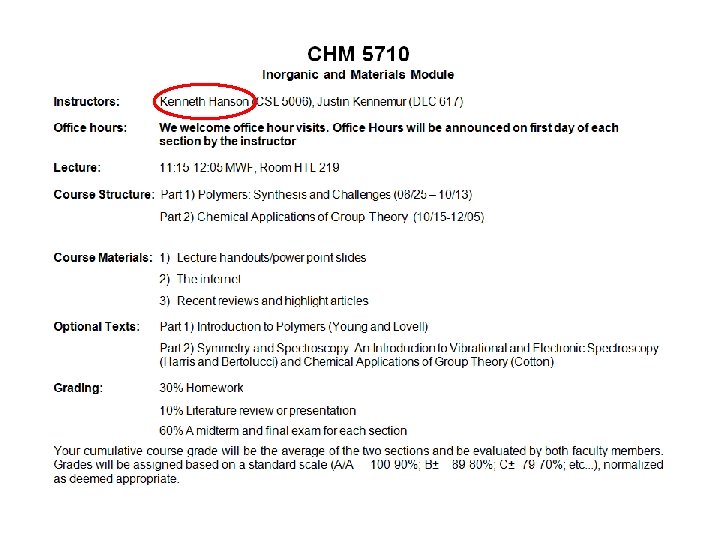
CHM 5710 Chemical Structure and Bonding Inorganic and Materials Chemistry Part 2: Chemical Applications of Group Theory MWF 11: 15 – 12: 05 am Ken Hanson Office Hours: MWF 1: 00 -2: 00 Office: CSL 5006 1
Syllabus Day! 2
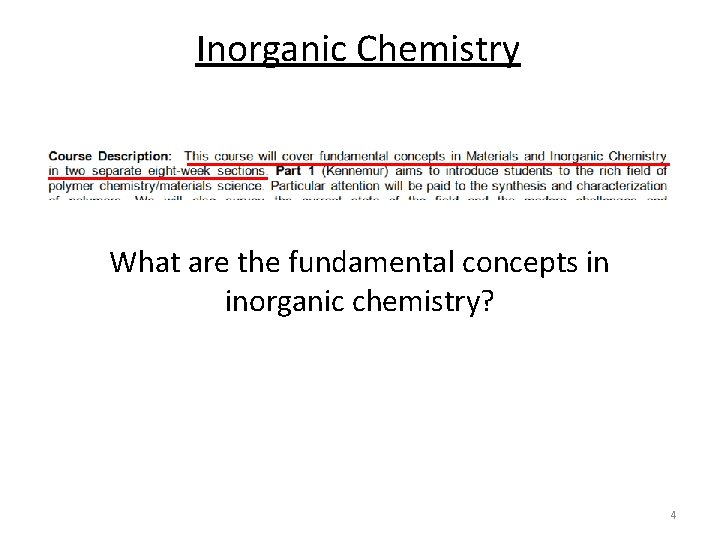
Inorganic Chemistry What are the fundamental concepts in inorganic chemistry? 4
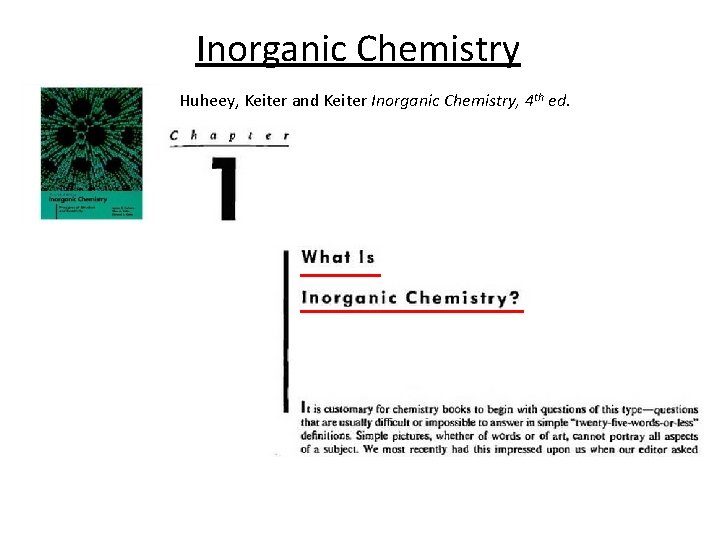
Inorganic Chemistry Huheey, Keiter and Keiter Inorganic Chemistry, 4 th ed.
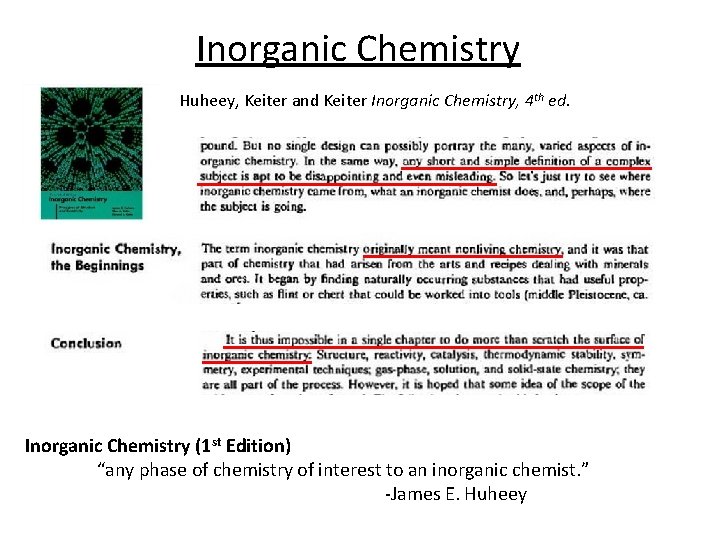
Inorganic Chemistry Huheey, Keiter and Keiter Inorganic Chemistry, 4 th ed. Inorganic Chemistry (1 st Edition) “any phase of chemistry of interest to an inorganic chemist. ” -James E. Huheey
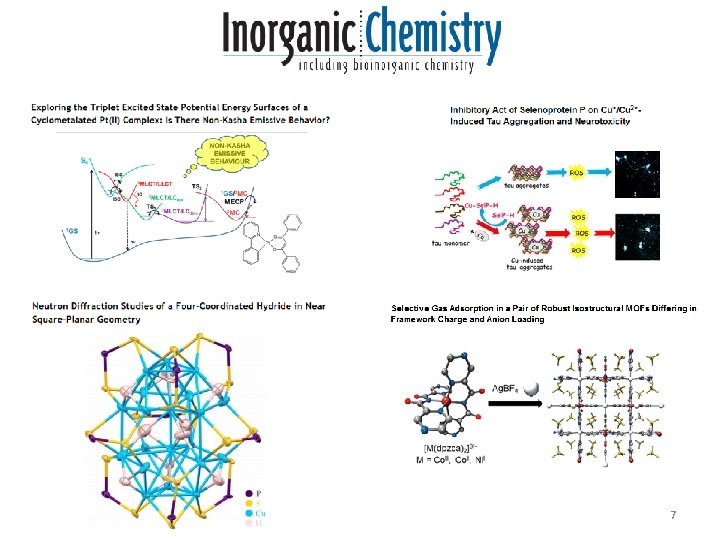
7
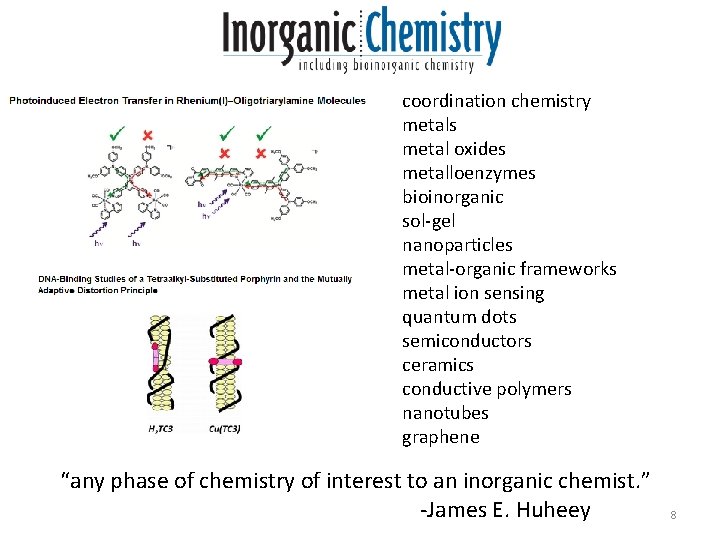
coordination chemistry metals metal oxides metalloenzymes bioinorganic sol-gel nanoparticles metal-organic frameworks metal ion sensing quantum dots semiconductors ceramics conductive polymers nanotubes graphene “any phase of chemistry of interest to an inorganic chemist. ” -James E. Huheey 8
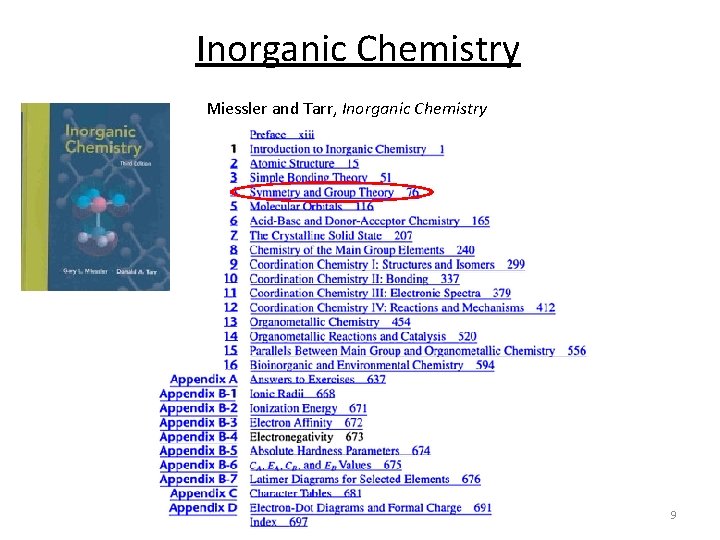
Inorganic Chemistry Miessler and Tarr, Inorganic Chemistry 9
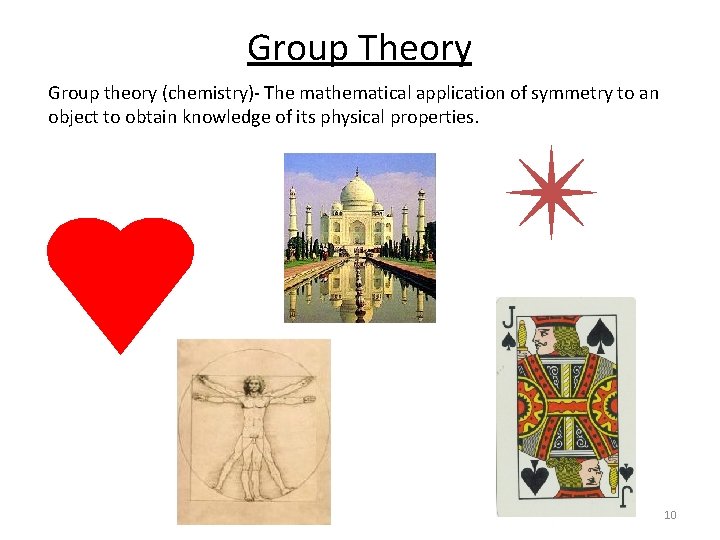
Group Theory Group theory (chemistry)- The mathematical application of symmetry to an object to obtain knowledge of its physical properties. 10
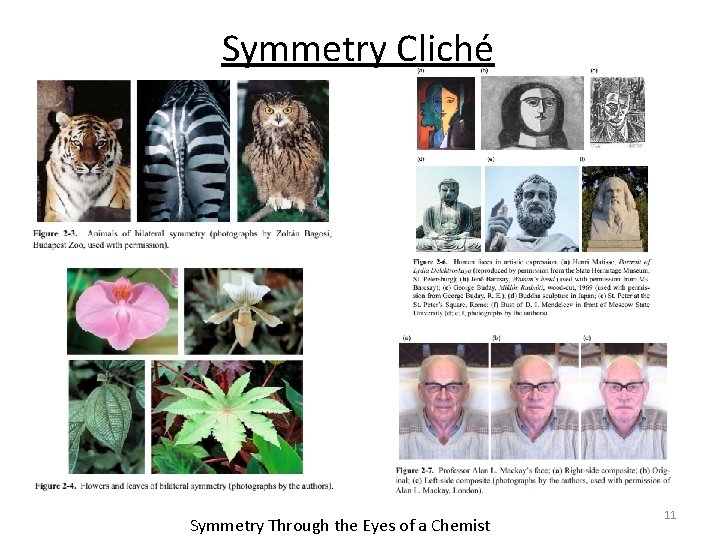
Symmetry Cliché Symmetry Through the Eyes of a Chemist 11
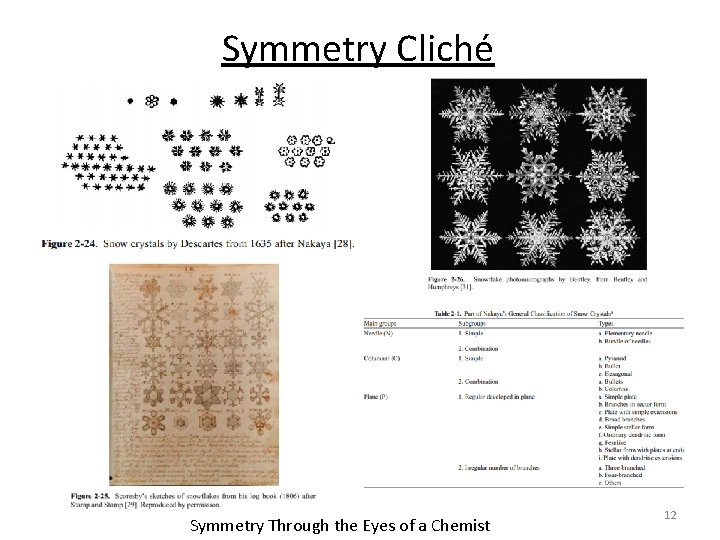
Symmetry Cliché Symmetry Through the Eyes of a Chemist 12
Applications of Symmetry • Symmetry (group theory) in cryptography • Symmetry breaking of strong and weak forces in the early universe • Symmetry (group theory) was used to predicted the existence of many elementary particles before they were found experimentally • Modern particle physics would not exist without group theory • X-ray crystallography • Spectroscopy • Quasicrystals-Periodic structure that lacks translational symmetry, has only local symmetry. (2011 Nobel Prize in chemistry, Dan Shechtman)
Group Theory Group theory (chemistry)- The mathematical application of symmetry to an object to obtain knowledge of its physical properties. Who has heard of group theory? Who has had Inorganic Chemistry? Who has covered group theory in Inorganic Chemistry? 14
What could be covered? Definitions and Theorems of Group Theory Symmetry Elements/Operations Symmetry Classifications Dipoles Optical Isomers Representations of Groups Irreducible Representations Molecular Orbital Theory Symmetry-Adapted Linear Combinations Projection Operators Polarizations Orbital Diagrams Term Symbols Expansion coefficients Crystal Field Theory Ligand Field Theory VSEPR Selection Rules Vibrational Modes Infrared Spectroscopy Raman Spectroscopy Electronic Spectroscopy Fluorescence Phosphorescene X-ray Crystallography Space Groups Lattice Symmetry 3 -D Space Groups etc… 15
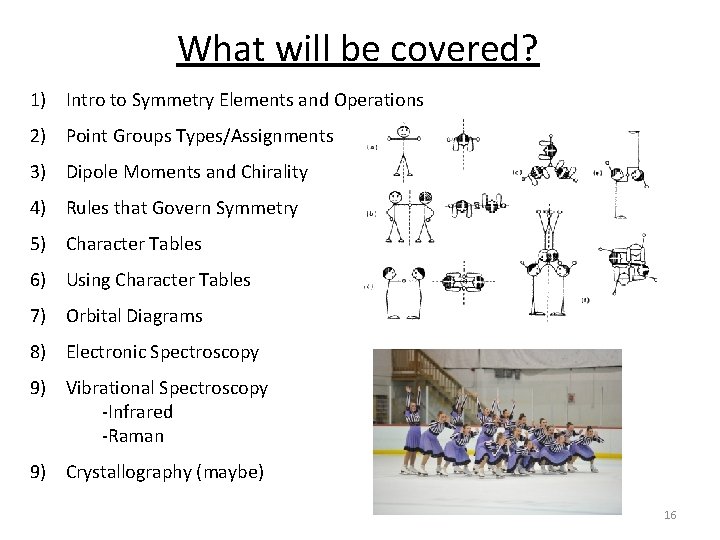
What will be covered? 1) Intro to Symmetry Elements and Operations 2) Point Groups Types/Assignments 3) Dipole Moments and Chirality 4) Rules that Govern Symmetry 5) Character Tables 6) Using Character Tables 7) Orbital Diagrams 8) Electronic Spectroscopy 9) Vibrational Spectroscopy -Infrared -Raman 9) Crystallography (maybe) 16
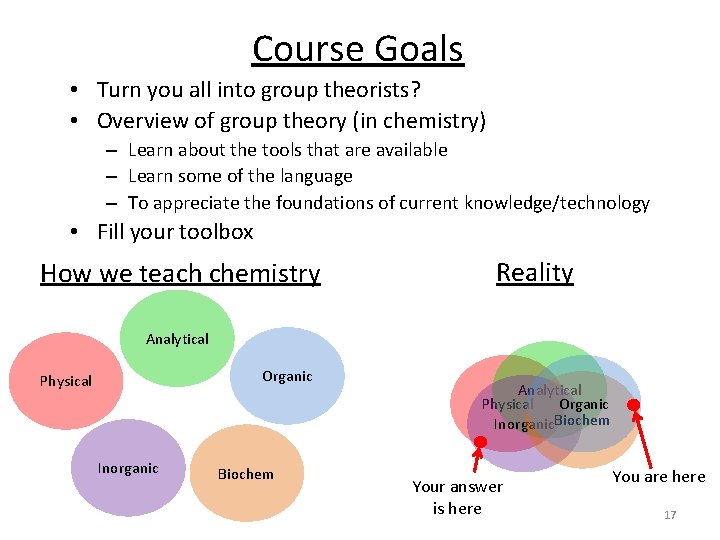
Course Goals • Turn you all into group theorists? • Overview of group theory (in chemistry) – Learn about the tools that are available – Learn some of the language – To appreciate the foundations of current knowledge/technology • Fill your toolbox How we teach chemistry Reality Analytical Organic Physical Inorganic Biochem Analytical Physical Organic Inorganic. Biochem Your answer is here You are here 17
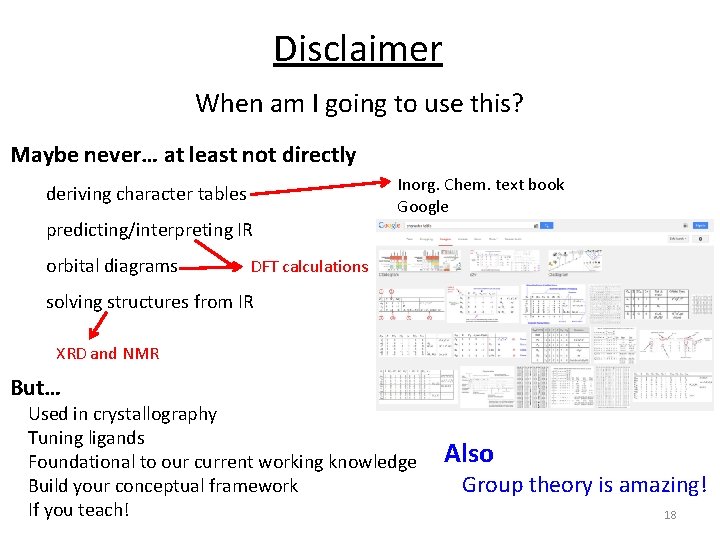
Disclaimer When am I going to use this? Maybe never… at least not directly deriving character tables predicting/interpreting IR orbital diagrams Inorg. Chem. text book Google DFT calculations solving structures from IR XRD and NMR But… Used in crystallography Tuning ligands Foundational to our current working knowledge Build your conceptual framework If you teach! Also Group theory is amazing! 18
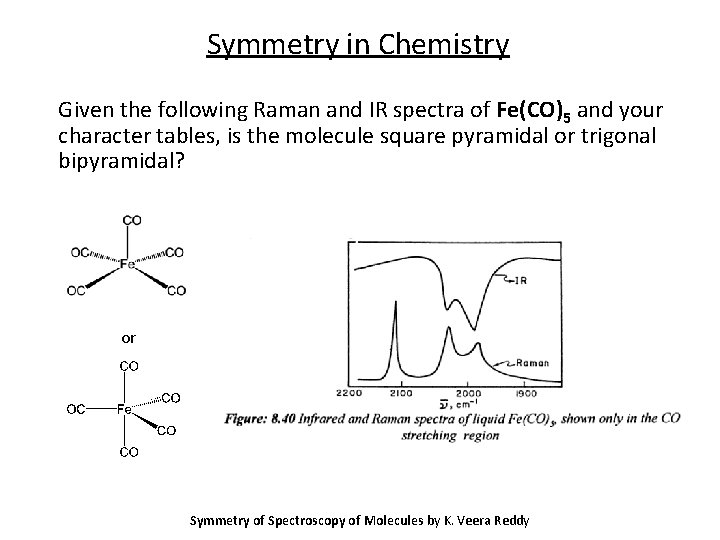
Symmetry in Chemistry Given the following Raman and IR spectra of Fe(CO)5 and your character tables, is the molecule square pyramidal or trigonal bipyramidal? or Symmetry of Spectroscopy of Molecules by K. Veera Reddy
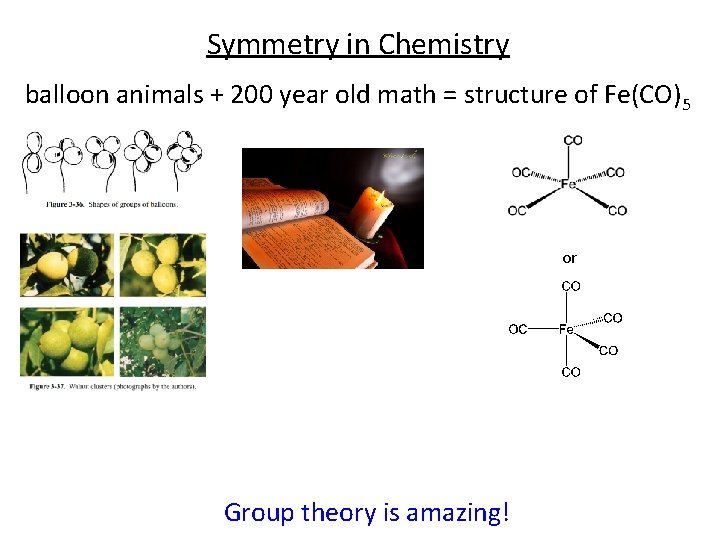
Symmetry in Chemistry balloon animals + 200 year old math = structure of Fe(CO)5 or Group theory is amazing!
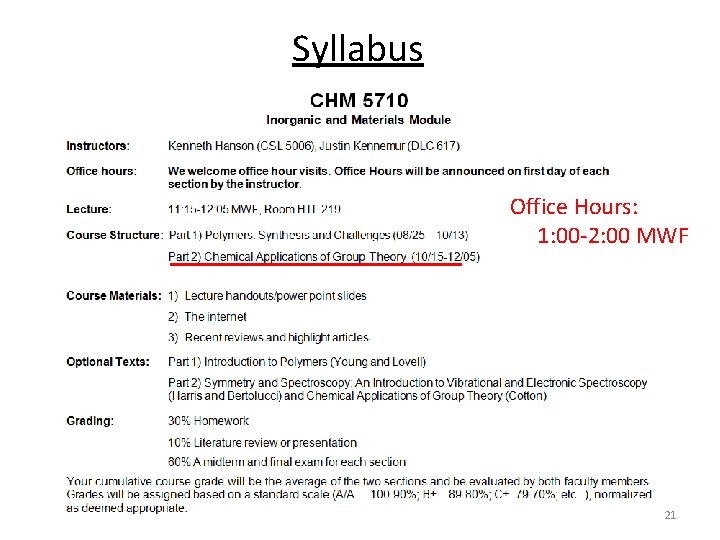
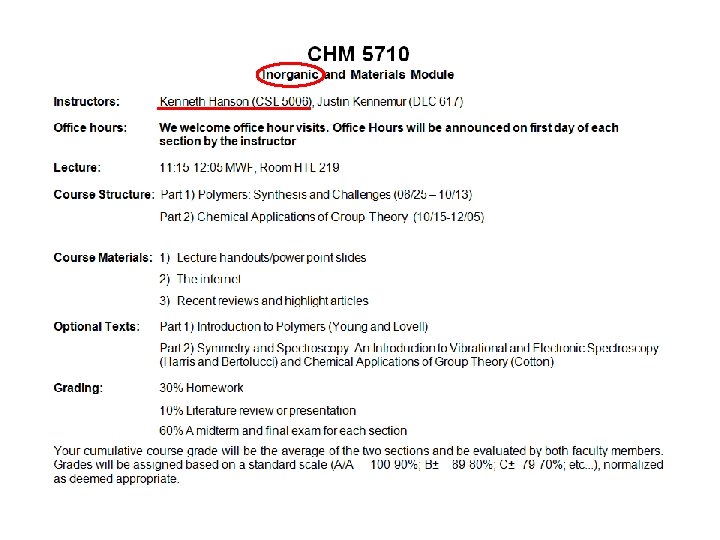
Syllabus Office Hours: 1: 00 -2: 00 MWF 21
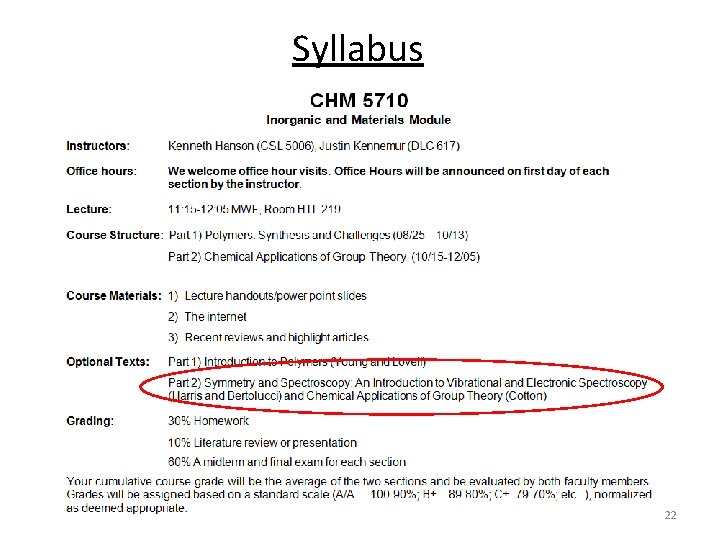
Syllabus 22
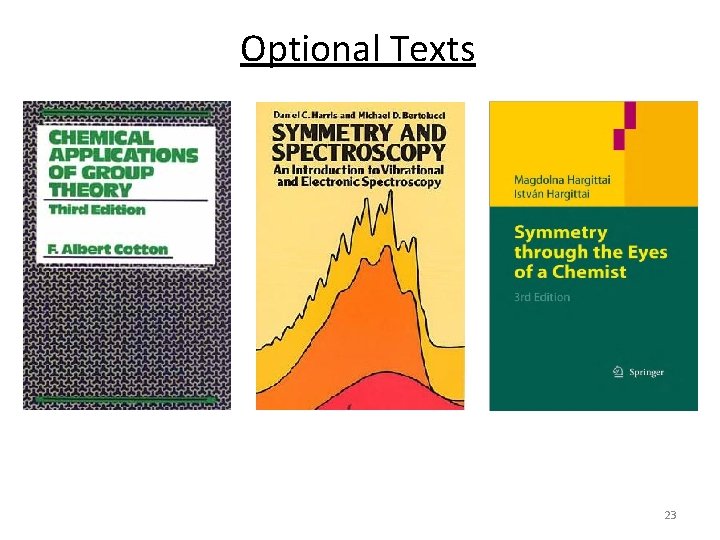
Optional Texts 23
Infinite Text 24
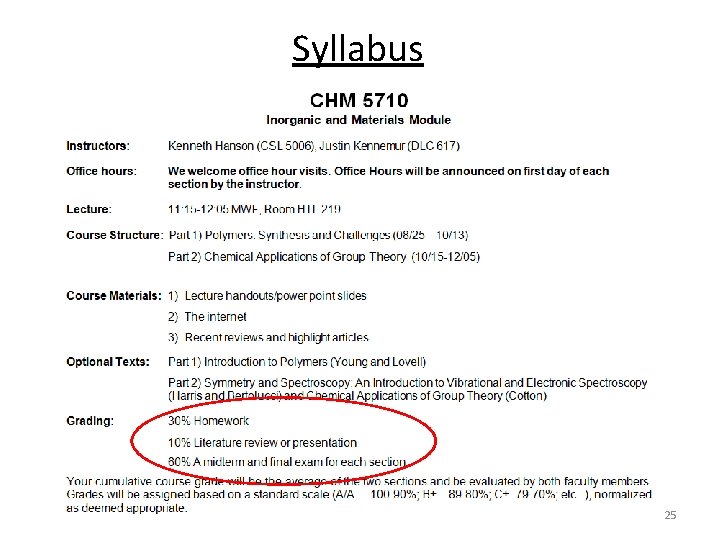
Syllabus 25
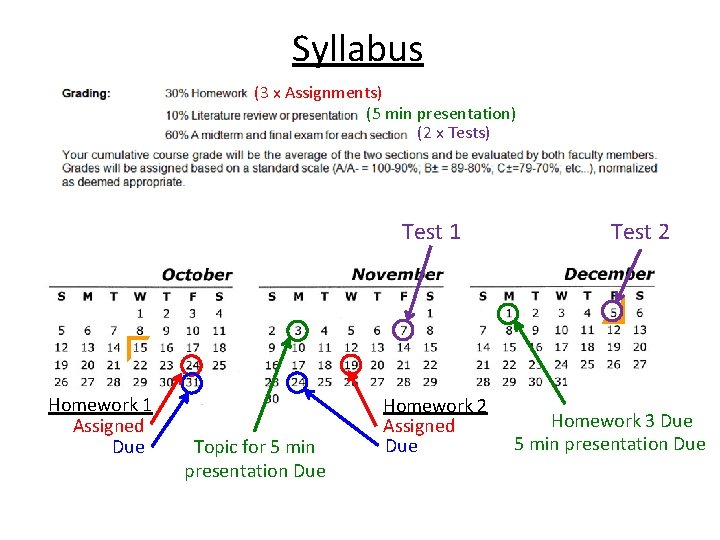
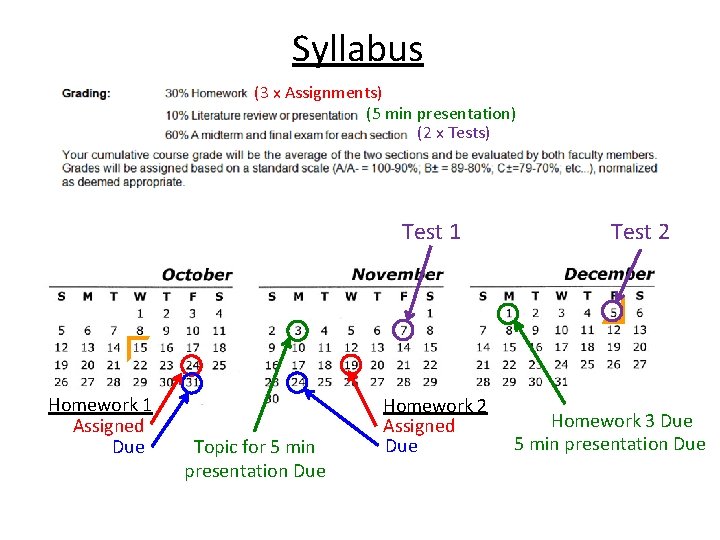
Syllabus (3 x Assignments) (5 min presentation) (2 x Tests) Test 1 Homework 1 Assigned Due Topic for 5 min presentation Due Homework 2 Assigned Due Test 2 Homework 3 Due 5 min presentation Due
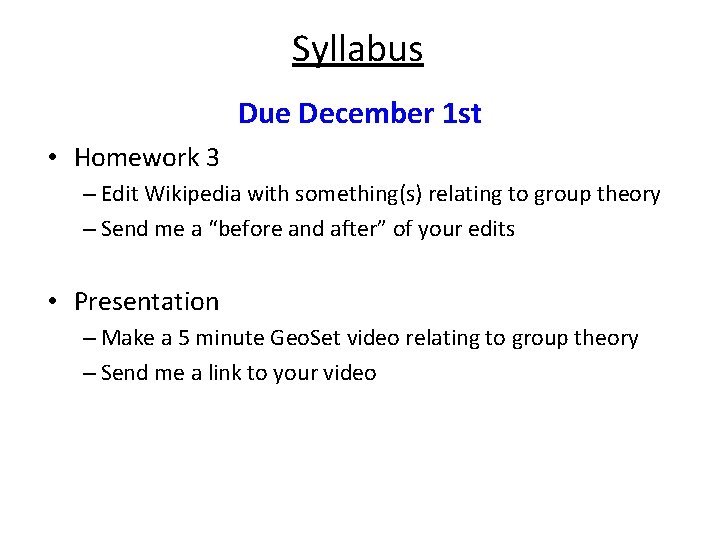
Syllabus Due December 1 st • Homework 3 – Edit Wikipedia with something(s) relating to group theory – Send me a “before and after” of your edits • Presentation – Make a 5 minute Geo. Set video relating to group theory – Send me a link to your video
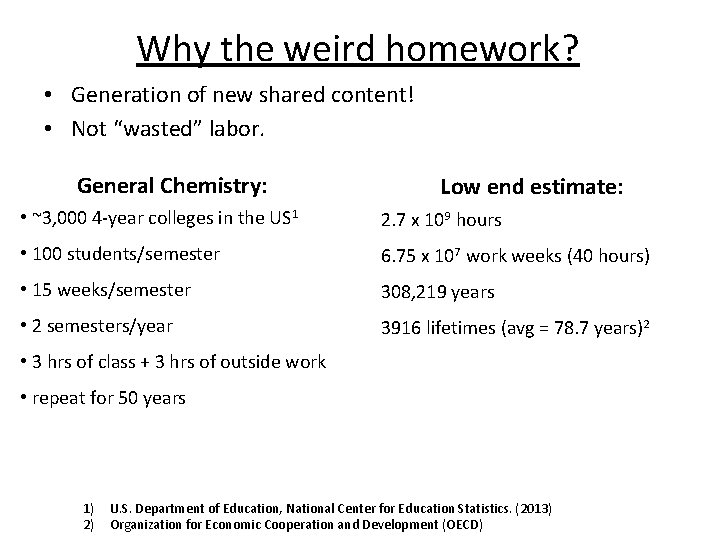
Why the weird homework? • Generation of new shared content! • Not “wasted” labor. General Chemistry: Low end estimate: • ~3, 000 4 -year colleges in the US 1 2. 7 x 10⁹ hours • 100 students/semester 6. 75 x 107 work weeks (40 hours) • 15 weeks/semester 308, 219 years • 2 semesters/year 3916 lifetimes (avg = 78. 7 years)2 • 3 hrs of class + 3 hrs of outside work • repeat for 50 years 1) 2) U. S. Department of Education, National Center for Education Statistics. (2013) Organization for Economic Cooperation and Development (OECD)
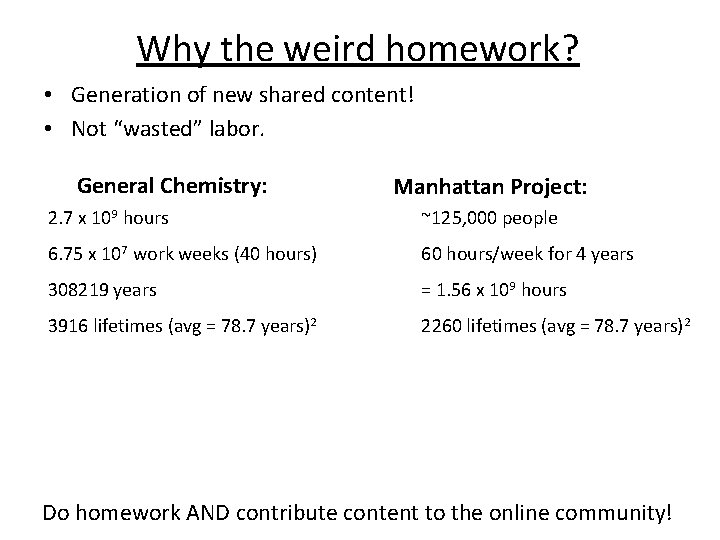
Why the weird homework? • Generation of new shared content! • Not “wasted” labor. General Chemistry: Manhattan Project: 2. 7 x 10⁹ hours ~125, 000 people 6. 75 x 107 work weeks (40 hours) 60 hours/week for 4 years 308219 years = 1. 56 x 109 hours 3916 lifetimes (avg = 78. 7 years)2 2260 lifetimes (avg = 78. 7 years)2 Do homework AND contribute content to the online community!
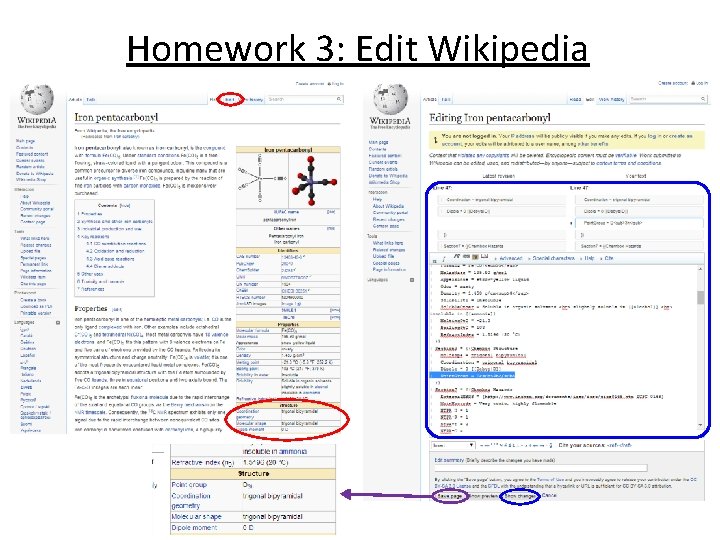
Homework 3: Edit Wikipedia
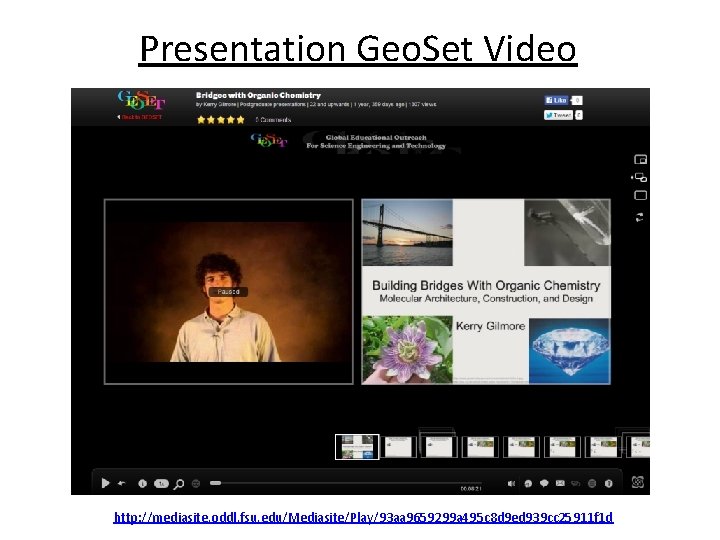
Presentation Geo. Set Video http: //mediasite. oddl. fsu. edu/Mediasite/Play/93 aa 9659299 a 495 c 8 d 9 ed 939 cc 25911 f 1 d
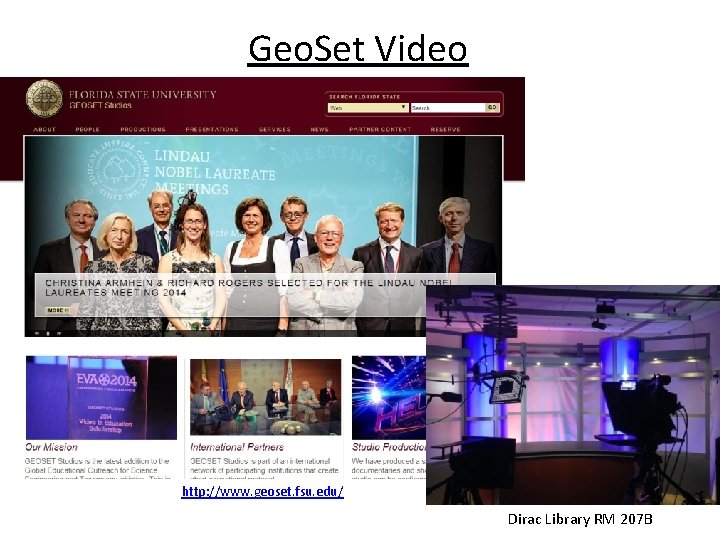
Geo. Set Video http: //www. geoset. fsu. edu/ Dirac Library RM 207 B
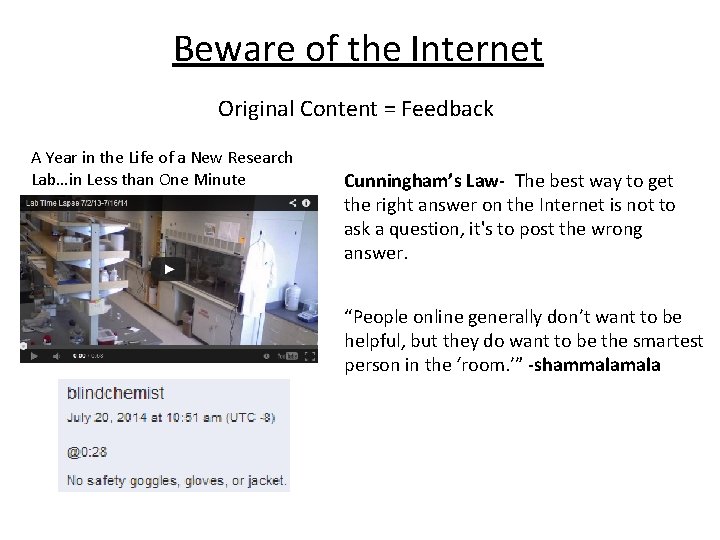
Beware of the Internet Original Content = Feedback A Year in the Life of a New Research Lab…in Less than One Minute Cunningham’s Law- The best way to get the right answer on the Internet is not to ask a question, it's to post the wrong answer. “People online generally don’t want to be helpful, but they do want to be the smartest person in the ‘room. ’” -shammala
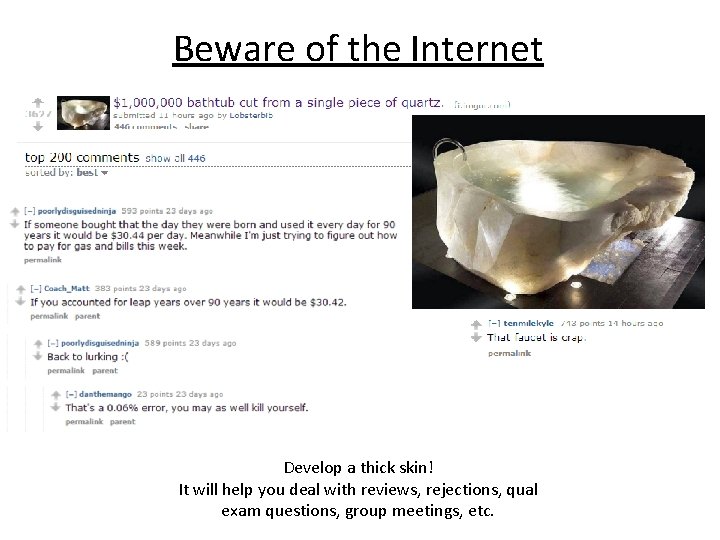
Beware of the Internet Develop a thick skin! It will help you deal with reviews, rejections, qual exam questions, group meetings, etc.
Syllabus (3 x Assignments) (5 min presentation) (2 x Tests) Test 1 Homework 1 Assigned Due Topic for 5 min presentation Due Homework 2 Assigned Due Test 2 Homework 3 Due 5 min presentation Due
Why the Camera? 1) Generating new content. 2) Cottrell Scholars Collaborative New Faculty Workshop Evaluation Study -Professor Marilyne Stains -University of Nebraska-Lincoln -Evaluation of the impact of science education research on instructional practices in higher education Anyone in witness protection?
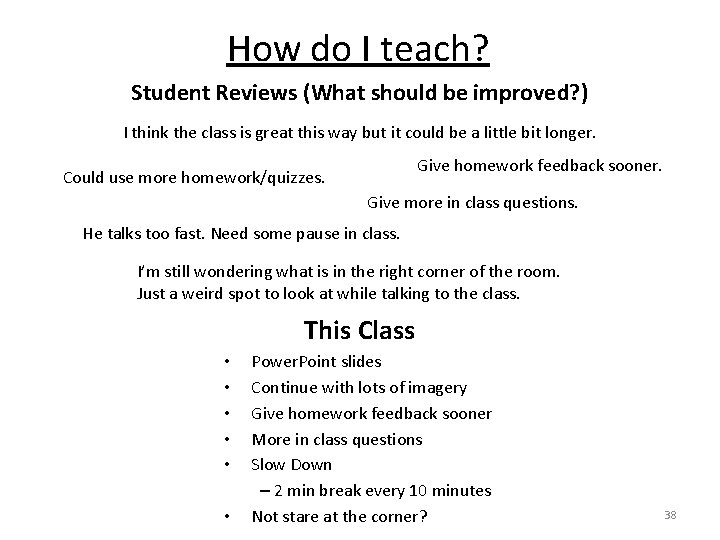
How do I teach? Student Reviews (What should be improved? ) I think the class is great this way but it could be a little bit longer. Give homework feedback sooner. Could use more homework/quizzes. Give more in class questions. He talks too fast. Need some pause in class. I’m still wondering what is in the right corner of the room. Just a weird spot to look at while talking to the class. This Class • • • Power. Point slides Continue with lots of imagery Give homework feedback sooner More in class questions Slow Down – 2 min break every 10 minutes Not stare at the corner? 38
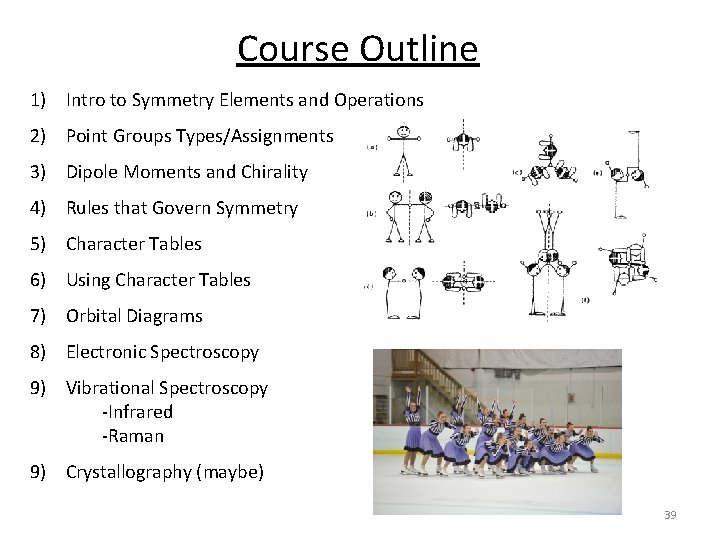
Course Outline 1) Intro to Symmetry Elements and Operations 2) Point Groups Types/Assignments 3) Dipole Moments and Chirality 4) Rules that Govern Symmetry 5) Character Tables 6) Using Character Tables 7) Orbital Diagrams 8) Electronic Spectroscopy 9) Vibrational Spectroscopy -Infrared -Raman 9) Crystallography (maybe) 39
- Slides: 39