
CHM 5175 Part 2 8 Transient Absorption Source
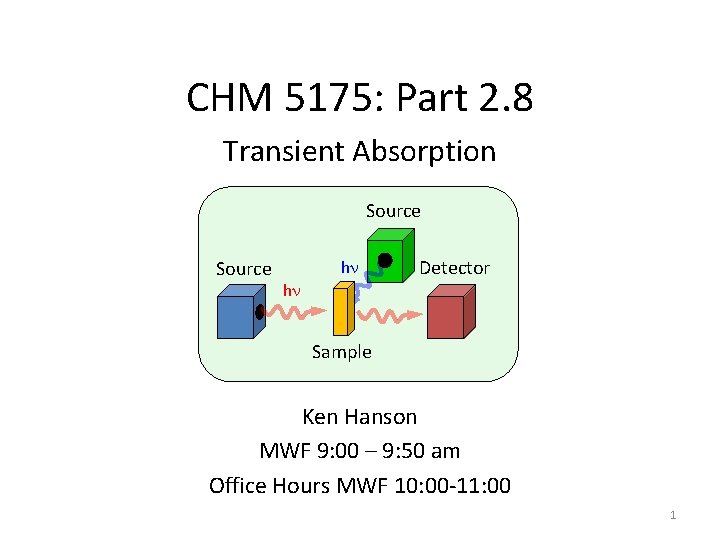
CHM 5175: Part 2. 8 Transient Absorption Source hn hn Detector Sample Ken Hanson MWF 9: 00 – 9: 50 am Office Hours MWF 10: 00 -11: 00 1
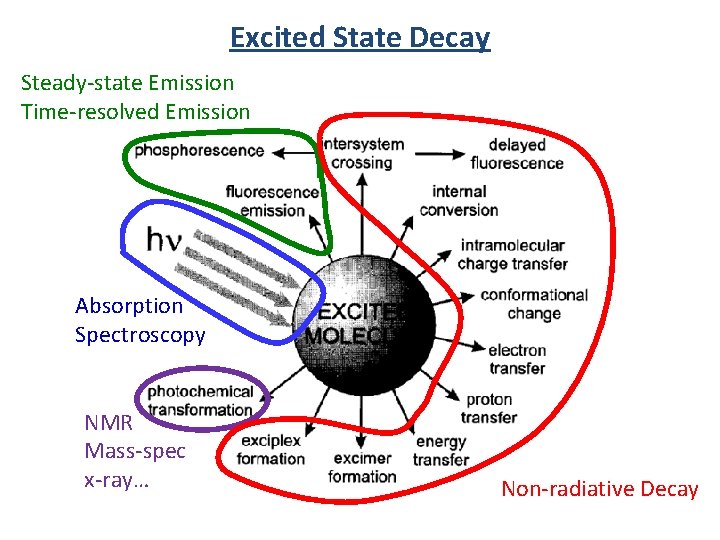
Excited State Decay Steady-state Emission Time-resolved Emission Absorption Spectroscopy NMR Mass-spec x-ray… Non-radiative Decay
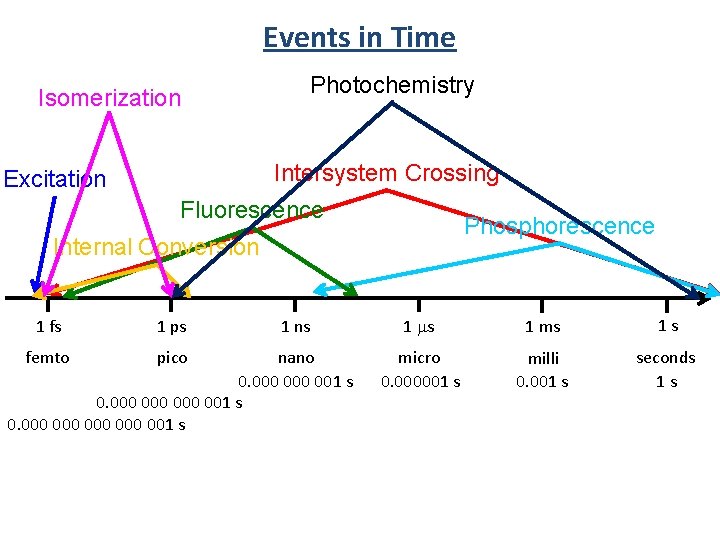
Events in Time Isomerization Photochemistry Intersystem Crossing Excitation Fluorescence Phosphorescence Internal Conversion 1 fs 1 ps femto pico 1 ns nano 0. 000 000 001 s 0. 000 000 000 001 s 1 ms 1 s micro 0. 000001 s milli 0. 001 s seconds 1 s
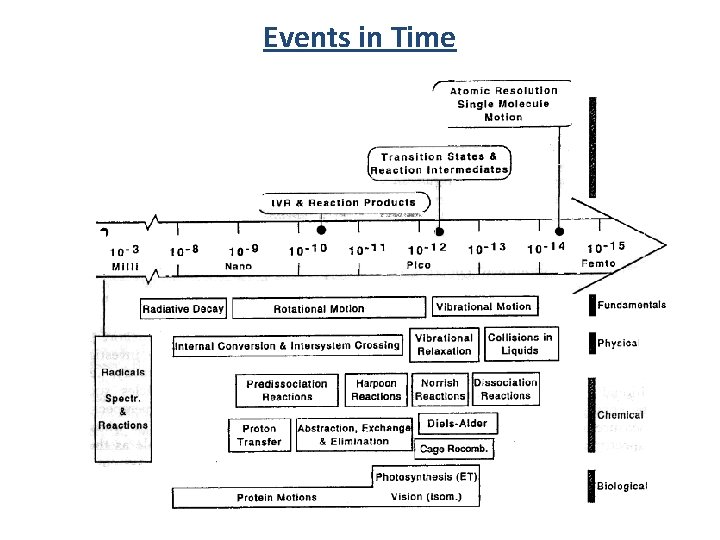
Events in Time
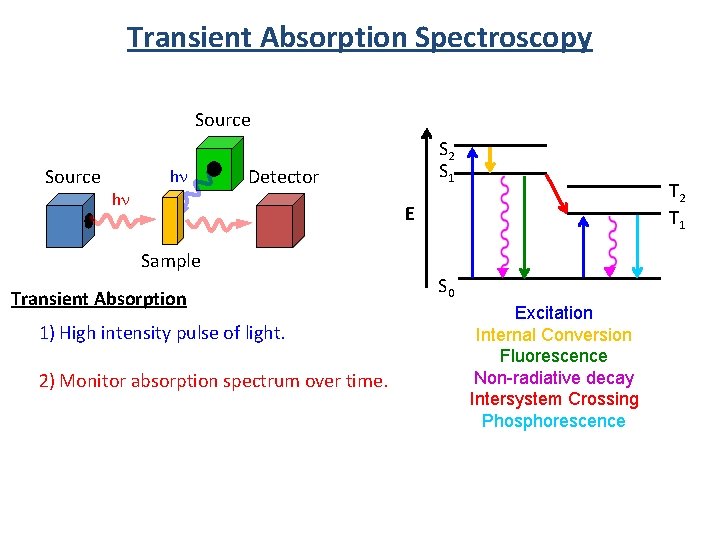
Transient Absorption Spectroscopy Source hn hn S 2 S 1 Detector T 2 T 1 E Sample Transient Absorption 1) High intensity pulse of light. 2) Monitor absorption spectrum over time. S 0 Excitation Internal Conversion Fluorescence Non-radiative decay Intersystem Crossing Phosphorescence

Transient Absorption Spectroscopy TA of Photochromic Sunglasses (seconds to minutes) Steps 1) Excitation (sunlight) 2) Go inside 3) Monitor color change over time
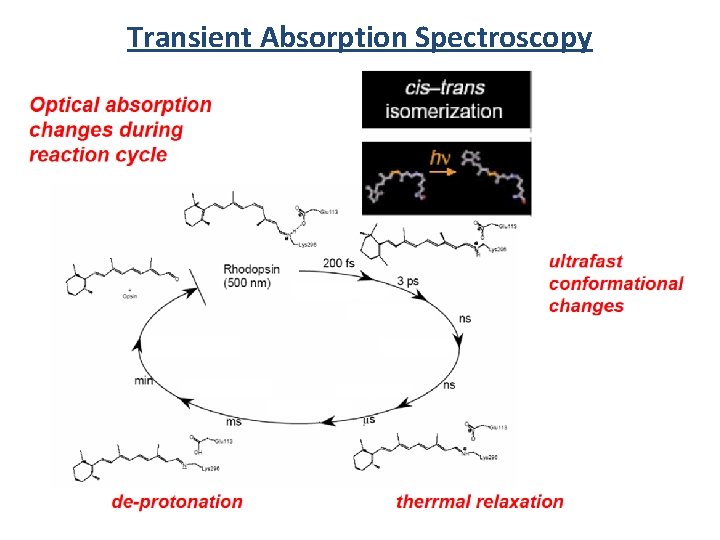
Transient Absorption Spectroscopy
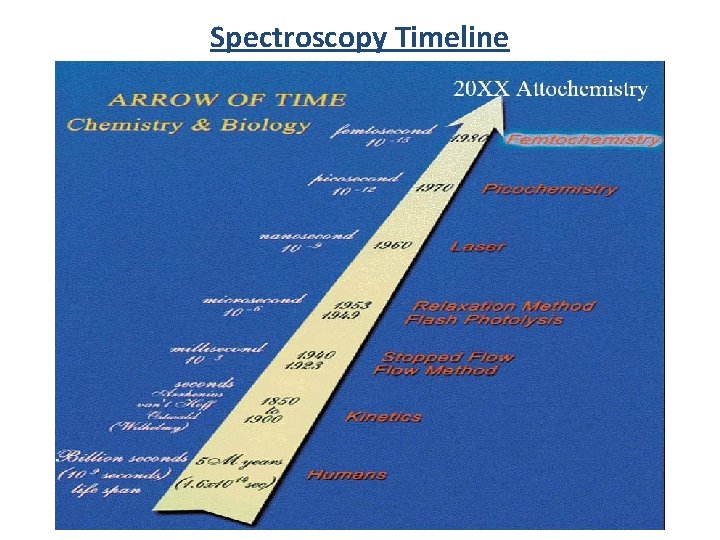
Spectroscopy Timeline
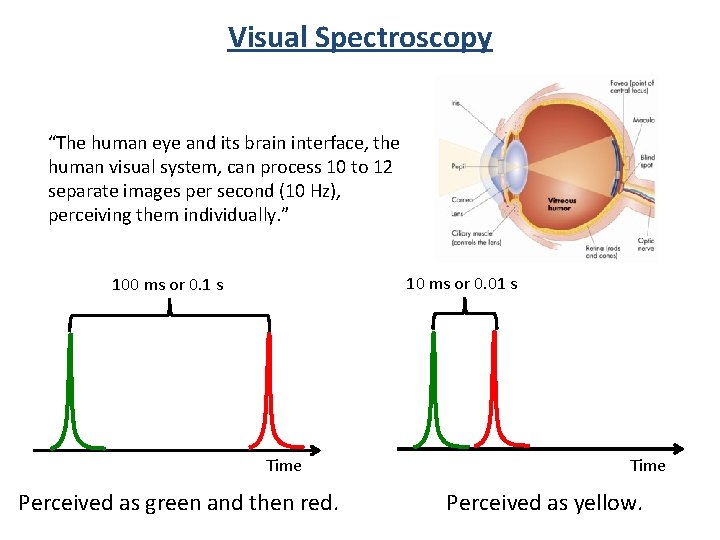
Visual Spectroscopy “The human eye and its brain interface, the human visual system, can process 10 to 12 separate images per second (10 Hz), perceiving them individually. ” 10 ms or 0. 01 s 100 ms or 0. 1 s Time Perceived as green and then red. Time Perceived as yellow.
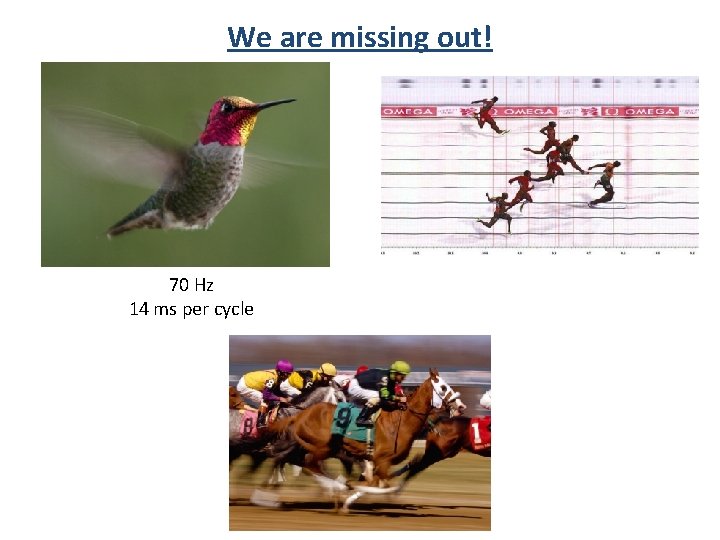
We are missing out! 70 Hz 14 ms per cycle
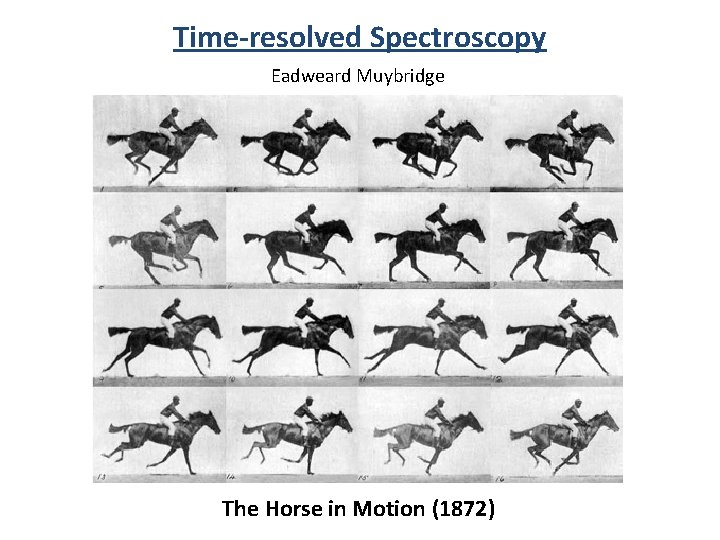
Time-resolved Spectroscopy Eadweard Muybridge The Horse in Motion (1872)
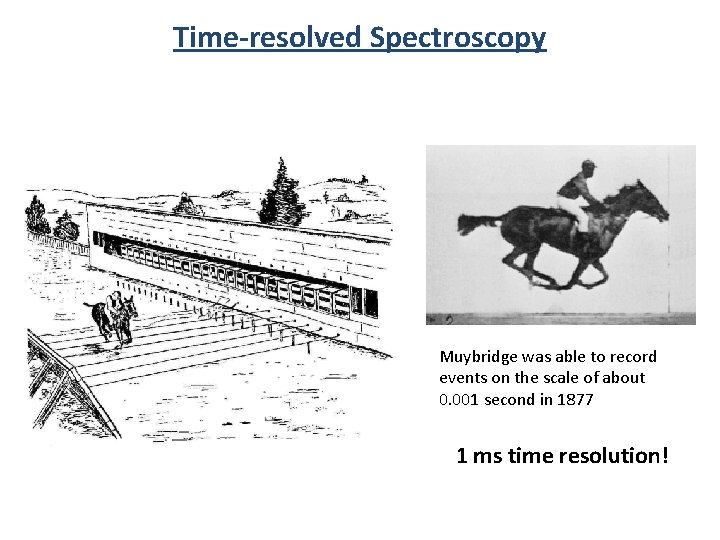
Time-resolved Spectroscopy Muybridge was able to record events on the scale of about 0. 001 second in 1877 1 ms time resolution!
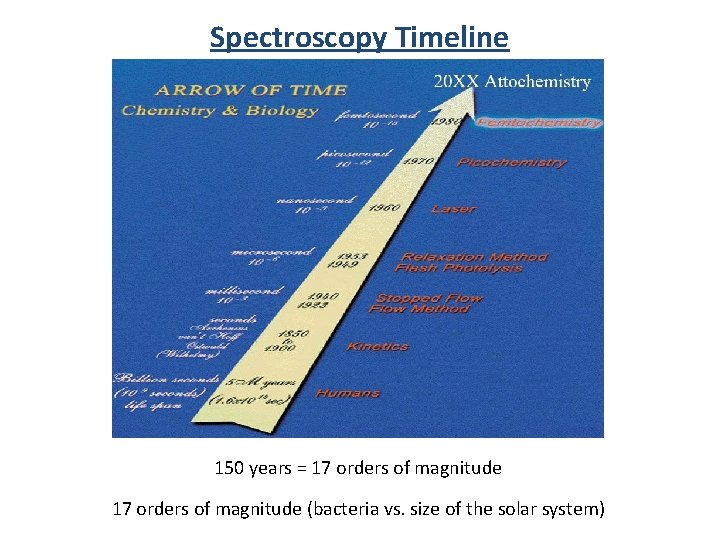
Spectroscopy Timeline 150 years = 17 orders of magnitude (bacteria vs. size of the solar system)
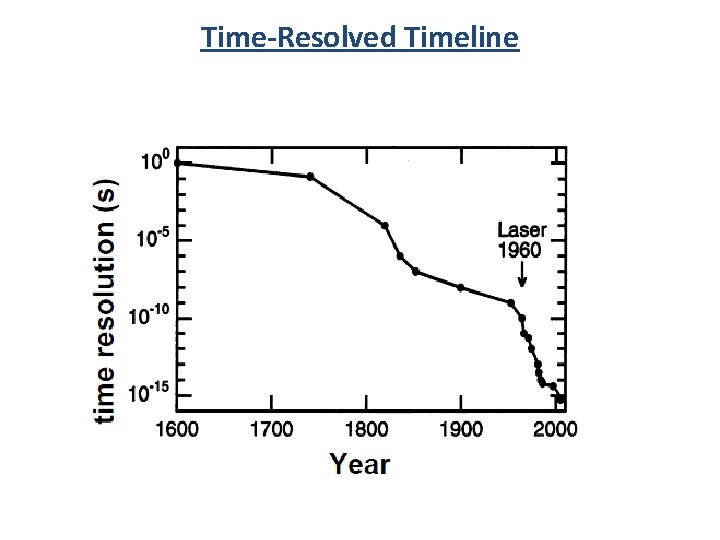
Time-Resolved Timeline
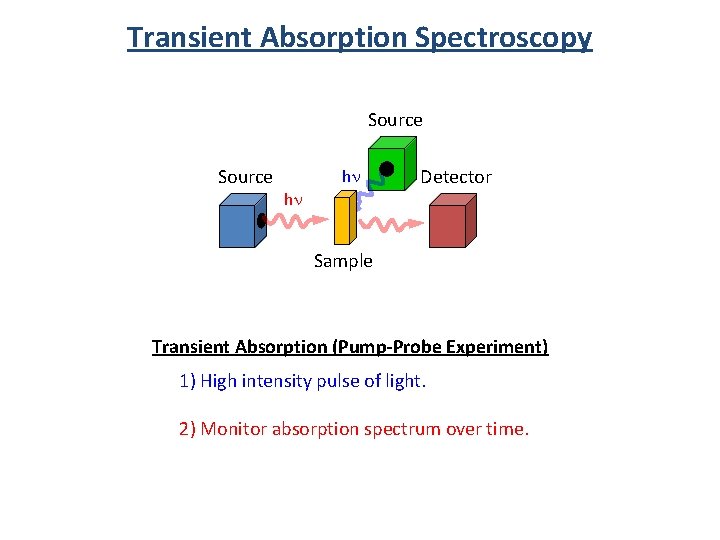
Transient Absorption Spectroscopy Source hn hn Detector Sample Transient Absorption (Pump-Probe Experiment) 1) High intensity pulse of light. 2) Monitor absorption spectrum over time.
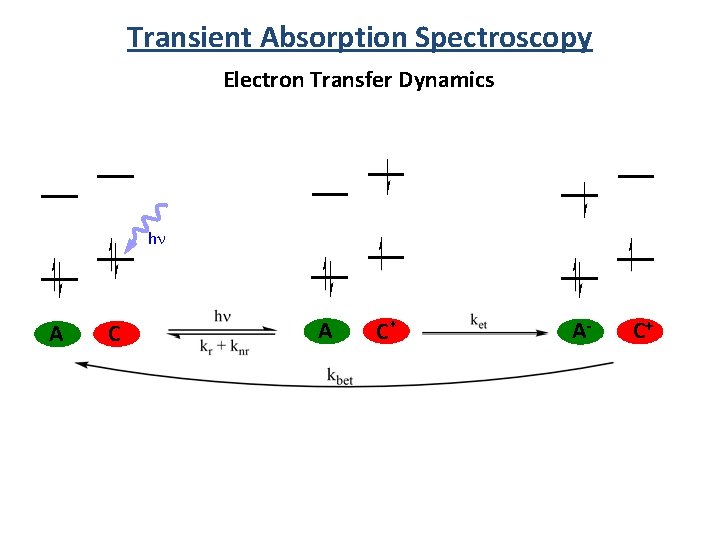
Transient Absorption Spectroscopy Electron Transfer Dynamics hn A C* A- C+
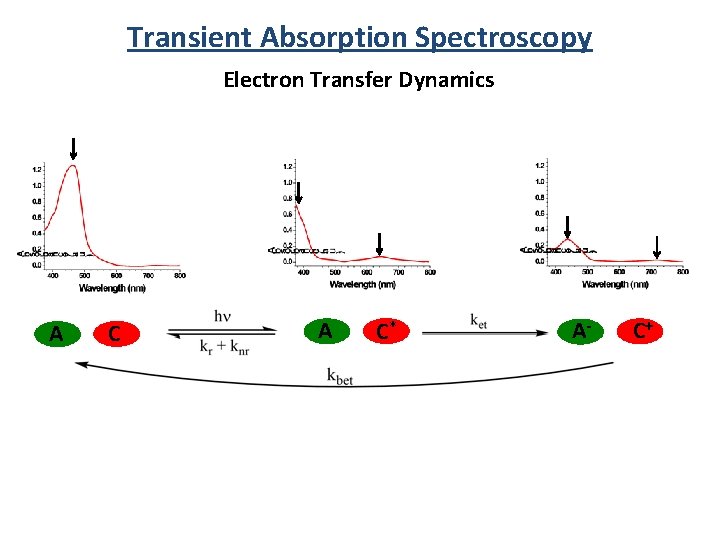
Transient Absorption Spectroscopy Electron Transfer Dynamics A C* A- C+
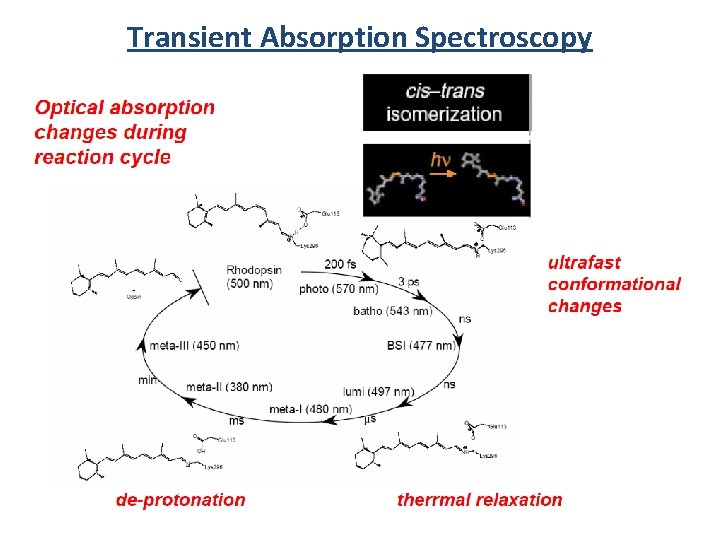
Transient Absorption Spectroscopy
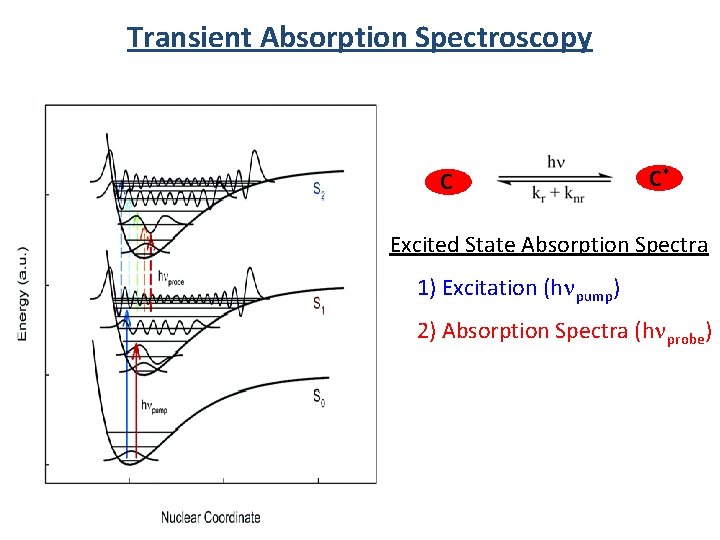
Transient Absorption Spectroscopy C C* Excited State Absorption Spectra 1) Excitation (hnpump) 2) Absorption Spectra (hnprobe)
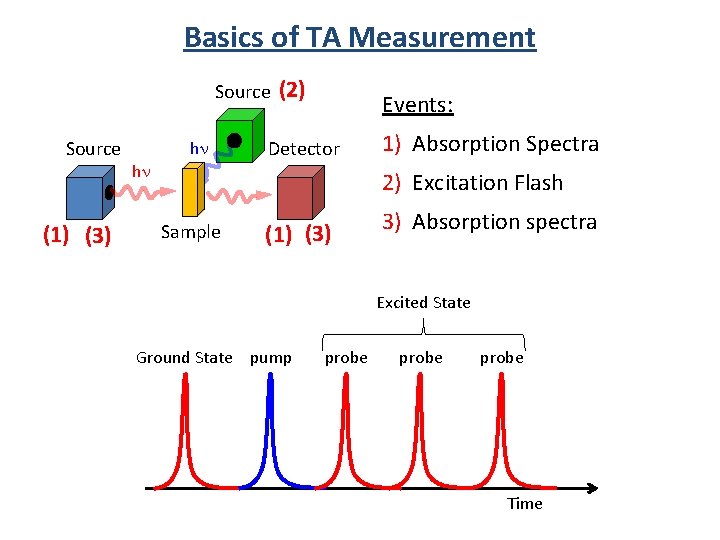
Basics of TA Measurement Source (1) (3) hn hn (2) Events: Detector 1) Absorption Spectra 2) Excitation Flash Sample (1) (3) 3) Absorption spectra Excited State Ground State pump probe Time
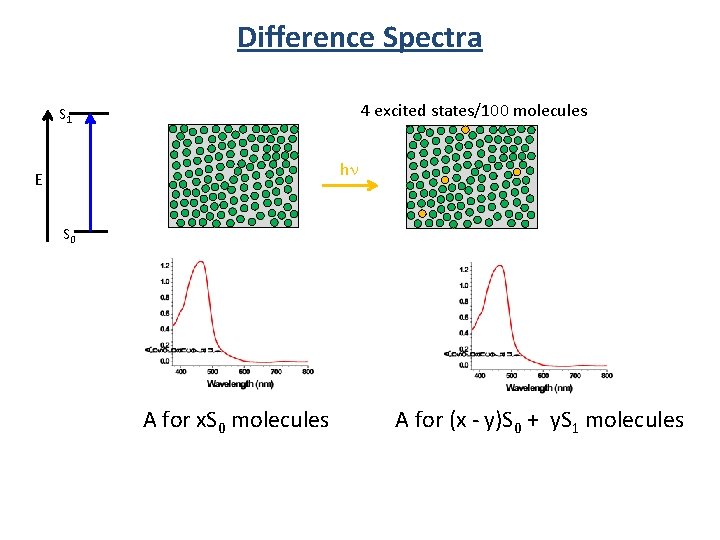
Difference Spectra 4 excited states/100 molecules S 1 hn E S 0 A for x. S 0 molecules A for (x - y)S 0 + y. S 1 molecules
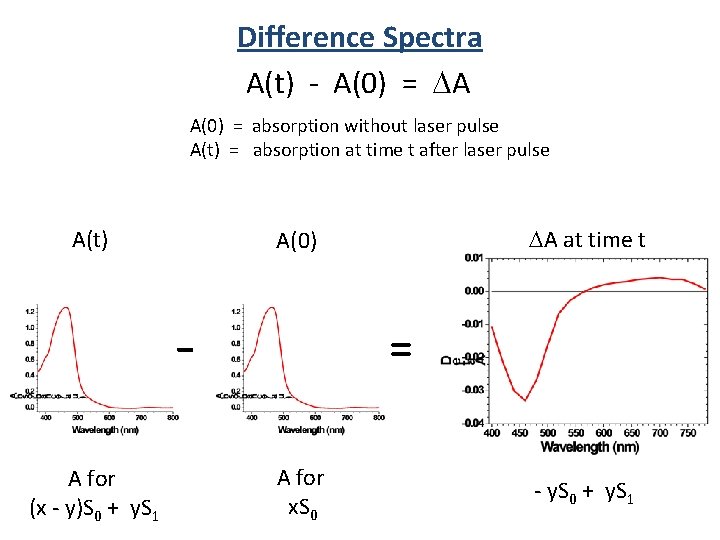
Difference Spectra A(t) - A(0) = DA A(0) = absorption without laser pulse A(t) = absorption at time t after laser pulse A(t) A for (x - y)S 0 + y. S 1 DA at time t A(0) = A for x. S 0 - y. S 0 + y. S 1
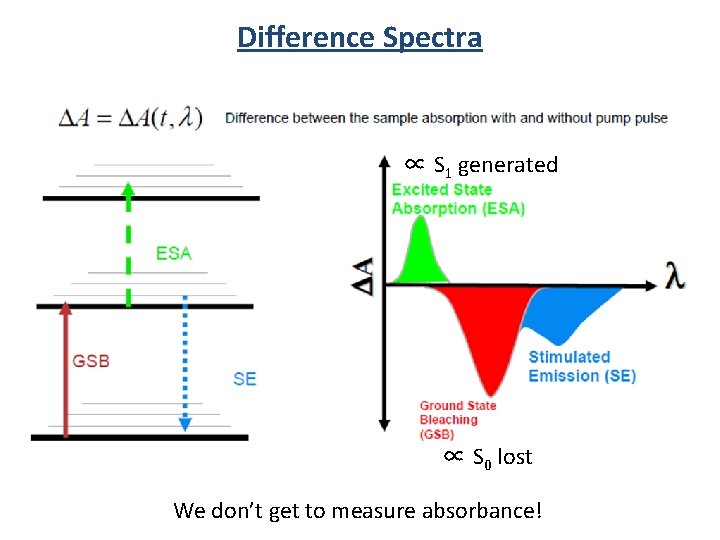
Difference Spectra ∝ S 1 generated ∝ S 0 lost We don’t get to measure absorbance!
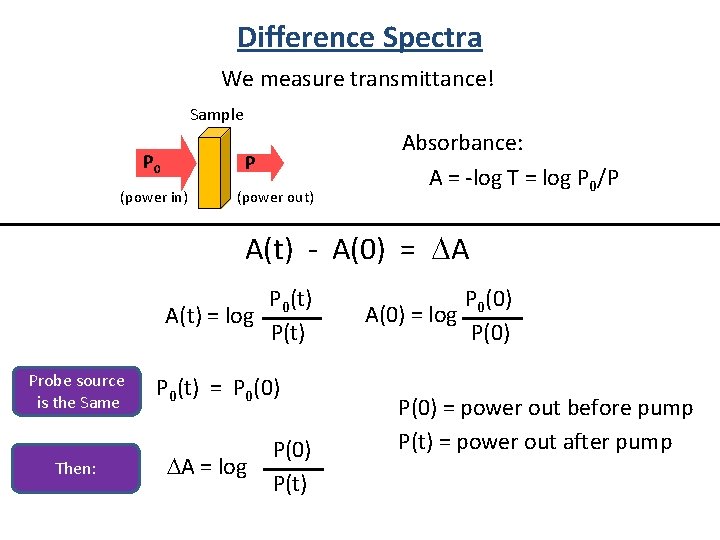
Difference Spectra We measure transmittance! Sample P 0 P (power in) (power out) Absorbance: A = -log T = log P 0/P A(t) - A(0) = DA P 0(t) A(t) = log P(t) Probe source is the Same Then: P 0(t) = P 0(0) DA = log P(0) P(t) P 0(0) A(0) = log P(0) = power out before pump P(t) = power out after pump
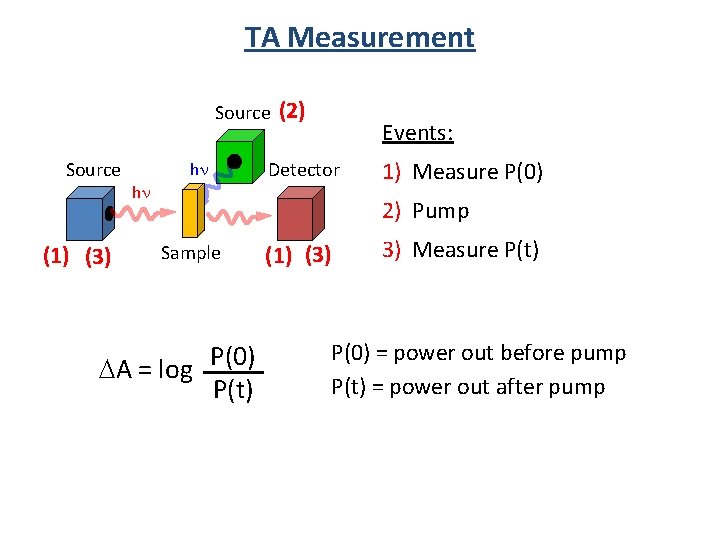
TA Measurement Source (1) (3) hn hn (2) Events: Detector 1) Measure P(0) 2) Pump Sample DA = log P(0) P(t) (1) (3) 3) Measure P(t) P(0) = power out before pump P(t) = power out after pump
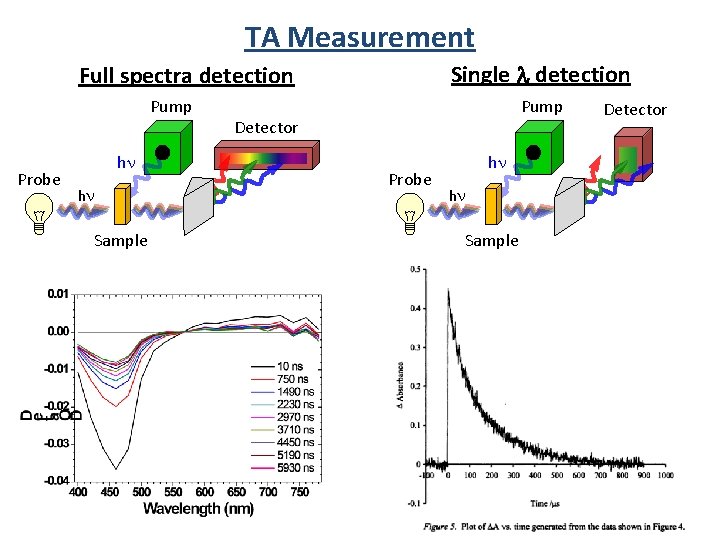
TA Measurement Single l detection Full spectra detection Pump Probe hn hn Sample Pump Detector Probe hn hn Sample Detector
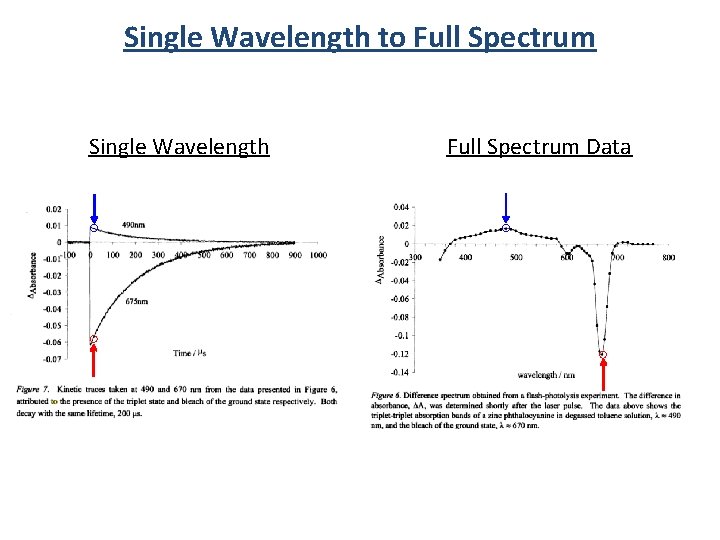
Single Wavelength to Full Spectrum Single Wavelength Full Spectrum Data
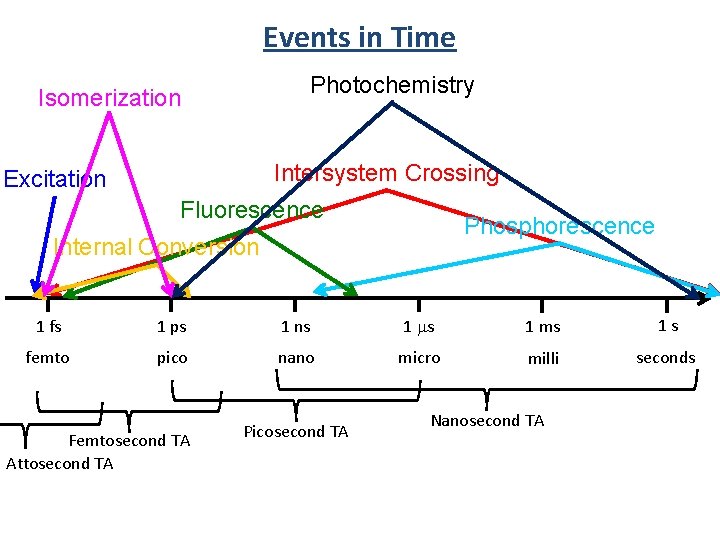
Events in Time Photochemistry Isomerization Intersystem Crossing Excitation Fluorescence Phosphorescence Internal Conversion 1 fs 1 ps 1 ns 1 ms 1 s femto pico nano micro milli seconds Femtosecond TA Attosecond TA Picosecond TA Nanosecond TA
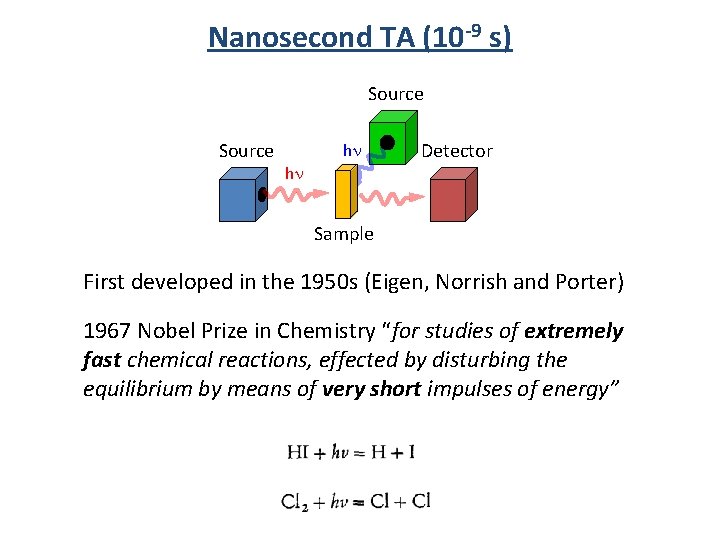
Nanosecond TA (10 -9 s) Source hn hn Detector Sample First developed in the 1950 s (Eigen, Norrish and Porter) 1967 Nobel Prize in Chemistry “for studies of extremely fast chemical reactions, effected by disturbing the equilibrium by means of very short impulses of energy”
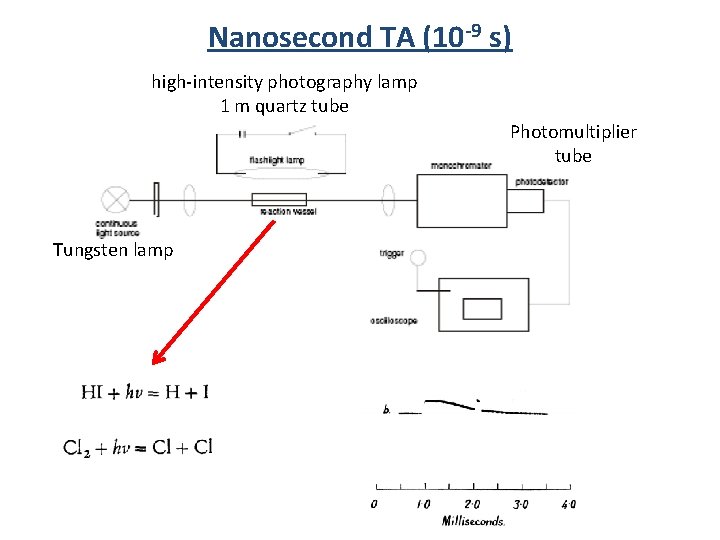
Nanosecond TA (10 -9 s) high-intensity photography lamp 1 m quartz tube Photomultiplier tube Tungsten lamp
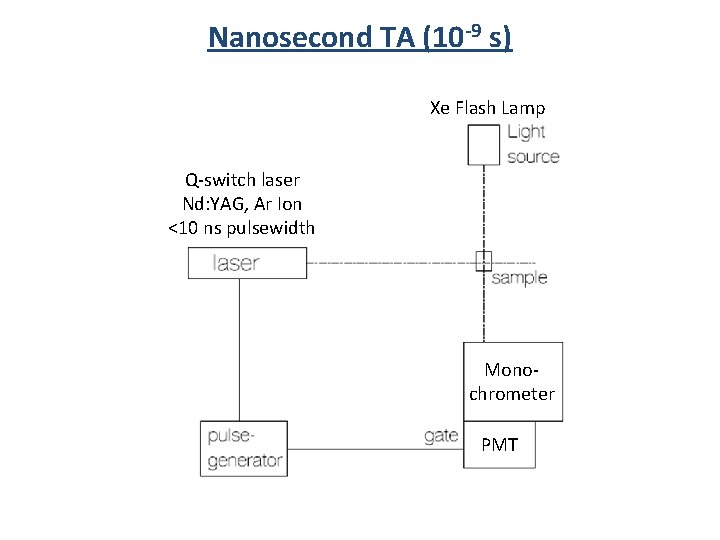
Nanosecond TA (10 -9 s) Xe Flash Lamp Q-switch laser Nd: YAG, Ar Ion <10 ns pulsewidth Monochrometer PMT
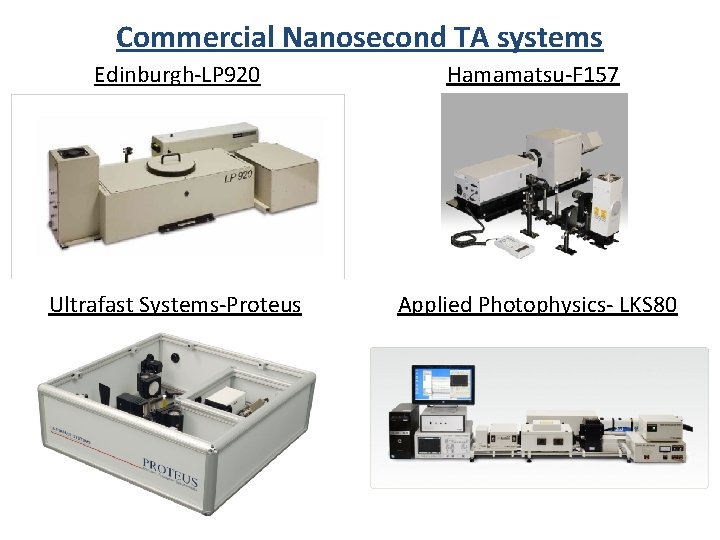
Commercial Nanosecond TA systems Edinburgh-LP 920 Hamamatsu-F 157 Ultrafast Systems-Proteus Applied Photophysics- LKS 80
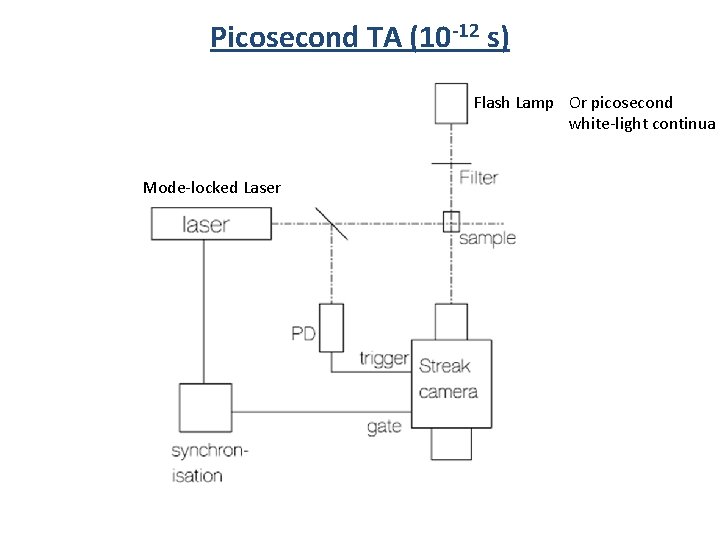
Picosecond TA (10 -12 s) Flash Lamp Or picosecond white-light continua Mode-locked Laser
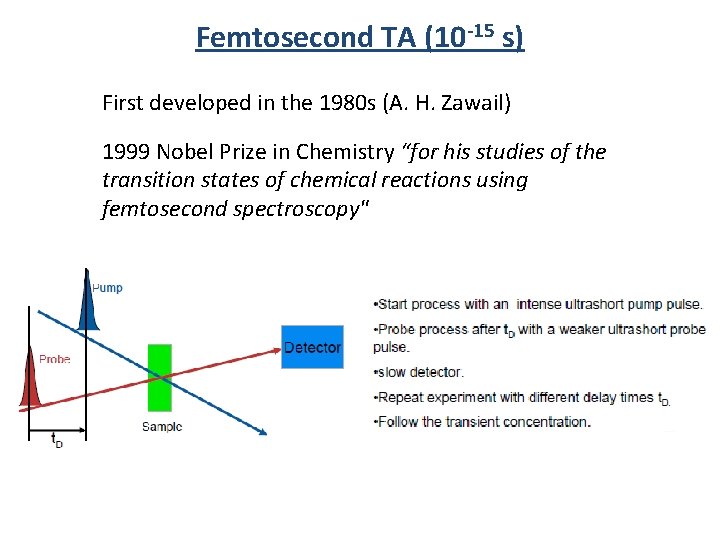
Femtosecond TA (10 -15 s) First developed in the 1980 s (A. H. Zawail) 1999 Nobel Prize in Chemistry “for his studies of the transition states of chemical reactions using femtosecond spectroscopy"
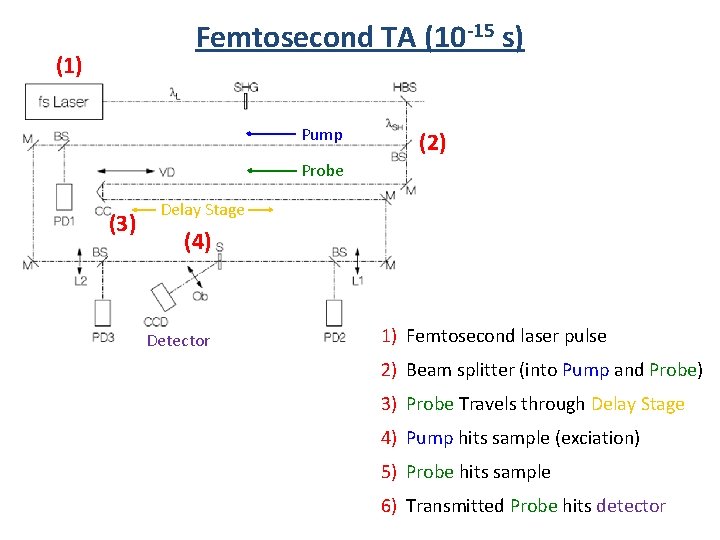
Femtosecond TA (10 -15 s) (1) Pump (2) Probe (3) Delay Stage (4) Detector 1) Femtosecond laser pulse 2) Beam splitter (into Pump and Probe) 3) Probe Travels through Delay Stage 4) Pump hits sample (exciation) 5) Probe hits sample 6) Transmitted Probe hits detector
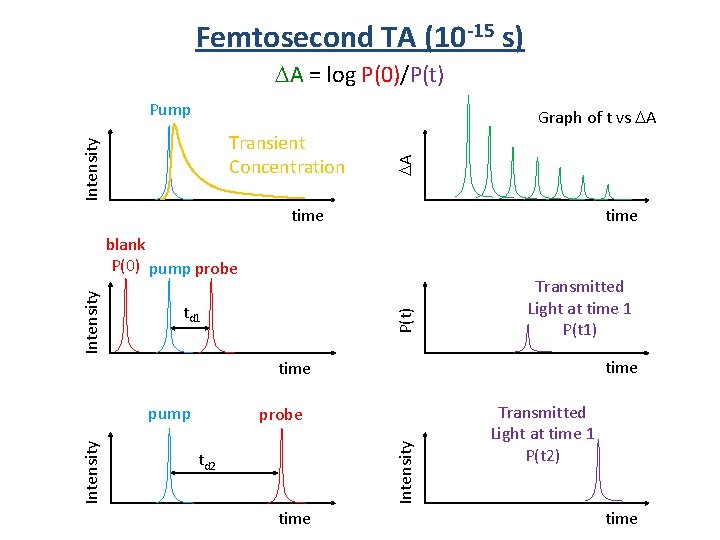
Femtosecond TA (10 -15 s) DA = log P(0)/P(t) Pump Intensity Transient Concentration DA Graph of t vs DA time td 1 P(t) Intensity blank P(0) pump probe Transmitted Light at time 1 P(t 1) time probe Intensity pump td 2 time Transmitted Light at time 1 P(t 2) time

Femtosecond TA (10 -15 s) P(t) < P(0) DA = log P(0)/P(t) blank P(0) pump probe Intensity blank P(0) pump probe td 1 Decrease Transmitted light P(t) time Increased Transmitted light P(t) time DA Graph of t vs DA td 1 time P(t) time DA P(t) > P(0) Graph of t vs DA time New species after laser pulse. Loss of species after laser pulse.
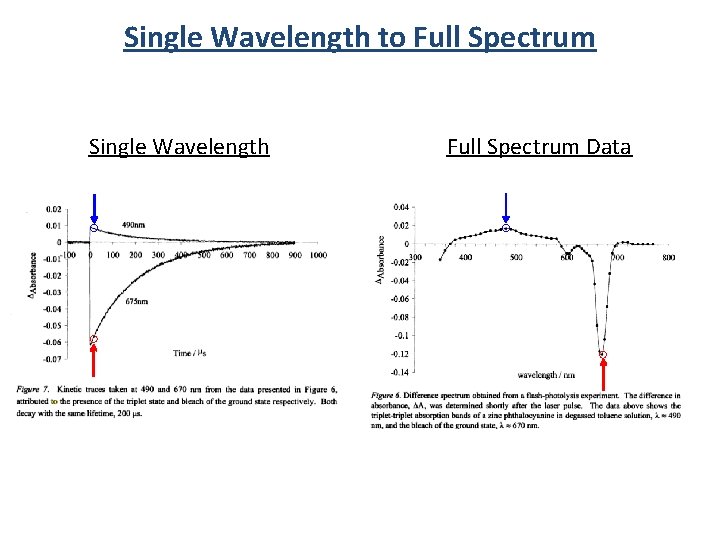
Single Wavelength to Full Spectrum Single Wavelength Full Spectrum Data
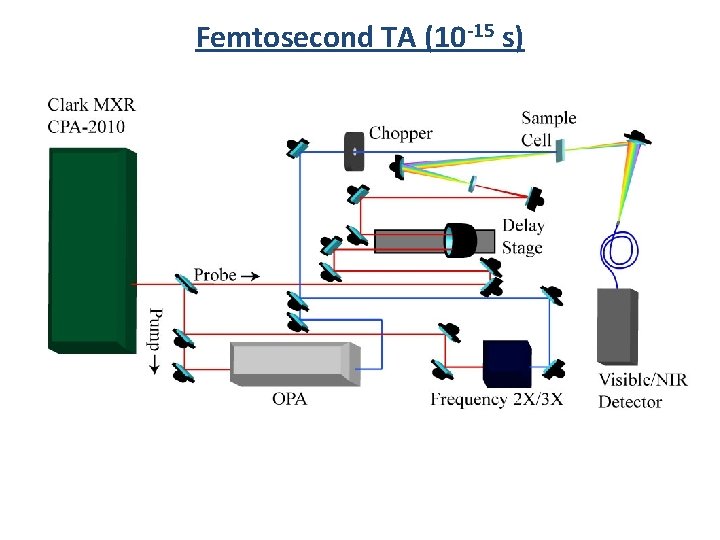
Femtosecond TA (10 -15 s)
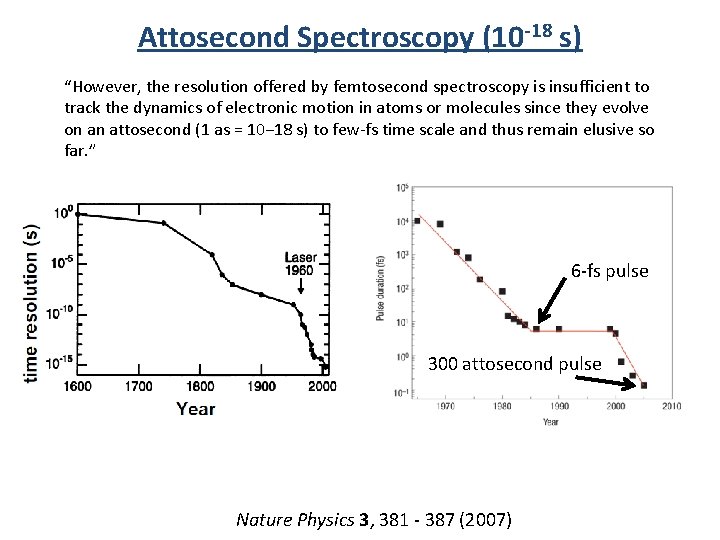
Attosecond Spectroscopy (10 -18 s) “However, the resolution offered by femtosecond spectroscopy is insufficient to track the dynamics of electronic motion in atoms or molecules since they evolve on an attosecond (1 as = 10− 18 s) to few-fs time scale and thus remain elusive so far. ” 6 -fs pulse 300 attosecond pulse Nature Physics 3, 381 - 387 (2007)
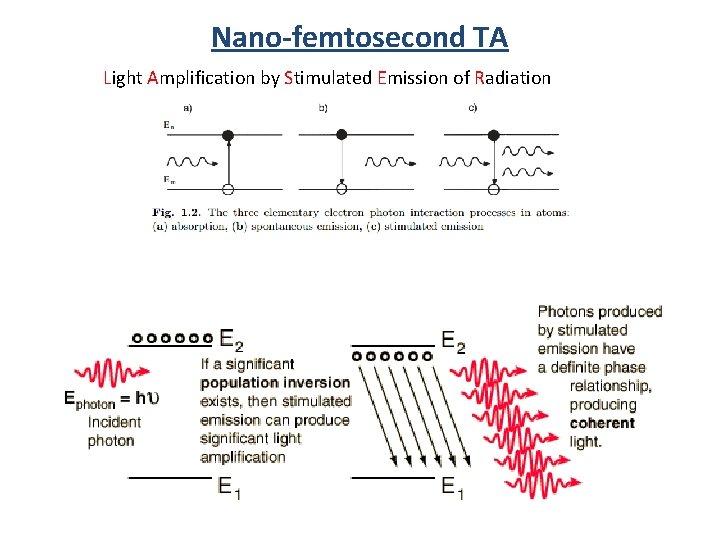
Nano-femtosecond TA Light Amplification by Stimulated Emission of Radiation
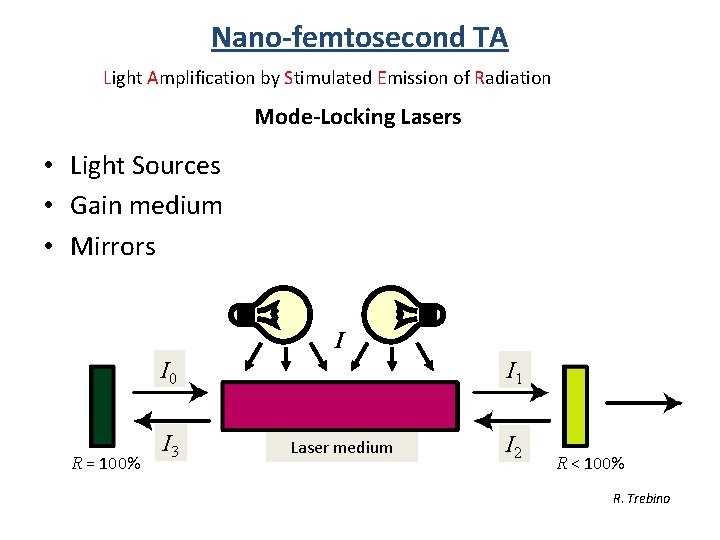
Nano-femtosecond TA Light Amplification by Stimulated Emission of Radiation Mode-Locking Lasers • Light Sources • Gain medium • Mirrors I I 0 R = 100% I 3 I 1 Laser medium I 2 R < 100% R. Trebino
Pico-femtosecond TA http: //www. youtube. com/watch? v=efx. Fdu. O 2 Yl 8
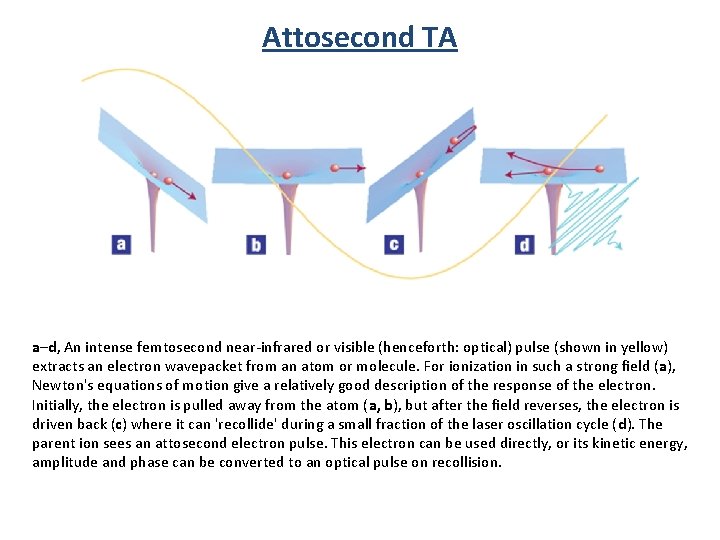
Attosecond TA a–d, An intense femtosecond near-infrared or visible (henceforth: optical) pulse (shown in yellow) extracts an electron wavepacket from an atom or molecule. For ionization in such a strong field (a), Newton's equations of motion give a relatively good description of the response of the electron. Initially, the electron is pulled away from the atom (a, b), but after the field reverses, the electron is driven back (c) where it can 'recollide' during a small fraction of the laser oscillation cycle (d). The parent ion sees an attosecond electron pulse. This electron can be used directly, or its kinetic energy, amplitude and phase can be converted to an optical pulse on recollision.
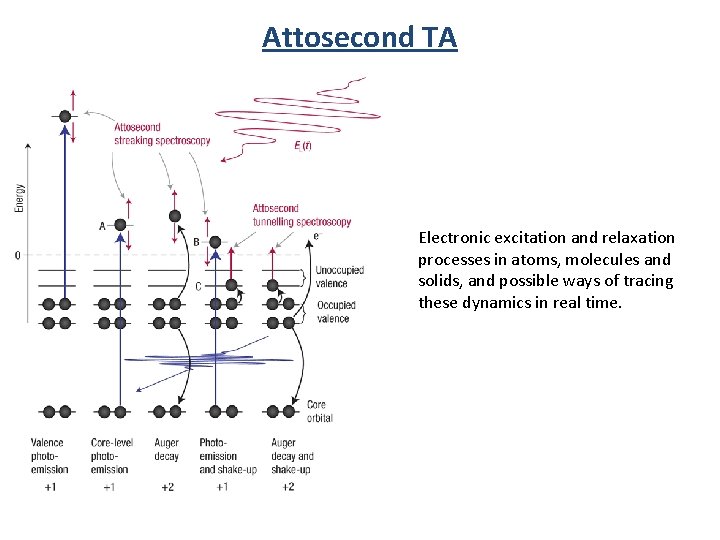
Attosecond TA Electronic excitation and relaxation processes in atoms, molecules and solids, and possible ways of tracing these dynamics in real time.
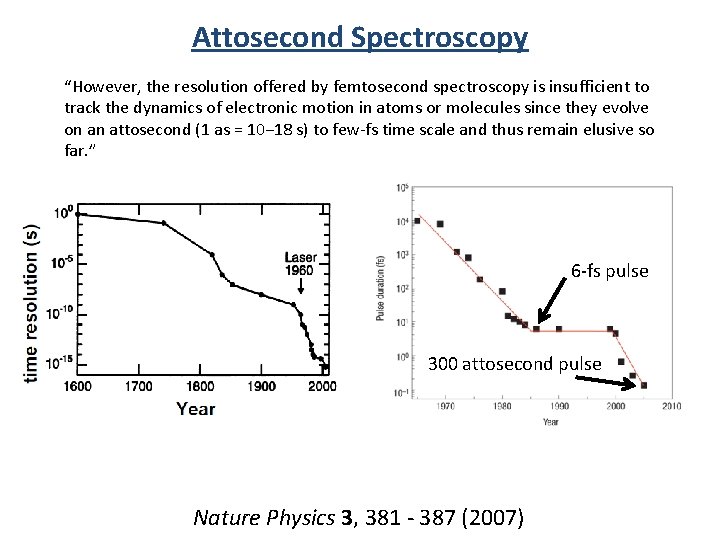
Attosecond Spectroscopy “However, the resolution offered by femtosecond spectroscopy is insufficient to track the dynamics of electronic motion in atoms or molecules since they evolve on an attosecond (1 as = 10− 18 s) to few-fs time scale and thus remain elusive so far. ” 6 -fs pulse 300 attosecond pulse Nature Physics 3, 381 - 387 (2007)
Transient Absorption End Any Questions?
- Slides: 47