
Chlorine testing with HACH colorimeters Learning Objectives At

Chlorine testing with HACH colorimeters Learning Objectives At the end of this lesson you will be able to: • Understand the importance of chlorine testing • Demonstrate the chlorine testing procedures To go to next page, click on Page- 1
Chlorine testing with HACH colorimeters Introduction The Water Corporation has a memorandum of understanding with the Department of Health to supply safe drinking water to consumers. To go to next page, click on Page- 2

Chlorine testing with HACH colorimeters Introduction Following a 2002 audit by the Department of Health the following changes were made: • Standardise all chlorine meters to HACH Pocket Colorimeters (also HACH DR 800 & 2000 series units). • Check calibration of all chlorine meters regularly. • Train all users to ensure competence. • 12 months given to develop resources and train everyone. To go to next page, click on Page- 3

Chlorine testing with HACH colorimeters Introduction Chlorine standards are difficult to make, preserve and store for field use. (i. e. 1. 0 mg/L chlorine). The Water Corp settled on using HACH Spec. Check secondary standards – they can only be used for 2 years from date of manufacture. To go to next page, click on Page- 4
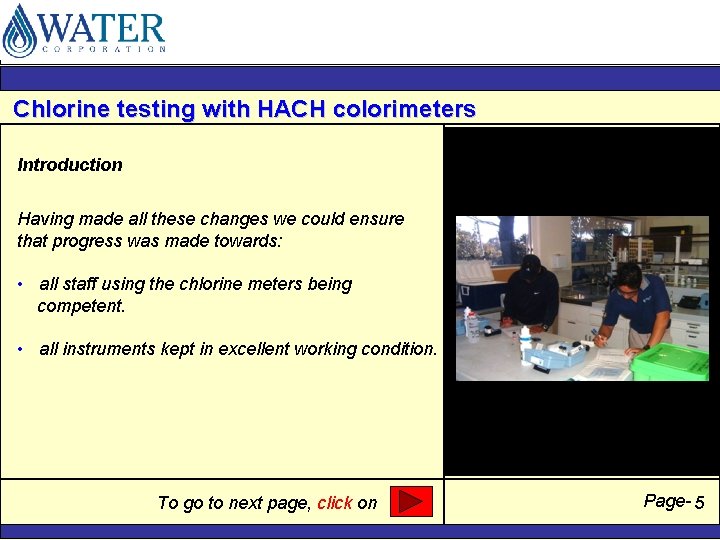
Chlorine testing with HACH colorimeters Introduction Having made all these changes we could ensure that progress was made towards: • all staff using the chlorine meters being competent. • all instruments kept in excellent working condition. To go to next page, click on Page- 5
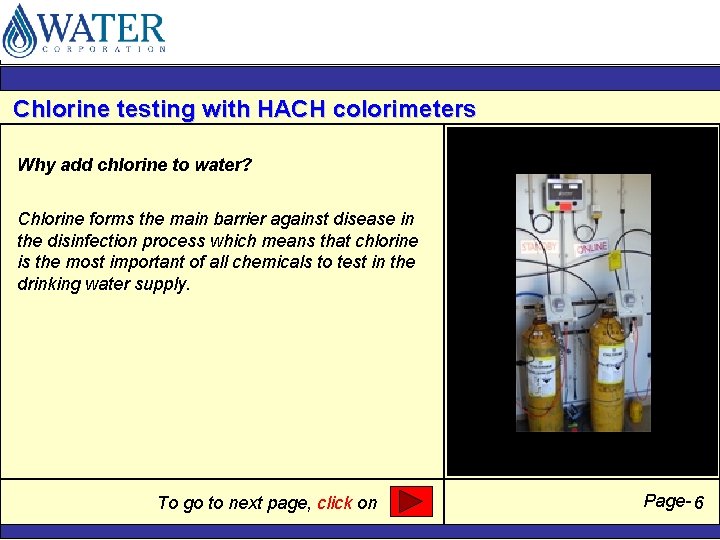
Chlorine testing with HACH colorimeters Why add chlorine to water? Chlorine forms the main barrier against disease in the disinfection process which means that chlorine is the most important of all chemicals to test in the drinking water supply. To go to next page, click on Page- 6
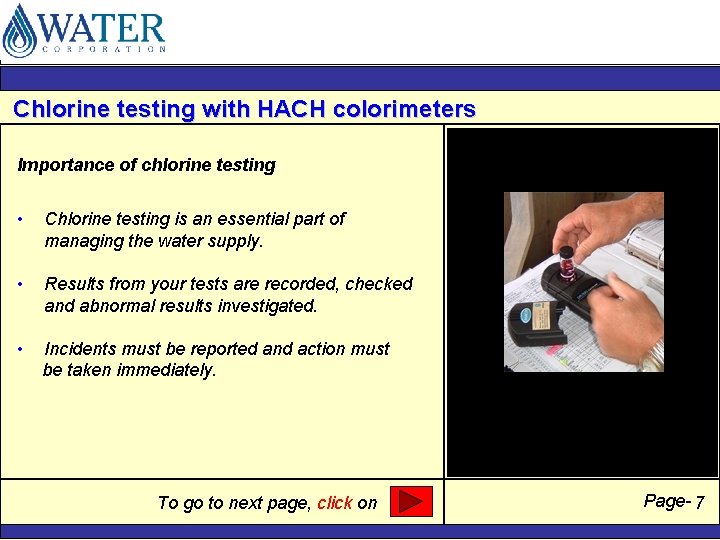
Chlorine testing with HACH colorimeters Importance of chlorine testing • Chlorine testing is an essential part of managing the water supply. • Results from your tests are recorded, checked and abnormal results investigated. • Incidents must be reported and action must be taken immediately. To go to next page, click on Page- 7
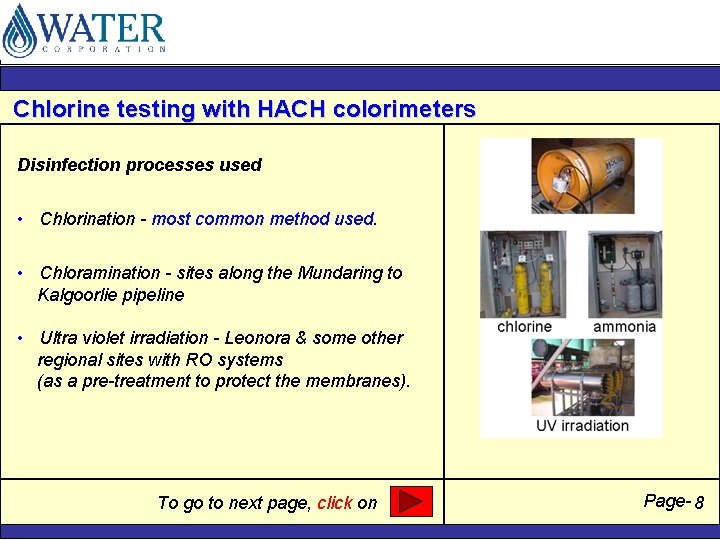
Chlorine testing with HACH colorimeters Disinfection processes used • Chlorination - most common method used. • Chloramination - sites along the Mundaring to Kalgoorlie pipeline • Ultra violet irradiation - Leonora & some other regional sites with RO systems (as a pre-treatment to protect the membranes). To go to next page, click on Page- 8
Chlorine testing with HACH colorimeters Chlorine chemistry The reaction between chlorine and water is shown as: Cl 2 chlorine + H 2 O water → HOCl hypochlorous acid + H+ hydrogen ion + Clchloride ion Note: HOCl - free residual chlorine. To go to next page, click on Page- 9
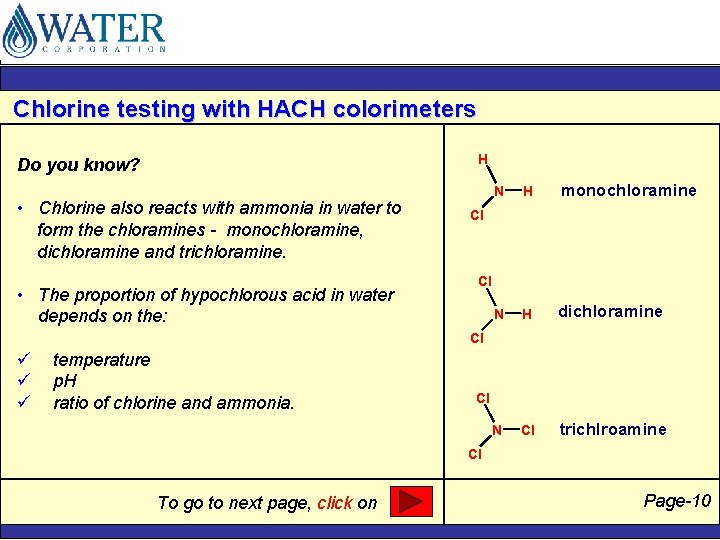
Chlorine testing with HACH colorimeters H Do you know? • Chlorine also reacts with ammonia in water to form the chloramines - monochloramine, dichloramine and trichloramine. • The proportion of hypochlorous acid in water depends on the: N H monochloramine N H dichloramine N Cl trichlroamine Cl Cl Cl ü ü ü temperature p. H ratio of chlorine and ammonia. Cl Cl To go to next page, click on Page-10
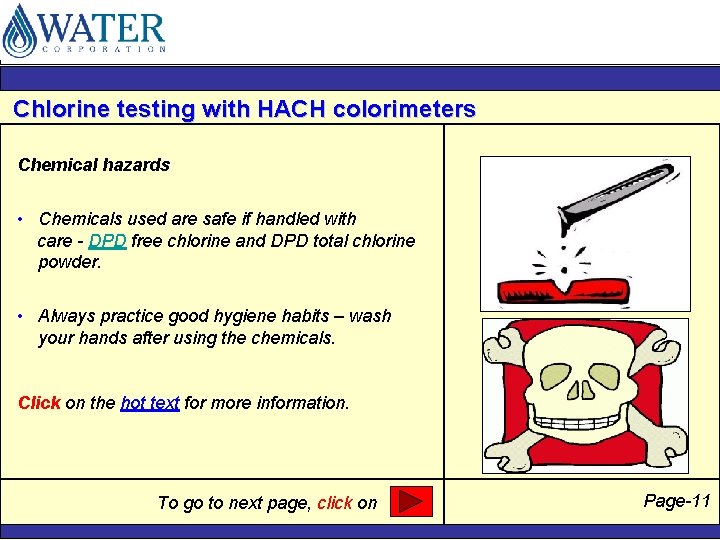
Chlorine testing with HACH colorimeters Chemical hazards • Chemicals used are safe if handled with care - DPD free chlorine and DPD total chlorine powder. • Always practice good hygiene habits – wash your hands after using the chemicals. Click on the hot text for more information. To go to next page, click on Page-11
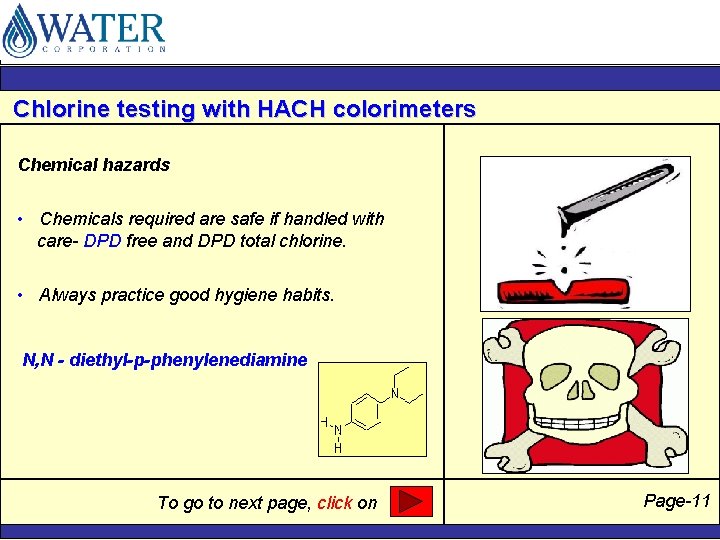
Chlorine testing with HACH colorimeters Chemical hazards • Chemicals required are safe if handled with care- DPD free and DPD total chlorine. • Always practice good hygiene habits. N, N - diethyl-p-phenylenediamine To go to next page, click on Page-11
- Slides: 12