
Chirality the Handedness of Molecules Isomers l Types

- Slides: 31
Chirality - the Handedness of Molecules
Isomers l Types l of isomers in this chapter we study enantiomers and diastereomers
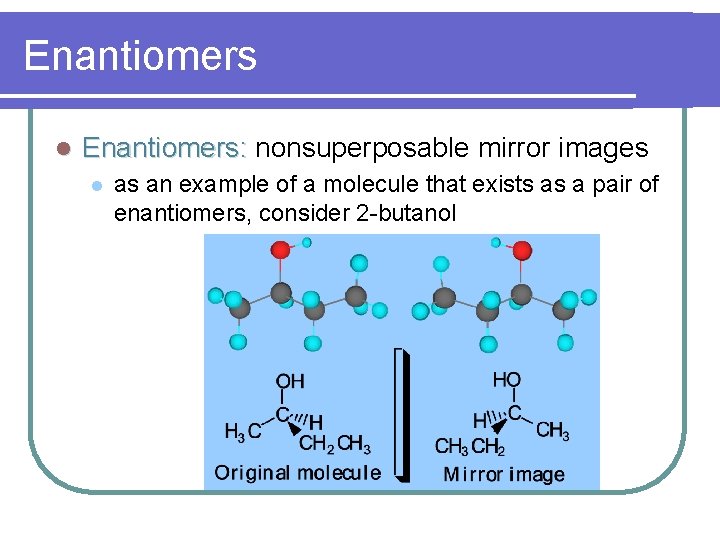
Enantiomers l Enantiomers: nonsuperposable mirror images l as an example of a molecule that exists as a pair of enantiomers, consider 2 -butanol
Enantiomers l one way to see that the mirror image of 2 butanol is not superposable on the original is to rotate the mirror image
Enantiomers l now try to fit one molecule on top of the other so that all groups and bonds match exactly
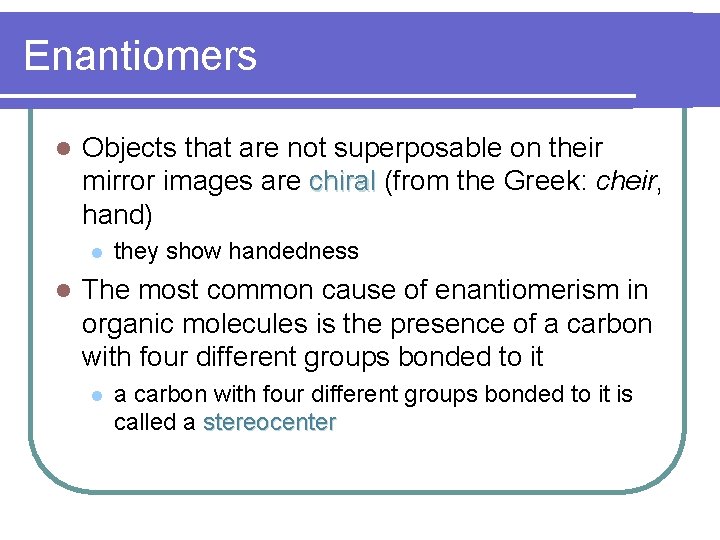
Enantiomers l Objects that are not superposable on their mirror images are chiral (from the Greek: cheir, hand) l l they show handedness The most common cause of enantiomerism in organic molecules is the presence of a carbon with four different groups bonded to it l a carbon with four different groups bonded to it is called a stereocenter
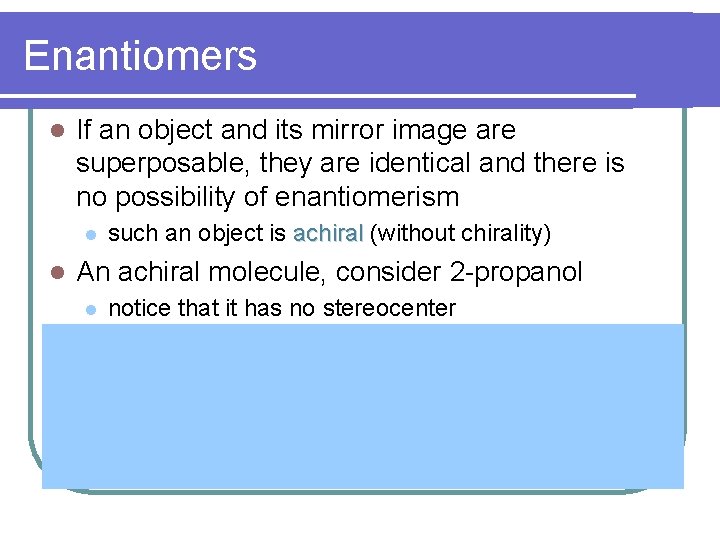
Enantiomers l If an object and its mirror image are superposable, they are identical and there is no possibility of enantiomerism l l such an object is achiral (without chirality) An achiral molecule, consider 2 -propanol l notice that it has no stereocenter
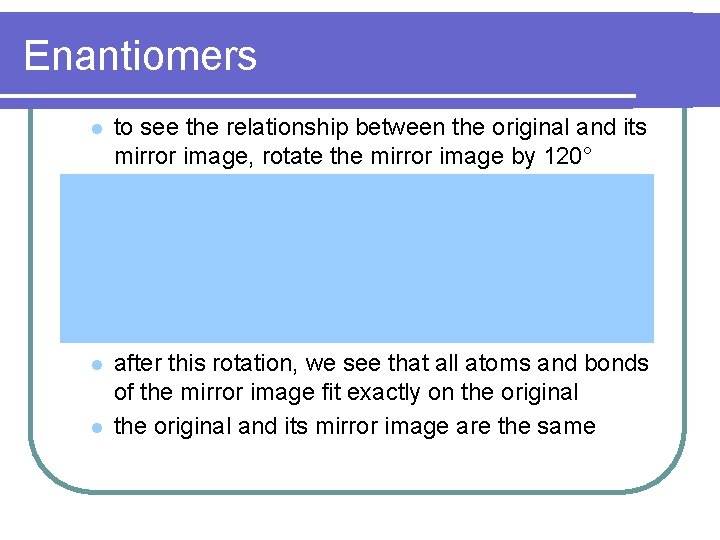
Enantiomers l to see the relationship between the original and its mirror image, rotate the mirror image by 120° l after this rotation, we see that all atoms and bonds of the mirror image fit exactly on the original and its mirror image are the same l
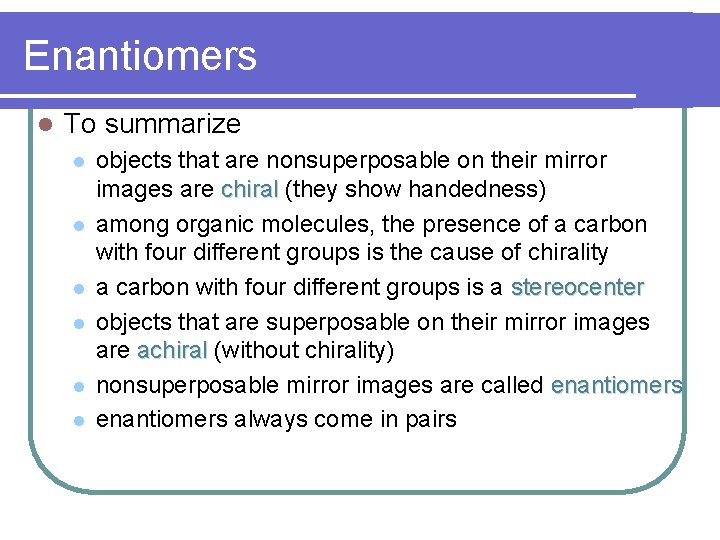
Enantiomers l To summarize l l l objects that are nonsuperposable on their mirror images are chiral (they show handedness) among organic molecules, the presence of a carbon with four different groups is the cause of chirality a carbon with four different groups is a stereocenter objects that are superposable on their mirror images are achiral (without chirality) nonsuperposable mirror images are called enantiomers always come in pairs
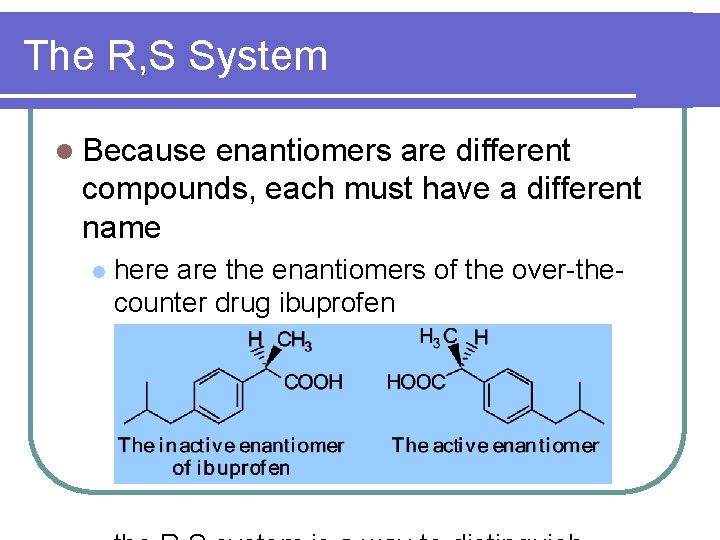
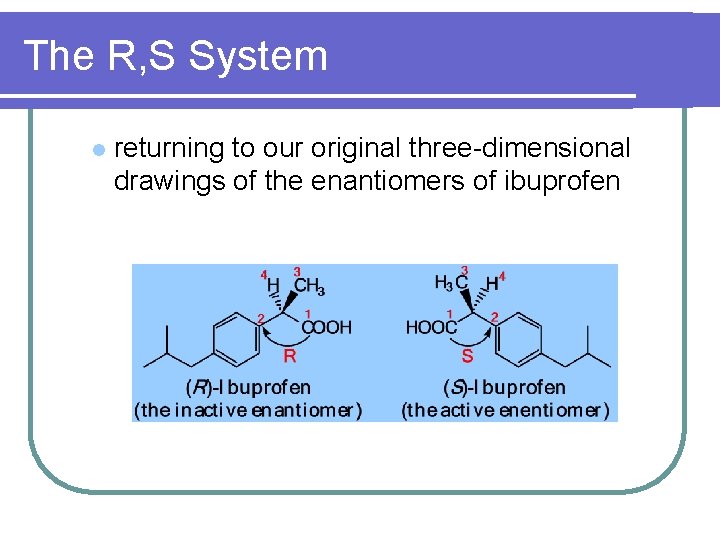
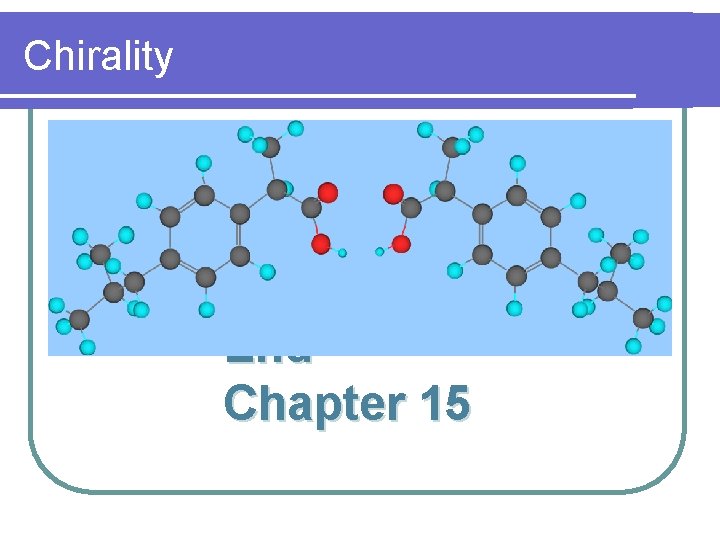
The R, S System l Because enantiomers are different compounds, each must have a different name l here are the enantiomers of the over-thecounter drug ibuprofen
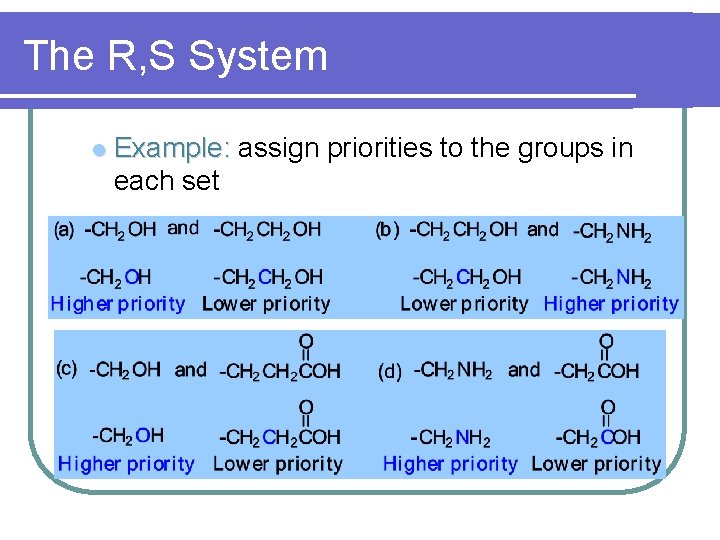
The R, S System l The first step in assigning an R or S configuration to a stereocenter is to arrange the groups on the stereocenter in order of priority is based on atomic number l the higher the atomic number, the higher the priority l
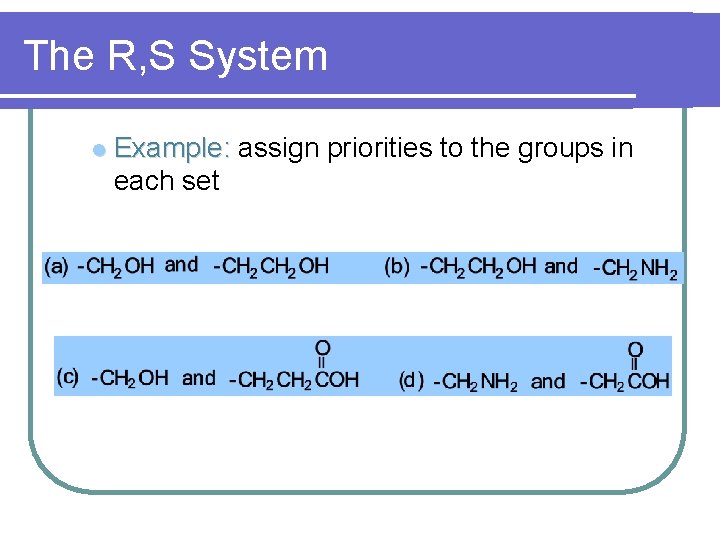
The R, S System l Example: assign priorities to the groups in each set
The R, S System l Example: assign priorities to the groups in each set
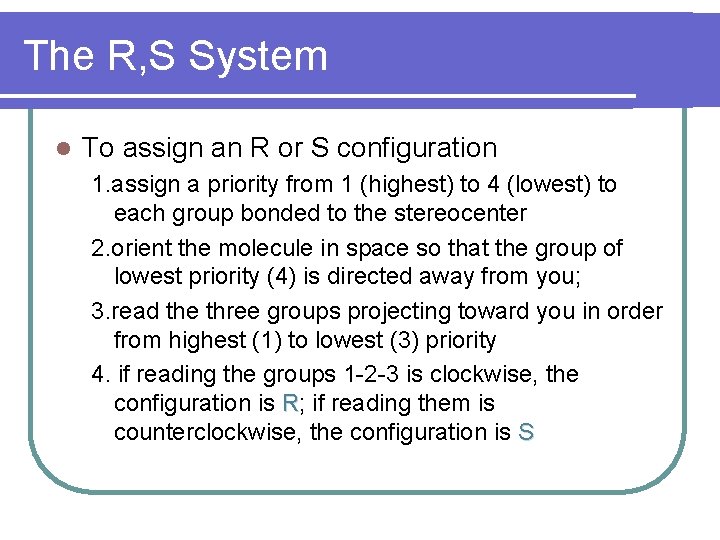
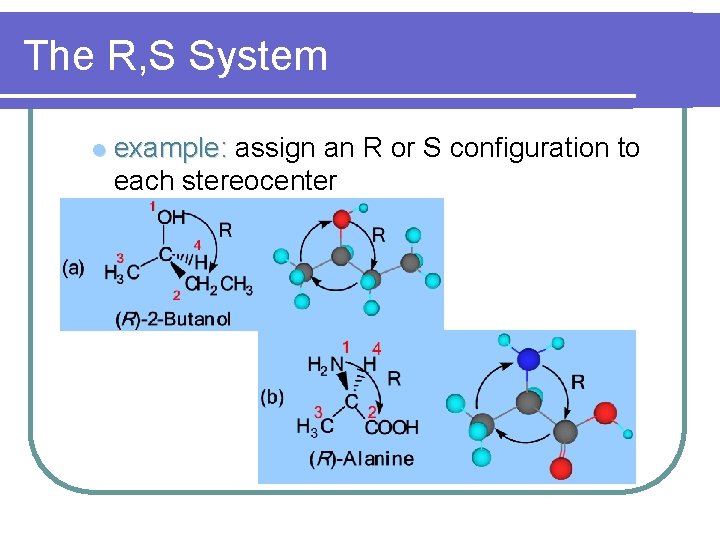
The R, S System l To assign an R or S configuration 1. assign a priority from 1 (highest) to 4 (lowest) to each group bonded to the stereocenter 2. orient the molecule in space so that the group of lowest priority (4) is directed away from you; 3. read the three groups projecting toward you in order from highest (1) to lowest (3) priority 4. if reading the groups 1 -2 -3 is clockwise, the configuration is R; if reading them is counterclockwise, the configuration is S
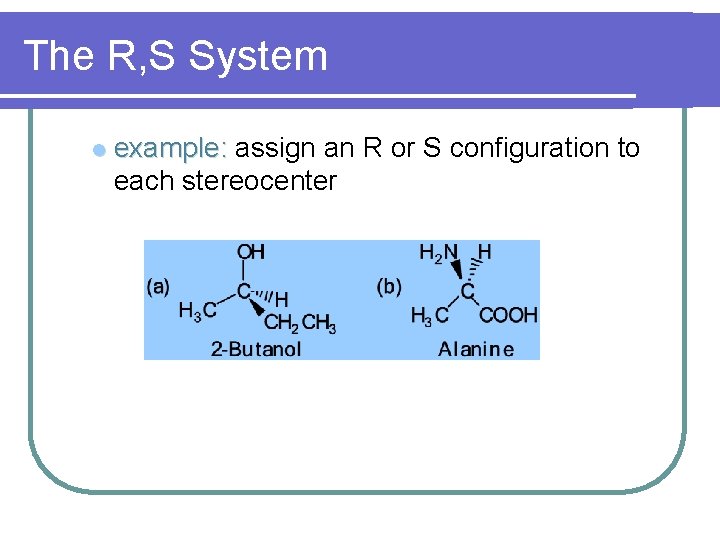
The R, S System l example: assign an R or S configuration to each stereocenter
The R, S System l example: assign an R or S configuration to each stereocenter
The R, S System l returning to our original three-dimensional drawings of the enantiomers of ibuprofen
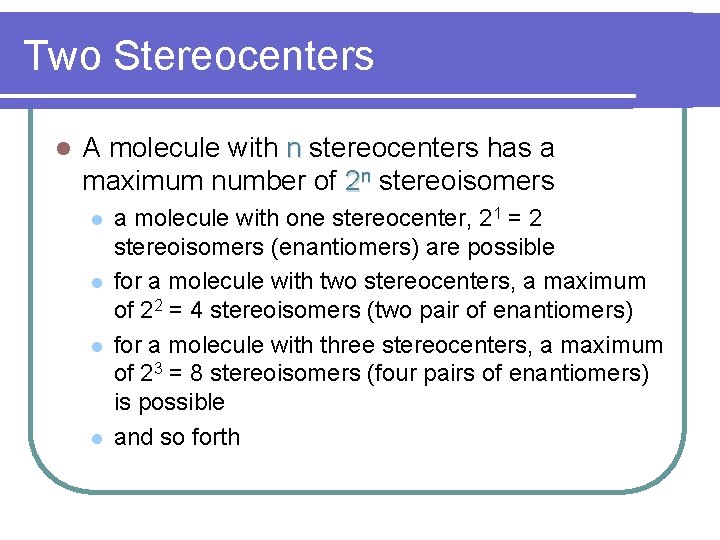
Two Stereocenters l A molecule with n stereocenters has a maximum number of 2 n stereoisomers l l a molecule with one stereocenter, 21 = 2 stereoisomers (enantiomers) are possible for a molecule with two stereocenters, a maximum of 22 = 4 stereoisomers (two pair of enantiomers) for a molecule with three stereocenters, a maximum of 23 = 8 stereoisomers (four pairs of enantiomers) is possible and so forth
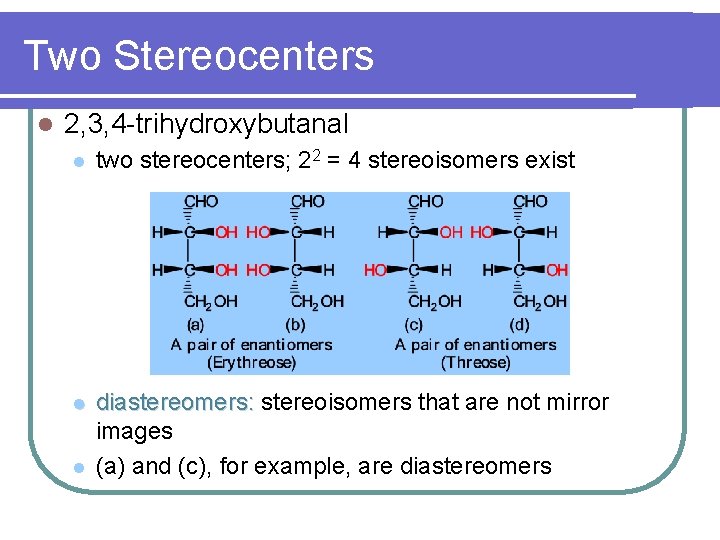
Two Stereocenters l 2, 3, 4 -trihydroxybutanal l two stereocenters; 22 = 4 stereoisomers exist l diastereomers: stereoisomers that are not mirror images (a) and (c), for example, are diastereomers l
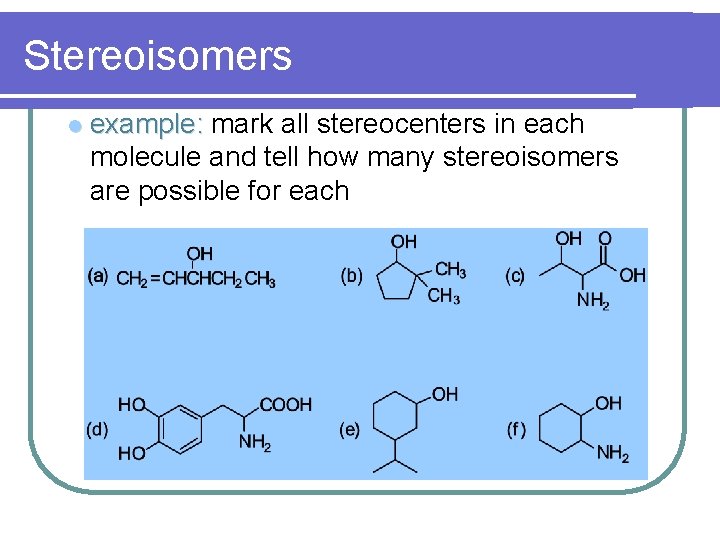
Stereoisomers l example: mark all stereocenters in each molecule and tell how many stereoisomers are possible for each
Stereoisomers example: mark all stereocenters in each molecule and tell how many stereoisomers are possible for each l solution: l
Stereoisomers l The 2 n rule applies equally well to molecules with three or more stereocenters
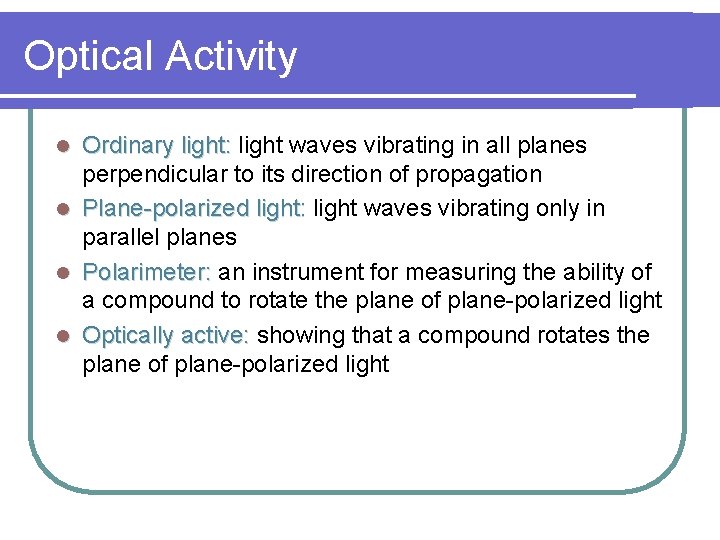
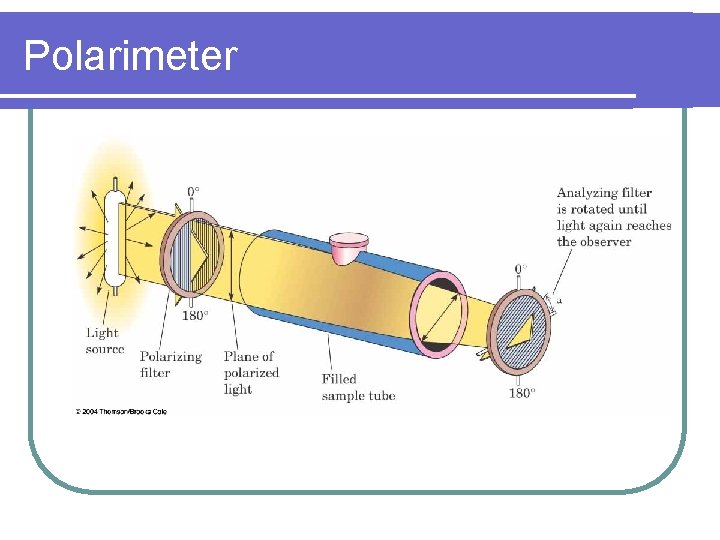
Optical Activity l l Ordinary light: light waves vibrating in all planes perpendicular to its direction of propagation Plane-polarized light: light waves vibrating only in parallel planes Polarimeter: an instrument for measuring the ability of a compound to rotate the plane of plane-polarized light Optically active: showing that a compound rotates the plane of plane-polarized light
Polarimeter
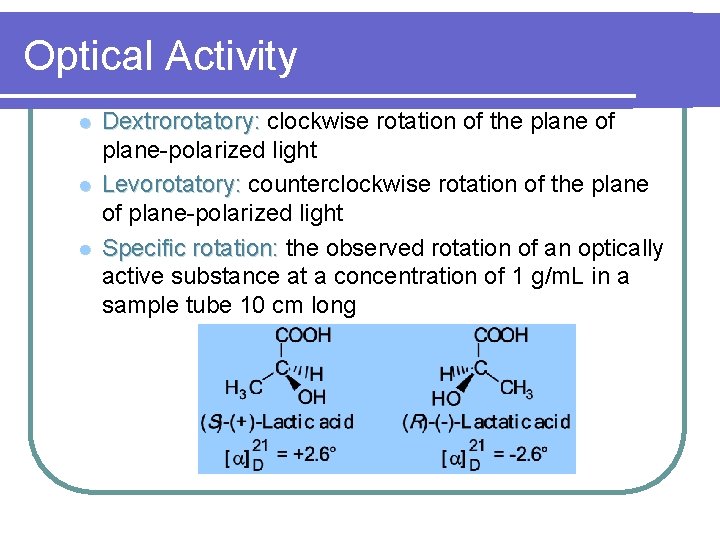
Optical Activity l l l Dextrorotatory: clockwise rotation of the plane of plane-polarized light Levorotatory: counterclockwise rotation of the plane of plane-polarized light Specific rotation: the observed rotation of an optically active substance at a concentration of 1 g/m. L in a sample tube 10 cm long
Chirality in Biomolecules l Except for inorganic salts and a few lowmolecular-weight organic substances, the molecules in living systems, both plant and animal, are chiral l l although these molecules can exist as a number of stereoisomers, almost invariably one stereoisomer is found in nature instances do occur in which more than one stereoisomer is found, but these rarely exist together in the same biological system
Chirality in Biomolecules l Enzymes (protein bio-catalysts) all have many stereocenters l l l an example is chymotrypsin, an enzyme in the intestines of animals that catalyzes the digestion of proteins chymotrypsin has 251 stereocenters the max number of stereoisomers possible is 2251! only one of these stereoisomers is produced because enzymes are chiral substances, most either produce or react with only substances that match their stereochemical requirements
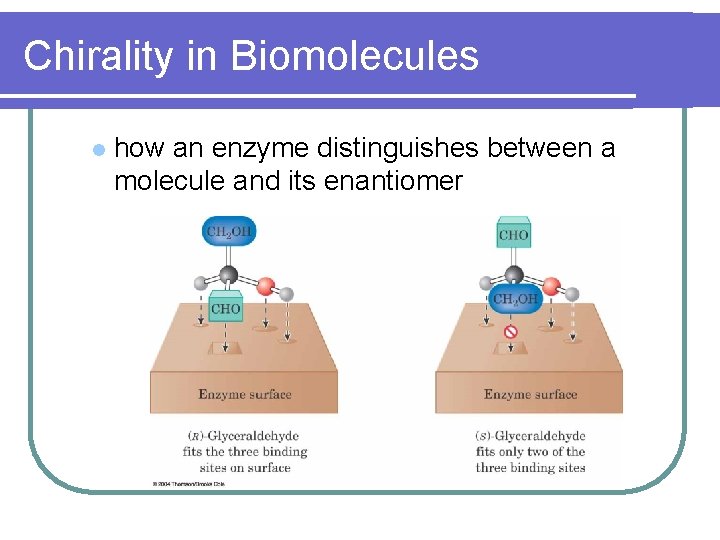
Chirality in Biomolecules l how an enzyme distinguishes between a molecule and its enantiomer
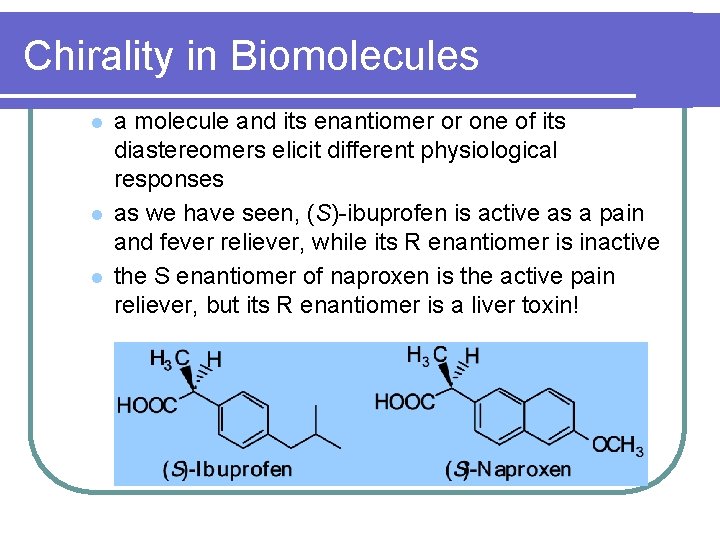
Chirality in Biomolecules l l l a molecule and its enantiomer or one of its diastereomers elicit different physiological responses as we have seen, (S)-ibuprofen is active as a pain and fever reliever, while its R enantiomer is inactive the S enantiomer of naproxen is the active pain reliever, but its R enantiomer is a liver toxin!
Chirality End Chapter 15