
CHINESE PROBLEMS Index Introduction The Nine Chapters on
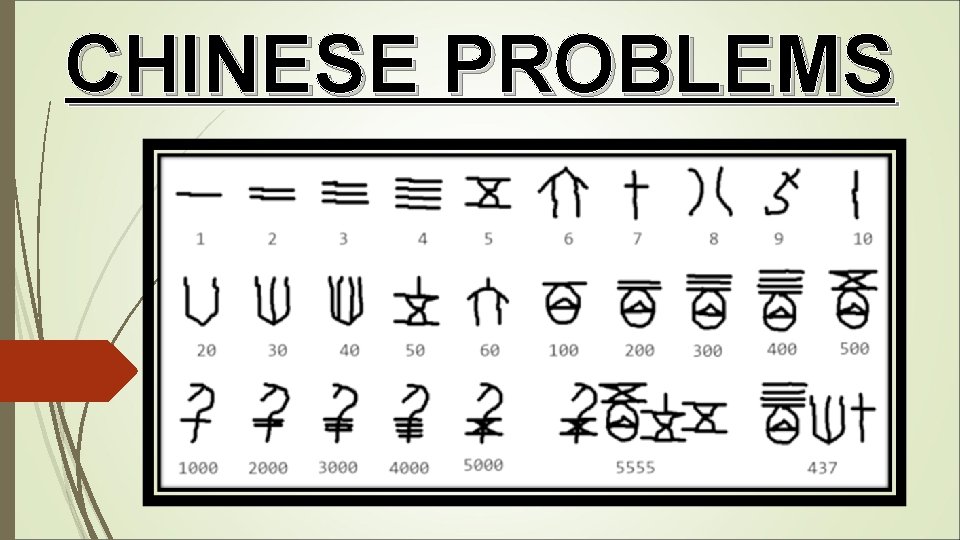
CHINESE PROBLEMS

Index Introduction: The Nine Chapters on the Mathematical Art The Pythagorean theorem vs Gougu ¯ theorem. ˇ Two Chinese problems: - At what height is the bamboo broken? - How deep is the pool?

九章算� (Jiǔzhāng Suànshù) The Nine Chapters on the Mathematical Art There are 246 mathematical problems in total and they are divided in 9 chapters: 1. 方田 Fangtian (Bounding fields): Surfaces and counting rods. 2. 粟米 Sumi (Millet and rice): Exchange of commodities at different rates. 3. 衰分 Cuifen (Proportional distribution): Distribution of commodities and money at proportional rates 4. 少廣 Shaoguang (Reducing dimensions): division by mixed numbers, extraction of square and cube roots; diameter of sphere, perimeter and diameter of circle. 5. 商功 Shanggong (Figuring for construction): Volumes of various shapes. 6. 均輸 Junshu (Equitable taxation): More advanced problems on proportion. 7. 盈不足 Yingbuzu (Equitable taxation): Linear problems (two unknowns). 8. 方程 Fangcheng (The two-sided reference): systems of linear equations. 9. 勾股 Gougu (Base and altitude): Problems involving the Gougu or Pythagorean theorem. ¯ ˇ
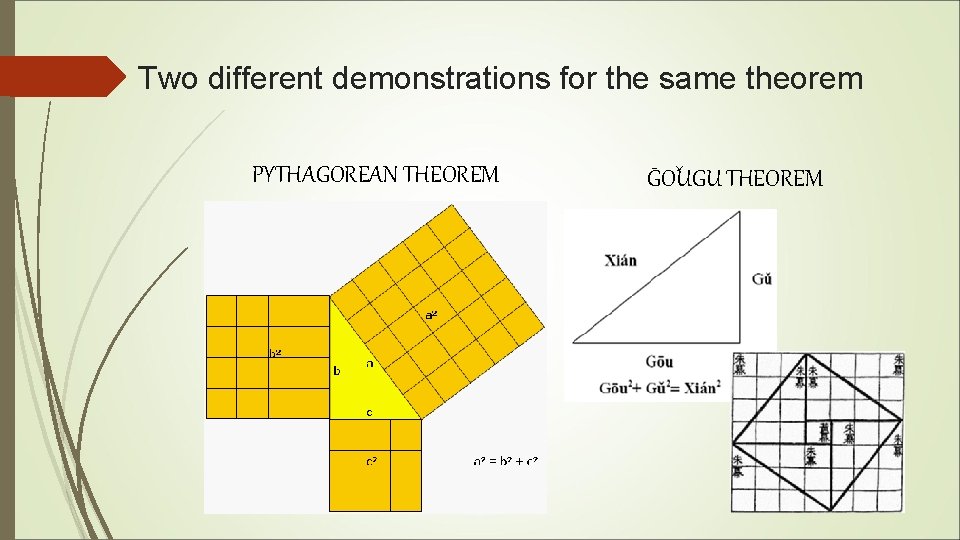
Two different demonstrations for the same theorem PYTHAGOREAN THEOREM ¯ ˇ GOUGU THEOREM
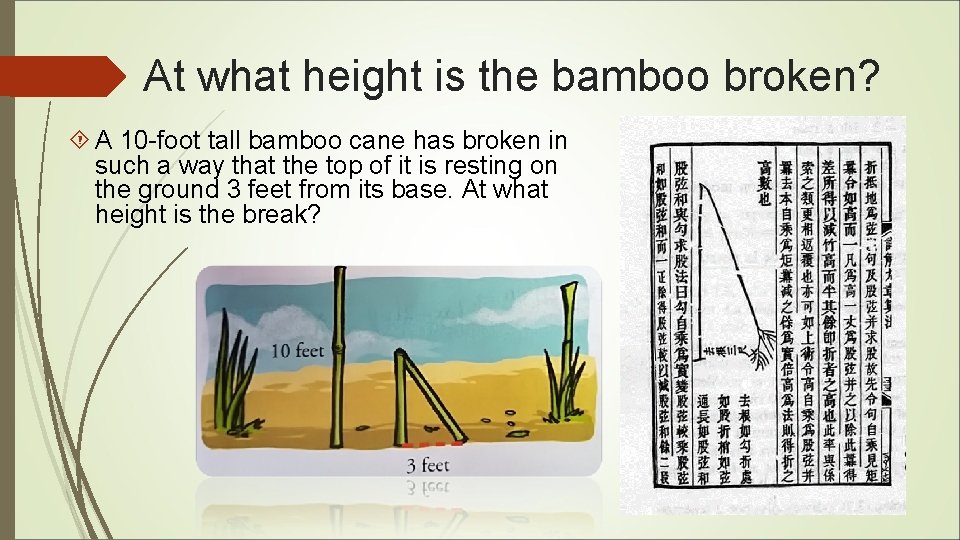
At what height is the bamboo broken? A 10 -foot tall bamboo cane has broken in such a way that the top of it is resting on the ground 3 feet from its base. At what height is the break?
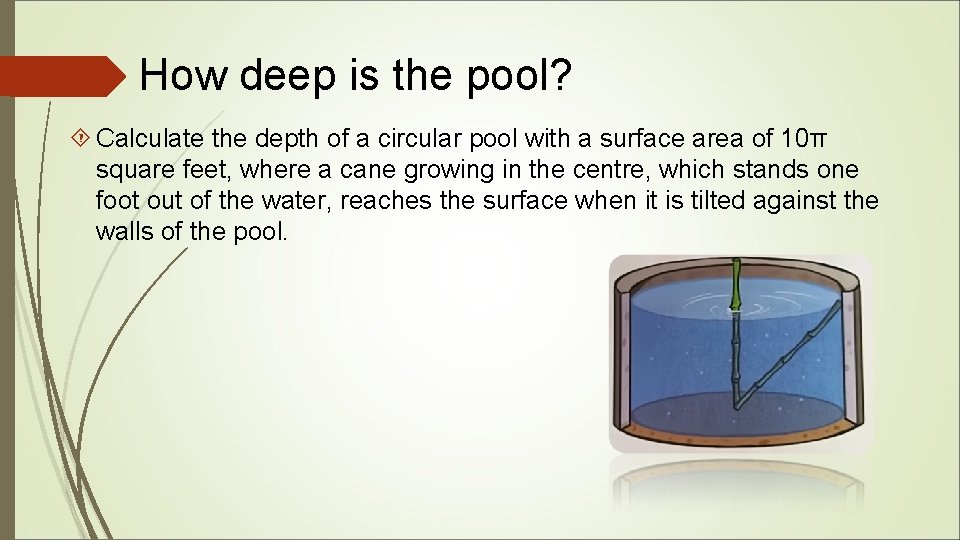
How deep is the pool? Calculate the depth of a circular pool with a surface area of 10π square feet, where a cane growing in the centre, which stands one foot out of the water, reaches the surface when it is tilted against the walls of the pool.

Pablo Miki García Pérez de Algaba & María de la Paz Llavero Ogalla. I. E. S Medina Azahara, 4º E. S. O.
- Slides: 7