
China Physical Map Take out your Chapter 6

- Slides: 27
China Physical Map Take out your Chapter 6 packets and open to map questions on page 2 https: //www. youtube. com/watch? v=QTN y. IJHc. Pd 0&t=3 s Homework: None tonight; you can add questions to your Cornell Notes…
The Philosophies of China Confucianism, Daoism, Legalism, and Buddhism
What is a philosophy? • Before we start, spend a couple of minutes with your group coming up with a definition of philosophy? What is it? Can you give an example?
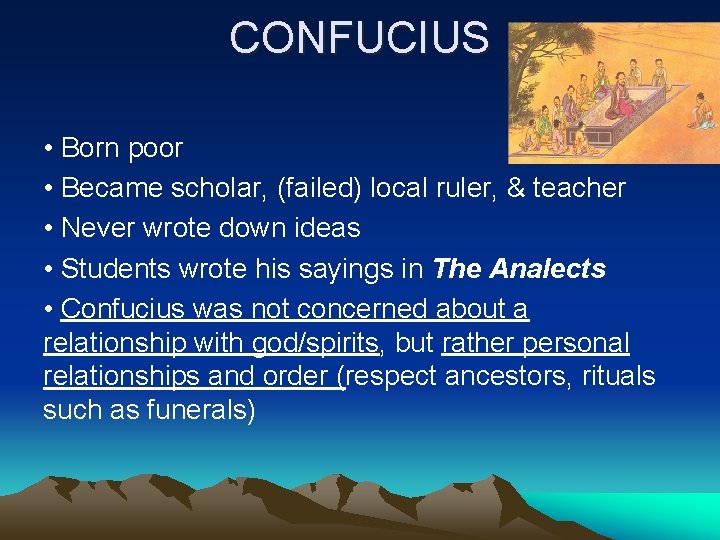
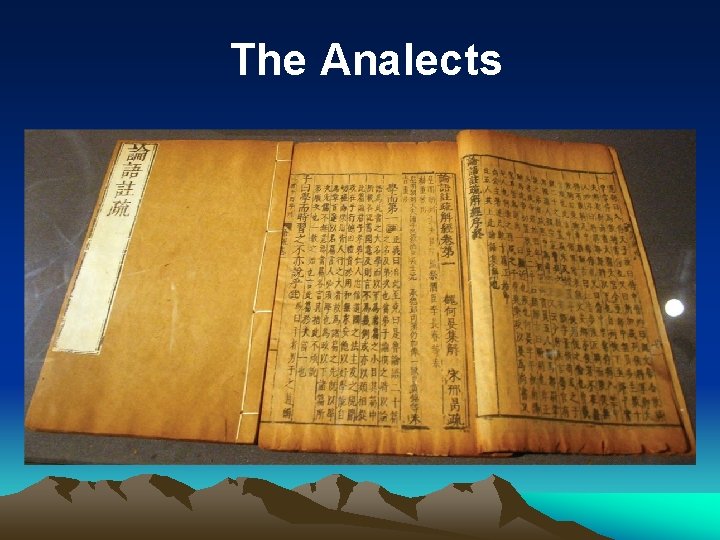
CONFUCIUS • Born poor • Became scholar, (failed) local ruler, & teacher • Never wrote down ideas • Students wrote his sayings in The Analects • Confucius was not concerned about a relationship with god/spirits, but rather personal relationships and order (respect ancestors, rituals such as funerals)
The Analects
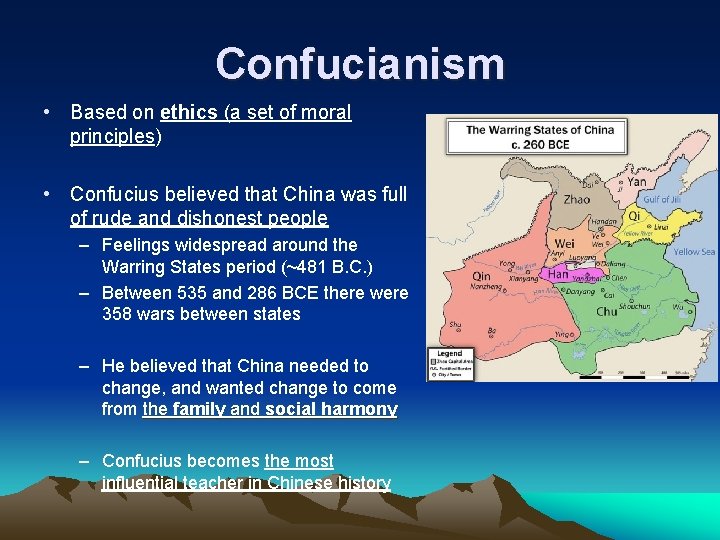
Confucianism • Based on ethics (a set of moral principles) • Confucius believed that China was full of rude and dishonest people – Feelings widespread around the Warring States period (~481 B. C. ) – Between 535 and 286 BCE there were 358 wars between states – He believed that China needed to change, and wanted change to come from the family and social harmony – Confucius becomes the most influential teacher in Chinese history
Warring States Period • • • Such continuous warfare must have had a heavy toll on the ordinary populace. Apart from invasion and its consequent destruction of property and crops, males were expected to fight for the state. One of the last great battles of the period at Changping involved the Qin conscripting every male over 15 years of age, but this seems to have been unusual. Still, with so many wars it would have been difficult for a farmer to have avoided military service. There were rewards for soldiers who fought well, notably in the Qin state where a whole system of ranks and rewards was introduced with 20 different levels open to everyone. For example, cutting off a single enemy head entitled the soldier to move up the ranking ladder and acquire around 5 acres of land. Success in war became the sole goal of the state and everyone in it, as the historian L. Feng here summarises: During the Warring States period, warfare was the most important aspect of social life, the principle of the state, and the compass that directed government policies. It is no exaggeration that by the late Warring States period (3 rd century BCE), war had escalated to the level that the entire state was organised for the very purpose of war, and this was true for all states (197).
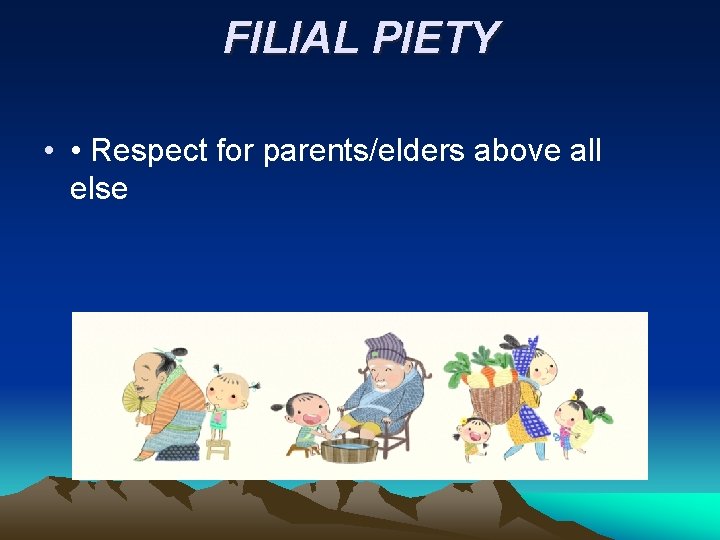
FILIAL PIETY • • Respect for parents/elders above all else
Family – The father should display high moral values and proper behavior to inspire his family (this shows that the father was the head of a typical Chinese family) – Children should respect and obey their parents – Family members should respect and be loyal towards one another
Social Harmony (through the government) – Fair, moral leaders are those which will bring order to China – The King should lead all of China by example – Lower classes should learn better behavior by following the example set by the upper classes.
Thoughts on Government • As for government, the three requisites are: “sufficiency of food, sufficiency of military equipment, and the confidence of the people in their ruler” (Analects). If only one is to be foregone, the Master insists that it is the military equipment. Of the two remaining, if another is to be foregone, the Master states that food should be the next to go. The most important is the people’s faith in their rulers. This is the foundation of the state and it can not exist without it
The Five Relationships Confucius saw five major human relationships • • Confucius believed that rulers would lead by moral example and people would behave properly through the example of those superior to them 1. Ruler subject 2. Parent child 3. Husband wife 4. Elder brother younger brother 5. Friend friend
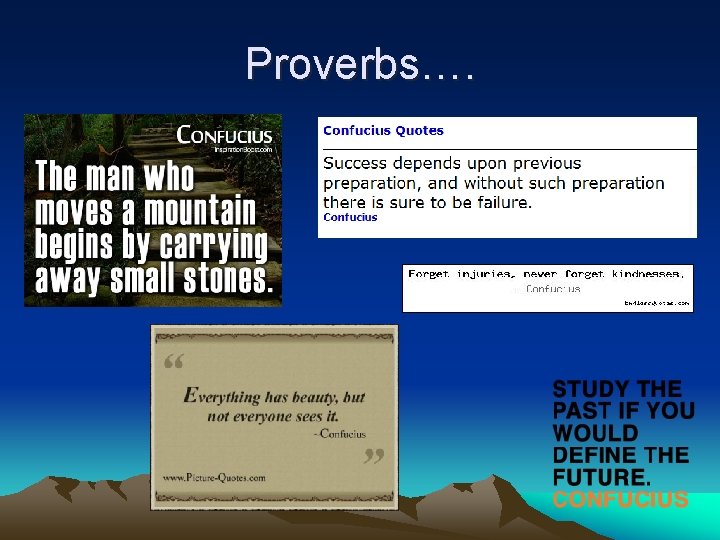
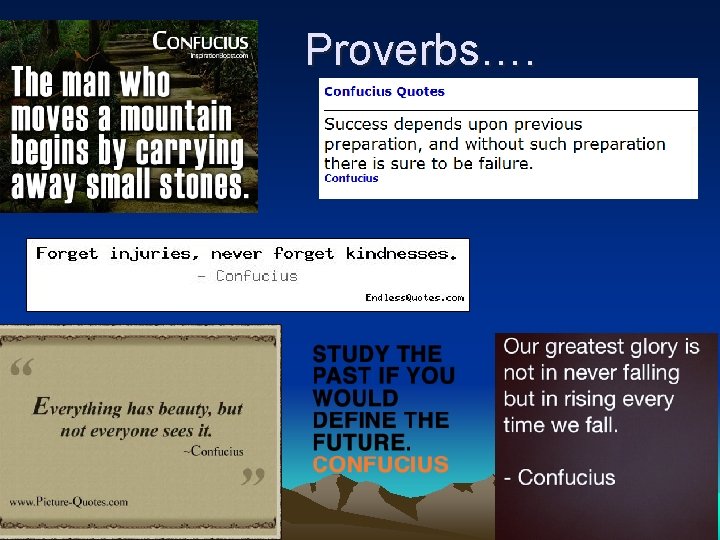
Proverbs….
Proverbs….
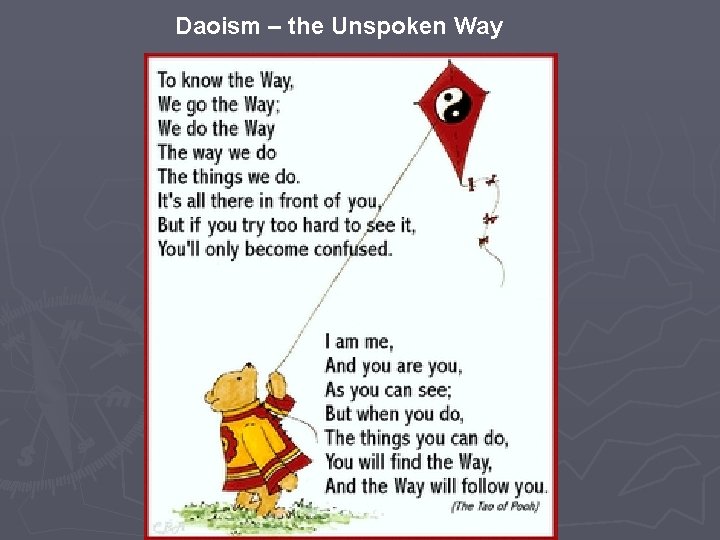
Daoism – the Unspoken Way
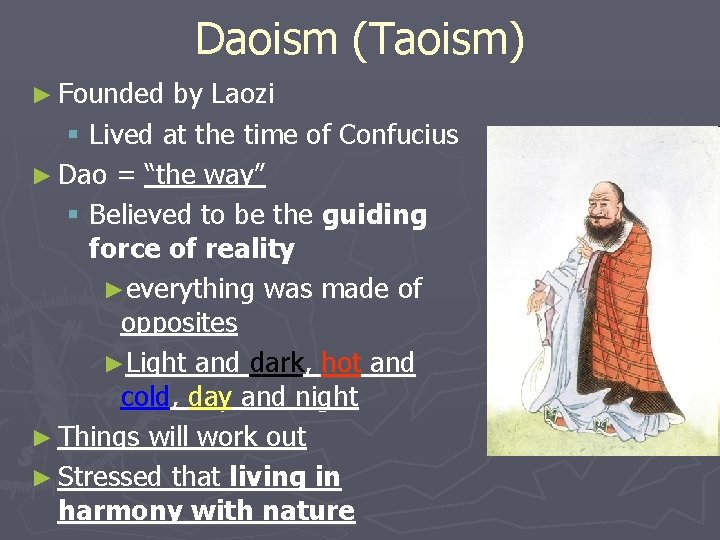
Daoism (Taoism) ► Founded by Laozi § Lived at the time of Confucius ► Dao = “the way” § Believed to be the guiding force of reality ►everything was made of opposites ►Light and dark, hot and cold, day and night ► Things will work out ► Stressed that living in harmony with nature
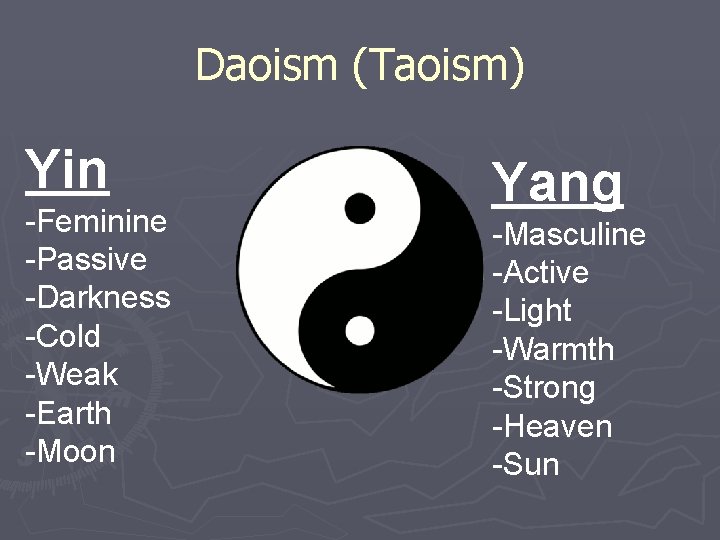
Daoism (Taoism) Yin -Feminine -Passive -Darkness -Cold -Weak -Earth -Moon Yang -Masculine -Active -Light -Warmth -Strong -Heaven -Sun
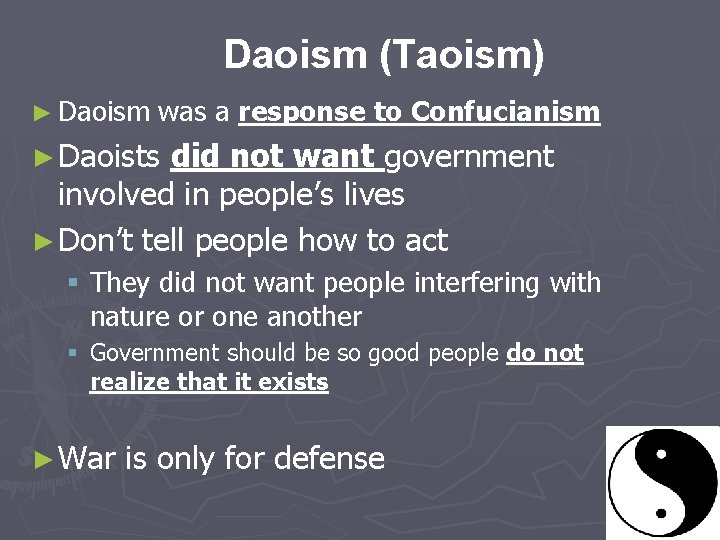
Daoism (Taoism) ► Daoism was a response to Confucianism ► Daoists did not want government involved in people’s lives ► Don’t tell people how to act § They did not want people interfering with nature or one another § Government should be so good people do not realize that it exists ► War is only for defense
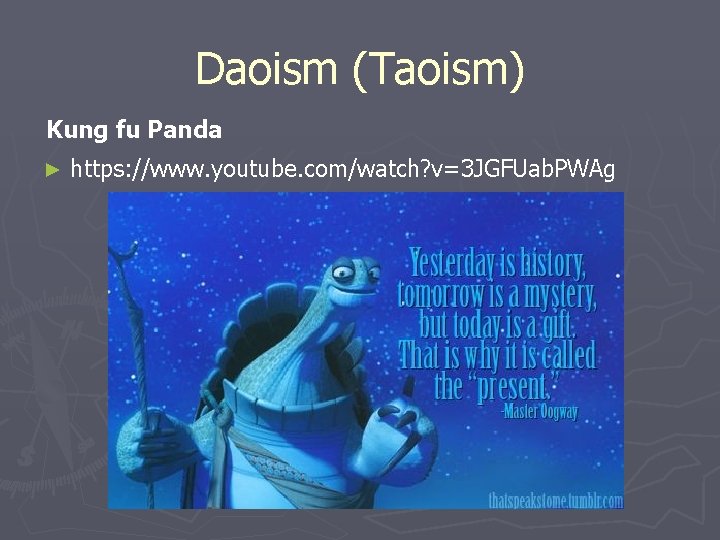
Daoism (Taoism) Kung fu Panda ► https: //www. youtube. com/watch? v=3 JGFUab. PWAg
Legalism n Founded by Hanz Feizi n Main philosophy: people were bad and needed to be controlled n Shi Huang Di was a famous Legalist – Legalists did not care about morals, and they only respected authority n Only a political philosophy, not a religion
n Legalism was very strict – Punishment was based on how bad crime was – Offender, family, and neighbors were all punished n Major goals were unity and efficiency n Wanted trained officials (not nobles) in control n Legalists wanted to expand China’s boundaries and always be prepared for war
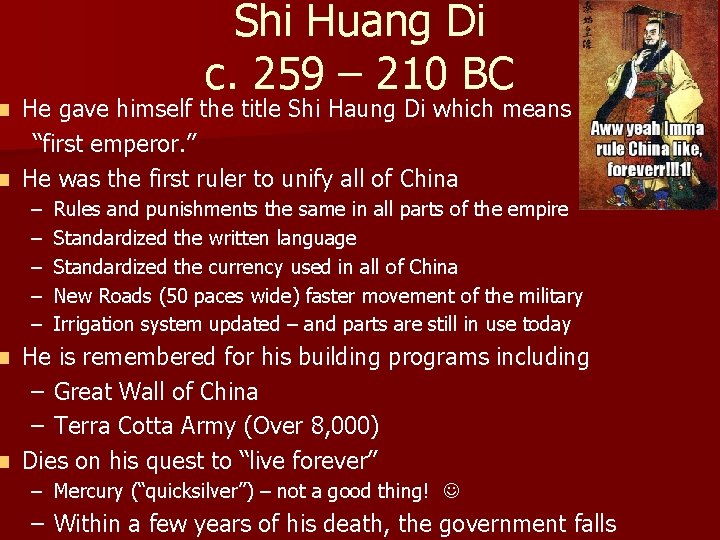
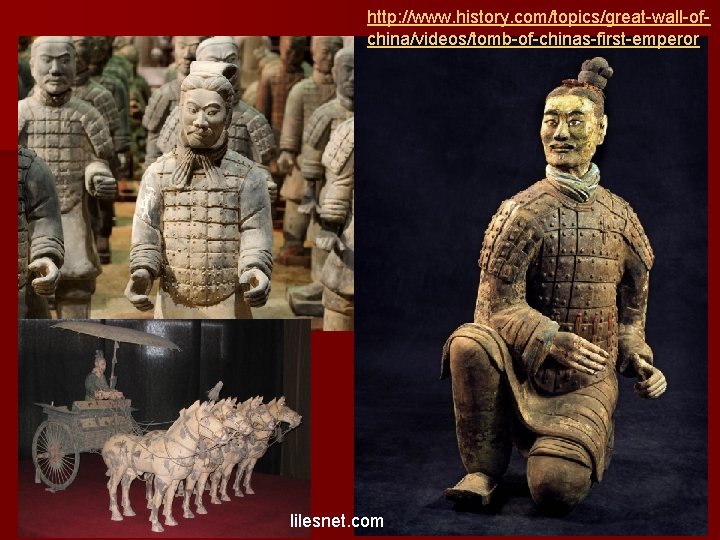
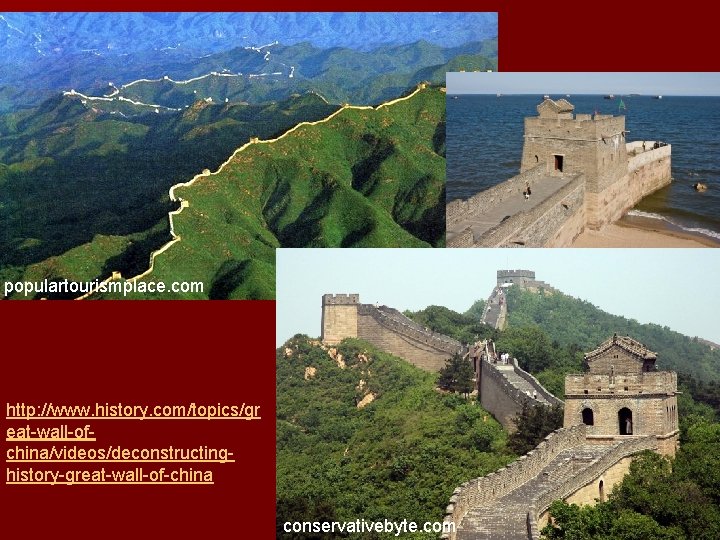
Shi Huang Di c. 259 – 210 BC He gave himself the title Shi Haung Di which means “first emperor. ” n He was the first ruler to unify all of China n – – – Rules and punishments the same in all parts of the empire Standardized the written language Standardized the currency used in all of China New Roads (50 paces wide) faster movement of the military Irrigation system updated – and parts are still in use today He is remembered for his building programs including – Great Wall of China – Terra Cotta Army (Over 8, 000) n Dies on his quest to “live forever” n – Mercury (“quicksilver”) – not a good thing! – Within a few years of his death, the government falls
http: //www. history. com/topics/great-wall-ofchina/videos/tomb-of-chinas-first-emperor lilesnet. com
populartourismplace. com http: //www. history. com/topics/gr eat-wall-ofchina/videos/deconstructinghistory-great-wall-of-china conservativebyte. com
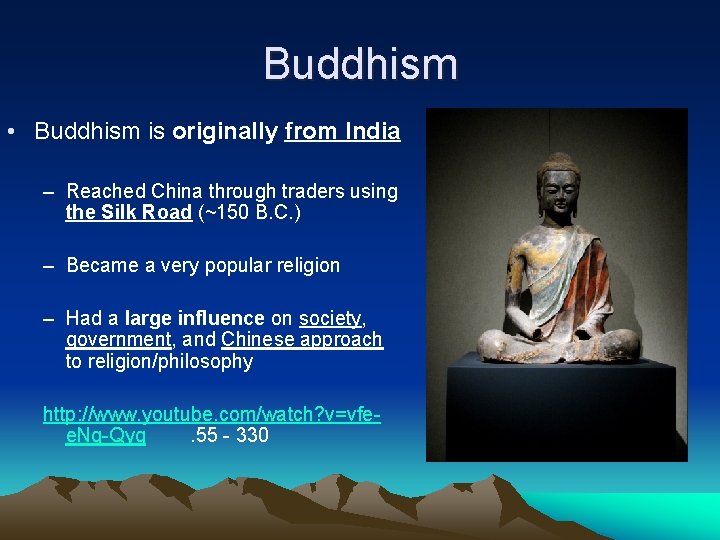
Buddhism • Buddhism is originally from India – Reached China through traders using the Silk Road (~150 B. C. ) – Became a very popular religion – Had a large influence on society, government, and Chinese approach to religion/philosophy http: //www. youtube. com/watch? v=vfee. Nq-Qyg . 55 - 330
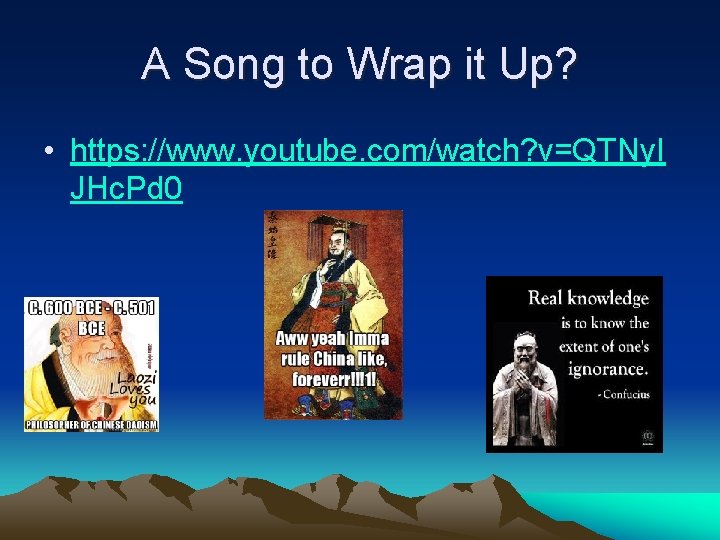
A Song to Wrap it Up? • https: //www. youtube. com/watch? v=QTNy. I JHc. Pd 0
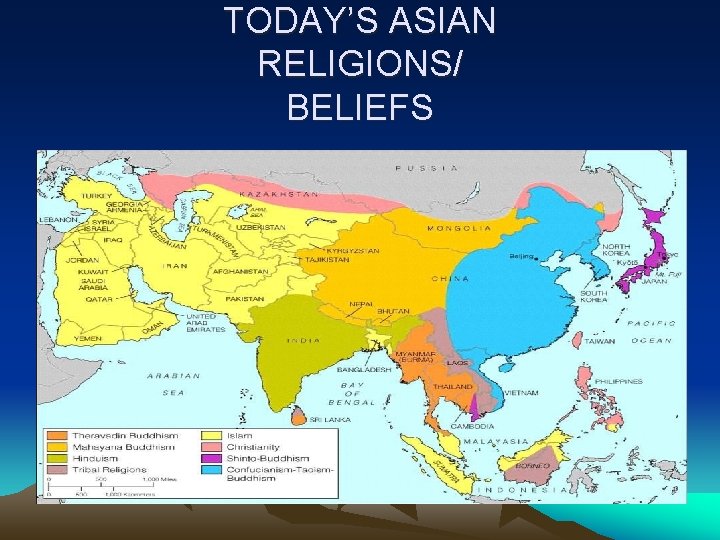
TODAY’S ASIAN RELIGIONS/ BELIEFS