
China and the United States Power Transition Theory
- Slides: 1
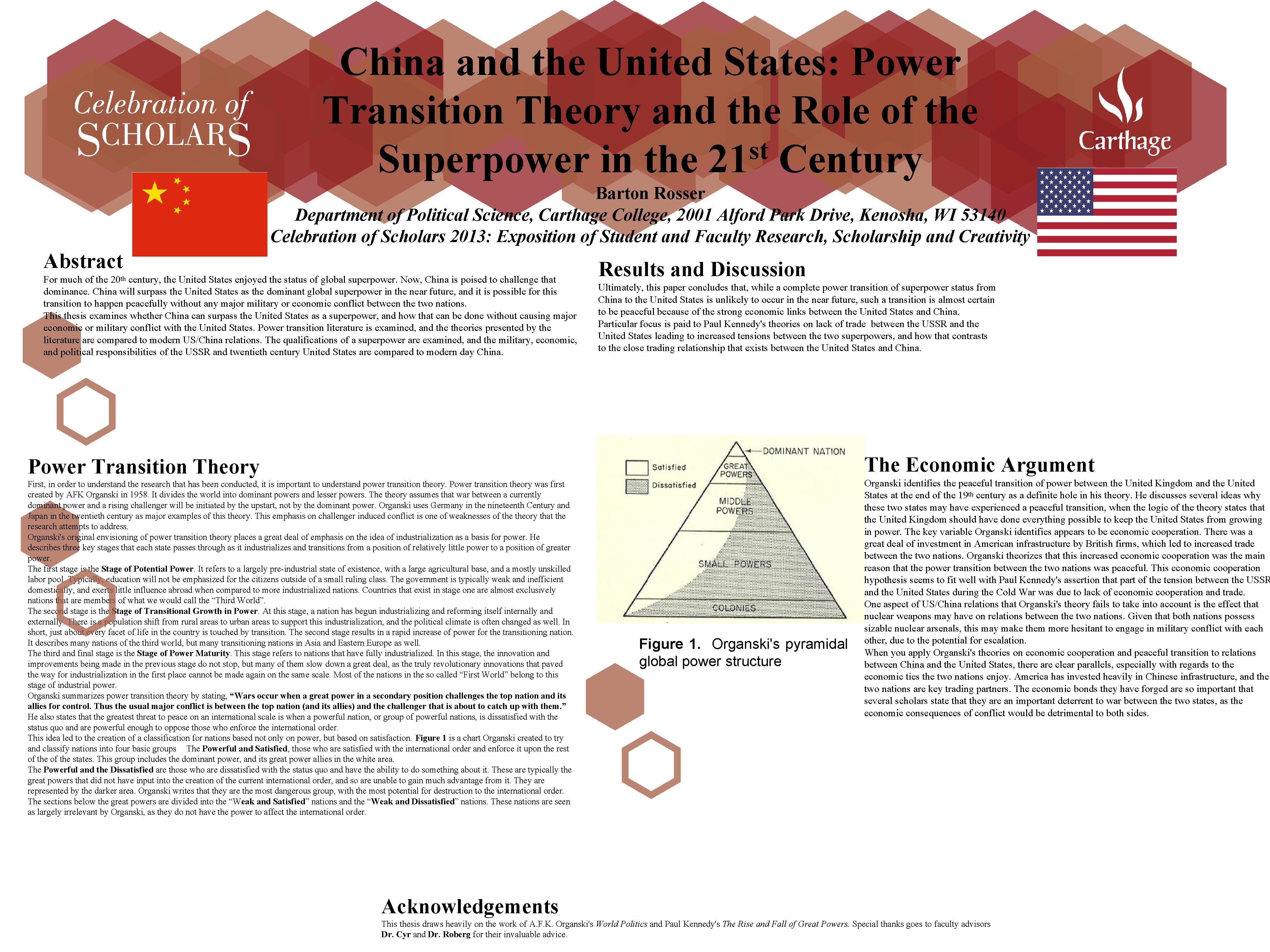
China and the United States: Power Transition Theory and the Role of the st Superpower in the 21 Century Barton Rosser Department of Political Science, Carthage College, 2001 Alford Park Drive, Kenosha, WI 53140 Celebration of Scholars 2013: Exposition of Student and Faculty Research, Scholarship and Creativity Abstract 20 th For much of the century, the United States enjoyed the status of global superpower. Now, China is poised to challenge that dominance. China will surpass the United States as the dominant global superpower in the near future, and it is possible for this transition to happen peacefully without any major military or economic conflict between the two nations. This thesis examines whether China can surpass the United States as a superpower, and how that can be done without causing major economic or military conflict with the United States. Power transition literature is examined, and theories presented by the literature are compared to modern US/China relations. The qualifications of a superpower are examined, and the military, economic, and political responsibilities of the USSR and twentieth century United States are compared to modern day China. Results and Discussion Ultimately, this paper concludes that, while a complete power transition of superpower status from China to the United States is unlikely to occur in the near future, such a transition is almost certain to be peaceful because of the strong economic links between the United States and China. Particular focus is paid to Paul Kennedy's theories on lack of trade between the USSR and the United States leading to increased tensions between the two superpowers, and how that contrasts to the close trading relationship that exists between the United States and China. The Economic Argument Power Transition Theory First, in order to understand the research that has been conducted, it is important to understand power transition theory. Power transition theory was first created by AFK Organski in 1958. It divides the world into dominant powers and lesser powers. The theory assumes that war between a currently dominant power and a rising challenger will be initiated by the upstart, not by the dominant power. Organski uses Germany in the nineteenth Century and Japan in the twentieth century as major examples of this theory. This emphasis on challenger induced conflict is one of weaknesses of theory that the research attempts to address. Organski's original envisioning of power transition theory places a great deal of emphasis on the idea of industrialization as a basis for power. He describes three key stages that each state passes through as it industrializes and transitions from a position of relatively little power to a position of greater power. The first stage is the Stage of Potential Power. It refers to a largely pre-industrial state of existence, with a large agricultural base, and a mostly unskilled labor pool. Typically, education will not be emphasized for the citizens outside of a small ruling class. The government is typically weak and inefficient domestically, and exerts little influence abroad when compared to more industrialized nations. Countries that exist in stage one are almost exclusively nations that are members of what we would call the “Third World”. The second stage is the Stage of Transitional Growth in Power. At this stage, a nation has begun industrializing and reforming itself internally and externally. There is a population shift from rural areas to urban areas to support this industrialization, and the political climate is often changed as well. In short, just about every facet of life in the country is touched by transition. The second stage results in a rapid increase of power for the transitioning nation. It describes many nations of the third world, but many transitioning nations in Asia and Eastern Europe as well. The third and final stage is the Stage of Power Maturity. This stage refers to nations that have fully industrialized. In this stage, the innovation and improvements being made in the previous stage do not stop, but many of them slow down a great deal, as the truly revolutionary innovations that paved the way for industrialization in the first place cannot be made again on the same scale. Most of the nations in the so called “First World” belong to this stage of industrial power. Organski summarizes power transition theory by stating, “Wars occur when a great power in a secondary position challenges the top nation and its allies for control. Thus the usual major conflict is between the top nation (and its allies) and the challenger that is about to catch up with them. ” He also states that the greatest threat to peace on an international scale is when a powerful nation, or group of powerful nations, is dissatisfied with the status quo and are powerful enough to oppose those who enforce the international order. This idea led to the creation of a classification for nations based not only on power, but based on satisfaction. Figure 1 is a chart Organski created to try and classify nations into four basic groups The Powerful and Satisfied, those who are satisfied with the international order and enforce it upon the rest of the states. This group includes the dominant power, and its great power allies in the white area. The Powerful and the Dissatisfied are those who are dissatisfied with the status quo and have the ability to do something about it. These are typically the great powers that did not have input into the creation of the current international order, and so are unable to gain much advantage from it. They are represented by the darker area. Organski writes that they are the most dangerous group, with the most potential for destruction to the international order. The sections below the great powers are divided into the “Weak and Satisfied” nations and the “Weak and Dissatisfied” nations. These nations are seen as largely irrelevant by Organski, as they do not have the power to affect the international order. Figure 1. Organski's pyramidal global power structure Organski identifies the peaceful transition of power between the United Kingdom and the United States at the end of the 19 th century as a definite hole in his theory. He discusses several ideas why these two states may have experienced a peaceful transition, when the logic of theory states that the United Kingdom should have done everything possible to keep the United States from growing in power. The key variable Organski identifies appears to be economic cooperation. There was a great deal of investment in American infrastructure by British firms, which led to increased trade between the two nations. Organski theorizes that this increased economic cooperation was the main reason that the power transition between the two nations was peaceful. This economic cooperation hypothesis seems to fit well with Paul Kennedy's assertion that part of the tension between the USSR and the United States during the Cold War was due to lack of economic cooperation and trade. One aspect of US/China relations that Organski's theory fails to take into account is the effect that nuclear weapons may have on relations between the two nations. Given that both nations possess sizable nuclear arsenals, this may make them more hesitant to engage in military conflict with each other, due to the potential for escalation. When you apply Organski's theories on economic cooperation and peaceful transition to relations between China and the United States, there are clear parallels, especially with regards to the economic ties the two nations enjoy. America has invested heavily in Chinese infrastructure, and the two nations are key trading partners. The economic bonds they have forged are so important that several scholars state that they are an important deterrent to war between the two states, as the economic consequences of conflict would be detrimental to both sides. Acknowledgements This thesis draws heavily on the work of A. F. K. Organski's World Politics and Paul Kennedy's The Rise and Fall of Great Powers. Special thanks goes to faculty advisors Dr. Cyr and Dr. Roberg for their invaluable advice.