
CHIMIOTHERAPIE ADJUVANTE DANS LE CBNPC Dr Mihaela ACHILLE
CHIMIOTHERAPIE ADJUVANTE DANS LE CBNPC Dr. Mihaela ACHILLE Clinique Claude Bernard METZ
Incidence annuelle 28 000 cas en France 170 000 cas aux USA 380 000 cas en Europe 1 200 000 cas dans le Monde
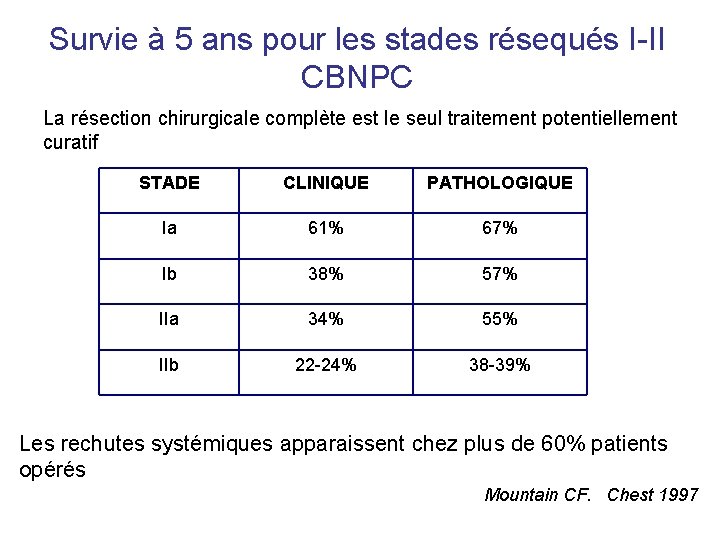
Survie à 5 ans pour les stades résequés I-II CBNPC La résection chirurgicale complète est le seul traitement potentiellement curatif STADE CLINIQUE PATHOLOGIQUE Ia 61% 67% Ib 38% 57% IIa 34% 55% IIb 22 -24% 38 -39% Les rechutes systémiques apparaissent chez plus de 60% patients opérés Mountain CF. Chest 1997
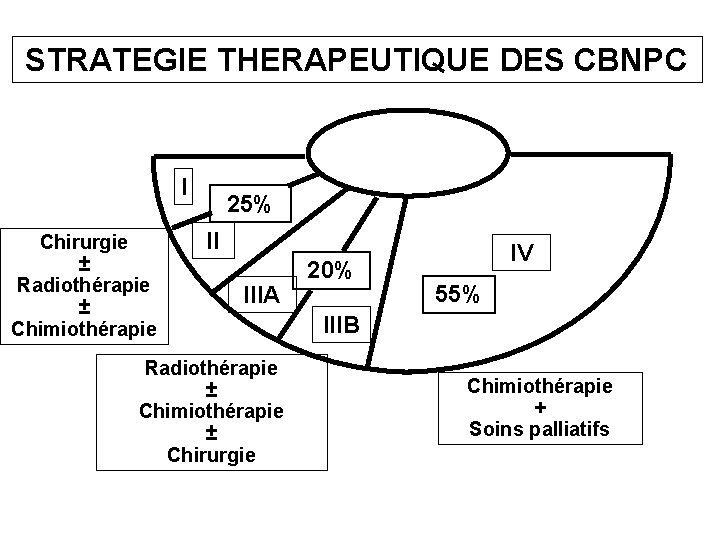
STRATEGIE THERAPEUTIQUE DES CBNPC I Chirurgie ± Radiothérapie ± Chimiothérapie 25% II IIIA Radiothérapie ± Chimiothérapie ± Chirurgie 20% IV 55% IIIB Chimiothérapie + Soins palliatifs
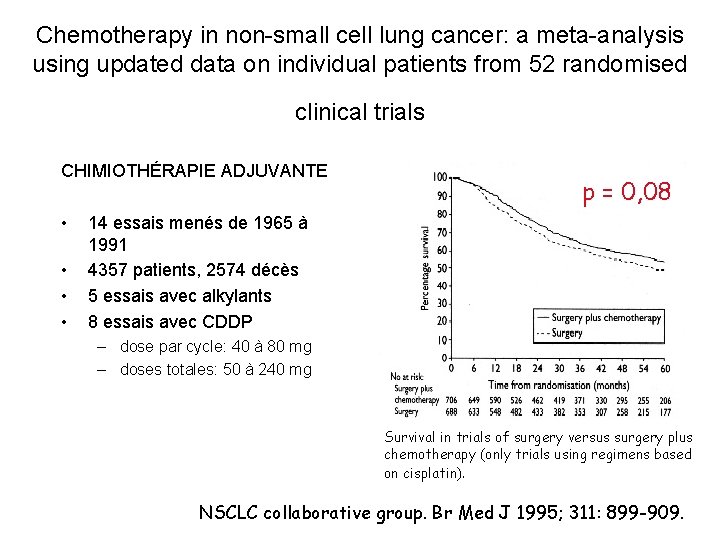
Chemotherapy in non-small cell lung cancer: a meta-analysis using updated data on individual patients from 52 randomised clinical trials CHIMIOTHÉRAPIE ADJUVANTE • • p = 0, 08 14 essais menés de 1965 à 1991 4357 patients, 2574 décès 5 essais avec alkylants 8 essais avec CDDP – dose par cycle: 40 à 80 mg – doses totales: 50 à 240 mg Survival in trials of surgery versus surgery plus chemotherapy (only trials using regimens based on cisplatin). NSCLC collaborative group. Br Med J 1995; 311: 899 -909.
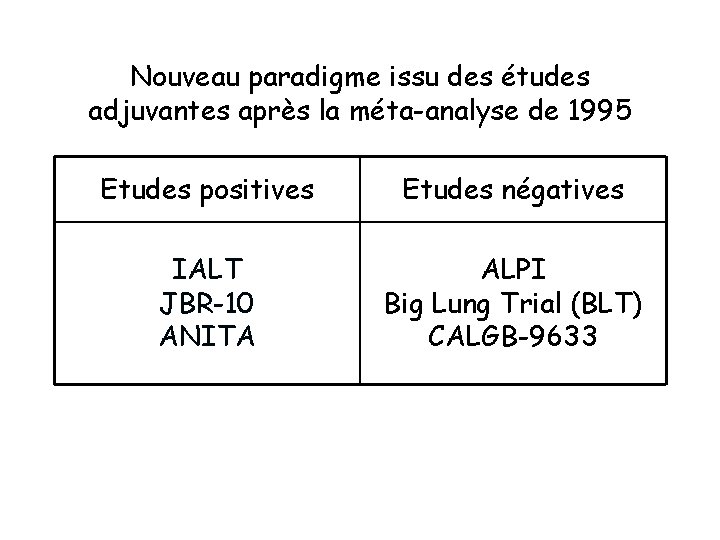
Nouveau paradigme issu des études adjuvantes après la méta-analyse de 1995 Etudes positives Etudes négatives IALT JBR-10 ANITA ALPI Big Lung Trial (BLT) CALGB-9633
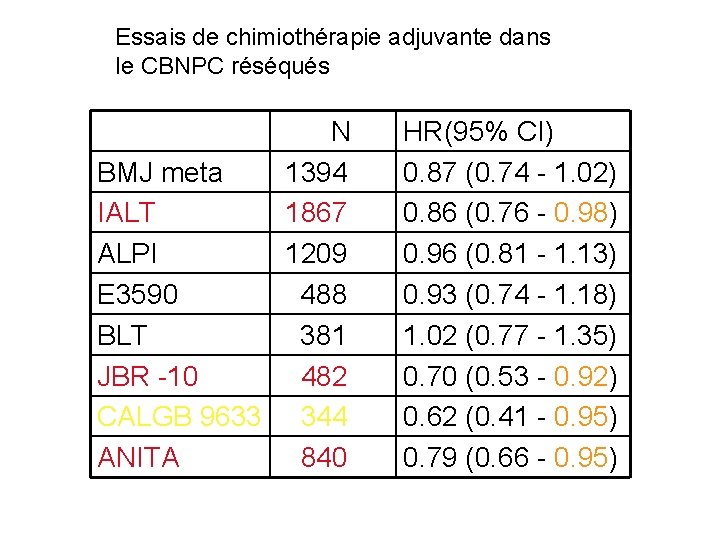
Essais de chimiothérapie adjuvante dans le CBNPC réséqués N BMJ meta 1394 IALT 1867 ALPI 1209 E 3590 488 BLT 381 JBR -10 482 CALGB 9633 344 ANITA 840 HR(95% CI) 0. 87 (0. 74 - 1. 02) 0. 86 (0. 76 - 0. 98) 0. 96 (0. 81 - 1. 13) 0. 93 (0. 74 - 1. 18) 1. 02 (0. 77 - 1. 35) 0. 70 (0. 53 - 0. 92) 0. 62 (0. 41 - 0. 95) 0. 79 (0. 66 - 0. 95)
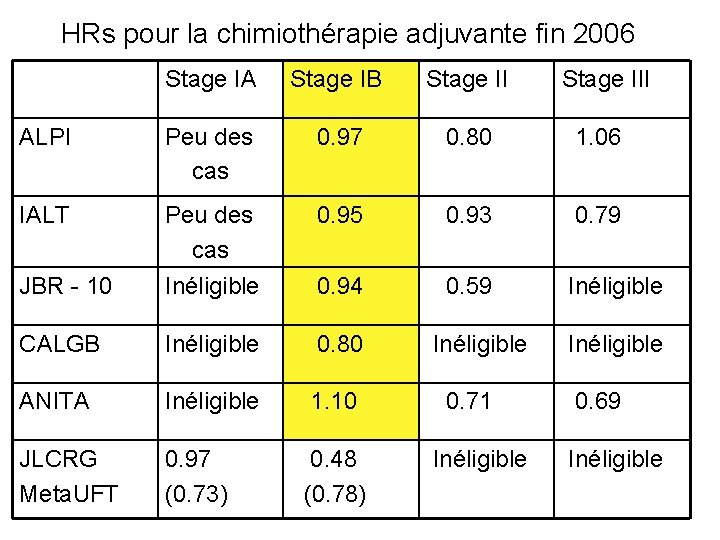
HRs pour la chimiothérapie adjuvante fin 2006 Stage IA Stage IB Stage II ALPI Peu des cas 0. 97 0. 80 1. 06 IALT 0. 95 0. 93 0. 79 JBR - 10 Peu des cas Inéligible 0. 94 0. 59 Inéligible CALGB Inéligible 0. 80 ANITA Inéligible 1. 10 JLCRG Meta. UFT 0. 97 (0. 73) 0. 48 (0. 78) Inéligible 0. 71 Inéligible Stage III Inéligible 0. 69 Inéligible
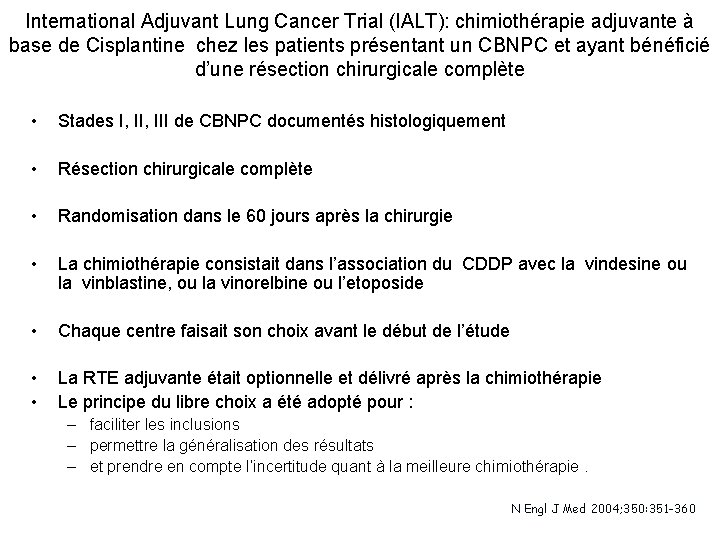
International Adjuvant Lung Cancer Trial (IALT): chimiothérapie adjuvante à base de Cisplantine chez les patients présentant un CBNPC et ayant bénéficié d’une résection chirurgicale complète • Stades I, III de CBNPC documentés histologiquement • Résection chirurgicale complète • Randomisation dans le 60 jours après la chirurgie • La chimiothérapie consistait dans l’association du CDDP avec la vindesine ou la vinblastine, ou la vinorelbine ou l’etoposide • Chaque centre faisait son choix avant le début de l’étude • • La RTE adjuvante était optionnelle et délivré après la chimiothérapie Le principe du libre choix a été adopté pour : – faciliter les inclusions – permettre la généralisation des résultats – et prendre en compte l’incertitude quant à la meilleure chimiothérapie. N Engl J Med 2004; 350: 351 -360
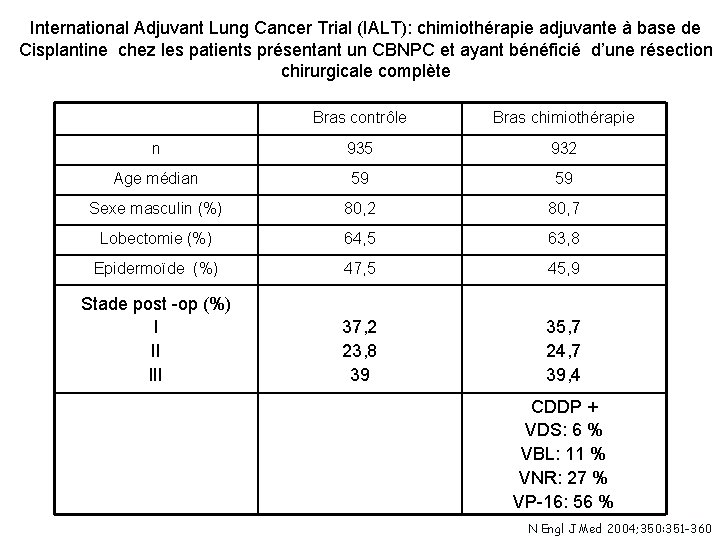
International Adjuvant Lung Cancer Trial (IALT): chimiothérapie adjuvante à base de Cisplantine chez les patients présentant un CBNPC et ayant bénéficié d’une résection chirurgicale complète Bras contrôle Bras chimiothérapie n 935 932 Age médian 59 59 Sexe masculin (%) 80, 2 80, 7 Lobectomie (%) 64, 5 63, 8 Epidermoïde (%) 47, 5 45, 9 Stade post -op (%) I II III 37, 2 23, 8 39 35, 7 24, 7 39, 4 CDDP + VDS: 6 % VBL: 11 % VNR: 27 % VP-16: 56 % N Engl J Med 2004; 350: 351 -360
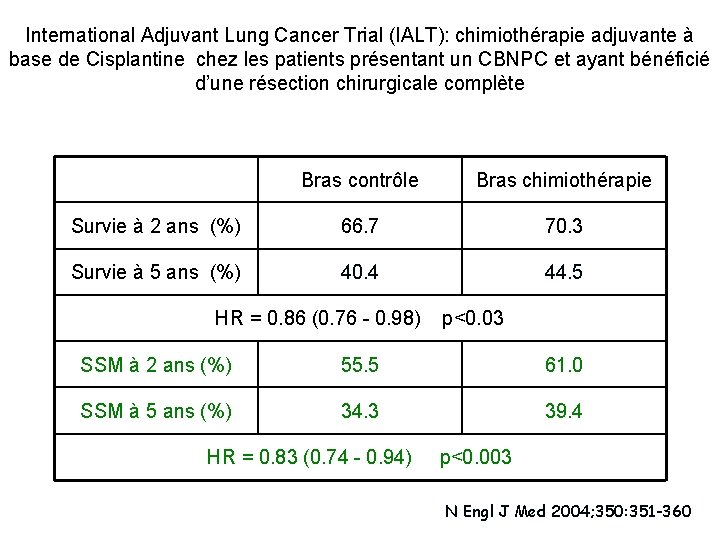
International Adjuvant Lung Cancer Trial (IALT): chimiothérapie adjuvante à base de Cisplantine chez les patients présentant un CBNPC et ayant bénéficié d’une résection chirurgicale complète Bras contrôle Bras chimiothérapie Survie à 2 ans (%) 66. 7 70. 3 Survie à 5 ans (%) 40. 4 44. 5 HR = 0. 86 (0. 76 - 0. 98) p<0. 03 SSM à 2 ans (%) 55. 5 61. 0 SSM à 5 ans (%) 34. 3 39. 4 HR = 0. 83 (0. 74 - 0. 94) p<0. 003 N Engl J Med 2004; 350: 351 -360
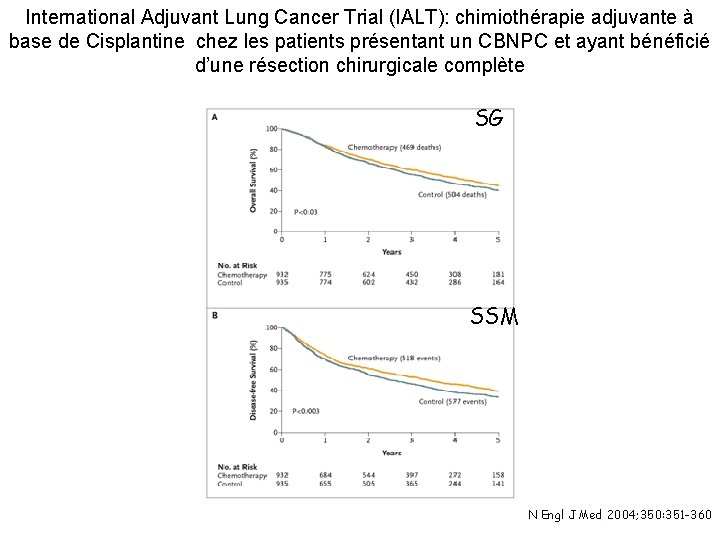
International Adjuvant Lung Cancer Trial (IALT): chimiothérapie adjuvante à base de Cisplantine chez les patients présentant un CBNPC et ayant bénéficié d’une résection chirurgicale complète SG SSM N Engl J Med 2004; 350: 351 -360
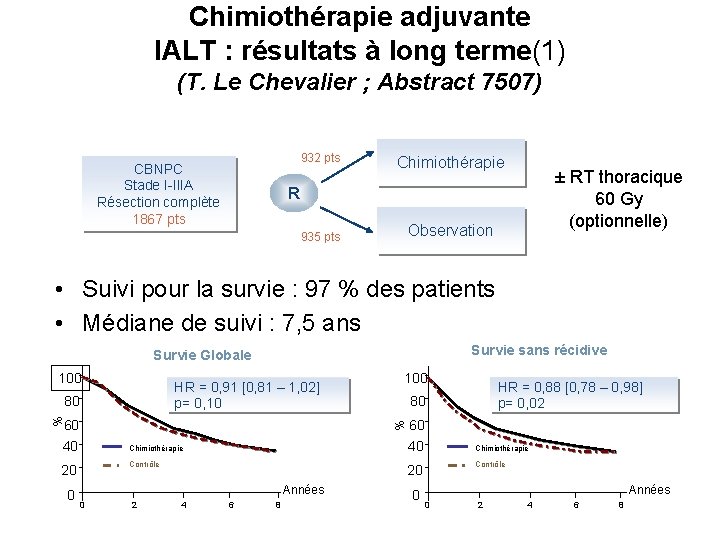
Chimiothérapie adjuvante IALT : résultats à long terme(1) (T. Le Chevalier ; Abstract 7507) 932 pts CBNPC Stade I-IIIA Résection complète 1867 pts Chimiothérapie ± RT thoracique 60 Gy (optionnelle) R Observation 935 pts • Suivi pour la survie : 97 % des patients • Médiane de suivi : 7, 5 ans Survie sans récidive Survie Globale 100 HR = 0, 91 [0, 81 – 1, 02] p= 0, 10 % 80 40 Contrôle 20 0 2 Chimiothérapie Contrôle 20 Années 0 60 40 Chimiothérapie 4 6 8 HR = 0, 88 [0, 78 – 0, 98] p= 0, 02 80 % 60 100 0 Années 0 2 4 6 8
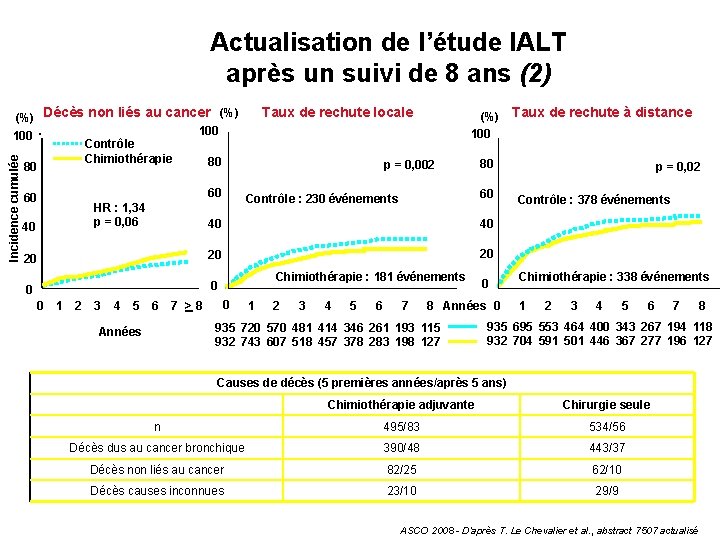
Actualisation de l’étude IALT après un suivi de 8 ans (2) Incidence cumulée (%) Décès non liés au cancer (%) 100 Contrôle Chimiothérapie 80 80 60 60 HR : 1, 34 p = 0, 06 Taux de rechute locale (%) 100 p = 0, 002 80 60 Contrôle : 230 événements 40 40 20 20 20 0 0 40 0 1 2 3 4 5 6 7 >8 Chimiothérapie : 181 événements 0 1 2 3 4 5 6 7 0 8 Années 0 935 720 570 481 414 346 261 193 115 932 743 607 518 457 378 283 198 127 Années Taux de rechute à distance p = 0, 02 Contrôle : 378 événements Chimiothérapie : 338 événements 1 2 3 4 5 6 7 8 935 695 553 464 400 343 267 194 118 932 704 591 501 446 367 277 196 127 Causes de décès (5 premières années/après 5 ans) Chimiothérapie adjuvante Chirurgie seule n 495/83 534/56 Décès dus au cancer bronchique 390/48 443/37 Décès non liés au cancer 82/25 62/10 Décès causes inconnues 23/10 29/9 ASCO 2008 - D’après T. Le Chevalier et al. , abstract 7507 actualisé
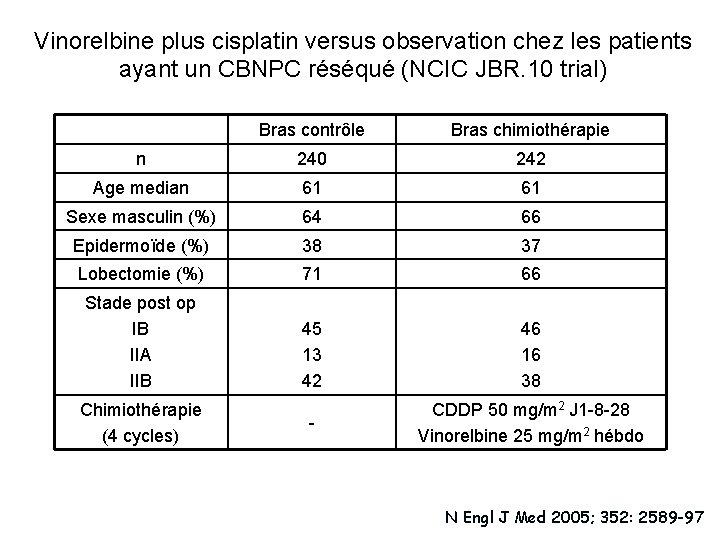
Vinorelbine plus cisplatin versus observation chez les patients ayant un CBNPC réséqué (NCIC JBR. 10 trial) Bras contrôle Bras chimiothérapie n 240 242 Age median 61 61 Sexe masculin (%) 64 66 Epidermoïde (%) 38 37 Lobectomie (%) 71 66 Stade post op IB IIA IIB 45 13 42 46 16 38 - CDDP 50 mg/m 2 J 1 -8 -28 Vinorelbine 25 mg/m 2 hébdo Chimiothérapie (4 cycles) N Engl J Med 2005; 352: 2589 -97
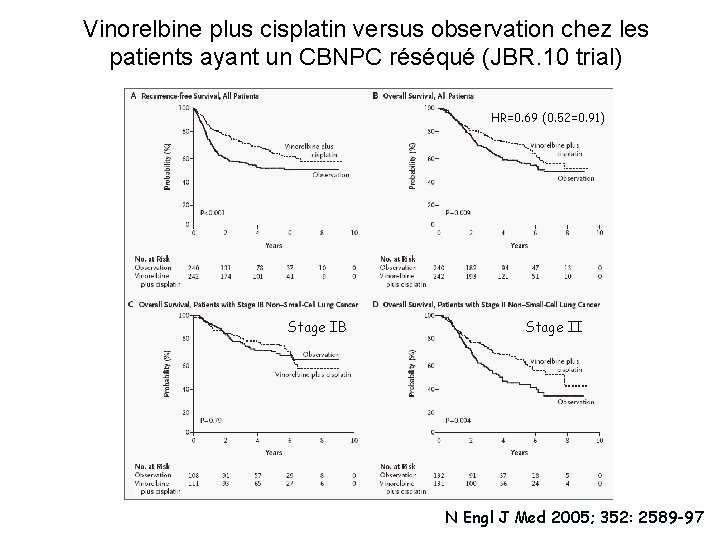
Vinorelbine plus cisplatin versus observation chez les patients ayant un CBNPC réséqué (JBR. 10 trial) HR=0. 69 (0. 52=0. 91) Stage IB Stage II N Engl J Med 2005; 352: 2589 -97
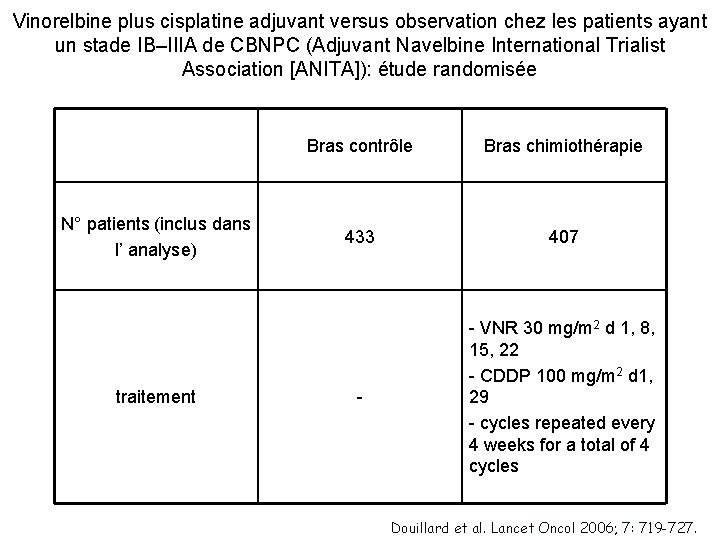
Vinorelbine plus cisplatine adjuvant versus observation chez les patients ayant un stade IB–IIIA de CBNPC (Adjuvant Navelbine International Trialist Association [ANITA]): étude randomisée N° patients (inclus dans l’ analyse) traitement Bras contrôle Bras chimiothérapie 433 407 - - VNR 30 mg/m 2 d 1, 8, 15, 22 - CDDP 100 mg/m 2 d 1, 29 - cycles repeated every 4 weeks for a total of 4 cycles Douillard et al. Lancet Oncol 2006; 7: 719 -727.
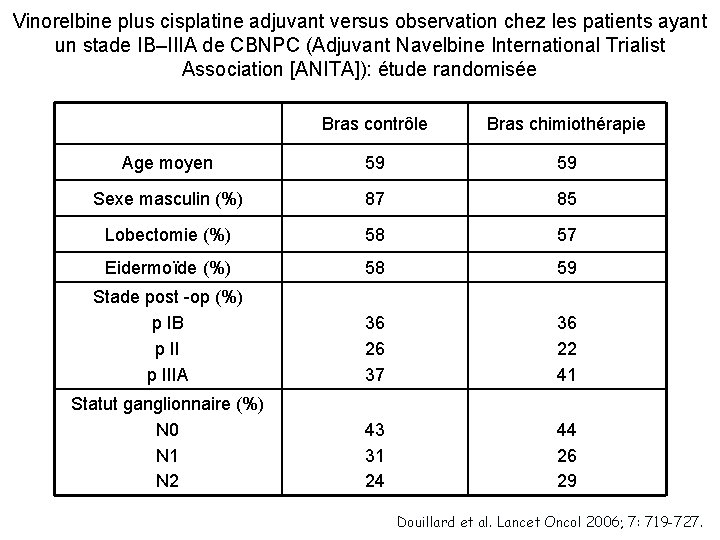
Vinorelbine plus cisplatine adjuvant versus observation chez les patients ayant un stade IB–IIIA de CBNPC (Adjuvant Navelbine International Trialist Association [ANITA]): étude randomisée Bras contrôle Bras chimiothérapie Age moyen 59 59 Sexe masculin (%) 87 85 Lobectomie (%) 58 57 Eidermoïde (%) 58 59 Stade post -op (%) p IB p IIIA 36 26 37 36 22 41 Statut ganglionnaire (%) N 0 N 1 N 2 43 31 24 44 26 29 Douillard et al. Lancet Oncol 2006; 7: 719 -727.
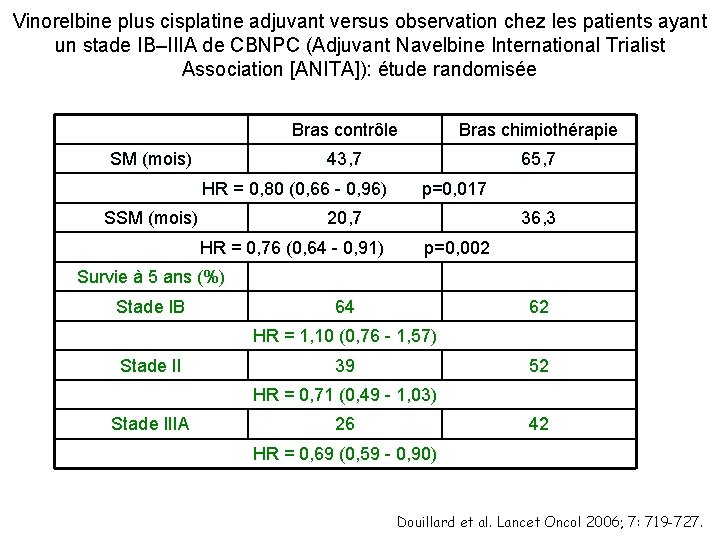
Vinorelbine plus cisplatine adjuvant versus observation chez les patients ayant un stade IB–IIIA de CBNPC (Adjuvant Navelbine International Trialist Association [ANITA]): étude randomisée SM (mois) Bras contrôle Bras chimiothérapie 43, 7 65, 7 HR = 0, 80 (0, 66 - 0, 96) SSM (mois) p=0, 017 20, 7 HR = 0, 76 (0, 64 - 0, 91) 36, 3 p=0, 002 Survie à 5 ans (%) Stade IB 64 62 HR = 1, 10 (0, 76 - 1, 57) Stade II 39 52 HR = 0, 71 (0, 49 - 1, 03) Stade IIIA 26 42 HR = 0, 69 (0, 59 - 0, 90) Douillard et al. Lancet Oncol 2006; 7: 719 -727.
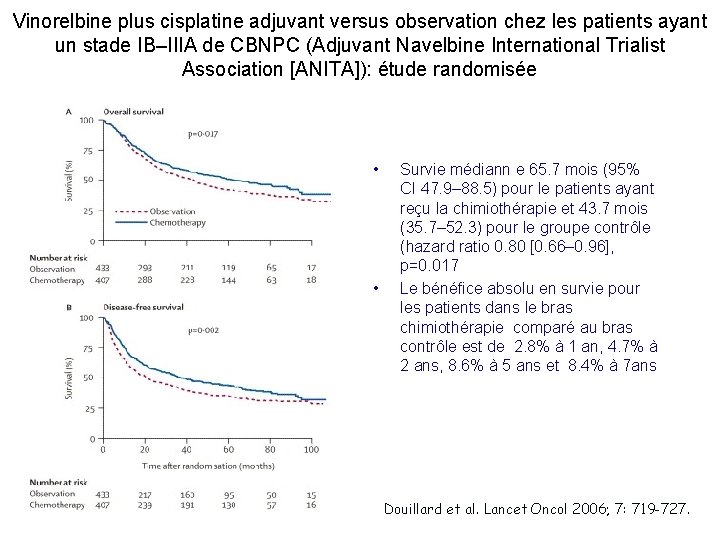
Vinorelbine plus cisplatine adjuvant versus observation chez les patients ayant un stade IB–IIIA de CBNPC (Adjuvant Navelbine International Trialist Association [ANITA]): étude randomisée • • Survie médiann e 65. 7 mois (95% CI 47. 9– 88. 5) pour le patients ayant reçu la chimiothérapie et 43. 7 mois (35. 7– 52. 3) pour le groupe contrôle (hazard ratio 0. 80 [0. 66– 0. 96], p=0. 017 Le bénéfice absolu en survie pour les patients dans le bras chimiothérapie comparé au bras contrôle est de 2. 8% à 1 an, 4. 7% à 2 ans, 8. 6% à 5 ans et 8. 4% à 7 ans Douillard et al. Lancet Oncol 2006; 7: 719 -727.
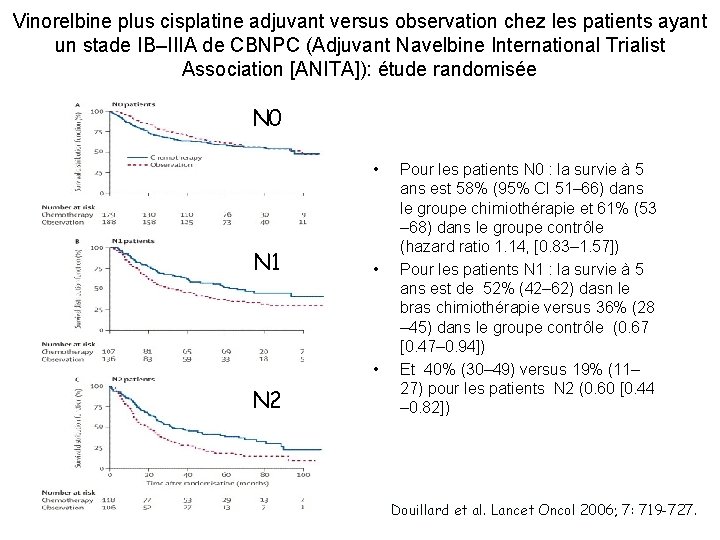
Vinorelbine plus cisplatine adjuvant versus observation chez les patients ayant un stade IB–IIIA de CBNPC (Adjuvant Navelbine International Trialist Association [ANITA]): étude randomisée N 0 • N 1 • • N 2 Pour les patients N 0 : la survie à 5 ans est 58% (95% CI 51– 66) dans le groupe chimiothérapie et 61% (53 – 68) dans le groupe contrôle (hazard ratio 1. 14, [0. 83– 1. 57]) Pour les patients N 1 : la survie à 5 ans est de 52% (42– 62) dasn le bras chimiothérapie versus 36% (28 – 45) dans le groupe contrôle (0. 67 [0. 47– 0. 94]) Et 40% (30– 49) versus 19% (11– 27) pour les patients N 2 (0. 60 [0. 44 – 0. 82]) Douillard et al. Lancet Oncol 2006; 7: 719 -727.
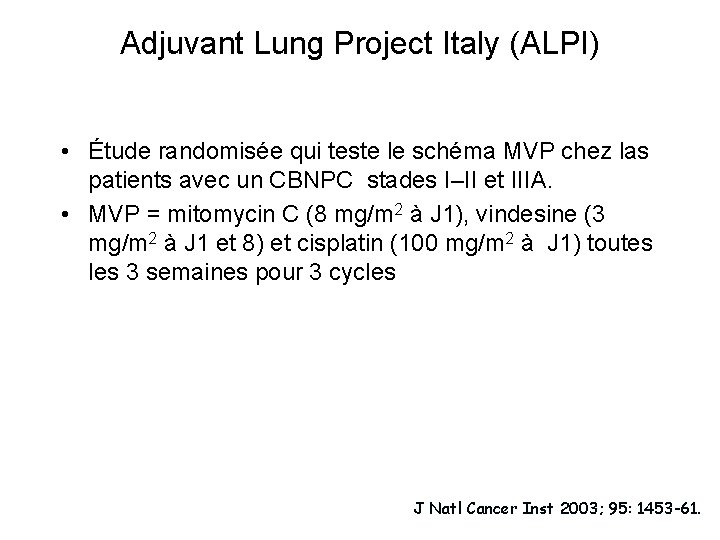
Adjuvant Lung Project Italy (ALPI) • Étude randomisée qui teste le schéma MVP chez las patients avec un CBNPC stades I–II et IIIA. • MVP = mitomycin C (8 mg/m 2 à J 1), vindesine (3 mg/m 2 à J 1 et 8) et cisplatin (100 mg/m 2 à J 1) toutes les 3 semaines pour 3 cycles J Natl Cancer Inst 2003; 95: 1453 -61.
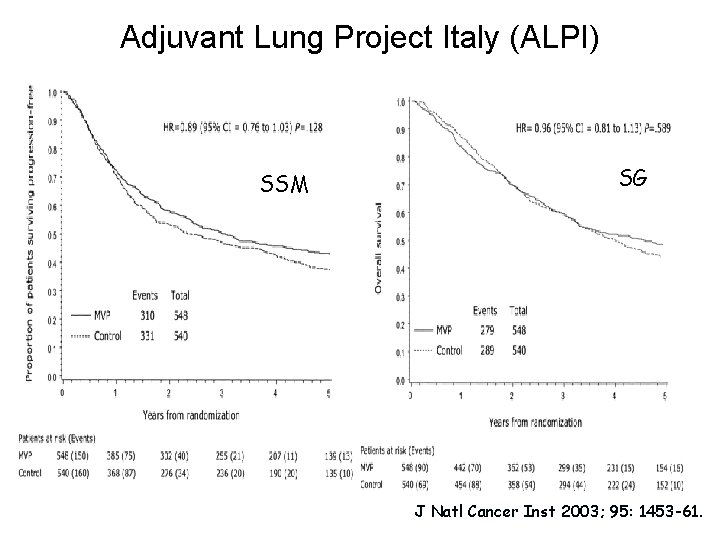
Adjuvant Lung Project Italy (ALPI) SSM SG J Natl Cancer Inst 2003; 95: 1453 -61.
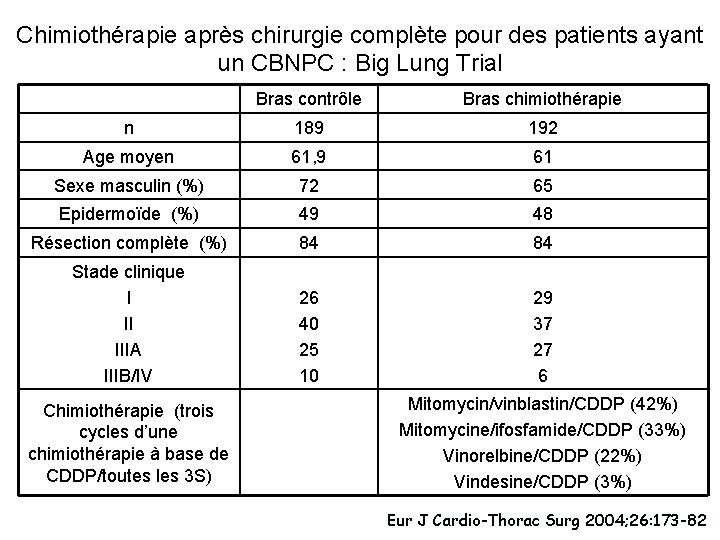
Chimiothérapie après chirurgie complète pour des patients ayant un CBNPC : Big Lung Trial Bras contrôle Bras chimiothérapie n 189 192 Age moyen 61, 9 61 Sexe masculin (%) 72 65 Epidermoïde (%) 49 48 Résection complète (%) 84 84 Stade clinique I II IIIA IIIB/IV 26 40 25 10 29 37 27 6 Chimiothérapie (trois cycles d’une chimiothérapie à base de CDDP/toutes les 3 S) Mitomycin/vinblastin/CDDP (42%) Mitomycine/ifosfamide/CDDP (33%) Vinorelbine/CDDP (22%) Vindesine/CDDP (3%) Eur J Cardio-Thorac Surg 2004; 26: 173 -82
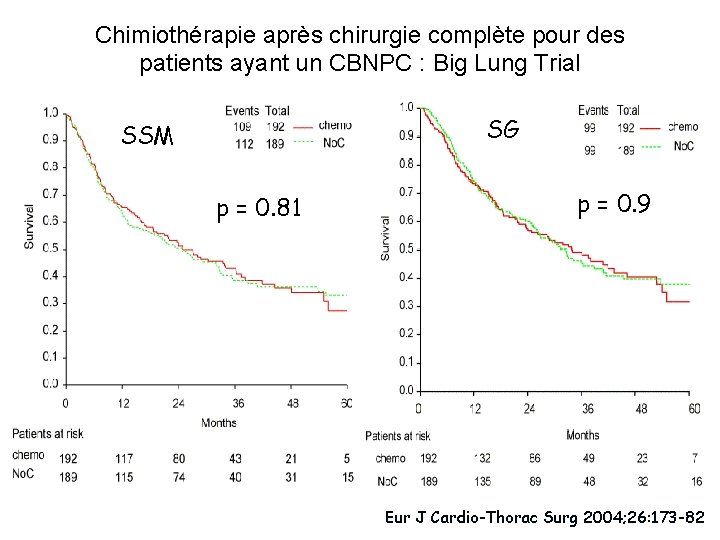
Chimiothérapie après chirurgie complète pour des patients ayant un CBNPC : Big Lung Trial SG SSM p = 0. 81 p = 0. 9 Eur J Cardio-Thorac Surg 2004; 26: 173 -82
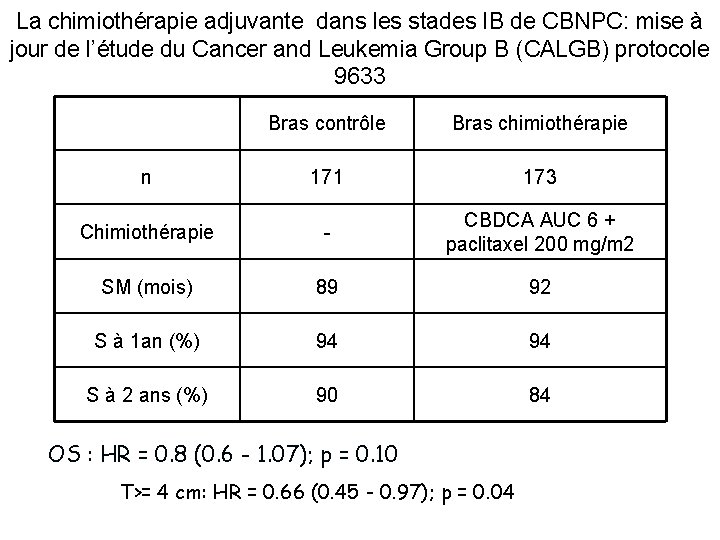
La chimiothérapie adjuvante dans les stades IB de CBNPC: mise à jour de l’étude du Cancer and Leukemia Group B (CALGB) protocole 9633 Bras contrôle Bras chimiothérapie n 171 173 Chimiothérapie - CBDCA AUC 6 + paclitaxel 200 mg/m 2 SM (mois) 89 92 S à 1 an (%) 94 94 S à 2 ans (%) 90 84 OS : HR = 0. 8 (0. 6 - 1. 07); p = 0. 10 T>= 4 cm: HR = 0. 66 (0. 45 - 0. 97); p = 0. 04
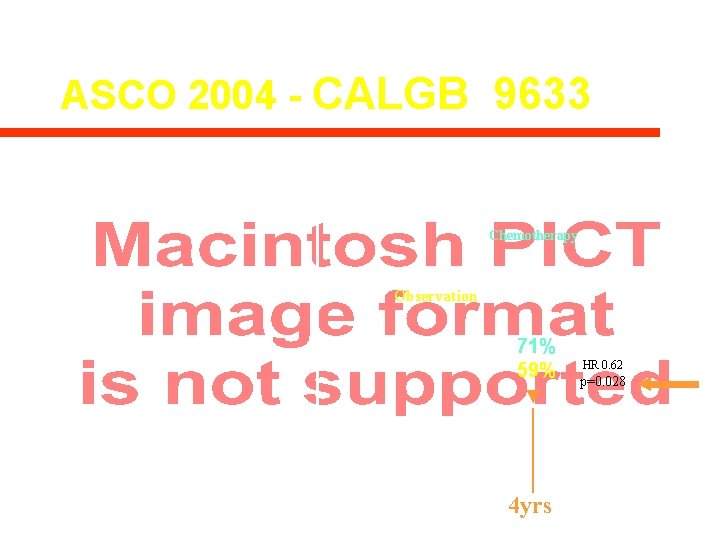
ASCO 2004 - CALGB 9633 Chemotherapy Observation 71% 59% YRS 4 yrs HR 0. 62 p=0. 028
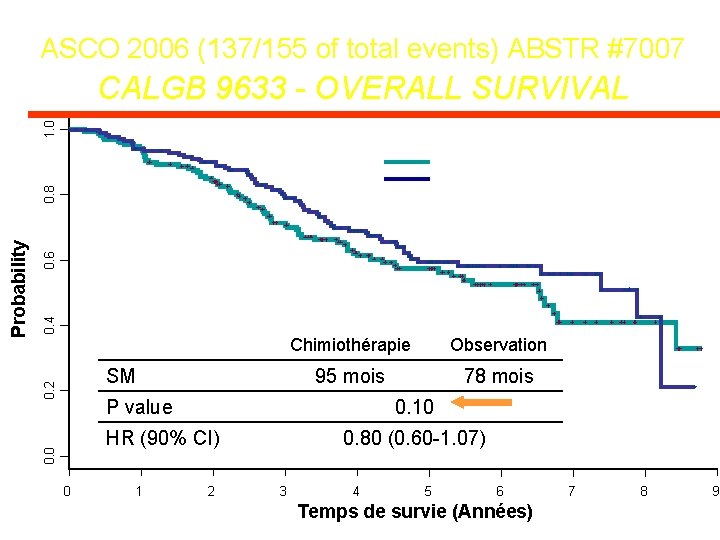
ASCO 2006 (137/155 of total events) ABSTR #7007 1. 0 CALGB 9633 - OVERALL SURVIVAL 0. 6 0. 4 0. 2 SM Chimiothérapie Observation 95 mois 78 mois P value 0. 10 HR (90% CI) 0. 0 Probability 0. 8 Observation Chemo 0 1 2 0. 80 (0. 60 -1. 07) 3 4 5 6 Temps de survie (Années) 7 8 9
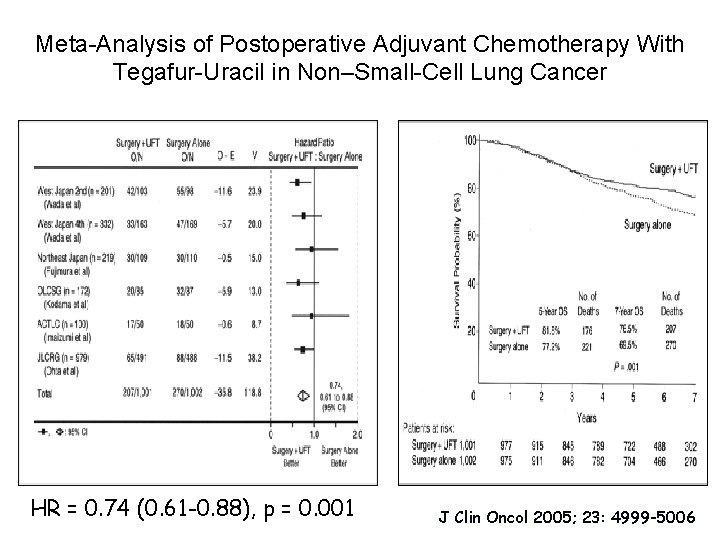
Meta-Analysis of Postoperative Adjuvant Chemotherapy With Tegafur-Uracil in Non–Small-Cell Lung Cancer HR = 0. 74 (0. 61 -0. 88), p = 0. 001 J Clin Oncol 2005; 23: 4999 -5006
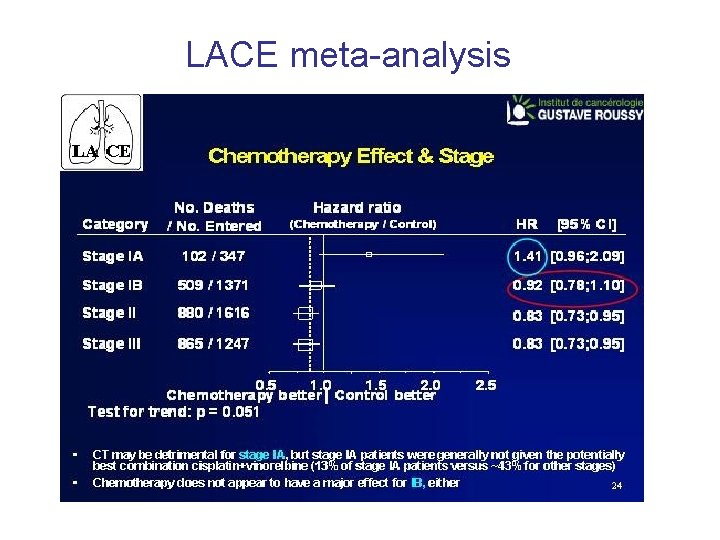
Chimiothérapie adjuvante / stades • Donnés insufffisantes pour récommander une chimiothérapie pour le stade IA • Analyse rétrospective : – IALT, bénéfice plus important pour le stade IIIAN 2 – JRB. 10, bénéfice en surive pour le stade II; mais pas pour le stade IB – ANITA, bénéfice en surive pour les stades II-III; pas de bénéfice pour le stade IB – CALGB 9633, étude négative ; mais bénéfice en survie pour T>4 cm Les analyses de sous groupes devraient être interprétés avec précaution
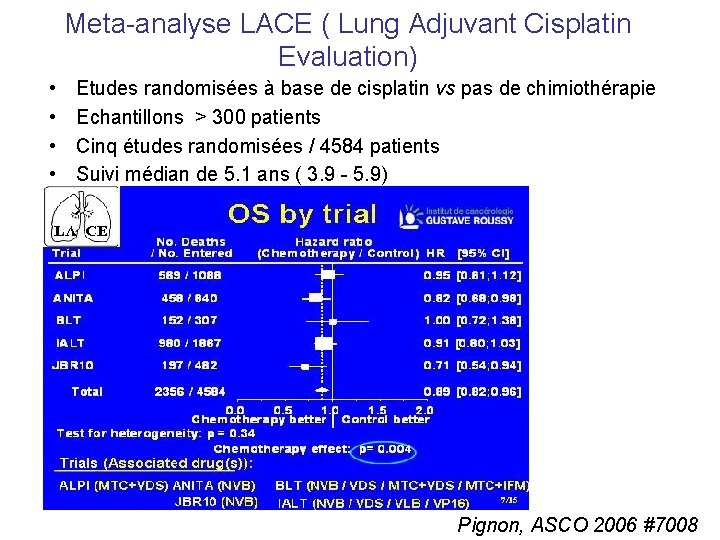
Meta-analyse LACE ( Lung Adjuvant Cisplatin Evaluation) • • Etudes randomisées à base de cisplatin vs pas de chimiothérapie Echantillons > 300 patients Cinq études randomisées / 4584 patients Suivi médian de 5. 1 ans ( 3. 9 - 5. 9) Pignon, ASCO 2006 #7008
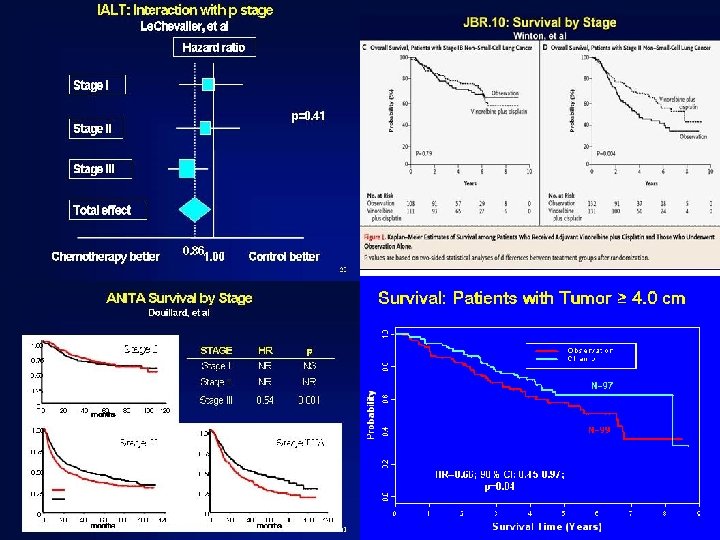
LACE meta-analysis
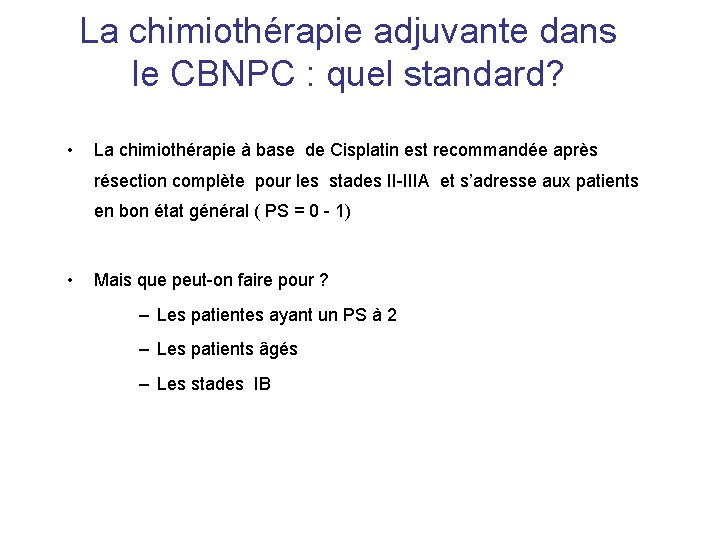
La chimiothérapie adjuvante dans le CBNPC : quel standard? • La chimiothérapie à base de Cisplatin est recommandée après résection complète pour les stades II-IIIA et s’adresse aux patients en bon état général ( PS = 0 - 1) • Mais que peut-on faire pour ? – Les patientes ayant un PS à 2 – Les patients âgés – Les stades IB
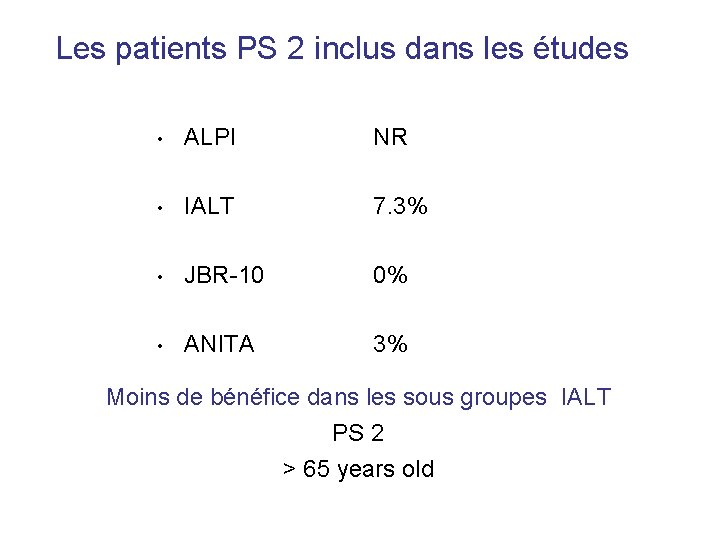
Les patients PS 2 inclus dans les études • ALPI NR • IALT 7. 3% • JBR-10 0% • ANITA 3% Moins de bénéfice dans les sous groupes IALT PS 2 > 65 years old
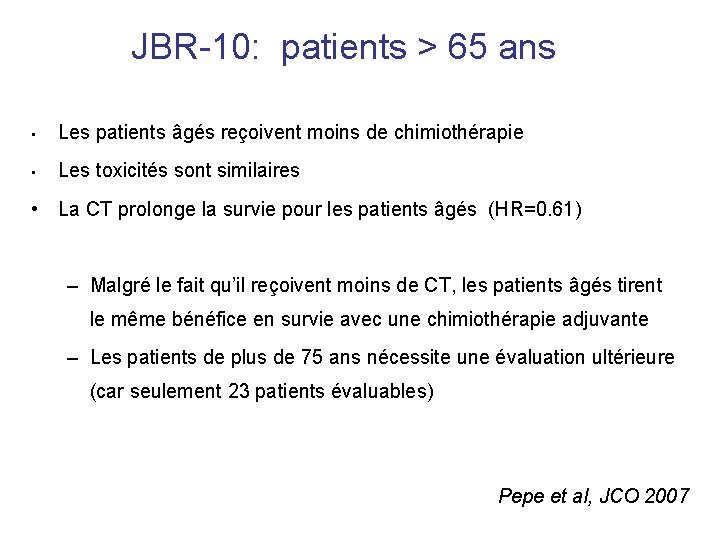
JBR-10: patients > 65 ans • Les patients âgés reçoivent moins de chimiothérapie • Les toxicités sont similaires • La CT prolonge la survie pour les patients âgés (HR=0. 61) – Malgré le fait qu’il reçoivent moins de CT, les patients âgés tirent le même bénéfice en survie avec une chimiothérapie adjuvante – Les patients de plus de 75 ans nécessite une évaluation ultérieure (car seulement 23 patients évaluables) Pepe et al, JCO 2007
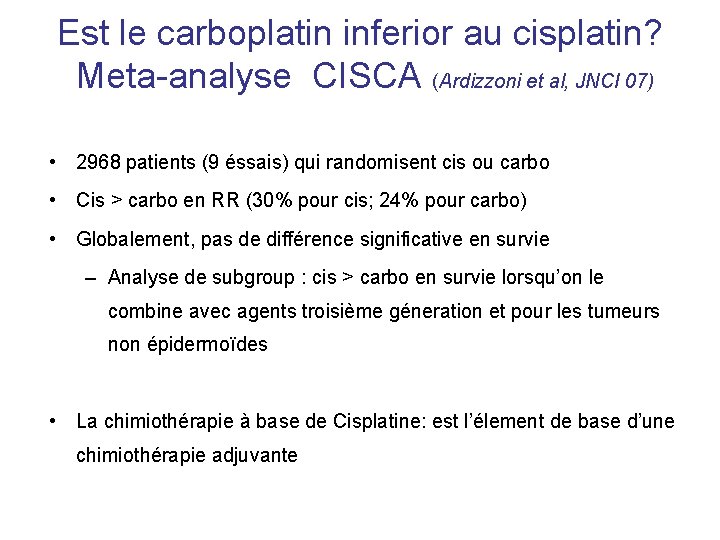
Est le carboplatin inferior au cisplatin? Meta-analyse CISCA (Ardizzoni et al, JNCI 07) • 2968 patients (9 éssais) qui randomisent cis ou carbo • Cis > carbo en RR (30% pour cis; 24% pour carbo) • Globalement, pas de différence significative en survie – Analyse de subgroup : cis > carbo en survie lorsqu’on le combine avec agents troisième géneration et pour les tumeurs non épidermoïdes • La chimiothérapie à base de Cisplatine: est l’élement de base d’une chimiothérapie adjuvante
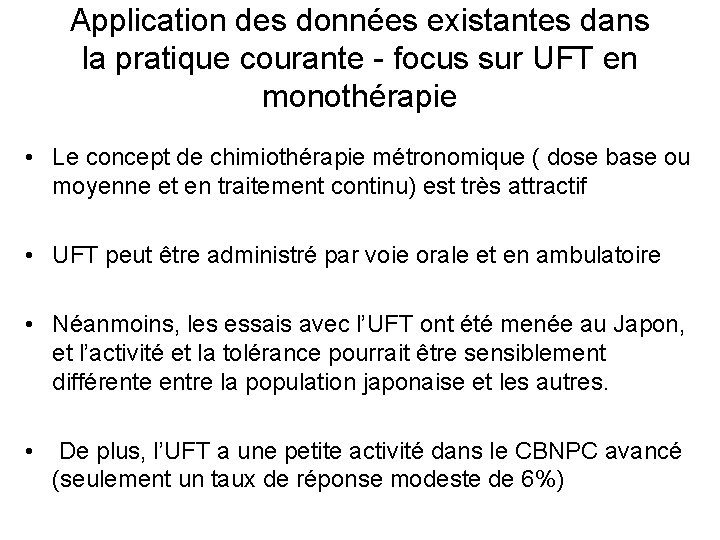
Application des données existantes dans la pratique courante - focus sur UFT en monothérapie • Le concept de chimiothérapie métronomique ( dose base ou moyenne et en traitement continu) est très attractif • UFT peut être administré par voie orale et en ambulatoire • Néanmoins, les essais avec l’UFT ont été menée au Japon, et l’activité et la tolérance pourrait être sensiblement différente entre la population japonaise et les autres. • De plus, l’UFT a une petite activité dans le CBNPC avancé (seulement un taux de réponse modeste de 6%)
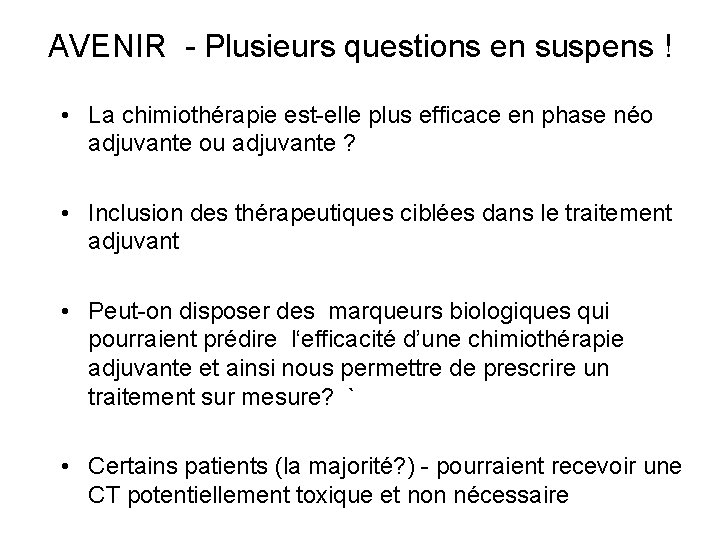
AVENIR - Plusieurs questions en suspens ! • La chimiothérapie est-elle plus efficace en phase néo adjuvante ou adjuvante ? • Inclusion des thérapeutiques ciblées dans le traitement adjuvant • Peut-on disposer des marqueurs biologiques qui pourraient prédire l‘efficacité d’une chimiothérapie adjuvante et ainsi nous permettre de prescrire un traitement sur mesure? ` • Certains patients (la majorité? ) - pourraient recevoir une CT potentiellement toxique et non nécessaire
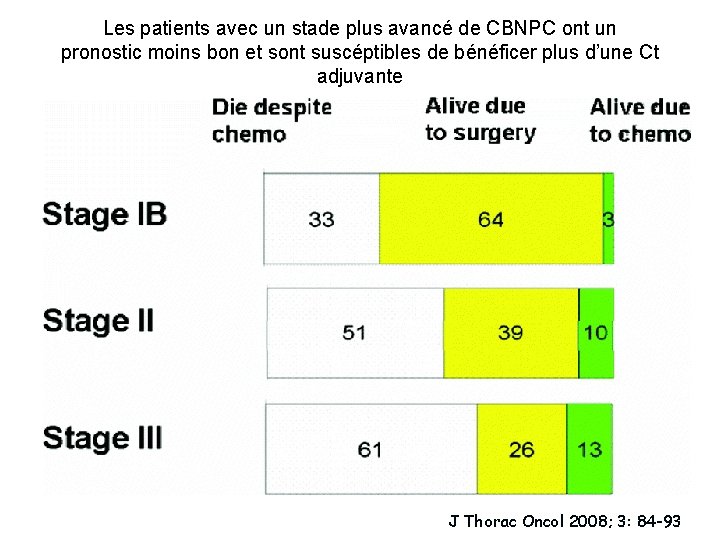
Les patients avec un stade plus avancé de CBNPC ont un pronostic moins bon et sont suscéptibles de bénéficer plus d’une Ct adjuvante J Thorac Oncol 2008; 3: 84 -93

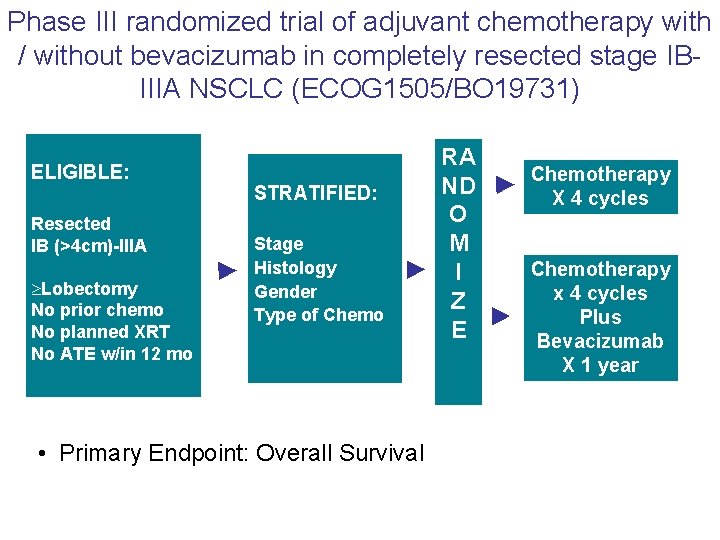
Phase III randomized trial of adjuvant chemotherapy with / without bevacizumab in completely resected stage IBIIIA NSCLC (ECOG 1505/BO 19731) ELIGIBLE: Resected IB (>4 cm)-IIIA ³Lobectomy No prior chemo No planned XRT No ATE w/in 12 mo STRATIFIED: Stage Histology Gender Type of Chemo • Primary Endpoint: Overall Survival RA ND O M I Z E Chemotherapy X 4 cycles Chemotherapy x 4 cycles Plus Bevacizumab X 1 year
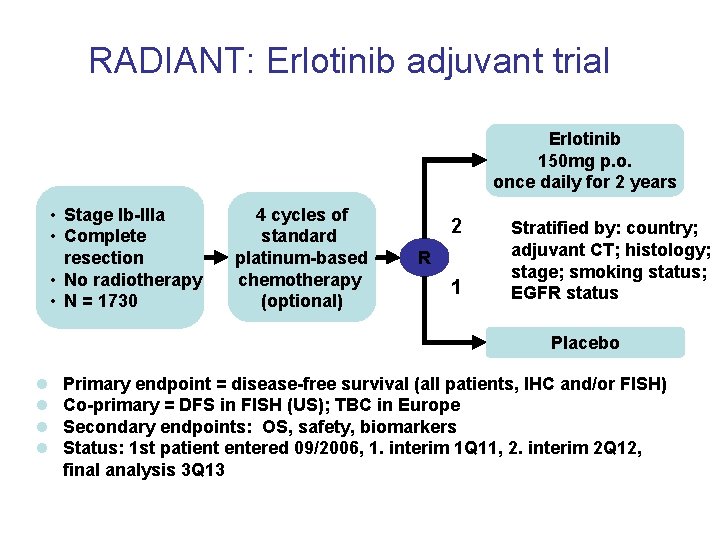
RADIANT: Erlotinib adjuvant trial Erlotinib 150 mg p. o. once daily for 2 years • Stage Ib-IIIa • Complete resection • No radiotherapy • N = 1730 4 cycles of standard platinum-based chemotherapy (optional) 2 R 1 Stratified by: country; adjuvant CT; histology; stage; smoking status; EGFR status Placebo l l Primary endpoint = disease-free survival (all patients, IHC and/or FISH) Co-primary = DFS in FISH (US); TBC in Europe Secondary endpoints: OS, safety, biomarkers Status: 1 st patient entered 09/2006, 1. interim 1 Q 11, 2. interim 2 Q 12, final analysis 3 Q 13
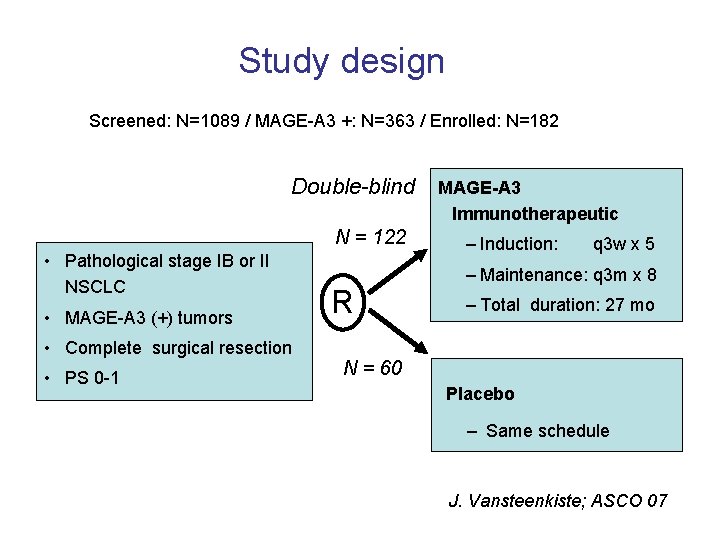
Study design Screened: N=1089 / MAGE-A 3 +: N=363 / Enrolled: N=182 Double-blind N = 122 • Pathological stage IB or II NSCLC • MAGE-A 3 (+) tumors • Complete surgical resection • PS 0 -1 R MAGE-A 3 Immunotherapeutic – Induction: q 3 w x 5 – Maintenance: q 3 m x 8 – Total duration: 27 mo N = 60 Placebo – Same schedule J. Vansteenkiste; ASCO 07
Disease-free Interval (DFI) HR = 0. 73 (95% CI 0. 44 -1. 20) one-sided logrank p = 0. 107 DFI: Interval from the date of surgical resection to the date recurrence) HR: Hazard ratio calculated by Cox analysis

Marqueurs moléculaires: comme facteurs predictifs / prognostics dans le CBNPC opéré
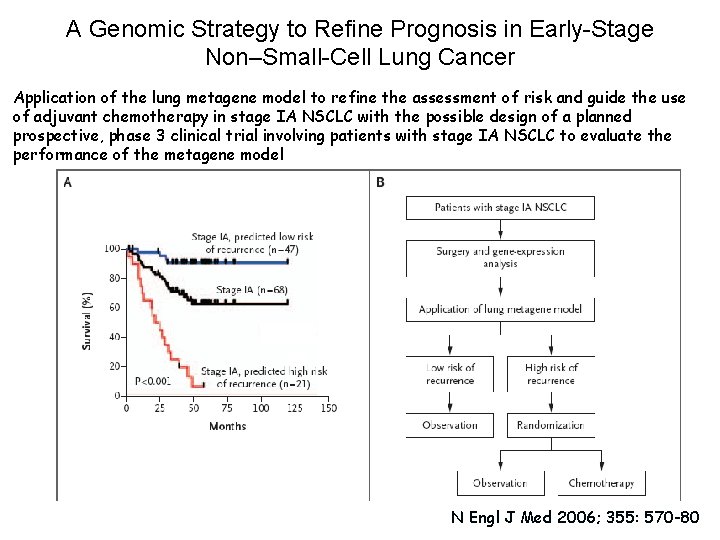
A Genomic Strategy to Refine Prognosis in Early-Stage Non–Small-Cell Lung Cancer Application of the lung metagene model to refine the assessment of risk and guide the use of adjuvant chemotherapy in stage IA NSCLC with the possible design of a planned prospective, phase 3 clinical trial involving patients with stage IA NSCLC to evaluate the performance of the metagene model N Engl J Med 2006; 355: 570 -80
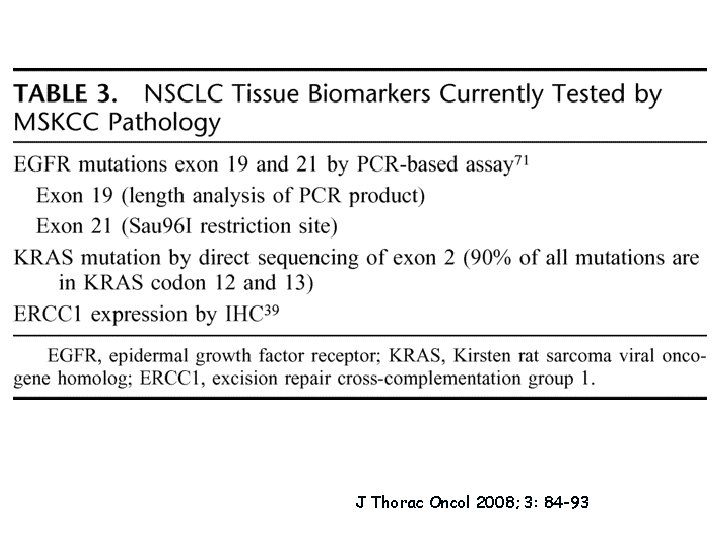
J Thorac Oncol 2008; 3: 84 -93
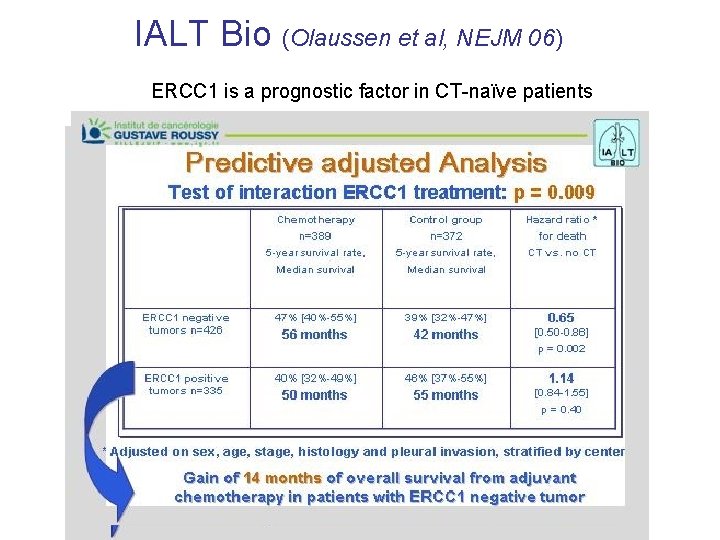
IALT Bio (Olaussen et al, NEJM 06) ERCC 1 is a prognostic factor in CT-naïve patients
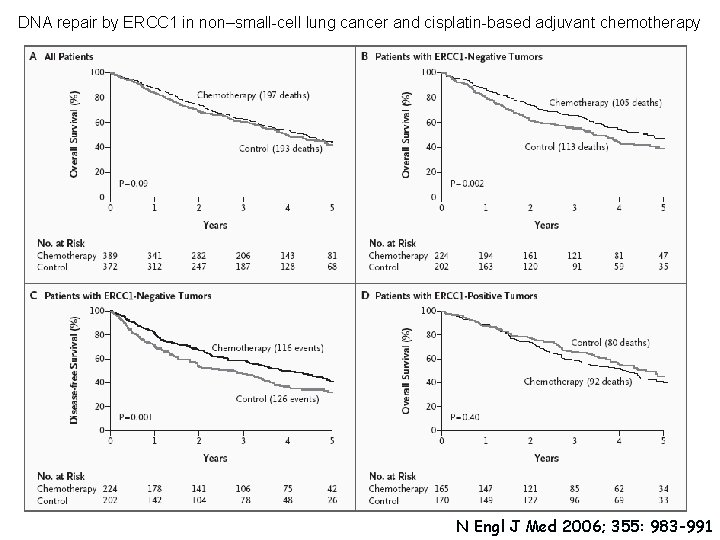
DNA repair by ERCC 1 in non–small-cell lung cancer and cisplatin-based adjuvant chemotherapy N Engl J Med 2006; 355: 983 -991
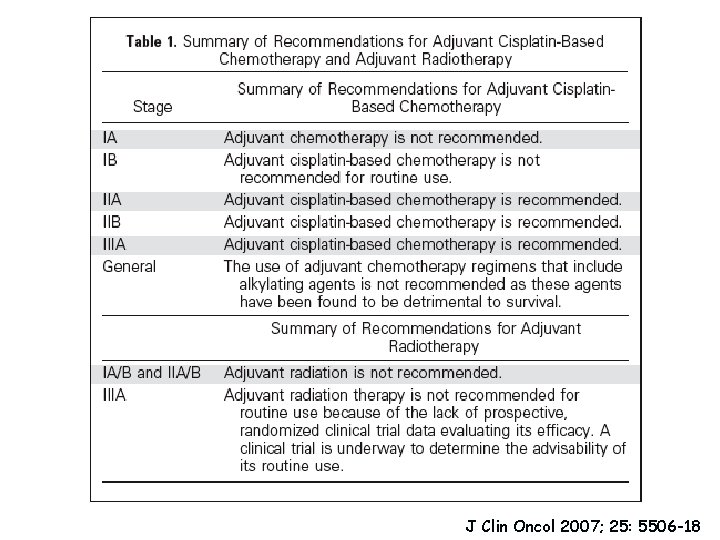
J Clin Oncol 2007; 25: 5506 -18
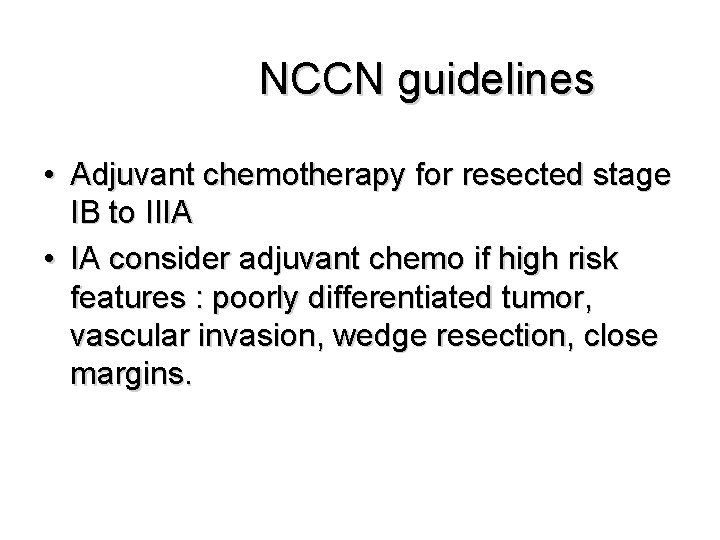
NCCN guidelines • Adjuvant chemotherapy for resected stage IB to IIIA • IA consider adjuvant chemo if high risk features : poorly differentiated tumor, vascular invasion, wedge resection, close margins.

Merci
- Slides: 53