
Chills and Thrills Undefined Behavior in C Pete
Chills and Thrills: Undefined Behavior in C++ Pete Isensee Development Manager XNA Professional Game Platform Microsoft
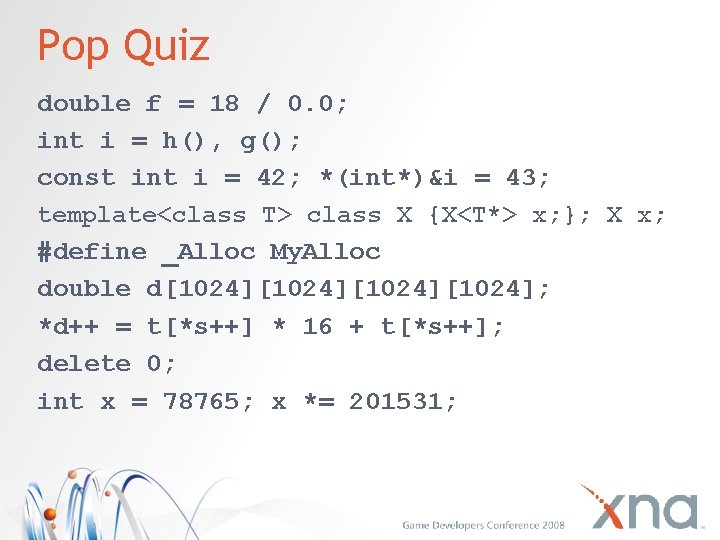
Pop Quiz double f = 18 / 0. 0; int i = h(), g(); const int i = 42; *(int*)&i = 43; template<class T> class X {X<T*> x; }; X x; #define _Alloc My. Alloc double d[1024][1024]; *d++ = t[*s++] * 16 + t[*s++]; delete 0; int x = 78765; x *= 201531;
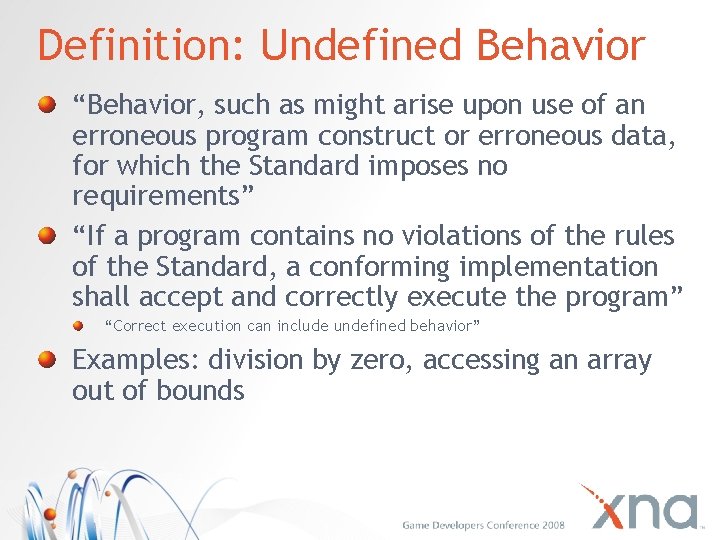
Definition: Undefined Behavior “Behavior, such as might arise upon use of an erroneous program construct or erroneous data, for which the Standard imposes no requirements” “If a program contains no violations of the rules of the Standard, a conforming implementation shall accept and correctly execute the program” “Correct execution can include undefined behavior” Examples: division by zero, accessing an array out of bounds
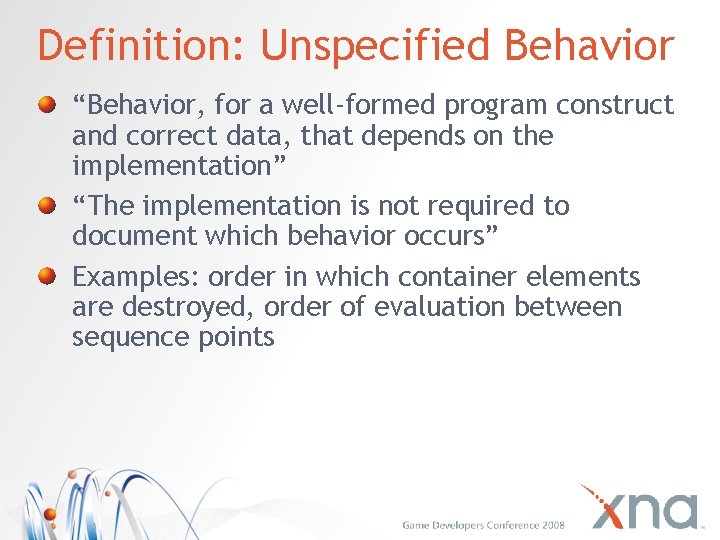
Definition: Unspecified Behavior “Behavior, for a well-formed program construct and correct data, that depends on the implementation” “The implementation is not required to document which behavior occurs” Examples: order in which container elements are destroyed, order of evaluation between sequence points
Definition: Implementation. Defined Behavior “Behavior, for a well-formed program construct and correct data, that depends on the implementation and that each implementation shall document” Examples: sizeof(int), whether signed integers use two’s complement
Common Areas of Chill/Thrill Object boundaries Object lifetime Function parameters Memory Mathematics Order of evaluation Conversions Const Pointers Padding Standard type sizes Inheritance Algorithms Iterators
Potential Outcomes Compiler error (best outcome) Compiler warning Analysis tool error Analysis tool warning Assertion Consistent crash, data loss or corruption Program termination Completely unpredictable results It works (worst outcome)
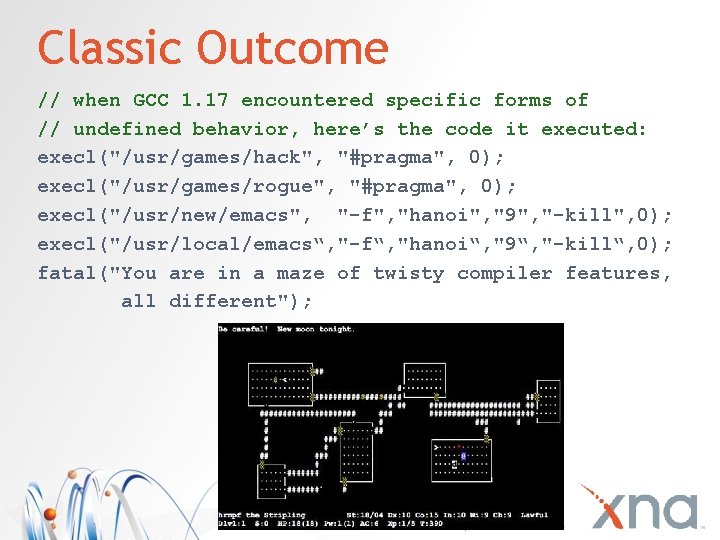
Classic Outcome // when GCC 1. 17 encountered specific forms of // undefined behavior, here’s the code it executed: execl("/usr/games/hack", "#pragma", 0); execl("/usr/games/rogue", "#pragma", 0); execl("/usr/new/emacs", "-f", "hanoi", "9", "-kill", 0); execl("/usr/local/emacs“, "-f“, "hanoi“, "9“, "-kill“, 0); fatal("You are in a maze of twisty compiler features, all different");
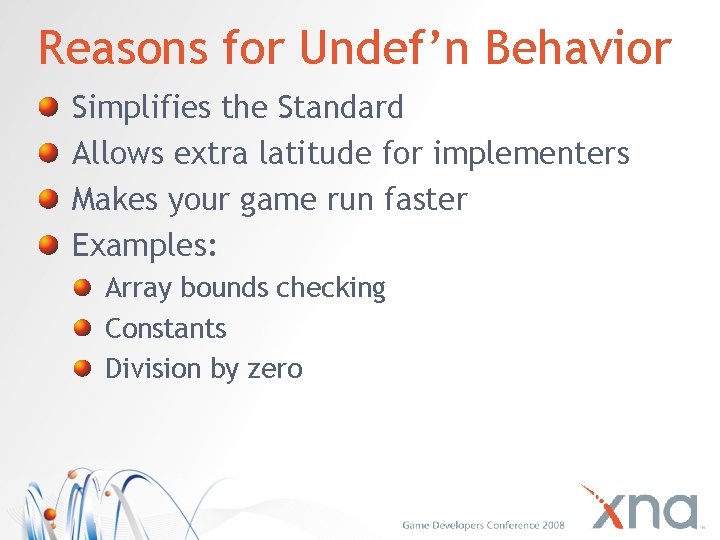
Reasons for Undef’n Behavior Simplifies the Standard Allows extra latitude for implementers Makes your game run faster Examples: Array bounds checking Constants Division by zero
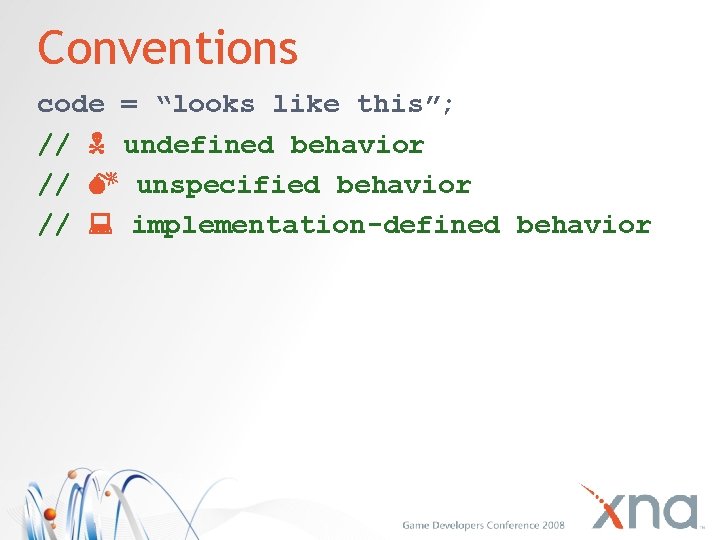
Conventions code = “looks like this”; // undefined behavior // unspecified behavior // implementation-defined behavior
![Object Boundaries char a[N]; char c = *(a+N); char* p = a+N; c =](http://slidetodoc.com/presentation_image_h/e4a39b69f72ab78ce3c97f0e33ed5124/image-11.jpg "Object Boundaries char a[N]; char c = *(a+N); char* p = a+N; c =")
Object Boundaries char a[N]; char c = *(a+N); char* p = a+N; c = *p; ++p; // // // C-style array outside bounds OK, points at end outside bounds vector<int> v; v. push_back(1); int i = v[10]; // outside bounds memcpy(a, a+1, N-1); // overlap
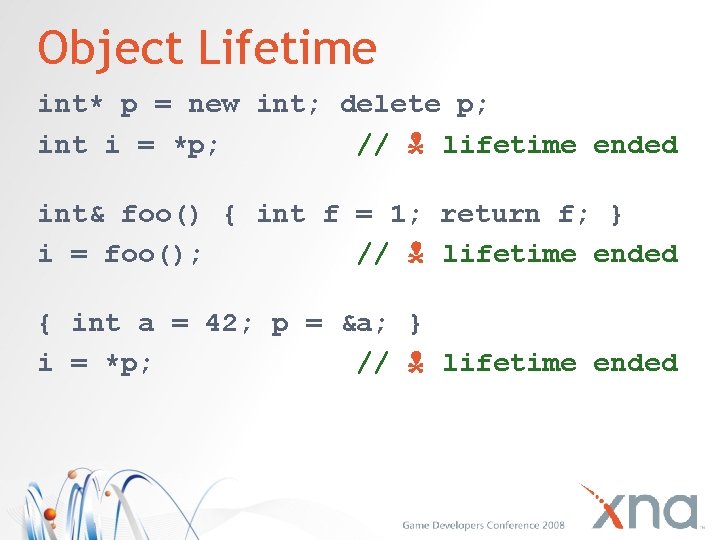
Object Lifetime int* p = new int; delete p; int i = *p; // lifetime ended int& foo() { int f = 1; return f; } i = foo(); // lifetime ended { int a = 42; p = &a; } i = *p; // lifetime ended
![Memory int* p = new int [0]; // OK (really) int i = *p;](http://slidetodoc.com/presentation_image_h/e4a39b69f72ab78ce3c97f0e33ed5124/image-13.jpg "Memory int* p = new int [0]; // OK (really) int i = *p;")
Memory int* p = new int [0]; // OK (really) int i = *p; // zero size delete p; // need delete [] int* q int* r delete = new int; = q; q; r; // double delete 0; // req. to have no effect
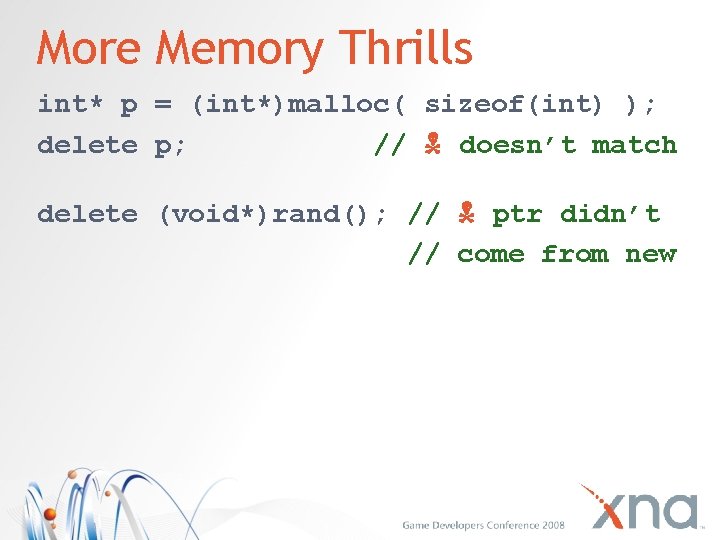
More Memory Thrills int* p = (int*)malloc( sizeof(int) ); delete p; // doesn’t match delete (void*)rand(); // ptr didn’t // come from new
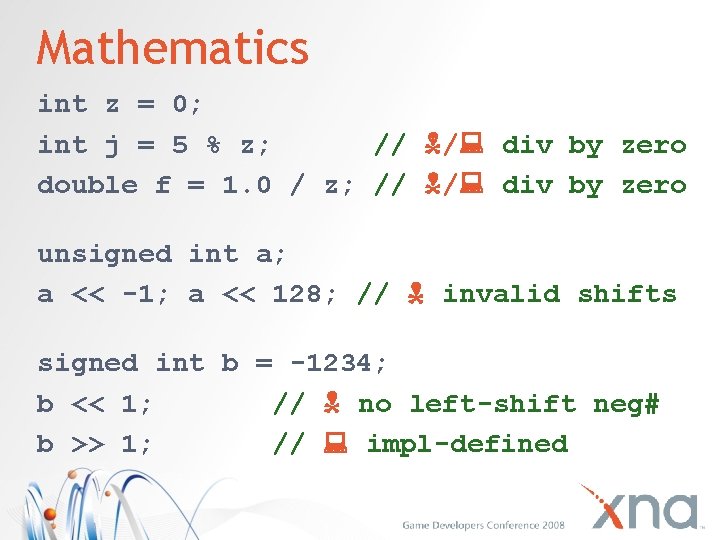
Mathematics int z = 0; int j = 5 % z; // / div by zero double f = 1. 0 / z; // / div by zero unsigned int a; a << -1; a << 128; // invalid shifts signed int b = -1234; b << 1; // no left-shift neg# b >> 1; // impl-defined
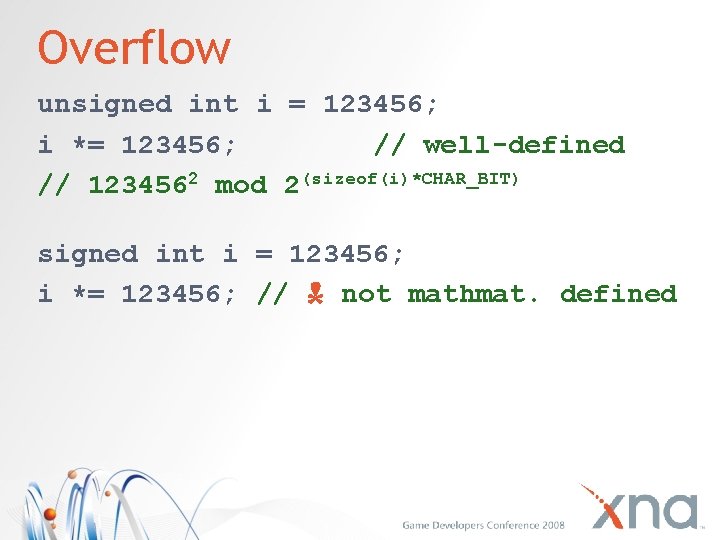
Overflow unsigned int i = 123456; i *= 123456; // well-defined // 1234562 mod 2(sizeof(i)*CHAR_BIT) signed int i = 123456; i *= 123456; // not mathmat. defined
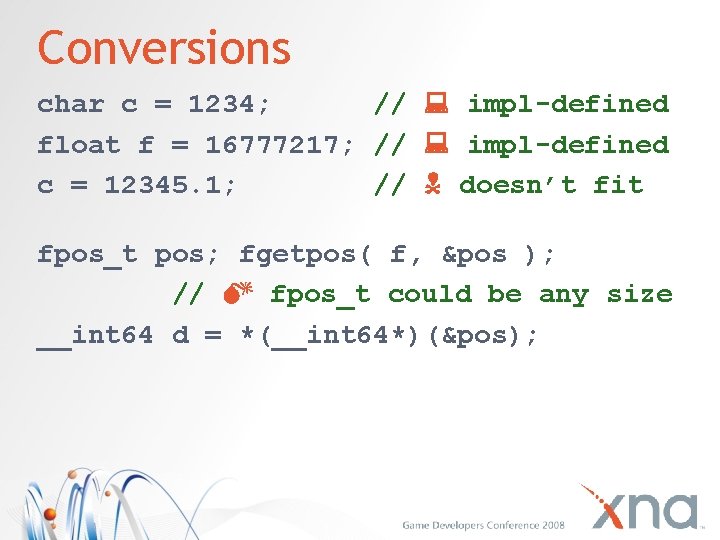
Conversions char c = 1234; // impl-defined float f = 16777217; // impl-defined c = 12345. 1; // doesn’t fit fpos_t pos; fgetpos( f, &pos ); // fpos_t could be any size __int 64 d = *(__int 64*)(&pos);
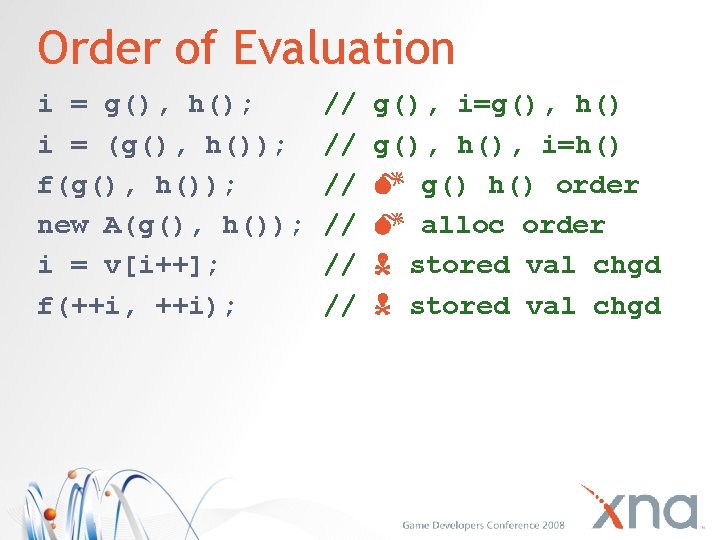
Order of Evaluation i = g(), h(); i = (g(), h()); f(g(), h()); new A(g(), h()); i = v[i++]; f(++i, ++i); // // // g(), i=g(), h(), i=h() g() h() order alloc order stored val chgd
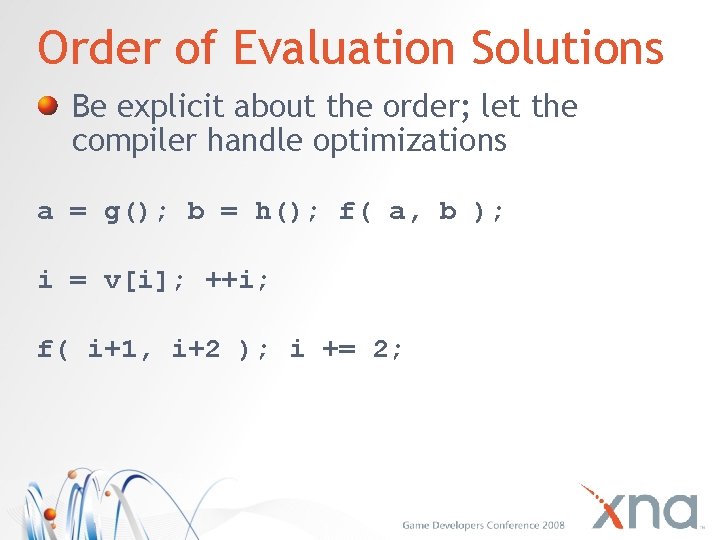
Order of Evaluation Solutions Be explicit about the order; let the compiler handle optimizations a = g(); b = h(); f( a, b ); i = v[i]; ++i; f( i+1, i+2 ); i += 2;
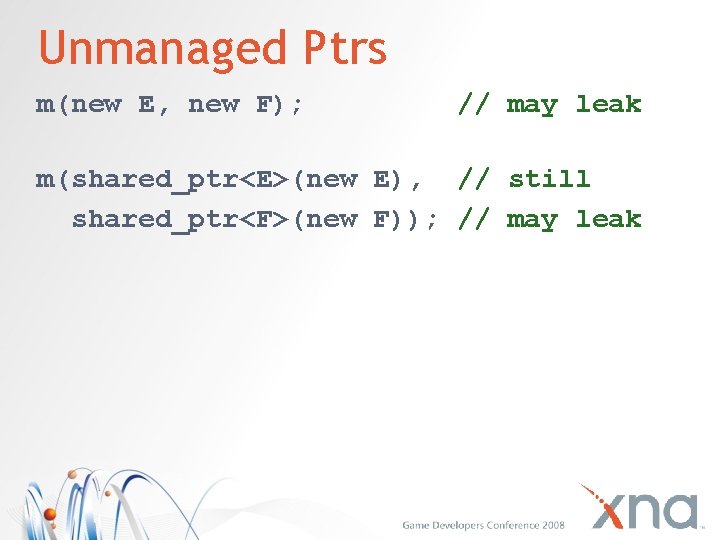
Unmanaged Ptrs m(new E, new F); // may leak m(shared_ptr<E>(new E), // still shared_ptr<F>(new F)); // may leak
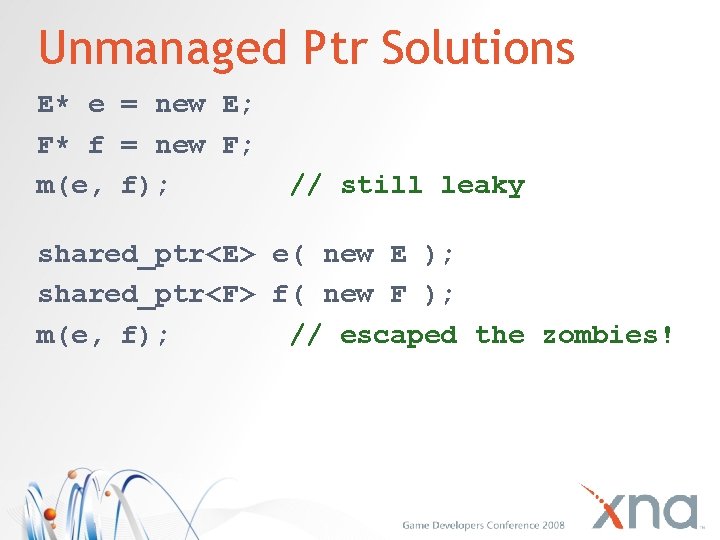
Unmanaged Ptr Solutions E* e = new E; F* f = new F; m(e, f); // still leaky shared_ptr<E> e( new E ); shared_ptr<F> f( new F ); m(e, f); // escaped the zombies!
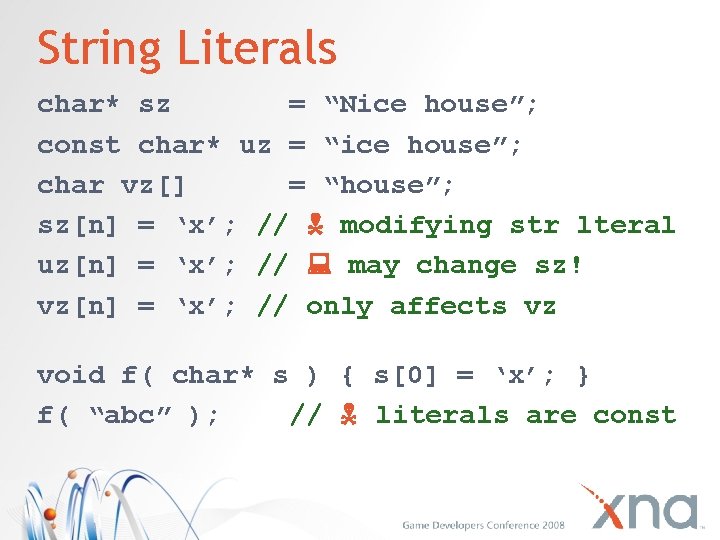
String Literals char* sz = “Nice house”; const char* uz = “ice house”; char vz[] = “house”; sz[n] = ‘x’; // modifying str lteral uz[n] = ‘x’; // may change sz! vz[n] = ‘x’; // only affects vz void f( char* s ) { s[0] = ‘x’; } f( “abc” ); // literals are const
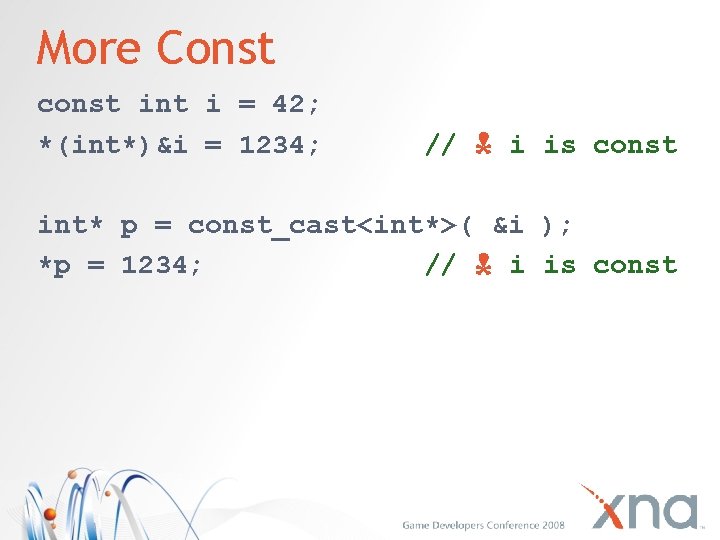
More Const const int i = 42; *(int*)&i = 1234; // i is const int* p = const_cast<int*>( &i ); *p = 1234; // i is const
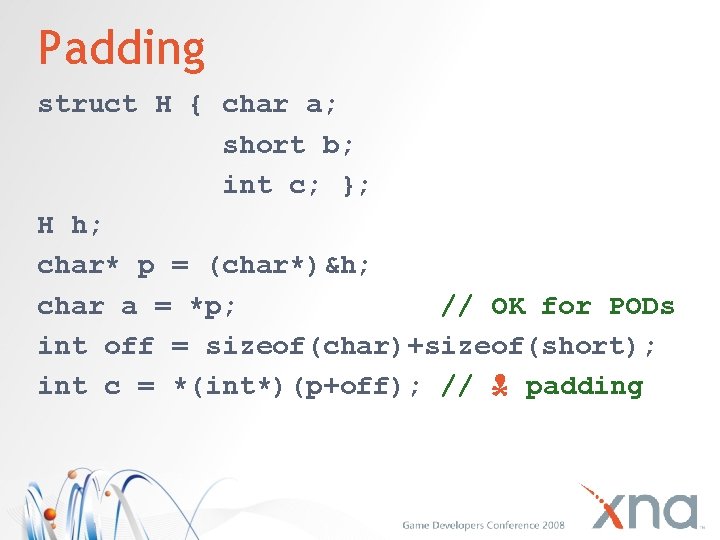
Padding struct H { char a; short b; int c; }; H h; char* p = (char*)&h; char a = *p; // OK for PODs int off = sizeof(char)+sizeof(short); int c = *(int*)(p+off); // padding
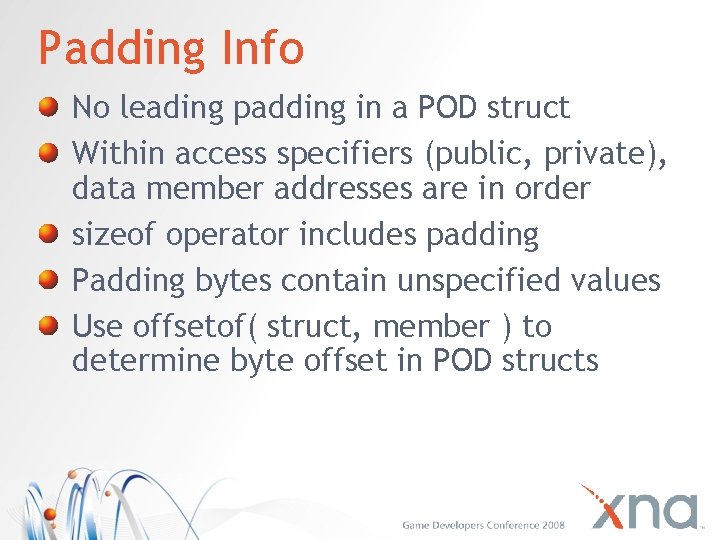
Padding Info No leading padding in a POD struct Within access specifiers (public, private), data member addresses are in order sizeof operator includes padding Padding bytes contain unspecified values Use offsetof( struct, member ) to determine byte offset in POD structs
![Algorithms int arr[6] = { 1, 5, 7, 2, 4, 3 }; // list](http://slidetodoc.com/presentation_image_h/e4a39b69f72ab78ce3c97f0e33ed5124/image-26.jpg "Algorithms int arr[6] = { 1, 5, 7, 2, 4, 3 }; // list")
Algorithms int arr[6] = { 1, 5, 7, 2, 4, 3 }; // list isn’t sorted bool b = binary_search(arr, arr+6, 3); set<int, less_equal<int> > s; s. insert(42); // compare returns 1 // for equivalent values
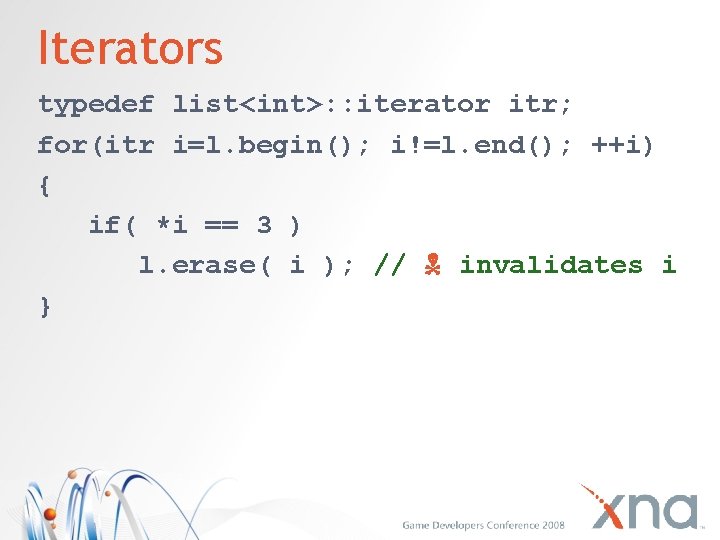
Iterators typedef list<int>: : iterator itr; for(itr i=l. begin(); i!=l. end(); ++i) { if( *i == 3 ) l. erase( i ); // invalidates i }
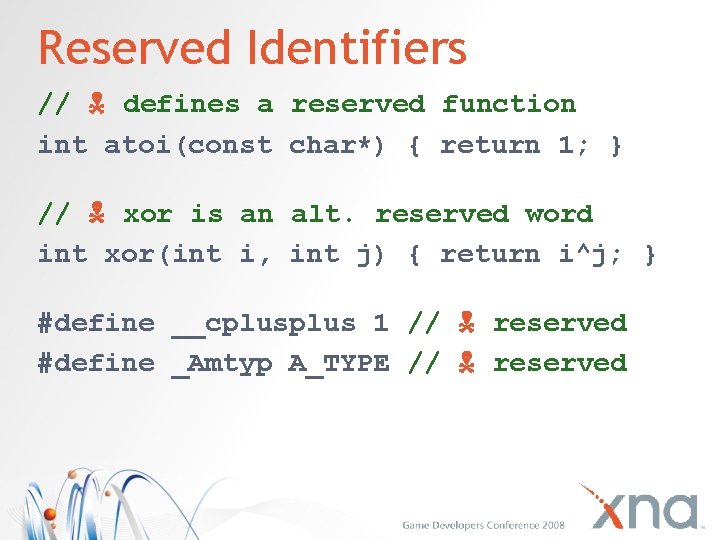
Reserved Identifiers // defines a reserved function int atoi(const char*) { return 1; } // xor is an alt. reserved word int xor(int i, int j) { return i^j; } #define __cplus 1 // reserved #define _Amtyp A_TYPE // reserved
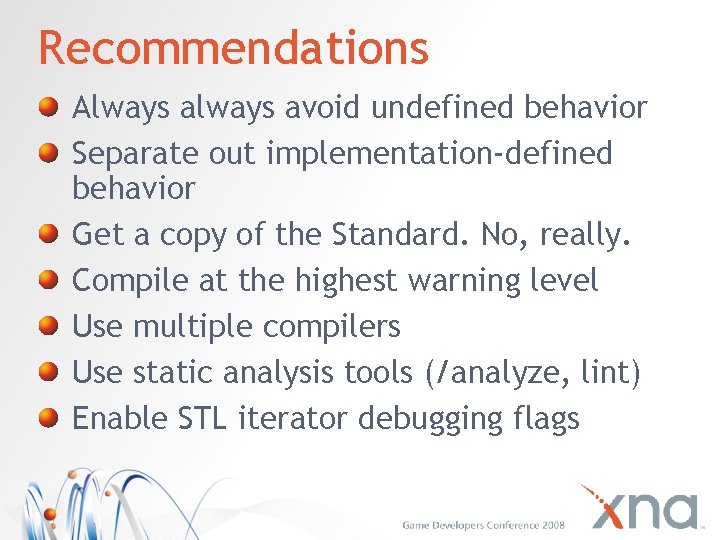
Recommendations Always avoid undefined behavior Separate out implementation-defined behavior Get a copy of the Standard. No, really. Compile at the highest warning level Use multiple compilers Use static analysis tools (/analyze, lint) Enable STL iterator debugging flags
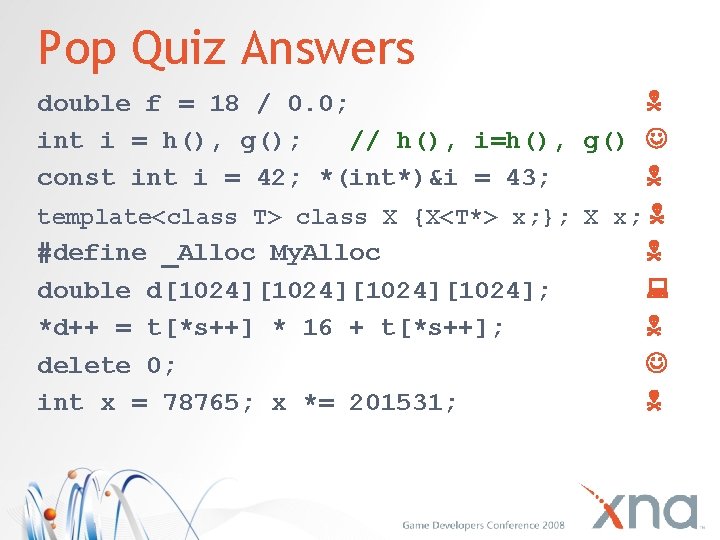
Pop Quiz Answers double f = 18 / 0. 0; int i = h(), g(); // h(), i=h(), g() const int i = 42; *(int*)&i = 43; template<class T> class X {X<T*> x; }; X x; #define _Alloc My. Alloc double d[1024][1024]; *d++ = t[*s++] * 16 + t[*s++]; delete 0; int x = 78765; x *= 201531;

http: //www. xna. com © 2008 Microsoft Corporation. All rights reserved. This presentation is for informational purposes only. Microsoft makes no warranties, express or implied, in this summary.
- Slides: 31