
Childrens Health in Northern Ireland Summary Births Summary
Children’s Health in Northern Ireland Summary
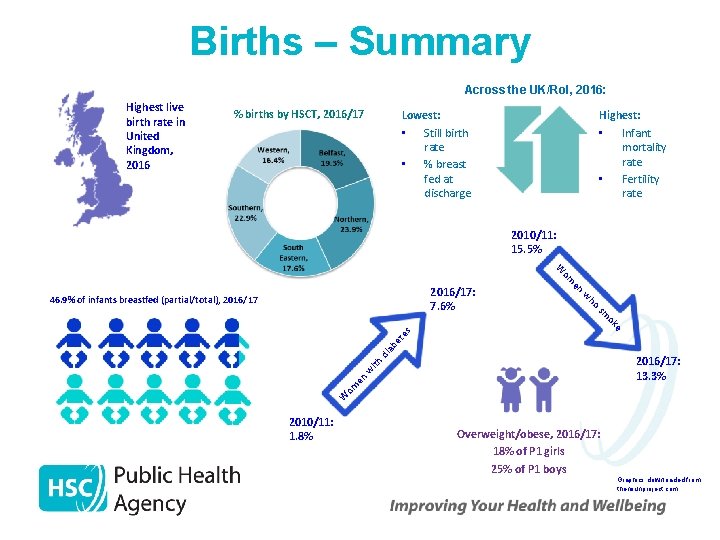
Births – Summary Across the UK/Ro. I, 2016: Highest live birth rate in United Kingdom, 2016 % births by HSCT, 2016/17 Lowest: • Still birth rate • % breast fed at discharge Highest: • Infant mortality rate • Fertility rate 2010/11: 15. 5% di ab et es e ok sm ho w en om W 2016/17: 7. 6% 46. 9% of infants breastfed (partial/total), 2016/17 W om en wi th 2016/17: 13. 3% 2010/11: 1. 8% Overweight/obese, 2016/17: 18% of P 1 girls 25% of P 1 boys Graphics downloaded from: thenounproject. com
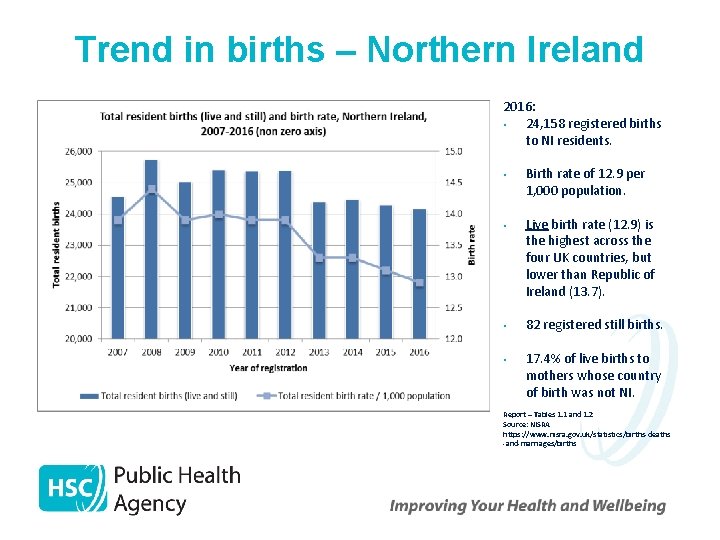
Trend in births – Northern Ireland 2016: • 24, 158 registered births to NI residents. • Birth rate of 12. 9 per 1, 000 population. • Live birth rate (12. 9) is the highest across the four UK countries, but lower than Republic of Ireland (13. 7). • 82 registered still births. • 17. 4% of live births to mothers whose country of birth was not NI. Report – Tables 1. 1 and 1. 2 Source: NISRA https: //www. nisra. gov. uk/statistics/births-deaths -and-marriages/births
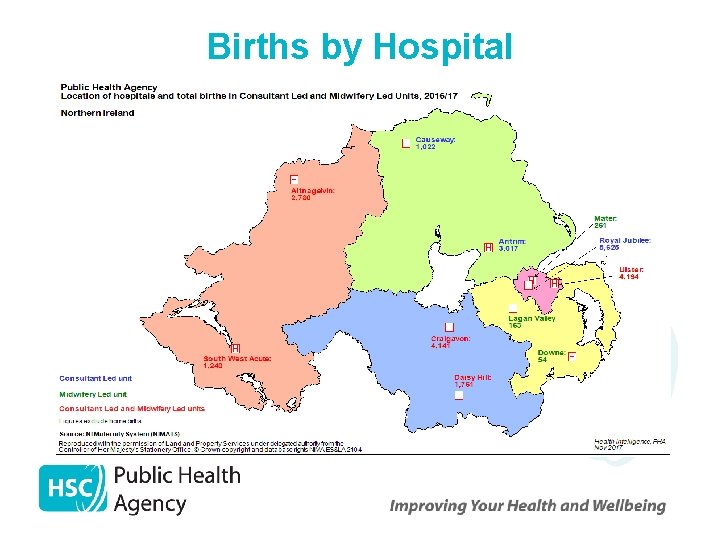
Births by Hospital
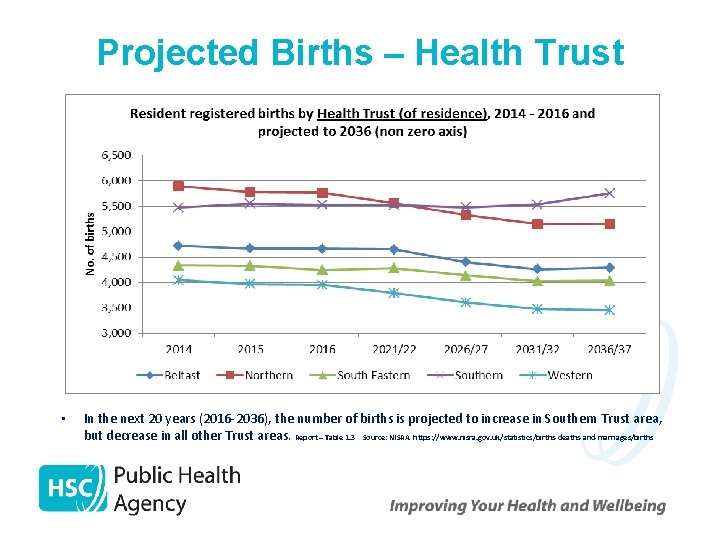
Projected Births – Health Trust • In the next 20 years (2016 -2036), the number of births is projected to increase in Southern Trust area, but decrease in all other Trust areas. Report – Table 1. 3 Source: NISRA https: //www. nisra. gov. uk/statistics/births-deaths-and-marriages/births
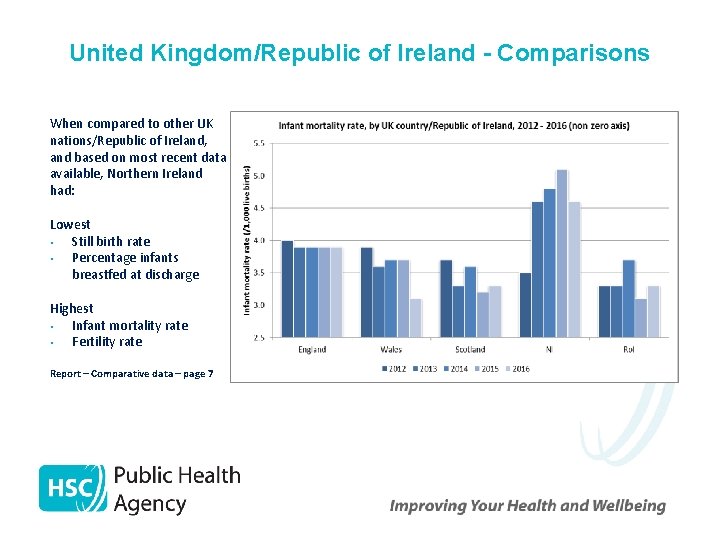
United Kingdom/Republic of Ireland - Comparisons When compared to other UK nations/Republic of Ireland, and based on most recent data available, Northern Ireland had: Lowest • Still birth rate • Percentage infants breastfed at discharge Highest • Infant mortality rate • Fertility rate Report – Comparative data – page 7
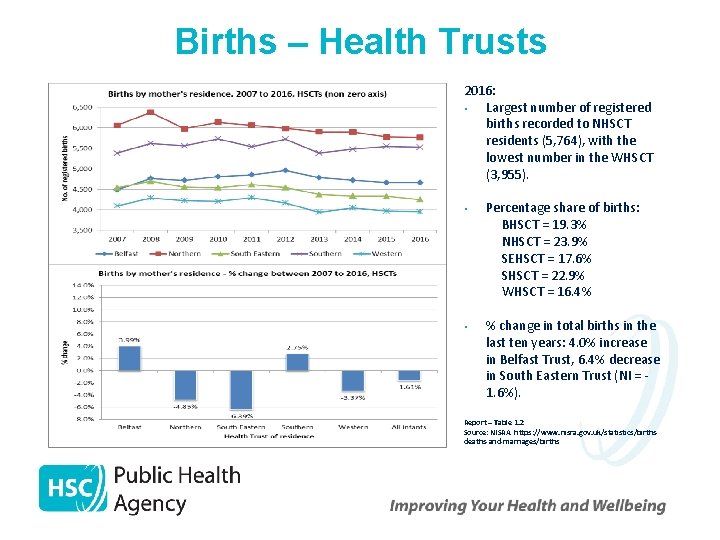
Births – Health Trusts 2016: • Largest number of registered births recorded to NHSCT residents (5, 764), with the lowest number in the WHSCT (3, 955). • Percentage share of births: –BHSCT = 19. 3% –NHSCT = 23. 9% –SEHSCT = 17. 6% –SHSCT = 22. 9% –WHSCT = 16. 4% • % change in total births in the last ten years: 4. 0% increase in Belfast Trust, 6. 4% decrease in South Eastern Trust (NI = 1. 6%). Report – Table 1. 2 Source: NISRA https: //www. nisra. gov. uk/statistics/birthsdeaths-and-marriages/births
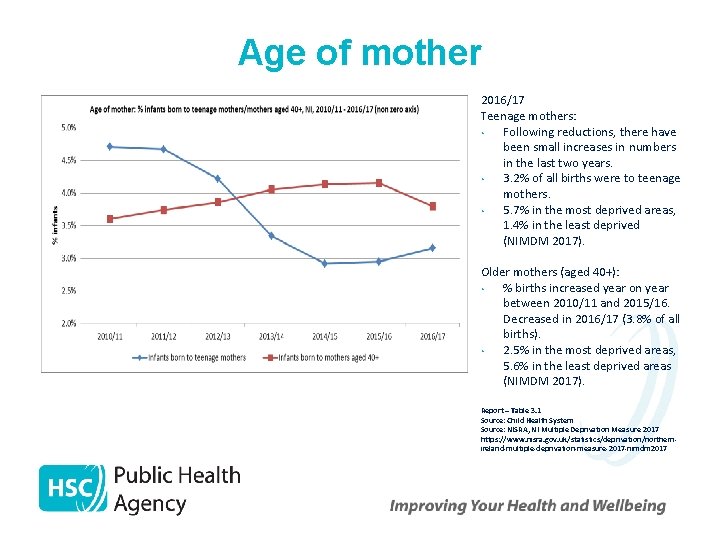
Age of mother 2016/17 Teenage mothers: • Following reductions, there have been small increases in numbers in the last two years. • 3. 2% of all births were to teenage mothers. • 5. 7% in the most deprived areas, 1. 4% in the least deprived (NIMDM 2017). Older mothers (aged 40+): • % births increased year on year between 2010/11 and 2015/16. Decreased in 2016/17 (3. 8% of all births). • 2. 5% in the most deprived areas, 5. 6% in the least deprived areas (NIMDM 2017). Report – Table 3. 1 Source: Child Health System Source: NISRA, NI Multiple Deprivation Measure 2017 https: //www. nisra. gov. uk/statistics/deprivation/northernireland-multiple-deprivation-measure-2017 -nimdm 2017
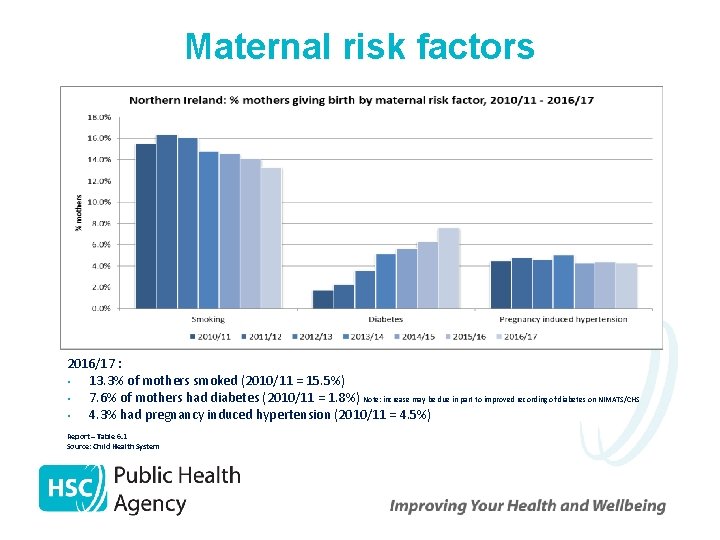
Maternal risk factors 2016/17 : • 13. 3% of mothers smoked (2010/11 = 15. 5%) • 7. 6% of mothers had diabetes (2010/11 = 1. 8%) Note: increase may be due in part to improved recording of diabetes on NIMATS/CHS • 4. 3% had pregnancy induced hypertension (2010/11 = 4. 5%) Report – Table 6. 1 Source: Child Health System
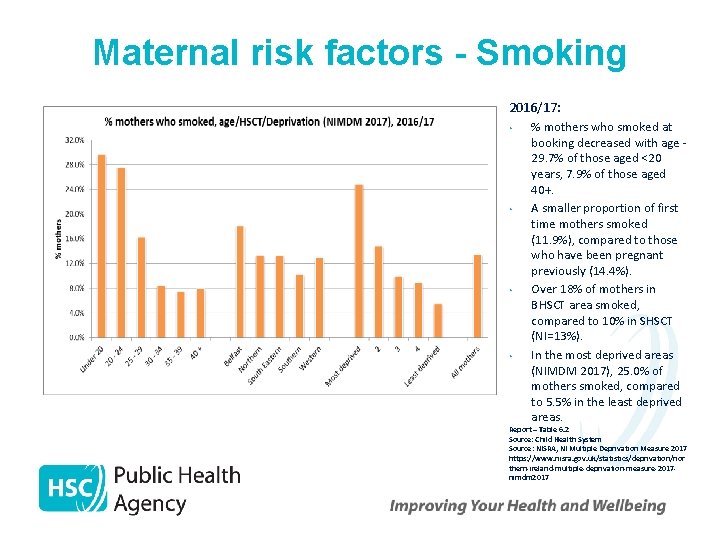
Maternal risk factors - Smoking 2016/17: • • % mothers who smoked at booking decreased with age - 29. 7% of those aged <20 years, 7. 9% of those aged 40+. A smaller proportion of first time mothers smoked (11. 9%), compared to those who have been pregnant previously (14. 4%). Over 18% of mothers in BHSCT area smoked, compared to 10% in SHSCT (NI=13%). In the most deprived areas (NIMDM 2017), 25. 0% of mothers smoked, compared to 5. 5% in the least deprived areas. Report – Table 6. 2 Source: Child Health System Source: NISRA, NI Multiple Deprivation Measure 2017 https: //www. nisra. gov. uk/statistics/deprivation/nor thern-ireland-multiple-deprivation-measure-2017 nimdm 2017
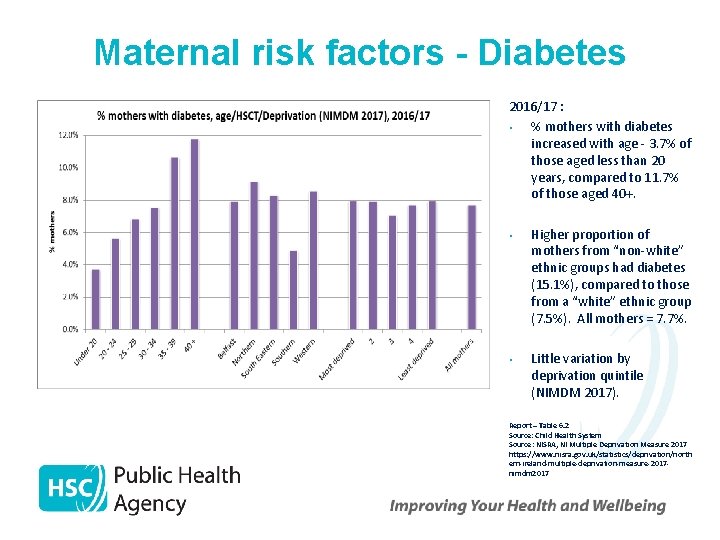
Maternal risk factors - Diabetes 2016/17 : • % mothers with diabetes increased with age - 3. 7% of those aged less than 20 years, compared to 11. 7% of those aged 40+. • Higher proportion of mothers from “non-white” ethnic groups had diabetes (15. 1%), compared to those from a “white” ethnic group (7. 5%). All mothers = 7. 7%. • Little variation by deprivation quintile (NIMDM 2017). Report – Table 6. 2 Source: Child Health System Source: NISRA, NI Multiple Deprivation Measure 2017 https: //www. nisra. gov. uk/statistics/deprivation/north ern-ireland-multiple-deprivation-measure-2017 nimdm 2017
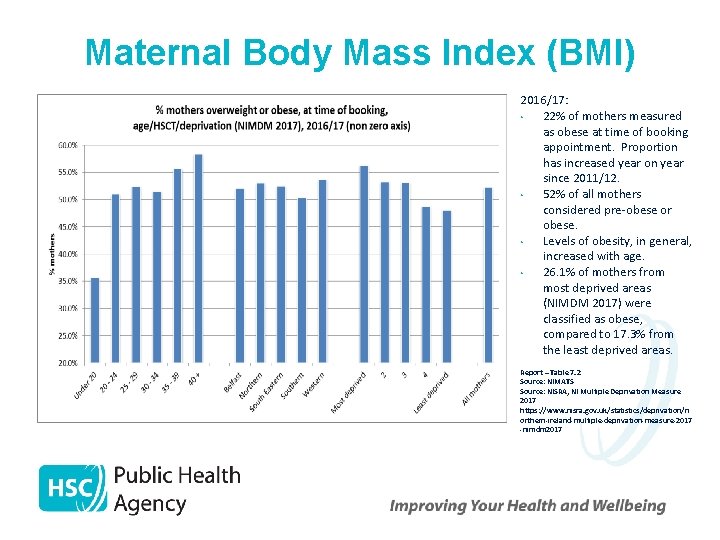
Maternal Body Mass Index (BMI) 2016/17: • 22% of mothers measured as obese at time of booking appointment. Proportion has increased year on year since 2011/12. • 52% of all mothers considered pre-obese or obese. • Levels of obesity, in general, increased with age. • 26. 1% of mothers from most deprived areas (NIMDM 2017) were classified as obese, compared to 17. 3% from the least deprived areas. Report – Table 7. 2 Source: NIMATS Source: NISRA, NI Multiple Deprivation Measure 2017 https: //www. nisra. gov. uk/statistics/deprivation/n orthern-ireland-multiple-deprivation-measure-2017 -nimdm 2017
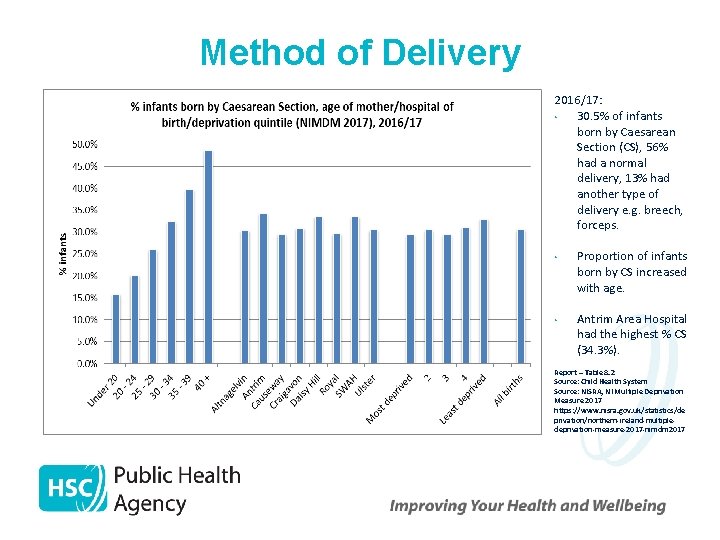
Method of Delivery 2016/17: • 30. 5% of infants born by Caesarean Section (CS), 56% had a normal delivery, 13% had another type of delivery e. g. breech, forceps. • Proportion of infants born by CS increased with age. • Antrim Area Hospital had the highest % CS (34. 3%). Report – Table 8. 2 Source: Child Health System Source: NISRA, NI Multiple Deprivation Measure 2017 https: //www. nisra. gov. uk/statistics/de privation/northern-ireland-multipledeprivation-measure-2017 -nimdm 2017
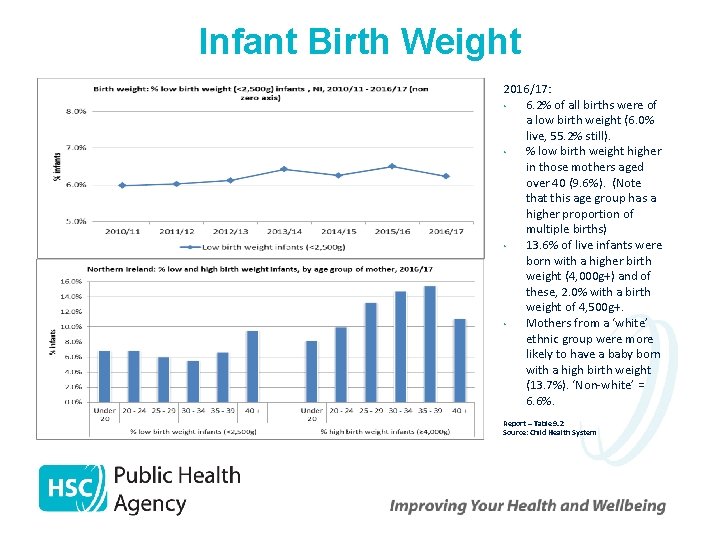
Infant Birth Weight 2016/17: • 6. 2% of all births were of a low birth weight (6. 0% live, 55. 2% still). • % low birth weight higher in those mothers aged over 40 (9. 6%). (Note that this age group has a higher proportion of multiple births) • 13. 6% of live infants were born with a higher birth weight (4, 000 g+) and of these, 2. 0% with a birth weight of 4, 500 g+. • Mothers from a ‘white’ ethnic group were more likely to have a baby born with a high birth weight (13. 7%). ‘Non-white’ = 6. 6%. Report – Table 9. 2 Source: Child Health System
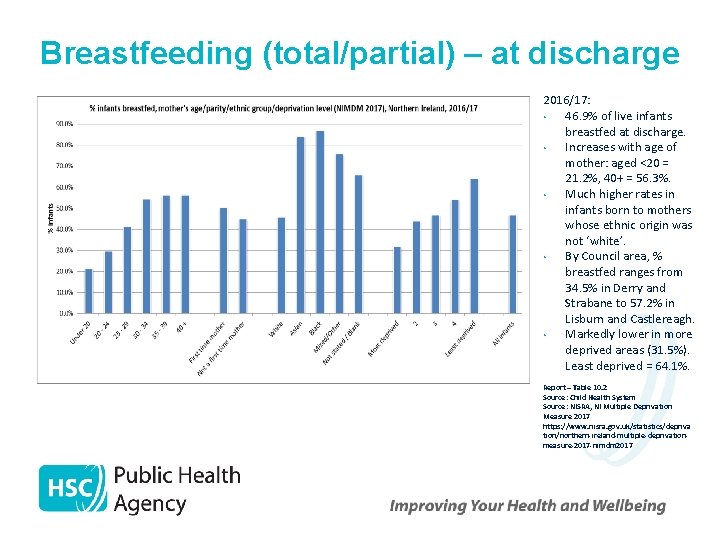
Breastfeeding (total/partial) – at discharge 2016/17: • 46. 9% of live infants breastfed at discharge. • Increases with age of mother: aged <20 = 21. 2%, 40+ = 56. 3%. • Much higher rates in infants born to mothers whose ethnic origin was not ‘white’. • By Council area, % breastfed ranges from 34. 5% in Derry and Strabane to 57. 2% in Lisburn and Castlereagh. • Markedly lower in more deprived areas (31. 5%). Least deprived = 64. 1%. Report – Table 10. 2 Source: Child Health System Source: NISRA, NI Multiple Deprivation Measure 2017 https: //www. nisra. gov. uk/statistics/depriva tion/northern-ireland-multiple-deprivationmeasure-2017 -nimdm 2017
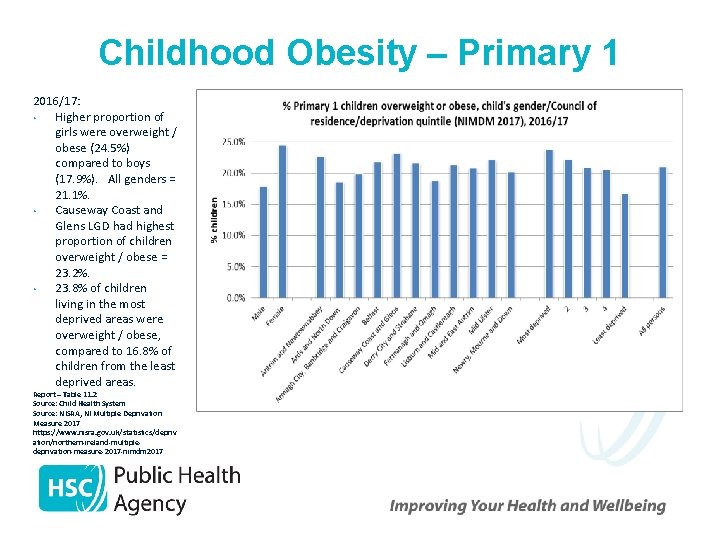
Childhood Obesity – Primary 1 2016/17: • Higher proportion of girls were overweight / obese (24. 5%) compared to boys (17. 9%). All genders = 21. 1%. • Causeway Coast and Glens LGD had highest proportion of children overweight / obese = 23. 2%. • 23. 8% of children living in the most deprived areas were overweight / obese, compared to 16. 8% of children from the least deprived areas. Report – Table 11. 2 Source: Child Health System Source: NISRA, NI Multiple Deprivation Measure 2017 https: //www. nisra. gov. uk/statistics/depriv ation/northern-ireland-multipledeprivation-measure-2017 -nimdm 2017
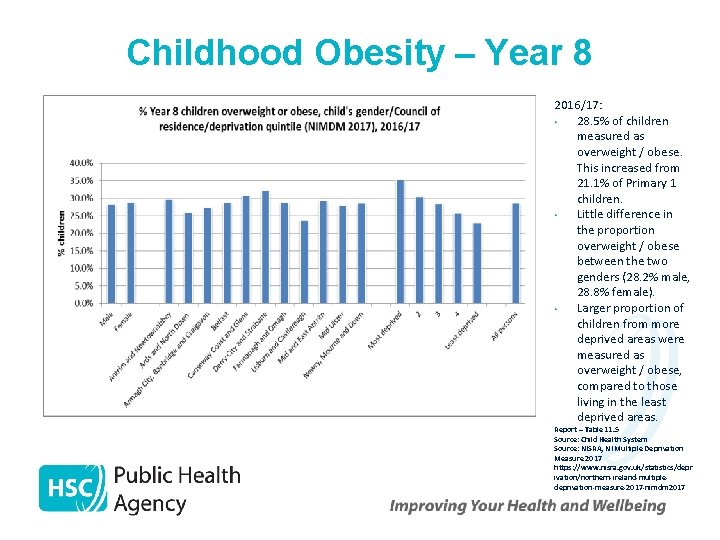
Childhood Obesity – Year 8 2016/17: • 28. 5% of children measured as overweight / obese. This increased from 21. 1% of Primary 1 children. • Little difference in the proportion overweight / obese between the two genders (28. 2% male, 28. 8% female). • Larger proportion of children from more deprived areas were measured as overweight / obese, compared to those living in the least deprived areas. Report – Table 11. 5 Source: Child Health System Source: NISRA, NI Multiple Deprivation Measure 2017 https: //www. nisra. gov. uk/statistics/depr ivation/northern-ireland-multipledeprivation-measure-2017 -nimdm 2017
- Slides: 17