
Children with an Emotional and Behavioral Disability EBD
Children with an Emotional and Behavioral Disability (EBD)
What it Means to Have EBD l l Children diagnosed with EBD have persistent and severe behaviors Behaviors can include: – Being disruptive – Anti-social – Aggressive – Hyperactivity – Poor social skills
DPI Qualifications of EBD l l l There assessments as well as an eligibility checklist to determine of the student may qualify for EBD services. The DPI definition of EBD is on the following two slides Link to eligibility checklist – http: //dpi. wi. gov/sites/default/files/imce/forms/pdf/ podelg-ebd-001. pdf Source: https: //sped. dpi. wi. gov/sped_ed
DPI Qualifications of EBD l l The student exhibits social, emotional or behavioral functioning that so departs from generally accepted, age appropriate ethnic or cultural norms that it adversely affects a child's academic progress, social relationships, personal adjustment, classroom adjustment, self-care or vocational skills; The behaviors are severe, chronic, and frequent, occur at school and at least 1 other setting, and the student exhibits at least 1 of 8 characteristics or patterns of behavior indicative of EBD Source: https: //sped. dpi. wi. gov/sped_ed
DPI Qualifications of EBD l l The IEP team used a variety of sources of information including observations and has reviewed prior, documented interventions; and, The IEP team did not identify or refuse to identify a student as EBD solely on the basis of another disability, social maladjustment, adjudicated delinquency, dropout, chemically dependency, cultural deprivation, familial instability, suspected child abuse, socioeconomic circumstances, or medical or psychiatric diagnostic statements. Source: https: //sped. dpi. wi. gov/sped_ed
Impact of EBD on a Student There are many types of behaviors that can impact the student both academically and functionally in elementary school l May have difficulty learning that is not explained by a learning disability l May struggle with social skills which does not allow students to make friends with their peers or connect with their teachers l May be aggressive physically towards other students or teachers which causes other students to be afraid of them which may cause stigmatization l Student may be depressed or unhappy which makes being in school all day difficult
Goals of Students with EBD Goals can vary for students based on their behaviors but some examples may include: l l l Staying in the classroom Working collaboratively with peers Completing homework Having positive peer interactions Reacting appropriately when frustrated (not being physically aggressive)
Typical Services for Students with EBD l Some students are able to stay in the classroom with supplementary aids and services – Assist student with making proper choices, give positive reinforcement, provide prompts l Some are in self-contained and in pull-out programming for all or part of the school day (these may be at the school or an alternative program) – Behaviors are too severe to be in regular classroom
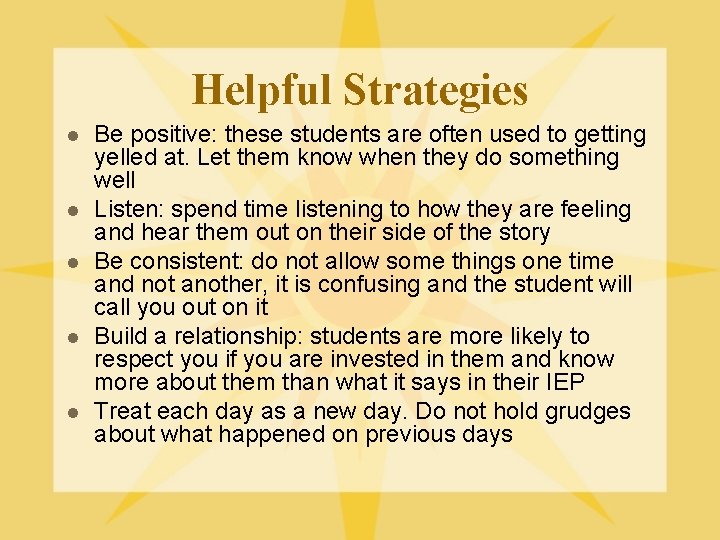
Helpful Strategies l l l Be positive: these students are often used to getting yelled at. Let them know when they do something well Listen: spend time listening to how they are feeling and hear them out on their side of the story Be consistent: do not allow some things one time and not another, it is confusing and the student will call you out on it Build a relationship: students are more likely to respect you if you are invested in them and know more about them than what it says in their IEP Treat each day as a new day. Do not hold grudges about what happened on previous days
- Slides: 9