
Children Family and the Community Prepared by Carnela
![Children, Family and the Community Prepared by: Carnela Coleman 1/20/2022 [Project Name] 1](https://slidetodoc.com/presentation_image_h2/847ac7d1a152f81c7910f469c2290a25/image-1.jpg "Children, Family and the Community Prepared by: Carnela Coleman 1/20/2022 [Project Name] 1")
Children, Family and the Community Prepared by: Carnela Coleman 1/20/2022 [Project Name] 1
Introduction • Objective – The goal of this presentation is to discuss how all parties collaborate working together with the children ages five through thirteen, family as well as the community provide the best overall quality of care and quality of life needed for a child to succeed in their learning development that will progress to their life's accomplishments. • Outcome – The strategic decisions required to allow all parties to move forward to the next phase by understanding how positive interaction and involvement influences a child’s learning and development when families, schools, and the community remain connected. 1/20/2022 [Project Name] 2
Agenda • Brief History and Describing the period of development ages 5 -13. • Role as a child development for children in that age group for those professional. • Good to Know: rationale this presentation supports • The Mesosystem from Bronfenbrenner’s Ecological System so parents understand how families, schools, and the community are connected. • Introducing Epstein’s Types of Involvement. • Epstein's Types of Involvement that describes: *The name of the type of involvement. *How this type of involvement influences a child’s learning and development. *At least one idea schools or communities could implement right away that aligns with the cultures represented at the school. 1/20/2022 [Project Name] 3
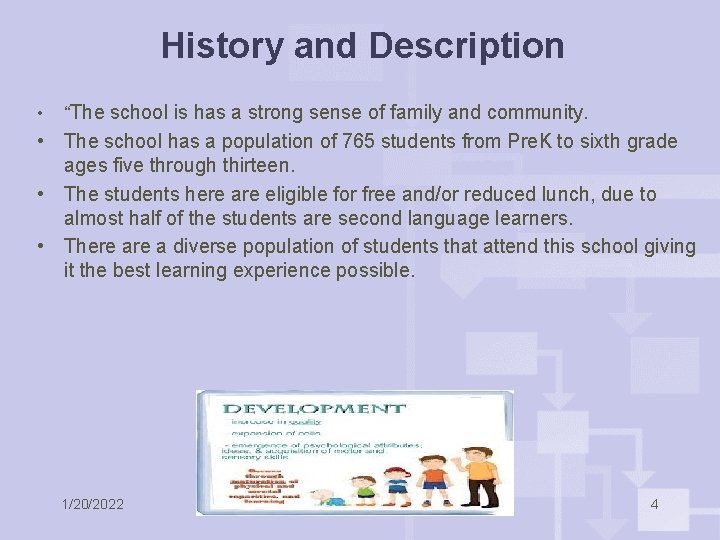
History and Description • “The school is has a strong sense of family and community. • The school has a population of 765 students from Pre. K to sixth grade ages five through thirteen. • The students here are eligible for free and/or reduced lunch, due to almost half of the students are second language learners. • There a diverse population of students that attend this school giving it the best learning experience possible. 1/20/2022 [Project Name] 4

Role as a Child Development Professional Role as a child development professional is to provide supportive services while academically teaching children the technical educational skills needed to successfully become self sufficient and succeed in todays society. 1/20/2022 [Project Name] 5
Good to Know • “Children who feel good about themselves are more able to resist negative peer pressure and make better choices for themselves. This is an important time for children to gain a sense of responsibility along with their growing independence. ” (CDCP, 2014) • Another important factor mentioned was “Erikson's notion that feelings of competence and personal esteem are of central importance for a child's well-being. 4, 5 For instance, children who do not see themselves as competent in academic, social, or other domains (such as athletics, music, drama, or scouting) during their elementary school years report depression and social isolation more often than their peers, 6 as well as anger and aggression. 7”(Jacquelynne S. Eccles, 2013) 1/20/2022 [Project Name] 6
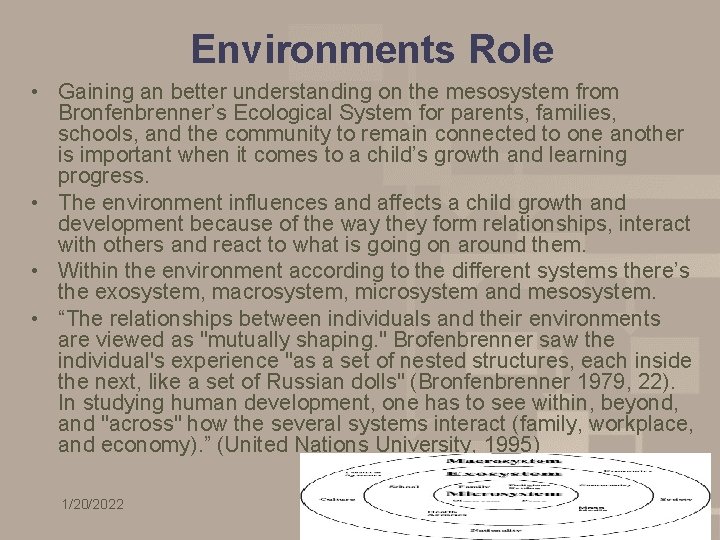
Environments Role • Gaining an better understanding on the mesosystem from Bronfenbrenner’s Ecological System for parents, families, schools, and the community to remain connected to one another is important when it comes to a child’s growth and learning progress. • The environment influences and affects a child growth and development because of the way they form relationships, interact with others and react to what is going on around them. • Within the environment according to the different systems there’s the exosystem, macrosystem, microsystem and mesosystem. • “The relationships between individuals and their environments are viewed as "mutually shaping. " Brofenbrenner saw the individual's experience "as a set of nested structures, each inside the next, like a set of Russian dolls" (Bronfenbrenner 1979, 22). In studying human development, one has to see within, beyond, and "across" how the several systems interact (family, workplace, and economy). ” (United Nations University, 1995) 1/20/2022 [Project Name] 7
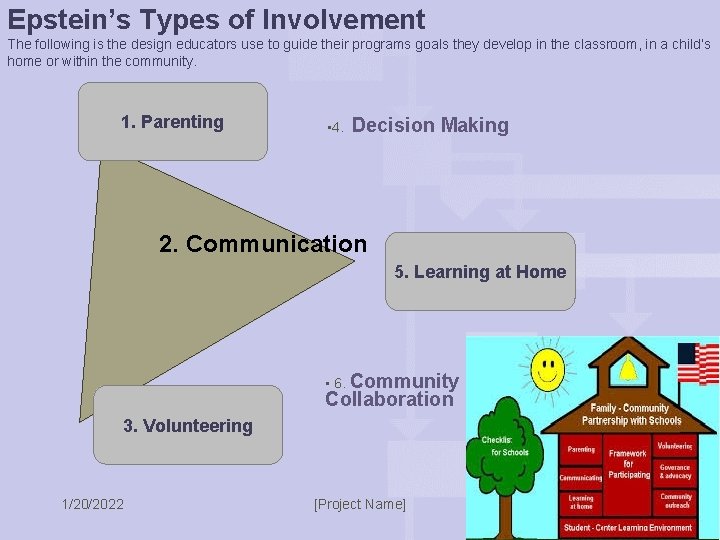
Epstein’s Types of Involvement The following is the design educators use to guide their programs goals they develop in the classroom, in a child’s home or within the community. 1. Parenting • 4. Decision Making 2. Communication 5. Learning at Home • 6. Community Collaboration 3. Volunteering 1/20/2022 [Project Name] 8
Epstein’s Types of Involvement Communication • Open communication is necessary amongst the child, parents, educators and the community in an effort for the child to progress and grow successfully. • Discussions about a child’s progress, medical, programs, events, activities, disability, problems, concerns, interest, journaling, goals, interventions, testing, assessments, evaluations, gifts, strengths, competencies, talents and anything that can add to the child’s future success should and can be communicated amongst all interested parties. • Communication can be done in a formal or non formal setting; one-on -one or in a group; face to face and or over the phone as an interview, logged in a journal daily, in a memo or an email or in a casual conversation. • Effective communication should be slow to respond as well as patient, warm, empathetic, caring and positive and never judgmental, criticized, one-sided or opinionated for it is about the quality of life and care of the child when looking at their best interest at heart. 1/20/2022 [Project Name] 9
References • Center for Disease and Control and Prevention (CDCP), 2014; Middle Childhood (9 -11 years of age) Developmental Milestones… http: //www. cdc. gov/ncbddd/childdevelopment/positiveparenting/middle • • Jacquelynne S. Eccles, 2013; The Future of Children, The Development of Children Ages 6 to 14… http: //www. princeton. edu • • • United Nations University 1995; The family from a child development perspective …http: //archive. unu. edu/unupress/unupbooks/uu 13 se 06. htm 1/20/2022 [Project Name] 10
- Slides: 10