
CHILDREN AND YOUTH ADHD AND IMPULSE CONTROL ATTENTION

- Slides: 14
CHILDREN AND YOUTH ADHD AND IMPULSE CONTROL
ATTENTION DEFICIT HYPERACTIVITY DISORDER (ADHD) �Affects 5) 5% of children, 3 -17 ys. (DSM- ◦ Parents surveyed suggest 11% (2011) � 4% of adults (2014) �Core Symptoms of ADHD: � Inattention � Impulsivity � Hyperactivity
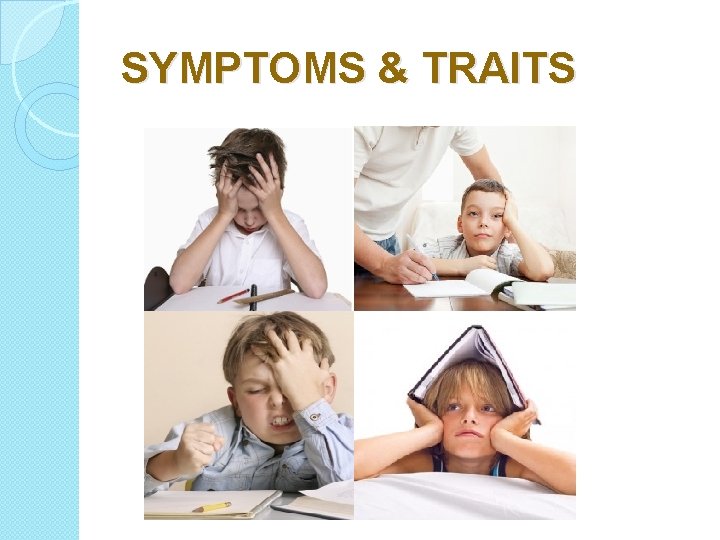
SYMPTOMS & TRAITS
ADHD SYMPTOMS: INATTENTION �Easily distracted �Difficulty focusing �Easily bored �Disorganized, losing things �Not listening, following instructions �Slowly processing information �Daydreaming
ADHD SYMPTOMS OF IMPULSIVITY �Impatience �Blurting �Lack out inappropriate comments of emotional restraint �Acting without regard for consequences �Impatient, not waiting for their turn
ADHD SYMPTOMS OF HYPERACTIVITY �Fidgeting/squirming �Constantly touching things �Excessive talking �Constantly moving �Difficulty doing quiet tasks
RESEARCH-SUGGESTED CAUSES �Genetics �May run in families �Brain tissues abnormalities �Environmental Factors: �Link to smoking/drinking alcohol during pregnancy �Link to young children exposed to lead �Brain Injury - may show similar symptoms �Research/Studies into causes still ongoing
DIAGNOSIS AND TREATMENT �Diagnosed specialist by a mental health �Pediatrician may want to rule out health factors �Treatment: �Medication �Psychotherapy �Education/training �Combination of treatments �No known “cure” �Treatments focus on reducing symptoms & improving functioning
COEXISTING CONDITIONS �Learning Disability �Oppositional Defiant Disorder (ODD) �Conduct Disorder �Anxiety and Depression �Bipolar Disorder �Tourette Syndrome �Mood Disorders �Substance Use Disorders
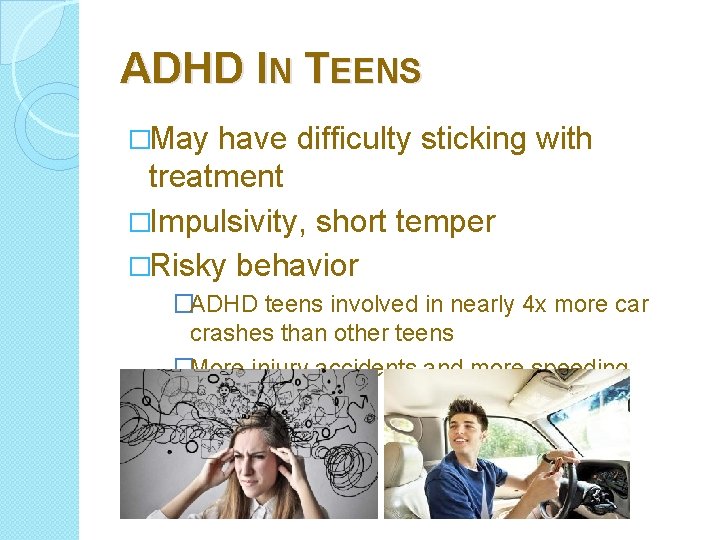
ADHD IN TEENS �May have difficulty sticking with treatment �Impulsivity, short temper �Risky behavior �ADHD teens involved in nearly 4 x more car crashes than other teens �More injury accidents and more speeding tickets
ADHD IN ADULTS �Difficulty keeping job, schedule, appointments �Failed relationships �Restless �Unsuccessful multitasking �Seeks out “quick fixes” rather than taking time to complete a task correctly
ADHD IN THE CRIMINAL JUSTICE SYSTEM �May commit crimes related to impulsivity and heightened emotional reactivity �Shoplifting, assault/battery, traffic violations, vandalism �May be crime victims or manipulated into committing crimes �ADHD associated with Conduct Disorder/Antisocial Personality Disorder (career criminal behavior)
INTERACTING WITH CITIZENS WHO HAVE ADHD �Ask one question at a time �Be clear, simple and direct �Repeat as necessary �Subjects may have agitation/outbursts �Subjects may have poor memory, impaired sense of time and direction �Subjects may try to rush through conversation
QUESTIONS? THANK YOU!