
Childmotivated refusal to attend school or difficulty remaining

- Slides: 23
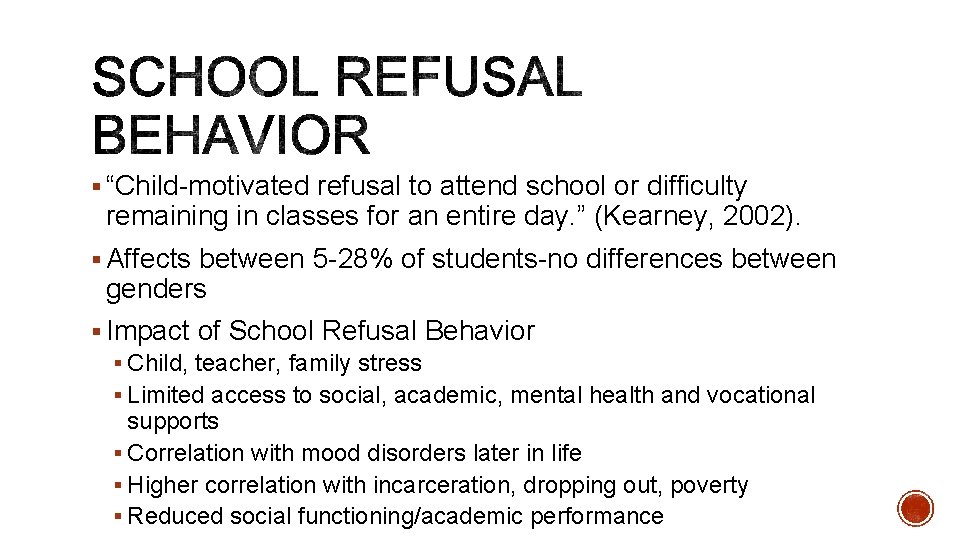
§ “Child-motivated refusal to attend school or difficulty remaining in classes for an entire day. ” (Kearney, 2002). § Affects between 5 -28% of students-no differences between genders § Impact of School Refusal Behavior § Child, teacher, family stress § Limited access to social, academic, mental health and vocational supports § Correlation with mood disorders later in life § Higher correlation with incarceration, dropping out, poverty § Reduced social functioning/academic performance
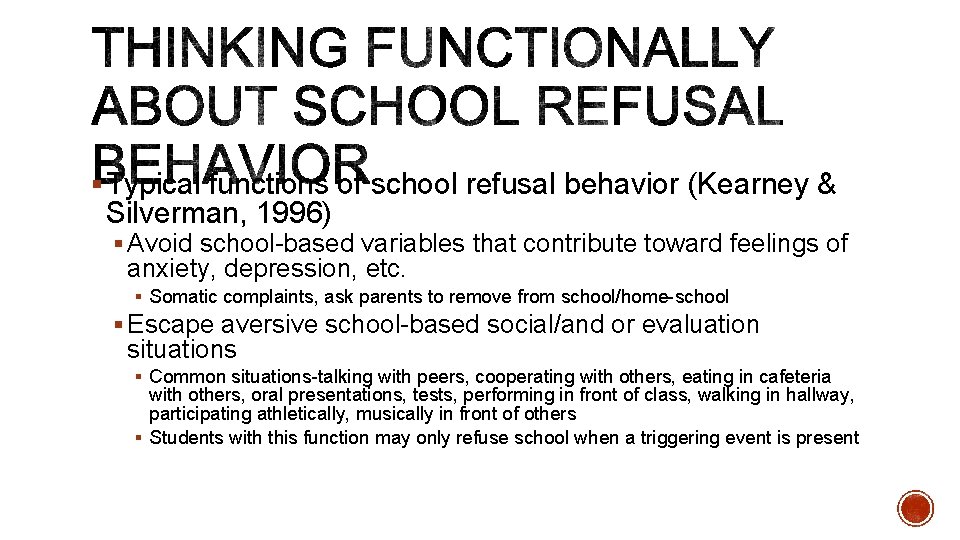
§ Typical functions of school refusal behavior (Kearney & Silverman, 1996) § Avoid school-based variables that contribute toward feelings of anxiety, depression, etc. § Somatic complaints, ask parents to remove from school/home-school § Escape aversive school-based social/and or evaluation situations § Common situations-talking with peers, cooperating with others, eating in cafeteria with others, oral presentations, tests, performing in front of class, walking in hallway, participating athletically, musically in front of others § Students with this function may only refuse school when a triggering event is present
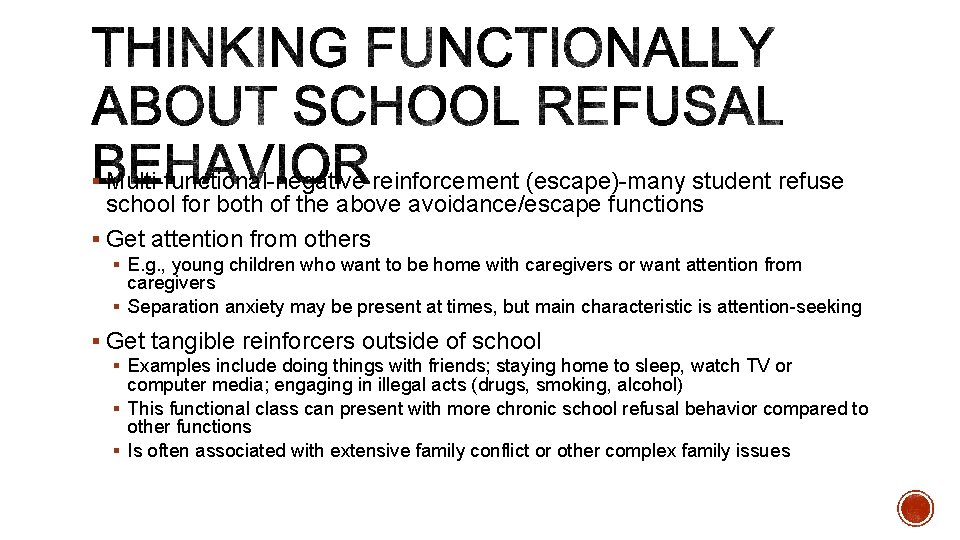
§ Multi-functional-negative reinforcement (escape)-many student refuse school for both of the above avoidance/escape functions § Get attention from others § E. g. , young children who want to be home with caregivers or want attention from caregivers § Separation anxiety may be present at times, but main characteristic is attention-seeking § Get tangible reinforcers outside of school § Examples include doing things with friends; staying home to sleep, watch TV or computer media; engaging in illegal acts (drugs, smoking, alcohol) § This functional class can present with more chronic school refusal behavior compared to other functions § Is often associated with extensive family conflict or other complex family issues
§ School refusal can be multi-functional (both escape and obtain) § E. g. , student may first refuse school to avoid aversive stimuli but likes having access to tangibles or attention when home
§ Covers all students who miss school § Can generate function-linked strategies that can be feasibly implemented in school by typical practitioners (Kearney & Albano, 2000) § School refusal due to anxiety - CBT most commonly used § School refusal not due to anxiety- CBT strategies used for anxiety not effective § CBT Study (Kearney & Silverman, 1999) § Compared function-based and non-function based treatment for eight children/youth § Function-based treatment improved § Non-function-based treatment resulted in worsening school-refusal rates.
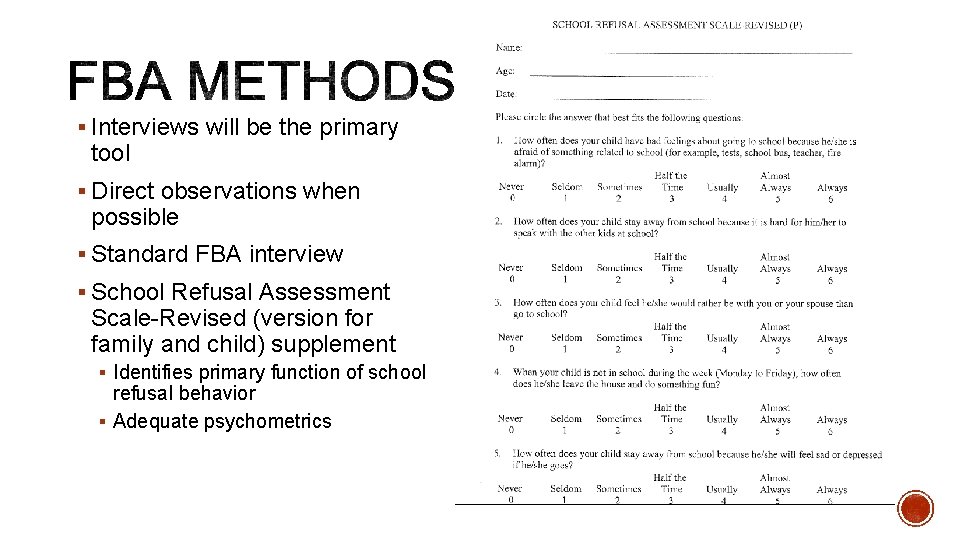
§ Interviews will be the primary tool § Direct observations when possible § Standard FBA interview § School Refusal Assessment Scale-Revised (version for family and child) supplement § Identifies primary function of school refusal behavior § Adequate psychometrics
§ Linked to hypothesis § Prevention intervention to modify setting event (if present and appropriate) and antecedents § Replacement behavior to be taught (functional equivalent and/or desired skills) § Reinforcement interventions-increase replacement behavior; decrease school refusal
§ School Refusal Behavior Definition—cries (shouts, sobs, reports illnesses) daily at home with parents protesting going to school, eats sparingly, sleeps intermittently through the night, expresses feelings of illness at school including nausea, hot flashes, palpitations, breathlessness, lightheadedness; engages in idiosyncratic speech (speaks in a manner characteristic of very young children) § Celia does attend school but is distressed throughout the day. The behaviors above happen every day at home (morning and evening) with the idiosyncratic speech happening in school and home § Setting events—separation anxiety-In interview, Celia reports that she worries about her parents’ wellbeing when she is not with them
§ School antecedents—being in social situations including PE, eating in cafeteria, parties, riding on school bus, speaking up in class, talking to teachers and administrators; § Antecedents for idiosyncratic speech include activities that are non- preferred (e. g. involving social interaction) or boring § Consequences/responses from others—Home: parents talk, cajole, promise activities and items if Celia goes to school, soothe and calm § Teachers provide soothing/calming, other educators provide soothing/calming. Celia rarely gets sent home due to behaviors.
§What would be your hypothesis for Celia’s school refusal behavior? §Share
§ Hypothesis 1: When Celia is: (a) required to be in a setting that separates her from her parents, and (b) required to be in school-based social situations, she will exhibit school refusal behavior. As a result, she gets attention from her parents, specifically her mother, and secondarily from teachers and other adults in school, and obtains soothing of her separation anxiety. § Hypothesis 2: When Celia is: (a) required to be in a setting that separates her from her parents, and (b) requested to do activities that are non-preferred (require social interaction or are perceived as boring), she will exhibit idiosyncratic speech. As a result, she gets attention from her parents, specifically her mother, and secondarily from teachers and other adults in school, and obtains soothing of her separation anxiety.
§ Reverse your number of team (e. g. 1’s are 2’s, 2’s are 1’s). § Team 1 addresses hypothesis 1 § Team 2 addresses hypothesis 2 § Come to consensus on a multi-component intervention plan linked to the hypothesis to address Celia’s school-refusal behavior. You can focus on an intervention for parents to do at home or school-based interventions or both.
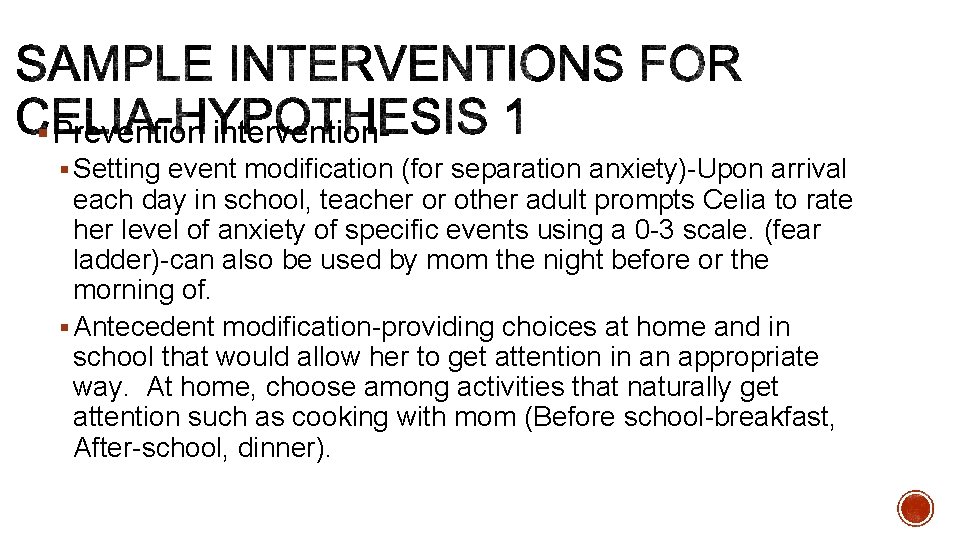
§ Prevention intervention§ Setting event modification (for separation anxiety)-Upon arrival each day in school, teacher or other adult prompts Celia to rate her level of anxiety of specific events using a 0 -3 scale. (fear ladder)-can also be used by mom the night before or the morning of. § Antecedent modification-providing choices at home and in school that would allow her to get attention in an appropriate way. At home, choose among activities that naturally get attention such as cooking with mom (Before school-breakfast, After-school, dinner).
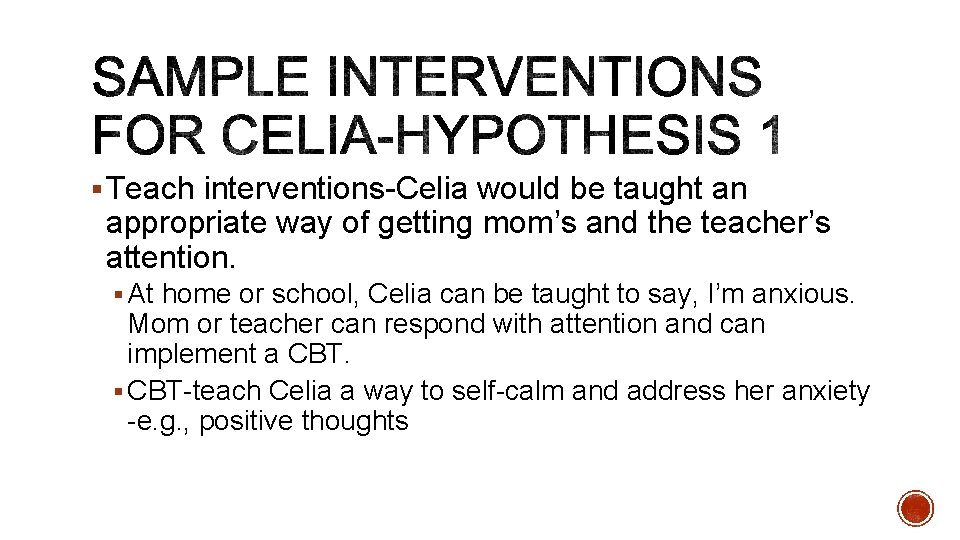
§ Teach interventions-Celia would be taught an appropriate way of getting mom’s and the teacher’s attention. § At home or school, Celia can be taught to say, I’m anxious. Mom or teacher can respond with attention and can implement a CBT. § CBT-teach Celia a way to self-calm and address her anxiety -e. g. , positive thoughts
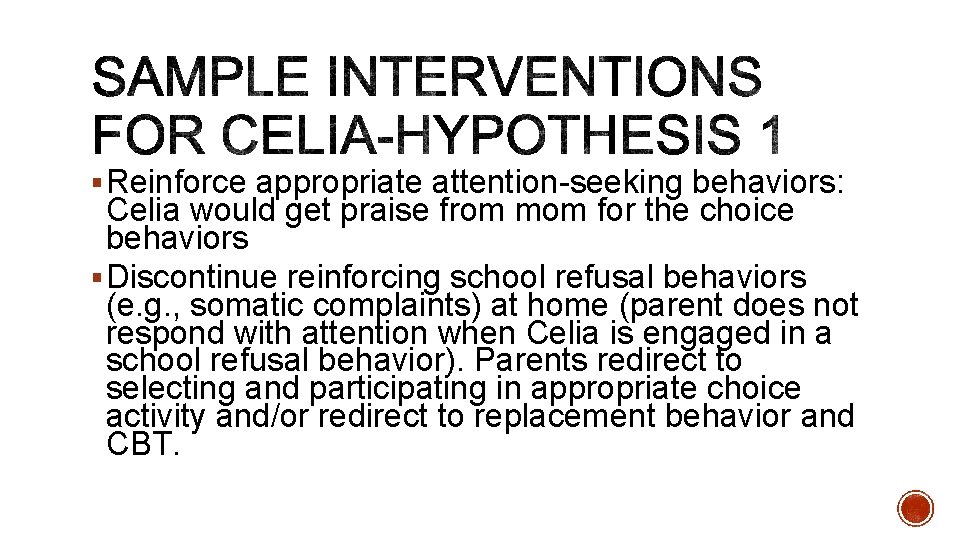
§ Reinforce appropriate attention-seeking behaviors: Celia would get praise from mom for the choice behaviors § Discontinue reinforcing school refusal behaviors (e. g. , somatic complaints) at home (parent does not respond with attention when Celia is engaged in a school refusal behavior). Parents redirect to selecting and participating in appropriate choice activity and/or redirect to replacement behavior and CBT.
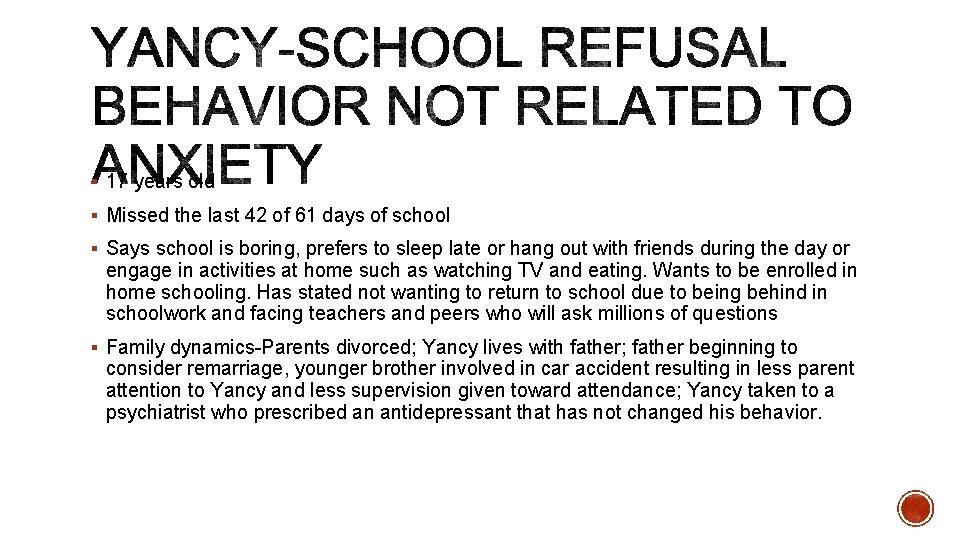
§ 17 years old § Missed the last 42 of 61 days of school § Says school is boring, prefers to sleep late or hang out with friends during the day or engage in activities at home such as watching TV and eating. Wants to be enrolled in home schooling. Has stated not wanting to return to school due to being behind in schoolwork and facing teachers and peers who will ask millions of questions § Family dynamics-Parents divorced; Yancy lives with father; father beginning to consider remarriage, younger brother involved in car accident resulting in less parent attention to Yancy and less supervision given toward attendance; Yancy taken to a psychiatrist who prescribed an antidepressant that has not changed his behavior.
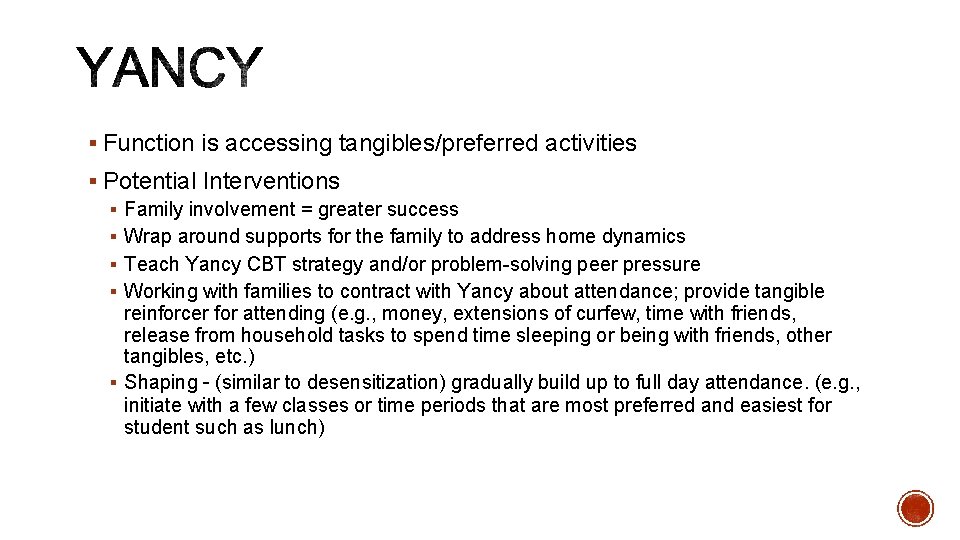
§ Function is accessing tangibles/preferred activities § Potential Interventions § Family involvement = greater success § Wrap around supports for the family to address home dynamics § Teach Yancy CBT strategy and/or problem-solving peer pressure § Working with families to contract with Yancy about attendance; provide tangible reinforcer for attending (e. g. , money, extensions of curfew, time with friends, release from household tasks to spend time sleeping or being with friends, other tangibles, etc. ) § Shaping – (similar to desensitization) gradually build up to full day attendance. (e. g. , initiate with a few classes or time periods that are most preferred and easiest for student such as lunch)
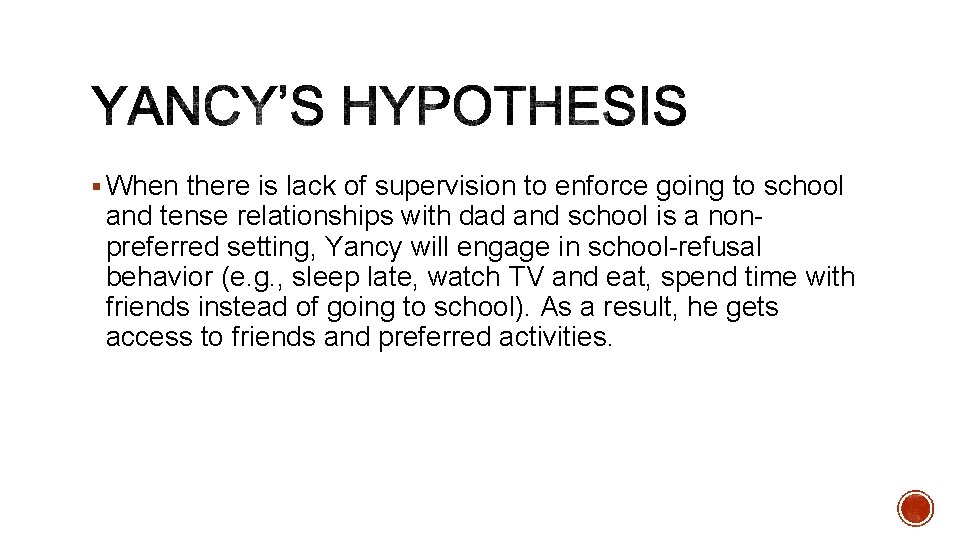
§ When there is lack of supervision to enforce going to school and tense relationships with dad and school is a nonpreferred setting, Yancy will engage in school-refusal behavior (e. g. , sleep late, watch TV and eat, spend time with friends instead of going to school). As a result, he gets access to friends and preferred activities.
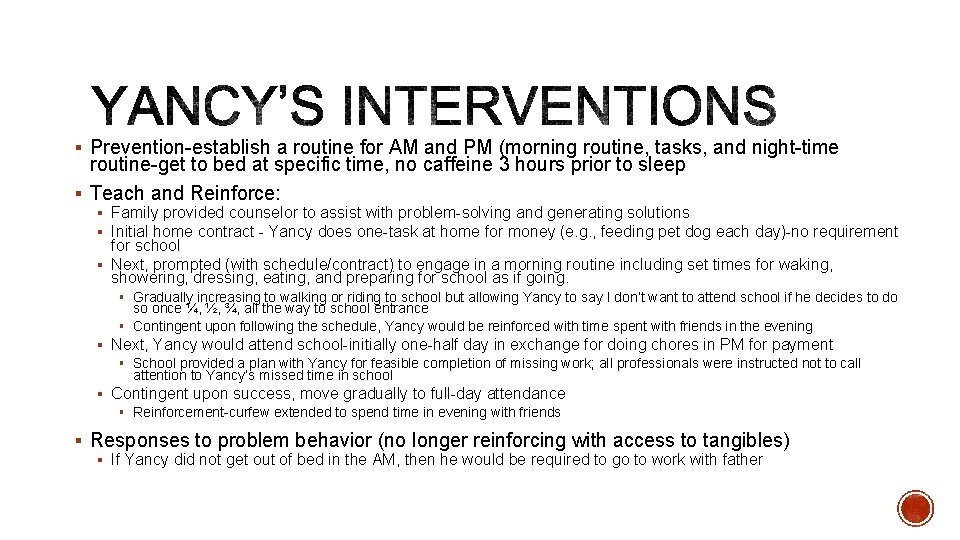
§ Prevention-establish a routine for AM and PM (morning routine, tasks, and night-time routine-get to bed at specific time, no caffeine 3 hours prior to sleep § Teach and Reinforce: § Family provided counselor to assist with problem-solving and generating solutions § Initial home contract - Yancy does one-task at home for money (e. g. , feeding pet dog each day)-no requirement for school § Next, prompted (with schedule/contract) to engage in a morning routine including set times for waking, showering, dressing, eating, and preparing for school as if going. § Gradually increasing to walking or riding to school but allowing Yancy to say I don’t want to attend school if he decides to do so once ¼, ½, ¾, all the way to school entrance § Contingent upon following the schedule, Yancy would be reinforced with time spent with friends in the evening § Next, Yancy would attend school-initially one-half day in exchange for doing chores in PM for payment § School provided a plan with Yancy for feasible completion of missing work; all professionals were instructed not to call attention to Yancy’s missed time in school § Contingent upon success, move gradually to full-day attendance § Reinforcement-curfew extended to spend time in evening with friends § Responses to problem behavior (no longer reinforcing with access to tangibles) § If Yancy did not get out of bed in the AM, then he would be required to go to work with father
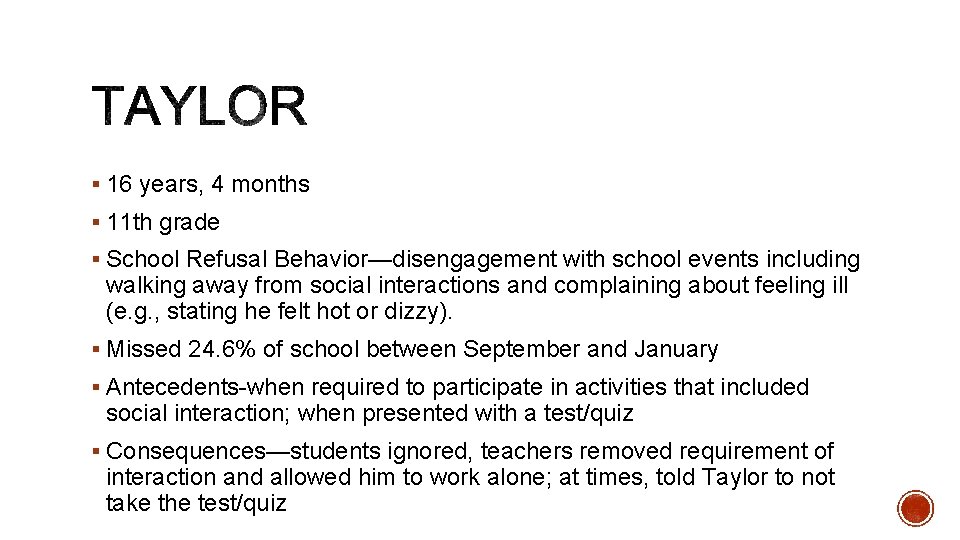
§ 16 years, 4 months § 11 th grade § School Refusal Behavior—disengagement with school events including walking away from social interactions and complaining about feeling ill (e. g. , stating he felt hot or dizzy). § Missed 24. 6% of school between September and January § Antecedents-when required to participate in activities that included social interaction; when presented with a test/quiz § Consequences—students ignored, teachers removed requirement of interaction and allowed him to work alone; at times, told Taylor to not take the test/quiz
§ What is Taylor’s hypothesis? § What would be Taylor’s intervention plan? § Share
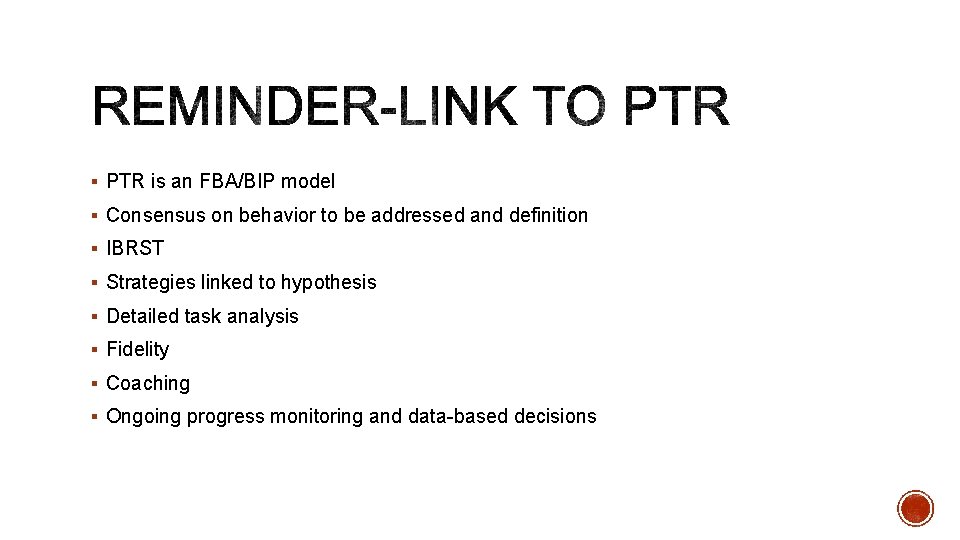
§ PTR is an FBA/BIP model § Consensus on behavior to be addressed and definition § IBRST § Strategies linked to hypothesis § Detailed task analysis § Fidelity § Coaching § Ongoing progress monitoring and data-based decisions