
Childhood Trauma Task Force December 3 rd 1
Childhood Trauma Task Force December 3 rd 1 pm – 3 pm
Agenda • Welcome and Introductions • Review of Annual Legislative Report Draft • Discussion: Creating Guidelines for Trauma-Informed Practice in Massachusetts

ANNUAL LEGISLATIVE REPORT DRAFT
Trauma-Informed and Responsive Care Principles and Domains: Adapted from SAMHSA for Statewide Application November 2019
Purpose of Framework • The purpose of this document is to articulate principles of traumainformed and responsive care that can apply to any school, healthcare provider, law enforcement agency, community organization, state agency or other entity that comes into contact with children and youth. From this point forward, we will refer to these entities collectively as “agencies and organizations. ” • This document relies on the trauma definition, principles, and domains as described by the federal Substance Abuse and Mental Health Services Administration (SAMHSA). The principles and domains have been adapted for use across sectors. • The framework will use “child, ” “children, ” and “youth” interchangeably. All terms refer to individuals under 18 years old (footnote)
Defining Trauma • “Individual trauma results from an event, series of events, or set of circumstances that is experienced by an individual as physically or emotionally harmful or life threatening and that has lasting adverse effects on the individual’s functioning and mental, physical, social, emotional, or spiritual well-being. ” SAMHSA (2014) • When a child experiences a traumatic event, it can interfere with the child’s development, which may result in changes in the child’s behavior or cognitive functioning. • Common cognitive issues associated with trauma include problems with memory, attention, and emotional regulation. • In addition, some children will experience physical symptoms such as headaches, stomachaches, and muscle pain. • It is important to remember that no two children will react to the same traumatic event in the same way.
Trauma-Informed and Responsive Adults • Trauma-informed and responsive adults know that all children, including those with trauma histories, have strengths, capabilities, and talents that should be nurtured throughout their lives. • Any adult who interacts with a child can be trauma-informed and responsive by doing the following: – Recognizing behaviors and physical symptoms that may be signs of trauma – Realizing that the behaviors are the child’s way of communicating emotions and coping with the effects of trauma – Responding to these behaviors in ways that avoid re-traumatization – Educating other adults about how to interact with children in traumainformed and responsive ways
Trauma-Informed and Responsive Adults • Some TIR adults will have short-term interactions with children that may last a day, week, or month. These brief interactions can still have powerful effects on the lives of children and families. • Other TIR adults will have ongoing relationships with the child and their family that could last throughout their lives. TIR adults with longer-term relationships with children can respond to a child’s trauma reaction by: – Teaching children healthy ways of expressing feelings and coping with stressful situations – Identifying and supporting the development of a child’s strengths – Seeking additional professional help when appropriate
Trauma-Informed and Responsive Systems • The National Child Traumatic Stress Network (NCTSN) defines a trauma-informed system as: – “…. one in which all parties involved recognize and respond to the impact of traumatic stress on those who have contact with the system, including children, caregivers, and service providers. Programs and agencies within such a system infuse and sustain trauma awareness, knowledge, and skills into organizational cultures, practices, and policies. ” • This definition was originally written for child and family service systems. However, the Childhood Trauma Task Force strongly encourages all institutions that come into contact with children and families to not only become trauma-informed and responsive themselves, but also work with partners across sectors to develop TIR systems in the community.
Principle #1: Safety • Children and youth who have experienced trauma have had their sense of safety disrupted. Therefore, it is vital for any adult who interacts with children to ensure the child’s physical and emotional safety using a culturally competent approach. • Ensuring a child’s physical safety means making sure that any spaces where children may be are designed to prevent physical injury and are properly maintained. It also means ensuring that children are protected from physical or sexual abuse from adults who have been entrusted with their care. • Ensuring a child’s emotional safety means: – Empowering all children to be their authentic selves – Teaching, supporting, and encouraging children to build relationships and be empathetic towards others – Allowing children to express their ideas, thoughts, and emotions without fear of ridicule or shame – Taking action to prevent bullying, coercion, and other abuses of power • Physical and emotional safety are deeply intertwined; one cannot exist without the other. • Agencies and organizations must also take steps to ensure the physical and emotional safety of staff members at all levels.
Principle #2: Trustworthiness and Transparency • Children and youth who have experienced trauma may be distrustful of authority figures and others who have power to make decisions that can impact their lives. • In addition, there are entire communities who have been subjected to abuse and harm by powerful institutions and individuals. Therefore, it is essential that trauma-informed and responsive individuals and institutions focus on how to build and maintain trust with traumatized children, youth and their families. • Transparency can be an effective tool in building trust with children, families, and communities. Whenever possible and within the bounds of confidentiality, adults who interact with children and youth should: – Engage in open and clear conversations with children and their families, especially regarding decisions that directly impact the child. – Be transparent and open about what information will be shared with whom – Specify what information will remain confidential – Explain the legal and practical implications of information-sharing and disclosures – Provide information in as timely of a manner as possible
Principle #3: Empowerment, Voice, and Choice • Children and youth who have experienced trauma may feel a loss of control and that they are powerless to do anything to change their situation. As such, adults who interact with children and youth should empower them make decisions about own their lives whenever possible. • Adults can empower children and youth by including them in decisionmaking processes, giving them choices, helping them set goals, and teaching them how to advocate for themselves. • In situations where a youth has caused harm, adults can also empower them by helping the youth identify ways of addressing the situation, accepting responsibility for their actions, and, where possible, repairing the harm that was done (i. e. restorative responses). • Families also need opportunities to have the same experiences of empowerment, voice, and choice as their children.
Principle #4: Peer Support • People who are survivors of trauma are a vital source of support for others who have experienced trauma. • When possible, agencies and organizations should create formal peer support programs that connect children, youth, and families to other individuals in their community who have experienced similar traumas, or connect them to existing programs in the community. • Agencies and organizations should also provide formal peer support for their employees, especially those who are repeatedly exposed to trauma as a part of their job responsibilities. • Agencies and organizations must take care to properly train and support individuals who volunteer or are employed as peer mentors.
Principle #5: Combatting Discrimination and Promoting Racial/Gender/Cultural Responsivity • Individual stereotypes and biases negatively influence how people interact with one another, whether they are based on race, gender identity, sexual orientation, religion, immigration status, or some other cultural factor. • In addition, structural racism, sexism, classism, homophobia, ableism, and other forms of systemic discrimination that are inherent in all institutions are types of trauma that negatively impact children, youth, and families. • It takes both individual and collective action to undo the harm that has already been done by systemic discrimination and to prevent future harm from occurring.
Principle #5: Combatting Discrimination and Promoting Racial/Gender/Cultural Responsivity • To address systemic issues, agency and organization leaders should create opportunities for staff members to engage in open, honest dialogues about issues of race, gender, class, sexual orientation, and other cultural factors. • Agencies and organizations should also identify and take concrete actions to address systemic racism, sexism, classism, homophobia, ableism, and other forms of systemic discrimination in their institutions.
Principle #5: Combatting Discrimination and Promoting Racial/Gender/Cultural Responsivity • Adults who interact with children and youth should acknowledge their own stereotypes and biases, be aware of how these biases may be influencing their interactions with children and families, and learn to undo the biases that they hold. • Adults should also take corrective action to minimize the impact their biases have on decisions that affect children and families.
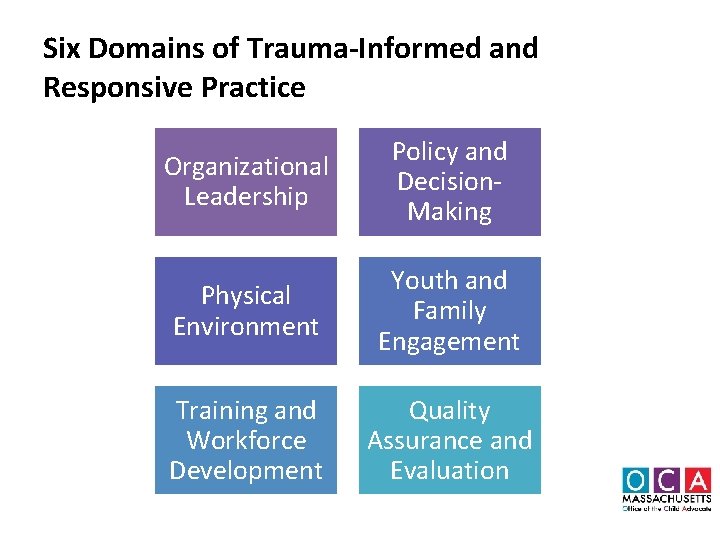
Six Domains of Trauma-Informed and Responsive Practice Organizational Leadership Policy and Decision. Making Physical Environment Youth and Family Engagement Training and Workforce Development Quality Assurance and Evaluation
Organizational Leadership • Trauma-informed and responsive leaders: – Articulate the principles of TIR care in their mission and/or vision statements – Incorporate TIR principles into all policies, programs, and practices – Use their decision-making authority to make the financial and time investments needed to implement the TIR domains – Clearly communicate roles, responsibilities, and expectations to youth, families, and staff members – Invite youth, families, and staff members to provide input and feedback into organizational decision-making – Are visible members of the agency/organization and the community
Physical Environment • Trauma-informed and responsive physical environments: – Are well-lit with natural light or soft, bright lighting – Keep noise levels to a minimum – Provide comfortable seating options that are accessible to all types of bodies – Use welcoming language on signs – Provide private spaces for youth and families to have conversations with staff members and/or regroup after a triggering event – Are designed with input from youth, families, and staff members
Training and Workforce Development • Agencies and organizations can build a traumainformed and responsive workforce by: – Asking potential employees about their awareness of trauma and trauma-informed and responsive practices during the hiring process – Hiring individuals with lived experience – Providing training on the impact of childhood trauma and appropriate responses to all employees and volunteers during orientation and as a part of ongoing professional development.
Training and Workforce Development • Training on trauma-informed and responsive practice should include: – Explanations of the different types of trauma (acute, complex, historical, racial, intergenerational) – The biological effects of trauma on brain development – The effect that trauma can have on a child’s sense of safety, sense of self, and physical health – The impact that trauma can have on a child’s behavior. This should include discussion of internalizing and externalizing behaviors, as well as how these behaviors may vary by age. – Information about trauma in vulnerable populations of youth (e. g. LGBTQ+ youth, homeless youth, commercially sexually exploited children) – Protective factors that can help children recover from trauma and how to build on a child’s strengths – Information on how to identify potential triggers/activators – De-escalation and other communication techniques – Information about Secondary Traumatic Stress (STS) and practices for prevention
Training and Workforce Development • Suggested practices to address Secondary Traumatic Stress: – Reflective supervision – Peer support – Mindfulness exercises and other self-directed attention practices/skills – Manageable caseloads (classroom sizes, ratios) – Adequate staffing (numbers/positions) – Mental health benefits
Policy and Decision-Making • This section pertains to the development and maintenance of organizational/institutional policies, practices, and procedures. • Trauma-informed and responsive policies and procedures: – Are clearly articulated, especially those pertaining to the physical and emotional safety of children, families, and staff – Identify clear roles and responsibilities for staff members – Maintain predictable schedules and routines, when possible – Ensure that children and families see the same people as often as possible – If there is going to be a change in a schedule, routine, provider, or other plan, provide as much advance notice to the child and family as possible – Develop a process for staff members to follow if a child makes a trauma disclosure, and ensure all staff members are trained in that process. – Respect confidentiality – Are aware of agency/organization decisions and actions that could be retraumatizing for children and families, and take steps to minimize the potential for re-traumatization
Policy and Decision-Making • Decision-making in trauma-informed and responsive institutions: – Includes children and families in decision-making processes as often as possible. Some examples of opportunities for the inclusion of child and family voice are: • • In the development of policies and procedures In creating individual treatment goals In developing service plans In designing or re-designing physical spaces – Provides opportunities for staff inclusion in the development of policies and procedures as often as possible. – Provides explanations for how and why any decisions are made that impact the child and family • Trauma-informed and responsive organizations/institutions review their policies, practices, and procedures on a regular basis to ensure continued fidelity to trauma-informed and responsive principles.
Youth and Family Engagement • Trauma-informed and responsive adults and institutions can engage youth and families in any or all of the following ways: • Mind Your Manner Introduce yourself and your role Explain information clearly Be calm and respectful Recognize courage and bravery Be an active listener When interacting with younger children, come down to their eye level and use simpler language – Be mindful of your body language; children are very attuned to nonverbal cues – Consider cultural elements and how different interactions can be interpreted differently (ex. , avoiding eye contact as a means of respecting authority) – – –
Youth and Family Engagement • Ask Questions – Ask the child and family members for their preferred names – Ask about a child’s interests – Ask youth and family members how they are feeling – Ask youth and family members for their preferences whenever possible; this can help establish a sense of control. – Ask if the child or family member needs a break during long processes or proceedings (ex. intakes) – Ask the child and family members about their trauma triggers/activators, when appropriate
Youth and Family Engagement • Support Recovery – Inform children and families about trauma and potential reactions to it – Remind children and families that their feelings and behaviors are normal responses to traumatic situations when appropriate – Help children and families name emotions – Teach coping skills, such as breathing, grounding techniques, writing, or drawing – Facilitate connections to services, when appropriate – Share information using multiple formats, including written, audio, and visual
Quality Assurance and Evaluation • Trauma-informed and responsive institutions should develop processes for regularly assessing the design and implementation of policies, programs and/or practices to ensure they are having the desired impact and in alignment with trauma-informed and responsive principles. • In doing so, institutions should: – Clearly identify the desired outcomes – Include the voices of youth, families, and staff in developing these outcomes whenever possible – Include the voices of youth, families, and staff in measuring outcomes, identifying challenges, and generating ideas for improvement – Analyze data by race, gender, and other demographic information to uncover and address disparities – Be ready to adapt policies, programs, or practices based on assessment results

Next Meeting • January 7 th – 1 pm – 3 pm – Ashburton – 10 th Floor – Charles River Conference Room
- Slides: 29