
Childhood Immunization Update Presented by Date Disclosure Statements
Childhood Immunization Update Presented by: Date:
Disclosure Statements • Neither the planners of this session nor I have any financial relationship with pharmaceutical companies, biomedical device manufacturers, or corporations whose products and services are related to the vaccines we discuss. • There is no commercial support being received for this event. • The mention of specific brands of vaccines in this presentation is for the purpose of providing education and does not constitute endorsement. • The GA Immunization Program utilizes ACIP recommendations as the basis for this presentation and for our guidelines, policies, and recommendations. • For certain vaccines this may represent a slight departure from or offlabel use of the vaccine package insert guidelines.
Disclosure Statement • To obtain nursing contact hours for this session, you must be present for the entire hour and complete an evaluation. • Continuing education will be provided through the Georgia Department of Public Health • Georgia Department of Public Health is an approved provider of continuing nursing education by the Alabama State Nurses Association, an accredited approver by the American Nurses Credentialing Center’s Commission of Accreditation
Objectives At the end of this presentation, participants will be able to: • Recall the role vaccines play in preventing vaccinepreventable diseases • Discuss GA Immunization law and DPH rules and regulations for schools and child care attendance • Discuss the role of a vaccine champion • List two reliable resources for immunization information
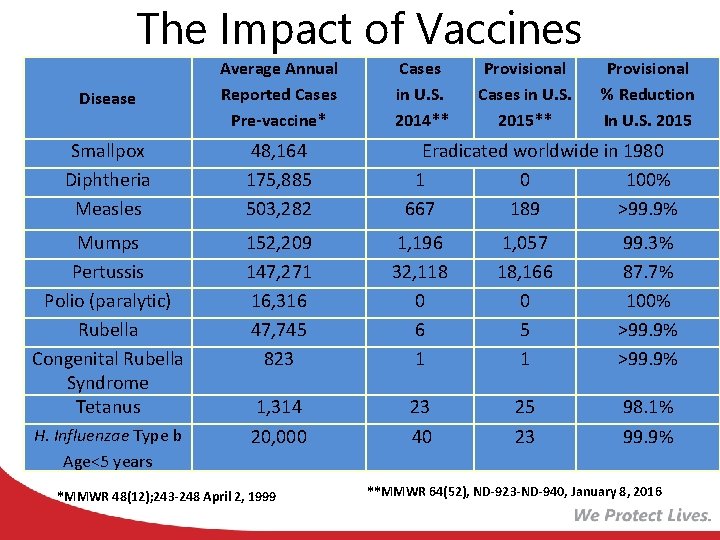
The Impact of Vaccines Disease Average Annual Reported Cases Pre-vaccine* Smallpox Diphtheria Measles 48, 164 175, 885 503, 282 Mumps Pertussis Polio (paralytic) Rubella Congenital Rubella Syndrome Tetanus 152, 209 147, 271 16, 316 47, 745 823 1, 196 32, 118 0 6 1 1, 057 18, 166 0 5 1 99. 3% 87. 7% 100% >99. 9% 1, 314 20, 000 23 40 25 23 98. 1% 99. 9% H. Influenzae Type b Age<5 years *MMWR 48(12); 243 -248 April 2, 1999 Cases in U. S. 2014** Provisional Cases in U. S. 2015** Provisional % Reduction In U. S. 2015 Eradicated worldwide in 1980 1 0 100% 667 189 >99. 9% **MMWR 64(52), ND-923 -ND-940, January 8, 2016
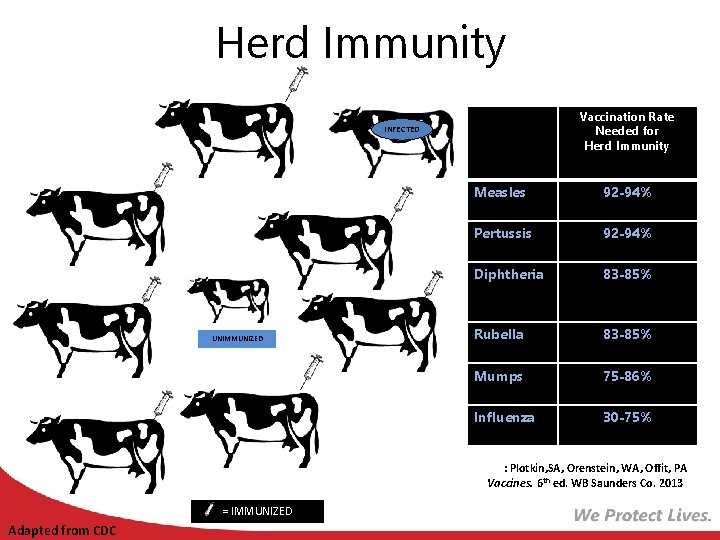
Herd Immunity Immunized individuals block infection from reaching those who are unimmunized Vaccination Rate Needed for Herd Immunity INFECTED UNIMMUNIZED Measles 92 -94% Pertussis 92 -94% Diphtheria 83 -85% Rubella 83 -85% Mumps 75 -86% Influenza 30 -75% Ref: Plotkin, SA, Orenstein, WA, Offit, PA Vaccines. 6 th ed. WB Saunders Co. 2013 = IMMUNIZED Adapted from CDC
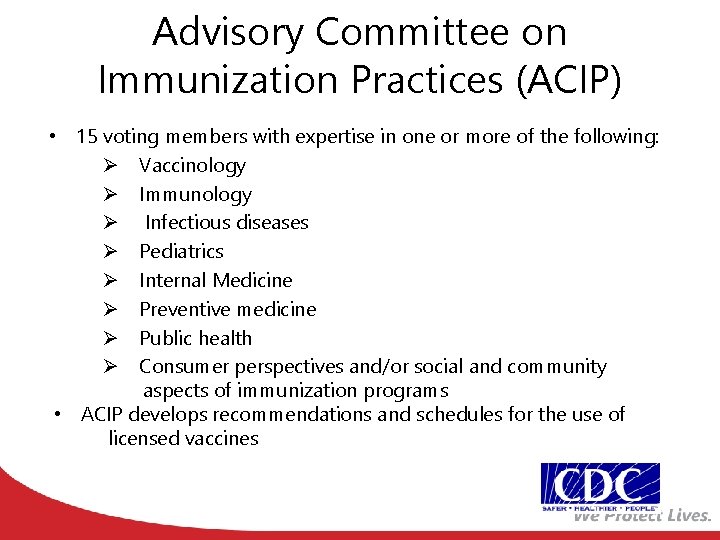
Advisory Committee on Immunization Practices (ACIP) • 15 voting members with expertise in one or more of the following: Ø Vaccinology Ø Immunology Ø Infectious diseases Ø Pediatrics Ø Internal Medicine Ø Preventive medicine Ø Public health Ø Consumer perspectives and/or social and community aspects of immunization programs • ACIP develops recommendations and schedules for the use of licensed vaccines
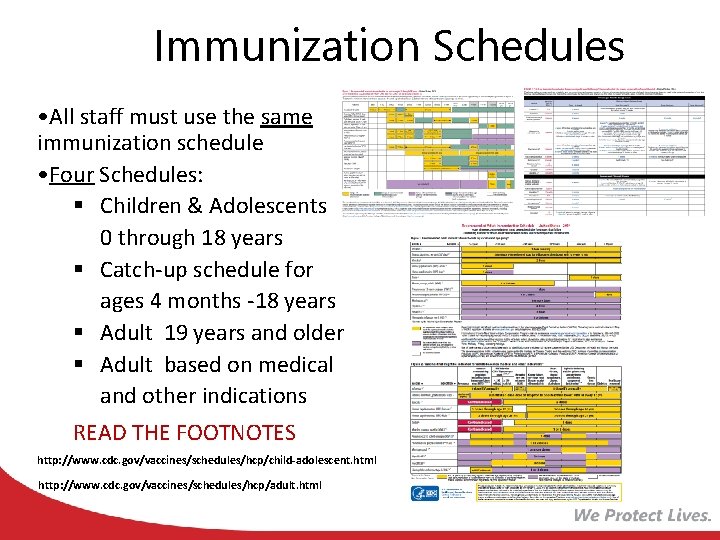
Immunization Schedules • All staff must use the same immunization schedule • Four Schedules: § Children & Adolescents 0 through 18 years § Catch-up schedule for ages 4 months -18 years § Adult 19 years and older § Adult based on medical and other indications READ THE FOOTNOTES http: //www. cdc. gov/vaccines/schedules/hcp/child-adolescent. html http: //www. cdc. gov/vaccines/schedules/hcp/adult. html
Indication Recommendation Requirement Indication • -Information about the appropriate use of the vaccine Recommendation • -ACIP statement that broadens and further delineates the • Indication found in the package insert -Basis for standards for best practice Requirement • -Mandate by a state that a particular vaccine must be administered and documented before entrance to child care and/or school
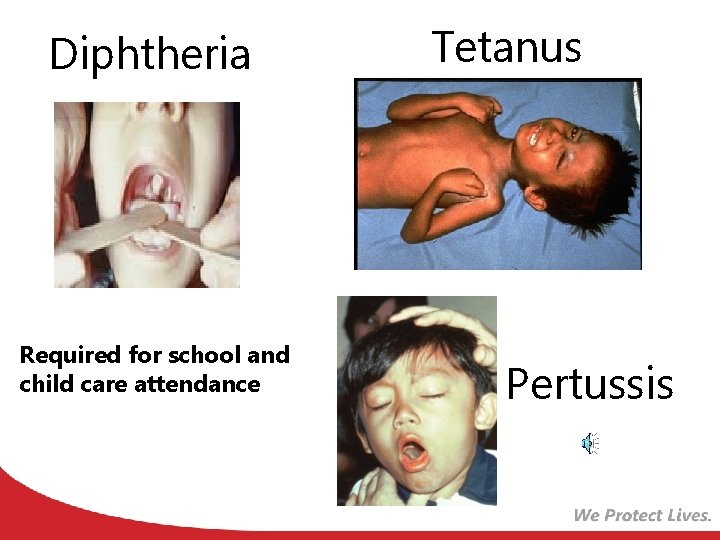
Diphtheria Required for school and child care attendance Tetanus Pertussis
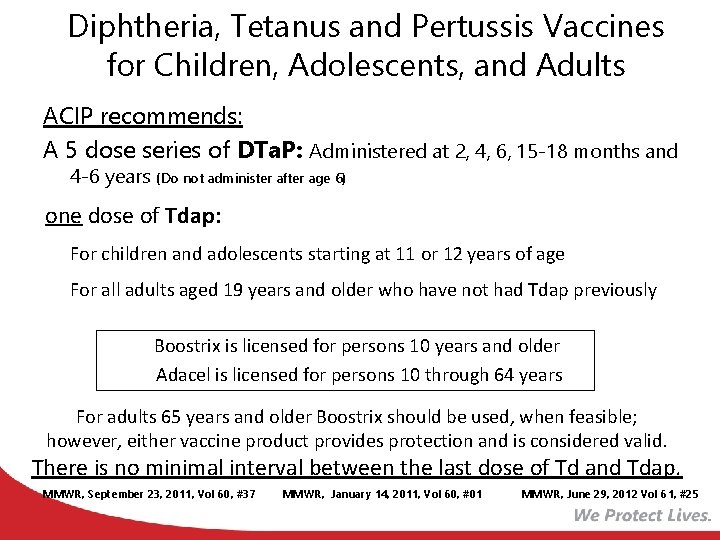
Diphtheria, Tetanus and Pertussis Vaccines for Children, Adolescents, and Adults ACIP recommends: A 5 dose series of DTa. P: Administered at 2, 4, 6, 15 -18 months and 4 -6 years (Do not administer after age 6) one dose of Tdap: For children and adolescents starting at 11 or 12 years of age For all adults aged 19 years and older who have not had Tdap previously Boostrix is licensed for persons 10 years and older Adacel is licensed for persons 10 through 64 years For adults 65 years and older Boostrix should be used, when feasible; however, either vaccine product provides protection and is considered valid. There is no minimal interval between the last dose of Td and Tdap. MMWR, September 23, 2011, Vol 60, #37 MMWR, January 14, 2011, Vol 60, #01 MMWR, June 29, 2012 Vol 61, #25
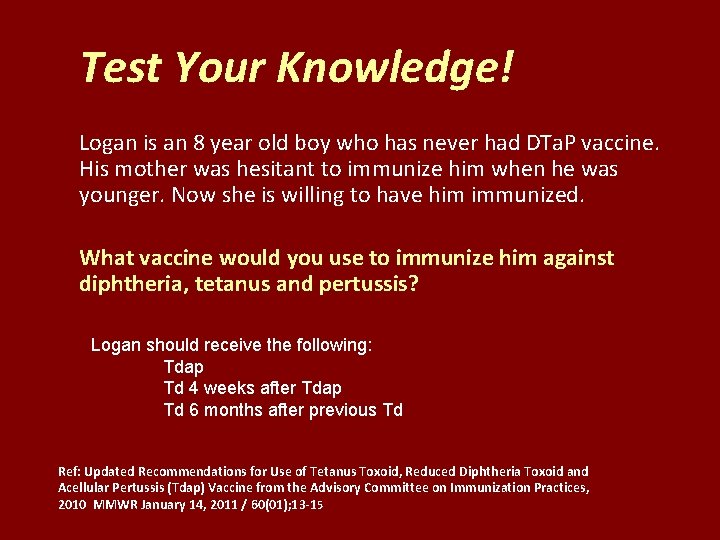
Test Your Knowledge! Logan is an 8 year old boy who has never had DTa. P vaccine. His mother was hesitant to immunize him when he was younger. Now she is willing to have him immunized. What vaccine would you use to immunize him against diphtheria, tetanus and pertussis? Logan should receive the following: Tdap Td 4 weeks after Tdap Td 6 months after previous Td Ref: Updated Recommendations for Use of Tetanus Toxoid, Reduced Diphtheria Toxoid and Acellular Pertussis (Tdap) Vaccine from the Advisory Committee on Immunization Practices, 2010 MMWR January 14, 2011 / 60(01); 13 -15
Test Your Knowledge! Four month old Lucas was given Tdap instead of DTa. P. What should be done? If Tdap was inadvertently given to a child under age 7 years, it should not be counted as either the first, second, or third dose of DTa. P. The dose should be repeated with DTa. P. Continue vaccinating on schedule. If the dose of Tdap was administered for the fourth or fifth DTa. P dose, the Tdap dose can be counted as valid. Please remind your staff to always check the vaccine vial at least 3 times before administering any vaccine. IAC Ask the Experts - Reviewed July 2014
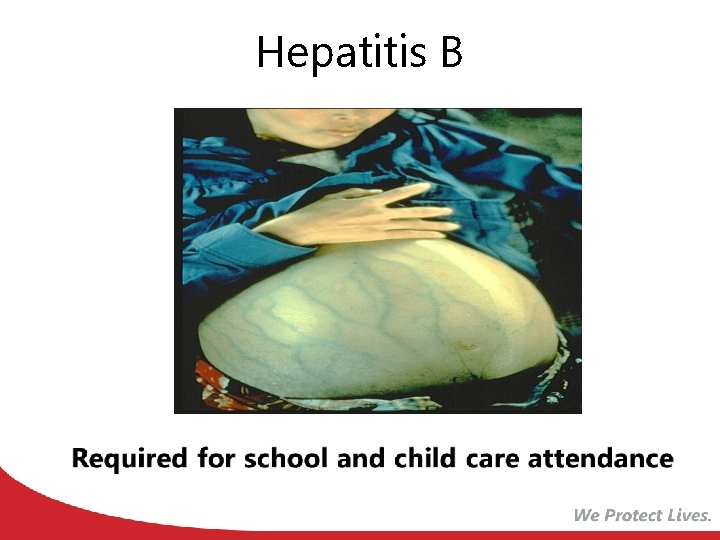
Hepatitis B
Hepatitis A Vaccine for Children ACIP recommends 2 doses of hepatitis A vaccine for: • All children 12 through 23 months of age (Separate the 2 doses by 6 to 18 months) • Any child or adolescent 2 through 18 years, who has not previously received the vaccine, can receive the vaccine at subsequent visits. • Caretakers who will have contact with adoptees from countries with high rates of hepatitis A if contact will be within 60 days of arrival in U. S. The first dose of the 2 dose series should be given as soon as adoption is planned. MMWR, May 19, 2006, Vol 55, #RR-07 Required for school and child care attendance
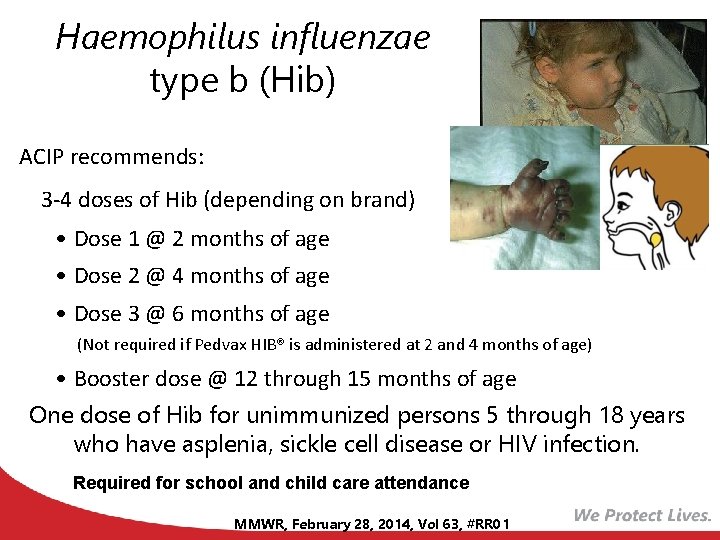
Haemophilus influenzae type b (Hib) ACIP recommends: 3 -4 doses of Hib (depending on brand) • Dose 1 @ 2 months of age • Dose 2 @ 4 months of age • Dose 3 @ 6 months of age (Not required if Pedvax HIB® is administered at 2 and 4 months of age) • Booster dose @ 12 through 15 months of age One dose of Hib for unimmunized persons 5 through 18 years who have asplenia, sickle cell disease or HIV infection. Required for school and child care attendance MMWR, February 28, 2014, Vol 63, #RR 01
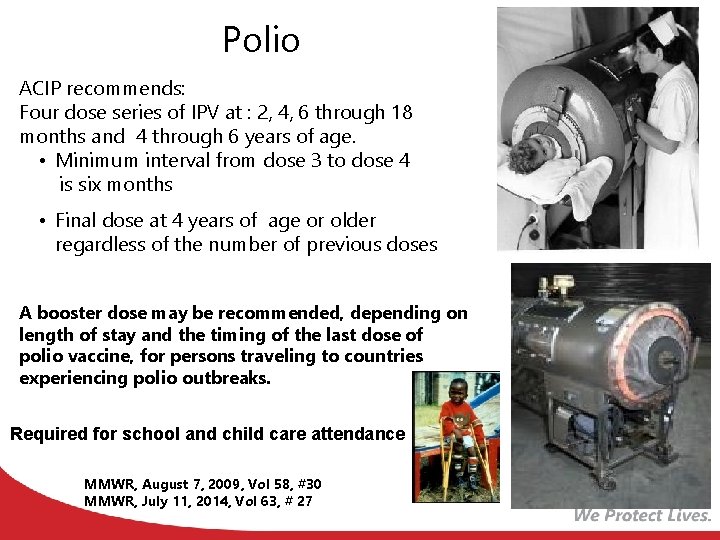
Polio ACIP recommends: Four dose series of IPV at : 2, 4, 6 through 18 months and 4 through 6 years of age. • Minimum interval from dose 3 to dose 4 is six months • Final dose at 4 years of age or older regardless of the number of previous doses A booster dose may be recommended, depending on length of stay and the timing of the last dose of polio vaccine, for persons traveling to countries experiencing polio outbreaks. Required for school and child care attendance MMWR, August 7, 2009, Vol 58, #30 MMWR, July 11, 2014, Vol 63, # 27 Source: World Health Organization
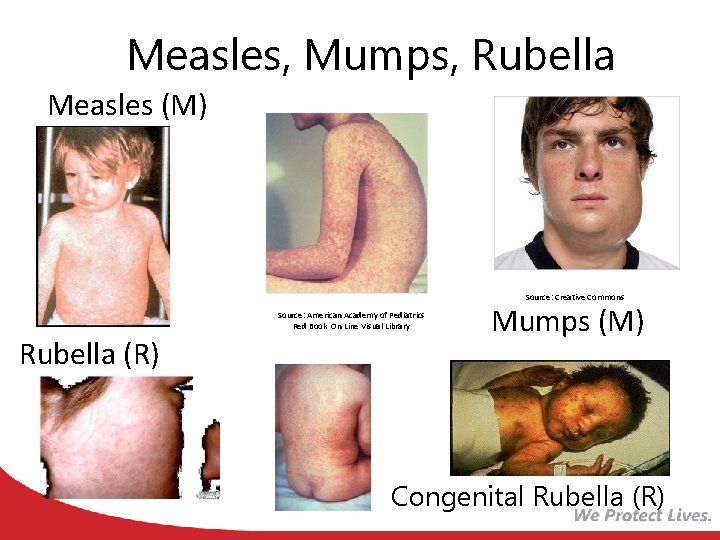
Measles, Mumps, Rubella Measles (M) Source: Creative Commons Source: American Academy of Pediatrics Red Book On Line Visual Library Rubella (R) Mumps (M) Congenital Rubella (R)
MMR Vaccine ACIP recommends 2 doses of MMR: – Dose 1 @ 12 through 15 months of age – Dose 2 @ 4 through 6 years of age – Second dose can be administered at an earlier age provided the interval between the first and second dose is at least 28 days Required for school and child care attendance Acceptable presumptive evidence of MMR immunity • Documentation of age appropriate vaccination with MMR vaccine • Laboratory evidence of immunity • Laboratory confirmation of disease • Birth before 1957 Birth date not acceptable evidence of rubella immunity for women who could become pregnant MMWR, June 14, 2013, Vol 62, #RR-04
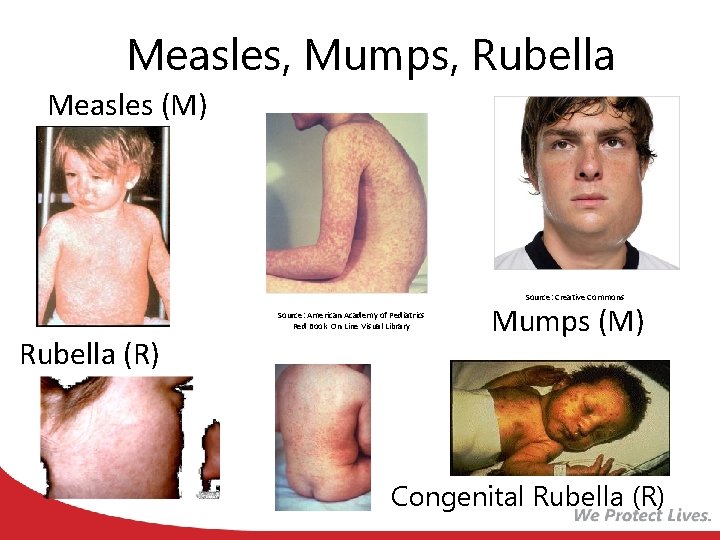
Measles, Mumps, Rubella Measles (M) Source: Creative Commons Source: American Academy of Pediatrics Red Book On Line Visual Library Rubella (R) Mumps (M) Congenital Rubella (R)
MMR Vaccine ACIP recommends 2 doses of MMR: – Dose 1 @ 12 through 15 months of age – Dose 2 @ 4 through 6 years of age – Second dose can be administered at an earlier age provided the interval between the first and second dose is at least 28 days Required for school and child care attendance Acceptable presumptive evidence of MMR immunity • Documentation of age appropriate vaccination with MMR vaccine • Laboratory evidence of immunity • Laboratory confirmation of disease • Birth before 1957 Birth date not acceptable evidence of rubella immunity for women who could become pregnant MMWR, June 14, 2013, Vol 62, #RR-04
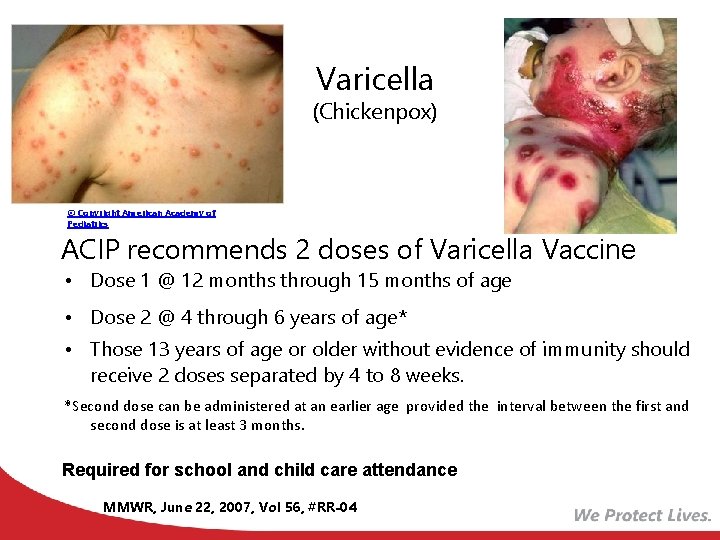
Varicella (Chickenpox) © Copyright American Academy of Pediatrics ACIP recommends 2 doses of Varicella Vaccine • Dose 1 @ 12 months through 15 months of age • Dose 2 @ 4 through 6 years of age* • Those 13 years of age or older without evidence of immunity should receive 2 doses separated by 4 to 8 weeks. *Second dose can be administered at an earlier age provided the interval between the first and second dose is at least 3 months. Required for school and child care attendance MMWR, June 22, 2007, Vol 56, #RR-04
Acceptable Evidence of Varicella Immunity • Written documentation of age-appropriate vaccination • Laboratory evidence of immunity or laboratory confirmation of varicella disease • U. S. -born before 1980* • Healthcare provider diagnosis or verification of varicella disease • History of herpes zoster based on healthcare provider diagnosis. * Birth year immunity criterion does not apply to healthcare personnel or pregnant women MMWR 2007; 56(RR-4); 16 -17
ACIP Recommendations for use of MMRV (Pro. Quad®) Licensed for ages 12 months through 12 years Dose 1 at ages 12 through 47 months • Either MMR and varicella vaccines or MMRV vaccine can be used. • Providers who are considering administering MMRV should discuss the benefits and risks of both vaccination options with the parent or caregiver, since MMRV can lead to 1 extra febrile seizure for every 2300 -2600 vaccinations. • Unless the parent or caregiver expresses a preference for MMRV vaccine, CDC recommends that MMR vaccine and varicella vaccines should be administered for the first dose in this age group. Dose 1 or 2 given at ages 48 months and older • MMRV vaccine generally is preferred over separate injections of its equivalent component vaccines (i. e. , MMR and varicella vaccines). MMWR, May 7, 2010, Vol 59, #RR 03
Spacing of Live Virus Vaccines and Other Products • PPD and live virus vaccine – Apply PPD at same visit as MMR – If MMR given first, delay PPD 4 weeks or longer – Apply PPD first, then give MMR when skin test read • Spacing with antibody-containing products such as immune globulin (IG)
Test Your Knowledge! Five-year-old Tonia received her second MMR a week ago. How long should she wait before receiving live attenuated influenza vaccine (LAIV)? LAIV can be administered simultaneously with another live vaccine (for example, MMR, varicella), but if not given at the same time, ACIP recommends waiting four weeks before administering the second live vaccine. IAC Ask the Experts - Reviewed January 2014
Pneumococcal Conjugate Vaccine for Children (PCV 13) ACIP recommends PCV 13 for: – All children 2 through 59 months of age – Children 60 through 71 months who have underlying medical conditions that increase their risk of pneumococcal disease or complications – Children and adolescents aged 6 through 18 years with: • • • immunocompromising conditions functional or anatomic asplenia CSF leaks or cochlear implants, solid organ transplants or chronic renal failure those who have not previously received PCV 13 Required for school and child care attendance MMWR, December 10, 2010, Vo 1 59, #RR-11 MMWR, June 28, 2013, Vol 62, #25
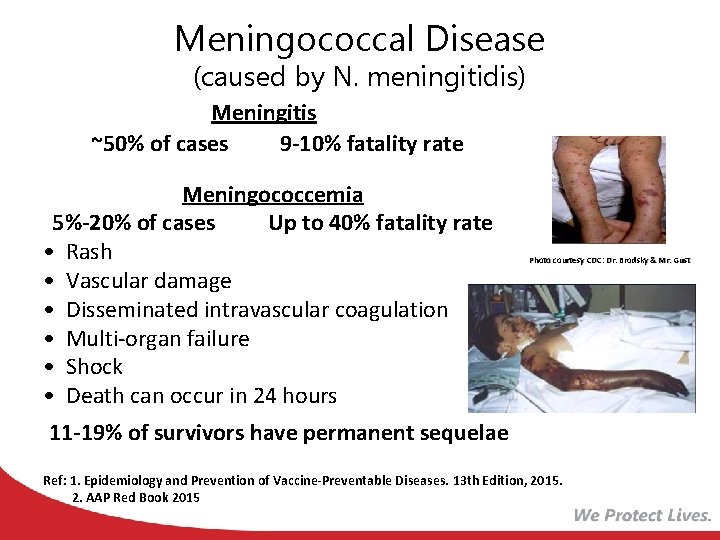
Meningococcal Disease (caused by N. meningitidis) Meningitis ~50% of cases 9 -10% fatality rate Meningococcemia 5%-20% of cases Up to 40% fatality rate • Rash • Vascular damage • Disseminated intravascular coagulation • Multi-organ failure • Shock • Death can occur in 24 hours Photo courtesy CDC: Dr. Brodsky & Mr. Gust 11 -19% of survivors have permanent sequelae Ref: 1. Epidemiology and Prevention of Vaccine-Preventable Diseases. 13 th Edition, 2015. 2. AAP Red Book 2015
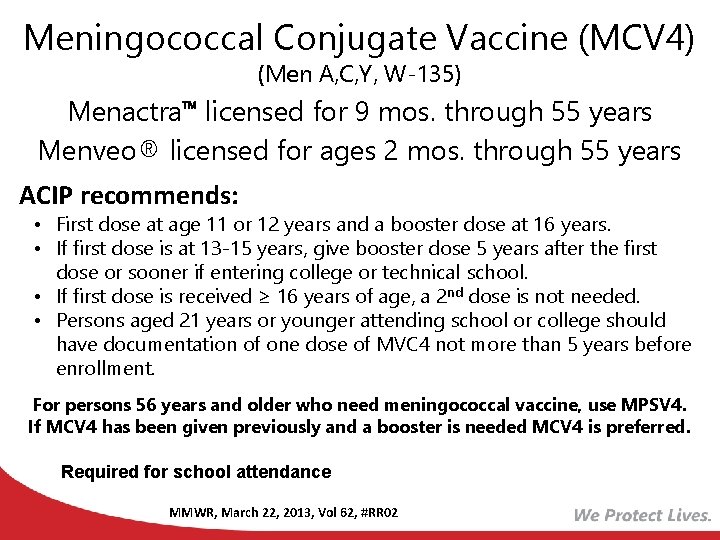
Meningococcal Conjugate Vaccine (MCV 4) (Men A, C, Y, W-135) Menactra licensed for 9 mos. through 55 years Menveo® licensed for ages 2 mos. through 55 years ACIP recommends: • First dose at age 11 or 12 years and a booster dose at 16 years. • If first dose is at 13 -15 years, give booster dose 5 years after the first dose or sooner if entering college or technical school. • If first dose is received ≥ 16 years of age, a 2 nd dose is not needed. • Persons aged 21 years or younger attending school or college should have documentation of one dose of MVC 4 not more than 5 years before enrollment. For persons 56 years and older who need meningococcal vaccine, use MPSV 4. If MCV 4 has been given previously and a booster is needed MCV 4 is preferred. Required for school attendance MMWR, March 22, 2013, Vol 62, #RR 02
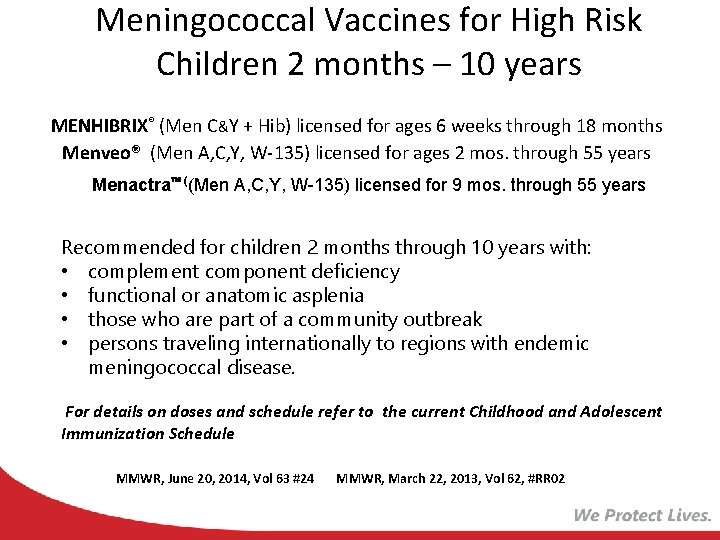
Meningococcal Vaccines for High Risk Children 2 months – 10 years MENHIBRIX® (Men C&Y + Hib) licensed for ages 6 weeks through 18 months Menveo® (Men A, C, Y, W-135) licensed for ages 2 mos. through 55 years Menactra ((Men A, C, Y, W-135) licensed for 9 mos. through 55 years Recommended for children 2 months through 10 years with: • complement component deficiency • functional or anatomic asplenia • those who are part of a community outbreak • persons traveling internationally to regions with endemic meningococcal disease. For details on doses and schedule refer to the current Childhood and Adolescent Immunization Schedule MMWR, June 20, 2014, Vol 63 #24 MMWR, March 22, 2013, Vol 62, #RR 02
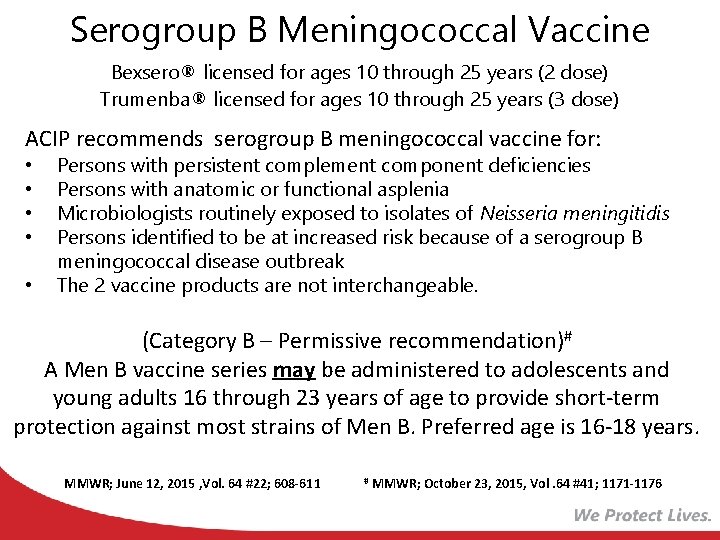
Serogroup B Meningococcal Vaccine Bexsero® licensed for ages 10 through 25 years (2 dose) Trumenba® licensed for ages 10 through 25 years (3 dose) ACIP recommends serogroup B meningococcal vaccine for: • • • Persons with persistent complement component deficiencies Persons with anatomic or functional asplenia Microbiologists routinely exposed to isolates of Neisseria meningitidis Persons identified to be at increased risk because of a serogroup B meningococcal disease outbreak The 2 vaccine products are not interchangeable. (Category B – Permissive recommendation)# A Men B vaccine series may be administered to adolescents and young adults 16 through 23 years of age to provide short-term protection against most strains of Men B. Preferred age is 16 -18 years. MMWR; June 12, 2015 , Vol. 64 #22; 608 -611 # MMWR; October 23, 2015, Vol. 64 #41; 1171 -1176
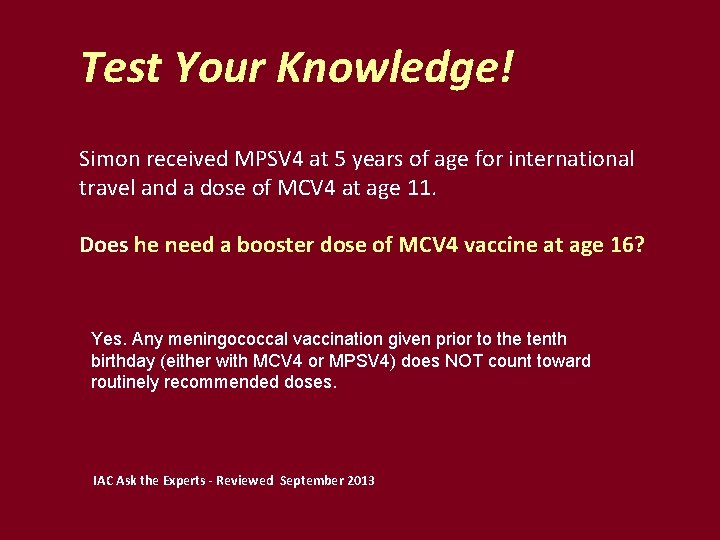
Test Your Knowledge! Simon received MPSV 4 at 5 years of age for international travel and a dose of MCV 4 at age 11. Does he need a booster dose of MCV 4 vaccine at age 16? Yes. Any meningococcal vaccination given prior to the tenth birthday (either with MCV 4 or MPSV 4) does NOT count toward routinely recommended doses. IAC Ask the Experts - Reviewed September 2013
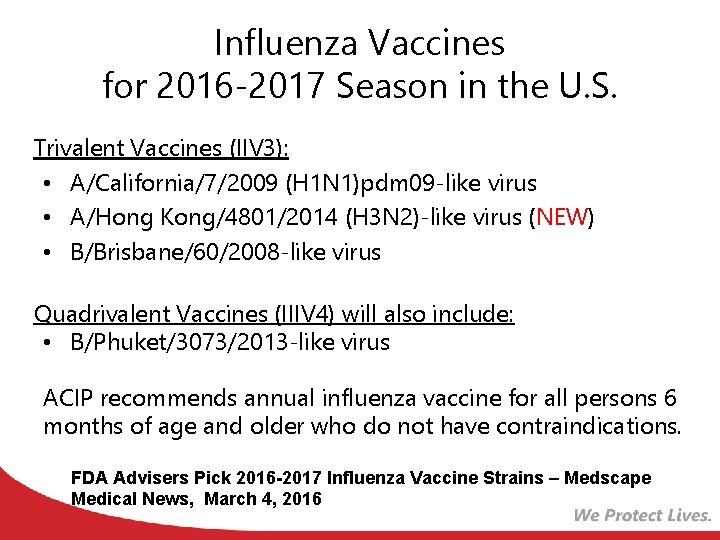
Influenza Vaccines for 2016 -2017 Season in the U. S. Trivalent Vaccines (IIV 3): • A/California/7/2009 (H 1 N 1)pdm 09 -like virus • A/Hong Kong/4801/2014 (H 3 N 2)-like virus (NEW) • B/Brisbane/60/2008 -like virus Quadrivalent Vaccines (IIIV 4) will also include: • B/Phuket/3073/2013 -like virus ACIP recommends annual influenza vaccine for all persons 6 months of age and older who do not have contraindications. FDA Advisers Pick 2016 -2017 Influenza Vaccine Strains – Medscape Medical News, March 4, 2016
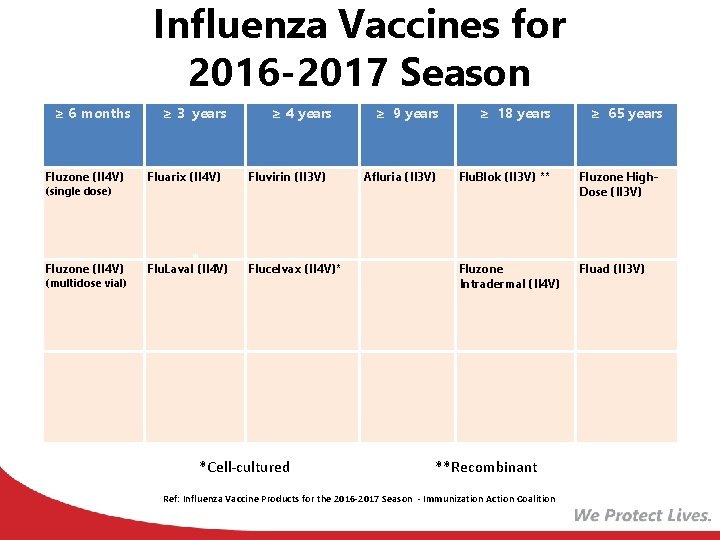
Influenza Vaccines for 2016 -2017 Season ≥ 6 months ≥ 3 years Fluzone (II 4 V) Fluarix (II 4 V) Fluzone (II 4 V) Flu. Laval (II 4 V) (single dose) (multidose vial) * ≥ 4 years Fluvirin (II 3 V) Flucelvax (II 4 V)* *Cell-cultured ≥ 9 years ≥ 18 years Afluria (II 3 V) Flu. Blok (II 3 V) ** Fluzone High. Dose (II 3 V) Fluzone Intradermal (II 4 V) Fluad (II 3 V) **Recombinant Ref: Influenza Vaccine Products for the 2016 -2017 Season - Immunization Action Coalition ≥ 65 years
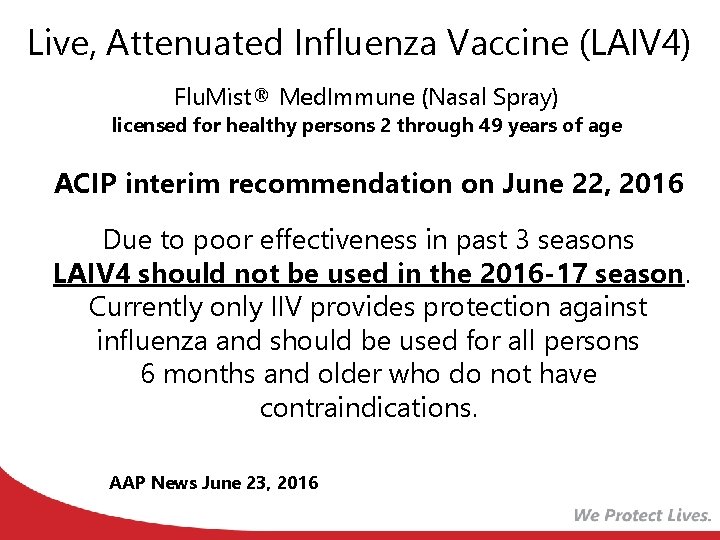
Live, Attenuated Influenza Vaccine (LAIV 4) Flu. Mist® Med. Immune (Nasal Spray) licensed for healthy persons 2 through 49 years of age ACIP interim recommendation on June 22, 2016 Due to poor effectiveness in past 3 seasons LAIV 4 should not be used in the 2016 -17 season. Currently only IIV provides protection against influenza and should be used for all persons 6 months and older who do not have contraindications. AAP News June 23, 2016
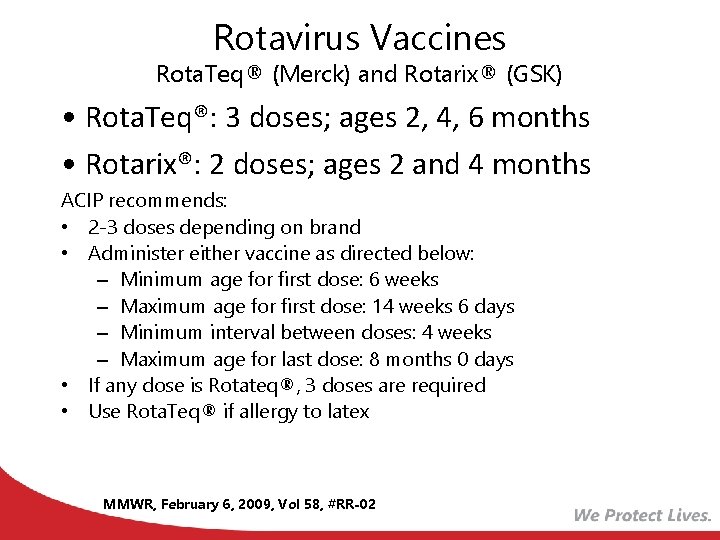
Rotavirus Vaccines Rota. Teq® (Merck) and Rotarix® (GSK) • Rota. Teq®: 3 doses; ages 2, 4, 6 months • Rotarix®: 2 doses; ages 2 and 4 months ACIP recommends: • 2 -3 doses depending on brand • Administer either vaccine as directed below: – Minimum age for first dose: 6 weeks – Maximum age for first dose: 14 weeks 6 days – Minimum interval between doses: 4 weeks – Maximum age for last dose: 8 months 0 days • If any dose is Rotateq®, 3 doses are required • Use Rota. Teq® if allergy to latex MMWR, February 6, 2009, Vol 58, #RR-02
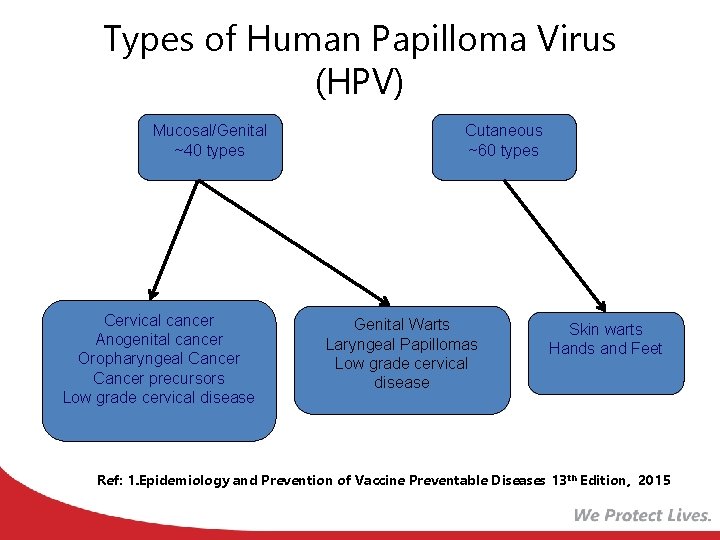
Types of Human Papilloma Virus (HPV) Mucosal/Genital ~40 types High risk types 16, 18, 31, 33, 45, 52, 58 (and others) Cervical cancer Anogenital cancer Oropharyngeal Cancer precursors Low grade cervical disease Cutaneous ~60 types Low risk types 6, 11 and others Genital Warts Laryngeal Papillomas Low grade cervical disease Skin warts Hands and Feet Ref: 1. Epidemiology and Prevention of Vaccine Preventable Diseases 13 th Edition, 2015 2. Red Book – AAP 2015 Report of the Committee on Infectious Diseases
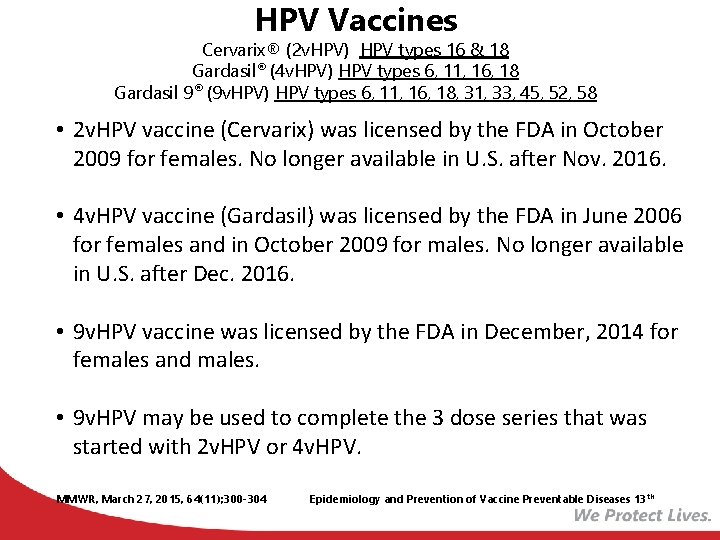
HPV Vaccines Cervarix® (2 v. HPV) HPV types 16 & 18 Gardasil® (4 v. HPV) HPV types 6, 11, 16, 18 Gardasil 9® (9 v. HPV) HPV types 6, 11, 16, 18, 31, 33, 45, 52, 58 • 2 v. HPV vaccine (Cervarix) was licensed by the FDA in October 2009 for females. No longer available in U. S. after Nov. 2016. • 4 v. HPV vaccine (Gardasil) was licensed by the FDA in June 2006 for females and in October 2009 for males. No longer available in U. S. after Dec. 2016. • 9 v. HPV vaccine was licensed by the FDA in December, 2014 for females and males. • 9 v. HPV may be used to complete the 3 dose series that was started with 2 v. HPV or 4 v. HPV. MMWR, March 27, 2015, 64(11); 300 -304 Epidemiology and Prevention of Vaccine Preventable Diseases 13 th Edition, 2015
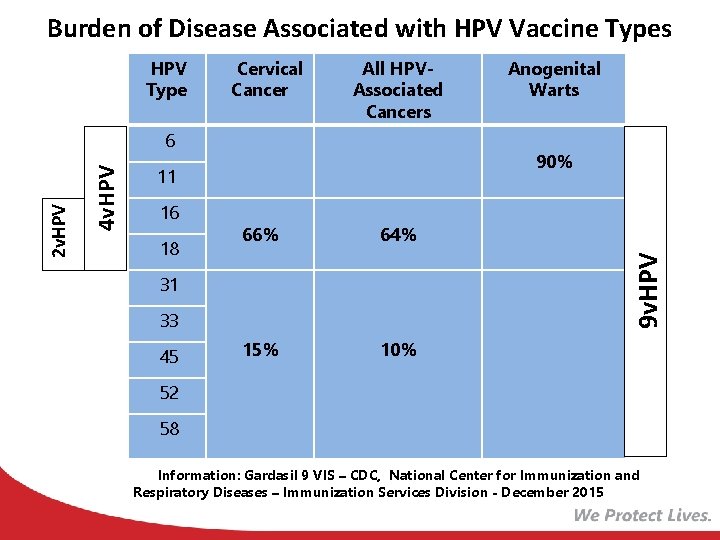
Burden of Disease Associated with HPV Vaccine Types HPV Type Cervical Cancer All HPVAssociated Cancers 90% 11 16 18 66% 64% 15% 10% 9 v. HPV 4 v. HPV 2 v. HPV 6 31 33 45 Anogenital Warts 52 58 Provider Information: Gardasil 9 VIS – CDC, National Center for Immunization and Respiratory Diseases – Immunization Services Division - December 2015
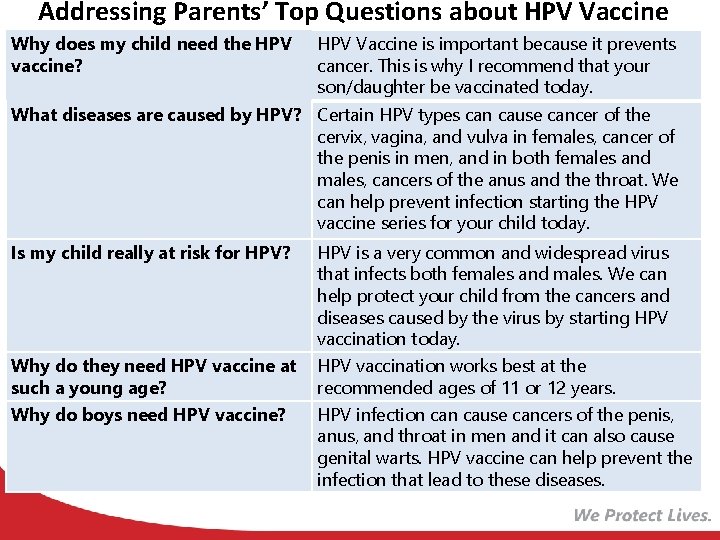
Addressing Parents’ Top Questions about HPV Vaccine Why does my child need the HPV vaccine? HPV Vaccine is important because it prevents cancer. This is why I recommend that your son/daughter be vaccinated today. What diseases are caused by HPV? Certain HPV types can cause cancer of the cervix, vagina, and vulva in females, cancer of the penis in men, and in both females and males, cancers of the anus and the throat. We can help prevent infection starting the HPV vaccine series for your child today. Is my child really at risk for HPV? HPV is a very common and widespread virus that infects both females and males. We can help protect your child from the cancers and diseases caused by the virus by starting HPV vaccination today. Why do they need HPV vaccine at such a young age? HPV vaccination works best at the recommended ages of 11 or 12 years. Why do boys need HPV vaccine? HPV infection cause cancers of the penis, anus, and throat in men and it can also cause genital warts. HPV vaccine can help prevent the infection that lead to these diseases.
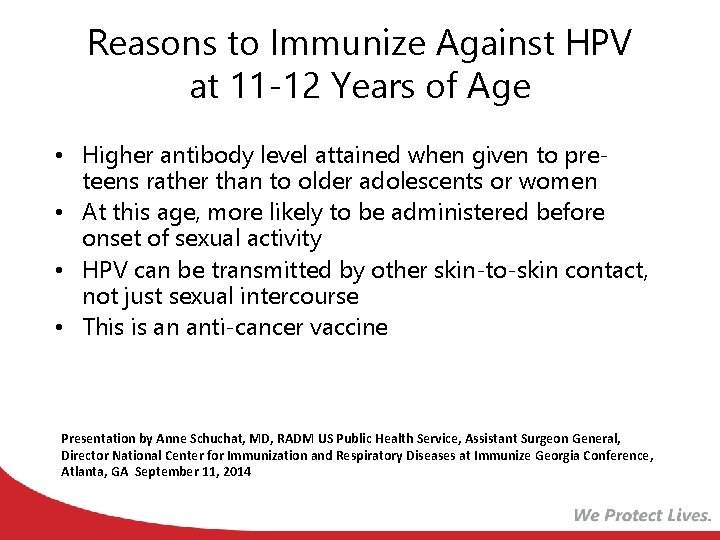
Reasons to Immunize Against HPV at 11 -12 Years of Age • Higher antibody level attained when given to preteens rather than to older adolescents or women • At this age, more likely to be administered before onset of sexual activity • HPV can be transmitted by other skin-to-skin contact, not just sexual intercourse • This is an anti-cancer vaccine Presentation by Anne Schuchat, MD, RADM US Public Health Service, Assistant Surgeon General, Director National Center for Immunization and Respiratory Diseases at Immunize Georgia Conference, Atlanta, GA September 11, 2014
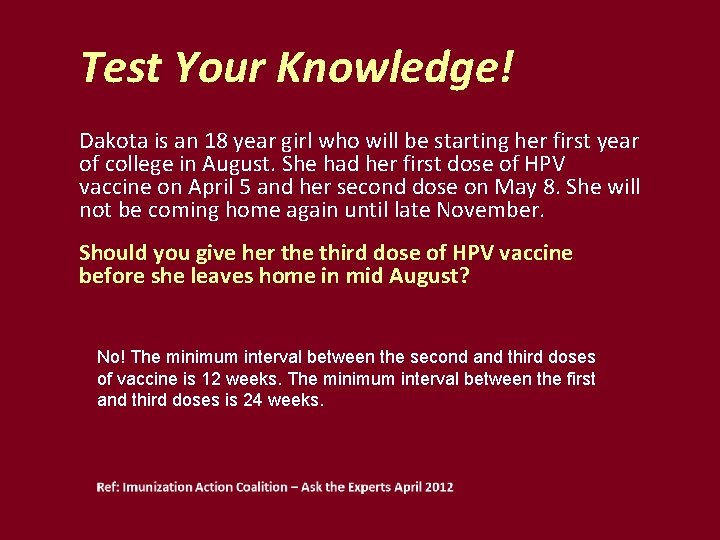
Test Your Knowledge! Dakota is an 18 year girl who will be starting her first year of college in August. She had her first dose of HPV vaccine on April 5 and her second dose on May 8. She will not be coming home again until late November. Should you give her the third dose of HPV vaccine before she leaves home in mid August? No! The minimum interval between the second and third doses of vaccine is 12 weeks. The minimum interval between the first and third doses is 24 weeks.
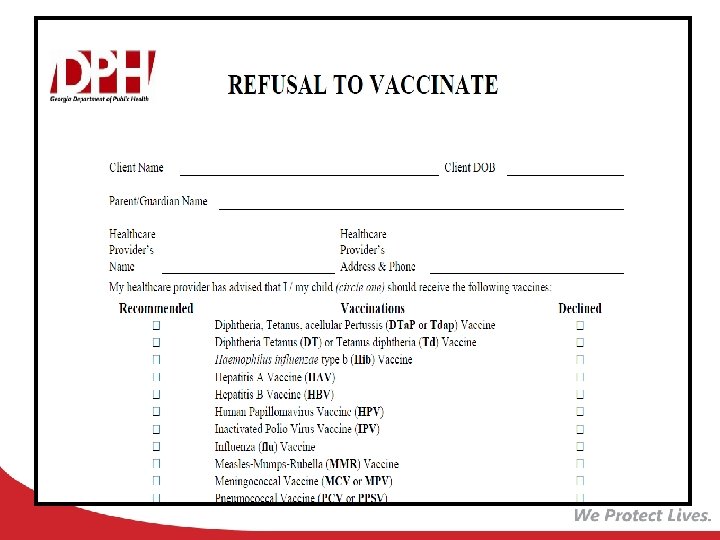
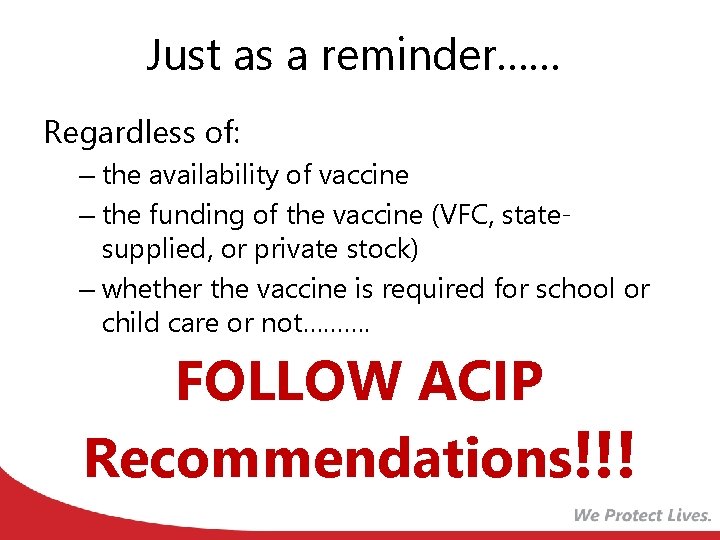
Just as a reminder…… Regardless of: – the availability of vaccine – the funding of the vaccine (VFC, statesupplied, or private stock) – whether the vaccine is required for school or child care or not………. FOLLOW ACIP Recommendations!!!
Requirements for School and Childcare Attendance
Vaccines Required for School and Childcare Attendance: • Consistent with the Recommended Childhood and Adolescent Immunization Schedule • Require children to be age appropriately immunized against each of the specified vaccine preventable diseases
Goal • Vaccines work Goal 100 % compliance rate • Immunization Laws work • Partnerships work
DPH Rules and Regulations • Provide definition of terms • Stipulate the specific requirements – List required vaccines or – Acceptable proof of immunity – Define medical and religious exemptions • Provide directions for issuing, maintaining, and inspecting certificates GA Rules and Regulations updated for the 2014 -2015 school year to reflect the new school requirements. (511 -2 -2)
Job Aids for Assessing Certificates of Immunization
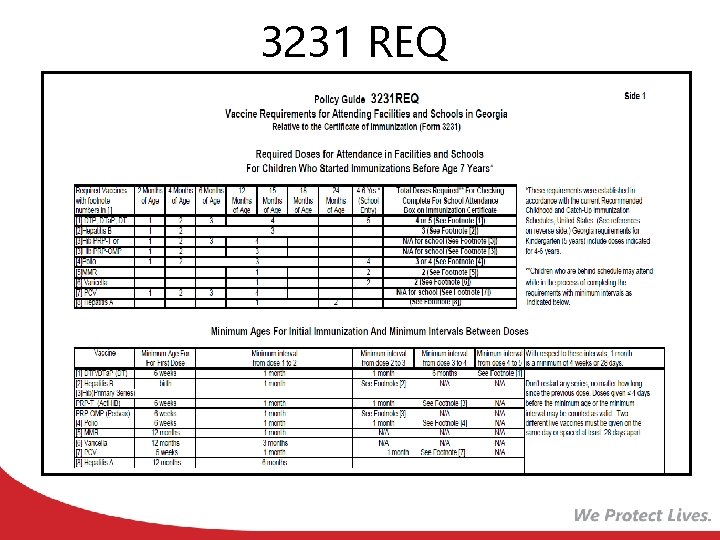
3231 REQ
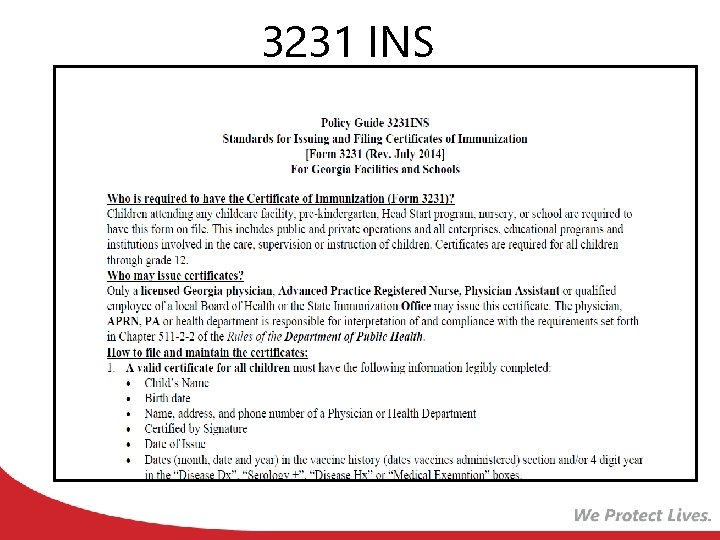
3231 INS
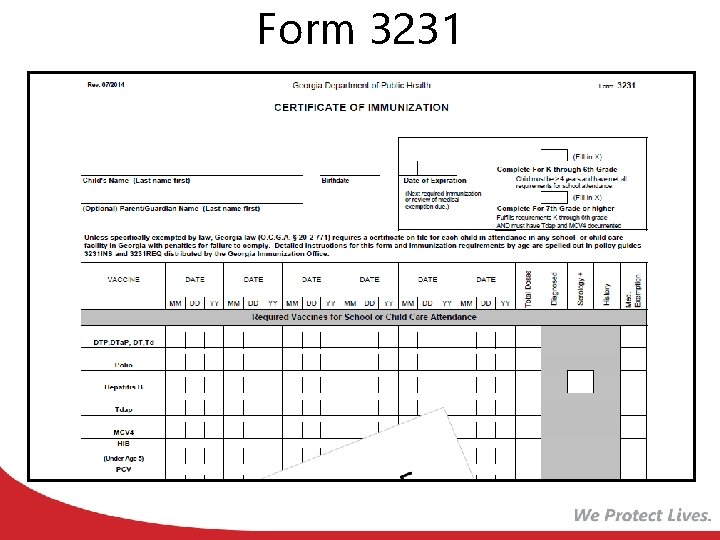
Form 3231
Certificate of Immunization (Form 3231) • A child must have a certificate on file at each facility or school he attends • Photocopies of appropriately completed and signed certificates are acceptable • If a certificate is not on file for each child attending, the facility is held legally responsible • A licensed Georgia physician, APRN, PA or public health official is responsible for the interpretation of and compliance with the requirements for vaccines and completing the certificate • Only physician offices and health clinics can obtain blank certificates
Valid Certificates • All certificates must be marked with : – Child’s name – Birth date – Name and Address of Physician, APRN, PA, Qualified Board of Health official or State Immunization Office Official – Certified Signature – Date of Issue
“X” Marks the Spot
Expiration Date • Expires on the date entered as “Expiration Date” • Must be replaced with a current certificate within 30 days after the expiration date, or child is excluded from attending • Allows for a child who does not meet all the immunization requirements to attend child care or school while he is catching up • Required for all children four years and older who have not completed vaccine requirement for 7 th grade • Required if a medical exemption for a vaccine(s) is marked • Should not be completed if “Complete for 7 th Grade or higher” is marked
“Complete for School Attendance” • Do not expire • Issued only to children who: – Are four years of age or older; and – Have met all the requirements for school attendance as outlined in the Policy Guide 3231 REQ; and – Have all the required vaccine administration dates or natural immunity dates filled in; and – Do not have a “Date of Expiration”
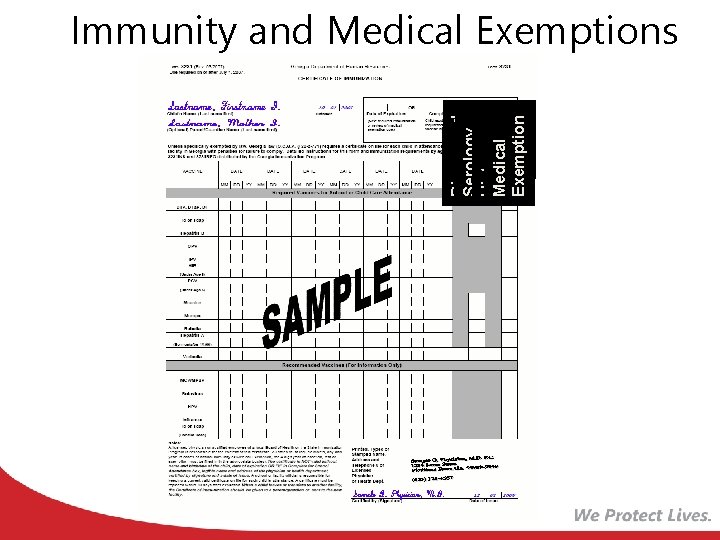
Diagnosed Serology History Medical Exemption Immunity and Medical Exemptions
Exemptions Medical: • Physical disability or condition that contraindicates immunization for that specific vaccine • Documented in the medical exemption box indicated for each vaccine • Reviewed annually
Exemptions Religious: • Documented on form 2208 • Form kept on file by the school or facility in lieu of a Certificate of Immunization (form 3231) • Do not expire
Child Care Requirements • Number of vaccine doses • Always need more doses • Must have a current “expiration date”
School Requirements • A “new entrant” enrolling in a Georgia school at any grade or level, must be age appropriately immunized with required vaccines • Number of doses depends on the child’s age at the time of school entry • Once “Complete for 7 th Grade or higher ” on file immunizations may be recommended but not required Reminder: Tdap and MCV 4 required at entry into 7 th grade for students born on or after 1 -1 -2002 and all “new entrants” 8 th through 12 th grades
Immunization Assessments The following information is recorded during the immunization assessment: Ø Number of children enrolled Ø Number of children who have valid current certificates Ø Number of children with expired certificates Ø Number of children with current 30 -day waivers Ø Number of children with religious exemptions Ø Number of children with medical exemptions Ø Number of children with certificates marked “complete” but missing required doses Ø Number of children with no documentation on file
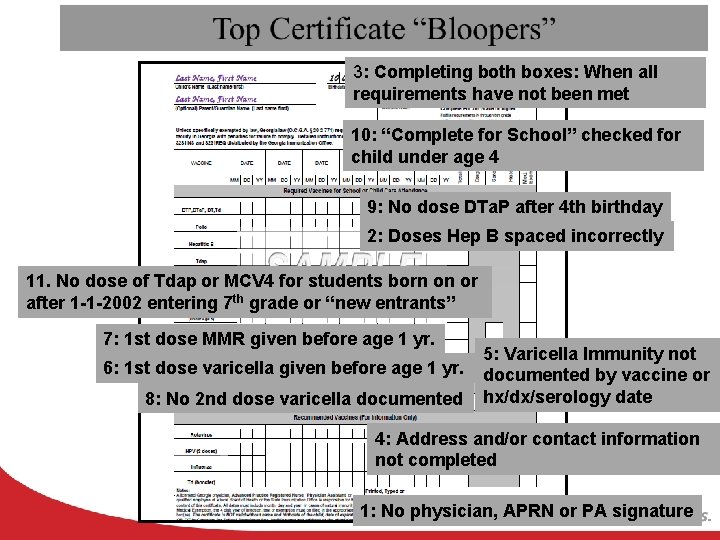
3: Completing both boxes: When all requirements have not been met 10: “Complete for School” checked for child under age 4 9: No dose DTa. P after 4 th birthday 2: Doses Hep B spaced incorrectly 11. No dose of Tdap or MCV 4 for students born on or after 1 -1 -2002 entering 7 th grade or “new entrants” 7: 1 st dose MMR given before age 1 yr. 6: 1 st dose varicella given before age 1 yr. 8: No 2 nd dose varicella documented 5: Varicella Immunity not documented by vaccine or hx/dx/serology date 4: Address and/or contact information not completed 1: No physician, APRN or PA signature
Maintenance of Certificates To be valid, certificates must be current – Certificate becomes invalid on the “Date of Expiration” – Child must submit a current certificate within 30 days after the expiration date or be excluded from attendance – Facility or school is responsible for notifying parent/guardian of an upcoming expiration date and requesting a current certificate be submitted – Any school/facility official who does not enforce the requirements shall be guilty of a misdemeanor
Filing of Certificates • All children enrolled must have a valid Certificate of Immunization on file • Certificates must be available for inspection by health officials • If child attends more than one facility, a photocopy to the second facility is acceptable • If child leaves or transfers to another school or facility, the certificate should be given to a parent/guardian or sent to the new school/facility • In the case of religious exemption, form 2208 must be on file after 8/2015
Tickler Filing System • “How to” instructions located in the Immunization Guidelines for Child Care Facility Operators & School Personnel (Form 3258) • Tickler system (set up by month and year) • Remind parents or care givers • Give parents information sheet about requirements • Document follow-up • Enforce requirements
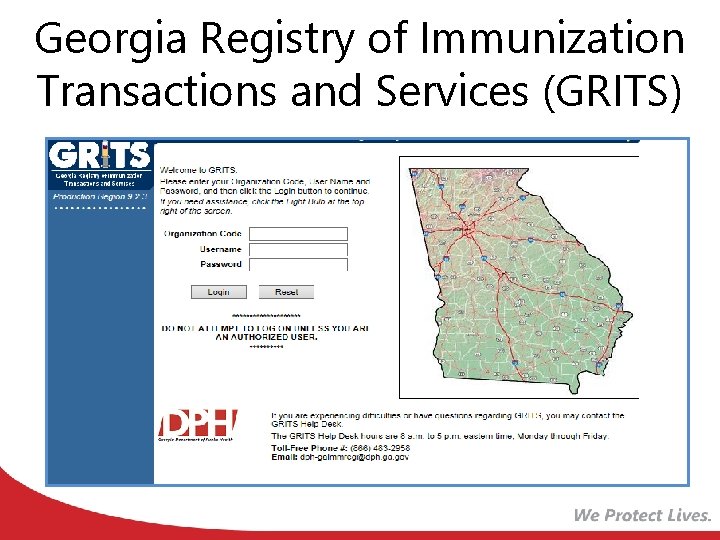
Georgia Registry of Immunization Transactions and Services (GRITS)
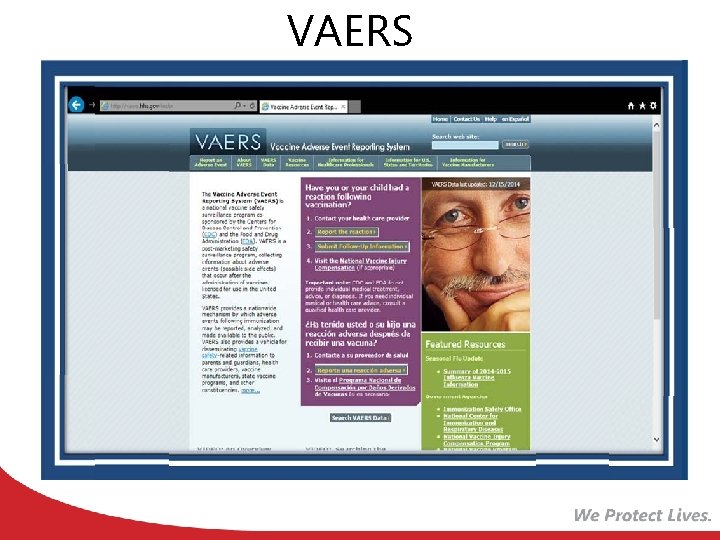
Responsibilities • Physicians and Public Health Clinics: – Know current legal requirements for attendance and accurately completing the certificate – Administering immunizations according to the current Recommended Childhood and Adolescent Immunization Schedule – Report the occurrence of any disease listed on the “Notifiable Disease List” – Report any adverse event following the administration of a vaccine to VAERS • Child Care and School : – – Review the certificates for validity prior to accepting Develop a system for immunization certificate management/Tickler system Have certificates available for inspection and audit by health officials Report the occurrence of any disease listed on the “Notifiable Disease List” • Parent/Caregiver: - Stay on immunization schedule – Obtain immunization certificate – Provide copy of certificate to each facility
Critical Elements for Immunization Services
Every Office and Clinic Needs A Vaccine Champion! • Lead your immunization team. • Educate all staff about new vaccines and recommendations. • Teach new staff about vaccine storage, handling, & administration. • Initiate processes to improve immunization rates in your practice/facility. • Assure immunizations of all staff are up-to-date.
Standards for Child, Adolescent, and Adult Immunization Practices • • Availability of vaccines Assessment of client’s vaccination status Effective communication with client or parent Proper storage and handling of vaccines Accurate documentation of vaccinations Implementation of strategies to improve rates Developing partnerships and community-based approaches to vaccine delivery
VAERS
Vaccine Injury Compensation Program (VICP) National Vaccine Injury Compensation Program provides compensation to individuals found to be injured by or have died from certain childhood vaccines. – – Established in 1988 by NCVIA Federal “no fault” system to compensate those injured Claim must be filed by individual, parent or guardian Must show that injury is on “Vaccine Injury Table”

IT STARTS WITH YOU!
Healthcare Personnel (HCP) Need These Immunizations: • Annual influenza vaccine • Tdap or Td • Hepatitis B (exposure risk) Check immunity Validate immune status of: • Varicella • Measles, Mumps & Rubella(MMR) Are YOU up to date?
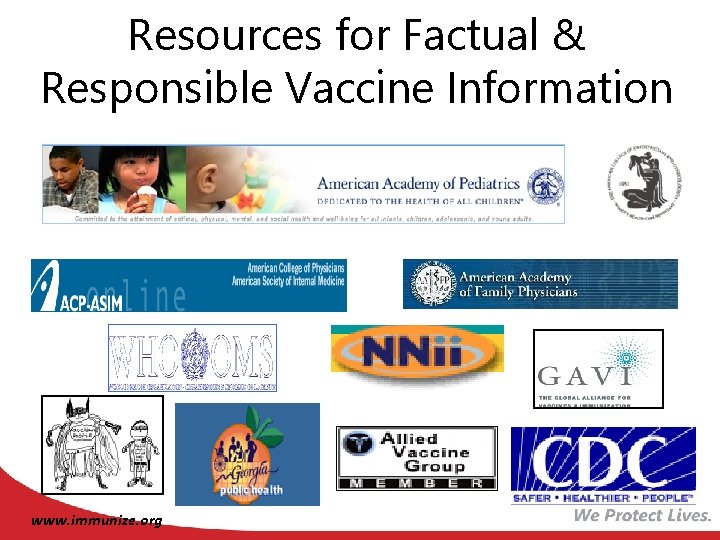
Resources for Factual & Responsible Vaccine Information www. immunize. org
Stay Current! • Sign up for listserv sites which provide timely information pertinent to your practice www. immunize. org/resources/emailnews. asp – AAP Newsletter – CDC immunization websites (32 in all) – CHOP Parents Pack Newsletter – IAC Express – Websites specific to particular vaccines
Internet Resources Georgia Department of Public Health l http: //dph. georgia. gov/immunization-section CDC Immunization information l http: //www. cdc. gov/vaccines/ CDC Flu information l http: //www. cdc. gov/flu/ Immunization Action Coalition l www. immunize. org
Resources • Local health department • District Immunization Coordinator • GA Immunization Program Office – On call Help line: 404 -657 -3158 – GRITS Help Line: 1 -866 -483 -2958 – VFC Help Line: 1 -800 -848 -3868 – Website http: //dph. georgia. gov/immunization-section – Your local Immunization Program Consultant (IPC) – Epidemiology: 1 -866 -782 -4584 • GA Chapter of the AAP • GA Academy of Family Physicians
It’s a Team Effort! High Immunization rates begin with a team designed plan! What can your team do to improve rates?
- Slides: 81