
Child Sexual Abuse Disclosure Dynamics and Best Practices
Child Sexual Abuse: Disclosure Dynamics and Best Practices for Questioning Children AKA: Kids Say the Darndest Things Presented by: Miriam Wolf, MS, LCSW 2018 Beyond the Bench Conference Santa Clara County, CA

The “Discovery” of Child Sexual Abuse- 1980 s

Child Sexual Abuse Accommodation Syndrome • Summit, Roland (1983). The child sexual abuse accommodation syndrome. Child Abuse & Neglect, 7, 177193. • CSAAS Components: § Secrecy § Helplessness § Entrapment and Accommodation § Delayed, Conflicted, Unconvincing Disclosure § Retraction

Child Sexual Abuse Accommodation Syndrome • Decried as “junk science” § Not a syndrome § Not a diagnostic tool § Not listed in DSM § Doesn’t address false allegations § Presumes child was abused • Response § Summit, R. C. (1992). Abuse of the child abuse accommodation syndrome. Journal of Child Sexual Abuse, 1(4), 153 -163.
Sources of current science/evidence base • Retrospective studies of adults • Studies of children whose cases were reported to authorities during childhood • Research that compares children’s disclosure patterns in cases with corroborative evidence • Anecdotal/lab studies • Offender “M. O. ” studies
Differing conclusions across researcher groups • “The Disclosure Wars” 6
Example: London, et al. • London, K. , Bruck, M. , Wright, D. B. , & Ceci, S. J. (2008). Review of the contemporary literature on how children report sexual abuse to others: Findings, methodological issues, and implications forensic interviewers. Memory, 16(1), 29 -47. • London, K. , Bruck, M. , Ceci, S. J. , & Shuman, D. W. (2005). Disclosure of child sexual abuse: What does the research tell us about the ways that children tell? Psychology, Public Policy, and Law, 11(1), 194– 226.
Example: Lyon • Lyon, T. (2007). False denials: Overcoming methodological biases in abuse disclosure research. In M. -E. Pipe, M. E. Lamb, Y. Orbach, & A. C. Cederborg (Eds. ), Child sexual abuse: Disclosure, delay, and denial (pp. 41 -62). Mahwah, NJ: Lawrence Erlbaum Associates. • Lyon, T. D. (2002). Scientific support for expert testimony on Child Sexual Abuse Accommodation Syndrome. In J. R. Conte (Ed. ), Critical issues in child sexual abuse (pp. 107 -138). Newbury Park, CA: Sage.
Why are there different conclusions across studies? • Definitional differences • Anecdotal (lab) vs field studies • External validity • Ecological validity • Meta-analyses • Sample biases • Suspicion bias • Substantiation bias

Secrecy and delayed disclosure, into adulthood – an area of consensus • Non-disclosure of CSA during childhood is very common • 60 -70% of adults who report they were molested as children do not recall disclosing their abuse to anyone during childhood (In other words, 2/3 of victims delay reporting until into adulthood!) • London, et. al. (2005, 2007, 2008)

Delays in reporting among children who do disclose during childhood – an area of consensus • “…[W]hen children do disclose [during childhood] it often takes them a long time to do so. ” (London, 2005) • “Delays in telling anyone about the abuse for several months, a year, or even longer occur in a significant percentage of child sexual abuse cases. ” (Olafson and Lederman, 2006) • Only 10 -18% of CSA victims who disclosed their abuse to someone during childhood recall their abuse being reported to authorities (Olafson and Lederman, 2006)

Non-disclosure and incremental disclosure during formal interviews – an area without consensus • “The data clearly demonstrate that most children who are interviewed about sexual abuse do disclose and do not later recant…” (London, et. al. , 2005, 2008) • “…The nondisclosure of sexual abuse among truly abused children is a real and serious phenomenon… (Lyon, 2007) • “Many suspected victims of child maltreatment are reluctant to allege abuse when formally interviewed…even when there is clear evidence that they were, in fact, abused. (Hershkowitz, Lamb and Katz, 2014).

Offender behaviors and impact on disclosure dynamics • Recent research points to similarities between intrafamilial and extrafamilial adult offenders § Sex offenders emphasize the extent to which they seduce their victims over time § Sex offenders victimize children both within and outside their families, and across ages and genders § They choose victims based on perceived vulnerability § Grooming, seduction and intimidation are more common than force and threats, and provides insight into the means by which offenders convince children to keep the abuse a secret o Lyon and Ahern (2011). Disclosure of Child Sexual Abuse. APSAC Handbook on Child Maltreatment, Chapter 14.

DO CHILDREN TELL FULLY WHEN DIRECTLY ASKED? – an area without consensus THE DISAGREEMENTS… • “The data clearly demonstrate that most children who are interviewed about sexual abuse do disclose and do not later recant…” (London, et. al. , 2005, 2008) • “…The nondisclosure of sexual abuse among truly abused children is a real and serious phenomenon… (Lyon, 2007) • …[W]hen questioned during formal interviews, children may only partially disclose during the initial interview. (Olafson and Lederman, 2006) 14
STUDIES OF DISCLOSURE RATES IN FORMAL FORENSIC INTERVIEWS • Across 17 studies published since 1990, the mean disclosure rate during forensic interviews was about 2/3; about 1/3 on average denied abuse (London, et al, 2007) • The most significant predictor of disclosure during forensic interviews is whether the child had previously disclosed (London, et al, 2007). • “…it is clear that allegation rates vary dramatically depending on the relationship between alleged victims and abusers. Children are much less likely to make accusations about parents or parent figures… as opposed to other suspected perpetrators, with over half of the children denying suspected abuse by a parent figure when directly asked by an investigative interviewer…” Hershkowitz et al. , 2014).

DISCLOSURE IN CASES IN WHICH THERE WAS NO PREVIOUS DISCLOSURE • Studies with external corroborating evidence show that 43 -50% of children who have not previously disclosed DO NOT disclose sexual abuse during formal interviews. o Across 21 studies examining gonorrhea in children, the average disclosure rate was only 43%. (Lyon, 2007) o Swedish case study with videotaped evidence had a 50% disclosure rate (Sjoberg & Lindblad, 2002).
SEX OFFENDER M. O. RESEARCH Lyon, T. D. , & Ahern, E. C. (2011) • Research on offender tactics informs our understanding of children’s disclosure patterns o Sex offenders emphasize the extent to which they seduce their victims over time rather than commit isolated assaults o Child sex offenders either seek out or take advantage of opportunities to molest children with whom they are familiar o Sex offenders often victimize children both within and outside their families and the findings on modus operandi indicate more similarities than differences in approach o Offenders endorse a mixture of bribes and threats as a means of ensuring the victim's compliance o Offenders often inform children about serious consequences of disclosure
LAB/ANECDOTAL RESEARCH ABOUT DISCLOSURE PATTERNS • Non-abused children’s reports of vaginal and anal touching during a medical exam (Saywitz, Goodman, Nicholas & Moan, 1991) • 72 5 and 7 year old girls • Half received scoliosis exam • 100% reported on free recall • Half received anogenital exam • Only 22% reported on free recall • Only 11% reported on free recall • 3 “false reports” using option posing questions, of which only 1 child gave details
Recantation – an area without consensus • 4% - Bradley and Wood (1996) • 23. 1% - Malloy and Lyon (2007) • “Our findings suggest that we can learn little by simply comparing recantation rates of different studies. Instead, it is imperative to consider the range of factors that may influence recantation in any particular study. ” • Malloy et. al. (2007)

Recantation – Filial Dependency Model Malloy, Lyon, Quas (2007) • 257 cases selected from 465 substantiated cases of CSA that resulted in a dependency court filing during a 1 -year period in LA County • • Children abused by a parent figure were more likely to recant Children whose NOCs were unsupportive were more likely to recant Younger children (<10 years) are more likely than older children to recant If all three of these factors are present, the child is 50% more likely to recant • Children initially placed in foster care (20%) were somewhat less likely to recant than children who remained with a family member (27. 4%) • Overall recantation rate: 23. 1%

Recantation or False Allegation? Malloy, et. al. (2007) • Recantation rates among cases with corroboration: • Cases with medical evidence: 20% • Cases where perpetrator admitted: 16. 7% • Cases with multiple victims: 17. 4% • Recantation rates in which there was evidence of custody related conflict: 17. 5%, compared to the overall sample of 23. 1%

Recantation – Wrap-Up • Bradley and Wood (1992): Recantation rate of 4% • Malloy, et. al. (2007) Recantation rates 23% fully recanted • 11% (additional) partially recanted or minimized earlier statements • Similar rates of recantation in cases with corroborating evidence Recent study: • Malloy, Mugno, Rivard, Lyon, Quas (2016). Familial Influences on Recantation in Substantiated Child Sexual Abuse Cases. Child Maltreatment, Vol. 21(3) 256 -261
COMPLEXITIES IN THE RESEARCH • Research sample biases o Suspicion bias o Substantiation bias
What to do with conflicting science? • “If the field is to be guided by scientifically validated concepts then this must be predicated on the literature that comes closest to the standards of science. ” • “Research studies that avoid suspicion bias and substantiation bias come closer to this scientific standard than do research studies that suffer from one or both of these biases…” o Olafson and Lederman (2006). The State of the Debate About Children's Disclosure Patterns in Child Sexual Abuse Cases. Juvenile and Family Court Journal, 57(1): pp. 27 -40

BEST PRACTICES IN QUESTIONING CHILDREN (in and out of court) • Child Forensic Interviewing o What is it? o Overview of current “best practices o How can knowledge of disclosure dynamics inform the approach to and types of questions that should be asked in forensic interviews and in court?

WHAT IS A CHILD FORENSIC INTERVIEW? • An interview conducted for legal purposes, to determine if a crime MAY have occurred and/or to assess child protection concerns • Uses evidence-based strategies to maximize the amount of information children can produce, as well as maximize the accuracy of that information • Best practices draw on research from diverse fields such as child development, linguistics, psychology and law
A child forensic interview is defined as… • “…a developmentally sensitive and legally sound method of gathering factual information regarding allegations of abuse or exposure to violence. This interview is conducted by a competently trained, neutral professional utilizing research and practice-informed techniques as part of a larger investigative process. ” [italics added] - OJJDP Best Practices Bulletin (2015) Downloadable at: https: //www. ojjdp. gov/pubs/248749. pdf
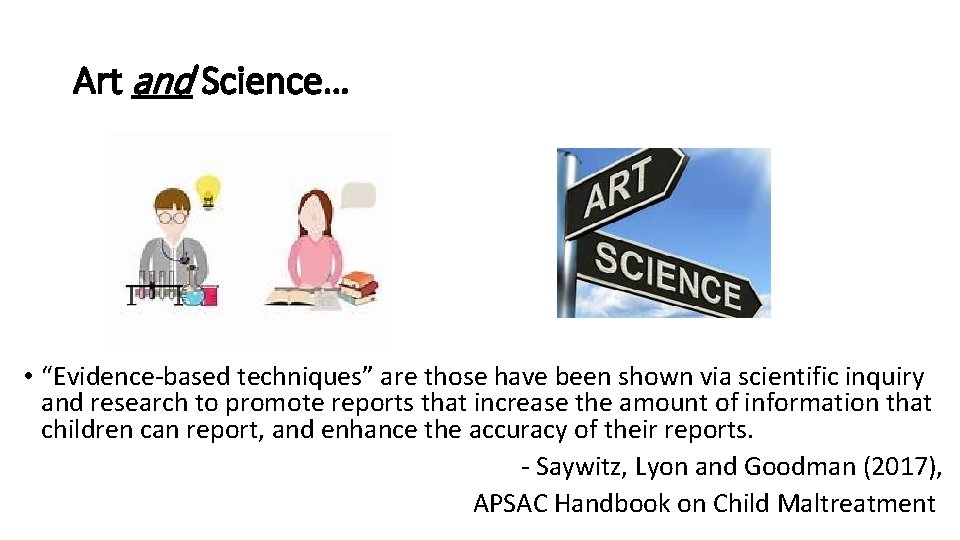
Art and Science… • “Evidence-based techniques” are those have been shown via scientific inquiry and research to promote reports that increase the amount of information that children can report, and enhance the accuracy of their reports. - Saywitz, Lyon and Goodman (2017), APSAC Handbook on Child Maltreatment
The science says… Common CFI Components/Structure: • Rapport Building Phase • Narrative Event Practice (AKA Episodic Memory Training) • Instructions • Truth/lie discussion and/or eliciting a promise to tell the truth • Other rapport building activities, per local practice/protocol • Substantive Phase • Transition questions • Narrative and Detail Gathering about discrete episodes • Closure Phase • Saywitz, Lyon and Goodman (2018); Poole (2016); OJJDP Best Practices (2015).
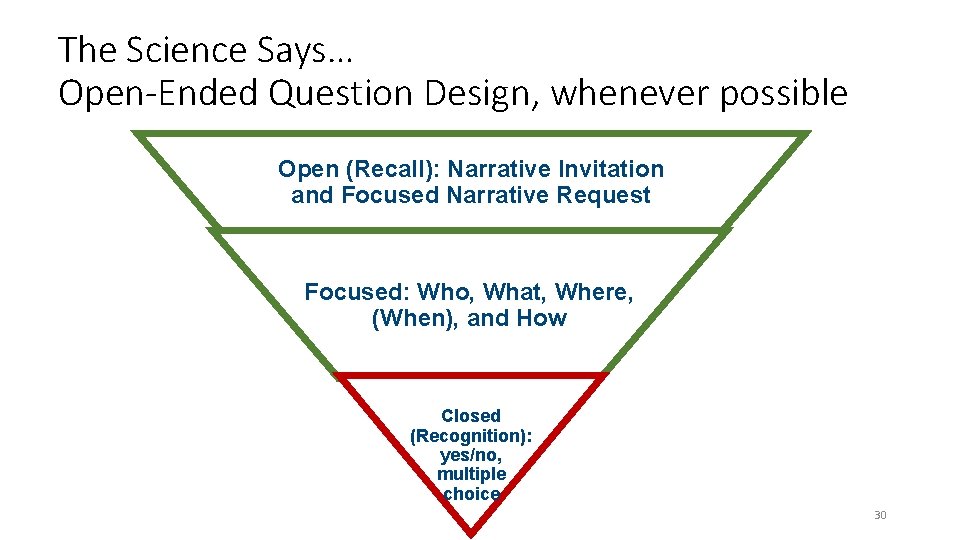
The Science Says… Open-Ended Question Design, whenever possible Open (Recall): Narrative Invitation and Focused Narrative Request Focused: Who, What, Where, (When), and How Closed (Recognition): yes/no, multiple choice 30
Increasingly, interviewers may be trained in a variety of interview models or protocols and utilize a “toolbox” of evidence-based techniques, individualized to the needs of the child and the case. - Saywitz, Lyon and Goodman (2017) in APSAC Handbook on Child Maltreatment
ALL RECOGNIZED, RESEARCH-BASED FORENSIC INTERVIEW MODELS EMPHASIZE: • The impact of a neutral interview setting • Importance of interviewer training • Reliance on a research base to guide question design • A phased approach to interviewing • Reducing duplicative interviewing by first responders • Field interviewing is generally done by least trained interviewer • Field interviewing is often not recorded, leaving it vulnerable to criticism • Distinguish between REPEATED, REDUNDANT interviews vs PLANNED, MULTIPLE interviews
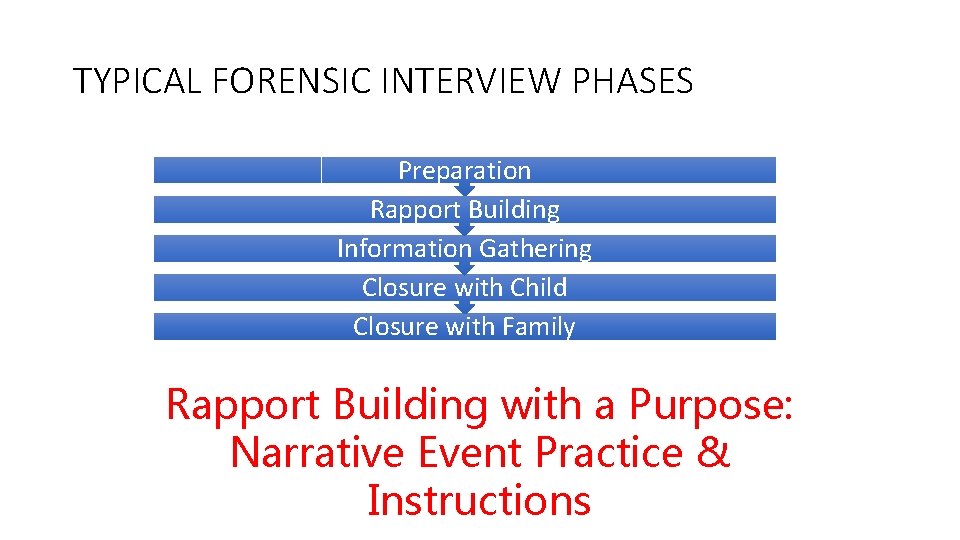
TYPICAL FORENSIC INTERVIEW PHASES Preparation Rapport Building Information Gathering Closure with Child Closure with Family Rapport Building with a Purpose: Narrative Event Practice & Instructions 33
NARRATIVE EVENT PRACTICE, AKA EPISODIC MEMORY TRAINING: THE “NEW” RAPPORT BUILDING
Narrative Event Practice • Children “learn” what their job is during the interview (testimony) • Children “learn” that they are the experts in the interview (testimony) • Interviewer “learns” what types of questions this child is developmentally able to understand answer • Interviewer listens for “script memory” vs “episodic memory” • A tool to assess “readiness” and/or “reluctance”
Narrative Event Practice • Things you like to do • Things you don’t like to do • Recent event Narrative, with “Tell me more” and “What happened next” prompts (e. g. last birthday, memorable recent event, today’s events)
Interview Instructions (Sample: from Tom Lyon’s 10 -Step) • Don’t know • Don’t understand • You’re wrong • Ignorant Interviewer • Promise to tell the truth • Eliciting a promise to tell the truth • More likely to tell the truth if a promise is elicited (Lyon & Dorado, 2008) • Truth induction is more effective than distinguishing between truth and lie • “Competency” should be an issue for the courtroom and ability to take an oath in the courtroom
INFORMATION GATHERING/ ALLEGATION PHASE “Tell me why you’re here. ” In research studies, approximately 50% of children who disclose in forensic interviews do so in response to this question, eliminating the need for more direct questions or body drawings, thus reducing criticism about children’s suggestibility. 38
ALLEGATION FOLLOW-UPS (Lyon 10 -Step) • It’s really important that you tell me why you came to talk with me today • I heard you talked to/saw… • Someone’s worried… • Someone bothered you… • Something wasn’t right… • If these are not fruitful in a child who has previously disclosed, the interviewer will proceed with some predetermined, case specific prompts, ideally determined in consultation with a multidisciplinary team.
INFORMATION GATHERING/ ALLEGATION PHASE The interviewer proceeds through the interview by asking “most preferred” types of questions whenever possible, and by following any“less preferred” question with an open-ended prompt MOST PREFERRED - You said X. -Tell me everything -Tell me more -What happened next? - WH questions LEAST PREFERRED - Yes/No - Forced Choice - Externally Derived 40
Information Gathering Phase • Child’s Narrative • Forensically relevant details • Script vs Episodic details Who What Where (When ) How 41
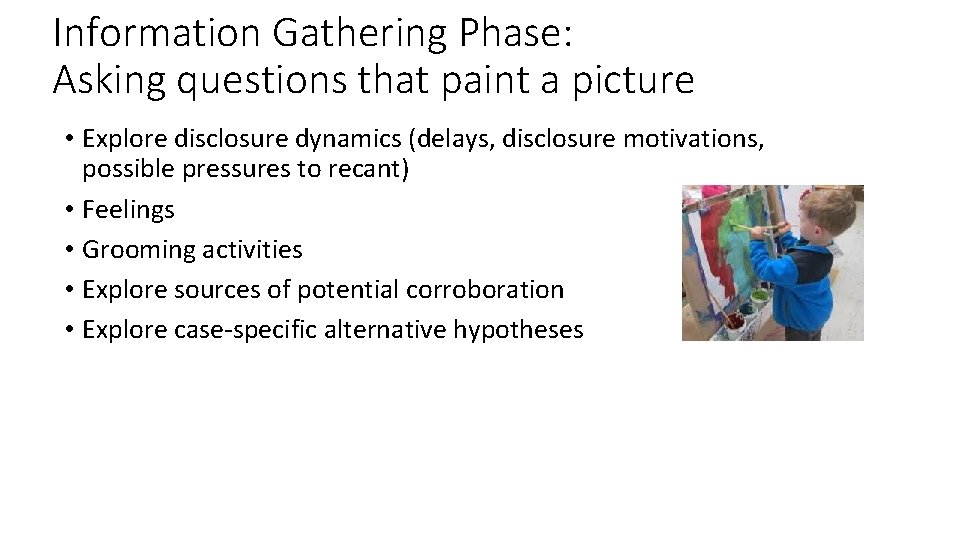
Information Gathering Phase: Asking questions that paint a picture • Explore disclosure dynamics (delays, disclosure motivations, possible pressures to recant) • Feelings • Grooming activities • Explore sources of potential corroboration • Explore case-specific alternative hypotheses
PRINCIPLES IN INFO GATHERING • LESS IS OFTEN MORE • The Forensic Interviewer may recommend NOT asking questions that are developmentally inappropriate • HOW THE QUESTION IS PHRASED CAN IMPROVE ACCURACY; THIS IS THE FORENSIC INTERVIEWER’S SPECIAL SKILL SET • >1 x or one time? Tell me everything about the first time/last time/another time vs How many times? • How did your body feel? vs Did it hurt? • How did you decide to tell? How did people find out? vs Why didn’t you tell before? • Where were your clothes? vs Were your clothes on or off?
A PARTICULAR CHALLENGE: TIME AND NUMBER QUESTIONS • Time and Number questions • • • When did that happen How long ago Number of times Before or after • Ability to place events in time begins around age 10, but temporal concepts evolve into adolescence
REMEDIES FOR TIME AND NUMBER CHALLENGES • Did it happen more than one time or one time? • Tell me about the first time • Tell me about the last time • Tell me about the time you remember most • Episodic vs script memories • Interviewer listens to and follows children’s narratives and episodic details whenever possible; these may contain the answers to temporal and number questions without needing to ask
APPROACHES RELUCTANCE • Additional emotional support • “Draw and tell” • Peripheral detail gathering • Avoid resorting to direct, leading questions; no evidence that they assist reluctant kids and plenty of evidence that they reduce accuracy and completeness • Document reluctance and/or pressures not to disclose or factors associated with recantation risk • Consider follow-up interview or extended interview protocol
CONCLUDING THE INTERVIEW • Interviewer transitions child to neutral topic and concludes interview • Team members address child’s and non-offending family members questions and needs • Team members address next steps Legal (criminal and dependency) Medical Referrals for therapy, victim advocacy and other services 47
SUMMARY • A substantial proportion of sexually abused children are reluctant or ambivalent about disclosing abuse • Forensic interviews should explore not only “facts” but can also shed light on disclosure dynamics, including explanations for delays and potential pressures to recant, which contain important elements for case decision making by MDT members and courts
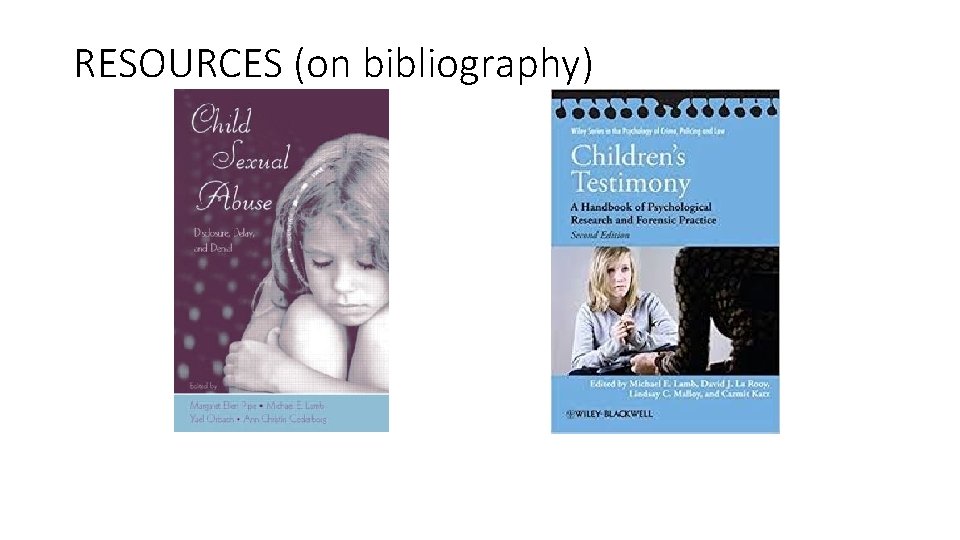
RESOURCES (on bibliography)
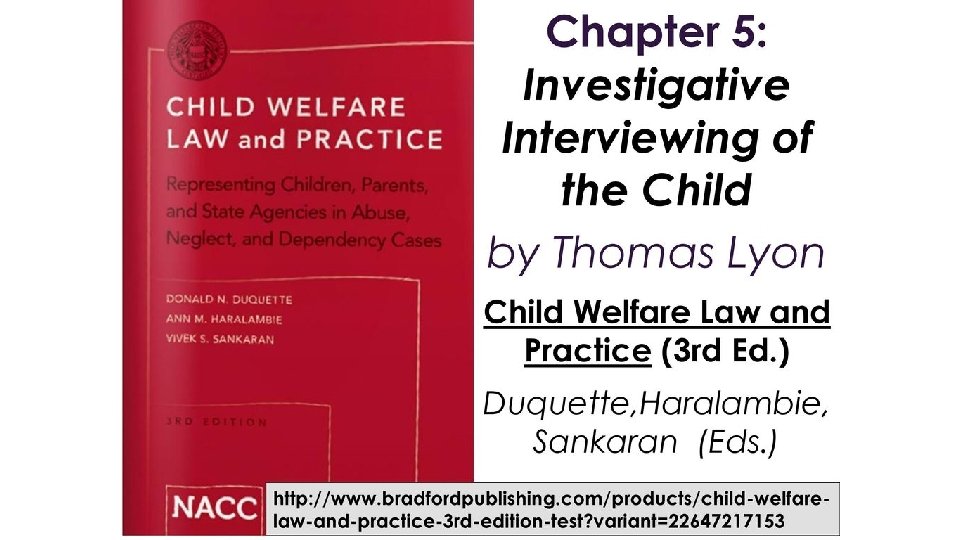

http: //www. ojjdp. gov/pubs/248749. pdf 51
On-line resources • Tom Lyon’s website: • Google: Tom Lyon Be Press • National Children’s Advocacy Center Child Abuse Library On-Line (Ca. Lio) • National Children’s Alliance

Q&A • Bibliography/resources attached • Contact information • Miriam Wolf, MS, LCSW • mwolflcsw@comcast. net
- Slides: 54