
CHILD PROTECTION UPDATE 2016 For corporate staff NSW
- Slides: 32
CHILD PROTECTION UPDATE 2016 For corporate staff © NSW Department of Education | Child Protection Update 2016 11 September 2021
SESSION OBJECTIVES To better understand your role in protecting children: – identifying indicators of abuse and neglect – obligations for reporting Understanding the definitions of reportable conduct – identifying the appropriate use of electronic communication. Slide 2
ALL STAFF MUST BE AWARE OF: § The indicators of abuse and neglect in children and young people § The obligation to advise workplace managers if they identify concerns about the safety, welfare and wellbeing of children and young people § The limitation to concerns that arise from, or during the course of their work. Slide 3
ALL STAFF MUST PARTICIPATE IN CHILD PROTECTION TRAINING: § All staff must participate in a child protection induction and annual updates § This includes workplace managers, parttime, temporary, casual staff and those who join during the year § Registers to be kept in each workplace. Slide 4
WHAT IS RISK OF HARM? Slide 5
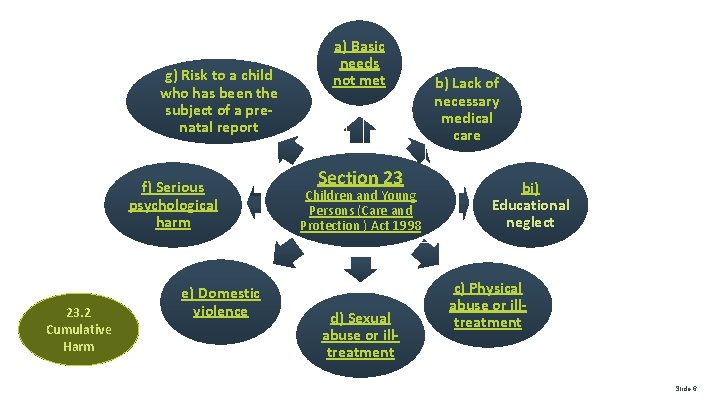
g) Risk to a child who has been the subject of a prenatal report f) Serious psychological harm 23. 2 Cumulative Harm e) Domestic violence a) Basic needs not met Section 23 Children and Young Persons (Care and Protection ) Act 1998 d) Sexual abuse or illtreatment b) Lack of necessary medical care bi) Educational neglect c) Physical abuse or illtreatment Slide 6
INDICATORS § Indicators are clues to children and young people’s experiences. § Indicators are not necessarily conclusive that abuse is happening. § If you have concerns about a child or young person then discuss them with your workplace manager. Slide 7
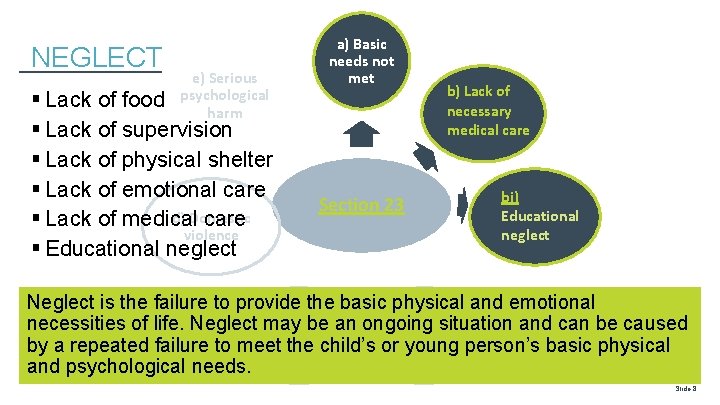
NEGLECT e) Serious psychological harm § Lack of food § Lack of supervision § Lack of physical shelter § Lack of emotional care d) Domestic § Lack of medical care violence § Educational neglect a) Basic needs not met Section 23 b) Lack of necessary medical care bi) Educational neglect Neglect is the failure to provide the basic physical and emotional c) Sexual c) Physical necessities of life. Neglect may be an ongoing situation and can be caused abuse or illby a repeated failure to meet the child’s ortreatment young person’s basic physical treatment and psychological needs. Slide 8
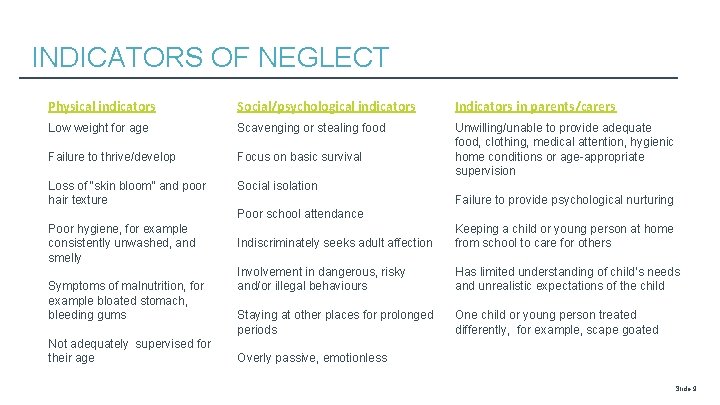
INDICATORS OF NEGLECT Physical indicators Social/psychological indicators Indicators in parents/carers Low weight for age Scavenging or stealing food Failure to thrive/develop Focus on basic survival Unwilling/unable to provide adequate food, clothing, medical attention, hygienic home conditions or age-appropriate supervision Loss of “skin bloom” and poor hair texture Social isolation Failure to provide psychological nurturing Poor school attendance Poor hygiene, for example consistently unwashed, and smelly Symptoms of malnutrition, for example bloated stomach, bleeding gums Not adequately supervised for their age Indiscriminately seeks adult affection Keeping a child or young person at home from school to care for others Involvement in dangerous, risky and/or illegal behaviours Has limited understanding of child’s needs and unrealistic expectations of the child Staying at other places for prolonged periods One child or young person treated differently, for example, scape goated Overly passive, emotionless Slide 9
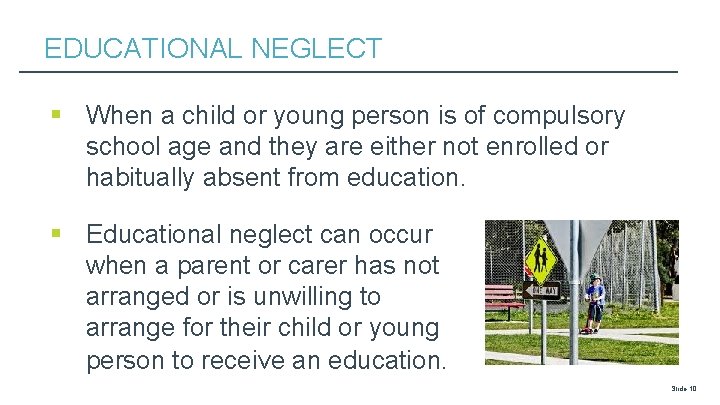
EDUCATIONAL NEGLECT § When a child or young person is of compulsory school age and they are either not enrolled or habitually absent from education. § Educational neglect can occur when a parent or carer has not arranged or is unwilling to arrange for their child or young person to receive an education. Slide 10
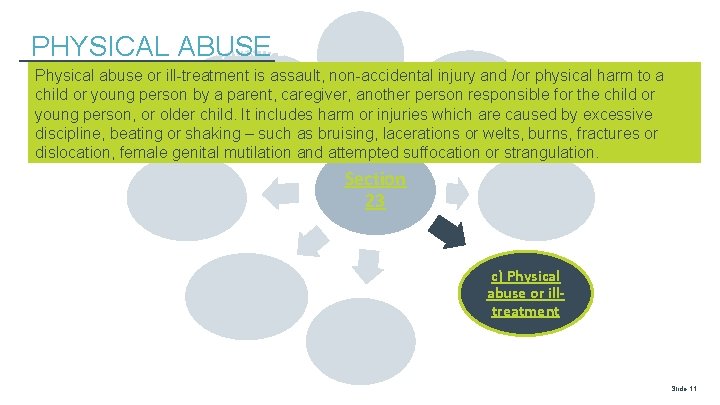
a) Basic needs child who has b) not met Physical abuse or ill-treatment is assault, non-accidental injury and /or physical harm to a been the Necessary child or young person by subject a parent, caregiver, another person responsible for the child or of a medical young person, or older child. It includes harm or injuries which pre-natal careare caused by excessive discipline, beating or shaking – such as bruising, lacerations or welts, burns, fractures or report dislocation, female genital mutilation and attempted suffocation or strangulation. PHYSICAL ABUSE f) Risk to a e) Serious psychologic al harm d) Domestic violence Section 23 c) Sexual abuse or ill -treatment bi) Access to an education c) Physical abuse or illtreatment Slide 11
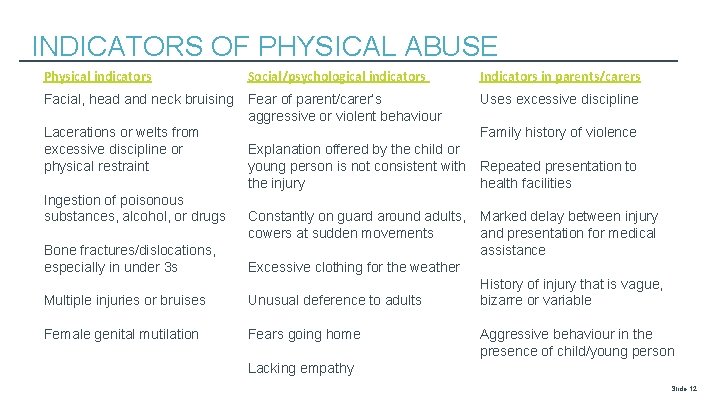
INDICATORS OF PHYSICAL ABUSE Physical indicators Social/psychological indicators Indicators in parents/carers Facial, head and neck bruising Fear of parent/carer’s aggressive or violent behaviour Uses excessive discipline Lacerations or welts from excessive discipline or physical restraint Ingestion of poisonous substances, alcohol, or drugs Bone fractures/dislocations, especially in under 3 s Family history of violence Explanation offered by the child or young person is not consistent with the injury Constantly on guard around adults, cowers at sudden movements Repeated presentation to health facilities Marked delay between injury and presentation for medical assistance Excessive clothing for the weather Multiple injuries or bruises Unusual deference to adults Female genital mutilation Fears going home History of injury that is vague, bizarre or variable Aggressive behaviour in the presence of child/young person Lacking empathy Slide 12
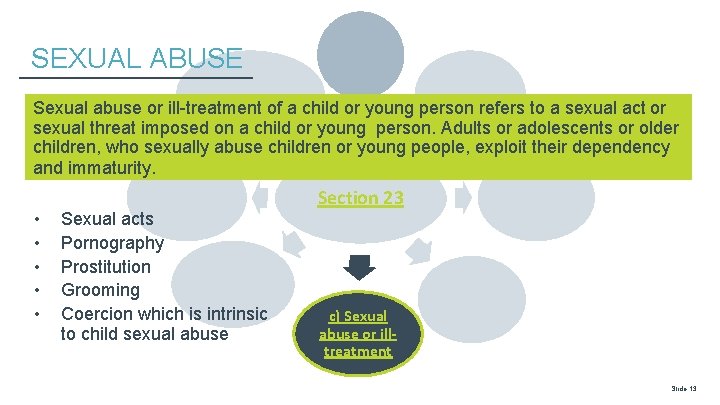
SEXUAL ABUSE f) as been the a) Basic needs not met subject of a pre-natal Sexual abuse or ill-treatment of a child or young person refers to a sexual act or report sexual threat imposed on a child or young person. Adults or adolescents or older children, who sexually abuse children or young people, exploit their dependency and immaturity. • • • e) Serious psychologic Sexual acts al harm Pornography Prostitution d) Domestic Grooming violence Coercion which is intrinsic to child sexual abuse Section 23 c) Sexual abuse or illtreatment bi) Access to an education c) Physical abuse or illtreatment Slide 13
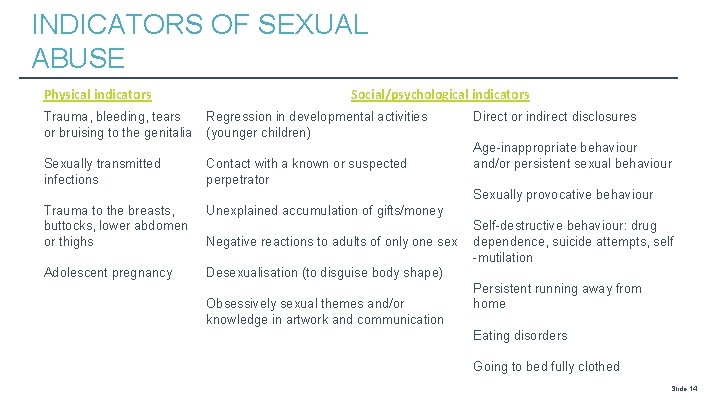
INDICATORS OF SEXUAL ABUSE Physical indicators Trauma, bleeding, tears or bruising to the genitalia Sexually transmitted infections Social/psychological indicators Regression in developmental activities (younger children) Contact with a known or suspected perpetrator Direct or indirect disclosures Age-inappropriate behaviour and/or persistent sexual behaviour Sexually provocative behaviour Trauma to the breasts, buttocks, lower abdomen or thighs Unexplained accumulation of gifts/money Adolescent pregnancy Desexualisation (to disguise body shape) Negative reactions to adults of only one sex Obsessively sexual themes and/or knowledge in artwork and communication Self-destructive behaviour: drug dependence, suicide attempts, self -mutilation Persistent running away from home Eating disorders Going to bed fully clothed Slide 14
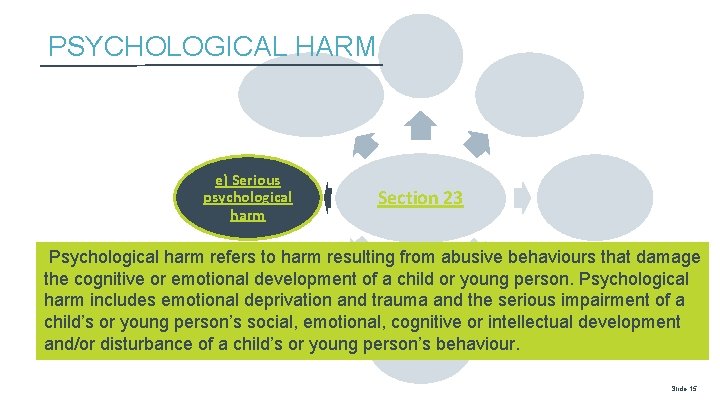
PSYCHOLOGICAL HARM e) Serious psychological harm Section 23 bi) Access to an education Psychological harm refers to harm resulting from abusive behaviours that damage c) Physical the cognitive or emotional development of a child or young person. Psychological d) Domestic abuse or harm includes emotional deprivation impairment of a violence and trauma and the serious illchild’s or young person’s social, emotional, cognitive intellectual development c) Sexual or treatment abuse orbehaviour. ill and/or disturbance of a child’s or young person’s -treatment Slide 15
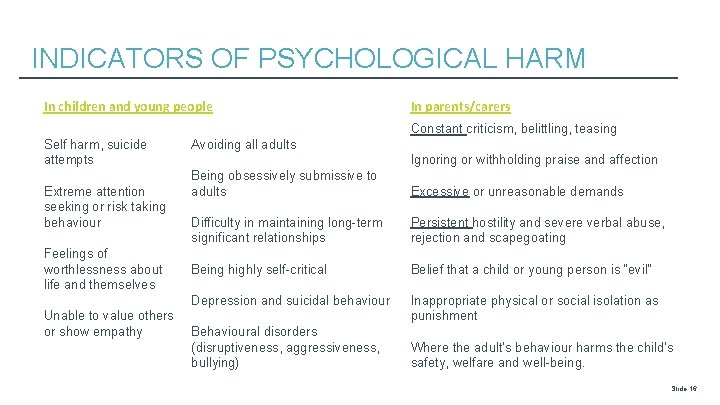
INDICATORS OF PSYCHOLOGICAL HARM In children and young people In parents/carers Constant criticism, belittling, teasing Self harm, suicide attempts Extreme attention seeking or risk taking behaviour Feelings of worthlessness about life and themselves Unable to value others or show empathy Avoiding all adults Ignoring or withholding praise and affection Being obsessively submissive to adults Excessive or unreasonable demands Difficulty in maintaining long-term significant relationships Persistent hostility and severe verbal abuse, rejection and scapegoating Being highly self-critical Belief that a child or young person is “evil” Depression and suicidal behaviour Inappropriate physical or social isolation as punishment Behavioural disorders (disruptiveness, aggressiveness, bullying) Where the adult’s behaviour harms the child’s safety, welfare and well-being. Slide 16
INDICATORS OF ABUSE AND NEGLECT EXERCISE REFER TO HANDOUT 1 Match the scenario on the left hand side of the page to the form of abuse or neglect that might be suspected. Slide 17
STAFF ROLES AND RESPONSIBILITIES Slide 18 18
RESPONDING TO CHILD PROTECTION AND CHILD WELLBEING CONCERNS § Inform your workplace manager of any child protection concerns § Provide relevant information to assist the workplace manager to make a decision about what to do next. Slide 19
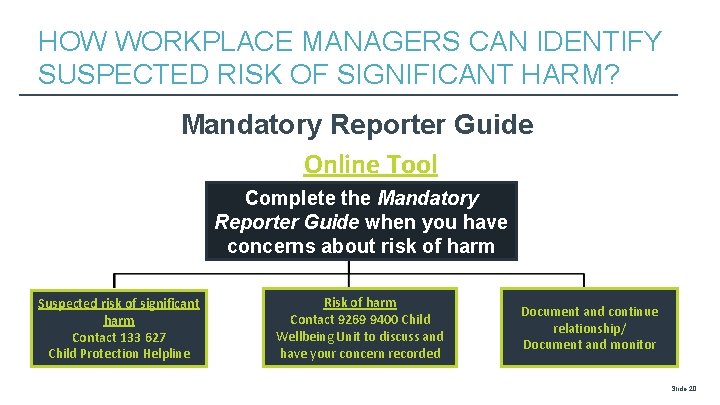
HOW WORKPLACE MANAGERS CAN IDENTIFY SUSPECTED RISK OF SIGNIFICANT HARM? Mandatory Reporter Guide Online Tool Complete the Mandatory Reporter Guide when you have concerns about risk of harm Suspected risk of significant harm Contact 133 627 Child Protection Helpline Risk of harm Contact 9269 9400 Child Wellbeing Unit to discuss and have your concern recorded Document and continue relationship/ Document and monitor Slide 20
REPORTING TO COMMUNITY SERVICES Where there are concerns that a child or young person is at suspected risk of significant harm a report MUST be made to Family and Community Services. • It is the responsibility of the workplace manager to make a report to the Child Protection Helpline phone (13 3627 or 13 DOCS) • The workplace manager provides the staff member with the Contact Reference Number (CRN) and gives appropriate feedback. Slide 21
ALLEGATIONS AGAINST EMPLOYEES IN THE AREA OF CHILD PROTECTION Slide 22
WHAT IS REPORTABLE CONDUCT? § any sexual offence, or sexual misconduct, committed against, with or in the presence of a child - including a child pornography offence § any assault, ill-treatment or neglect of a child § any behaviour that causes psychological harm to a child. Whether or not, in any case, with the consent of the child. Slide 23
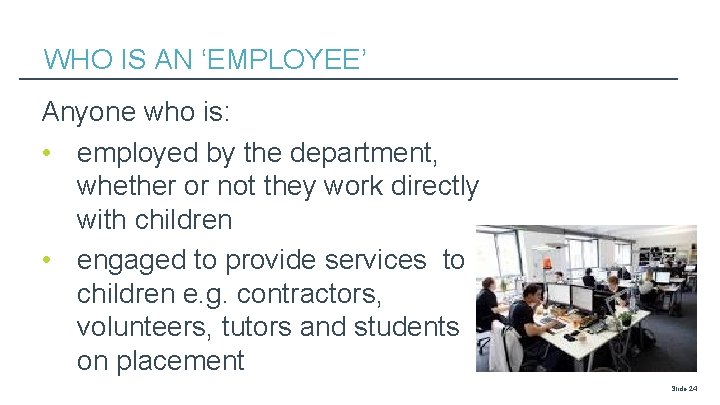
WHO IS AN ‘EMPLOYEE’ Anyone who is: • employed by the department, whether or not they work directly with children • engaged to provide services to children e. g. contractors, volunteers, tutors and students on placement Slide 24
THE DEFINITION OF SEXUAL MISCONDUCT Sexual misconduct includes: • crossing professional boundaries • sexually explicit comments • overtly sexual behaviour. Slide 25
CROSSING PROFESSIONAL BOUNDARIES Behaviour that can reasonably be perceived as involving an inappropriate and overly personal relationship with, or focus on a child or young person, or a group of children or young people. Slide 26
SEXUALLY EXPLICIT BEHAVIOUR IS: • inappropriate conversation and jokes of a sexual manner • comments that express a desire to act sexually • unwarranted and inappropriate touching • sexual exhibitionism • exposing children to sexual behaviour of others including pornography. Slide 27
APPROPRIATE USE OF ELECTRONIC COMMUNICATION AND SOCIAL MEDIA • • Use appropriate language in email and text messages Do not send threatening, abusive or obscene messages Do not invite students outside your family into your personal social network site Report any situations where you become aware of inappropriate use. Slide 28
Never use the Department’s networks to view, upload, download or circulate: • • • Sexually related or pornographic messages or material Violent or hate-related messages or material Racist or other offensive messages aimed at a particular group or individual Malicious, libelous or slanderous material Subversive or other messages or material related to illegal activities. Slide 29
EXERCISE APPROPRIATE OR INAPPROPRIATE? 1. A colleague has friended some of his son’s Year 9 friends on Facebook. 2. A member of your team often talks about a ‘special’ relationship he has with the child in the building next to the office. It involves giving her special gifts and treats and showing special favours to her that do not include her siblings. 3. Your Year 10 daughter mentions that, in her study of classical art, her art teacher has included paintings that depict nudity. Slide 30
EXERCISE APPROPRIATE OR INAPPROPRIATE? 4. A teacher has a twitter account that he uses to discuss aspects of his life. 5. A secondary teacher encourages her students to use email for communication and sending class work. 6. A school staff member has a photo of a student in the school as a screen saver on her computer. Slide 31
RESOURCES • Protecting and Supporting Children and Young People: policy and procedures https: //www. det. nsw. edu. au/policies/student_ser v/child_protection/prot_children/implementation_ 1_PD 20020067. shtml • Mandatory Reporter Guide http: //www. keepthemsafe. nsw. gov. au/ Slide 32