
Child Observation Chapter 3 Chapter Outline Introduction Principles
Child Observation Chapter 3
Chapter Outline Introduction Principles of good practice Description of FETAC level 5 Child Development (D 20005) assessment requirements Observations methods Writing up single observations The child study Revision questions

Reasons for Observing Children To understand where children are at in terms of their physical, intellectual (cognitive), language, emotional development so that the activities planned are developmentally appropriate yet challenging for them To have a record of children’s progress for parents or other professionals as may be required To be informed about individual children’s developmental progress, perhaps identifying signs of developmental delay that may require further investigation To observe children exhibiting problem behaviour, to investigate frequency, possible triggers and how staff are responding to the behaviour

Principles of Good Practice Confidentiality Accurate description Objectivity
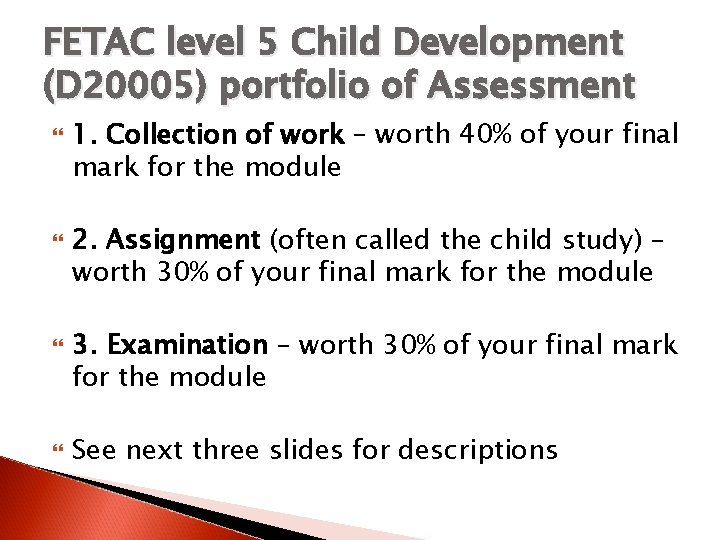
FETAC level 5 Child Development (D 20005) portfolio of Assessment 1. Collection of work – worth 40% of your final mark for the module 2. Assignment (often called the child study) – worth 30% of your final mark for the module 3. Examination – worth 30% of your final mark for the module See next three slides for descriptions
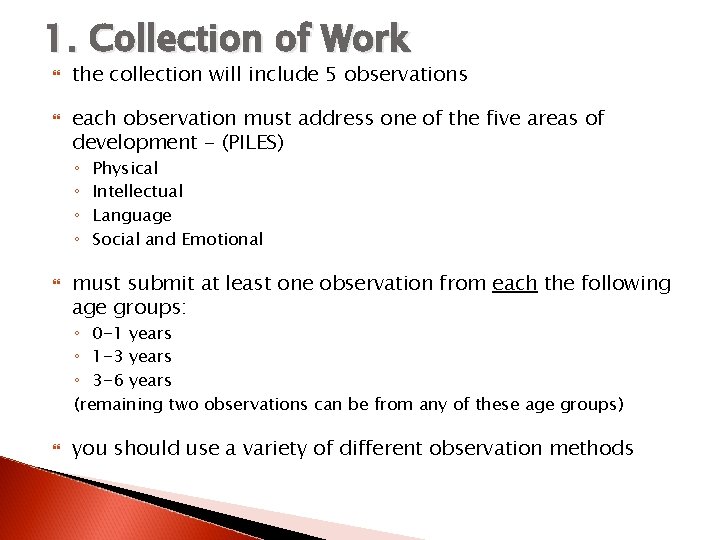
1. Collection of Work the collection will include 5 observations each observation must address one of the five areas of development - (PILES) ◦ ◦ Physical Intellectual Language Social and Emotional must submit at least one observation from each the following age groups: ◦ 0 -1 years ◦ 1 -3 years ◦ 3 -6 years (remaining two observations can be from any of these age groups) you should use a variety of different observation methods

2. Assignment (child study) One child is chosen and 5 separate observations are carried out with this one child One observation is carried out on each of the 5 areas of development – ◦ ◦ ◦ Physical Intellectual Language Social Emotional An overall evaluation is carried out
3. Examination The examination is 1½ hours long and tests candidates on all aspects of the course Section A – ◦ 12 short questions, must answer 10 Section B – ◦ 3 structured (long) questions, must answer 2

Observation Methods Narrative Pre-coded Checklist Time sample Event sample Movement or flow charts Tables, pie charts and bar charts Using audio or video recordings during observations

Description of Methods Please see textbook pages 42 to 51 for detailed description of methods
Writing up observations When writing up observations (including the 5 single observations required by the FETAC level 5 Child Development module) it is advisable to follow a clear and structured format This ensures that both the writer of the observation and its readers are clear about ◦ ◦ (a) who is being observed (b) why are they being observed (c) where they are being observed (d) what information the observation has gathered and what it means Suggested headings are given on next slide with more detailed descriptions of each heading on page 51 of textbook
Suggested Headings All observations should have a signed observation brief to the front. Title of observation Date Time observation started and finished Number of children present Number of adults present Permission obtained from Description of setting Immediate context Brief description of the child observed Aim of observation Rationale Method used Media used The observation itself The evaluation Personal learning gained References and bibliography Recommendations (a requirement for FETAC for level 6) Signatures (3)
Child Study At level 5 the child study is composed of 5 different sections or parts: 1. 2. 3. 4. 5. Proposal Five Observations Overall Evaluation Critical Evaluation References and Bibliography For details please see page 54 of textbook
Revision questions 1. Give 4 reasons why child observations are carried out in childcare settings 2. In relation to child observations: 3. What is meant by the term objectivity in relation to child observations? 4. Name and describe 4 different observation methods (a) what is confidentiality (b) why is it important (c) how can childcare workers protect children’s confidentiality?
- Slides: 14