
Child Labour in the context of Child Protection
Child Labour in the context of Child Protection Systems Approach Teona Aslanishvili Child Protection Specialist UNICEF Myanmar taslanishvili@unicef. org Seminar on Child Labour and Social Protection June 11 th 2014 Nay Pyi Taw
The themes of this presentation ü How to view Child Labour in the context of child protection systems approach ü Key areas for a child protection systems approach to child labour ü What are the areas where child protection systems approach is linked with social protection
What can we say about child labour? • Child labour deprives children of their right to go to school, exposes them to violence, and reinforces intergenerational cycles of poverty. • The risks are higher for children and adolescents whose families are poor, who are excluded from services due to stigma, discrimination, and other issues related to access, or who have lost the protection and care of their parents.
• Child labour constitutes a serious violation of children’s rights BUT • Child labour is preventable through integrated approaches that simultaneously address poverty and inequity, improve access to and quality of education and mobilize public support for respecting children’s rights.
Issues to address • Child protection: “preventing and responding to violence, exploitation and abuse. ” • Understanding the underlying causes of child labour and addressing their interconnectedness is the key premise behind the prevention and response approach. • Effective action against child labour must address the full range of vulnerabilities that children face, and must recognize that these wider concerns are not always adequately dealt with in existing response strategies, policies and laws.

Systems Approach in Child Protection The systems approach: • Facilitates more systematic policy development and programming that considers the child, family and community as a whole. • Supports better coordination of poverty reduction, social welfare, justice, labour, and education policies ensures cost-effectiveness and efficiency. • Addresses social drivers such as marginalization and discrimination based on ethnicity, gender or other characteristics.
Key areas for a child protection systems approach to child labour • Legal reform • Education • Social protection
Legal Reforms • Provide clear legislative guidance on the types and conditions of activities that should be considered child labour. • For effective application, laws should be accompanied by policy interventions that provide alternatives in the form of education and vocational training, as well as social protection measures that benefit children and families. • Can trigger and promote social change and transformation of social norms.
Education • Child labour acts as a major barrier to education, affecting enrollment, attendance and performance in school. • Improving access to quality education has great potential to reduce child labour. • An estimated 57 million children of primary school age were out of school in 2011 (UNESCO Institute for Statistics, Education for All Global Monitoring Report, Policy Paper No. 9, June 2013. ) • Almost half of all children currently out of school may never enroll, and the other half may either enter late or drop out early. • There is a high probability that children who are out of school will be exposed to violence and exploitation in workplaces. Some of the 600 million children who are in school also work in violent and exploitative workplaces, increasing their risk of dropping out. • The role of education to prevent and respond to child labour.

Social Protection • Child labour is largely driven by vulnerabilities caused by poverty and deprivation. • Progress to eliminate child labour is closely linked to reducing these vulnerabilities, mitigating economic shocks, and providing families with social protection and an adequate level of regular income. • Social protection as: the set of public and private policies and programmes aimed at preventing, reducing and eliminating economic and social vulnerabilities to poverty and deprivation. • This can include programmes such as social transfers, social health insurance, social support services, and accessible child care. • Well-functioning social protection systems can contribute to addressing some of the underlying causes of violence, abuse, exploitation and neglect of children
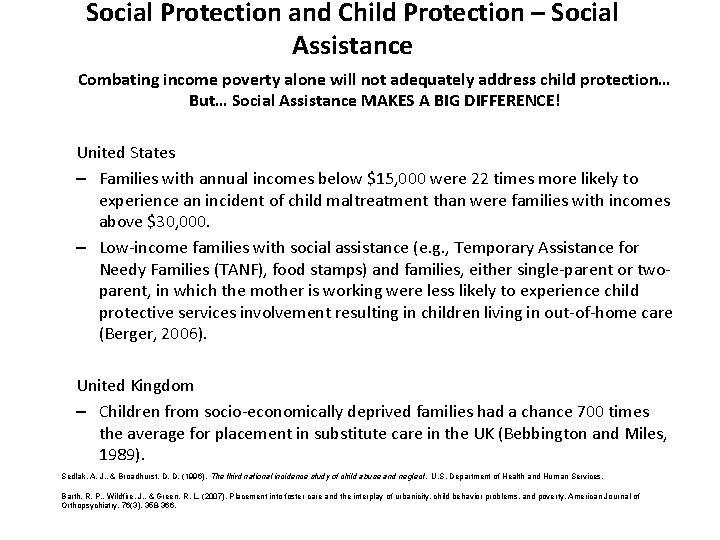
Social Protection and Child Protection – Social Assistance Combating income poverty alone will not adequately address child protection… But… Social Assistance MAKES A BIG DIFFERENCE! United States – Families with annual incomes below $15, 000 were 22 times more likely to experience an incident of child maltreatment than were families with incomes above $30, 000. – Low-income families with social assistance (e. g. , Temporary Assistance for Needy Families (TANF), food stamps) and families, either single-parent or twoparent, in which the mother is working were less likely to experience child protective services involvement resulting in children living in out-of-home care (Berger, 2006). United Kingdom – Children from socio-economically deprived families had a chance 700 times the average for placement in substitute care in the UK (Bebbington and Miles, 1989). Sedlak, A. J. , & Broadhurst, D. D. (1996). The third national incidence study of child abuse and neglect. U. S. Department of Health and Human Services. Barth, R. P. , Wildfire, J. , & Green, R. L. (2007). Placement into foster care and the interplay of urbanicity, child behavior problems, and poverty. American Journal of Orthopsychiatry, 76(3), 358 -366.
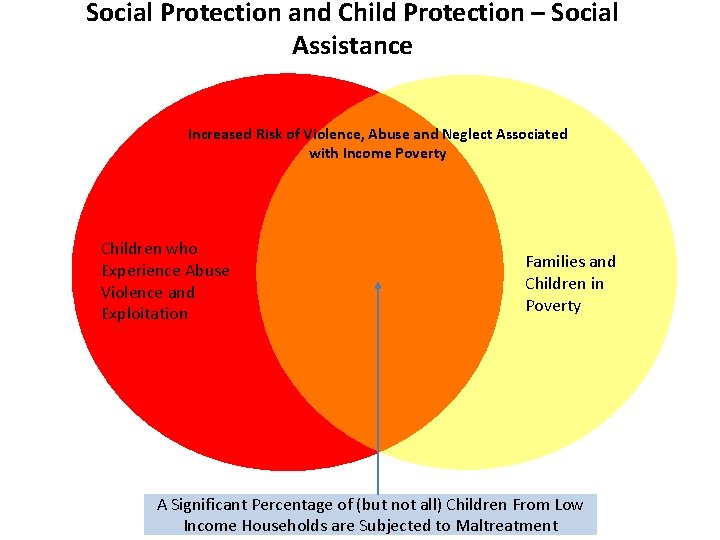
Social Protection and Child Protection – Social Assistance Increased Risk of Violence, Abuse and Neglect Associated with Income Poverty Children who Experience Abuse Violence and Exploitation Families and Children in Poverty A Significant Percentage of (but not all) Children From Low Income Households are Subjected to Maltreatment
Social Protection and Child Protection – Income Support Lack of Support to the Poorest Families Means Children are Unnecessarily Separated from Families, and / or are Landing in Dangerous Situations – A study of tea shops in 2002 and another conducted in 2012 found that over 75% of children gave part or all of money earned to their parents. – 51% of children found their job through their parents or relatives. – Over 70% of children are working due to social-economic circumstances in their household. – In Myanmar, there are over 20, 000 children living in orphanage care. Hundreds of thousands more are living in boarding schools. – 75% of children in orphanages in Myanmar have at least one parent alive; and the primary reason for placement in orphanage care is poverty (lack of access to services is the second reason).
Social Assistance – Some Considerations… • In the design of income support to families, the impact on children should be a major consideration. • Children who are impacted currently in Myanmar by lack of income support to families (children in orphanage care, children who are working) should be included and fully considered in the design phase of social assistance programmes. • We don’t always need to target children in order to reach children. • Social Assistance is critical… But only answers a part of the problem. • Children who experience violence or exploitation need an extended safety net often strengthened by protective services. • Case Management – particularly if social assistance is targeted to assist with issues of access…
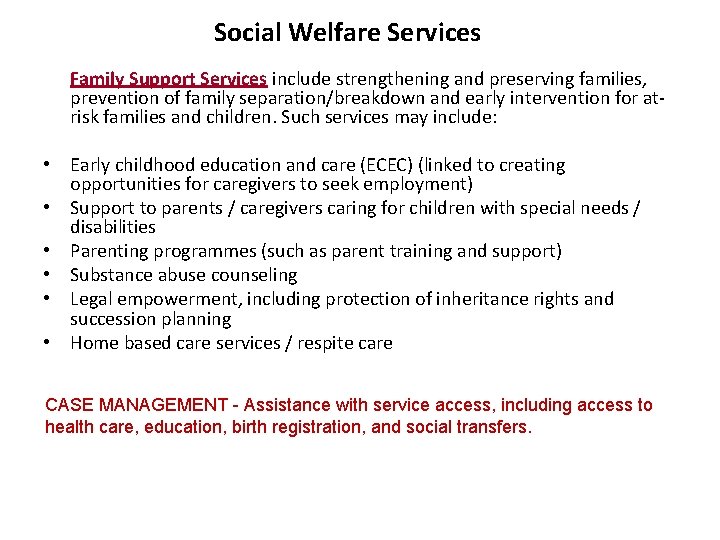
Social Welfare Services Family Support Services include strengthening and preserving families, prevention of family separation/breakdown and early intervention for atrisk families and children. Such services may include: • Early childhood education and care (ECEC) (linked to creating opportunities for caregivers to seek employment) • Support to parents / caregivers caring for children with special needs / disabilities • Parenting programmes (such as parent training and support) • Substance abuse counseling • Legal empowerment, including protection of inheritance rights and succession planning • Home based care services / respite care CASE MANAGEMENT - Assistance with service access, including access to health care, education, birth registration, and social transfers.
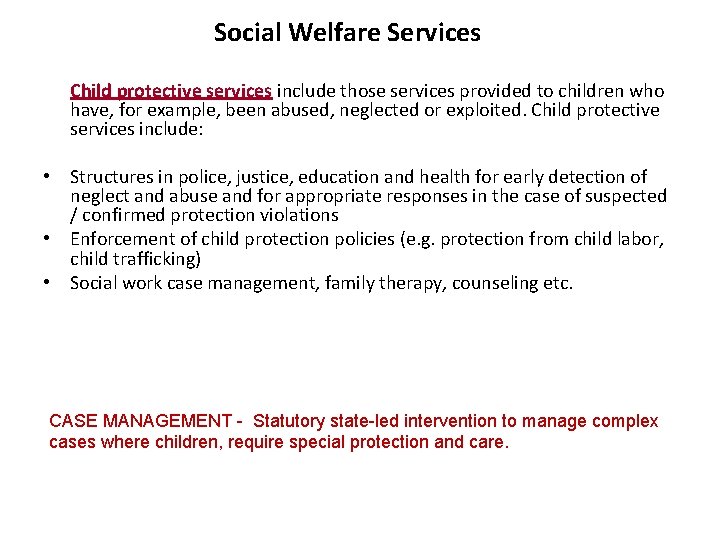
Social Welfare Services Child protective services include those services provided to children who have, for example, been abused, neglected or exploited. Child protective services include: • Structures in police, justice, education and health for early detection of neglect and abuse and for appropriate responses in the case of suspected / confirmed protection violations • Enforcement of child protection policies (e. g. protection from child labor, child trafficking) • Social work case management, family therapy, counseling etc. CASE MANAGEMENT - Statutory state-led intervention to manage complex cases where children, require special protection and care.
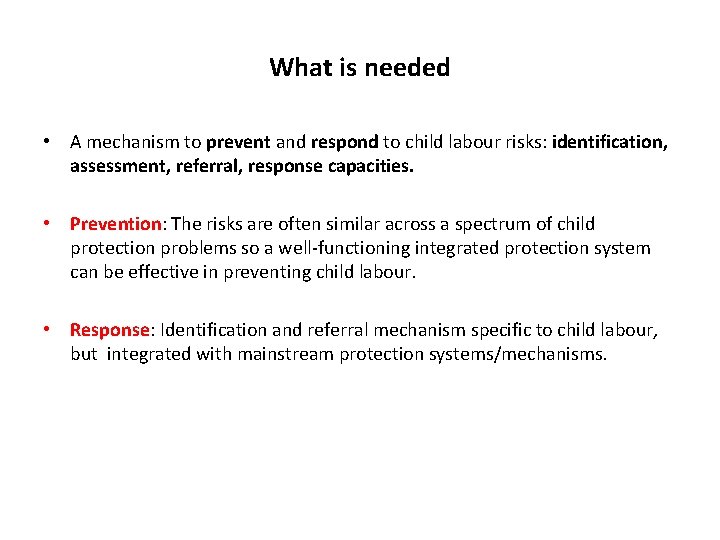
What is needed • A mechanism to prevent and respond to child labour risks: identification, assessment, referral, response capacities. • Prevention: The risks are often similar across a spectrum of child protection problems so a well-functioning integrated protection system can be effective in preventing child labour. • Response: Identification and referral mechanism specific to child labour, but integrated with mainstream protection systems/mechanisms.

Thank you!
- Slides: 18