
Child Development Unit 5 Children from One to
- Slides: 21
Child Development Unit 5 Children from One to Three
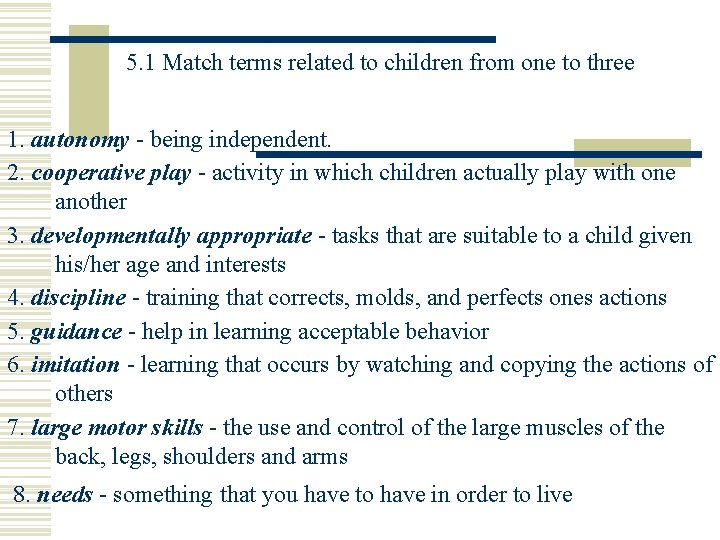
5. 1 Match terms related to children from one to three 1. autonomy - being independent. 2. cooperative play - activity in which children actually play with one another 3. developmentally appropriate - tasks that are suitable to a child given his/her age and interests 4. discipline - training that corrects, molds, and perfects ones actions 5. guidance - help in learning acceptable behavior 6. imitation - learning that occurs by watching and copying the actions of others 7. large motor skills - the use and control of the large muscles of the back, legs, shoulders and arms 8. needs - something that you have to have in order to live
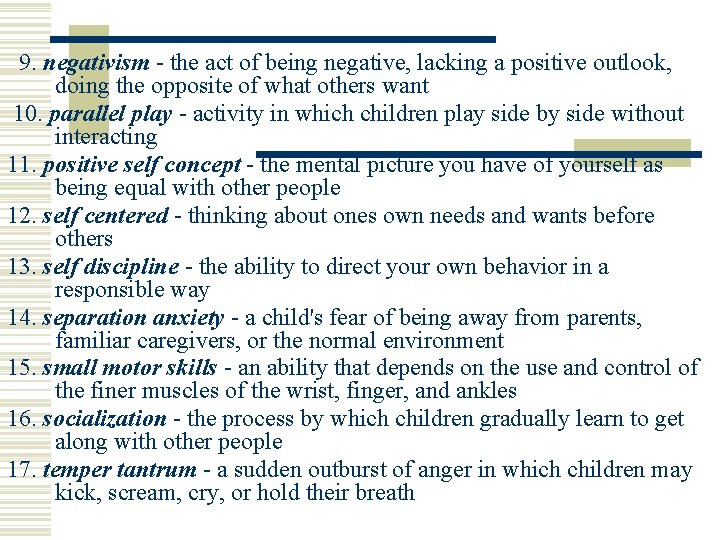
9. negativism - the act of being negative, lacking a positive outlook, doing the opposite of what others want 10. parallel play - activity in which children play side by side without interacting 11. positive self concept - the mental picture you have of yourself as being equal with other people 12. self centered - thinking about ones own needs and wants before others 13. self discipline - the ability to direct your own behavior in a responsible way 14. separation anxiety - a child's fear of being away from parents, familiar caregivers, or the normal environment 15. small motor skills - an ability that depends on the use and control of the finer muscles of the wrist, finger, and ankles 16. socialization - the process by which children gradually learn to get along with other people 17. temper tantrum - a sudden outburst of anger in which children may kick, scream, cry, or hold their breath
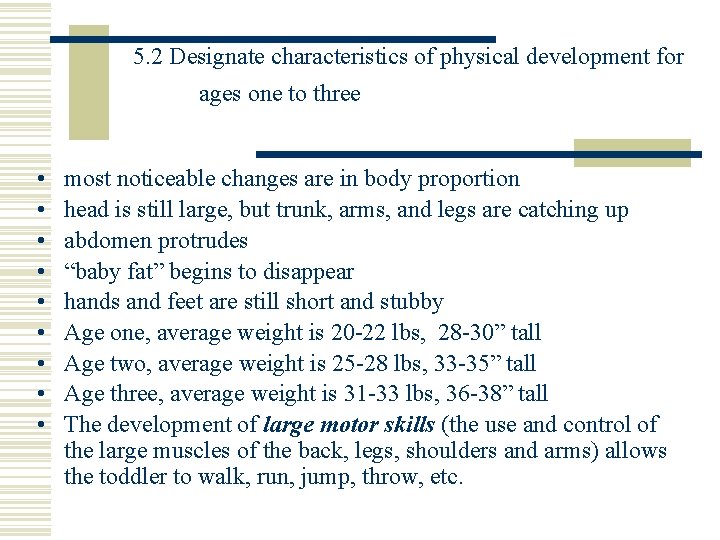
5. 2 Designate characteristics of physical development for ages one to three • • • most noticeable changes are in body proportion head is still large, but trunk, arms, and legs are catching up abdomen protrudes “baby fat” begins to disappear hands and feet are still short and stubby Age one, average weight is 20 -22 lbs, 28 -30” tall Age two, average weight is 25 -28 lbs, 33 -35” tall Age three, average weight is 31 -33 lbs, 36 -38” tall The development of large motor skills (the use and control of the large muscles of the back, legs, shoulders and arms) allows the toddler to walk, run, jump, throw, etc.
5. 3 Name routines for young children that promote sound physical health • • • physical play nutritious meals enough sleep bathing brushing teeth
5. 4 Designate ways to provide a safe environment for toddlers • • close and lock windows and doors examine toys often always require a car seat cover electrical outlets keep heavy objects out of reach watch for choking hazards store poisons and medicines out of reach Never leave toddler unattended.
5. 5 Describe meals suitable for toddlers • Food cut in small pieces ■ To be picked up with fingers or spoon ● green beans, peas, corn, cooked carrots • Small amounts of each item • Foods low in fat, cholesterol, salt and sugar • Nutritious beverages: lowfat milk, water, juices
5. 6 Name features of appropriate clothes for toddler ◆ ◆ ◆ elastic waist Velcro big buttons durable fabrics cuffs that can be unrolled straps that can be let out
5. 7 List bedtime problems of toddlers and ways to minimize the problems • Fears keep toddlers from sleeping: ■ ■ dark robbers fires imaginary monsters • Parents should be patient and understanding. • A night light may be useful in the child’s room. • These fears are real to the child and he/she not be shamed or ridiculed.
5. 8 Explain process of toilet training • 1. 2. 3. 4. 5. ◆ Children will cooperate when ready. Child must be able to understand what the parent wants them to do. Child must be able to recognize the sensation of needing to empty the bladder or rectum. Child must be able to tighten the sphincter muscles related to the bladder or rectum to prevent elimination. They must get to the bathroom, pull down their training pants and sit on the potty chair. They must be able to relax the sphincter muscles so they can empty the bladder or rectum. Toileting usually follows a pattern: bowel control first, daytime bladder control, then nighttime bladder control
5. 9 Designate characteristics of intellectual development for ages one to three • • egocentric or self centered. memories are very short may not think ahead. very curious ■ ■ put things in mouth touch everything • learn by watching and imitating behavior • have difficulties distinguishing between reality and make believe
5. 10 Match ways children learn with correct definitions (same as CD 4. 10) • incidental learning-unplanned learning • trial-and-error learning-when a child tries several solutions before finding one that works • imitation-learning by watching and copying others • directed learning- learning that results from being taught
5. 11 State ways to promote intellectual development in toddlers • interact with the child ■ talk with them ■ play with them • provide toys • encourage learning • take advantage of teachable moments which are unplanned opportunities to introduce new ideas
5. 12 List characteristics of safe, suitable toys for toddlers • • durable age appropriate push-pull toys (large motor skills) Toys that stimulate the small motor skills (an ability that depends on the use and control of the finer muscles of the wrist, finger, and ankles) ■ ■ ■ simple puzzles nesting toys crayons
5. 13 Designate characteristics of emotional and social development for ages one to three • behavior is inconsistent ■ sweet and cooperative one minute stubborn the next • excited to try new things • attachments to toys is common • emotions are fragile ■ feelings hurt very easily • participates in parallel play (activity in which children play side by side without interacting)
5. 14 State ways to influence toddlers’ emotional and social development • • • patience understanding encourage, but don’t push approval praise
5. 15 Name common emotions of toddlers • • • anger frustration happiness sadness negativism (the act of being negative, lacking a positive outlook, doing the opposite of what others want)
5. 16 List ways toddlers express emotions • • hugs kisses laughing/giggling temper tantrum (a sudden outburst of anger in which children may kick, scream, cry, or hold their breath) • negativism (the act of being negative, lacking a positive outlook, doing the opposite of what others want)
5. 17 State ways relationships influence child development • Nothing is more important to a child than family. • It is within the family the child receives love and attention. • Families provide structure needed to feel a sense of order and purpose. • Communication plays a vital role in developing positive parent-child relationships. • Children are greatly influenced by their parent’s relationship. • A strong family unit provides for all developmental needs.
5. 18 • • Name ways to help young children develop a positive self-concept meet basic human needs: food, clothing, shelter encouragement love support
5. 19 Designate effective guidance techniques for ages one to three provide a structured environment/routines ◆ set limits ◆ consistence ◆ remove child from situation ◆ “time-out” ◆