
Child Development Theories WHY IS CHILDHOOD CRUCIAL Research
- Slides: 19
Child Development Theories
WHY IS CHILDHOOD CRUCIAL? Research has shown that early childhood may be the most important life stage for brain development. A baby’s brain is about one quarter the size of an adults’. Scientists have found that babies’ brains develop in response to stimulation. Arouses senses such as sight, sound, touch, taste, and smell. Babies who are stimulated develop more quickly and have a more secure self-image.
What is a theory? • • A theory should allow us to predict and explain human behavior It should be stated in such a way that it can be shown to be false It must be open to scientific investigation
CHILD DEVELOPMENT THEORISTS Although researches don’t always agree, scientific researchers have agreed upon the five following general rules. Development is similar for each individual Development builds upon earlier learning. Development proceeds at an individual rate. The different areas of development are interrelated. Development is a lifelong process.
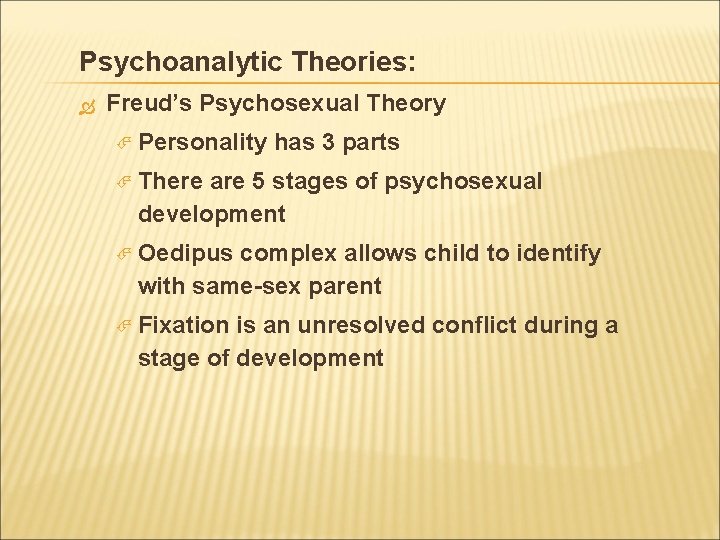
Psychoanalytic Theories: Freud’s Psychosexual Theory Personality has 3 parts There are 5 stages of psychosexual development Oedipus complex allows child to identify with same-sex parent Fixation is an unresolved conflict during a stage of development
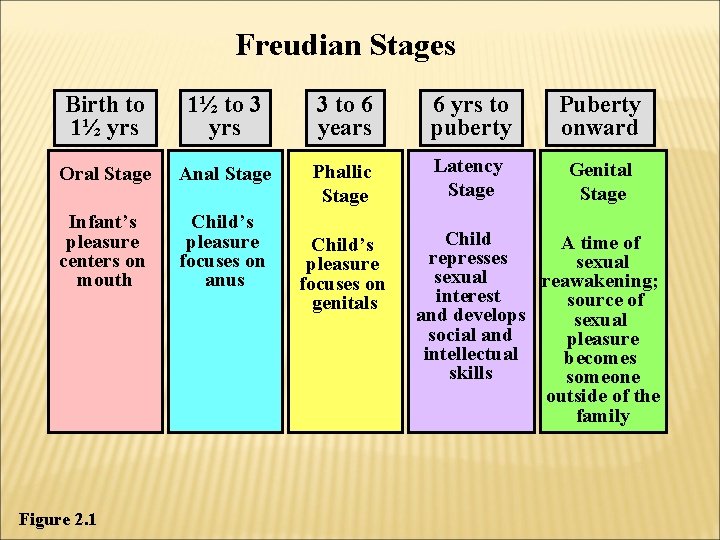
Freudian Stages Birth to 1½ yrs 1½ to 3 yrs 3 to 6 years 6 yrs to puberty Puberty onward Oral Stage Anal Stage Phallic Stage Latency Stage Genital Stage Infant’s pleasure centers on mouth Child’s pleasure focuses on anus Figure 2. 1 Child’s pleasure focuses on genitals Child A time of represses sexual reawakening; interest source of and develops sexual social and pleasure intellectual becomes skills someone outside of the family
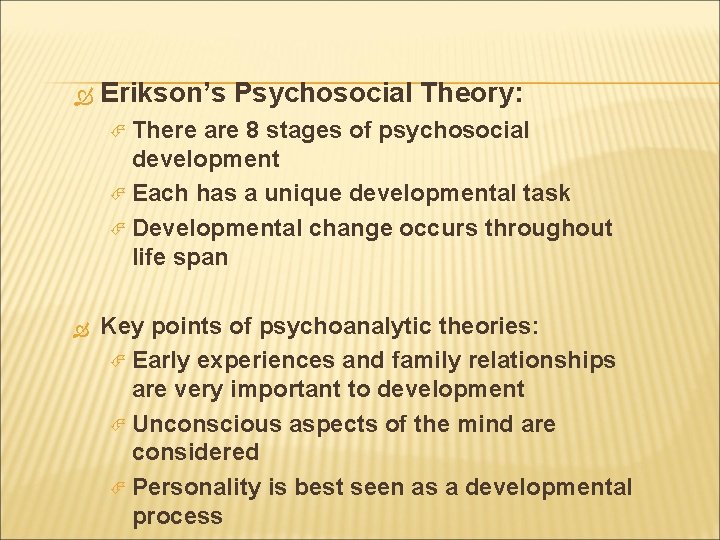
Erikson’s Psychosocial Theory: There are 8 stages of psychosocial development Each has a unique developmental task Developmental change occurs throughout life span Key points of psychoanalytic theories: Early experiences and family relationships are very important to development Unconscious aspects of the mind are considered Personality is best seen as a developmental process
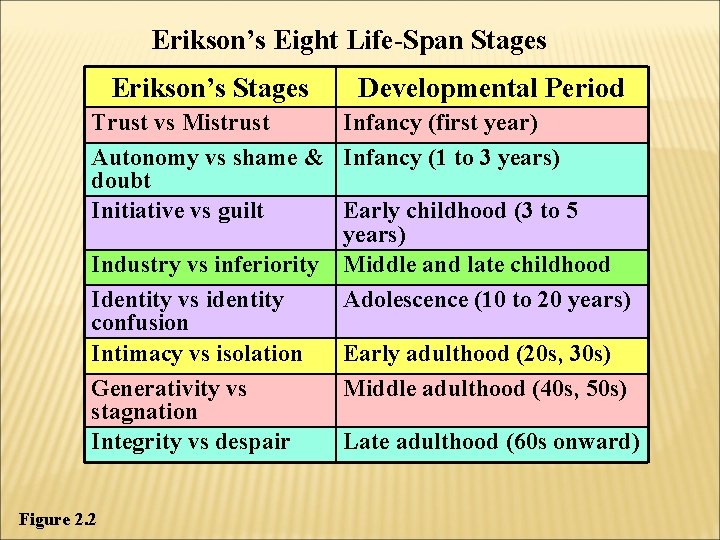
Erikson’s Eight Life-Span Stages Erikson’s Stages Developmental Period Trust vs Mistrust Infancy (first year) Autonomy vs shame & Infancy (1 to 3 years) doubt Initiative vs guilt Early childhood (3 to 5 years) Industry vs inferiority Middle and late childhood Identity vs identity Adolescence (10 to 20 years) confusion Intimacy vs isolation Early adulthood (20 s, 30 s) Generativity vs Middle adulthood (40 s, 50 s) stagnation Integrity vs despair Late adulthood (60 s onward) Figure 2. 2
Cognitive theories: Piaget’s cognitive developmental theory Stresses conscious mental processes Cognitive processes are influenced by biological maturation Four stages of cognitive development in children Assimilation and accommodation underlie how children understand the world, adapt to it, and organize their experiences
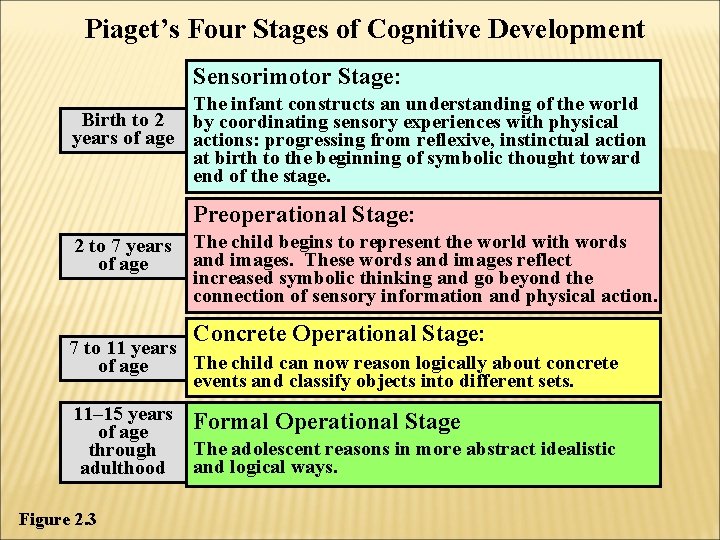
Piaget’s Four Stages of Cognitive Development Sensorimotor Stage: The infant constructs an understanding of the world Birth to 2 by coordinating sensory experiences with physical years of age actions: progressing from reflexive, instinctual action at birth to the beginning of symbolic thought toward end of the stage. Preoperational Stage: 2 to 7 years of age The child begins to represent the world with words and images. These words and images reflect increased symbolic thinking and go beyond the connection of sensory information and physical action. Concrete Operational Stage: 7 to 11 years The child can now reason logically about concrete of age events and classify objects into different sets. 11– 15 years Formal Operational Stage of age The adolescent reasons in more abstract idealistic through adulthood and logical ways. Figure 2. 3
Vygotsky’s sociocultural cognitive theory Children actively construct their knowledge Social interaction and culture guide cognitive development Learning is based upon inventions of society Knowledge is created through interactions with other people and objects in the culture Less skilled persons learn from the more skilled Information-processing theory Compares computers to the human mind Thinking is information processing
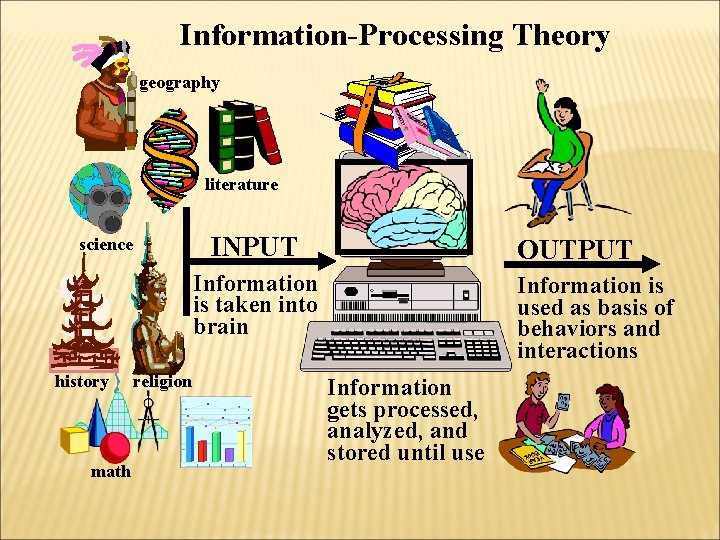
Information-Processing Theory geography literature INPUT science OUTPUT Information is taken into brain history math religion Information is used as basis of behaviors and interactions Information gets processed, analyzed, and stored until use
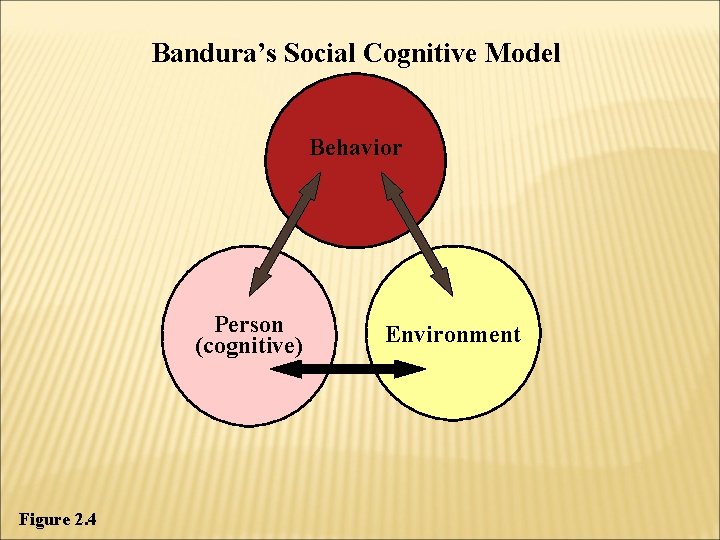
Bandura’s Social Cognitive Model Behavior Person (cognitive) Figure 2. 4 Environment
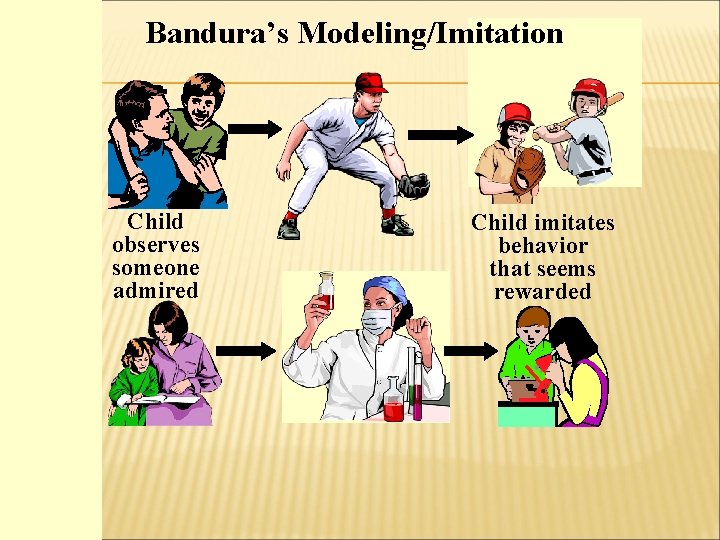
Bandura’s Modeling/Imitation Child observes someone admired Child imitates behavior that seems rewarded
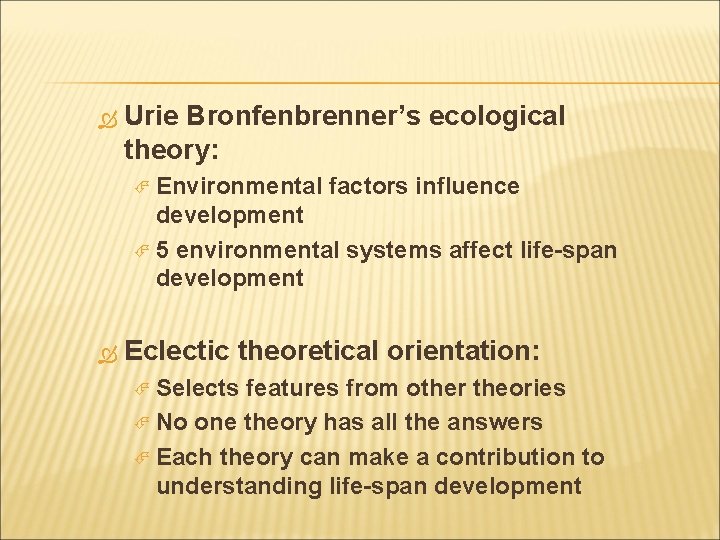
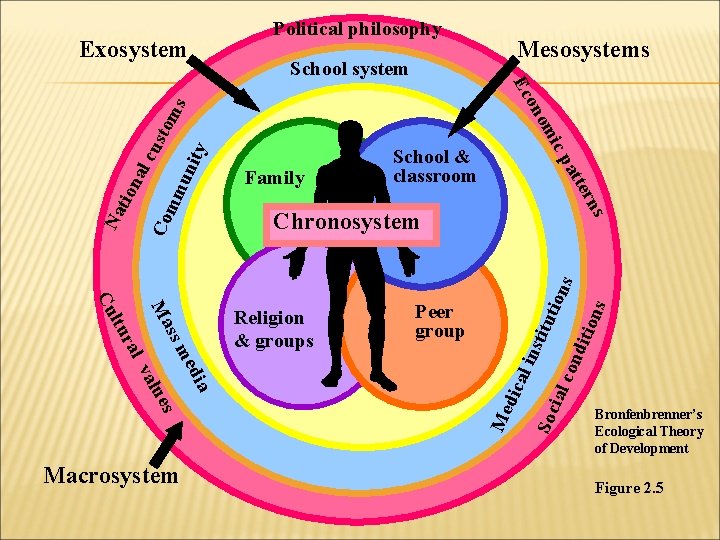
Urie Bronfenbrenner’s ecological theory: Environmental factors influence development 5 environmental systems affect life-span development Eclectic theoretical orientation: Selects features from other theories No one theory has all the answers Each theory can make a contribution to understanding life-span development
Political philosophy Exosystem School system ms uni t y sto mm ern na l cu School & classroom att Family ic p om on Ec s ndi tion l co Soc ia dic al i n stit Peer group Me a s lue va edi ss m Ma ral ltu Cu Macrosystem Religion & groups utio n s Co Chronosystem s Na tio Mesosystems Bronfenbrenner’s Ecological Theory of Development Figure 2. 5
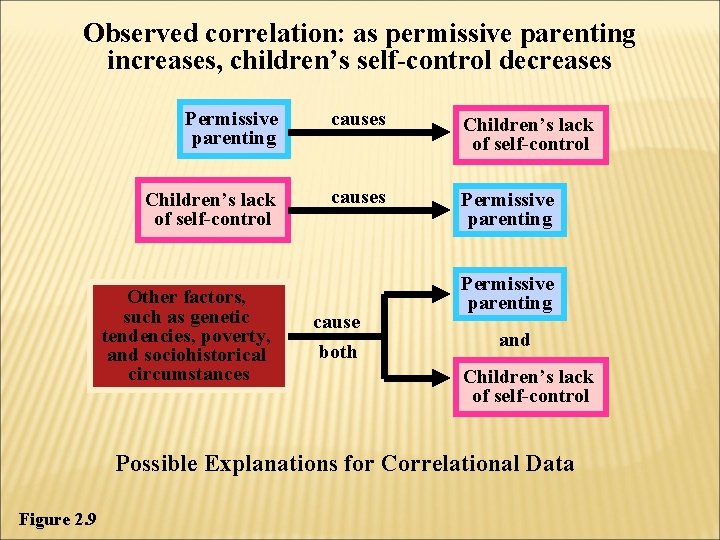
Observed correlation: as permissive parenting increases, children’s self-control decreases Permissive parenting causes Children’s lack of self-control causes Permissive parenting Other factors, such as genetic tendencies, poverty, and sociohistorical circumstances cause both Permissive parenting and Children’s lack of self-control Possible Explanations for Correlational Data Figure 2. 9
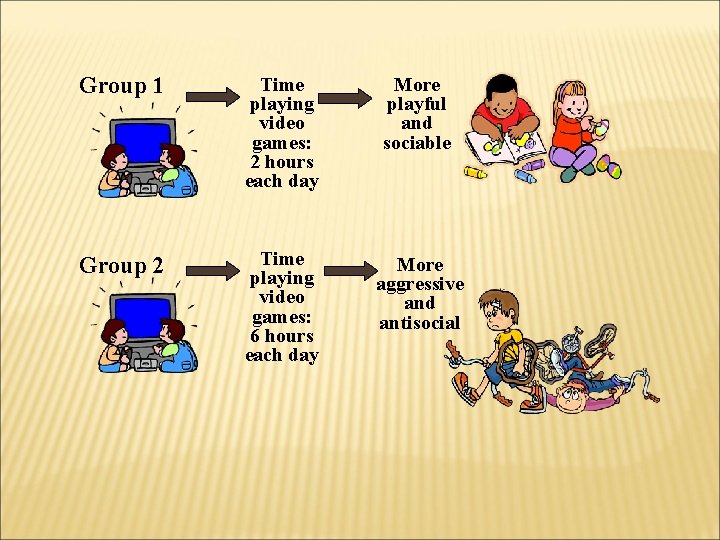
Group 1 Time playing video games: 2 hours each day More playful and sociable Group 2 Time playing video games: 6 hours each day More aggressive and antisocial
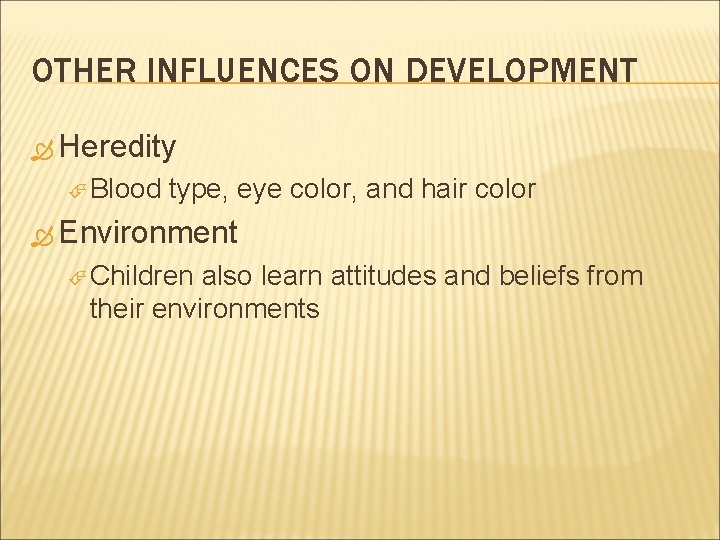
OTHER INFLUENCES ON DEVELOPMENT Heredity Blood type, eye color, and hair color Environment Children also learn attitudes and beliefs from their environments