
Child Development Ninth Edition Laura E Berk Chapter
Child Development Ninth Edition ● Laura E. Berk Chapter 1 History, Theory, and Applied Directions © 2013 Pearson Education, Inc. All rights reserved.
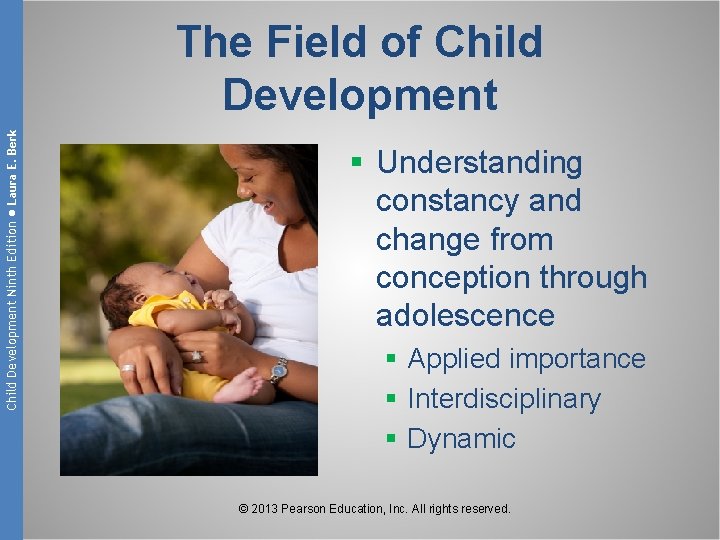
Child Development Ninth Edition ● Laura E. Berk The Field of Child Development § Understanding constancy and change from conception through adolescence § Applied importance § Interdisciplinary § Dynamic © 2013 Pearson Education, Inc. All rights reserved.
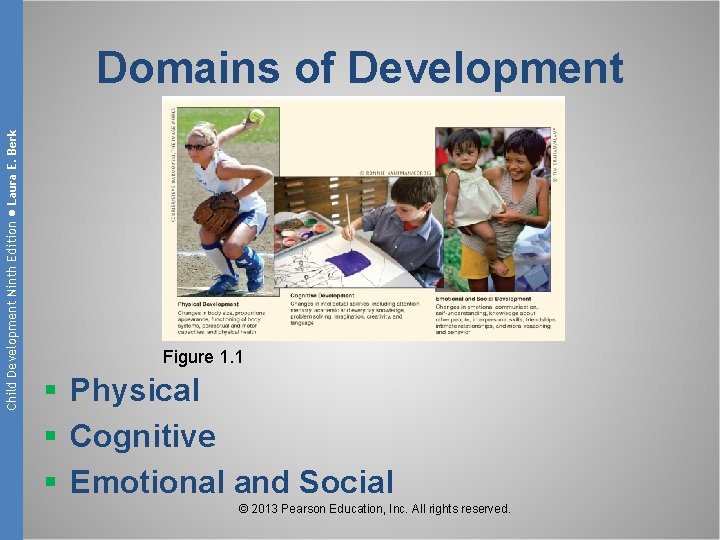
Child Development Ninth Edition ● Laura E. Berk Domains of Development Figure 1. 1 § Physical § Cognitive § Emotional and Social © 2013 Pearson Education, Inc. All rights reserved.
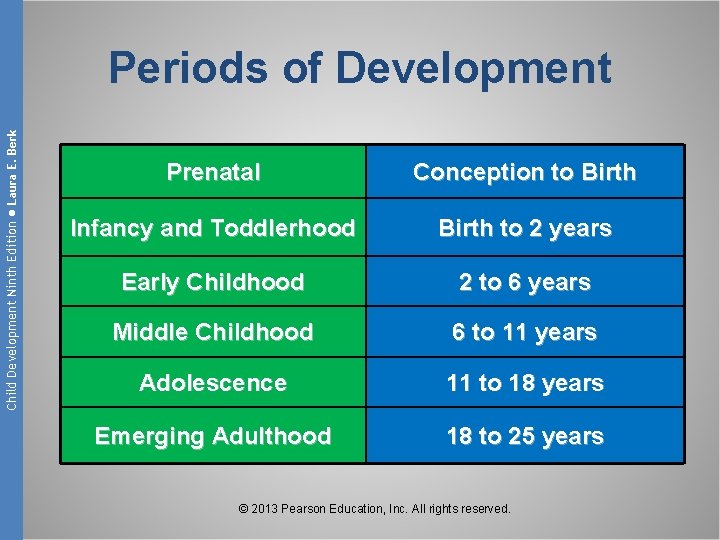
Child Development Ninth Edition ● Laura E. Berk Periods of Development Prenatal Conception to Birth Infancy and Toddlerhood Birth to 2 years Early Childhood 2 to 6 years Middle Childhood 6 to 11 years Adolescence 11 to 18 years Emerging Adulthood 18 to 25 years © 2013 Pearson Education, Inc. All rights reserved.
Child Development Ninth Edition ● Laura E. Berk Theory § An orderly, integrated, evidence-based set of statements that: § Describes § Explains § Predicts behavior © Elena Elisseeva | Dreamstime. com © 2013 Pearson Education, Inc. All rights reserved.
Basic Issues in Development Child Development Ninth Edition ● Laura E. Berk ü Continuous or discontinuous? ü One course of development or many? ü Nature or nurture? © Barbara Reddoch | Dreamstime. com © 2013 Pearson Education, Inc. All rights reserved.
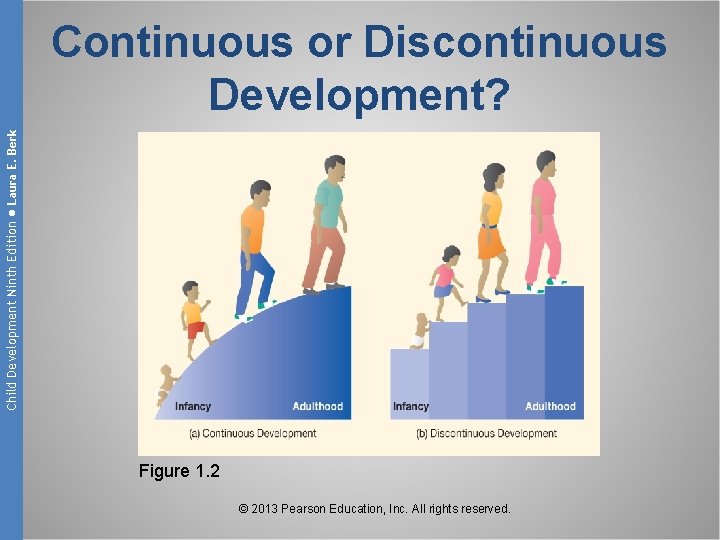
Child Development Ninth Edition ● Laura E. Berk Continuous or Discontinuous Development? Figure 1. 2 © 2013 Pearson Education, Inc. All rights reserved.
Child Development Ninth Edition ● Laura E. Berk Contexts of Development § Unique combinations of personal and environmental circumstances § Results in different developmental paths § Factors: § Heredity and biological makeup § Environment (home, child care, school, neighborhood) § Circumstances (community resources, social values, historical time period) © 2013 Pearson Education, Inc. All rights reserved.
Child Development Ninth Edition ● Laura E. Berk Nature and Nurture Nature Nurture § Inborn, biological givens § Based on genetic inheritance § Physical and social world § Influence biological and psychological development © 2013 Pearson Education, Inc. All rights reserved.
Child Development Ninth Edition ● Laura E. Berk Stability vs. Plasticity § Stability: usually associated with heredity § Lifelong characteristics § Early experiences establish patterns § Plasticity: responsive to experience § Balanced view embraces continuous and discontinuous change © 2013 Pearson Education, Inc. All rights reserved.
Child Development Ninth Edition ● Laura E. Berk For Discussion: What Is Your Stance on the Three Basic Issues of Human Development? Directions: The following four pairs of statements relate to basic issues about human development. Read each statement carefully. Then write down the number and letter of the statement in each pair that more closely reflects your own view. 1 A. Development is a continuous, gradual progression, with new abilities, skills, and knowledge gradually added at a relatively uniform pace. 1 B. Development occurs at different rates, alternating between periods of little change and periods of abrupt, rapid change. 2 A. All humans follow the same general sequence of development. 2 B. Each individual has a unique course of development. 3 A. Children respond to the world in much the same way as adults. The main difference is that children’s thinking is less sophisticated and complex than adults’. 3 B. Children have unique ways of thinking about and responding to the world that are very different from those of adults. 4 A. An individual’s personality is mostly determined by heredity. 4 B. An individual’s personality can be modified through caregiving experiences. © 2013 Pearson Education, Inc. All rights reserved.
Child Development Ninth Edition ● Laura E. Berk Resilient Children § Ability to adapt effectively in the face of threats to development § What factors offer protection? § Personal characteristics, including temperament § Warm parental relationship § Social support outside immediate family § Community resources and opportunities © 2013 Pearson Education, Inc. All rights reserved.
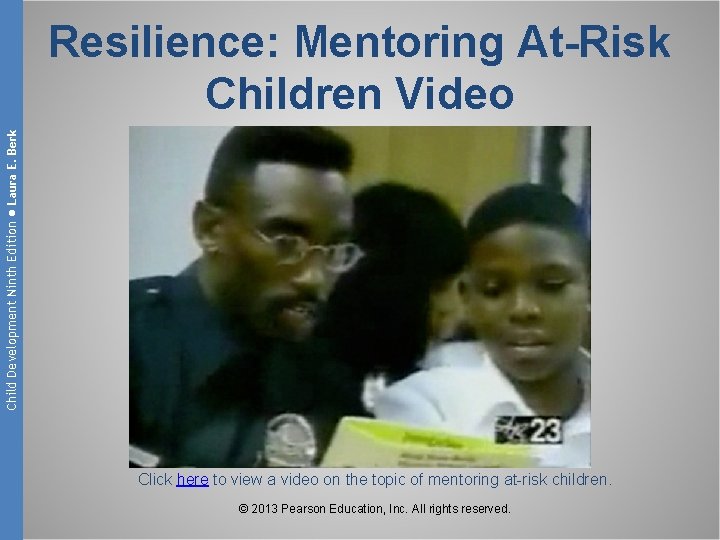
Child Development Ninth Edition ● Laura E. Berk Resilience: Mentoring At-Risk Children Video Click here to view a video on the topic of mentoring at-risk children. © 2013 Pearson Education, Inc. All rights reserved.
Child Development Ninth Edition ● Laura E. Berk Historical Views of Childhood (to age 7 or 8) regarded as Medieval Era separate phase with special needs 16 th Century Puritan “child depravity” views John Locke’s “tabula rasa” or “blank 17 th Century slate” view Jean Jacques Rousseau’s “noble 18 th Century savages” view © 2013 Pearson Education, Inc. All rights reserved.
Child Development Ninth Edition ● Laura E. Berk Scientific Beginnings § Darwin’s Theory of Evolution § § Natural selection Survival of the fittest Genes passed to later generations Theorists believe children develop in manner similar to evolution → scientific child study © 2013 Pearson Education, Inc. All rights reserved.
Child Development Ninth Edition ● Laura E. Berk Early Scientific Study of Development Normative Approach • Age-related averages • Based on measurements of large numbers of people Mental Testing Movement Simon & Binet: Early developers of intelligence tests James Mark • Developmental theorist • Nature & nurture of equal importance Baldwin © 2013 Pearson Education, Inc. All rights reserved.
Child Development Ninth Edition ● Laura E. Berk Psychoanalytic Perspective § Childhood stages involve conflicts between biological drives and social expectations. § Freud’s psychosexual theory § Erikson’s psychosocial theory © 2013 Pearson Education, Inc. All rights reserved.
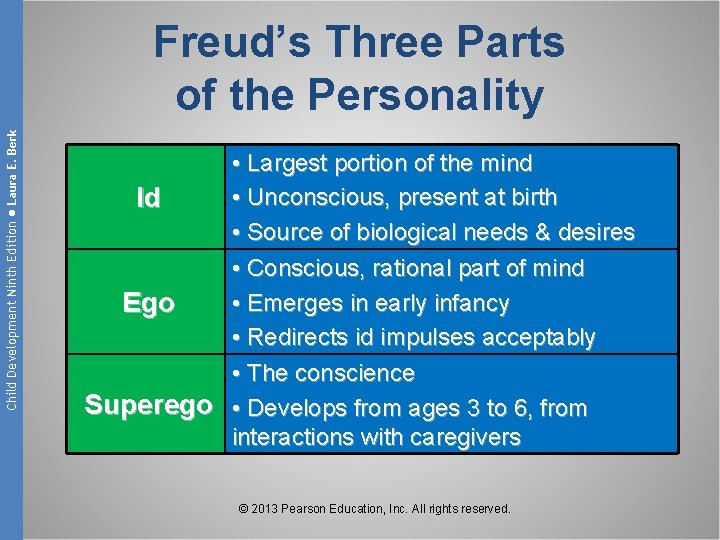
Child Development Ninth Edition ● Laura E. Berk Freud’s Three Parts of the Personality • Largest portion of the mind • Unconscious, present at birth Id • Source of biological needs & desires • Conscious, rational part of mind • Emerges in early infancy Ego • Redirects id impulses acceptably • The conscience Superego • Develops from ages 3 to 6, from interactions with caregivers © 2013 Pearson Education, Inc. All rights reserved.

Child Development Ninth Edition ● Laura E. Berk Freud’s Psychosexual Stages § § § Oral Anal Phallic Latency Genital © Constantin Opris | Dreamstime. com © 2013 Pearson Education, Inc. All rights reserved.
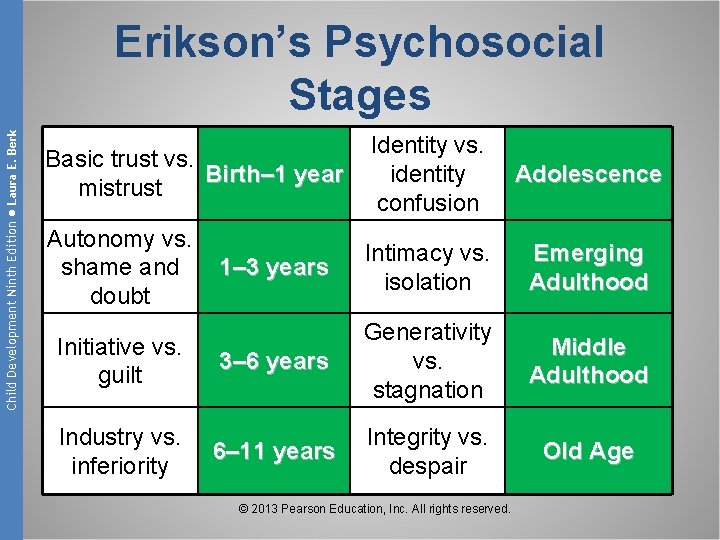
Child Development Ninth Edition ● Laura E. Berk Erikson’s Psychosocial Stages Basic trust vs. Birth– 1 year mistrust Identity vs. identity confusion Adolescence Autonomy vs. shame and doubt 1– 3 years Intimacy vs. isolation Emerging Adulthood Initiative vs. guilt 3– 6 years Generativity vs. stagnation Middle Adulthood Industry vs. inferiority 6– 11 years Integrity vs. despair Old Age © 2013 Pearson Education, Inc. All rights reserved.
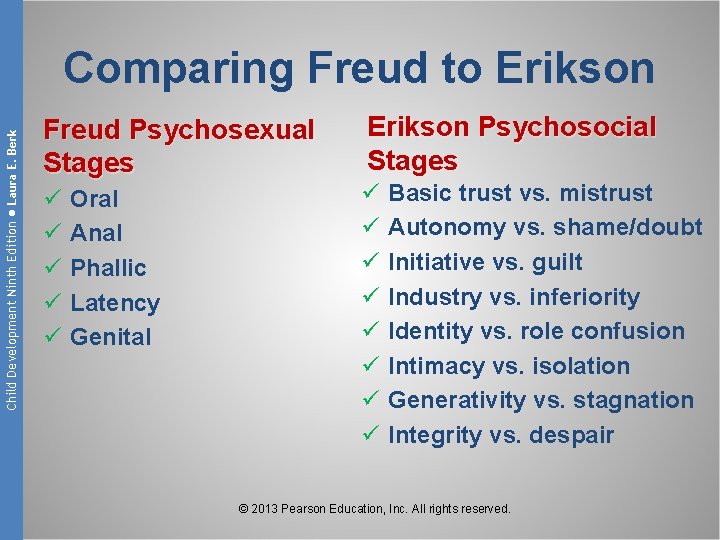
Child Development Ninth Edition ● Laura E. Berk Comparing Freud to Erikson Freud Psychosexual Stages ü ü ü Oral Anal Phallic Latency Genital Erikson Psychosocial Stages ü ü ü ü Basic trust vs. mistrust Autonomy vs. shame/doubt Initiative vs. guilt Industry vs. inferiority Identity vs. role confusion Intimacy vs. isolation Generativity vs. stagnation Integrity vs. despair © 2013 Pearson Education, Inc. All rights reserved.
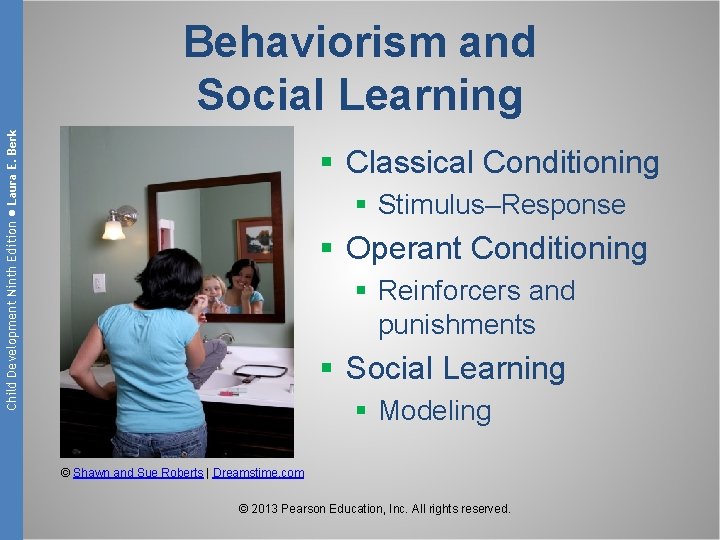
Child Development Ninth Edition ● Laura E. Berk Behaviorism and Social Learning § Classical Conditioning § Stimulus–Response § Operant Conditioning § Reinforcers and punishments § Social Learning § Modeling © Shawn and Sue Roberts | Dreamstime. com © 2013 Pearson Education, Inc. All rights reserved.
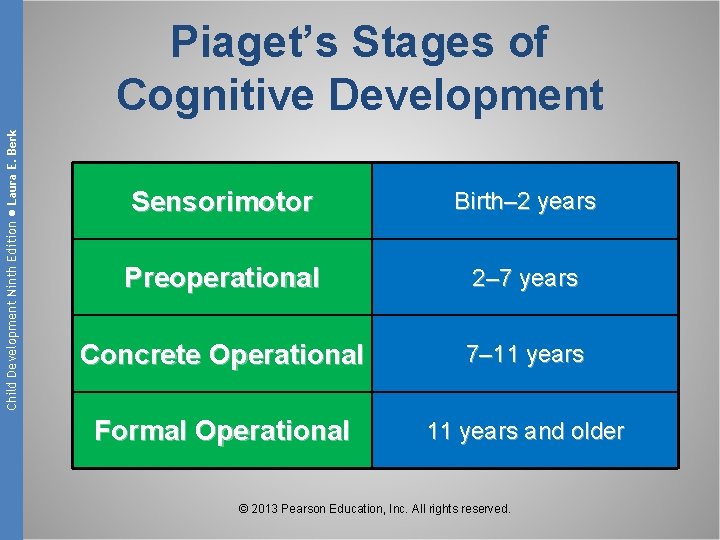
Child Development Ninth Edition ● Laura E. Berk Piaget’s Stages of Cognitive Development Sensorimotor Birth– 2 years Preoperational 2– 7 years Concrete Operational 7– 11 years Formal Operational 11 years and older © 2013 Pearson Education, Inc. All rights reserved.
Child Development Ninth Edition ● Laura E. Berk Recent Theoretical Perspectives § Information Processing § The human mind might also be viewed as a symbolmanipulating system through which information flows. § Developmental Cognitive Neuroscience § Brings together researchers from psychology, biology, neuroscience, and medicine to study relationship between brain and developing child’s cognitive processing, behavior patterns § Ethology § Concerned with adaptive value of behavior © 2013 Pearson Education, Inc. All rights reserved.
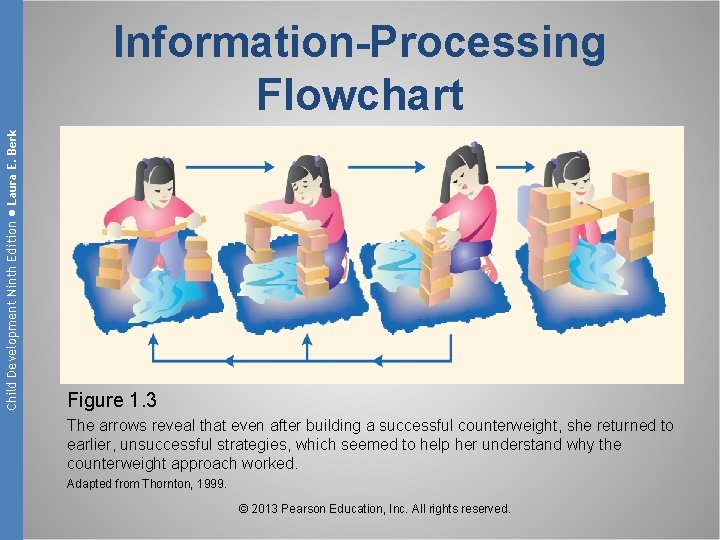
Child Development Ninth Edition ● Laura E. Berk Information-Processing Flowchart Figure 1. 3 The arrows reveal that even after building a successful counterweight, she returned to earlier, unsuccessful strategies, which seemed to help her understand why the counterweight approach worked. Adapted from Thornton, 1999. © 2013 Pearson Education, Inc. All rights reserved.
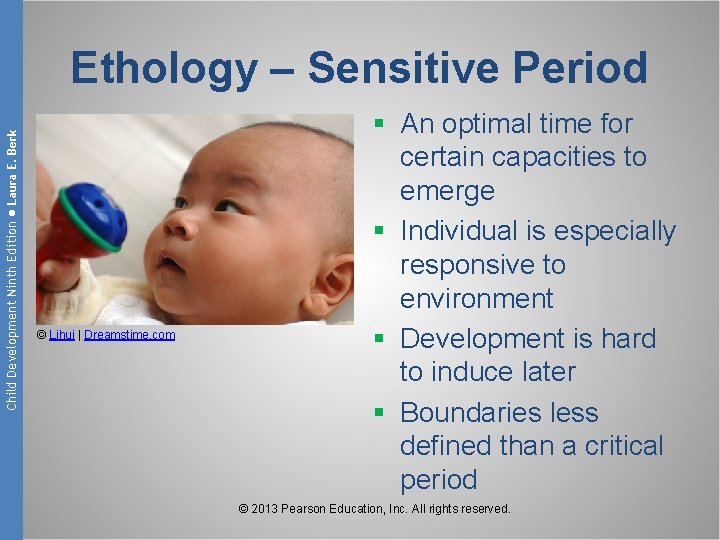
Child Development Ninth Edition ● Laura E. Berk Ethology – Sensitive Period © Lihui | Dreamstime. com § An optimal time for certain capacities to emerge § Individual is especially responsive to environment § Development is hard to induce later § Boundaries less defined than a critical period © 2013 Pearson Education, Inc. All rights reserved.
Child Development Ninth Edition ● Laura E. Berk Evolutionary Developmental Psychology § Seeks to understand the adaptive value of human competencies § Studies cognitive, emotional, and social competencies and how they change with age § Role of learning § What behaviors are no longer adaptive? § Complete organism–environment system © 2013 Pearson Education, Inc. All rights reserved.

Child Development Ninth Edition ● Laura E. Berk Vygotsky’s Sociocultural Theory § Transmission of culture to a new generation § Beliefs, customs, skills § Requires social interaction to learn § Cooperative dialogues © Dawn Balaban | Dreamstime. com § Socially mediated process © 2013 Pearson Education, Inc. All rights reserved.
Child Development Ninth Edition ● Laura E. Berk Ecological Systems Theory § Child develops within complex system of relationships § § Microsystem Mesosystem Exosystem Macrosystem § Environment is ever changing § Chronosystem © 2013 Pearson Education, Inc. All rights reserved.
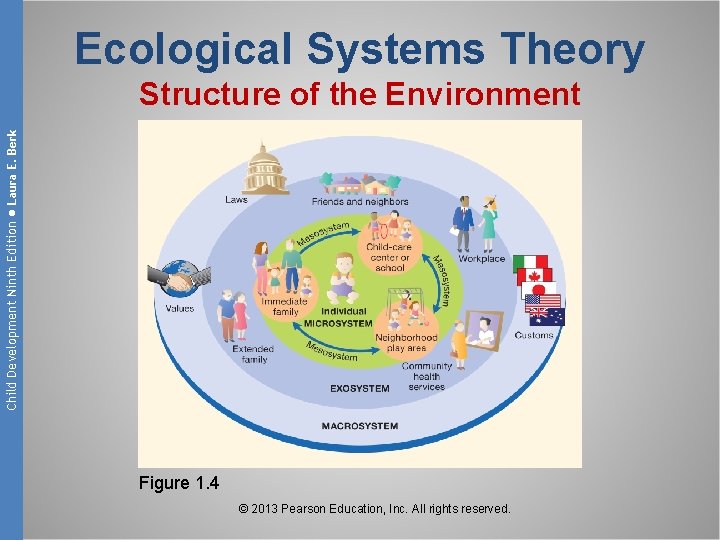
Ecological Systems Theory Child Development Ninth Edition ● Laura E. Berk Structure of the Environment Figure 1. 4 © 2013 Pearson Education, Inc. All rights reserved.
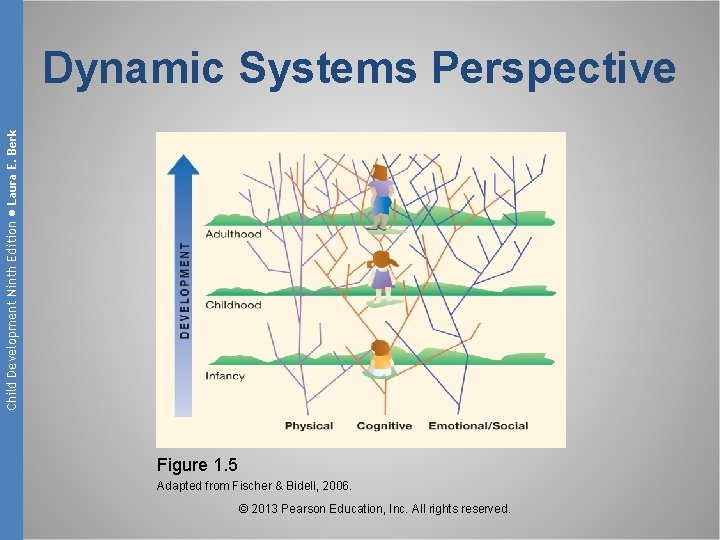
Child Development Ninth Edition ● Laura E. Berk Dynamic Systems Perspective Figure 1. 5 Adapted from Fischer & Bidell, 2006. © 2013 Pearson Education, Inc. All rights reserved.
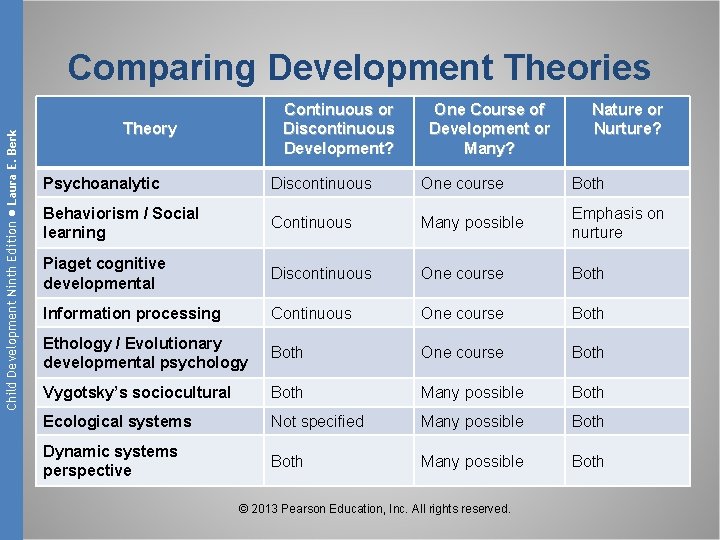
Child Development Ninth Edition ● Laura E. Berk Comparing Development Theories Continuous or Discontinuous Development? Theory One Course of Development or Many? Nature or Nurture? Psychoanalytic Discontinuous One course Both Behaviorism / Social learning Continuous Many possible Emphasis on nurture Piaget cognitive developmental Discontinuous One course Both Information processing Continuous One course Both Ethology / Evolutionary developmental psychology Both One course Both Vygotsky’s sociocultural Both Many possible Both Ecological systems Not specified Many possible Both Dynamic systems perspective Both Many possible Both © 2013 Pearson Education, Inc. All rights reserved.
Child Development Ninth Edition ● Laura E. Berk Social Policy § Planned set of actions by a group, institution, or governing body to attain a social goal § Public policy: laws and other government social policy programs § Bronfenbrenner’s ecological systems theory § U. S. lags behind © 2013 Pearson Education, Inc. All rights reserved.
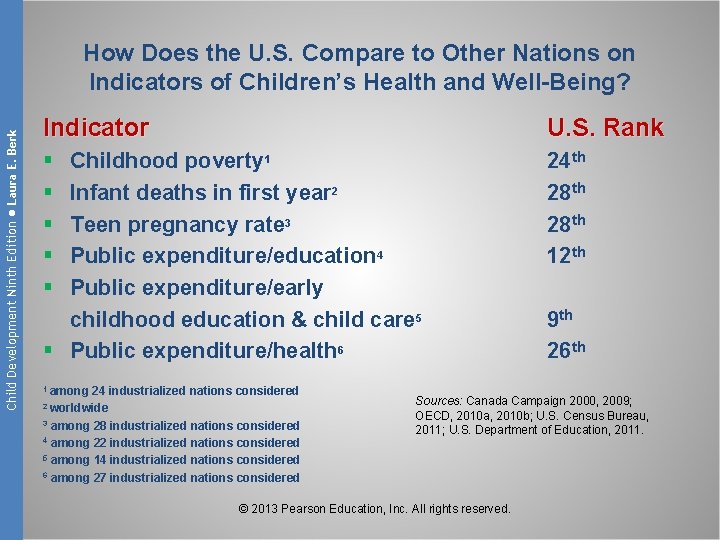
Child Development Ninth Edition ● Laura E. Berk How Does the U. S. Compare to Other Nations on Indicators of Children’s Health and Well-Being? Indicator U. S. Rank § § § 24 th 28 th 12 th Childhood poverty 1 Infant deaths in first year 2 Teen pregnancy rate 3 Public expenditure/education 4 Public expenditure/early childhood education & child care 5 § Public expenditure/health 6 1 among 24 industrialized nations considered 2 worldwide 3 among 28 industrialized nations considered 4 among 22 industrialized nations considered 5 among 14 industrialized nations considered 6 among 27 industrialized nations considered 9 th 26 th Sources: Canada Campaign 2000, 2009; OECD, 2010 a, 2010 b; U. S. Census Bureau, 2011; U. S. Department of Education, 2011. © 2013 Pearson Education, Inc. All rights reserved.
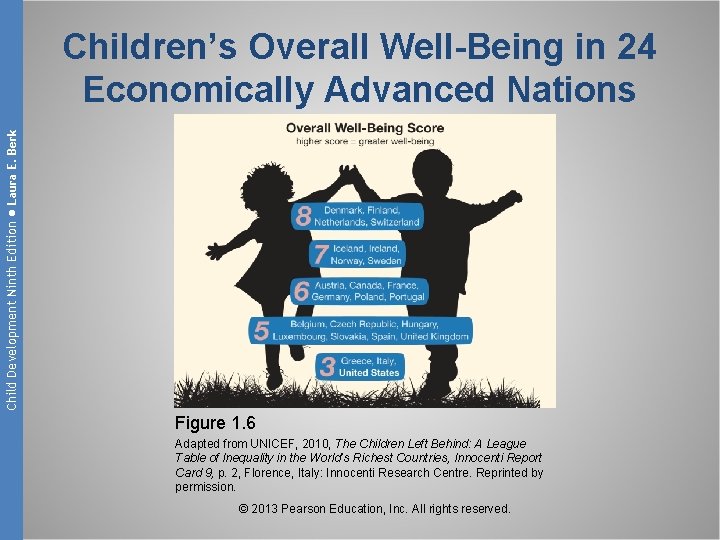
Child Development Ninth Edition ● Laura E. Berk Children’s Overall Well-Being in 24 Economically Advanced Nations Figure 1. 6 Adapted from UNICEF, 2010, The Children Left Behind: A League Table of Inequality in the World’s Richest Countries, Innocenti Report Card 9, p. 2, Florence, Italy: Innocenti Research Centre. Reprinted by permission. © 2013 Pearson Education, Inc. All rights reserved.
Child Development Ninth Edition ● Laura E. Berk Individualist and Collectivist Societies Individualist Collectivist § People think of themselves as separate from others. § Concerned with personal goals § People define themselves as part of a group. § Concerned with group goals over individual goals © 2013 Pearson Education, Inc. All rights reserved.
Child Development Ninth Edition ● Laura E. Berk Social Issues and Child Development § Child development research contributed to success of many programs § Project Head Start § WIC § UN Convention on Rights of the Child § Welfare reform promotes development only when improves standard of living § Justification for child-oriented policies: § Children are the future § Humanitarian grounds—children have basic rights as human beings © 2013 Pearson Education, Inc. All rights reserved.
Child Development Ninth Edition ● Laura E. Berk For Discussion: Applying Ecological Systems Theory to a “Hot Topic” in Child Development Form small groups and select a “hot topic” in child development, such as the effects of divorce, child abuse and neglect, quality of child care, the obesity epidemic, public policies for children, or sex education programs in the schools. Once your group has selected a topic, consider how each level of the environment may affect development, including bidirectional influences and the role of third parties. © 2013 Pearson Education, Inc. All rights reserved.

Child Development Ninth Edition ● Laura E. Berk This multimedia product and its contents are protected under copyright law. The following are prohibited by law: § Any public performance or display, including transmission of any image over a network; § Preparation of any derivative work, including the extraction, in whole or in part of any images; § Any rental, lease, or lending of the program. © 2013 Pearson Education, Inc. All rights reserved.
- Slides: 39