
Child Development Ninth Edition Laura E Berk Chapter

Child Development Ninth Edition ● Laura E. Berk Chapter 6 Cognitive Development: Piagetian, Core Knowledge, and Vygotskian Perspectives © 2013 Pearson Education, Inc. All rights reserved.

Child Development Ninth Edition ● Laura E. Berk Cognitive Development Research § Cognition: inner processes and products of the mind that lead to “knowing” § Research goals: § Chart typical course § Examine individual differences § Uncover mechanisms of cognitive development © Poznyakov | Dreamstime. com © 2013 Pearson Education, Inc. All rights reserved.

Child Development Ninth Edition ● Laura E. Berk Basics of Piaget’s Theory § Constructivist approach § General theory of development: All aspects of cognition change in an integrated fashion. § Four universal, invariant stages: § § Sensorimotor Preoperational Concrete operational Formal operational © 2013 Pearson Education, Inc. All rights reserved.

Schemes Child Development Ninth Edition ● Laura E. Berk § Psychological structures § Organized ways of making sense of experience § Change with age § Action-based (motor patterns) at first § Later move to a mental (thinking) level © Lindamstyle | Dreamstime. com © 2013 Pearson Education, Inc. All rights reserved.

Child Development Ninth Edition ● Laura E. Berk Adaptation § Assimilation § Using current schemes to interpret external world § Used during equilibrium § Accommodation § Adjusting old schemes, creating new ones to better fit environment § Prompted by disequilibrium § Balance between assimilation and accommodation varies over time. © 2013 Pearson Education, Inc. All rights reserved.

Child Development Ninth Edition ● Laura E. Berk Organization Internal rearranging and linking of schemes © Sergei Popov | Dreamstime. com © 2013 Pearson Education, Inc. All rights reserved.

Child Development Ninth Edition ● Laura E. Berk Sensorimotor Stage: Birth to 2 Years § Building schemes through sensory and motor exploration § Circular reaction © Jin Peng | Dreamstime. com © 2013 Pearson Education, Inc. All rights reserved.
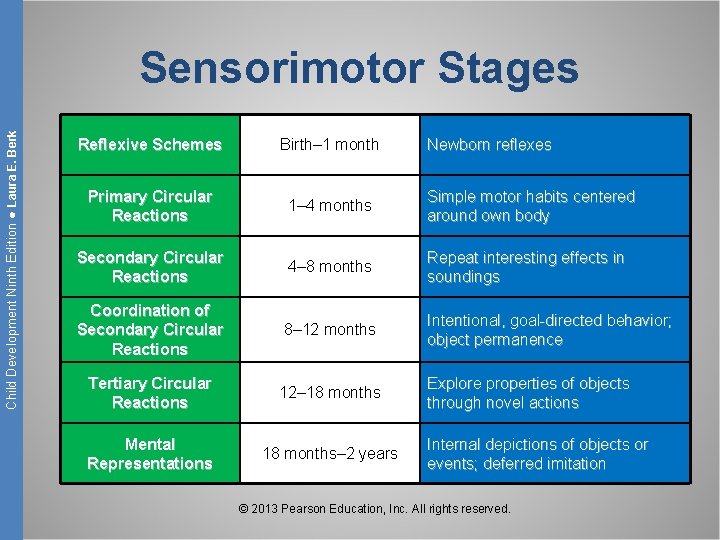
Child Development Ninth Edition ● Laura E. Berk Sensorimotor Stages Reflexive Schemes Birth– 1 month Newborn reflexes Primary Circular Reactions 1– 4 months Simple motor habits centered around own body Secondary Circular Reactions 4– 8 months Repeat interesting effects in soundings Coordination of Secondary Circular Reactions 8– 12 months Intentional, goal-directed behavior; object permanence Tertiary Circular Reactions 12– 18 months Explore properties of objects through novel actions Mental Representations 18 months– 2 years Internal depictions of objects or events; deferred imitation © 2013 Pearson Education, Inc. All rights reserved.
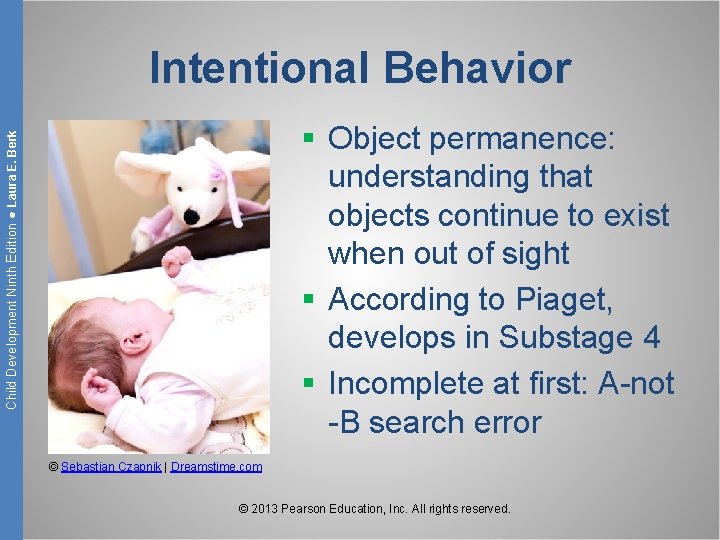
Intentional Behavior Child Development Ninth Edition ● Laura E. Berk § Object permanence: understanding that objects continue to exist when out of sight § According to Piaget, develops in Substage 4 § Incomplete at first: A-not -B search error © Sebastian Czapnik | Dreamstime. com © 2013 Pearson Education, Inc. All rights reserved.

Child Development Ninth Edition ● Laura E. Berk Testing Infant Understanding of Object Permanence Using Predictive Eye Tracking Figure 6. 2 Adapted from Bertenthal, Longo, & Kenny, 2007. © 2013 Pearson Education, Inc. All rights reserved.

Child Development Ninth Edition ● Laura E. Berk Testing Infants for Deferred Imitation Figure 6. 3 After researchers performed a novel series of actions with a puppet, this 6 month-old imitated the actions a day later —(a) removing the glove; (b) shaking the glove to ring a bell inside. With age, gains in recall are evident in deferred imitation of others’ behavior over longer delays. Photos: Courtesy of Carolyn Rovee-Collier. © 2013 Pearson Education, Inc. All rights reserved.
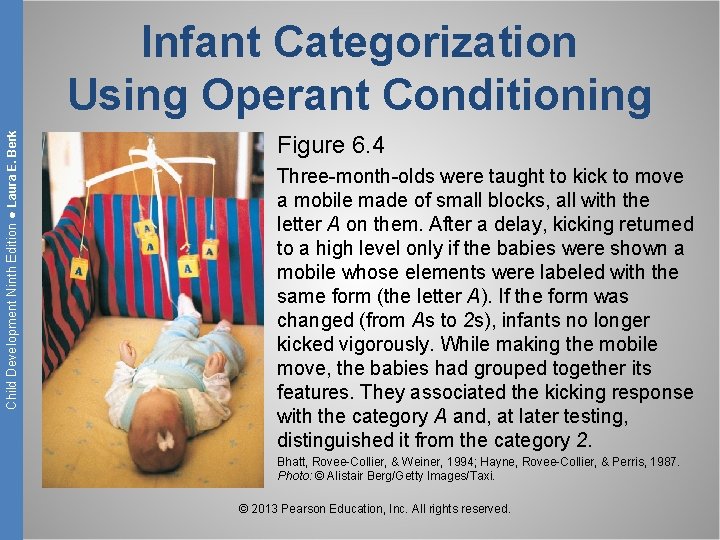
Child Development Ninth Edition ● Laura E. Berk Infant Categorization Using Operant Conditioning Figure 6. 4 Three-month-olds were taught to kick to move a mobile made of small blocks, all with the letter A on them. After a delay, kicking returned to a high level only if the babies were shown a mobile whose elements were labeled with the same form (the letter A). If the form was changed (from As to 2 s), infants no longer kicked vigorously. While making the mobile move, the babies had grouped together its features. They associated the kicking response with the category A and, at later testing, distinguished it from the category 2. Bhatt, Rovee-Collier, & Weiner, 1994; Hayne, Rovee-Collier, & Perris, 1987. Photo: © Alistair Berg/Getty Images/Taxi. © 2013 Pearson Education, Inc. All rights reserved.

Child Development Ninth Edition ● Laura E. Berk Mental Representation § Internal, mental depictions of information § § Images: objects, people, places Concepts: categories Can manipulate with mind Allow: § Deferred imitation § Make-believe play © 2013 Pearson Education, Inc. All rights reserved.
Child Development Ninth Edition ● Laura E. Berk Deferred Imitation § Piaget: develops at about 18 months § Newer research: § 6 weeks – facial imitation § 6– 9 months – copy actions with objects § 12– 18 months – imitate skillfully © 2013 Pearson Education, Inc. All rights reserved.
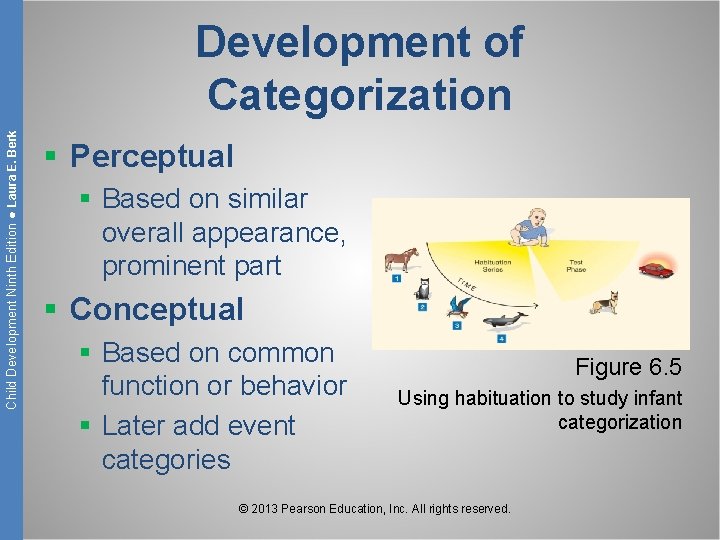
Child Development Ninth Edition ● Laura E. Berk Development of Categorization § Perceptual § Based on similar overall appearance, prominent part § Conceptual § Based on common function or behavior § Later add event categories Figure 6. 5 Using habituation to study infant categorization © 2013 Pearson Education, Inc. All rights reserved.
Child Development Ninth Edition ● Laura E. Berk Differing Views on Categorization ü Older infants/toddlers more sensitive to perceptual features and relationships ü Shift from perceptual to conceptual basis § But all researchers believe exploration of objects and environment contribute to categorization skills. § Adult labeling also important § Cultural variations © 2013 Pearson Education, Inc. All rights reserved.
Child Development Ninth Edition ● Laura E. Berk Problem Solving § At 7– 8 months, infants develop intentional means–end action sequences. § At 10– 12 months, infants engage in analogical problem solving. § By age 1, infants form flexible mental representations of using tools to get objects. § Displaced reference © 2013 Pearson Education, Inc. All rights reserved.
Child Development Ninth Edition ● Laura E. Berk Symbolic Function of Pictures § Awareness emerges in second year. § Infants do not view pictures as symbols. § Even newborns have some perception. § Most 15 - to 24 -month-olds can distinguish between real object and picture. § Begin using pictures to communicate § Mostly understand symbolic nature © 2013 Pearson Education, Inc. All rights reserved.
Child Development Ninth Edition ● Laura E. Berk Video Deficit Effect § About 40% of U. S. 3 -month-olds watch television regularly (90% by age 2). § Infants confuse video images with reality. § Studies show video deficit effect on toddlers: § Poorer skill performance § Deferred imitation and word learning § Poorer problem solving § Experts recommend against mass media exposure before age 2½. © 2013 Pearson Education, Inc. All rights reserved.
Child Development Ninth Edition ● Laura E. Berk Evaluation of Sensorimotor Stage Timing of: How Piaget • Object search was right • A-not-B • Make-believe play • Timing of object permanence, How Piaget deferred imitation, categorization, might have problem solving by analogy been wrong • All occur sooner than Piaget thought. Some suggest infants are born with core knowledge in several domains of thought. © 2013 Pearson Education, Inc. All rights reserved.
Child Development Ninth Edition ● Laura E. Berk The Preoperational Stage: 2 to 7 Years § Mental representation § Language § Piaget believed it developed from sensorimotor experiences. § Make-believe play § Dual representation © 2013 Pearson Education, Inc. All rights reserved.
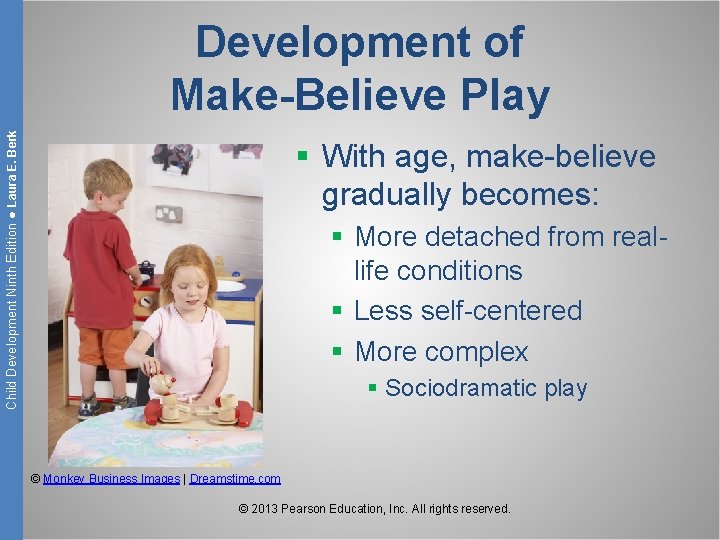
Child Development Ninth Edition ● Laura E. Berk Development of Make-Believe Play § With age, make-believe gradually becomes: § More detached from reallife conditions § Less self-centered § More complex § Sociodramatic play © Monkey Business Images | Dreamstime. com © 2013 Pearson Education, Inc. All rights reserved.
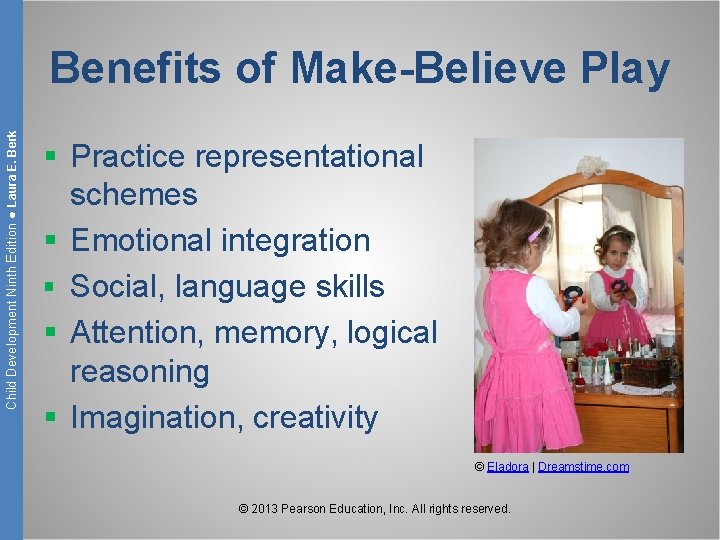
Child Development Ninth Edition ● Laura E. Berk Benefits of Make-Believe Play § Practice representational schemes § Emotional integration § Social, language skills § Attention, memory, logical reasoning § Imagination, creativity © Eladora | Dreamstime. com © 2013 Pearson Education, Inc. All rights reserved.
Child Development Ninth Edition ● Laura E. Berk Dual Representation § Viewing a symbolic object as both an object and a symbol § Mastered around age 3 § Adult teaching can help. § Provide lots of maps, photos, drawings, make-believe playthings, etc. § Point out similarities to real world. § Expose children to diverse symbols. © Vstock | Dreamstime. com © 2013 Pearson Education, Inc. All rights reserved.
Child Development Ninth Edition ● Laura E. Berk Limitations of Preoperational Thought ü Cannot perform mental operations ü Egocentrism and animistic thinking ü Cannot conserve ü Lack hierarchical classification © 2013 Pearson Education, Inc. All rights reserved.
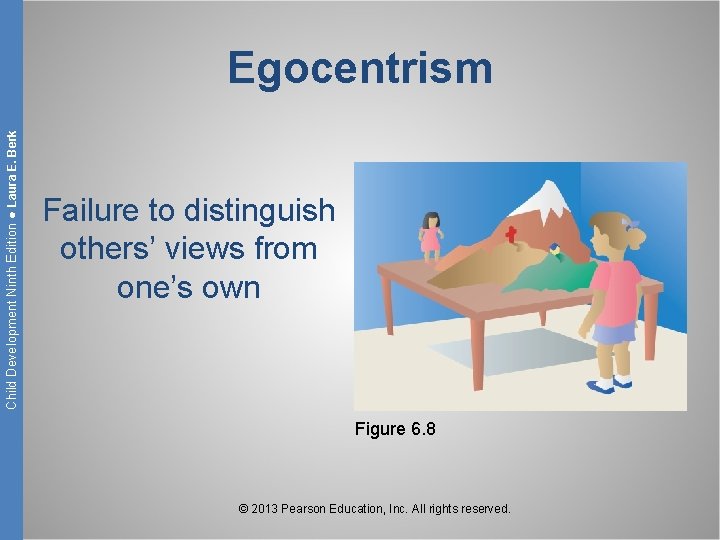
Child Development Ninth Edition ● Laura E. Berk Egocentrism Failure to distinguish others’ views from one’s own Figure 6. 8 © 2013 Pearson Education, Inc. All rights reserved.
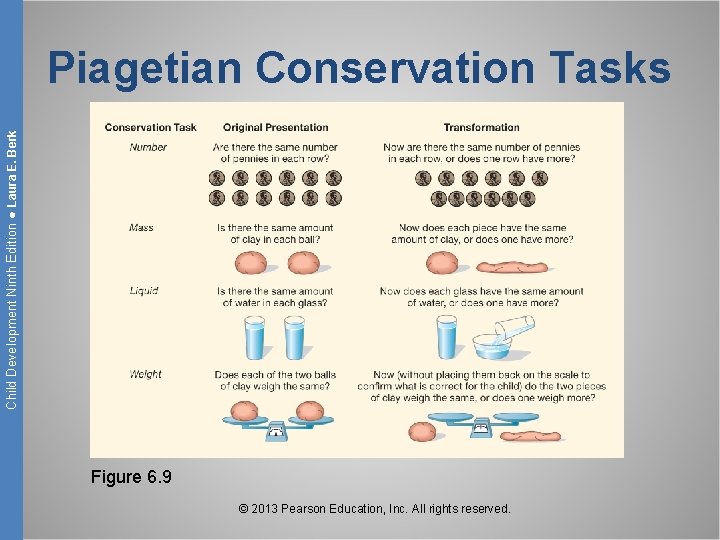
Child Development Ninth Edition ● Laura E. Berk Piagetian Conservation Tasks Figure 6. 9 © 2013 Pearson Education, Inc. All rights reserved.
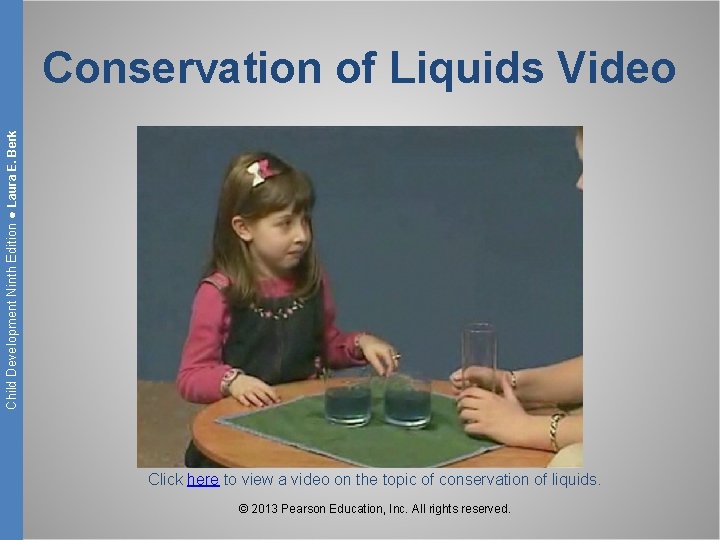
Child Development Ninth Edition ● Laura E. Berk Conservation of Liquids Video Click here to view a video on the topic of conservation of liquids. © 2013 Pearson Education, Inc. All rights reserved.

Child Development Ninth Edition ● Laura E. Berk Preoperational Thinking § Centration § Focus on one aspect and neglect others § Irreversibility © Miroslav Ferkuniak | Dreamstime. com § Cannot mentally reverse a set of steps © 2013 Pearson Education, Inc. All rights reserved.
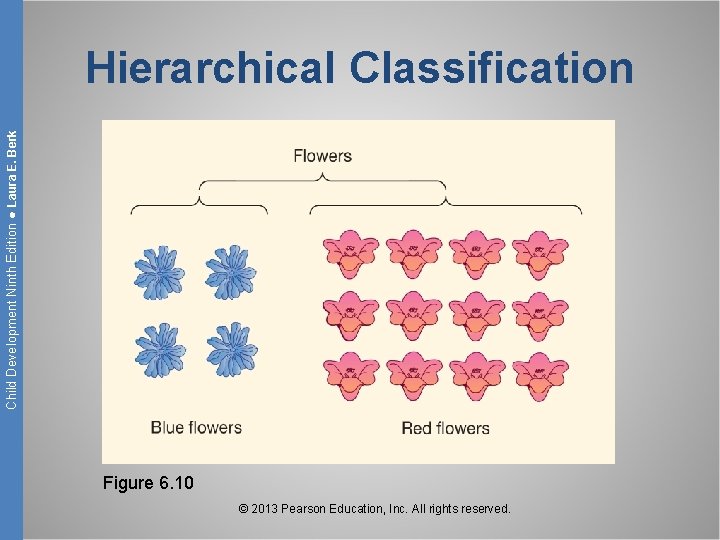
Child Development Ninth Edition ● Laura E. Berk Hierarchical Classification Figure 6. 10 © 2013 Pearson Education, Inc. All rights reserved.
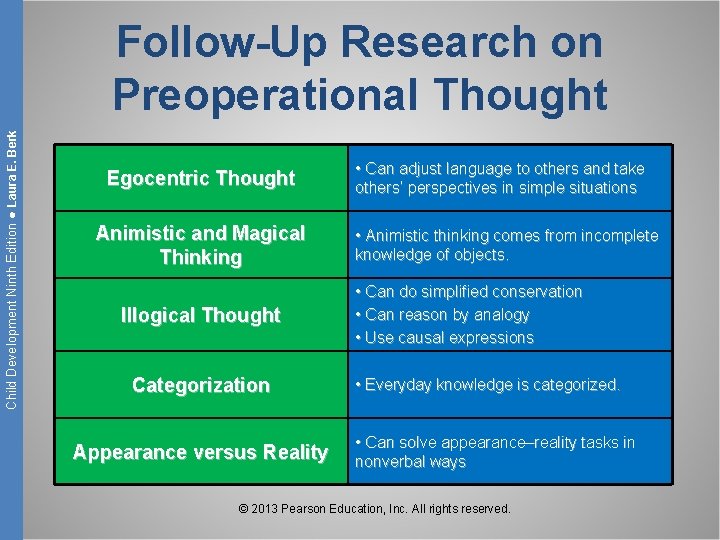
Child Development Ninth Edition ● Laura E. Berk Follow-Up Research on Preoperational Thought Egocentric Thought Animistic and Magical Thinking Illogical Thought Categorization Appearance versus Reality • Can adjust language to others and take others’ perspectives in simple situations • Animistic thinking comes from incomplete knowledge of objects. • Can do simplified conservation • Can reason by analogy • Use causal expressions • Everyday knowledge is categorized. • Can solve appearance–reality tasks in nonverbal ways © 2013 Pearson Education, Inc. All rights reserved.
Child Development Ninth Edition ● Laura E. Berk Evaluation of the Preoperational Stage How Piaget Preschoolers do develop beginnings of was right logical thinking. How Piaget Logical thinking develops more might have gradually than Piaget thought. been wrong © 2013 Pearson Education, Inc. All rights reserved.
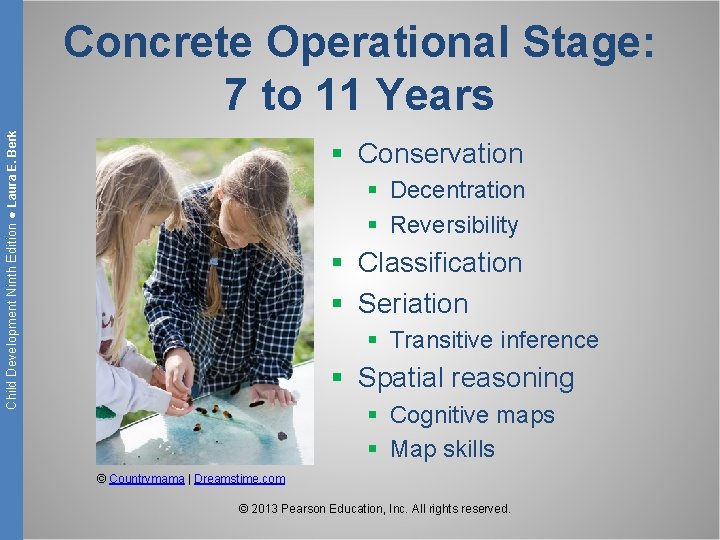
Child Development Ninth Edition ● Laura E. Berk Concrete Operational Stage: 7 to 11 Years § Conservation § Decentration § Reversibility § Classification § Seriation § Transitive inference § Spatial reasoning § Cognitive maps § Map skills © Countrymama | Dreamstime. com © 2013 Pearson Education, Inc. All rights reserved.
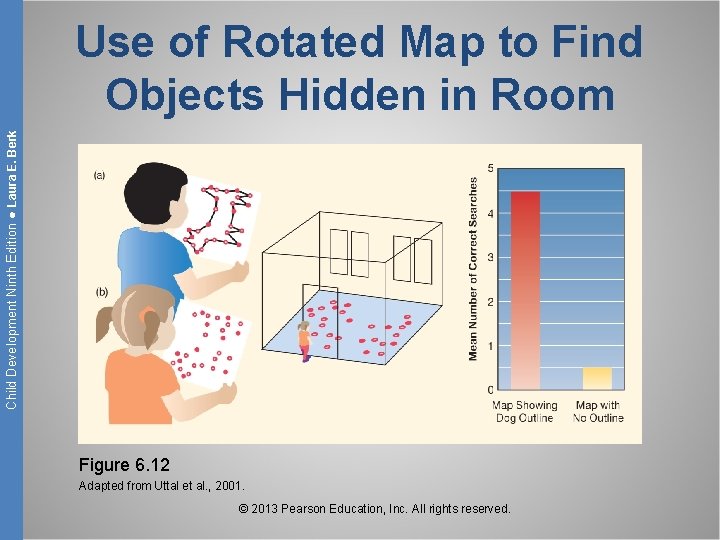
Child Development Ninth Edition ● Laura E. Berk Use of Rotated Map to Find Objects Hidden in Room Figure 6. 12 Adapted from Uttal et al. , 2001. © 2013 Pearson Education, Inc. All rights reserved.
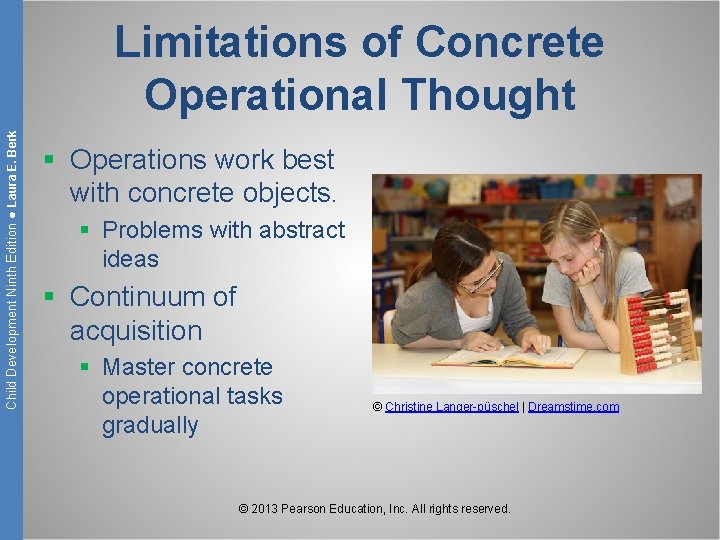
Child Development Ninth Edition ● Laura E. Berk Limitations of Concrete Operational Thought § Operations work best with concrete objects. § Problems with abstract ideas § Continuum of acquisition § Master concrete operational tasks gradually © Christine Langer-püschel | Dreamstime. com © 2013 Pearson Education, Inc. All rights reserved.

Child Development Ninth Edition ● Laura E. Berk Follow-Up Research on Concrete Operational Thought § Culture and teaching practices affect performance on tasks. § Conservation often delayed in tribal societies. § Going to school gives experience on Piagetian tasks. § Relevant nonschool experiences of some cultures can help, too. © 2013 Pearson Education, Inc. All rights reserved.
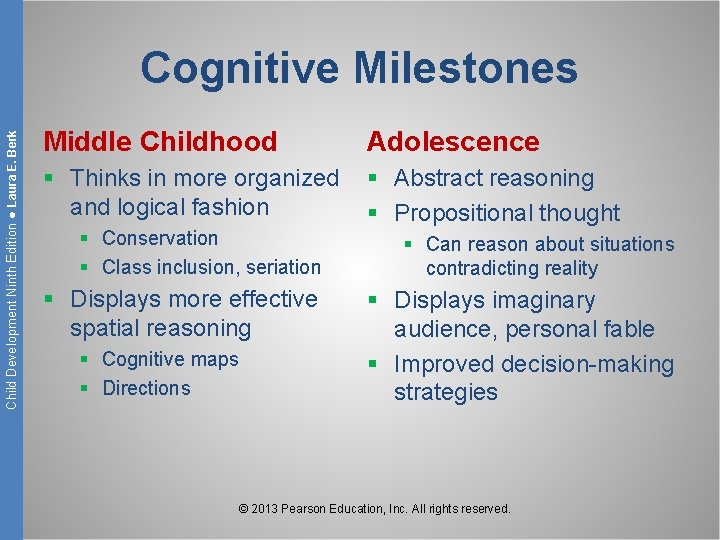
Child Development Ninth Edition ● Laura E. Berk Cognitive Milestones Middle Childhood Adolescence § Thinks in more organized and logical fashion § Abstract reasoning § Propositional thought § Conservation § Class inclusion, seriation § Can reason about situations contradicting reality § Displays more effective spatial reasoning § Displays imaginary audience, personal fable § Improved decision-making strategies § Cognitive maps § Directions © 2013 Pearson Education, Inc. All rights reserved.
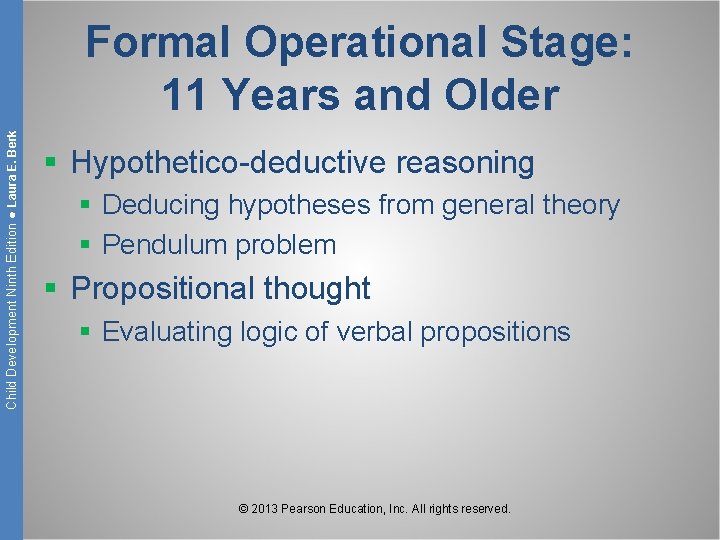
Child Development Ninth Edition ● Laura E. Berk Formal Operational Stage: 11 Years and Older § Hypothetico-deductive reasoning § Deducing hypotheses from general theory § Pendulum problem § Propositional thought § Evaluating logic of verbal propositions © 2013 Pearson Education, Inc. All rights reserved.

Child Development Ninth Edition ● Laura E. Berk Piaget’s Pendulum Problem Figure 6. 14 © 2013 Pearson Education, Inc. All rights reserved.
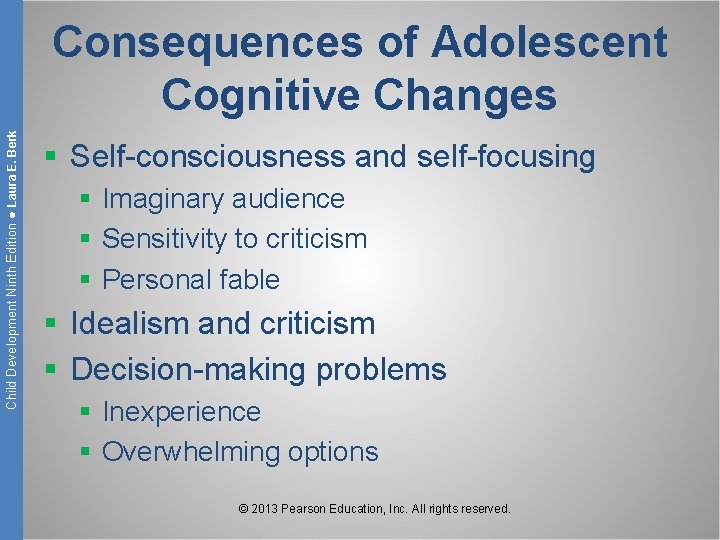
Child Development Ninth Edition ● Laura E. Berk Consequences of Adolescent Cognitive Changes § Self-consciousness and self-focusing § Imaginary audience § Sensitivity to criticism § Personal fable § Idealism and criticism § Decision-making problems § Inexperience § Overwhelming options © 2013 Pearson Education, Inc. All rights reserved.
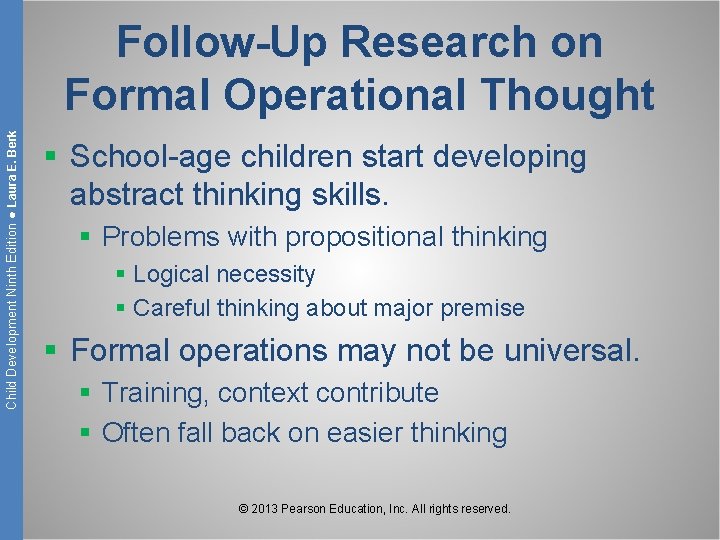
Child Development Ninth Edition ● Laura E. Berk Follow-Up Research on Formal Operational Thought § School-age children start developing abstract thinking skills. § Problems with propositional thinking § Logical necessity § Careful thinking about major premise § Formal operations may not be universal. § Training, context contribute § Often fall back on easier thinking © 2013 Pearson Education, Inc. All rights reserved.

Child Development Ninth Edition ● Laura E. Berk Educational Principles Derived from Piaget’s Theory § Discovery learning § Sensitivity to children’s readiness to learn § Acceptance of individual differences © Rmarmion | Dreamstime. com © 2013 Pearson Education, Inc. All rights reserved.
Child Development Ninth Edition ● Laura E. Berk Overall Evaluation of Piaget’s Theory ü Piaget’s change processes—assimilation, accommodation, and organization—can’t account for patterns of children’s changes observed today. ü Cognitive development not always selfgenerating ü Cognition not as broadly stagelike as Piaget believed ü Piaget’s theory still inspires research. © 2013 Pearson Education, Inc. All rights reserved.
Child Development Ninth Edition ● Laura E. Berk Core Knowledge Perspective § Evolutionary perspective: infants start life with innate, special-purpose knowledge systems. § Core domains of thought § Core domains prepare us to rapidly develop key aspects of cognition. § Development is domain-specific. § Children as naïve theorists © 2013 Pearson Education, Inc. All rights reserved.
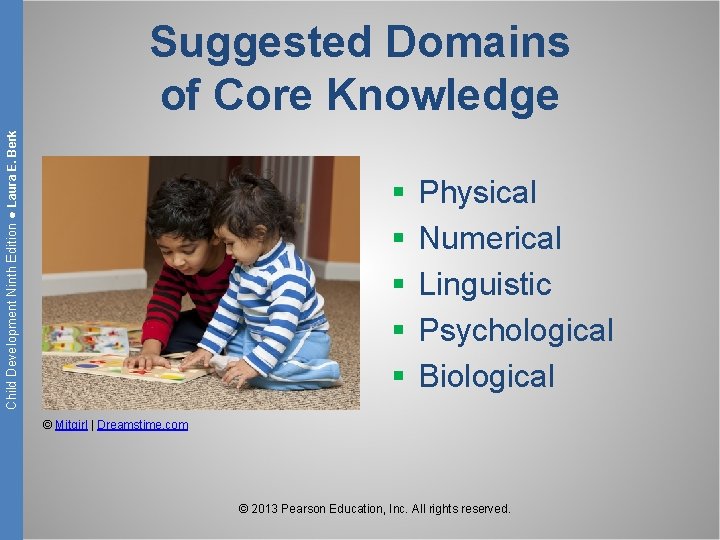
Child Development Ninth Edition ● Laura E. Berk Suggested Domains of Core Knowledge § § § Physical Numerical Linguistic Psychological Biological © Mitgirl | Dreamstime. com © 2013 Pearson Education, Inc. All rights reserved.
Child Development Ninth Edition ● Laura E. Berk Development of Infants’ Physical Knowledge One solid object cannot move through another 2– 3 months Size comparisons – notice when objects are: • Too wide for openings 5– 6 months • Too tall for containers 7– 8 months Gravity, object support 4– 8 months © 2013 Pearson Education, Inc. All rights reserved.
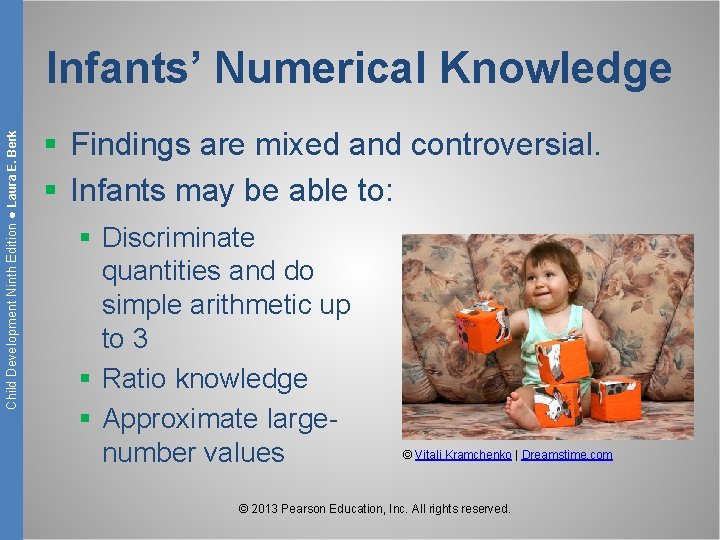
Child Development Ninth Edition ● Laura E. Berk Infants’ Numerical Knowledge § Findings are mixed and controversial. § Infants may be able to: § Discriminate quantities and do simple arithmetic up to 3 § Ratio knowledge § Approximate largenumber values © Vitali Kramchenko | Dreamstime. com © 2013 Pearson Education, Inc. All rights reserved.

Child Development Ninth Edition ● Laura E. Berk Testing Infants for Basic Number Concepts Figure 6. 16 © From K. Wynn, 1992, “Addition and Subtraction by Human Infants. ” Adapted with permission of Macmillan Publishers Ltd. , Nature, 358, p. 749. © 2013 Pearson Education, Inc. All rights reserved.
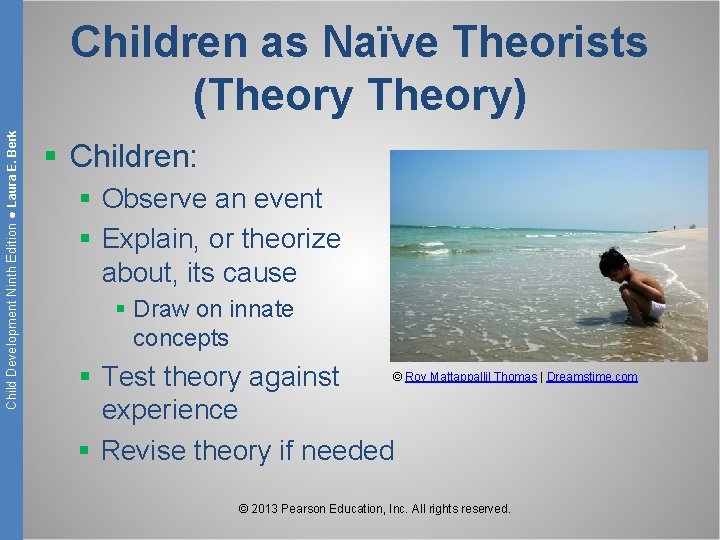
Child Development Ninth Edition ● Laura E. Berk Children as Naïve Theorists (Theory) § Children: § Observe an event § Explain, or theorize about, its cause § Draw on innate concepts © Roy Mattappallil Thomas | Dreamstime. com § Test theory against experience § Revise theory if needed © 2013 Pearson Education, Inc. All rights reserved.
Child Development Ninth Edition ● Laura E. Berk Is Biology a Core Domain? § Develops later than other domains § Psychological explanations for biological events § Late development is common around the world. § More evidence is needed. © 2013 Pearson Education, Inc. All rights reserved.
Child Development Ninth Edition ● Laura E. Berk Evaluation of Core Knowledge Perspective ü Most serious consideration of beginnings of thinking ü Amount and nature of inborn knowledge hotly debated ü Suggests environment and experience work together, but does not clarify how ü Suggests cognitive development is independent; little attention to learning with others © 2013 Pearson Education, Inc. All rights reserved.
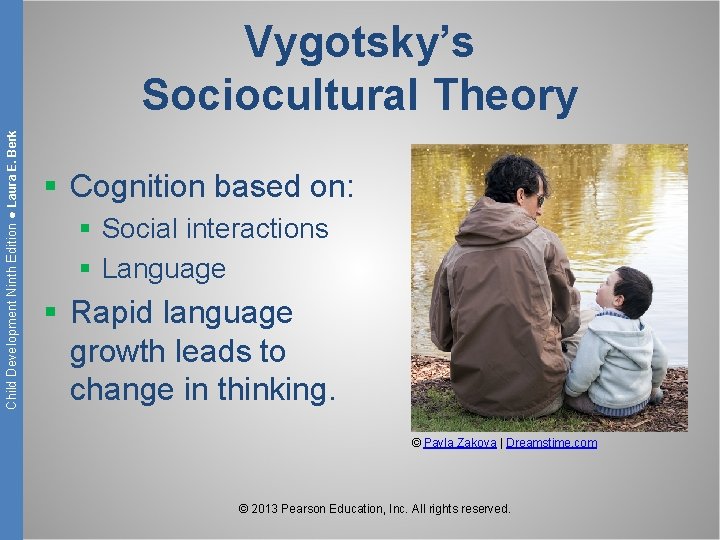
Child Development Ninth Edition ● Laura E. Berk Vygotsky’s Sociocultural Theory § Cognition based on: § Social interactions § Language § Rapid language growth leads to change in thinking. © Pavla Zakova | Dreamstime. com © 2013 Pearson Education, Inc. All rights reserved.
Child Development Ninth Edition ● Laura E. Berk Children’s Private Speech § Piaget called this “egocentric speech. ” § Vygotsky viewed as foundation for all higher cognitive processes. § Helps guide behavior § Used more when tasks are difficult, after errors, or when confused § Gradually becomes more silent § Children with learning and behavior problems use longer. © 2013 Pearson Education, Inc. All rights reserved.
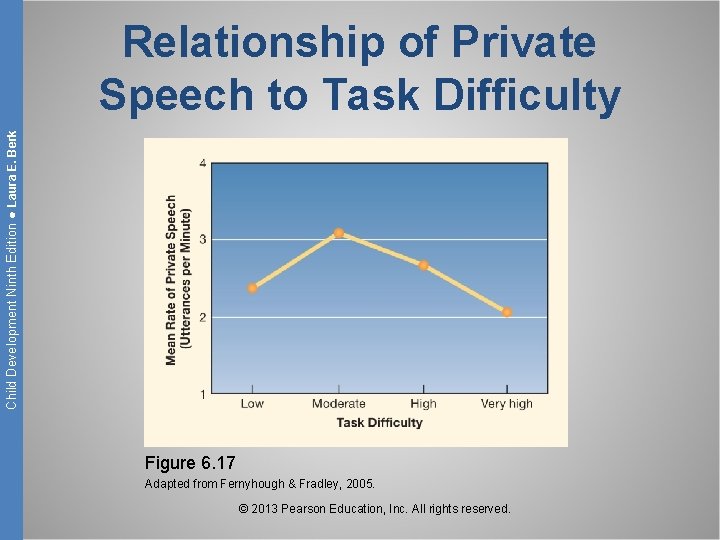
Child Development Ninth Edition ● Laura E. Berk Relationship of Private Speech to Task Difficulty Figure 6. 17 Adapted from Fernyhough & Fradley, 2005. © 2013 Pearson Education, Inc. All rights reserved.
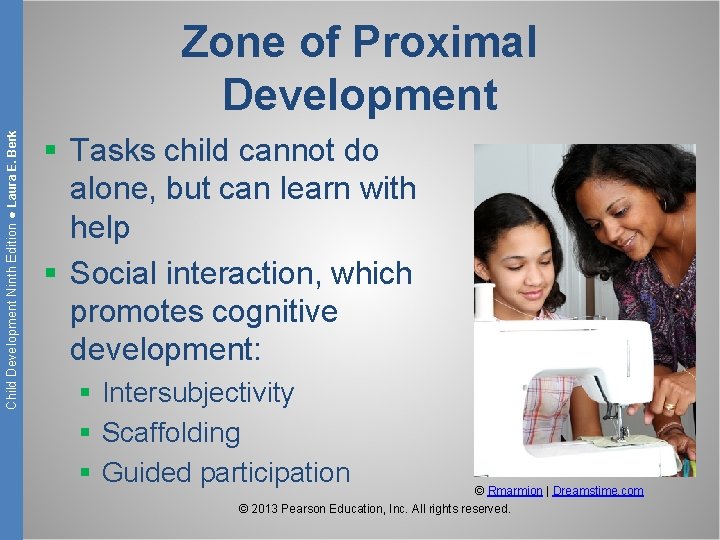
Child Development Ninth Edition ● Laura E. Berk Zone of Proximal Development § Tasks child cannot do alone, but can learn with help § Social interaction, which promotes cognitive development: § Intersubjectivity § Scaffolding § Guided participation © Rmarmion | Dreamstime. com © 2013 Pearson Education, Inc. All rights reserved.
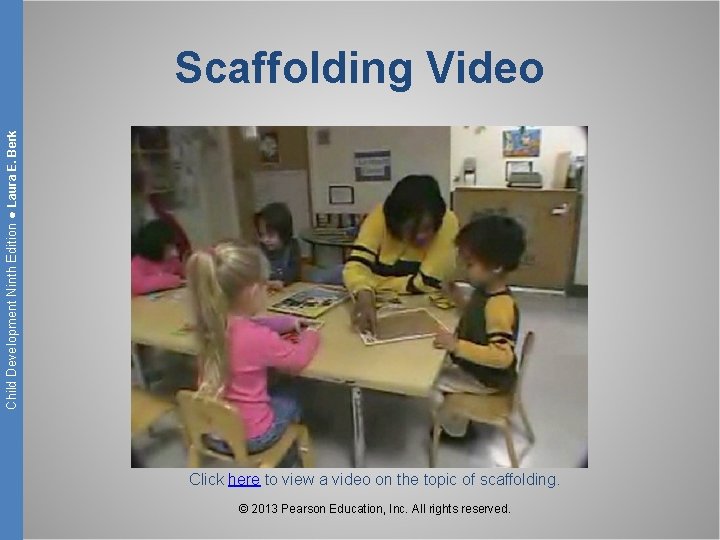
Child Development Ninth Edition ● Laura E. Berk Scaffolding Video Click here to view a video on the topic of scaffolding. © 2013 Pearson Education, Inc. All rights reserved.
Child Development Ninth Edition ● Laura E. Berk Vygotsky and Make-Believe Play § Provides zone of proximal development § Imaginary substitutions help children separate thinking from objects. § Rules strengthen capacity to think before acting. § Helps children understand social norms and expectations © 2013 Pearson Education, Inc. All rights reserved.
Child Development Ninth Edition ● Laura E. Berk Social Origins of Make-Believe Play § Make-believe play is major means by which children grow cognitively and learn about important activities in culture. § Toddlers need encouragement to participate in imaginative make-believe play. § Mothers and siblings play an important role in modeling make-believe play. © 2013 Pearson Education, Inc. All rights reserved.

Child Development Ninth Edition ● Laura E. Berk For Discussion: Speaking to Parents and Teachers About the Importance of Make-Believe Play Pretend you have been asked to speak to a group of parents and teachers of preschool-age children. Both the parents and teachers are concerned that too much classroom time is being devoted to play and wonder if they should incorporate more academics into the curriculum. List information you would include in your discussion. For example, what are some benefits of make-believe play in early childhood? Will an emphasis on academics promote greater cognitive development than an emphasis on makebelieve play? Why or why not? © 2013 Pearson Education, Inc. All rights reserved.

Vygotsky and Education Child Development Ninth Edition ● Laura E. Berk § Assisted discovery § Teacher: § Guides learning § Tailors help to zone of proximal development § Peer collaboration © Monika Adamczyk | Dreamstime. com © 2013 Pearson Education, Inc. All rights reserved.
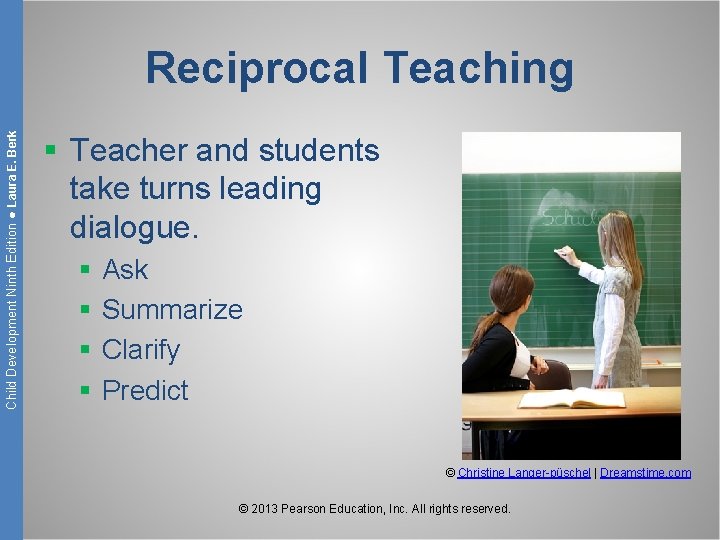
Child Development Ninth Edition ● Laura E. Berk Reciprocal Teaching § Teacher and students take turns leading dialogue. § § Ask Summarize Clarify Predict © Christine Langer-püschel | Dreamstime. com © 2013 Pearson Education, Inc. All rights reserved.
Child Development Ninth Edition ● Laura E. Berk Cooperative Learning § Small groups of classmates work toward common goals. § Intersubjectivity § Cultural variations in ability to learn cooperatively § Enhances peer relationships © 2013 Pearson Education, Inc. All rights reserved.
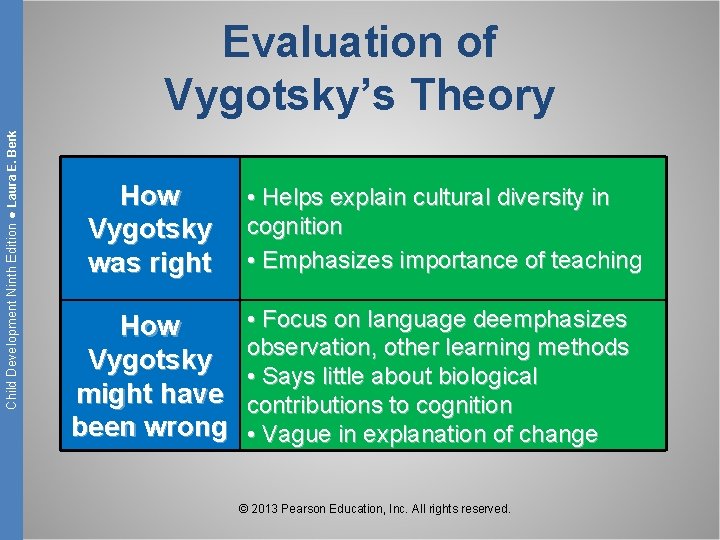
Child Development Ninth Edition ● Laura E. Berk Evaluation of Vygotsky’s Theory How Vygotsky was right • Helps explain cultural diversity in cognition • Emphasizes importance of teaching How Vygotsky might have been wrong • Focus on language deemphasizes observation, other learning methods • Says little about biological contributions to cognition • Vague in explanation of change © 2013 Pearson Education, Inc. All rights reserved.
Child Development Ninth Edition ● Laura E. Berk For Discussion: The Impact of Culture on Child Development Throughout Chapter 6, there are numerous examples of how cultural experiences contribute to cognitive development. List some major cognitive milestones of infancy, childhood, and adolescence. For each milestone, explain how cultural factors contribute to it. Once you have completed your list, share some examples with the class. © 2013 Pearson Education, Inc. All rights reserved.

Child Development Ninth Edition ● Laura E. Berk This multimedia product and its contents are protected under copyright law. The following are prohibited by law: § Any public performance or display, including transmission of any image over a network; § Preparation of any derivative work, including the extraction, in whole or in part of any images; § Any rental, lease, or lending of the program. © 2013 Pearson Education, Inc. All rights reserved.
- Slides: 65