
Child Development Ninth Edition Laura E Berk Chapter

Child Development Ninth Edition ● Laura E. Berk Chapter 6 Cognitive Development: Piagetian, Core Knowledge, and Vygotskian Perspectives © 2013 Pearson Education, Inc. All rights reserved.
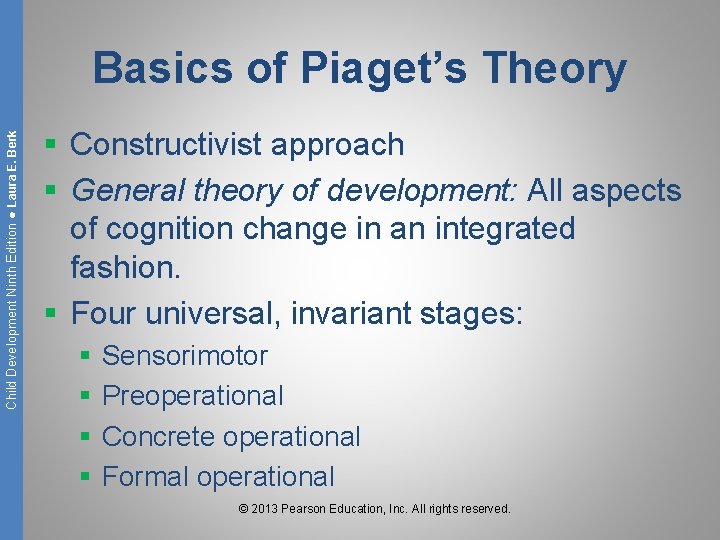
Child Development Ninth Edition ● Laura E. Berk Basics of Piaget’s Theory § Constructivist approach § General theory of development: All aspects of cognition change in an integrated fashion. § Four universal, invariant stages: § § Sensorimotor Preoperational Concrete operational Formal operational © 2013 Pearson Education, Inc. All rights reserved.

Child Development Ninth Edition ● Laura E. Berk Sensorimotor Stage: Birth to 2 Years § Building schemes through sensory and motor exploration § Circular reaction © Jin Peng | Dreamstime. com © 2013 Pearson Education, Inc. All rights reserved.
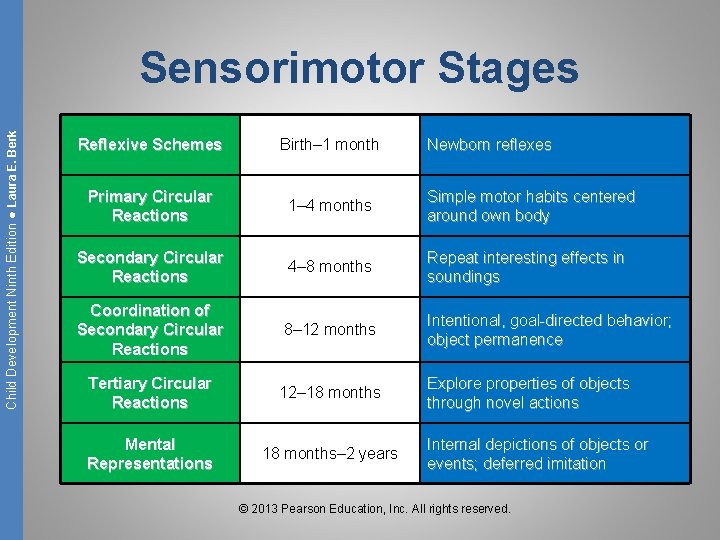
Child Development Ninth Edition ● Laura E. Berk Sensorimotor Stages Reflexive Schemes Birth– 1 month Newborn reflexes Primary Circular Reactions 1– 4 months Simple motor habits centered around own body Secondary Circular Reactions 4– 8 months Repeat interesting effects in soundings Coordination of Secondary Circular Reactions 8– 12 months Intentional, goal-directed behavior; object permanence Tertiary Circular Reactions 12– 18 months Explore properties of objects through novel actions Mental Representations 18 months– 2 years Internal depictions of objects or events; deferred imitation © 2013 Pearson Education, Inc. All rights reserved.
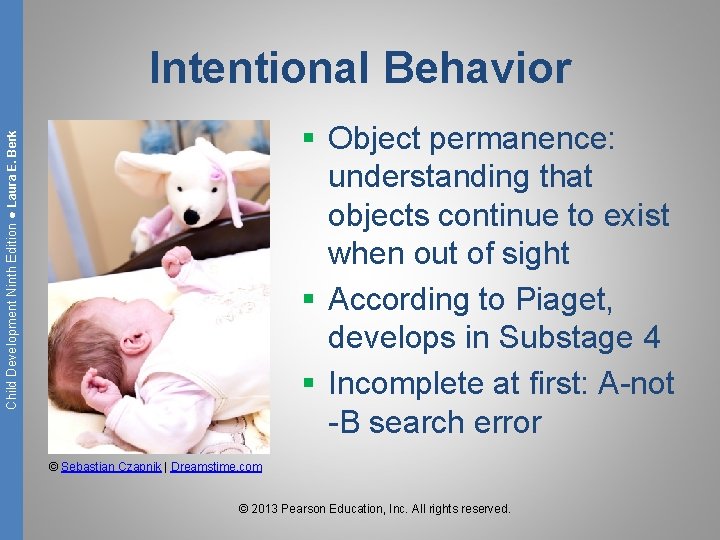
Intentional Behavior Child Development Ninth Edition ● Laura E. Berk § Object permanence: understanding that objects continue to exist when out of sight § According to Piaget, develops in Substage 4 § Incomplete at first: A-not -B search error © Sebastian Czapnik | Dreamstime. com © 2013 Pearson Education, Inc. All rights reserved.

Child Development Ninth Edition ● Laura E. Berk Testing Infant Understanding of Object Permanence Using Predictive Eye Tracking Figure 6. 2 Adapted from Bertenthal, Longo, & Kenny, 2007. © 2013 Pearson Education, Inc. All rights reserved.

Child Development Ninth Edition ● Laura E. Berk Testing Infants for Deferred Imitation Figure 6. 3 After researchers performed a novel series of actions with a puppet, this 6 month-old imitated the actions a day later —(a) removing the glove; (b) shaking the glove to ring a bell inside. With age, gains in recall are evident in deferred imitation of others’ behavior over longer delays. Photos: Courtesy of Carolyn Rovee-Collier. © 2013 Pearson Education, Inc. All rights reserved.

Child Development Ninth Edition ● Laura E. Berk Infant Categorization Using Operant Conditioning Figure 6. 4 Three-month-olds were taught to kick to move a mobile made of small blocks, all with the letter A on them. After a delay, kicking returned to a high level only if the babies were shown a mobile whose elements were labeled with the same form (the letter A). If the form was changed (from As to 2 s), infants no longer kicked vigorously. While making the mobile move, the babies had grouped together its features. They associated the kicking response with the category A and, at later testing, distinguished it from the category 2. Bhatt, Rovee-Collier, & Weiner, 1994; Hayne, Rovee-Collier, & Perris, 1987. Photo: © Alistair Berg/Getty Images/Taxi. © 2013 Pearson Education, Inc. All rights reserved.
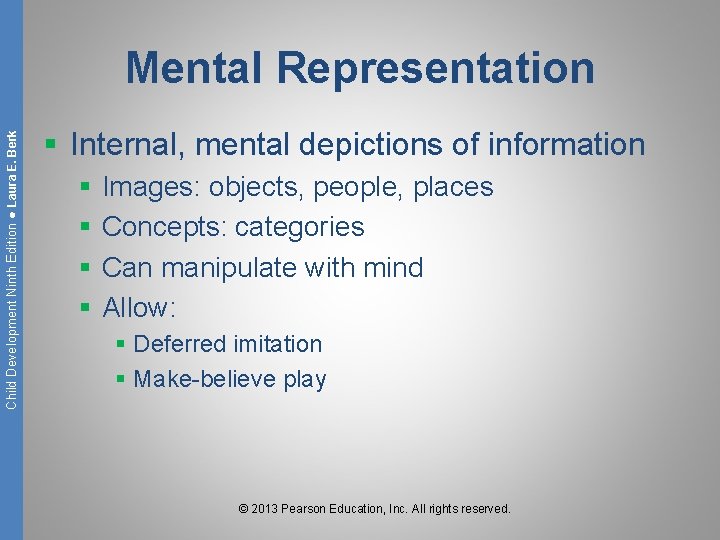
Child Development Ninth Edition ● Laura E. Berk Mental Representation § Internal, mental depictions of information § § Images: objects, people, places Concepts: categories Can manipulate with mind Allow: § Deferred imitation § Make-believe play © 2013 Pearson Education, Inc. All rights reserved.
Child Development Ninth Edition ● Laura E. Berk Deferred Imitation § Piaget: develops at about 18 months § Newer research: § 6 weeks – facial imitation § 6– 9 months – copy actions with objects § 12– 18 months – imitate skillfully © 2013 Pearson Education, Inc. All rights reserved.

Child Development Ninth Edition ● Laura E. Berk Development of Categorization § Perceptual § Based on similar overall appearance, prominent part § Conceptual § Based on common function or behavior § Later add event categories Figure 6. 5 Using habituation to study infant categorization © 2013 Pearson Education, Inc. All rights reserved.

Child Development Ninth Edition ● Laura E. Berk Differing Views on Categorization ü Older infants/toddlers more sensitive to perceptual features and relationships ü Shift from perceptual to conceptual basis § But all researchers believe exploration of objects and environment contribute to categorization skills. § Adult labeling also important § Cultural variations © 2013 Pearson Education, Inc. All rights reserved.
Child Development Ninth Edition ● Laura E. Berk Problem Solving § At 7– 8 months, infants develop intentional means–end action sequences. § At 10– 12 months, infants engage in analogical problem solving. § By age 1, infants form flexible mental representations of using tools to get objects. § Displaced reference © 2013 Pearson Education, Inc. All rights reserved.
Child Development Ninth Edition ● Laura E. Berk Symbolic Function of Pictures § Awareness emerges in second year. § Infants do not view pictures as symbols. § Even newborns have some perception. § Most 15 - to 24 -month-olds can distinguish between real object and picture. § Begin using pictures to communicate § Mostly understand symbolic nature © 2013 Pearson Education, Inc. All rights reserved.
Child Development Ninth Edition ● Laura E. Berk The Preoperational Stage: 2 to 7 Years § Mental representation § Language § Piaget believed it developed from sensorimotor experiences. § Make-believe play § Dual representation © 2013 Pearson Education, Inc. All rights reserved.
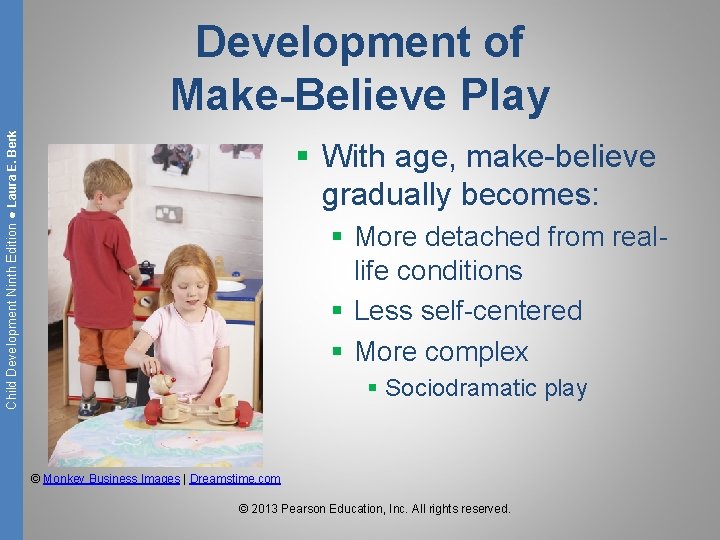
Child Development Ninth Edition ● Laura E. Berk Development of Make-Believe Play § With age, make-believe gradually becomes: § More detached from reallife conditions § Less self-centered § More complex § Sociodramatic play © Monkey Business Images | Dreamstime. com © 2013 Pearson Education, Inc. All rights reserved.
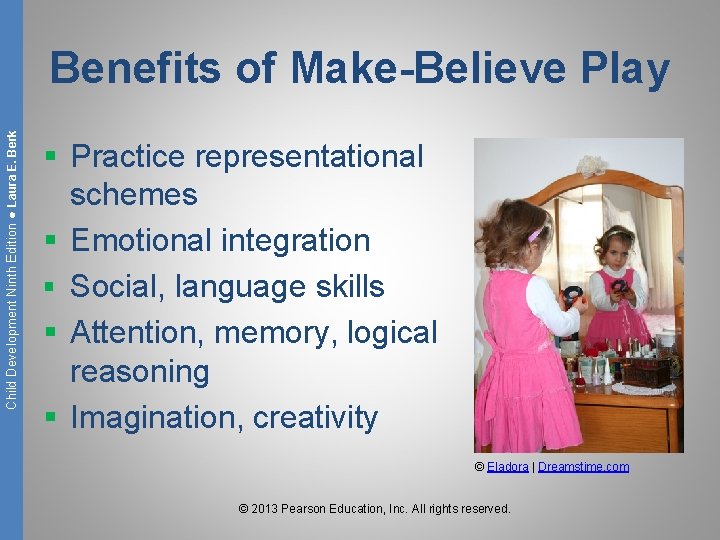
Child Development Ninth Edition ● Laura E. Berk Benefits of Make-Believe Play § Practice representational schemes § Emotional integration § Social, language skills § Attention, memory, logical reasoning § Imagination, creativity © Eladora | Dreamstime. com © 2013 Pearson Education, Inc. All rights reserved.
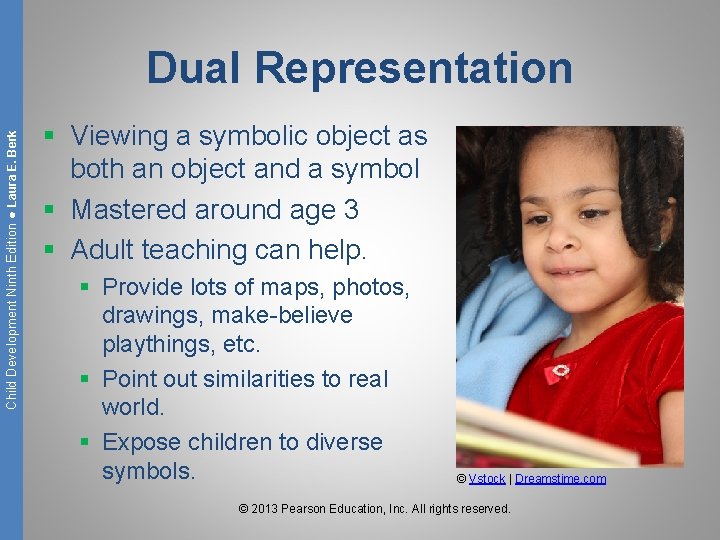
Child Development Ninth Edition ● Laura E. Berk Dual Representation § Viewing a symbolic object as both an object and a symbol § Mastered around age 3 § Adult teaching can help. § Provide lots of maps, photos, drawings, make-believe playthings, etc. § Point out similarities to real world. § Expose children to diverse symbols. © Vstock | Dreamstime. com © 2013 Pearson Education, Inc. All rights reserved.
Child Development Ninth Edition ● Laura E. Berk Limitations of Preoperational Thought ü Cannot perform mental operations ü Egocentrism and animistic thinking ü Cannot conserve ü Lack hierarchical classification © 2013 Pearson Education, Inc. All rights reserved.
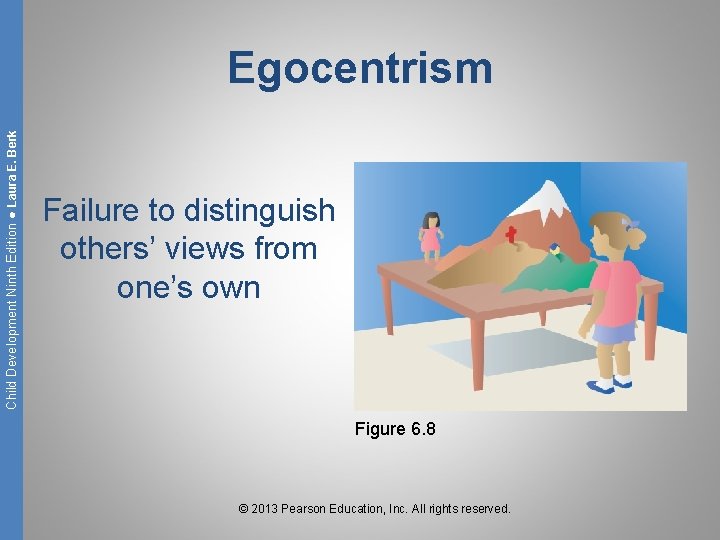
Child Development Ninth Edition ● Laura E. Berk Egocentrism Failure to distinguish others’ views from one’s own Figure 6. 8 © 2013 Pearson Education, Inc. All rights reserved.
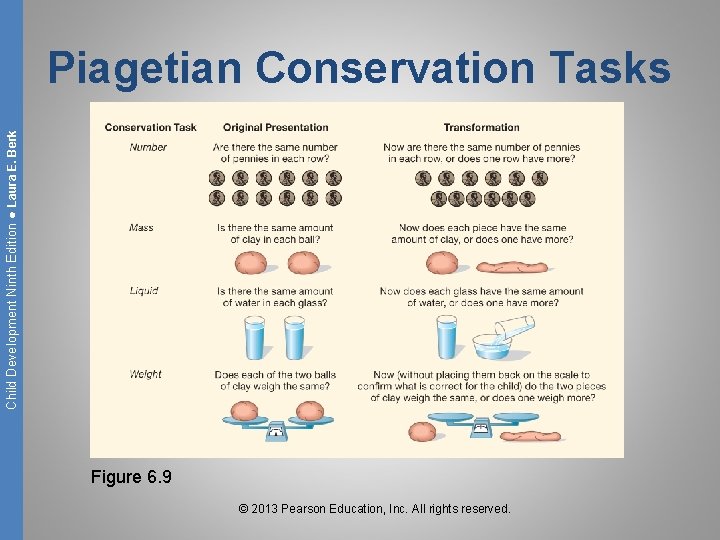
Child Development Ninth Edition ● Laura E. Berk Piagetian Conservation Tasks Figure 6. 9 © 2013 Pearson Education, Inc. All rights reserved.
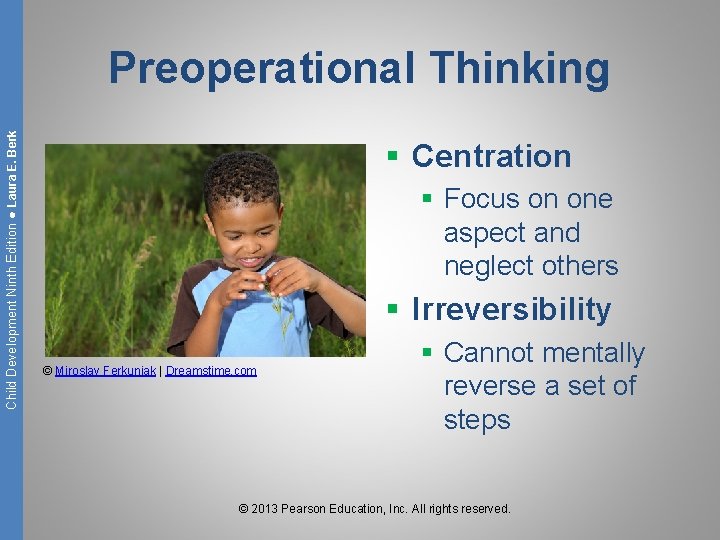
Child Development Ninth Edition ● Laura E. Berk Preoperational Thinking § Centration § Focus on one aspect and neglect others § Irreversibility © Miroslav Ferkuniak | Dreamstime. com § Cannot mentally reverse a set of steps © 2013 Pearson Education, Inc. All rights reserved.
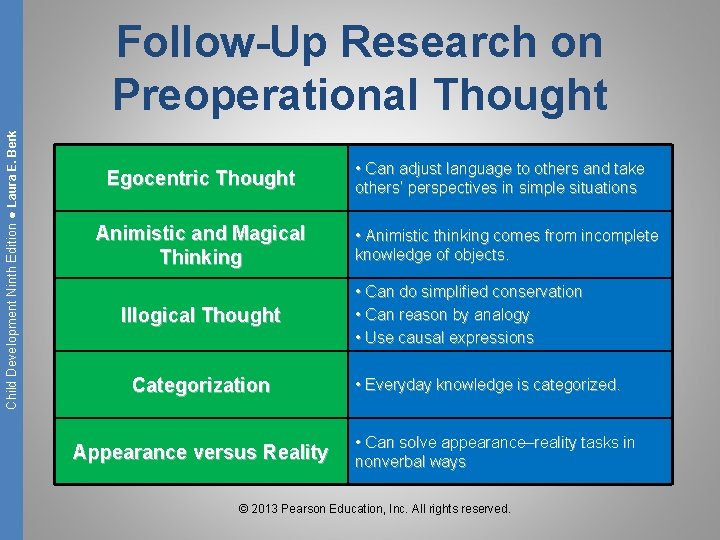
Child Development Ninth Edition ● Laura E. Berk Follow-Up Research on Preoperational Thought Egocentric Thought Animistic and Magical Thinking Illogical Thought Categorization Appearance versus Reality • Can adjust language to others and take others’ perspectives in simple situations • Animistic thinking comes from incomplete knowledge of objects. • Can do simplified conservation • Can reason by analogy • Use causal expressions • Everyday knowledge is categorized. • Can solve appearance–reality tasks in nonverbal ways © 2013 Pearson Education, Inc. All rights reserved.
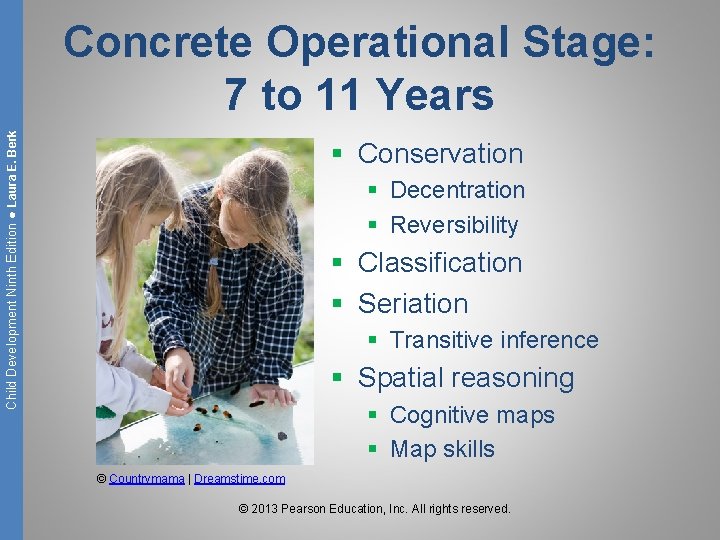
Child Development Ninth Edition ● Laura E. Berk Concrete Operational Stage: 7 to 11 Years § Conservation § Decentration § Reversibility § Classification § Seriation § Transitive inference § Spatial reasoning § Cognitive maps § Map skills © Countrymama | Dreamstime. com © 2013 Pearson Education, Inc. All rights reserved.
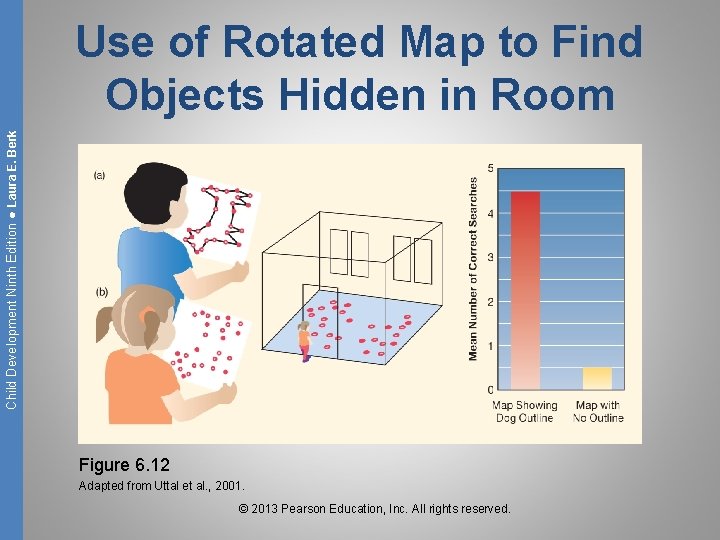
Child Development Ninth Edition ● Laura E. Berk Use of Rotated Map to Find Objects Hidden in Room Figure 6. 12 Adapted from Uttal et al. , 2001. © 2013 Pearson Education, Inc. All rights reserved.
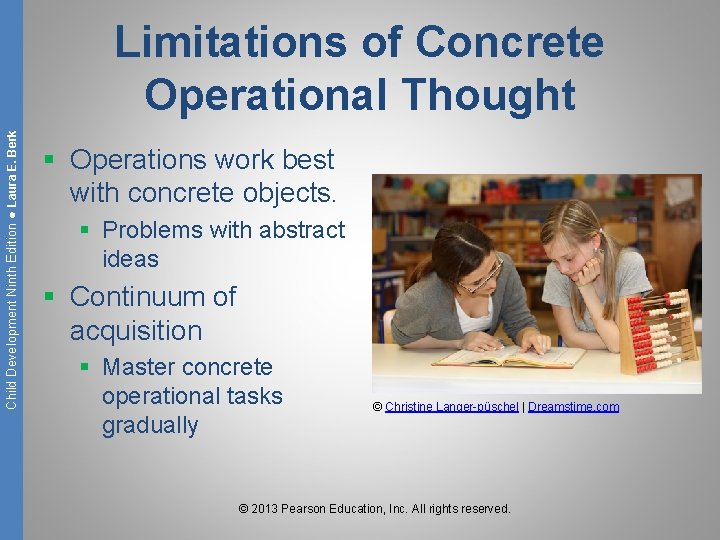
Child Development Ninth Edition ● Laura E. Berk Limitations of Concrete Operational Thought § Operations work best with concrete objects. § Problems with abstract ideas § Continuum of acquisition § Master concrete operational tasks gradually © Christine Langer-püschel | Dreamstime. com © 2013 Pearson Education, Inc. All rights reserved.

Child Development Ninth Edition ● Laura E. Berk Follow-Up Research on Concrete Operational Thought § Culture and teaching practices affect performance on tasks. § Conservation often delayed in tribal societies. § Going to school gives experience on Piagetian tasks. § Relevant nonschool experiences of some cultures can help, too. © 2013 Pearson Education, Inc. All rights reserved.
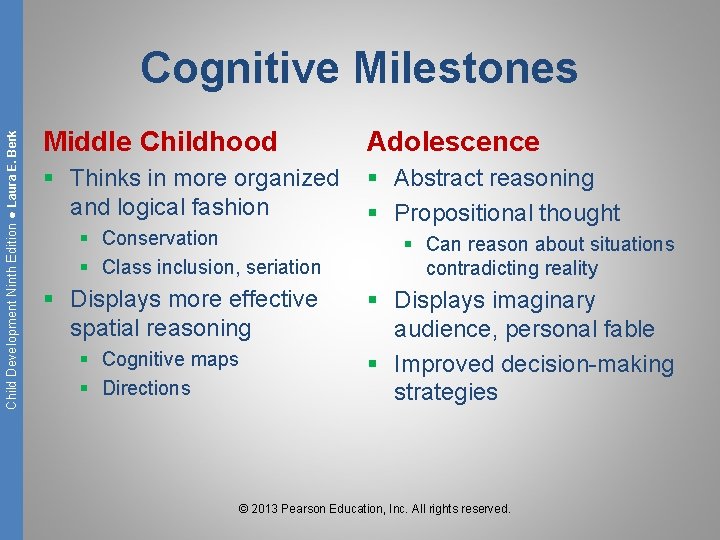
Child Development Ninth Edition ● Laura E. Berk Cognitive Milestones Middle Childhood Adolescence § Thinks in more organized and logical fashion § Abstract reasoning § Propositional thought § Conservation § Class inclusion, seriation § Can reason about situations contradicting reality § Displays more effective spatial reasoning § Displays imaginary audience, personal fable § Improved decision-making strategies § Cognitive maps § Directions © 2013 Pearson Education, Inc. All rights reserved.
Child Development Ninth Edition ● Laura E. Berk Consequences of Adolescent Cognitive Changes § Self-consciousness and self-focusing § Imaginary audience § Sensitivity to criticism § Personal fable § Idealism and criticism § Decision-making problems § Inexperience § Overwhelming options © 2013 Pearson Education, Inc. All rights reserved.
Child Development Ninth Edition ● Laura E. Berk Follow-Up Research on Formal Operational Thought § School-age children start developing abstract thinking skills. § Problems with propositional thinking § Logical necessity § Careful thinking about major premise § Formal operations may not be universal. § Training, context contribute § Often fall back on easier thinking © 2013 Pearson Education, Inc. All rights reserved.
Child Development Ninth Edition ● Laura E. Berk Overall Evaluation of Piaget’s Theory ü Piaget’s change processes—assimilation, accommodation, and organization—can’t account for patterns of children’s changes observed today. ü Cognitive development not always selfgenerating ü Cognition not as broadly stagelike as Piaget believed ü Piaget’s theory still inspires research. © 2013 Pearson Education, Inc. All rights reserved.
Child Development Ninth Edition ● Laura E. Berk Core Knowledge Perspective § Evolutionary perspective: infants start life with innate, special-purpose knowledge systems. § Core domains of thought § Core domains prepare us to rapidly develop key aspects of cognition. § Development is domain-specific. § Children as naïve theorists © 2013 Pearson Education, Inc. All rights reserved.
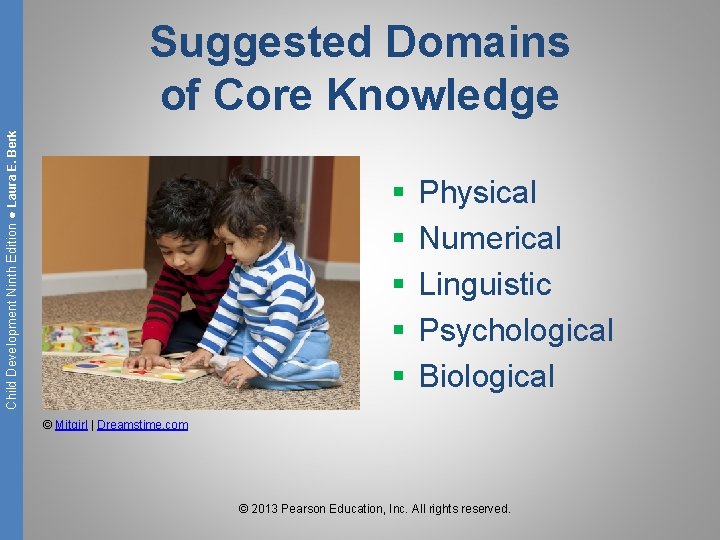
Child Development Ninth Edition ● Laura E. Berk Suggested Domains of Core Knowledge § § § Physical Numerical Linguistic Psychological Biological © Mitgirl | Dreamstime. com © 2013 Pearson Education, Inc. All rights reserved.
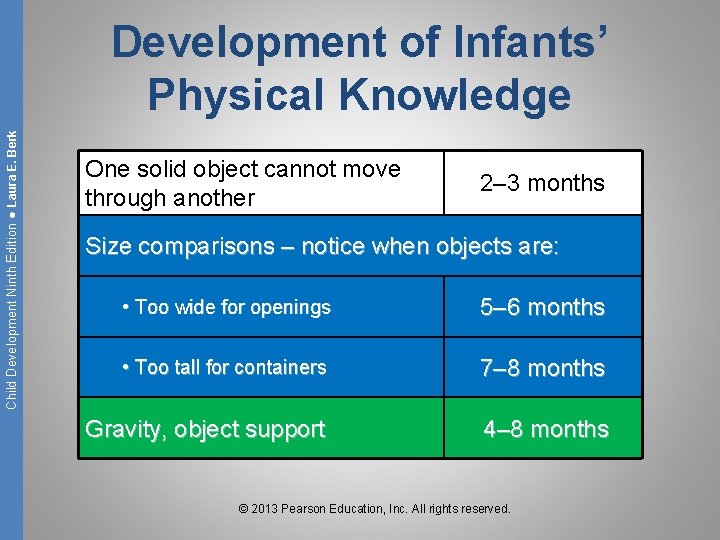
Child Development Ninth Edition ● Laura E. Berk Development of Infants’ Physical Knowledge One solid object cannot move through another 2– 3 months Size comparisons – notice when objects are: • Too wide for openings 5– 6 months • Too tall for containers 7– 8 months Gravity, object support 4– 8 months © 2013 Pearson Education, Inc. All rights reserved.
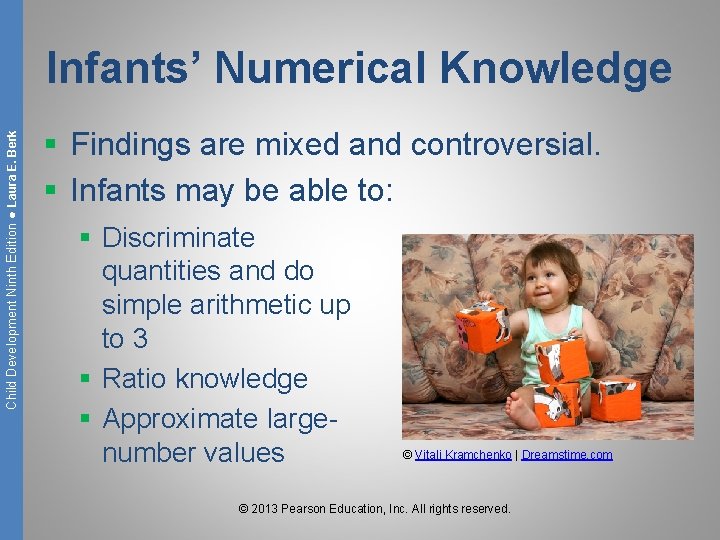
Child Development Ninth Edition ● Laura E. Berk Infants’ Numerical Knowledge § Findings are mixed and controversial. § Infants may be able to: § Discriminate quantities and do simple arithmetic up to 3 § Ratio knowledge § Approximate largenumber values © Vitali Kramchenko | Dreamstime. com © 2013 Pearson Education, Inc. All rights reserved.

Child Development Ninth Edition ● Laura E. Berk Testing Infants for Basic Number Concepts Figure 6. 16 © From K. Wynn, 1992, “Addition and Subtraction by Human Infants. ” Adapted with permission of Macmillan Publishers Ltd. , Nature, 358, p. 749. © 2013 Pearson Education, Inc. All rights reserved.
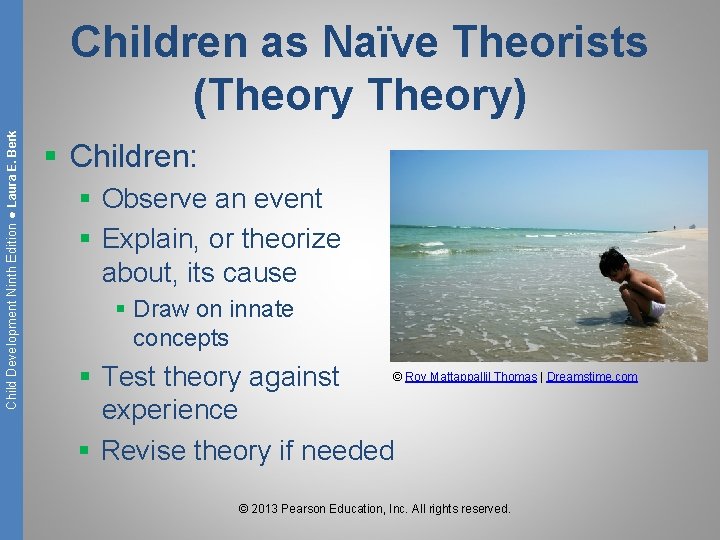
Child Development Ninth Edition ● Laura E. Berk Children as Naïve Theorists (Theory) § Children: § Observe an event § Explain, or theorize about, its cause § Draw on innate concepts © Roy Mattappallil Thomas | Dreamstime. com § Test theory against experience § Revise theory if needed © 2013 Pearson Education, Inc. All rights reserved.
Child Development Ninth Edition ● Laura E. Berk Is Biology a Core Domain? § Develops later than other domains § Psychological explanations for biological events § Late development is common around the world. § More evidence is needed. © 2013 Pearson Education, Inc. All rights reserved.
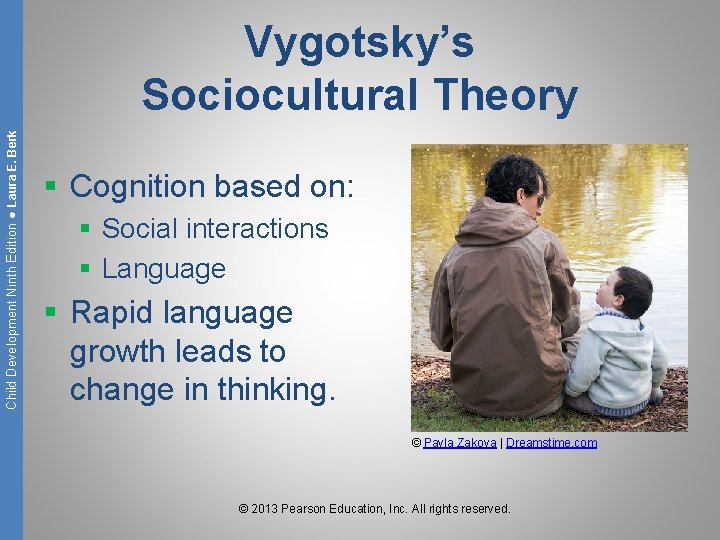
Child Development Ninth Edition ● Laura E. Berk Vygotsky’s Sociocultural Theory § Cognition based on: § Social interactions § Language § Rapid language growth leads to change in thinking. © Pavla Zakova | Dreamstime. com © 2013 Pearson Education, Inc. All rights reserved.
Child Development Ninth Edition ● Laura E. Berk Children’s Private Speech § Piaget called this “egocentric speech. ” § Vygotsky viewed as foundation for all higher cognitive processes. § Helps guide behavior § Used more when tasks are difficult, after errors, or when confused § Gradually becomes more silent § Children with learning and behavior problems use longer. © 2013 Pearson Education, Inc. All rights reserved.
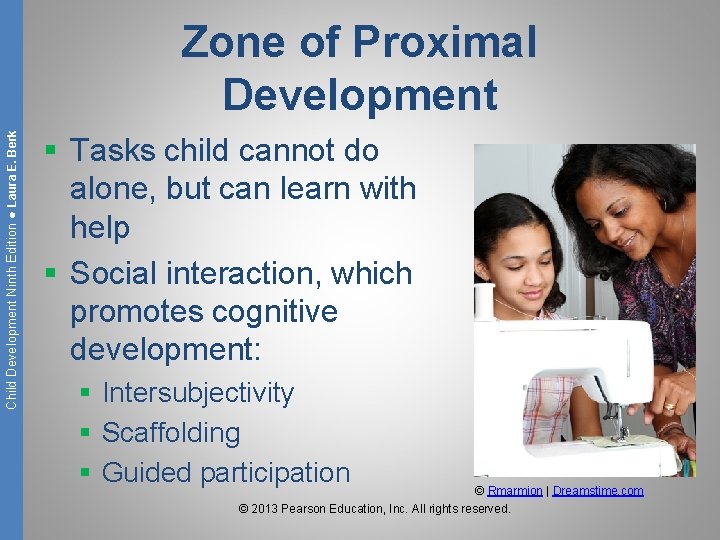
Child Development Ninth Edition ● Laura E. Berk Zone of Proximal Development § Tasks child cannot do alone, but can learn with help § Social interaction, which promotes cognitive development: § Intersubjectivity § Scaffolding § Guided participation © Rmarmion | Dreamstime. com © 2013 Pearson Education, Inc. All rights reserved.
Child Development Ninth Edition ● Laura E. Berk Social Origins of Make-Believe Play § Make-believe play is major means by which children grow cognitively and learn about important activities in culture. § Toddlers need encouragement to participate in imaginative make-believe play. § Mothers and siblings play an important role in modeling make-believe play. © 2013 Pearson Education, Inc. All rights reserved.

Vygotsky and Education Child Development Ninth Edition ● Laura E. Berk § Assisted discovery § Teacher: § Guides learning § Tailors help to zone of proximal development § Peer collaboration © Monika Adamczyk | Dreamstime. com © 2013 Pearson Education, Inc. All rights reserved.
Child Development Ninth Edition ● Laura E. Berk Evaluation of Vygotsky’s Theory How Vygotsky was right • Helps explain cultural diversity in cognition • Emphasizes importance of teaching How Vygotsky might have been wrong • Focus on language deemphasizes observation, other learning methods • Says little about biological contributions to cognition • Vague in explanation of change © 2013 Pearson Education, Inc. All rights reserved.
- Slides: 44