
Child Development Laboratory Annual Report 2013 2014 Department
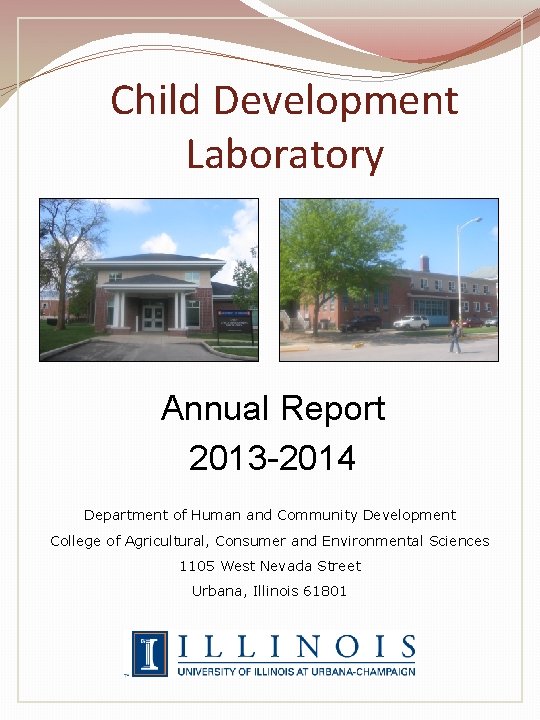
Child Development Laboratory Annual Report 2013 -2014 Department of Human and Community Development College of Agricultural, Consumer and Environmental Sciences 1105 West Nevada Street Urbana, Illinois 61801
Annual Report 2013 -2014 Table of Contents Page Mission Statement 2 Overview 3 -5 TABLE 1: Summary of Research Conducted 6 -12 TABLE 2: Observations Conducted 13 TABLE 3: Class Projects Conducted 14 -17 TABLE 4: Staff Members and Personnel-in-Training TABLE 5: Outreach and Presentation Activities of Staff Members 18 19 -22 Child Development Laboratory Department of Human and Community Development College of Agricultural, Consumer and Environmental Sciences UNIVERSITY OF ILLINOIS Urbana-Champaign Child Development Laboratory Annual Report 2013 -2014 1
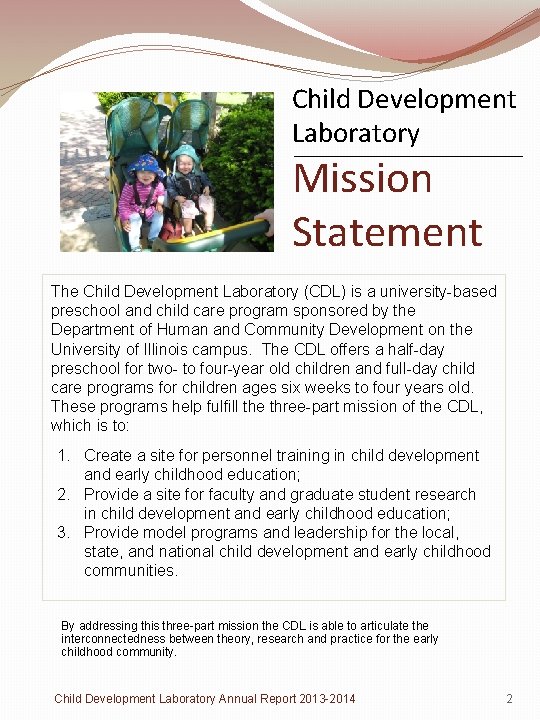
Child Development Laboratory Mission Statement The Child Development Laboratory (CDL) is a university-based preschool and child care program sponsored by the Department of Human and Community Development on the University of Illinois campus. The CDL offers a half-day preschool for two- to four-year old children and full-day child care programs for children ages six weeks to four years old. These programs help fulfill the three-part mission of the CDL, which is to: 1. Create a site for personnel training in child development and early childhood education; 2. Provide a site for faculty and graduate student research in child development and early childhood education; 3. Provide model programs and leadership for the local, state, and national child development and early childhood communities. By addressing this three-part mission the CDL is able to articulate the interconnectedness between theory, research and practice for the early childhood community. Child Development Laboratory Annual Report 2013 -2014 2
Overview The 2013 -2014 academic year was a time of growth as well as a time of transition for the Child Development Laboratory (CDL) program. In terms of growth, a concerted effort was made by staff members at the CDL as they worked with instructors, researchers and students to explore new ways in which the program could facilitate and support teaching, research and outreach initiatives on the University of Illinois at Urbana/Champaign (UIUC) campus. These efforts resulted in several novel and exciting teaching and research activities being implemented at the CDL, some of which were from disciplines not typically associated with work being conducted in a laboratory school setting. The broad scope of these activities is reflected in the tables that follow in this report. As a period of transition the 2013 -2014 academic term marked the end of half-day preschool programming for the CDL. Since its creation in 1942 the CDL offered half-day programming for two-, three- and four-year-old children. Over this 72 year period approximately 5, 200 children benefited from the high quality early childhood programming provided by the CDL’s half-day preschool classrooms. In recent years the CDL experienced a significant decline in the demand for half-day preschool enrollment, with fewer and fewer parents seeking out such programs for their children. This decline in half-day preschool applications/enrollment mirrored a trend occurring nationally. During this same period an increasing demand for enrollment in the full-day CDL classrooms became evident. With the growing decline in applications, it became increasingly difficult to fill the half-day preschool classrooms, thus making this portion of the overall CDL program financially unsustainable. A decision was made to begin phasing out the half-day preschool classrooms beginning with the 2011 -2012 school year, with the final half-day 4 -year-old classroom being conducted during the current reporting year. Although the phasing out of half-day preschool programming marked the end of a rich, historical tradition at the CDL, the number of full-day child care classrooms that were first implemented in the 1990 -1991 school year expanded to replace the half-day classrooms as they were being phased out. This shift to full-day programming has allowed the CDL to continue to provide high quality programming to enrolled children and their families while at the same time supporting the teaching, research and outreach missions of the UIUC. The activities outlined in this Child Development Laboratory Annual Report provide clear evidence of how CDL staff members are able to balance the competing demands of these two missions. Teaching The generation of new knowledge broadly defined has been, and will continue to be central to the teaching mission of the CDL program. Whether it is facilitating undergraduate and graduate student observations, facilitating undergraduate and graduate student class projects, or serving as a site for practicum, internship and student teaching placements, the CDL plays an integral role in providing educational experiences for students from a variety of disciplinary and departmental homes. With such experiences these students engage in learning activities designed to challenge them as they begin making the connection between theory and research they are being exposed to in their university classes with real children in classroom settings. Child Development Laboratory Annual Report 2013 -2014 3
During the 2013 -2014 academic year the CDL program was extremely active in supporting the generation of new knowledge in the following ways: 1. facilitating 3, 559 student observations in support of 39 UIUC courses (see Table 2); 2. supporting 2, 046 students as they completed CDL classroom-based projects as part of course requirements for 32 different UIUC classes (see Table 3); and 3. serving as a practicum, internship or field placement site for 61 undergraduate students pursuing degree programs related to child development or early childhood education fields (see Table 4). These teaching activities drew students to the CDL from a variety of departments on the UIUC campus ranging from Anthropology, to Computer and Electrical Engineering, to Labor and Employment Relations, to Special Education, to Theater. In reaching students from such a wide range of courses/departments, the CDL was integral in facilitating the educational experiences of students from six of the colleges on the UIUC campus (i. e. , Agricultural, Consumer and Environmental Sciences; Applied Health Sciences; Education; Engineering; Fine & Applied Arts; Liberal Arts & Sciences). Research In addition to the emphasis on teaching activities, the generation of new knowledge via support of research activities is another core component of the CDL mission on the UIUC campus. There are several ways in which the CDL plays an integral role in research activities of faculty and students on the UIUC campus, including the following: 1. Undergraduate Research (e. g. , High Chair Interactions within a Child Care Context, senior thesis project for a student in the School of Art & Design); 2. Graduate Student Training on Research Methodologies (e. g. , HCD 590 students using the CDL to gain experience gathering observational data); 3. Doctoral Dissertation Research (e. g. , Microbial and Genetic Influences on Childhood Obesity, dissertation data collection project for a Division of Nutritional Sciences doctoral student); 4. Pilot Data Collection/Feasibility Studies (e. g. , STRONG Kids Study: Preschool Food Choice and Reasoning, project to pilot test measurement protocols for exploring the relationship between children’s executive functioning and their food preferences); 5. Instrumentation Projects (e. g. , Accelerometer Use to Assess Children’s Physical Activity, project to calibrate and examine the feasibility of new technologies for assessing the amount and intensity of children’s physical activity); 6. Support of Junior Faculty Investigators (e. g. , Children’s Understanding and Use of Generic Language, assistant professor in Psychology using the CDL as a data collection site for a “small grants” externally funded project); 5. Supporting Large Scale Projects (e. g. , Routines for Environmental Health in Child Care: Meals, Snacks and Cleaning Up, data collection as part of an EPA funded Illinois Children’s Environmental Health Research Center); and 6. Atypical Disciplines Supported (e. g. , Childs Play: A Comparative Analysis of the Effects of Nature-Based Play Environments and Traditional Playgrounds on Children’s Social and Cognitive Development, project emerging from the Department of Landscape Architecture). The strong commitment of CDL teachers and administrators to supporting research on the UIUC campus has made the program a central component in the research infrastructure of the UIUC campus environment. The strong support of research activities is one of the major reasons the CDL is recognized by peer institutions as one of the leading laboratory school programs on university campuses across the nation. Child Development Laboratory Annual Report 2013 -2014 4
In the pages that follow are summaries of the various activities conducted at the CDL during the 2013 -2014 year. These summaries will provide an indication of how the CDL program plays a critical role in the teaching, research and outreach activities of faculty, staff and students on the University of Illinois at Urbana/Champaign campus. Brent A. Mc. Bride, Ph. D Professor – Human Development Director – Child Development Laboratory Annual Report 2013 -2014 5
Table 1 Summary of Research Conducted 2013 -2014 Title of Study: STRONG Kids Study: Preschool Food Choice and Reasoning Investigator: Barbara Fiese – Professor, Department of Human and Community Development; STRONG Kids Research Team Subjects: all 4 - and 5 -year olds enrolled in the CDL program Purpose: To develop and pilot test measurement protocols for exploring the relationship between children’s executive functioning and their food preferences. Title of Study: Preschool Learning Skills Project Investigator: Psychology Eva Pomerantz – Professor, Department of Subjects: all 4 - and 5 -year old children enrolled in the CDL Purpose: To examine the impact of children’s self-regulation and executive functioning on school readiness skills. Title of Study: Sprouts: Growing Healthy Habits Investigator: Henna Muzaffar – Post Doctoral Fellow, Family Resiliency Center; Barbara Fiese – Professor, Department of Human and Community Development Subjects: 20 4 - and 5 -year olds enrolled in the CDL Purpose: To develop and pilot test a series of game-like tasks that will be used to empirically evaluate the impact of the Sprouts curriculum. Child Development Laboratory Annual Report 2013 -2014 6
Title of Study: Early Learning Curriculum Analysis Investigator: Stacy Uebelhoer – Graduate Student, Department of Curriculum and Instruction Subjects: both 2 -year-old classrooms in the CDL program Purpose: To develop appropriate assessment tools and protocols for conducting critical analysis comparisons of curriculum models used in preschool classrooms. Title of Study: Feasibility Study for Assessing Children’s Waist Circumference Investigator: Salma Musaad – Research Biostatistician, Family Resiliency Center Subjects: 15 CDL children between the ages of 3 months and 3 -years Purpose: To explore the feasibility and logistical constraints in methods for measuring young children’s waist circumference as an alternative route to measuring children’s BMI Title of Study: The Impact of Specialized Music Pedagogies on Young Children’s Development Investigator: Gregory De. Nardo – Professor, Music Education; Jennifer Thomas, Brian Sullivan & Jason Hawkins – Doctoral Students, Music Education Subjects: all children in 3 preschool-aged CDL classrooms Purpose: To develop, implement and evaluate alternative approaches to music education that encompasses on “open activities” and “immersion” approach to teaching music concepts and skills. Title of Study: Teachers’ Response to Distress in the Classroom Investigator: Niyantri Ravindran – Graduate Student, Department of Human and Community Development; Robin Jarret – Professor, Department of Human and Community Development Subjects: all children in the PS 1 classroom Purpose: An ethnography study to explore the relationship between classroom environments and teachers’ response to children experiencing emotional distress and conflicts with their peers. Child Development Laboratory Annual Report 2013 -2014 7
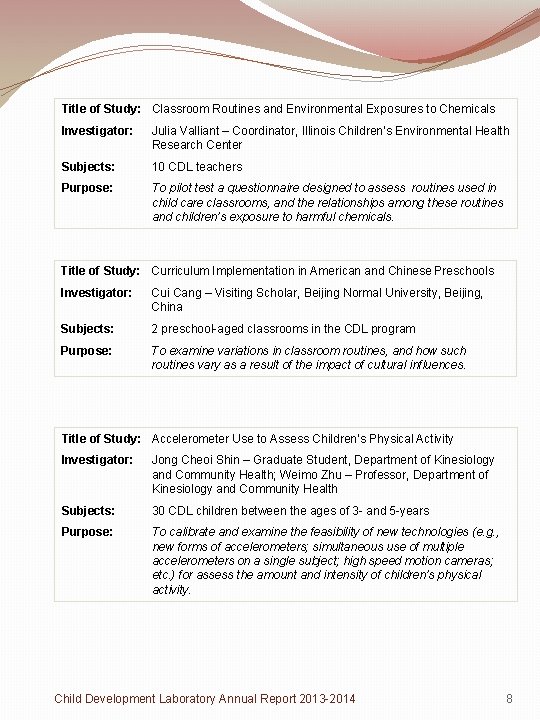
Title of Study: Classroom Routines and Environmental Exposures to Chemicals Investigator: Julia Valliant – Coordinator, Illinois Children’s Environmental Health Research Center Subjects: 10 CDL teachers Purpose: To pilot test a questionnaire designed to assess routines used in child care classrooms, and the relationships among these routines and children’s exposure to harmful chemicals. Title of Study: Curriculum Implementation in American and Chinese Preschools Investigator: Cui Cang – Visiting Scholar, Beijing Normal University, Beijing, China Subjects: 2 preschool-aged classrooms in the CDL program Purpose: To examine variations in classroom routines, and how such routines vary as a result of the impact of cultural influences. Title of Study: Accelerometer Use to Assess Children’s Physical Activity Investigator: Jong Cheoi Shin – Graduate Student, Department of Kinesiology and Community Health; Weimo Zhu – Professor, Department of Kinesiology and Community Health Subjects: 30 CDL children between the ages of 3 - and 5 -years Purpose: To calibrate and examine the feasibility of new technologies (e. g. , new forms of accelerometers; simultaneous use of multiple accelerometers on a single subject; high speed motion cameras; etc. ) for assess the amount and intensity of children’s physical activity. Child Development Laboratory Annual Report 2013 -2014 8
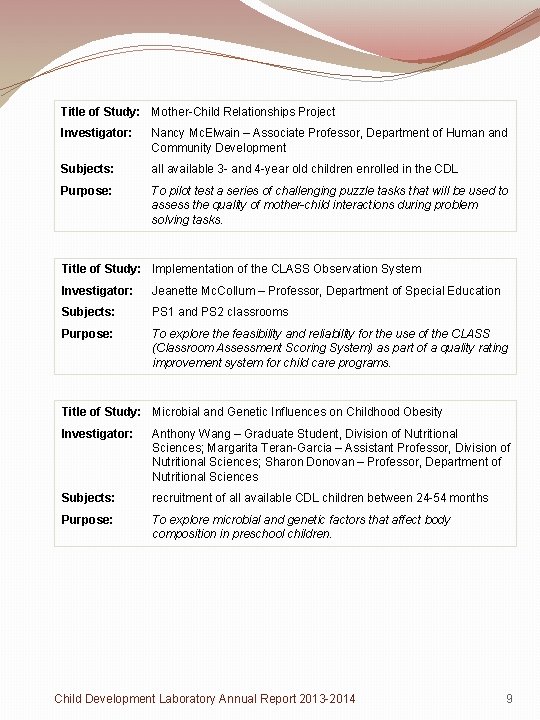
Title of Study: Mother-Child Relationships Project Investigator: Nancy Mc. Elwain – Associate Professor, Department of Human and Community Development Subjects: all available 3 - and 4 -year old children enrolled in the CDL Purpose: To pilot test a series of challenging puzzle tasks that will be used to assess the quality of mother-child interactions during problem solving tasks. Title of Study: Implementation of the CLASS Observation System Investigator: Jeanette Mc. Collum – Professor, Department of Special Education Subjects: PS 1 and PS 2 classrooms Purpose: To explore the feasibility and reliability for the use of the CLASS (Classroom Assessment Scoring System) as part of a quality rating improvement system for child care programs. Title of Study: Microbial and Genetic Influences on Childhood Obesity Investigator: Anthony Wang – Graduate Student, Division of Nutritional Sciences; Margarita Teran-Garcia – Assistant Professor, Division of Nutritional Sciences; Sharon Donovan – Professor, Department of Nutritional Sciences Subjects: recruitment of all available CDL children between 24 -54 months Purpose: To explore microbial and genetic factors that affect body composition in preschool children. Child Development Laboratory Annual Report 2013 -2014 9
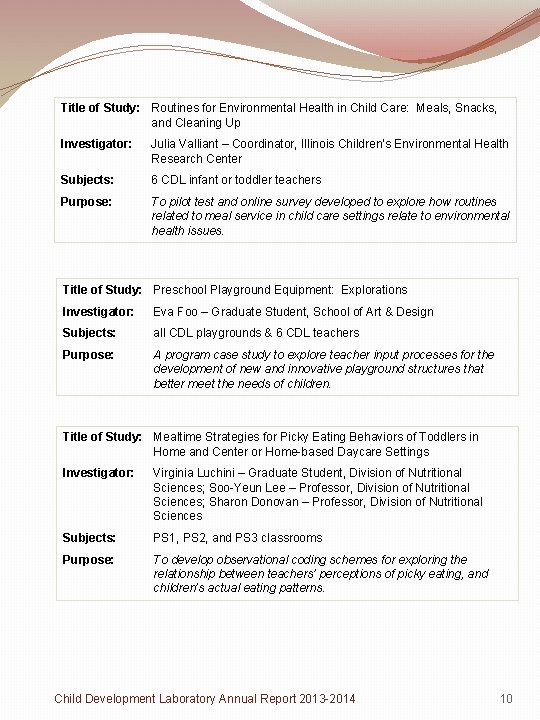
Title of Study: Routines for Environmental Health in Child Care: Meals, Snacks, and Cleaning Up Investigator: Julia Valliant – Coordinator, Illinois Children’s Environmental Health Research Center Subjects: 6 CDL infant or toddler teachers Purpose: To pilot test and online survey developed to explore how routines related to meal service in child care settings relate to environmental health issues. Title of Study: Preschool Playground Equipment: Explorations Investigator: Eva Foo – Graduate Student, School of Art & Design Subjects: all CDL playgrounds & 6 CDL teachers Purpose: A program case study to explore teacher input processes for the development of new and innovative playground structures that better meet the needs of children. Title of Study: Mealtime Strategies for Picky Eating Behaviors of Toddlers in Home and Center or Home-based Daycare Settings Investigator: Virginia Luchini – Graduate Student, Division of Nutritional Sciences; Soo-Yeun Lee – Professor, Division of Nutritional Sciences; Sharon Donovan – Professor, Division of Nutritional Sciences Subjects: PS 1, PS 2, and PS 3 classrooms Purpose: To develop observational coding schemes for exploring the relationship between teachers’ perceptions of picky eating, and children’s actual eating patterns. Child Development Laboratory Annual Report 2013 -2014 10
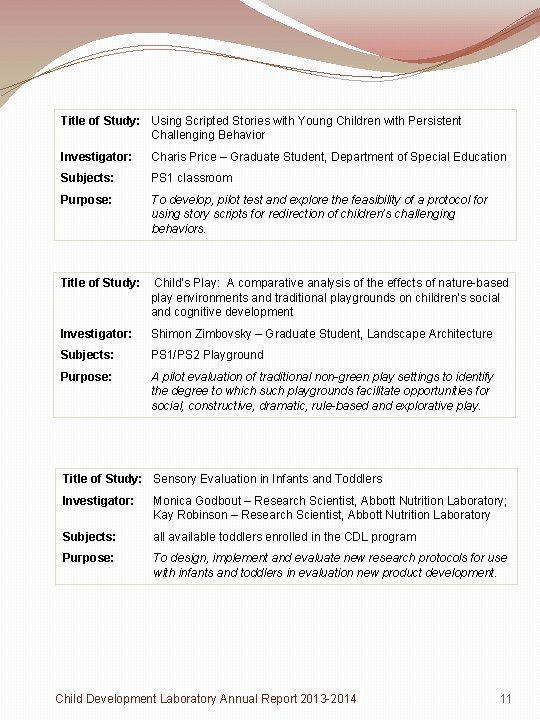
Title of Study: Using Scripted Stories with Young Children with Persistent Challenging Behavior Investigator: Charis Price – Graduate Student, Department of Special Education Subjects: PS 1 classroom Purpose: To develop, pilot test and explore the feasibility of a protocol for using story scripts for redirection of children’s challenging behaviors. Title of Study: Child’s Play: A comparative analysis of the effects of nature-based play environments and traditional playgrounds on children’s social and cognitive development Investigator: Shimon Zimbovsky – Graduate Student, Landscape Architecture Subjects: PS 1/PS 2 Playground Purpose: A pilot evaluation of traditional non-green play settings to identify the degree to which such playgrounds facilitate opportunities for social, constructive, dramatic, rule-based and explorative play. Title of Study: Sensory Evaluation in Infants and Toddlers Investigator: Monica Godbout – Research Scientist, Abbott Nutrition Laboratory; Kay Robinson – Research Scientist, Abbott Nutrition Laboratory Subjects: all available toddlers enrolled in the CDL program Purpose: To design, implement and evaluate new research protocols for use with infants and toddlers in evaluation new product development. Child Development Laboratory Annual Report 2013 -2014 11
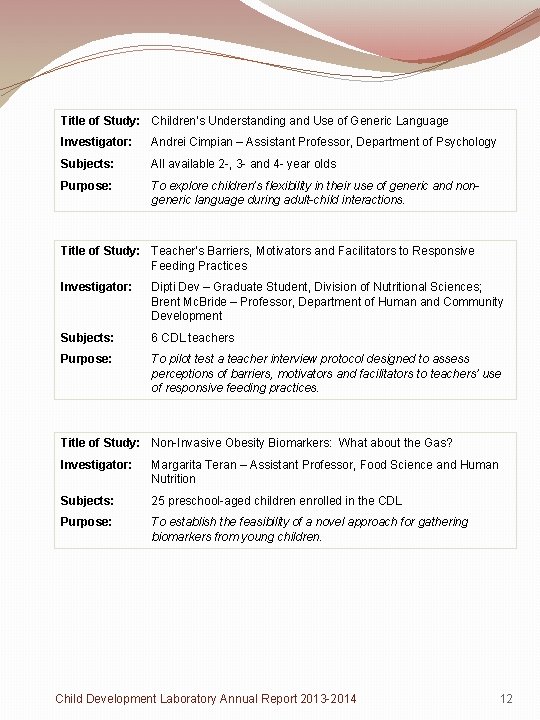
Title of Study: Children’s Understanding and Use of Generic Language Investigator: Andrei Cimpian – Assistant Professor, Department of Psychology Subjects: All available 2 -, 3 - and 4 - year olds Purpose: To explore children’s flexibility in their use of generic and nongeneric language during adult-child interactions. Title of Study: Teacher’s Barriers, Motivators and Facilitators to Responsive Feeding Practices Investigator: Dipti Dev – Graduate Student, Division of Nutritional Sciences; Brent Mc. Bride – Professor, Department of Human and Community Development Subjects: 6 CDL teachers Purpose: To pilot test a teacher interview protocol designed to assess perceptions of barriers, motivators and facilitators to teachers’ use of responsive feeding practices. Title of Study: Non-Invasive Obesity Biomarkers: What about the Gas? Investigator: Margarita Teran – Assistant Professor, Food Science and Human Nutrition Subjects: 25 preschool-aged children enrolled in the CDL Purpose: To establish the feasibility of a novel approach for gathering biomarkers from young children. Child Development Laboratory Annual Report 2013 -2014 12
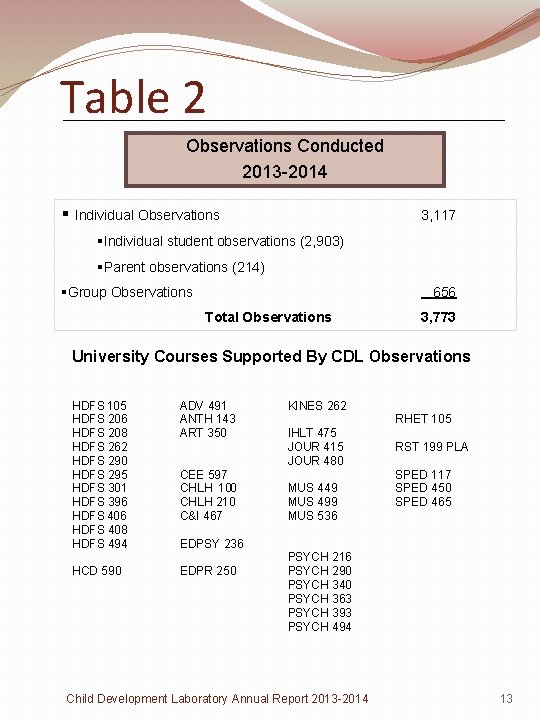
Table 2 Observations Conducted 2013 -2014 § Individual Observations 3, 117 §Individual student observations (2, 903) §Parent observations (214) §Group Observations 656 Total Observations 3, 773 University Courses Supported By CDL Observations HDFS 105 HDFS 206 HDFS 208 HDFS 262 HDFS 290 HDFS 295 HDFS 301 HDFS 396 HDFS 408 HDFS 494 ADV 491 ANTH 143 ART 350 HCD 590 EDPR 250 CEE 597 CHLH 100 CHLH 210 C&I 467 KINES 262 RHET 105 IHLT 475 JOUR 415 JOUR 480 MUS 449 MUS 499 MUS 536 RST 199 PLA SPED 117 SPED 450 SPED 465 EDPSY 236 PSYCH 216 PSYCH 290 PSYCH 340 PSYCH 363 PSYCH 393 PSYCH 494 Child Development Laboratory Annual Report 2013 -2014 13
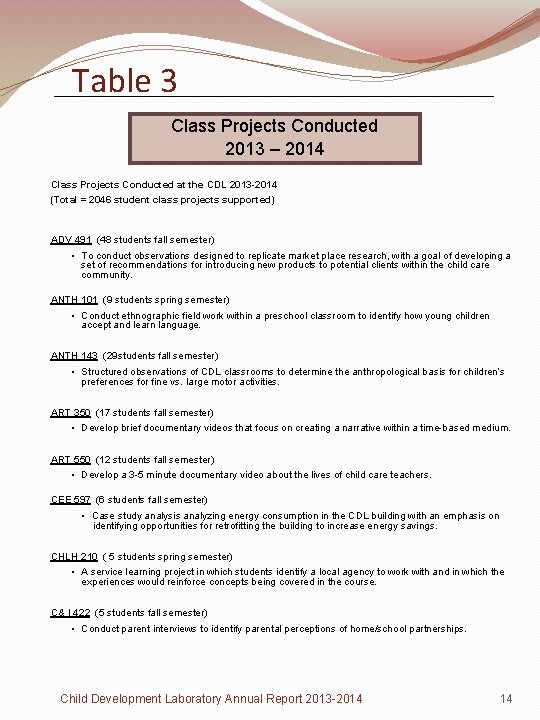
Table 3 Class Projects Conducted 2013 – 2014 Class Projects Conducted at the CDL 2013 -2014 (Total = 2046 student class projects supported) ADV 491 (48 students fall semester) • To conduct observations designed to replicate market place research, with a goal of developing a set of recommendations for introducing new products to potential clients within the child care community. ANTH 101 (9 students spring semester) • Conduct ethnographic field work within a preschool classroom to identify how young children accept and learn language. ANTH 143 (29 students fall semester) • Structured observations of CDL classrooms to determine the anthropological basis for children’s preferences for fine vs. large motor activities. ART 350 (17 students fall semester) • Develop brief documentary videos that focus on creating a narrative within a time-based medium. ART 550 (12 students fall semester) • Develop a 3 -5 minute documentary video about the lives of child care teachers. CEE 597 (6 students fall semester) • Case study analysis analyzing energy consumption in the CDL building with an emphasis on identifying opportunities for retrofitting the building to increase energy savings. CHLH 210 ( 5 students spring semester) • A service learning project in which students identify a local agency to work with and in which the experiences would reinforce concepts being covered in the course. C& I 422 (5 students fall semester) • Conduct parent interviews to identify parental perceptions of home/school partnerships. Child Development Laboratory Annual Report 2013 -2014 14
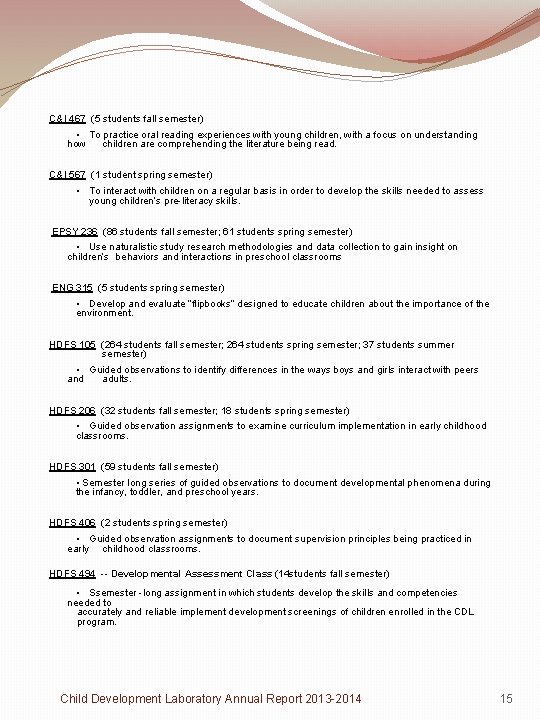
C&I 467 (5 students fall semester) • To practice oral reading experiences with young children, with a focus on understanding how children are comprehending the literature being read. C&I 567 (1 student spring semester) • To interact with children on a regular basis in order to develop the skills needed to assess young children’s pre-literacy skills. EPSY 236 (86 students fall semester; 61 students spring semester) • Use naturalistic study research methodologies and data collection to gain insight on children’s behaviors and interactions in preschool classrooms ENG 315 (5 students spring semester) • Develop and evaluate “flipbooks” designed to educate children about the importance of the environment. HDFS 105 (264 students fall semester; 264 students spring semester; 37 students summer semester) • Guided observations to identify differences in the ways boys and girls interact with peers and adults. HDFS 206 (32 students fall semester; 18 students spring semester) • Guided observation assignments to examine curriculum implementation in early childhood classrooms. HDFS 301 (59 students fall semester) • Semester long series of guided observations to document developmental phenomena during the infancy, toddler, and preschool years. HDFS 406 (2 students spring semester) • Guided observation assignments to document supervision principles being practiced in early childhood classrooms. HDFS 494 -- Developmental Assessment Class (14 students fall semester) • Ssemester -long assignment in which students develop the skills and competencies needed to accurately and reliable implement development screenings of children enrolled in the CDL program. Child Development Laboratory Annual Report 2013 -2014 15
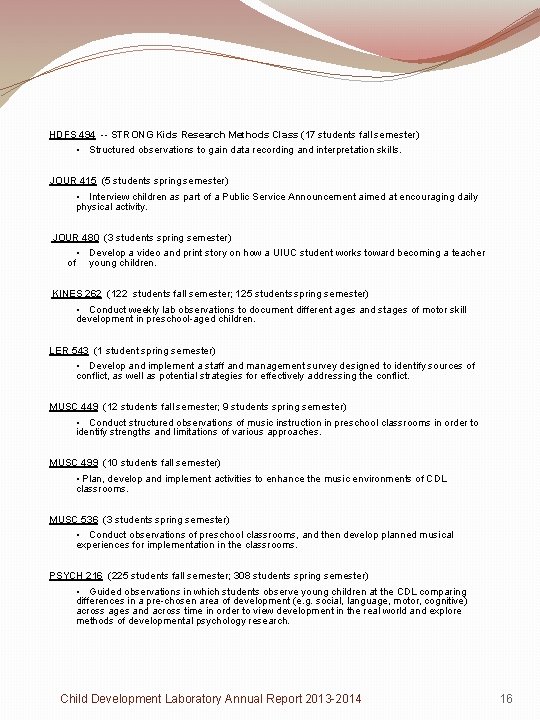
HDFS 494 -- STRONG Kids Research Methods Class (17 students fall semester) • Structured observations to gain data recording and interpretation skills. JOUR 415 (5 students spring semester) • Interview children as part of a Public Service Announcement aimed at encouraging daily physical activity. JOUR 480 (3 students spring semester) of • Develop a video and print story on how a UIUC student works toward becoming a teacher young children. KINES 262 (122 students fall semester; 125 students spring semester) • Conduct weekly lab observations to document different ages and stages of motor skill development in preschool-aged children. LER 543 (1 student spring semester) • Develop and implement a staff and management survey designed to identify sources of conflict, as well as potential strategies for effectively addressing the conflict. MUSC 449 (12 students fall semester; 9 students spring semester) • Conduct structured observations of music instruction in preschool classrooms in order to identify strengths and limitations of various approaches. MUSC 499 (10 students fall semester) • Plan, develop and implement activities to enhance the music environments of CDL classrooms. MUSC 536 (3 students spring semester) • Conduct observations of preschool classrooms, and then develop planned musical experiences for implementation in the classrooms. PSYCH 216 (225 students fall semester; 308 students spring semester) • Guided observations in which students observe young children at the CDL comparing differences in a pre-chosen area of development (e. g. social, language, motor, cognitive) across ages and across time in order to view development in the real world and explore methods of developmental psychology research. Child Development Laboratory Annual Report 2013 -2014 16
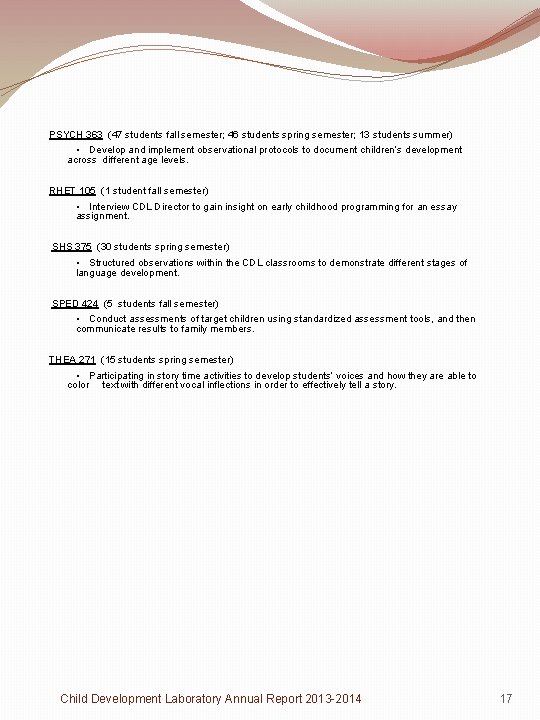
PSYCH 363 (47 students fall semester; 46 students spring semester; 13 students summer) • Develop and implement observational protocols to document children’s development across different age levels. RHET 105 (1 student fall semester) • Interview CDL Director to gain insight on early childhood programming for an essay assignment. SHS 375 (30 students spring semester) • Structured observations within the CDL classrooms to demonstrate different stages of language development. SPED 424 (5 students fall semester) • Conduct assessments of target children using standardized assessment tools, and then communicate results to family members. THEA 271 (15 students spring semester) • Participating in story time activities to develop students’ voices and how they are able to color text with different vocal inflections in order to effectively tell a story. Child Development Laboratory Annual Report 2013 -2014 17
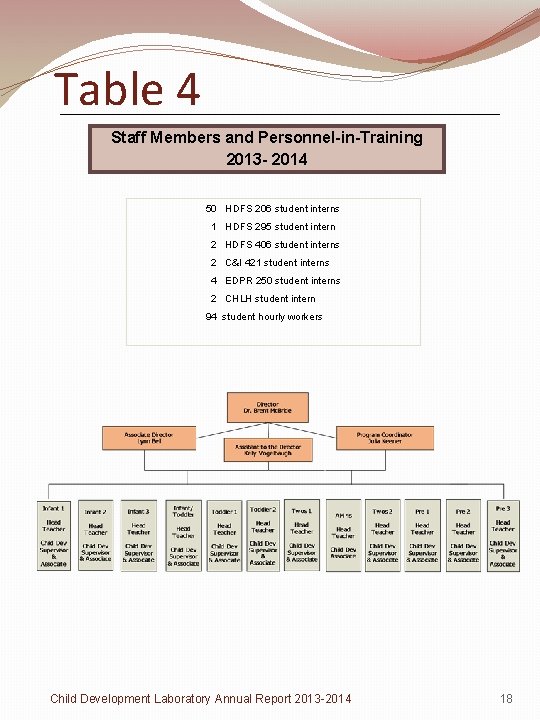
Table 4 Staff Members and Personnel-in-Training 2013 - 2014 50 HDFS 206 student interns 1 HDFS 295 student intern 2 HDFS 406 student interns 2 C&I 421 student interns 4 EDPR 250 student interns 2 CHLH student intern 94 student hourly workers Child Development Laboratory Annual Report 2013 -2014 18
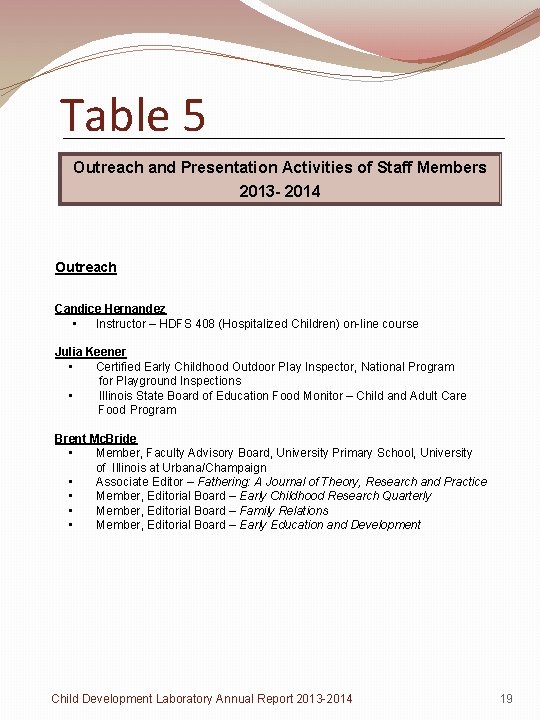
Table 5 Outreach and Presentation Activities of Staff Members 2013 - 2014 Outreach Candice Hernandez • Instructor – HDFS 408 (Hospitalized Children) on-line course Julia Keener • Certified Early Childhood Outdoor Play Inspector, National Program for Playground Inspections • Illinois State Board of Education Food Monitor – Child and Adult Care Food Program Brent Mc. Bride • Member, Faculty Advisory Board, University Primary School, University of Illinois at Urbana/Champaign • Associate Editor – Fathering: A Journal of Theory, Research and Practice • Member, Editorial Board – Early Childhood Research Quarterly • Member, Editorial Board – Family Relations • Member, Editorial Board – Early Education and Development Child Development Laboratory Annual Report 2013 -2014 19
Presentations Mc. Bride, B. A. (2014, April). Data and infrastructure: Critical Components for the creation of a laboratory school consortium. Paper presented at the American Educational Research Association Annual Meeting, Philadelphia, PA. Mc. Bride, B. A. , Laxman, D. J. Curtiss, S. , Santos, R. M. , Dyer, W. J. , Kern, J. , & Jeans, L. (2014, February). Identifying the training needs of early intervention personnel: Family focused programming includes fathers. Poster presented at the Conference on Research Innovations in Early Intervention, San Diego, CA. Mc. Bride, B. A. , Laxman, D. J. , Santos, R. M. , Dyer, W. J. , Jeans, L. M. , Sugimuria, N. , & Weglarz-Ward, J. (2014, April). Father involvement and the school readiness of children with disabilities. Paper presented at the American Educational Research Association Annual Meeting, Philadelphia, PA. Mc. Bride, B. A. (2013, September). Measuring father involvement. Invited talk given as part of the Paternal Involvement In Pregnancy Outcomes: From Preconception to the First Year of Life workshop co-sponsored by the National Institute of Child Health and Human Development/NIH, and the Maternal and Child Health Bureau/HRSA, Washington, DC. Donovan, S. M. , Pacey, M. , Bost, K. K. , Liechty, J. , & Mc. Bride, B. A. (2013, August). Assessing benefits and barriers to transdisciplinary training in the Illinois Transdisciplinary Obesity Prevention Program (I-TOPP). Poster presented at the Society for Nutrition Education and Behavior Annual Meeting, Portland, OR. Mc. Bride, B. A. , Laxman, D. J. , Dyer, W. J. , Kern, J. L. , Santos, R. M. , & Jeans, L. M. (2013, April). Disability status versus functional abilities in predicting child outcomes. Paper presented at the American Educational Research Association Annual Meeting, , San Francisco, CA. Mc. Bride, B. A. , Laxman, D. J. , Dyer, W. J. , Santos, R. M. , Jeans, L. , Corr, C. (2013, April). Father involvement and maternal depressive symptoms in families of children with disabilities. Poster presented at the Biennial Meeting of the Society for Research in Child Development, Seattle, WA. Kern, J. , Mc. Bride, B. A, , Laxman, D. J. , Dyer, W. J. , Santos, R. M. , Sugumura, S. , & Jeans, L. (2013, April). Testing measurement invariance of functional factors of father involvement in families of children with disabilities. Poster presented at the Biennial Meeting of the Society for Research in Child Development, Seattle, WA. Bost, K. K. , Wiler, A. R. , fiese, B. H. , Hammons, A. J. , & Mc. Bride, B. A. (2013, April). Caregiver attachment and children’s food consumption: Emotion regulation and family routines as mediators. Paper presented at the Biennial Meeting of the Society for Research in Child Development, Seattle, WA. Child Development Laboratory Annual Report 2013 -2014 20
Presentations (cont. ) Mc. Bride, B. A. , & Dev, D. (2013, April). Head Start and child care teachers’ perceived facilitators and Barriers to childhood obesity prevention: Implications for policy. Poster presented at the Biennial Meeting of the Society for Research in Child Development, Seattle, WA. Dev, D. , & Mc. Bride, B. A. (2013, April). Predictors of Head Start and Childcare teachers’ mealtime feeding practices: An ecological approach. Poster presented at the Biennial Meeting of the Society for Research in Child Development, Seattle, WA. Publications (*designates refereed journal) * Mc. Bride, B. A. , & Dev, D. A. , (in press). Preventing childhood obesity: Feeding strategies to help preschoolers develop healthy eating habits. Young Children. * Dev, D. A. , Speirs, K. E. , Mc. Bride, B. A. , Donovan, S. M. , & Chapman-Novakofski, K. (in press). Head Start and child care providers’ motivators, barriers and facilitators to practicing family-style meal service. Early Childhood Research Quarterly. * Dev, D. A. , Mc. Bride, B. A. , Speirs, K. E. , Donovan, S. M. , & Cho, H. (in press). Predictors of Head Start and child care providers’ healthful and controlling feeding practices with 2 - to 5 -year old children. Journal of the Academy of Nutrition and Dietetics. * Laxman, D. J. , Mc. Bride, B. A. , Jeans, L. M. , Dyer, W. J. , Santos, R. M. , Kern, J. , Sugimura, N. , & Curtiss, S. L. (in press). Father involvement and maternal depressive symptoms in families of children with disabilities. Maternal and Child Health Journal. * Jeans, L. M. , Santos, R. M. , Laxman, D. J. , Mc. Bride, B. A. , & Dyer, W. J. (in press). Early predictors of ASD in young children using a nationally representative dataset. Journal of Early Intervention. * Bost, K. K. , Wiley, A. R. , Fiese, B. , Hammons, A. , Mc. Bride, B. A. , & STRONG Kids Research Team. (2014). Associations between adult attachment style, emotion regulation, and preschool children’s food consumption. Journal of Developmental and Behavioral Pediatrics, 35, 50 -61. * Dev, D. A, Mc. Bride, B. A. , Fiese, B. H. , Jones, B. L. , Cho. H. , & STRONG Kids Research Team. (2013). Risk factors for Overweight/Obesity in Pre-school Children. Childhood Obesity, 9, 399 - 404. * Dev, D. A. , Mc. Bride, B. A. , & STRONG Kids Research Team. (2013). Academy of Nutrition and Dietetics Benchmarks for Nutrition in Childcare (2011): Are childcare providers across contexts meeting recommendations? Journal of the Academy of Nutrition and Dietetics, 113, 1346 -1353. Child Development Laboratory Annual Report 2013 -2014 21
Publications (cont. ) (*designates refereed journal) * Fiese, B. H. , Bost, K. K. , Mc. Bride, B. A. , & Donovan, S. M. (2013). Childhood obesity prevention from cell to society. Trends in Endocrinology and Metabolism 24, 375 -376. * Jeans, L. M. , Santos, R. M. , Laxman, D. J. , Mc. Bride, B. A. , & Dyer, W. J. (2013). Examining ECLS-B: Maternal stress and depressive symptoms when raising children with ASD. Topics in Early Childhood Special Education, 33, 162 -171. * Mc. Bride, B. A. , Dyer, W. J. , & Laxman, D. J. (2013). Father involvement and student achievement: Variations based on ecological contexts. Early Child Development and Care, 183, 810 -826. Grants The Child Development Laboratory Program: Providing Child Care Access for Low-Income Undergraduate Student parents. A four year project designed to provide access to the CDL program services for university students who are parents of young children, sponsored by the U. S. Department of Education, 2009 -2013, $329, 964 (Mc. Bride – PI). Men’s Parenting Behaviors in Families of Children with Disabilities: Findings from the ECLS-B A two year study to explore the roles played by fathers in families of children with disabilities sponsored by the Institute of Education Sciences at the U. S. Department of Education, 2012 – 2014, $357, 513 (Mc. Bride – PI). STRONG Kids 2: A Cell-to-Society Approach to Nutrition in Early Childhood. A five-year prospective cohort study aimed at establishing intake patterns of milk and other dairy products that best promote growth and development, as well as prevention of childhood obesity. Dairy Research Institute, 2012 -2017, $1, 068, 758 (B. Fiese – PI). TOPP-U: Transdisciplinary Obesity Prevention Program. (co-Investigator). A two-year project to develop, implement and evaluate an integrated transdisciplinary curriculum for undergraduate students that focuses on the causes and consequences of childhood obesity, with an emphasis on blending the curriculum into existing research methods courses at universities across the country. NIFA/U. S. Department of Agriculture, $746, 928 (B. Fiese – PI), 2013 -2015. The Illinois Transdisciplinary Obesity Prevention Program – I-TOPP A five year training grant designed to establish a new transdisciplinary, research-based Ph. D/MPH degree program that focuses on developing a cohort of obesity research scholars, sponsored by the National Institute of Food and Agriculture, U. S. Department of Agriculture, 2011 – 2015, $4, 500, 000 (S. Donovan - Project Director). The Role of Head Start and Child Care Classrooms in Early Childhood Obesity: A Cumulative Risk Model A two year training grant and study designed to identify potential determinants of obesity during the early childhood years, sponsored by Office of Program Research and Evaluation/Administration for Children and Families via the Early Care and Education Research Scholars: Head Start Graduate Student Research Grants program, 2011 – 2013, $47, 203 (Mc. Bride - PI). Child Development Laboratory Annual Report 2013 -2014 22
Our Philosophy 1. Respect – We believe everything we do should be done with respect for the individual, their history and culture. 2. Relationships – We believe relationships are the foundation of and the context for all learning and development. These relationships build community at the individual, classroom, school, university and wider community levels. 3. Whole Person – We value the uniqueness of each individual and what they bring to the learning process. 4. Competence - We believe in the competence and potential of all learners. 5. Learning & Development – We believe learning and development happen over the span of a lifetime through choices, play, exploration, experimentation and reflection. Child Development Laboratory Annual Report 2013 -2014 23
- Slides: 24