
Child Development 3e by Robert Feldman Chapter 9
Child Development, 3/e by Robert Feldman Chapter 9 Cognitive Development in the Preschool Years Created by Barbara H. Bratsch Feldman Child Development, 3/e © 2004 Prentice Hall
• How does Piaget interpret cognitive development in the preschool years? • How do information processing approaches and Vygotsky’s theory explain cognitive development? • How do children’s linguistic abilities develop in the preschool years, and what is the importance of early linguistic development? • What kinds of preschool educational programs are available in the United States, and what effects do they have? • What effect does television have on preschoolers? Feldman Child Development, 3/e © 2004 Prentice Hall
Piaget and Preoperational Thinking • Preoperational stage – according to Piaget, the stage that lasts from 2 to 7 during which children’s use of symbolic thinking grows, mental reasoning emerges, and the use of concepts increases • Operations are organized, formal, logical mental processes • Symbolic function – according to Piaget, the ability to use a mental symbol, a word or an object to represent something that is not physically present • Centration – the process of concentrating on one limited aspect of a stimulus and ignoring other aspects Feldman Child Development, 3/e © 2004 Prentice Hall
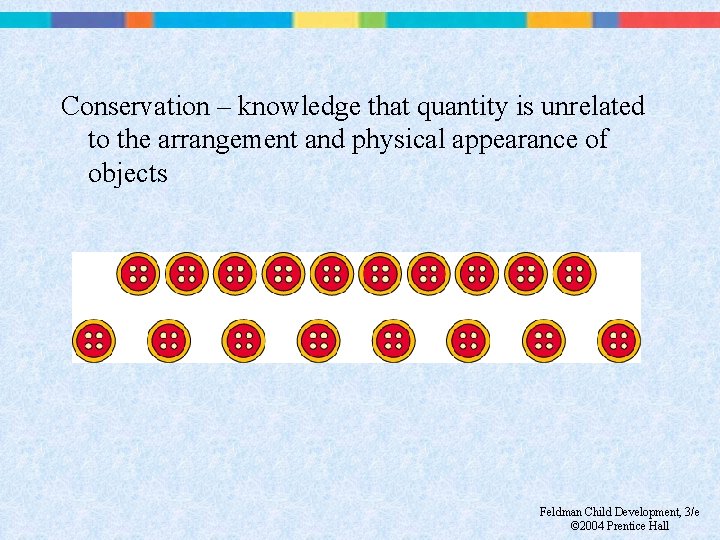
Conservation – knowledge that quantity is unrelated to the arrangement and physical appearance of objects Feldman Child Development, 3/e © 2004 Prentice Hall
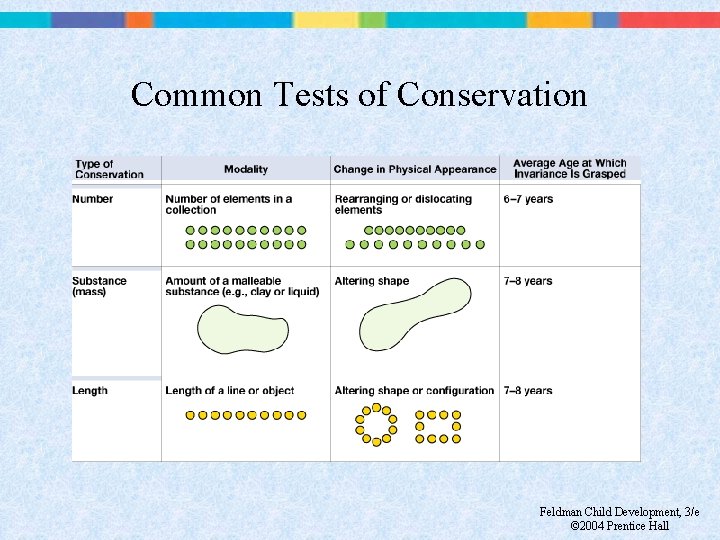
Common Tests of Conservation Feldman Child Development, 3/e © 2004 Prentice Hall
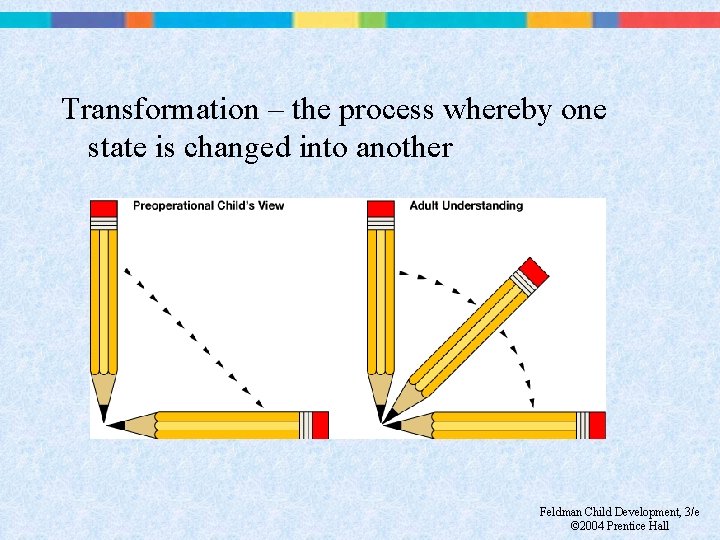
Transformation – the process whereby one state is changed into another Feldman Child Development, 3/e © 2004 Prentice Hall
• Egocentric thought – thinking that does not take the viewpoints of others into account • Intuitive thought – thinking that reflects preschoolers’ use of primitive reasoning and their avid acquisition of knowledge about the world Feldman Child Development, 3/e © 2004 Prentice Hall
Preschool Memory • Autobiographical memory is memory of particular events from one’s own life • Scripts are broad representations in memory of events and the order in which they occur. Preschoolers may remember being in a restaurant, talking to a waitress, getting food and eating. These scripts become more detailed as children get older. Feldman Child Development, 3/e © 2004 Prentice Hall
Vygotsky’s View on Preschool Cognitive Development Lev Vygotsky proposed that the focus on cognitive development should be on a child’s social and cultural world, as opposed to the Piagetian approach, which concentrates on individual performance Feldman Child Development, 3/e © 2004 Prentice Hall
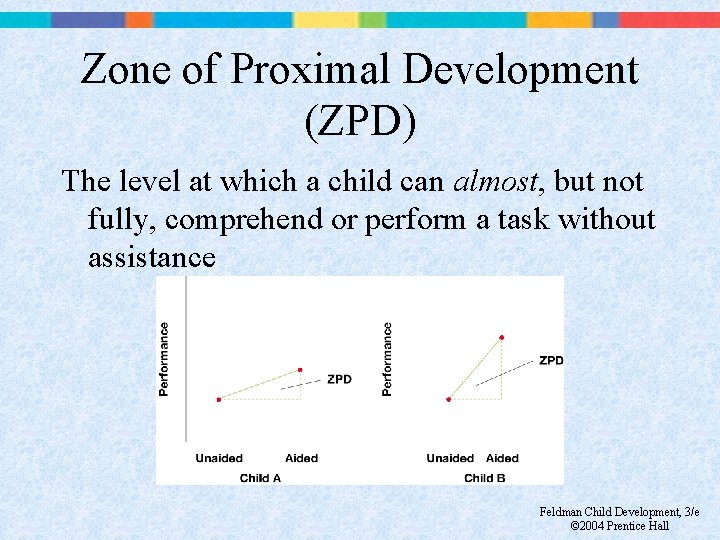
Zone of Proximal Development (ZPD) The level at which a child can almost, but not fully, comprehend or perform a task without assistance Feldman Child Development, 3/e © 2004 Prentice Hall
Language Acquisition in the Preschool Years • Syntax – the combining of words and phrases to form meaningful sentences • Fast mapping – the process in which new words are associated with their meaning after only a brief encounter • Grammar – the system of rules that determine how thoughts can be expressed • Private Speech – spoken language that is not intended for others and is commonly used by children during the preschool years Feldman Child Development, 3/e © 2004 Prentice Hall
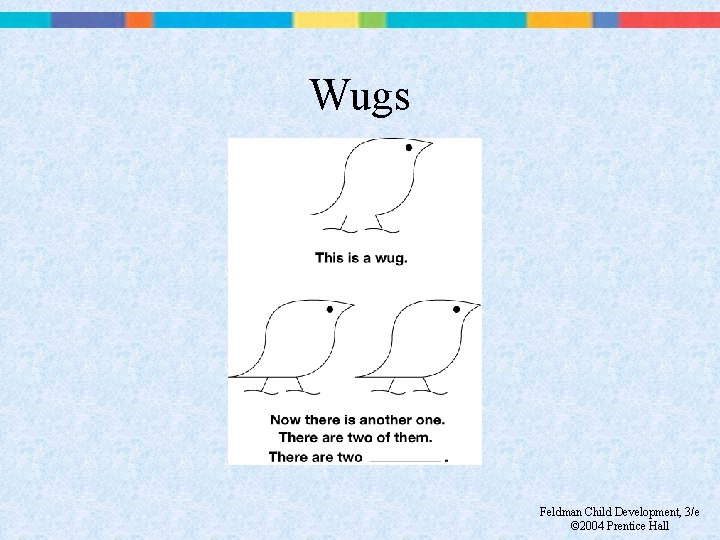
Wugs Feldman Child Development, 3/e © 2004 Prentice Hall
• Pragmatics is the aspect of language relating to communicating effectively and appropriately with others • Social speech refers to speech directed toward another person and meant to be understood by that one person Feldman Child Development, 3/e © 2004 Prentice Hall
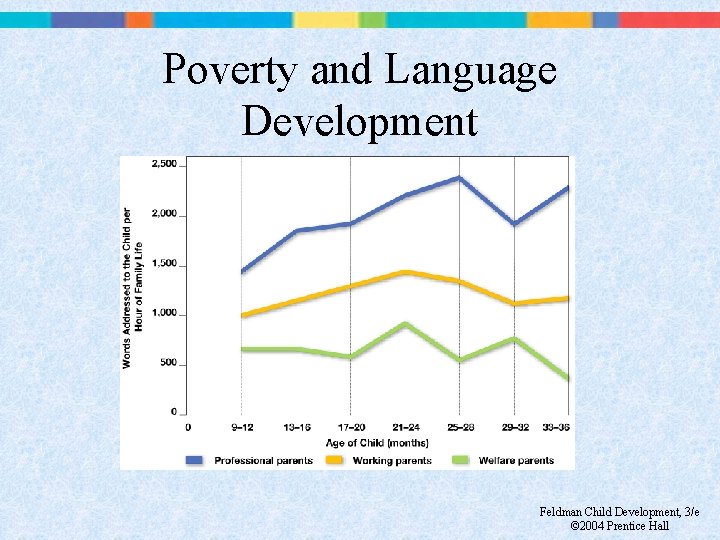
Poverty and Language Development Feldman Child Development, 3/e © 2004 Prentice Hall
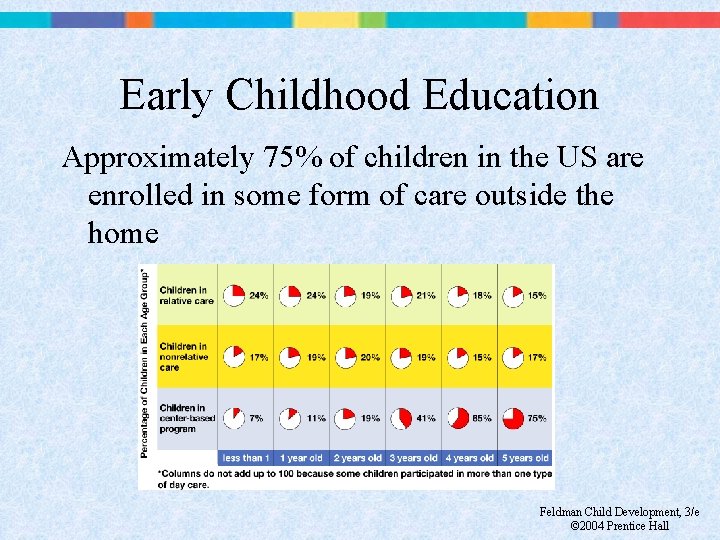
Early Childhood Education Approximately 75% of children in the US are enrolled in some form of care outside the home Feldman Child Development, 3/e © 2004 Prentice Hall
• Child care centers are places that provide care for children while their parents are at work • Preschool (nursery school) is a child facility designed to provide intellectual and social experiences for youngsters • School child care is a child care facility provided by some local school systems in the U. S. Feldman Child Development, 3/e © 2004 Prentice Hall
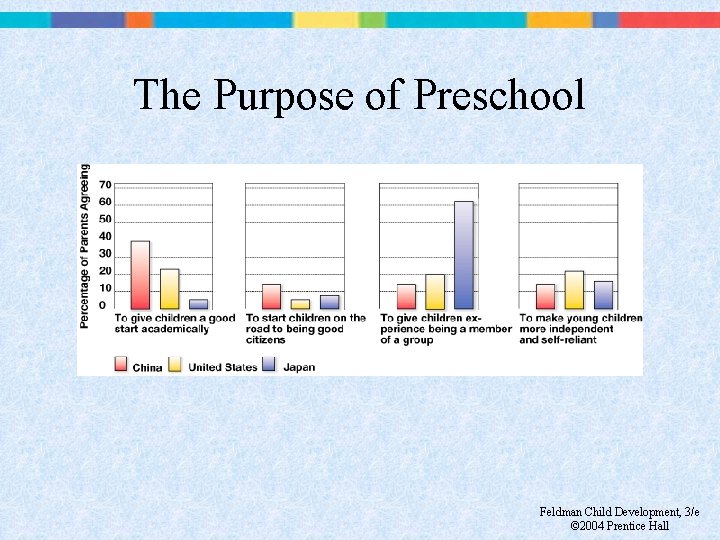
The Purpose of Preschool Feldman Child Development, 3/e © 2004 Prentice Hall
Developmentally Appropriate Educational Practice: education based on both typical development and the unique characteristics of a given child Feldman Child Development, 3/e © 2004 Prentice Hall
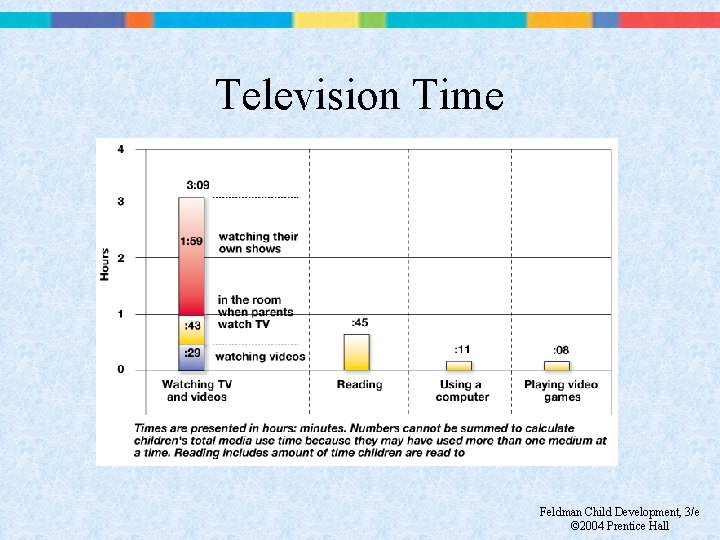
Television Time Feldman Child Development, 3/e © 2004 Prentice Hall
- Slides: 19