
Child Development 3e by Robert Feldman Chapter 2
Child Development, 3/e by Robert Feldman Chapter 2 Theoretical Perspectives and Research: Asking and Answering Questions on Children’s Development Created by Barbara H. Bratsch Feldman Child Development, 3/e © 2004 Prentice Hall
• What are the major perspectives on child development? • What is the scientific method, and how does it help answer questions about child development? • What are the major research strategies and challenges? Feldman Child Development, 3/e © 2004 Prentice Hall
What are Theories? ? Theories are explanations and predictions concerning phenomena of interest, providing a framework for understanding the relationships among an organized set of facts or principles Feldman Child Development, 3/e © 2004 Prentice Hall

Major Perspectives on Child Development • • • Psychodynamic Behavioral Cognitive Contextual Evolutionary Feldman Child Development, 3/e © 2004 Prentice Hall

Psychodynamic Perspective Frued’s (1856 -1939) psychoanalytic theory suggests that unconscious forces act to determine personality and behavior Psychosexual development – a series of stages that children pass through in which pleasure, or gratification, is focused on a particular biological function and body part Fixation – behavior reflecting an earlier stage of development Feldman Child Development, 3/e © 2004 Prentice Hall
Three aspects of personality according to Freud: • Id: raw, unorganized, inborn part of personality present at birth • Ego: rational and reasonable part of personality • Superego: the aspect of personality that represents a person’s conscious, incorporating distinctions between right and wrong Feldman Child Development, 3/e © 2004 Prentice Hall
Psychosocial Theory • Erikson’s (1902 -1994) psychosocial development encompasses changes in our interactions with and understandings of one another, as well as in our knowledge and understanding of ourselves as members of society • Erikson suggested that growth and change continue throughout the life span Feldman Child Development, 3/e © 2004 Prentice Hall

Behavioral Perspective Behavioral perspective suggests that keys to understanding development are observable behavior and outside stimuli in the environment. If we know stimuli, we can predict behavior Feldman Child Development, 3/e © 2004 Prentice Hall
Classical Conditioning John B Watson (1878 -1958) was one of the first American psychologists to advocate a behavioral perspective Classical conditioning – an organism learns to respond in a particular way to a neutral stimulus that normally does not bring about that type of response Feldman Child Development, 3/e © 2004 Prentice Hall
Operant Conditioning Operant conditioning is a form of learning in which a voluntary response is strengthened or weakened by its association with positive or negative consequences B. F. Skinner (1904 -1990) believed that individuals learn to act deliberately on their environments to bring about a desired state of affairs Feldman Child Development, 3/e © 2004 Prentice Hall
Reinforcement a stimulus is provided that increases the probability that a preceding behavior will be repeated Punishment the introduction of an unpleasant or painful stimulus or the removal of a desirable stimulus, will decrease the probability that a preceding behavior will occur in the future Behavior Modification a formal technique for promoting the frequency of desirable behaviors and decreasing the incidence of unwanted ones Feldman Child Development, 3/e © 2004 Prentice Hall
Social-Cognitive Learning Theory Albert Bandura developed an approach to the study of development that emphasizes learning by observing the behavior of another person, called a model. Bandura named this social-cognitive learning theory Feldman Child Development, 3/e © 2004 Prentice Hall
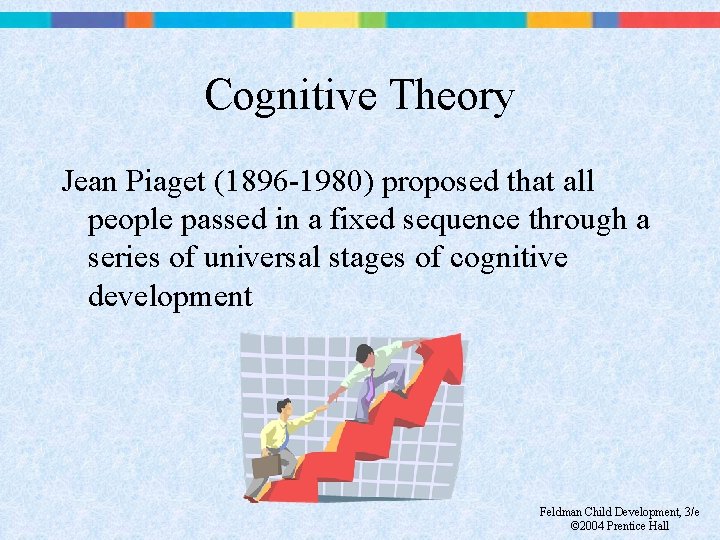
Cognitive Theory Jean Piaget (1896 -1980) proposed that all people passed in a fixed sequence through a series of universal stages of cognitive development Feldman Child Development, 3/e © 2004 Prentice Hall
Children’s adaptation to new information can be explained by two principles: Assimilation – the process in which people understand an experience in terms of their current stage of cognitive development and way of thinking Accommodation – the process that changes existing ways of thinking in response to encounters with new stimuli or events Feldman Child Development, 3/e © 2004 Prentice Hall
Information processing approaches deals with how individuals take in, process and store information – similar to a computer. This approach assumes that even complex behavior such as learning, remembering, categorizing, and thinking can be broken down into a series of individual, specific steps. Feldman Child Development, 3/e © 2004 Prentice Hall
Cognitive Neuroscience Approaches focus on how brain processes are related to cognitive activity Feldman Child Development, 3/e © 2004 Prentice Hall

Contextual Perspective considers the relationship between individuals and their physical, cognitive, personality and social worlds. A child’s unique development cannot be viewed without seeing the child in social and cultural context Two theories fall into this category: Bronfenbrenner’s bioecological approach Vygotsky’s sociocultural theory Feldman Child Development, 3/e © 2004 Prentice Hall
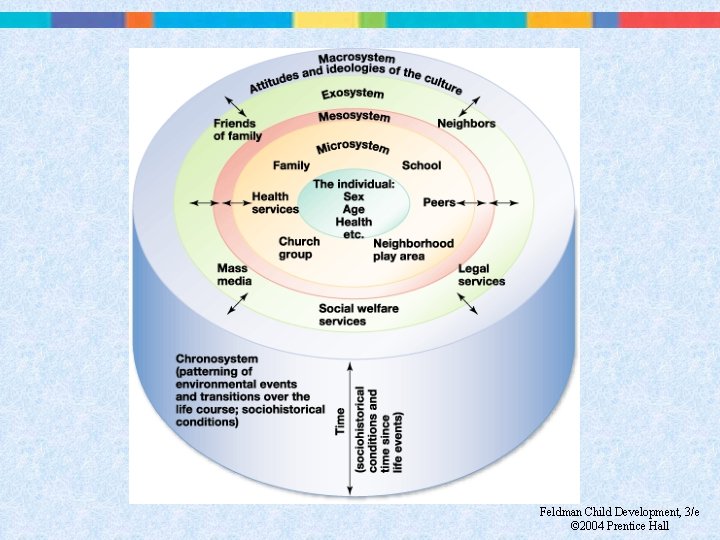
Urie Brofenbrenner suggested 5 environmental levels that influence every biological organism: • Microsystem – everyday environment eg. • • homes, friends, caregivers Mesosystem – connections between aspects of the microsystem eg. child to parent Exosystem – encompasses social institutions eg. government, community, schools Macrosystem – larger cultural influences eg. society in general, religious systems, political thought Chronosystem – underlies all other systems eg. historical events and changes Feldman Child Development, 3/e © 2004 Prentice Hall
Feldman Child Development, 3/e © 2004 Prentice Hall
Vygotsky’s sociocultural theory emphasizes how cognitive development proceeds as a result of social interactions among members of a culture Feldman Child Development, 3/e © 2004 Prentice Hall
Evolutionary Perspective • a theory that seeks to identify behavior that is the result of our genetic inheritance from our ancestors • 1859 Charles Darwin discusses natural selection in On the Origin of Species • Konrad Lorenz (1903 -1989) demonstrated the importance of biological determinants in influencing behavior patterns Feldman Child Development, 3/e © 2004 Prentice Hall
Scientific Method and Research Scientific method is the process of posing and answering questions using careful, controlled techniques that include systematic, orderly observation and the collection of data. Three steps 1) Identifying questions of interest – formulate a theory 2) Formulating an explanation – develop a hypothesis 3) Carrying out research – operationalize hypothesis, select a research method, collect and analyze data Feldman Child Development, 3/e © 2004 Prentice Hall
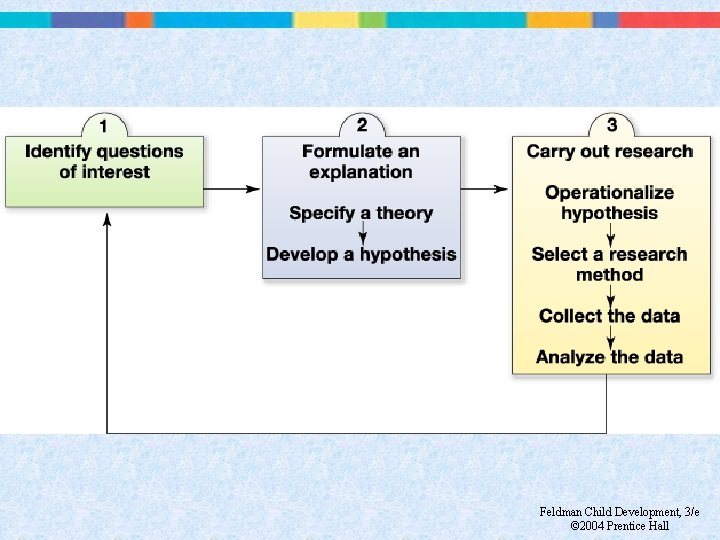
Feldman Child Development, 3/e © 2004 Prentice Hall
Two categories of research • Correlational research – looks for a relationship between two factors • Experimental research – looks for causal relationships between various factors Feldman Child Development, 3/e © 2004 Prentice Hall
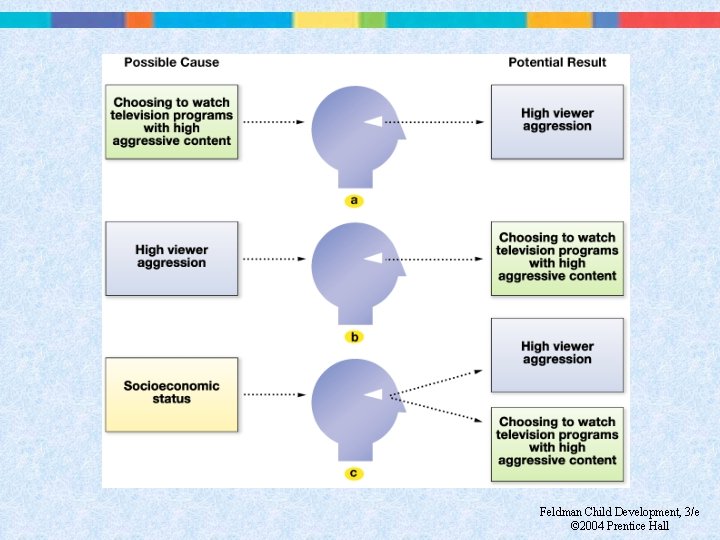
Feldman Child Development, 3/e © 2004 Prentice Hall

Correlational Studies Correlation coefficient ranges from +1 to – 1 Positive correlation = one factor increases, other factor increases Negative correlation = one factor increases, other factor decreases Zero correlation = no relationship exists Feldman Child Development, 3/e © 2004 Prentice Hall
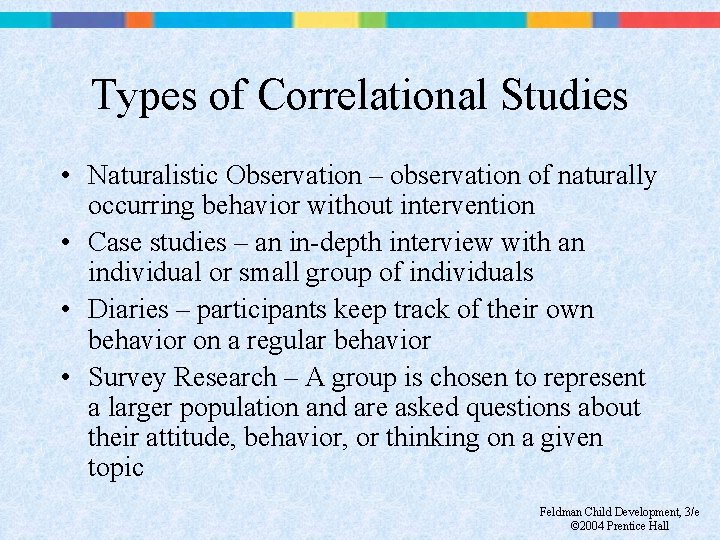
Types of Correlational Studies • Naturalistic Observation – observation of naturally occurring behavior without intervention • Case studies – an in-depth interview with an individual or small group of individuals • Diaries – participants keep track of their own behavior on a regular behavior • Survey Research – A group is chosen to represent a larger population and are asked questions about their attitude, behavior, or thinking on a given topic Feldman Child Development, 3/e © 2004 Prentice Hall
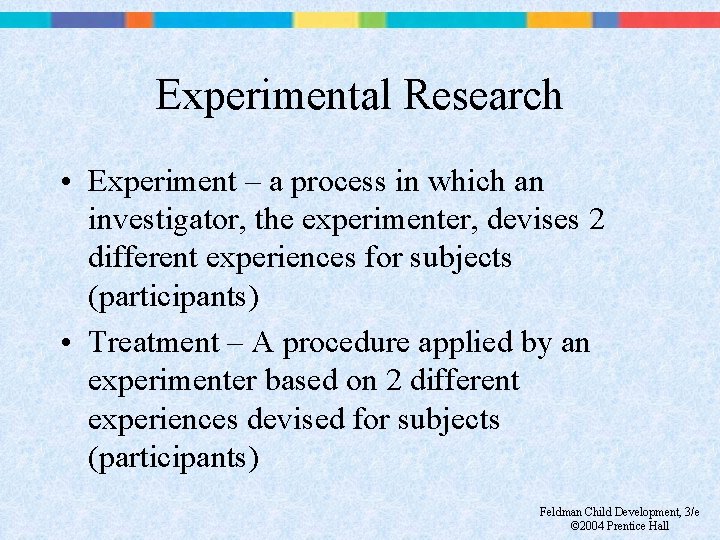
Experimental Research • Experiment – a process in which an investigator, the experimenter, devises 2 different experiences for subjects (participants) • Treatment – A procedure applied by an experimenter based on 2 different experiences devised for subjects (participants) Feldman Child Development, 3/e © 2004 Prentice Hall
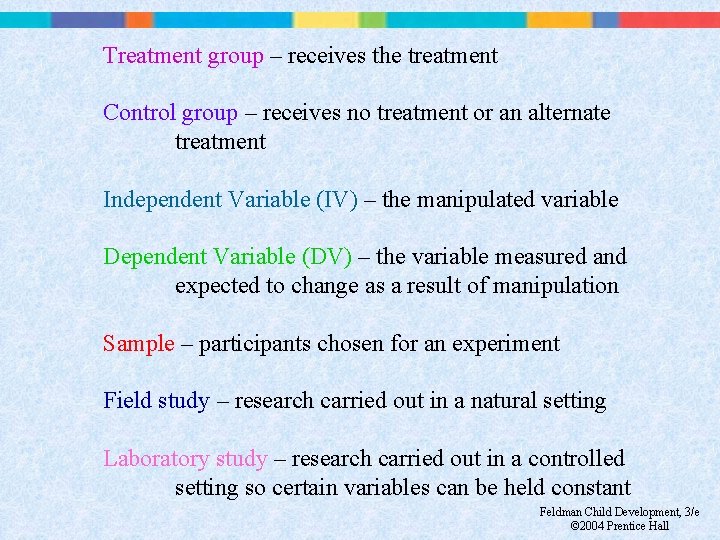
Treatment group – receives the treatment Control group – receives no treatment or an alternate treatment Independent Variable (IV) – the manipulated variable Dependent Variable (DV) – the variable measured and expected to change as a result of manipulation Sample – participants chosen for an experiment Field study – research carried out in a natural setting Laboratory study – research carried out in a controlled setting so certain variables can be held constant Feldman Child Development, 3/e © 2004 Prentice Hall
Two Approaches to Research • Theoretical Research – research designed to test developmental explanation and expand scientific knowledge • Applied Research – research meant to provide practical solutions to immediate problems Feldman Child Development, 3/e © 2004 Prentice Hall
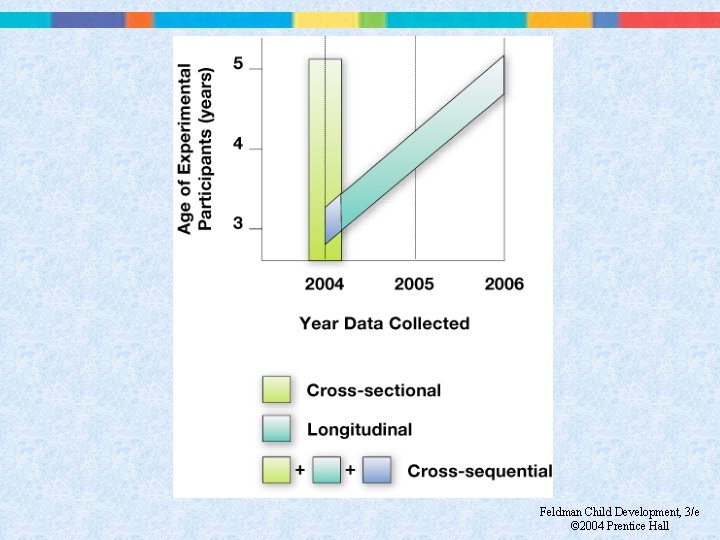
Three Strategies to Measure Developmental Change • Longitudinal Research – behavior of one or more individuals is measured as the subjects age • Cross-Sectional Research – people of different ages are compared at the same point in time • Cross – Sequential Studies – a number of different age groups are measured at several points in time Feldman Child Development, 3/e © 2004 Prentice Hall
Feldman Child Development, 3/e © 2004 Prentice Hall
Ethics and Research • Freedom from harm • Use of deception • Informed consent • Maintenance of privacy Feldman Child Development, 3/e © 2004 Prentice Hall
- Slides: 33