
Child Development 3e by Robert Feldman Chapter 10
Child Development, 3/e by Robert Feldman Chapter 10 Social and Personality Development in the Preschool Years Created by Barbara H. Bratsch Feldman Child Development, 3/e © 2004 Prentice Hall
• How do preschool-age children develop a concept of themselves? • How do children develop their sense of racial identity and gender? • In what sorts of social relationships do preschool-age children engage? • What sorts of disciplinary styles do parents employ, and what effects do they have? • How do children develop a moral sense? • How does aggression develop in preschool-age children? Feldman Child Development, 3/e © 2004 Prentice Hall
Erikson • Psychosocial development - according to Erikson, development that encompasses changes both in the understandings individuals have of themselves as members of society and in their comprehension of the meaning of others’ behavior • Initiative – vs – guilt stage – the period during which children aged 3 to 6 years experience conflict between independence of action and the sometimes negative results of that action Feldman Child Development, 3/e © 2004 Prentice Hall

Self-Concept in the Preschool Years • Self-Concept – a person’s identity or set of beliefs about what one is like as an individual • Collectivistic Orientation – a philosophy that promotes the notion of interdependence • Individualistic Orientation – a philosophy that emphasizes personal identity and the uniqueness of the individual Feldman Child Development, 3/e © 2004 Prentice Hall
Gender Identity • Gender Identity – the perception of oneself as male or female • Identification – the process in which children attempt to be similar to their parent of the same sex, incorporating the parent’s attitudes and values. • Gender Schema – a cognitive framework that organizes information relevant to gender • Gender Constancy – the fact that people are permanently males or females, depending on fixed, unchangeable biological factors • Androgynous – encompassing characteristics thought typical of both sexes Feldman Child Development, 3/e © 2004 Prentice Hall
Preschoolers’ Social Lives • Functional play – play that involves simple, repetitive activities typical of 3 -year-olds • Constructive play- play in which children manipulate objects to produce or build something • Parallel play – action in which children play with similar toys, in a similar manner, but do not interact with one another • Onlooker play – action in which children simply watch others at play but do not actually participate themselves • Associative play – play in which two or more children interact by sharing or borrowing toys or materials, although they do not do the same thing • Cooperative play – play in which children genuinely interact with one another, taking turns, playing games, or devising contests Feldman Child Development, 3/e © 2004 Prentice Hall

Preschoolers’ Social Lives Feldman Child Development, 3/e © 2004 Prentice Hall

Parental Discipline Styles • Authoritarian – parents who are controlling, punitive, rigid and cold and whose word is law; they value strict, unquestioning obedience from their children and do not tolerate expressions of disagreement • Permissive – parents who provide lax and inconsistent feedback and require little of their children • Authoritative parents – parents who are firm, setting clear and consistent limits, but try to reason with their children, explaining why they should behave in a particular way • Uninvolved parents – parents who show virtually no interest in their children, displaying indifferent, rejecting behavior Feldman Child Development, 3/e © 2004 Prentice Hall
Moral Development • Moral development refers to the maturation of people’s sense of justice, of what is right and wrong, and their behavior in connection with such issues • Heteronomous morality – the stage of moral development in which rules are seen as invariant and unchangeable • Immanent justice – the notion that rules that are broken earn immediate punishment • Prosocial behavior – helping behavior that benefits others Feldman Child Development, 3/e © 2004 Prentice Hall
• Abstract modeling – the process in which modeling paves the way for the development of more general rules and principles • Empathy – the understanding of what another individual feels. Empathy continues to grow through the preschool years Feldman Child Development, 3/e © 2004 Prentice Hall
Aggression and Violence in Preschoolers • Aggression is intentional harm or injury to another person • Emotional self-regulation is the capability to adjust one’s emotions to a desired state and level of intensity • Relational aggression – nonphysical aggression that is intended to hurt another person’s psychological well- being Feldman Child Development, 3/e © 2004 Prentice Hall
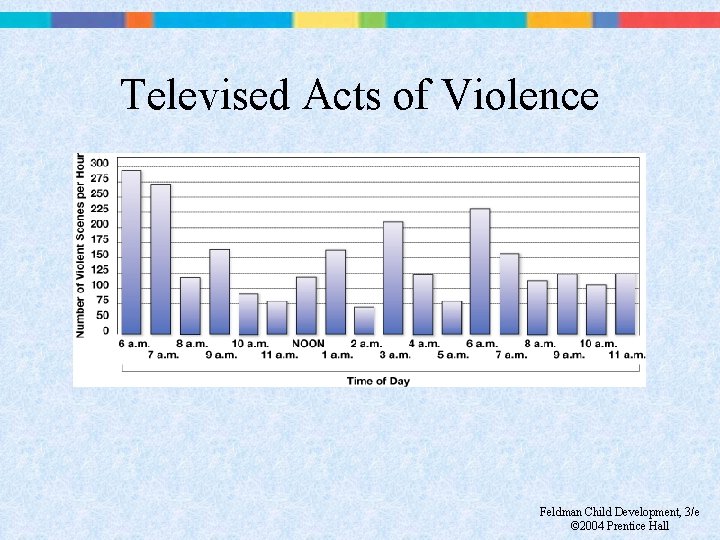
Televised Acts of Violence Feldman Child Development, 3/e © 2004 Prentice Hall
- Slides: 12