
Child Care and Protection Act 3 of 2015

- Slides: 49
Child Care and Protection Act 3 of 2015 Chapter 17 Ministry of Gender Equality and Child Welfare Legal Assistance Centre
Overview • Adoption is a useful way of affording children benefits offamily lifewhich might not otherwise be available to them. • The Child Care and Protection Act takeschild-centred a approach to adoptionwith the best interests of the child as a guiding standard. • The Act makes provision for intercountry adoptionwhere there is no suitable long-term care option for a child inside Namibia. • Only a small number of Namibian children are adopted each year, while many children are placed in kinship care or foster care.
1. New concepts Best interests of the child: The Act introduces the concept of the best interests of the child as the governing principle in adoptions. Adoption plan: The birth parents and adoptive parents in a disclosed adoption (where the identities of birth and adoptive parents are known to each other) may enter into an optional agreement covering issues such as the sharing of information. Inter-country adoptions: The Act sets out the process and requirements for a child who is habitually resident in Namibia to be adopted by a person who is habitually resident outside Namibia.
Formal adoption versus informal adoption and adoption in terms of customary law The Child Care and Protection Act covers only formal adoptions. l It does not apply to informal “adoptions” where a child is treated as a child of the family without a formal adoption process. l It does not apply to adoptions under customary law. Only formal adoptions concluded under the Act will be recognised for purposes such as liability for maintenance and intestate succession.
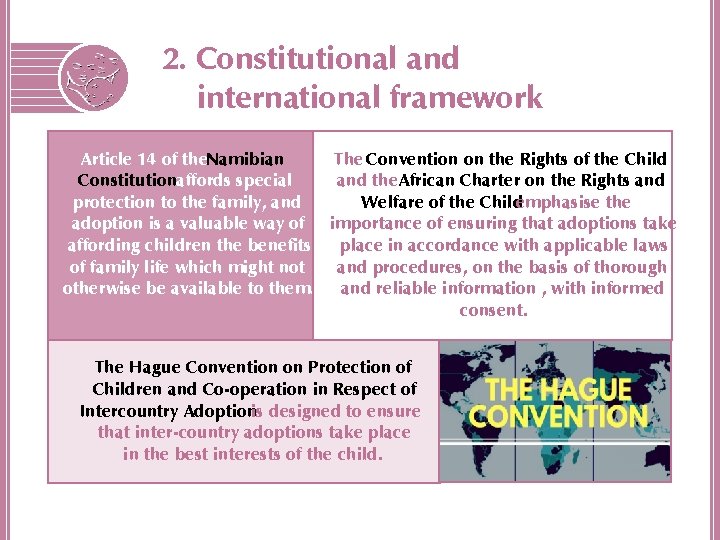
2. Constitutional and international framework Article 14 of the. Namibian The Convention on the Rights of the Child Constitutionaffords special and the African Charter on the Rights and protection to the family, and Welfare of the Childemphasise the adoption is a valuable way of importance of ensuring that adoptions take affording children the benefits place in accordance with applicable laws of family life which might not and procedures, on the basis of thorough otherwise be available to them. and reliable information , with informed consent. The Hague Convention on Protection of Children and Co-operation in Respect of Intercountry Adoptionis designed to ensure that inter-country adoptions take place in the best interests of the child.
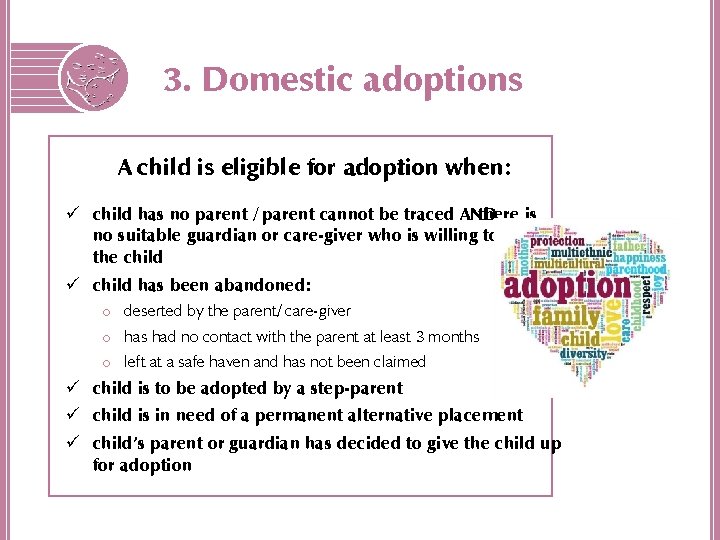
3. Domestic adoptions A child is eligible for adoption when: ü child has no parent / parent cannot be traced AND there is no suitable guardian or care-giver who is willing to care for the child ü child has been abandoned: o deserted by the parent/ care-giver o has had no contact with the parent at least 3 months o left at a safe haven and has not been claimed ü child is to be adopted by a step-parent ü child is in need of a permanent alternative placement ü child’s parent or guardian has decided to give the child up for adoption
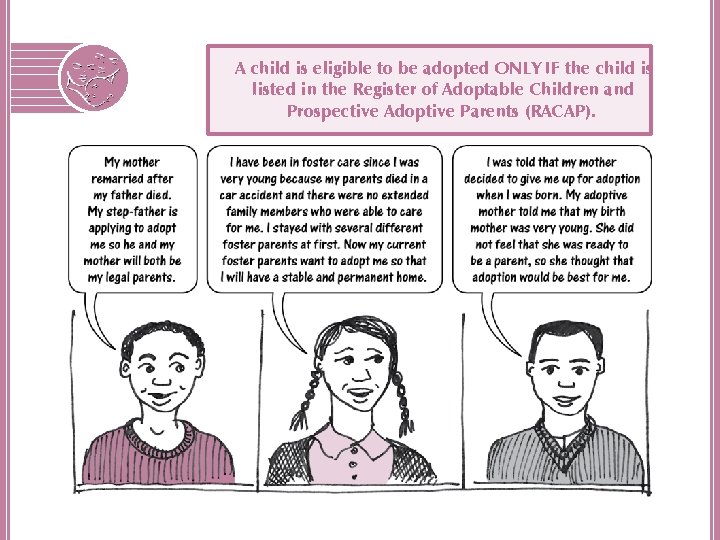
A child is eligible to be adopted ONLY IF the child is listed in the Register of Adoptable Children and Prospective Adoptive Parents (RACAP).
Birth certificates are required for all adoptable children BEFORE the adoption take place. • A birth certificate can be issued even if not all the relevant information is known, as in the case of an abandoned child. • Birth registration of all children prior to adoption will help to prevent child trafficking and other improper practices.
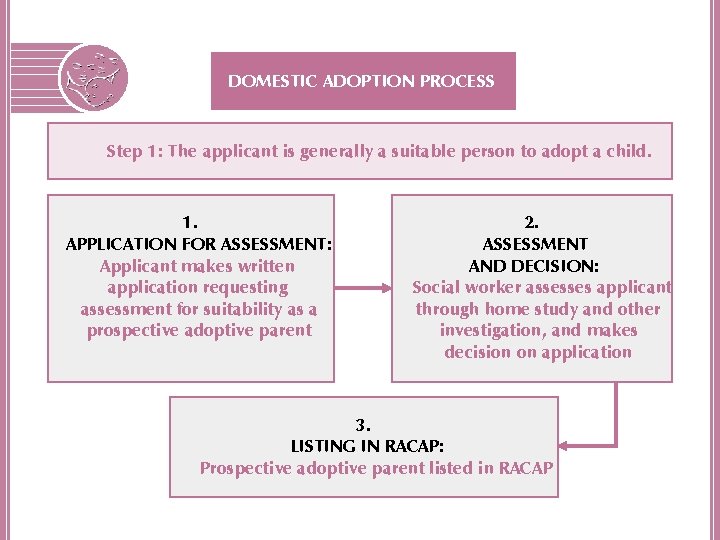
DOMESTIC ADOPTION PROCESS Step 1: The applicant is generally a suitable person to adopt a child. 1. APPLICATION FOR ASSESSMENT: Applicant makes written application requesting assessment for suitability as a prospective adoptive parent 2. ASSESSMENT AND DECISION: Social worker assesses applicant through home study and other investigation, and makes decision on application 3. LISTING IN RACAP: Prospective adoptive parent listed in RACAP
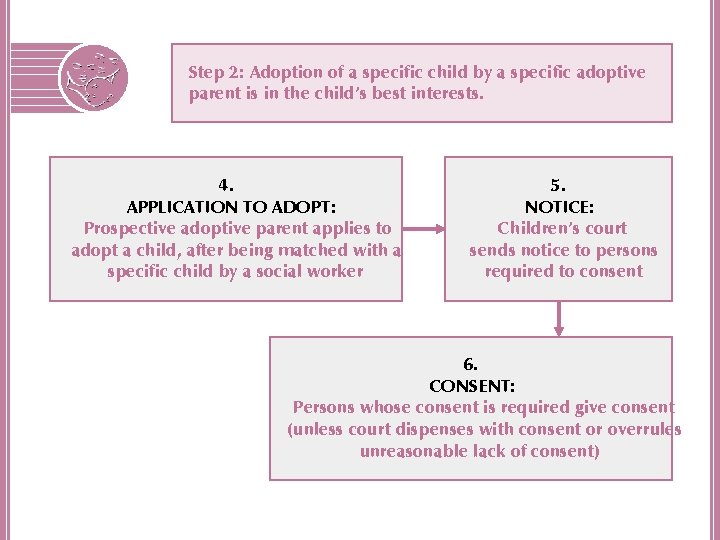
Step 2: Adoption of a specific child by a specific adoptive parent is in the child’s best interests. 4. APPLICATION TO ADOPT: Prospective adoptive parent applies to adopt a child, after being matched with a specific child by a social worker 5. NOTICE: Children’s court sends notice to persons required to consent 6. CONSENT: Persons whose consent is required give consent (unless court dispenses with consent or overrules unreasonable lack of consent)
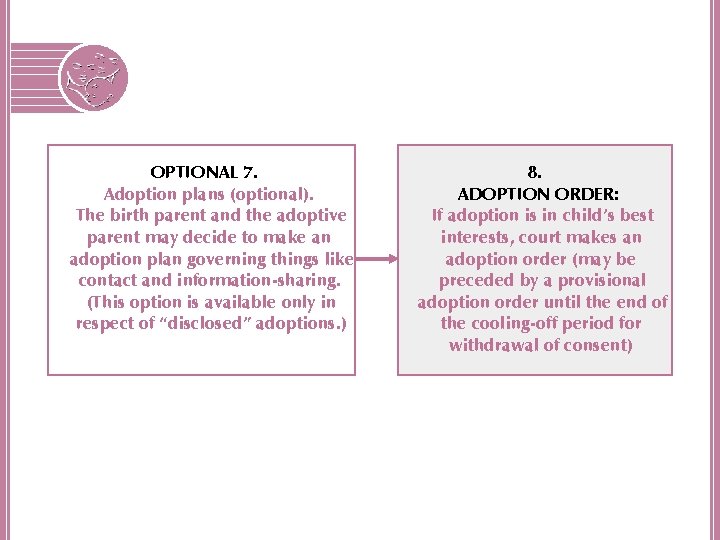
OPTIONAL 7. Adoption plans (optional). The birth parent and the adoptive parent may decide to make an adoption plan governing things like contact and information-sharing. (This option is available only in respect of “disclosed” adoptions. ) 8. ADOPTION ORDER: If adoption is in child’s best interests, court makes an adoption order (may be preceded by a provisional adoption order until the end of the cooling-off period for withdrawal of consent)
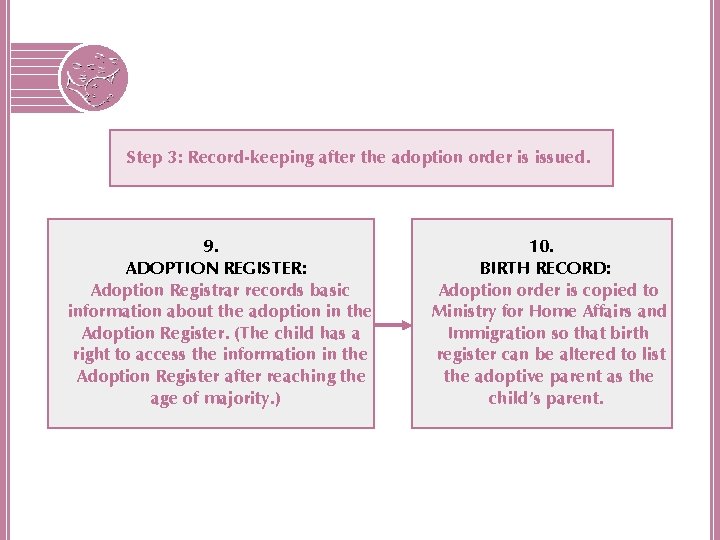
Step 3: Record-keeping after the adoption order is issued. 9. ADOPTION REGISTER: Adoption Registrar records basic information about the adoption in the Adoption Register. (The child has a right to access the information in the Adoption Register after reaching the age of majority. ) 10. BIRTH RECORD: Adoption order is copied to Ministry for Home Affairs and Immigration so that birth register can be altered to list the adoptive parent as the child’s parent.
Who can adopt a child? l marital status: o spouses in a marriage acting jointly o step-parent (married to biological parent) o widow, widower, divorced, single l age: at least 25 years old (unless they motivate exception) l habitually resident in Namibia l fit to undertake parental responsibilities and rights (police clearance certificate) A person is eligible to adopt a child ONLY IF the person has been approved as a prospective adoptive parent and listed in the Register of Adoptable Children and Prospective Adoptive Parents (RACAP).
Frequently-asked questions Can spouses in a customary marriage adopt a child jointly? Yes. Spouses in a “marriage” can adopt jointly. Can same-sex partners adopt a child jointly? No. Only “spouses in a marriage” can adopt a child jointly. Can opposite-sex couples who are cohabiting without being married adopt a child jointly? No. Joint adoption is possible only for married spouses. Is domestic adoption limited to Namibian citizens? No. A domestic adoption can take place in respect of any of the adoptive parent who is habitually resident in Namibia. Step-parent adoption The Act provides for adoption by a stepparent (adoption by “the spouse of a parent of the child”). There is no provision for joint adoption by the step-parent together with this biological parent, because the biological parent has no need to adopt.
(1) Application to be a prospective adoptive parent Applicant completes application form including: • basic information (citizenship, residency status, marital status, religion, main languages spoken, other persons in household, financial position, health) • reasons for wanting to adopt • preferences for adopted child (sex, age, etc) • “disclosed” or “non-disclosed” adoption • police clearance certificate • “Disclosed” adoption = adoptive parents and birth parents know each other’s identities and adoptive parents may decide to allow contact between child & birth parents (not required) • “Non-disclosed” adoption = identities not revealed Note that all adopted children have the right to access information about identity of their birth parents from the Adoption Register when they reach the age of majority.
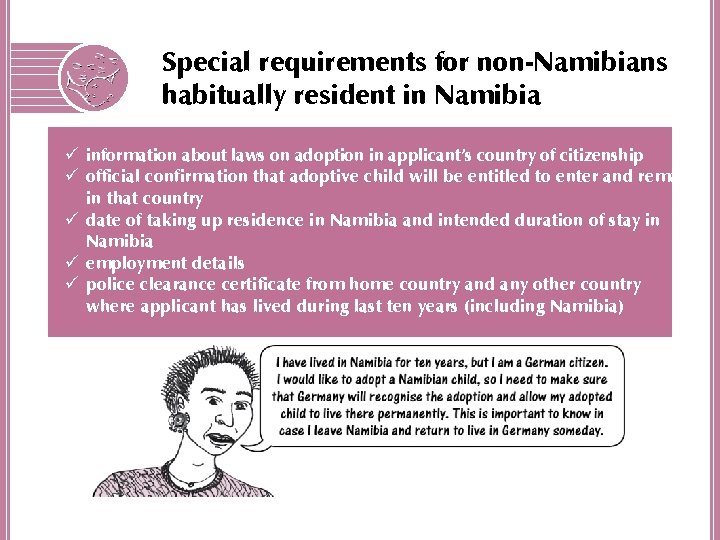
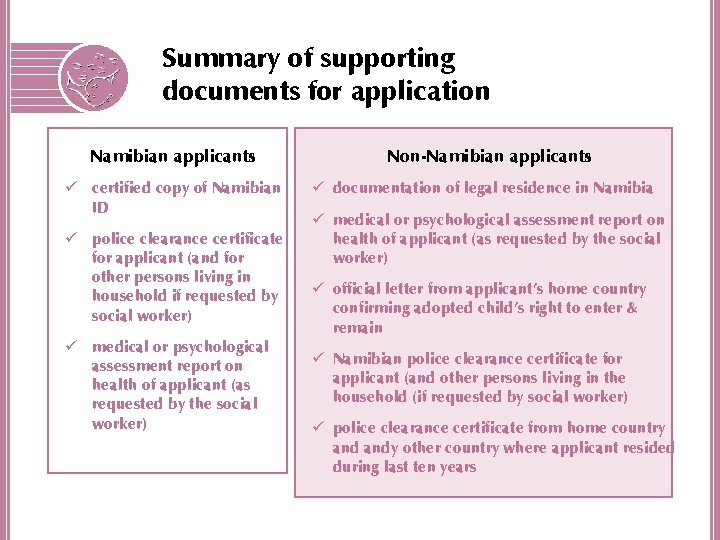
Special requirements for non-Namibians habitually resident in Namibia ü information about laws on adoption in applicant’s country of citizenship ü official confirmation that adoptive child will be entitled to enter and remain in that country ü date of taking up residence in Namibia and intended duration of stay in Namibia ü employment details ü police clearance certificate from home country and any other country where applicant has lived during last ten years (including Namibia)
Summary of supporting documents for application Namibian applicants ü certified copy of Namibian ID ü police clearance certificate for applicant (and for other persons living in household if requested by social worker) ü medical or psychological assessment report on health of applicant (as requested by the social worker) Non-Namibian applicants ü documentation of legal residence in Namibia ü medical or psychological assessment report on health of applicant (as requested by the social worker) ü official letter from applicant’s home country confirming adopted child’s right to enter & remain ü Namibian police clearance certificate for applicant (and other persons living in the household (if requested by social worker) ü police clearance certificate from home country andy other country where applicant resided during last ten years
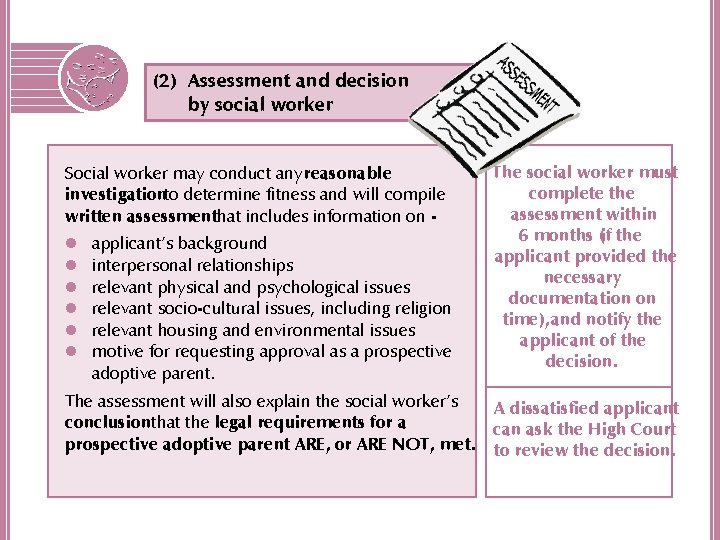
(2) Assessment and decision by social worker Social worker may conduct any reasonable investigationto determine fitness and will compile written assessmentthat includes information on l l l applicant’s background interpersonal relationships relevant physical and psychological issues relevant socio-cultural issues, including religion relevant housing and environmental issues motive for requesting approval as a prospective adoptive parent. The social worker must complete the assessment within 6 months (if the applicant provided the necessary documentation on time), and notify the applicant of the decision. The assessment will also explain the social worker’s A dissatisfied applicant conclusionthat the legal requirements for a can ask the High Court prospective adoptive parent ARE, or ARE NOT, met. to review the decision.
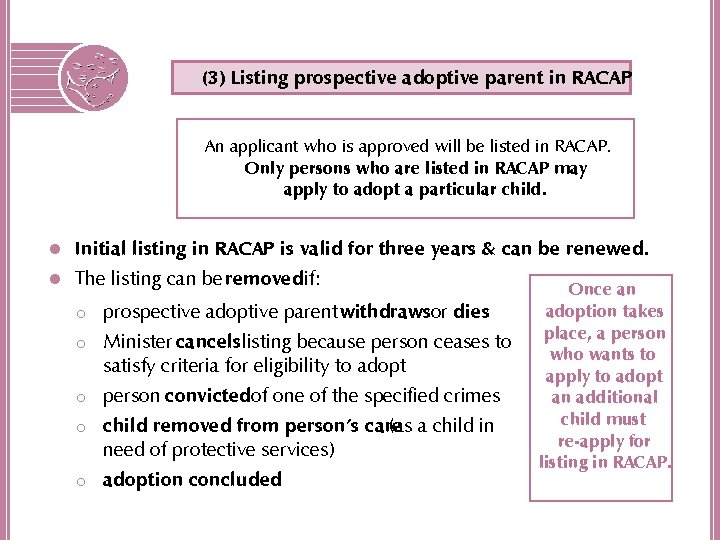
(3) Listing prospective adoptive parent in RACAP An applicant who is approved will be listed in RACAP. Only persons who are listed in RACAP may apply to adopt a particular child. l Initial listing in RACAP is valid for three years & can be renewed. l The listing can be removedif: o prospective adoptive parent withdrawsor dies o Minister cancelslisting because person ceases to satisfy criteria for eligibility to adopt o person convictedof one of the specified crimes o child removed from person’s care (as a child in need of protective services) o adoption concluded Once an adoption takes place, a person who wants to apply to adopt an additional child must re-apply for listing in RACAP.
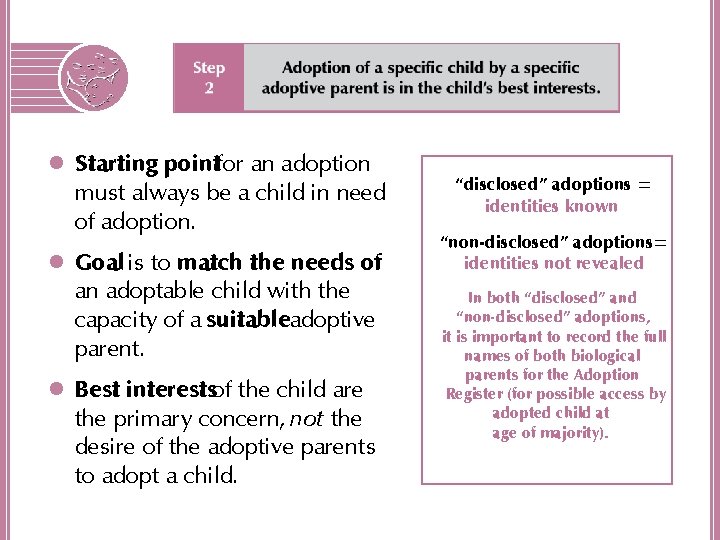
l Starting pointfor an adoption must always be a child in need of adoption. l Goal is to match the needs of an adoptable child with the capacity of a suitableadoptive parent. l Best interestsof the child are the primary concern, not the desire of the adoptive parents to adopt a child. “disclosed” adoptions = identities known “non-disclosed” adoptions= identities not revealed In both “disclosed” and “non-disclosed” adoptions, it is important to record the full names of both biological parents for the Adoption Register (for possible access by adopted child at age of majority).
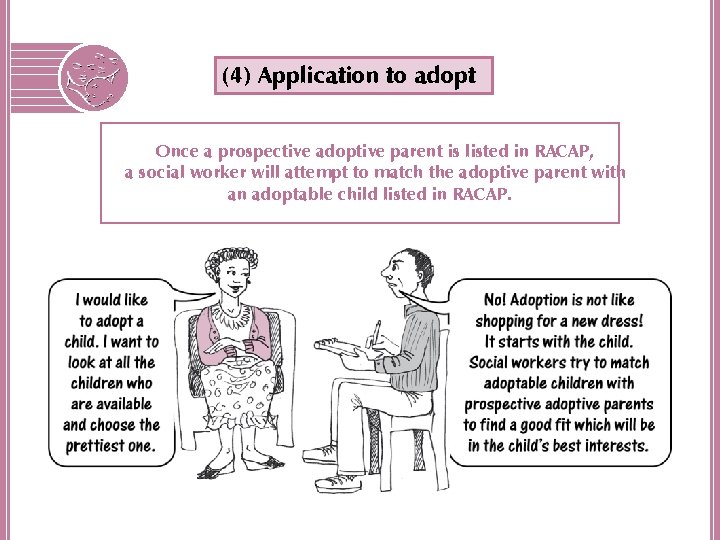
(4) Application to adopt Once a prospective adoptive parent is listed in RACAP, a social worker will attempt to match the adoptive parent with an adoptable child listed in RACAP.
Respecting preferences l A birth parent may name a particular adoptive parent as a condition of consent. l An applicant may also want to adopt a specific child who has been fostered by the applicant, or a child who is related to the applicant. l Social workers try to respect the preferences of the birth parents and the prospective adoptive parents, but in every case the prospective adoptive parent must be listed in RACAP, the child must be adoptable and the match must be assessed as being suitable.
Key documents l The prospective adoptive parent will submit an application to adopt a specific child with whom they have been matched, together with supporting documentation. l The social worker will submit anadoption reporton the application, together with o the previous application and assessment for the listing of the prospective adoptive parents in RACAP o the previous paperwork for the listing of the child as an adoptable child in RACAP. l The adoption cannot proceed without the birth certificateof the child to be adopted. Adoption is now a two-step process: (1) general assessment of fitness to adopt; (2) application to adopt a specific child.
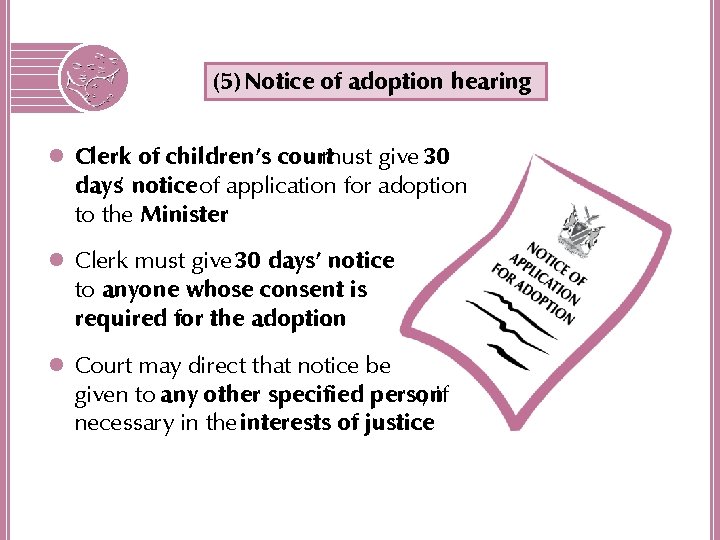
(5) Notice of adoption hearing l Clerk of children’s court must give 30 days’ notice of application for adoption to the Minister. l Clerk must give 30 days' notice to anyone whose consent is required for the adoption. l Court may direct that notice be given to any other specified person , if necessary in the interests of justice.
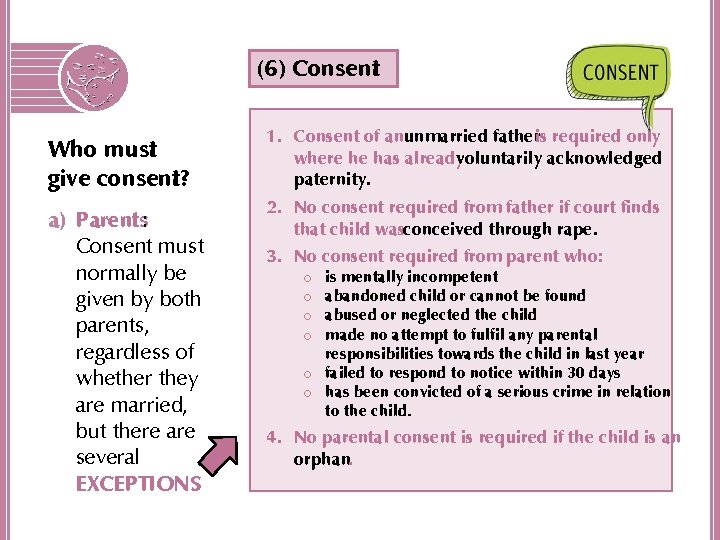
(6) Consent Who must give consent? a) Parents: Consent must normally be given by both parents, regardless of whether they are married, but there are several EXCEPTIONS 1. Consent of anunmarried fatheris required only where he has alreadyvoluntarily acknowledged paternity. 2. No consent required from father if court finds that child wasconceived through rape. 3. No consent required from parent who: is mentally incompetent abandoned child or cannot be found abused or neglected the child made no attempt to fulfil any parental responsibilities towards the child in last year o failed to respond to notice within 30 days o has been convicted of a serious crime in relation to the child. o o 4. No parental consent is required if the child is an orphan.
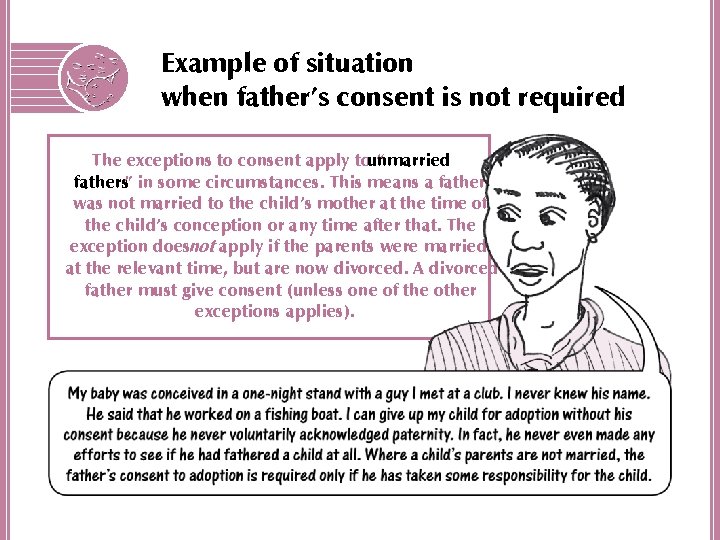
Example of situation when father’s consent is not required The exceptions to consent apply tounmarried “ fathers” in some circumstances. This means a father was not married to the child’s mother at the time of the child’s conception or any time after that. The exception doesnot apply if the parents were married at the relevant time, but are now divorced. A divorced father must give consent (unless one of the other exceptions applies).
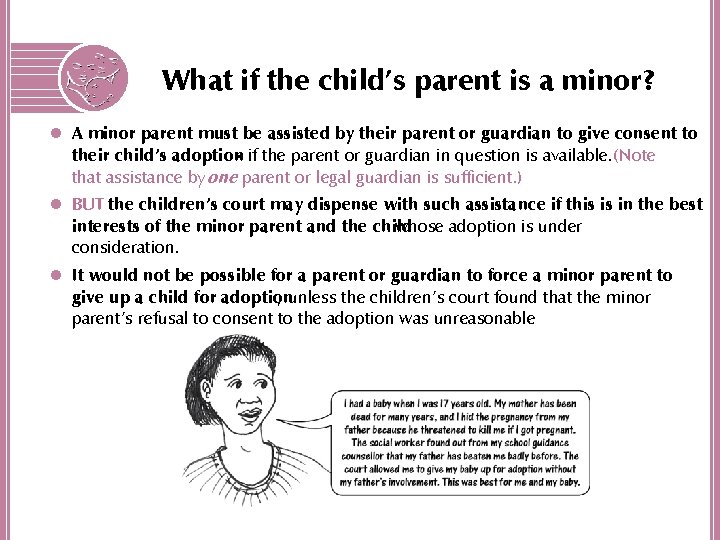
What if the child’s parent is a minor? l A minor parent must be assisted by their parent or guardian to give consent to their child’s adoption- if the parent or guardian in question is available. (Note that assistance by one parent or legal guardian is sufficient. ) l BUT the children’s court may dispense with such assistance if this is in the best interests of the minor parent and the child whose adoption is under consideration. l It would not be possible for a parent or guardian to force a minor parent to give up a child for adoption , unless the children’s court found that the minor parent’s refusal to consent to the adoption was unreasonable
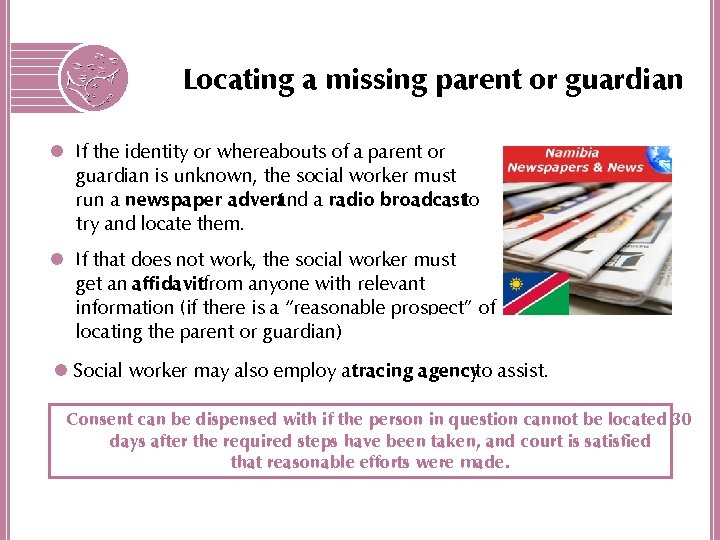
Locating a missing parent or guardian l If the identity or whereabouts of a parent or guardian is unknown, the social worker must run a newspaper advertand a radio broadcastto try and locate them. l If that does not work, the social worker must get an affidavitfrom anyone with relevant information (if there is a “reasonable prospect” of locating the parent or guardian) l Social worker may also employ atracing agencyto assist. Consent can be dispensed with if the person in question cannot be located 30 days after the required steps have been taken, and court is satisfied that reasonable efforts were made.
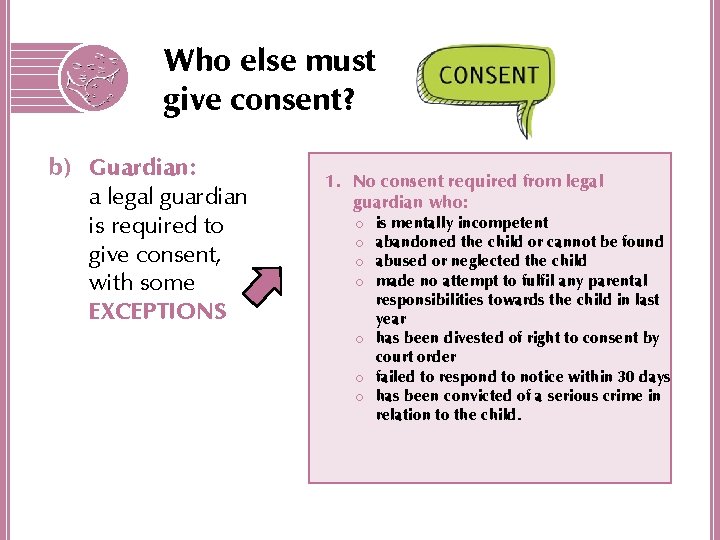
Who else must give consent? b) Guardian: a legal guardian is required to give consent, with some EXCEPTIONS 1. No consent required from legal guardian who: is mentally incompetent abandoned the child or cannot be found abused or neglected the child made no attempt to fulfil any parental responsibilities towards the child in last year o has been divested of right to consent by court order o failed to respond to notice within 30 days o has been convicted of a serious crime in relation to the child. o o
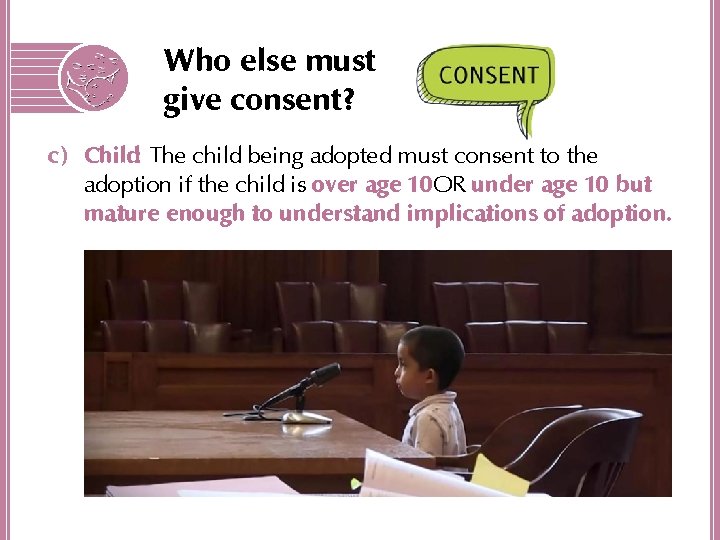
Who else must give consent? c) Child: The child being adopted must consent to the adoption if the child is over age 10 OR under age 10 but mature enough to understand implications of adoption.
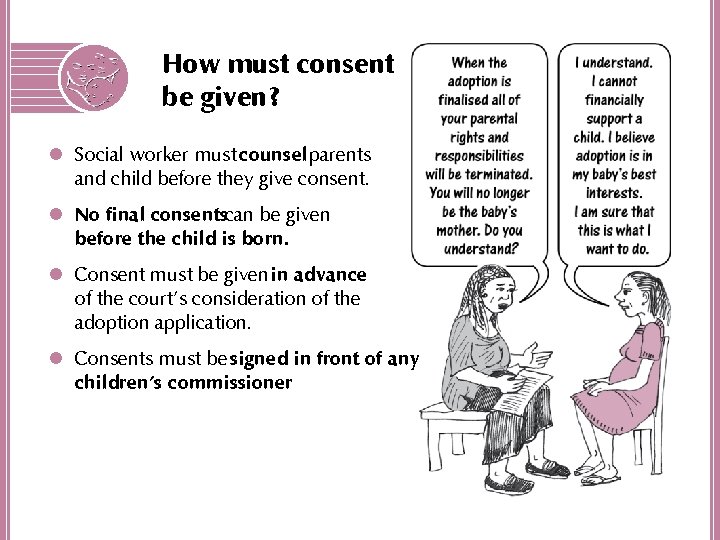
How must consent be given? l Social worker must counsel parents and child before they give consent. l No final consentscan be given before the child is born. l Consent must be given in advance of the court’s consideration of the adoption application. l Consents must be signed in front of any children’s commissioner.
Overruling unreasonable refusal of consent l Children’s court can overrule a refusal of consent IF o adoption would be in the child’s best interests AND o consent is being unreasonably withheld. l Before making this decision, the court must take into account o relationship between parent and child in last two years o potential for a good future relationship. l These criteria ensure that a parent who is unwilling to get involved in a child’s life does not try to obstruct an adoption only to be spiteful or uncooperative.
Withdrawal of consent during cooling-off period l Consent can be withdrawn during the 60 -day cooling off period (measured from date consent was signed). l Child will normally be placed with adoptive parents during cooling-off period, but could stay in foster care or place of safety. l Court can grant a provisional adoption order in the interim, but final adoption ordercan be granted only after expiry of cooling-off period for all persons required to give consent.
(7) Adoption plansoptional ( ) l In a “disclosed” adoption, the birth parents and adoptive parents may decide to make an adoption plan. l An adoption plan might include agreement on o sharing information about § child’s medical background § milestones in child’s development § important events in child’s life o contact with birth family o any other matter relating to the child. l The social worker will assist the parties if they want to make a plan. Adoption plans are optional and voluntary. An adoption plan takes effect only if it is made into a court order at the time of the adoption.
(8) Adoption order When the court is considering an adoption application, the paramount issue is the best interests of the child. Other relevant considerations : l desirability of preserving the child’s identity, language, culture and religious ties l views of the childif mature enough to be consulted l reasonable preferences of the parent l social worker’s report & recommendation l adoption plan(if there is one) Children’s court must be satisfied thatrequirements of the Actare met AND must consider all circumstances of the case. The order may include a provision on monitoringthe child’s well-being.
Effect of an adoption order The adopted child becomes the child of the adoptive parent in every way. l The birth certificatewill be altered to list the adoptive parent as the child’s parent. l All parental rights and responsibilities of birth parent are terminated. l Adoption order also automatically terminates any alternative placement in place prior to adoption l An adoption order does NOT affect any rights to property the child had before the adoption. l An adoption order does NOT permit any marriage or sexual intercoursebetween the child any other person which would have been prohibited had the child not been adopted. Appeals: A party who is unhappy with the decision of a children’s court on an application for adoption may appeal to the High Court. The child’s best interests will be the key issue.
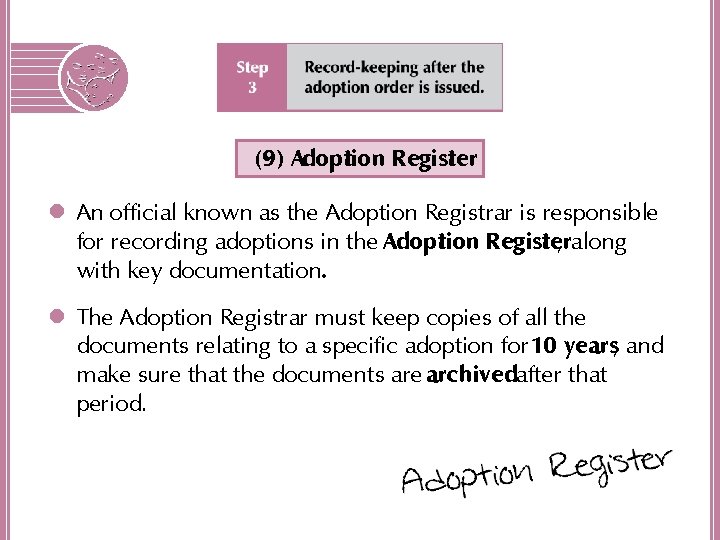
(9) Adoption Register l An official known as the Adoption Registrar is responsible for recording adoptions in the Adoption Register , along with key documentation. l The Adoption Registrar must keep copies of all the documents relating to a specific adoption for 10 years, and make sure that the documents are archivedafter that period.
(10) Birth record l Both the clerk of the children’s court and the Adoption Registrar have a duty to notify the Ministry of Home Affairs and Immigration of an adoption order. l These steps are intended to ensure alteration of the child’s birth record , so that the birth parents are replaced by the adoptive parents. l Ministry of Home Affairs and Immigration
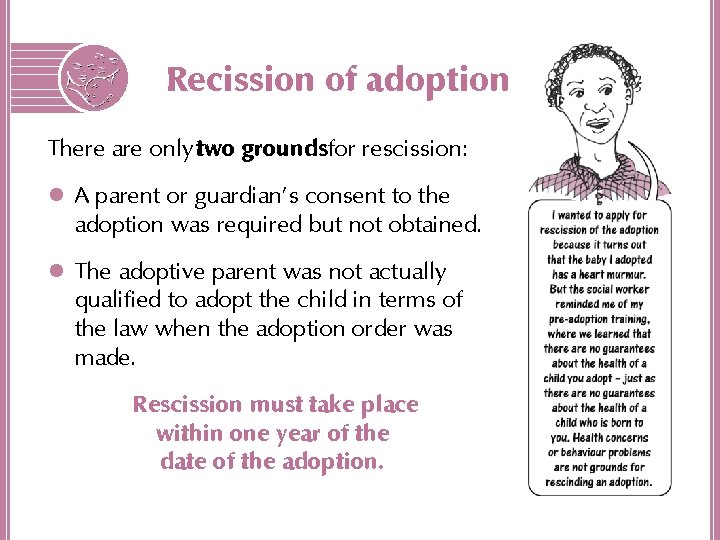
Recission of adoption There are only two groundsfor rescission: l A parent or guardian’s consent to the adoption was required but not obtained. l The adoptive parent was not actually qualified to adopt the child in terms of the law when the adoption order was made. Rescission must take place within one year of the date of the adoption.
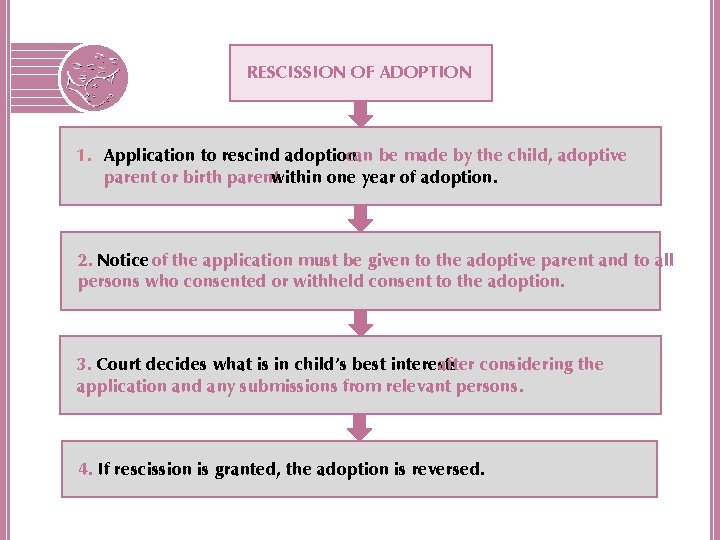
RESCISSION OF ADOPTION 1. Application to rescind adoption can be made by the child, adoptive parent or birth parentwithin one year of adoption. 2. Notice of the application must be given to the adoptive parent and to all persons who consented or withheld consent to the adoption. 3. Court decides what is in child’s best interests after considering the application and any submissions from relevant persons. 4. If rescission is granted, the adoption is reversed.
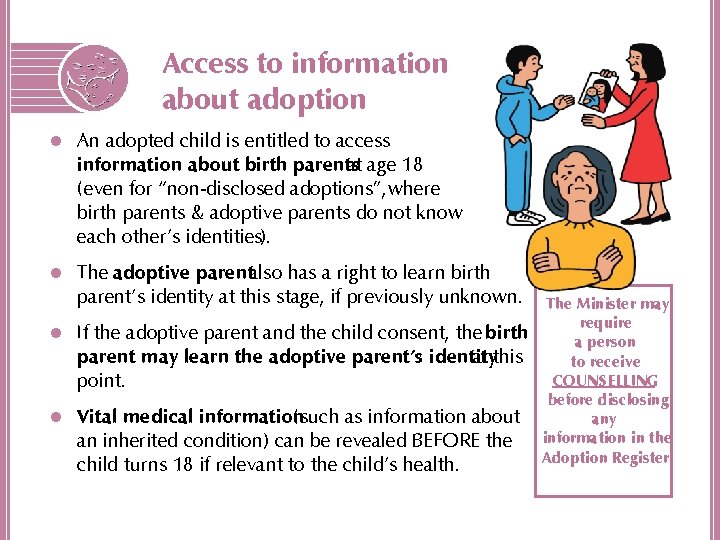
Access to information about adoption l An adopted child is entitled to access information about birth parents at age 18 (even for “non-disclosed adoptions”, where birth parents & adoptive parents do not know each other’s identities). l The adoptive parentalso has a right to learn birth parent’s identity at this stage, if previously unknown. l If the adoptive parent and the child consent, the birth parent may learn the adoptive parent’s identity at this point. l Vital medical information (such as information about an inherited condition) can be revealed BEFORE the child turns 18 if relevant to the child’s health. The Minister may require a person to receive COUNSELLING before disclosing any information in the Adoption Register.
4. Inter-country adoptions l The Act gives practical effect to the. Hague Convention, which provides a framework for inter-country adoption which protects the best interests of children. l Convention of the Rights of the Child & African Charter on the Rights and Welfare of the Child =inter-country adoption is an alternative means of providing care for a child who cannot be cared for in the country of origin in any suitable manner. l Namibia’s High Courtruled in 2004 that it is unconstitutional to have a blanket rule preventing foreigners from adopting Namibian children. The Hague Convention came into force in Namibia on 1 January 2016.
Principle of subsidiarity “Subsidiarity” means that l A child should be raised by his or her birth family or extended family whenever possible l If that is not possible or practicable, other forms of permanent care in the State of originshould be considered. l Inter-country adoption should be considered only after due consideration has been given to domestic solutions , and only if it is in the child’s best interests. l As a general rule, institutional care should be a last resortfor a child in need of a family.
Inter-country adoption process l All of the rules and procedures that apply to domestic adoptions also apply to inter-country adoptions, with some additional safeguards. l Intercountry adoption is defined by habitual residencerather than citizenship. It is any adoption where parents who are habitually resident in one country want to adopt a child who is habitually resident in another country. The relevant point is whether the child will be moved from one country to another. l The framework for intercountry adoption isdesigned to prevent sale or trafficking of children , or improper financial gains relating to adoption. l Inter-country adoption can proceed only if it is approved by the Central Authorities of both countries.
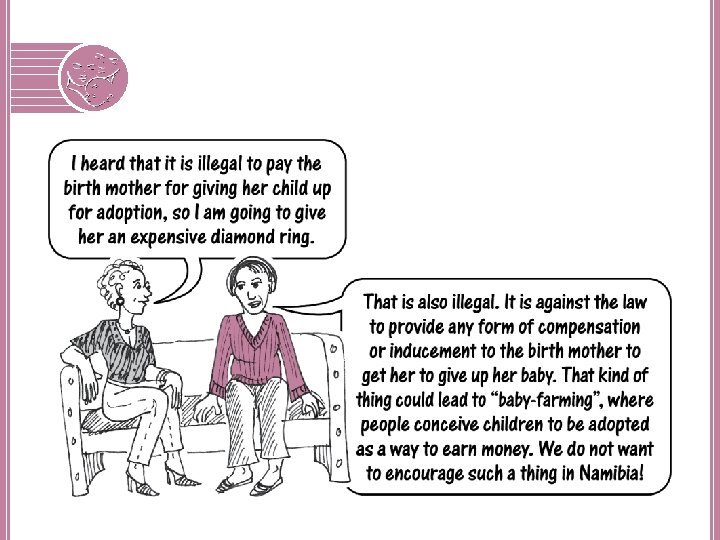
5. Crimes There a number of crimes aimed at preventing improper practices in respect of adoptions. l It is a crime for anyone to: o provide adoption services or facilitate an adoptionwithout being properly authorisedto do so o give or receive cashor other forms of compensationexcept for a small list of permitted payments o induce another person to give up a childfor adoption o arrange or publish an advertisementsoliciting anyone to be a surrogate mother , or dealing with adoption of a specific child l Penalty= fine of up to N$20 000, prison for up to five years, or both.
Permitted payments (1) Prospective adoptive parent may pay certain expenses: ü ü ü accommodation immediately before or after the child’s birth where necessary Pregnancy- and birth-related costs at public or private health care facility travelling to and from health facility food, water and vitamin supplements during pregnancy pre-natal courses to prepare for birth professional counselling services. These payments MUST be arranged through a designated social worker OR paid directly to the medical institution or other service provider in question. (2) Prescribed fees paid to legal practitioner, psychologist or other professional person for services provided in connection with adoption. (3) Payments made by or to an organ of state in connection with an adoption. Any permitted expenses are NOT refundable if the adoption fails to take place due to the death of the child or for any other good faith reason.
Permitted advertisements l publication of court order or noticein terms of the Act l advertisements by the Ministry for purposes of recruiting prospective adoptive parents for inclusion in RACAP l newspaper advertisements by private social workersfor the purpose of recruiting prospective adoptive parents, but only once every four months