
Child Care and Protection Act 3 of 2015
- Slides: 19
Child Care and Protection Act 3 of 2015 Chapter 25 Ministry of Gender Equality and Child Welfare Legal Assistance Centre
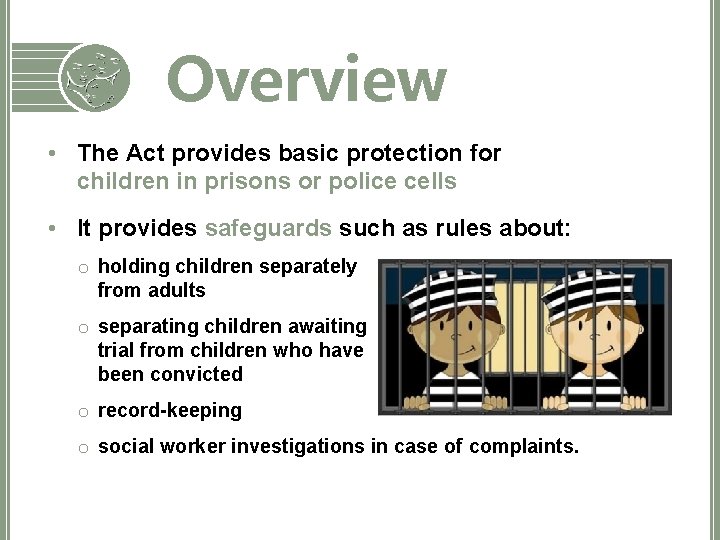
Overview • The Act provides basic protection for children in prisons or police cells • It provides safeguards such as rules about: o holding children separately from adults o separating children awaiting trial from children who have been convicted o record-keeping o social worker investigations in case of complaints.
1. Background The rules in the Child Care and Protection Act apply to - • children in conflict with the law (awaiting trial or convicted of a crime) AND • children in a prison or police cell in the care of a parent, guardian or care-giver “prison” = “correctional facility”
Criminal Procedure Act • Court or police may place juvenile accused in a place of safety if release on bail is not appropriate. • Court may convert criminal trial into child protection proceeding. • If juvenile is convicted, court may - o place the juvenile under supervision of probation officer o place the juvenile in the custody of suitable person (which may also involve supervision by probation officer) o send the child to a child detention centre instead of prison.
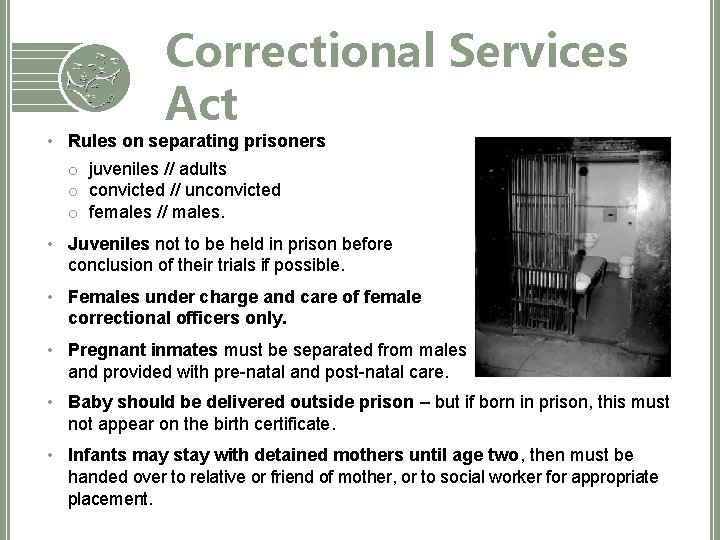
Correctional Services Act • Rules on separating prisoners o juveniles // adults o convicted // unconvicted o females // males. • Juveniles not to be held in prison before conclusion of their trials if possible. • Females under charge and care of female correctional officers only. • Pregnant inmates must be separated from males and provided with pre-natal and post-natal care. • Baby should be delivered outside prison – but if born in prison, this must not appear on the birth certificate. • Infants may stay with detained mothers until age two, then must be handed over to relative or friend of mother, or to social worker for appropriate placement.
Nampol Operational Guidelines • “Strictest precautionary measures” to prevent children from coming into contact with adult prisoners. • Children under age 16 must not be detained in police cells if it is possible to accommodate them elsewhere. • If a person is arrested with a child: o do not leave the child behind alone o leave the child with a relative or friend if possible o release prisoner on police bail or own recognizance if possible, or expedite bail application o hold child and prisoner in most appropriate place available, such as room at station or in cell on their own.
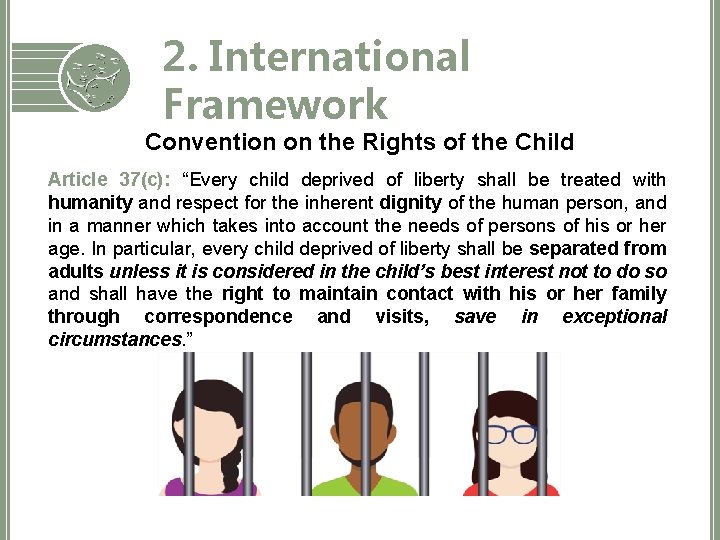
2. International Framework Convention on the Rights of the Child Article 37(c): “Every child deprived of liberty shall be treated with humanity and respect for the inherent dignity of the human person, and in a manner which takes into account the needs of persons of his or her age. In particular, every child deprived of liberty shall be separated from adults unless it is considered in the child’s best interest not to do so and shall have the right to maintain contact with his or her family through correspondence and visits, save in exceptional circumstances. ”
African Charter on the Rights and Welfare of the Child l The African Charter emphasises the need to apply special treatment to juvenile offenders to respect their dignity, and to work towards the child’s reintegration into family and society. l Like the Convention on the Rights of the Child, it requires that children who are detained or imprisoned must be separated from adults; unlike the Convention, it does not explicitly provide for a best-interests exception to this rule.
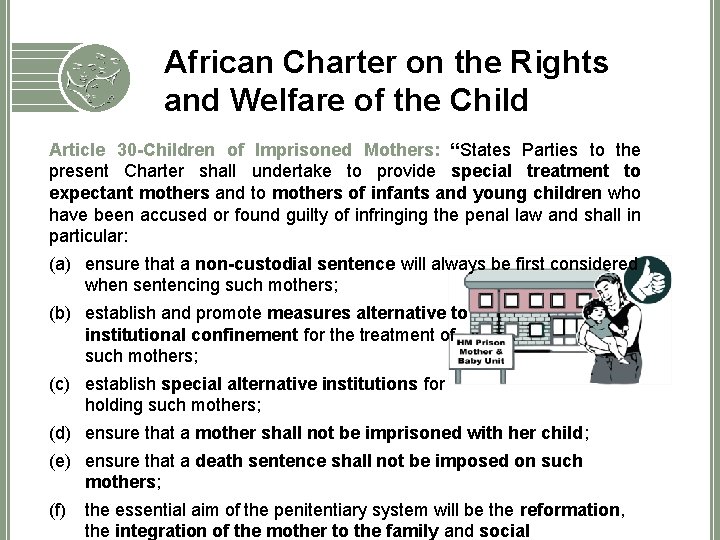
African Charter on the Rights and Welfare of the Child Article 30 -Children of Imprisoned Mothers: “States Parties to the present Charter shall undertake to provide special treatment to expectant mothers and to mothers of infants and young children who have been accused or found guilty of infringing the penal law and shall in particular: (a) ensure that a non-custodial sentence will always be first considered when sentencing such mothers; (b) establish and promote measures alternative to institutional confinement for the treatment of such mothers; (c) establish special alternative institutions for holding such mothers; (d) ensure that a mother shall not be imprisoned with her child; (e) ensure that a death sentence shall not be imposed on such mothers; (f) the essential aim of the penitentiary system will be the reformation, the integration of the mother to the family and social
3. Key rules in the Child Care and Protection Act Does NOT address the general position of children in conflict with the law (Child Justice Bill in process) Provides certain basic protections to ensure safety of children in prisons and police cells
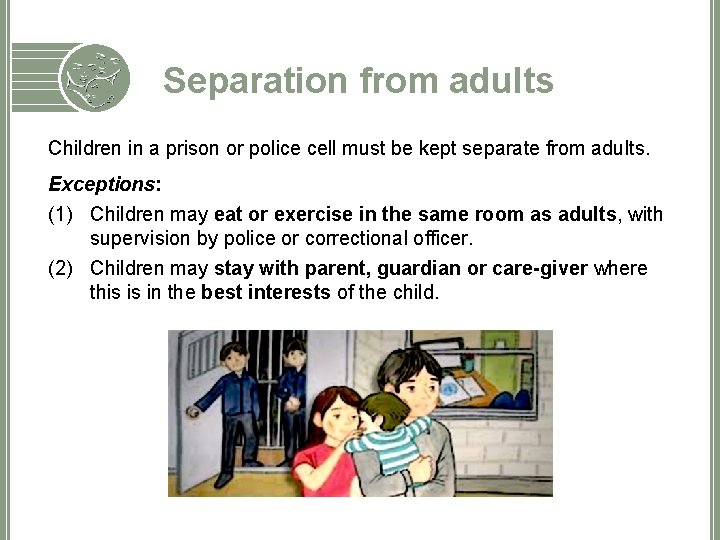
Separation from adults Children in a prison or police cell must be kept separate from adults. Exceptions: (1) Children may eat or exercise in the same room as adults, with supervision by police or correctional officer. (2) Children may stay with parent, guardian or care-giver where this is in the best interests of the child.
Visits Child is allowed visits by • parent, guardian, care-giver • legal practitioner • social worker • probation officer • health worker • religious counsellor or • any other person entitled by law to visit child as long as in the best interests of the child.
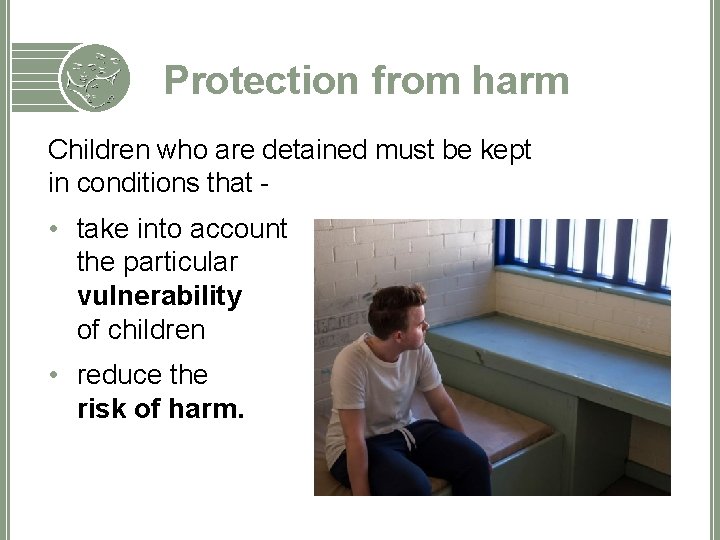
Protection from harm Children who are detained must be kept in conditions that - • take into account the particular vulnerability of children • reduce the risk of harm.
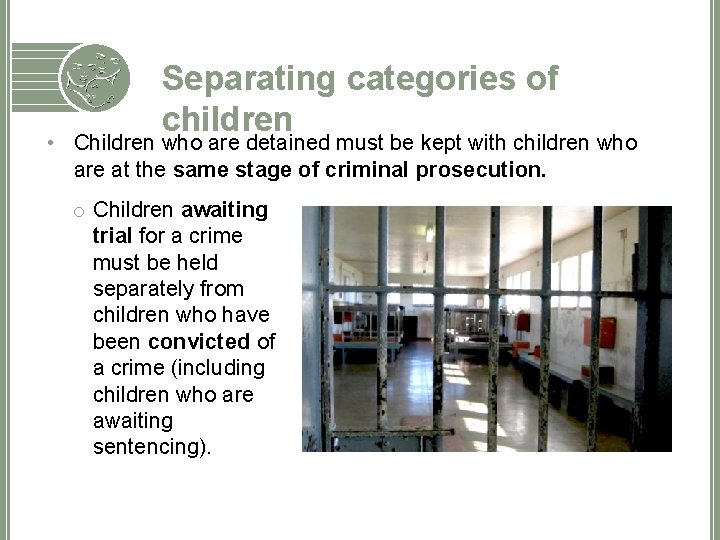
Separating categories of children • Children who are detained must be kept with children who are at the same stage of criminal prosecution. o Children awaiting trial for a crime must be held separately from children who have been convicted of a crime (including children who are awaiting sentencing).
4. Social worker investigations • A social worker must be informed when a child is in a prison or police cell with an incarcerated parent. • The social worker may conduct any investigation necessary to determine what is in the best interests of the child. Investigation may identify suitable care-giver May find that child is in need of protective services
5. Complaints l Complaint: may be made by the child or any other person o must be recorded and reported to ED of the Ministry responsible for child welfare l Concern: police or any State official observes that a child has been injured or is severely traumatized o must be recorded and reported to ED of the Ministry responsible for child welfare l Crime: Failure to report to ED is a crime punishable by fine up to N$4000 or prison for up to 1 year or both.
Action by Executive Director Initiate social worker investigation into the circumstances Arrange for immediate and appropriate medical treatment if necessary (injury, psychological trauma, sexual offence, illness, malnutrition, etc) Ministry of Gender Equality and Child Welfare
Involving the Children’s Advocate • If the ED receives a report of injury or trauma to a child in a prison or police cell, the ED must inform the Children’s Advocate. • Who is the Children’s Advocate? An official in the Office of the Ombudsman who can investigate individual complaints and monitor implementation of the Act.
6. Registers • Record-keeping: Each police station and prison must keep a register with details about the detention or presence of any child. • Inspection of register: The register must be available for inspection by any person who can show a sufficient interest. o Written request stating the reasons for wanting to examine the register o Must examine register in presence of police/prison official o Information in register is confidential and cannot be disclosed without permission from highest official. ***