
Child and Family Teaming CFT Module 1 Developing

- Slides: 27
Child and Family Teaming (CFT) Module 1 Developing an Effective Child and Family Team 1
Developing an Effective Child and Family Team � Welcome and Introductions � What is a Child and Family Team? � What is a CFT Meeting? 2
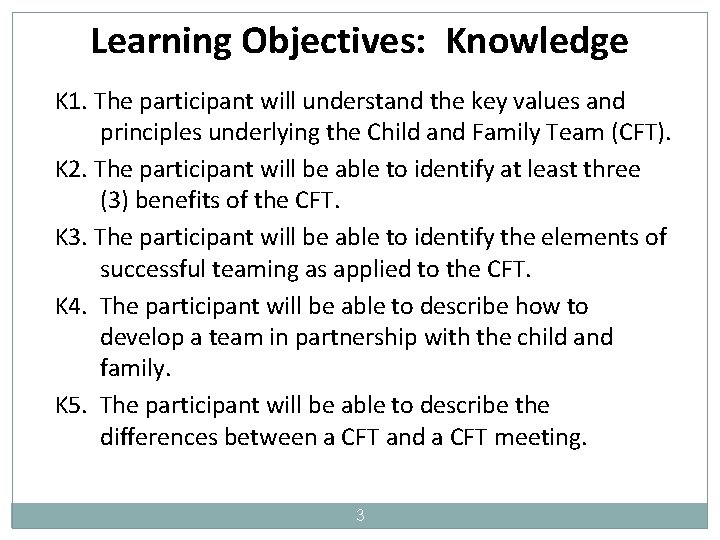
Learning Objectives: Knowledge K 1. The participant will understand the key values and principles underlying the Child and Family Team (CFT). K 2. The participant will be able to identify at least three (3) benefits of the CFT. K 3. The participant will be able to identify the elements of successful teaming as applied to the CFT. K 4. The participant will be able to describe how to develop a team in partnership with the child and family. K 5. The participant will be able to describe the differences between a CFT and a CFT meeting. 3
Learning Objectives: Skills S 1. Through a case scenario, the participant will be able to demonstrate the ability to engage, collaborate, and team with a child and family, based on their strengths and needs. 4
Learning Objectives: Values V 1. The participant will be able to speak about the benefits of working as part of a team to support the behavioral health and well-being of children and families. V 2. The participant will recognize the importance of the selfidentity of individual family members in the teaming process, encompassing, for example, race, ethnicity, class, culture, sexual orientation, and gender. V 4. The participant will be aware of the impact of trauma and historical trauma on the child and family within the context of the teaming process. V 5. The participant will be able to discuss the value of including the social support networks of children, youth and families in the CFT and how the networks can enhance the behavioral health of family members. 5
Teaming is more than the meetings � Teaming is a practice of ongoing engagement and collaboration. � The purpose of the Child and Family Team Meeting is to ensure that plans and decisions benefit the child through the integration of multiple perspectives. � Risk and accountability are shared among team members. � Teaming ensures “solutions” are customized. 6
Brainstorm 7
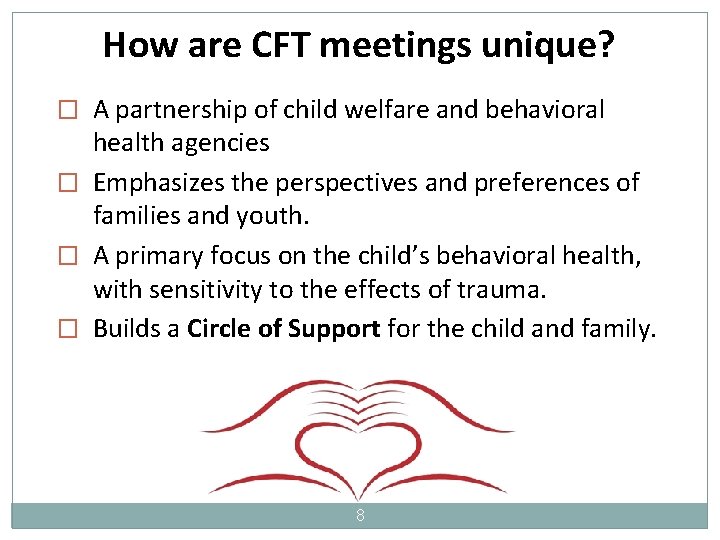
How are CFT meetings unique? � A partnership of child welfare and behavioral health agencies � Emphasizes the perspectives and preferences of families and youth. � A primary focus on the child’s behavioral health, with sensitivity to the effects of trauma. � Builds a Circle of Support for the child and family. 8
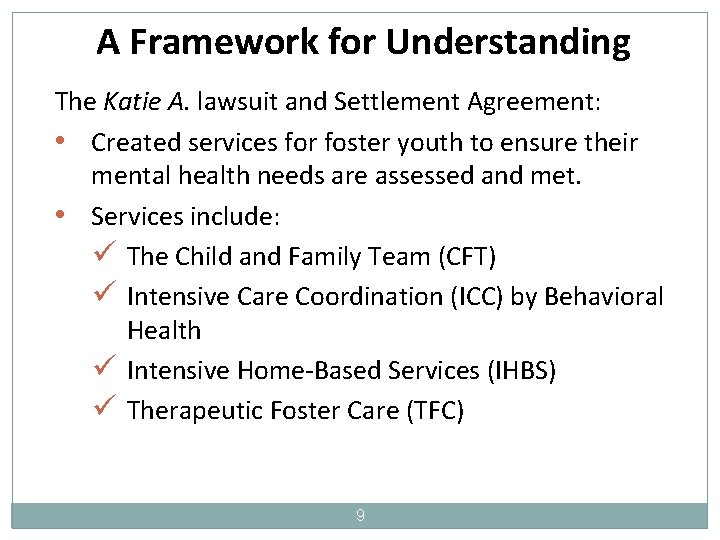
A Framework for Understanding The Katie A. lawsuit and Settlement Agreement: • Created services for foster youth to ensure their mental health needs are assessed and met. • Services include: ü The Child and Family Team (CFT) ü Intensive Care Coordination (ICC) by Behavioral Health ü Intensive Home-Based Services (IHBS) ü Therapeutic Foster Care (TFC) 9
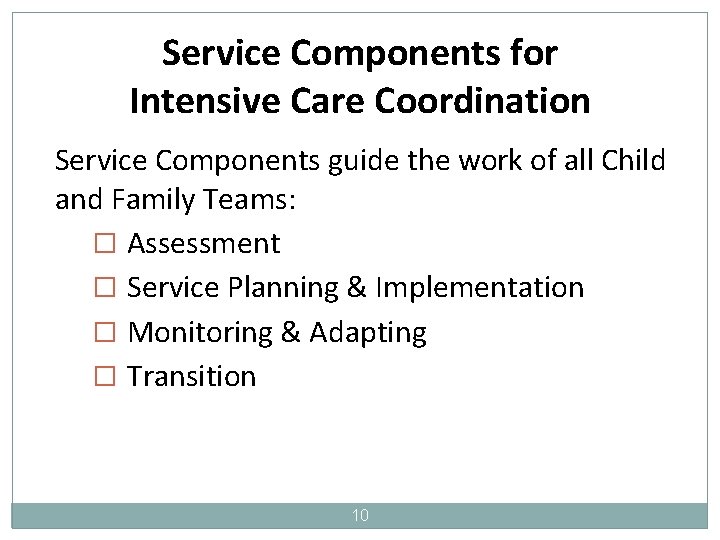
Service Components for Intensive Care Coordination Service Components guide the work of all Child and Family Teams: � Assessment � Service Planning & Implementation � Monitoring & Adapting � Transition 10
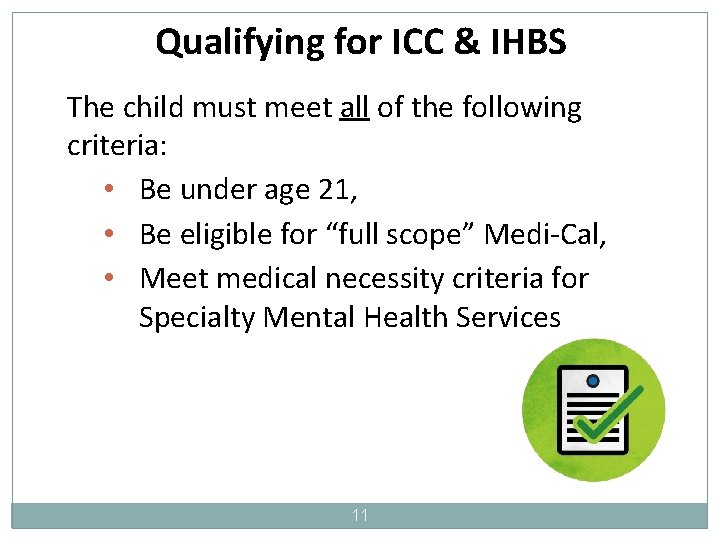
Qualifying for ICC & IHBS The child must meet all of the following criteria: • Be under age 21, • Be eligible for “full scope” Medi-Cal, • Meet medical necessity criteria for Specialty Mental Health Services 11
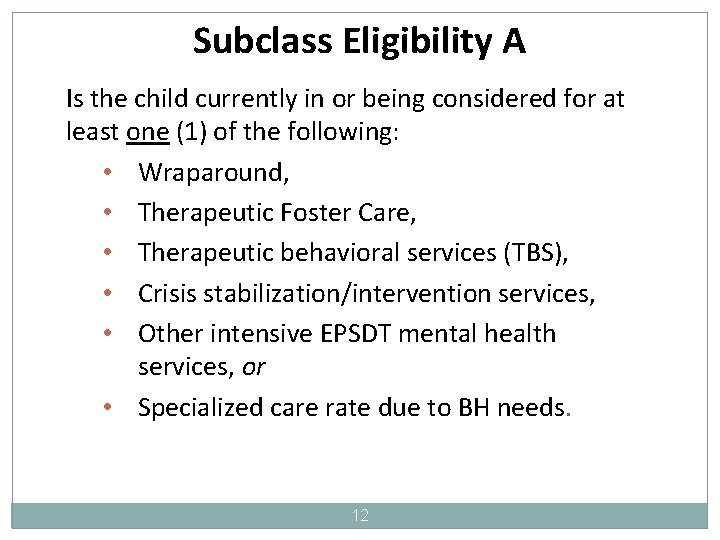
Subclass Eligibility A Is the child currently in or being considered for at least one (1) of the following: • Wraparound, • Therapeutic Foster Care, • Therapeutic behavioral services (TBS), • Crisis stabilization/intervention services, • Other intensive EPSDT mental health services, or • Specialized care rate due to BH needs. 12
or Subclass Eligibility B Is the child currently in or being considered for at least one (1) of the following: • Group home (RCL 10 or above) (former designation before CCR), • Psychiatric hospital, • A 24 -hour MH treatment facility, or • Has experienced at least three (3) placements within 24 months due to behavioral health needs. 13
A Framework for Understanding � The Child and Family Team is the primary entity tasked with planning, delivering, and monitoring mental health services and treatment goals for children in the child welfare system. 14
Framework for Understanding Child and Family Teams shall engage in a process that is: � family led, � youth guided, and � and agency supported. 15
Beginning the Teaming Process � Engagement begins when family first meets child � � welfare or behavioral health staff. Behavioral health screening conducted Referral issued for behavioral health assessment and treatment CW and BH staff begin to confer and build their working relationship (after obtaining releases). CW and BH staff build their respective relationships with the child and family, including gathering information about the family’s history, strengths, needs, and concerns. 16
Team Formation � Child welfare and behavioral health staff ask the family to identify members they want to include on their Child and Family Team. � Examples of members include: service providers; natural support persons, such as extended family, clergy, tribal elders, friends, and coaches; youth specialists; family advocates; and other professionals. � A mental health ICC Coordinator is required for recipients of ICC and IHBS. 17
Early in the Teaming Process � Child welfare and behavioral health staff clarify agency mandates, privacy and confidentiality � With family voice and choice, the team identifies and prioritizes key concerns regarding the child’s behavioral health and well-being (starting with child safety) 18
Goals � Develop a plan that addresses: ü Risk factors and safety concerns for the child/youth and family ü Behavioral health issues ü Other prioritized concerns related to child and family well-being. � Determine how all participants will take part in, support, and implement the plan developed by the team. 19
Key Principles • Child-centered and family-focused • Collaboration, support, and creativity: It takes a team! • Respect and self-advocacy • Honesty, transparency, and cultural humility • Evidence-based expertise; trauma-informed practice • Permanency • Empowerment for team decisions and accountability 20
Brainstorm 21
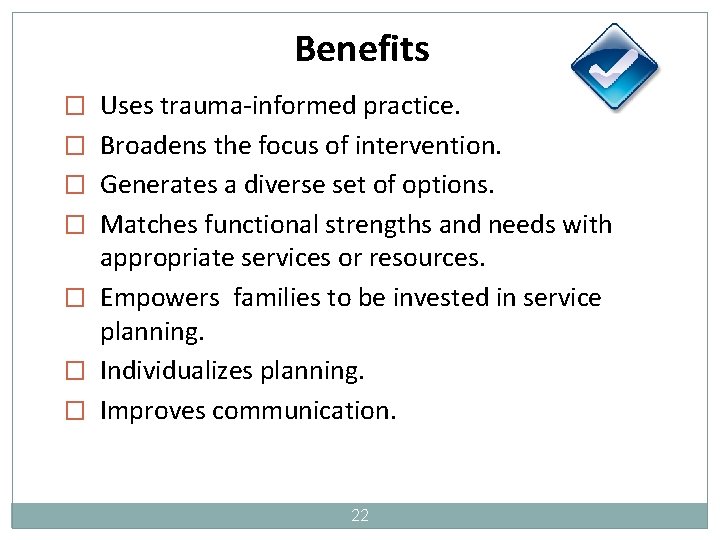
Benefits � Uses trauma-informed practice. � Broadens the focus of intervention. � Generates a diverse set of options. � Matches functional strengths and needs with appropriate services or resources. � Empowers families to be invested in service planning. � Individualizes planning. � Improves communication. 22
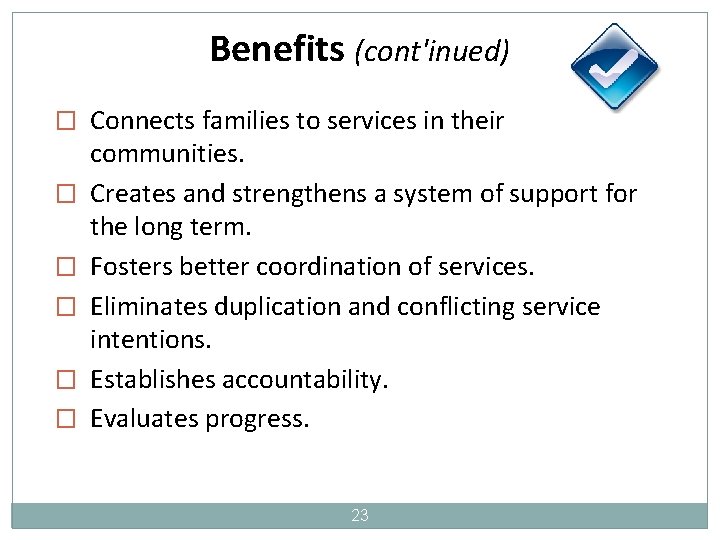
Benefits (cont'inued) � Connects families to services in their � � � communities. Creates and strengthens a system of support for the long term. Fosters better coordination of services. Eliminates duplication and conflicting service intentions. Establishes accountability. Evaluates progress. 23
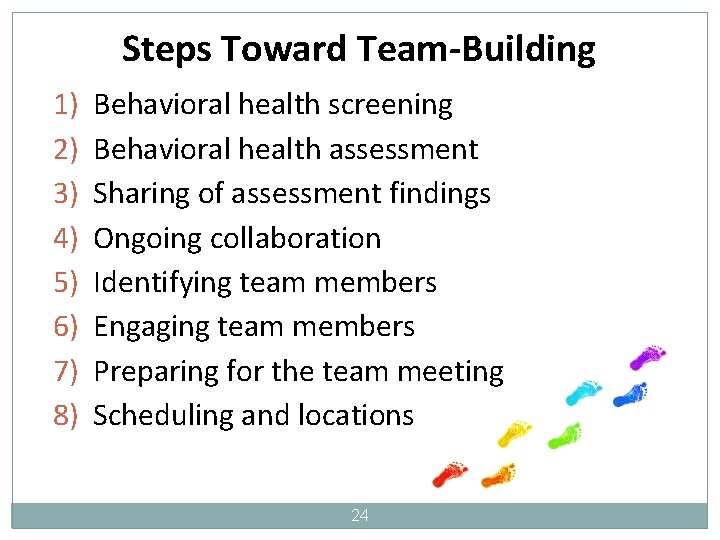
Steps Toward Team-Building 1) 2) 3) 4) 5) 6) 7) 8) Behavioral health screening Behavioral health assessment Sharing of assessment findings Ongoing collaboration Identifying team members Engaging team members Preparing for the team meeting Scheduling and locations 24
Engagement � Youth and parents are meaningfully engaged as pivotal and respected members of the Child and Family Team. � Youth and parent advocates can make substantial contributions to the team. 25
Let’s Practice 26
Positive Outcomes • Teaming and collaboration among agencies, families, and youth promote safety and improved well-being outcomes for children. • A Circle of Support grounds families within their communities and helps them to thrive. • What are your take-aways? 27