
Child and Adult Care Food Program CACFP At


- Slides: 22
Child and Adult Care Food Program (CACFP) At Risk and Outside School Hours Centers
PROMOTING HEALTHY EATING HABITS
Participants Must Be: • Financially Viable – Able to meet financial responsibilities without CACFP reimbursement. • Administratively Capable – Able to operate the Program in accordance with 7 CFR § 226. 6. • Program Accountable – Able to demonstrate sufficient internal controls to ensure Program accountability.
Pre-requisites: • Obtain a vendor code with the State of Maine http: //www. maine. gov/osc/pdf/forms/vendor_ME_w 9_v 4. pdf • Have liability insurance • Obtain a DUNS # https: //iupdate. dnb. com/i. Update/companylookup. htm – Required to receive Federal funds. – Obtain a SIC code from www. siccode. com to obtain a DUNS#
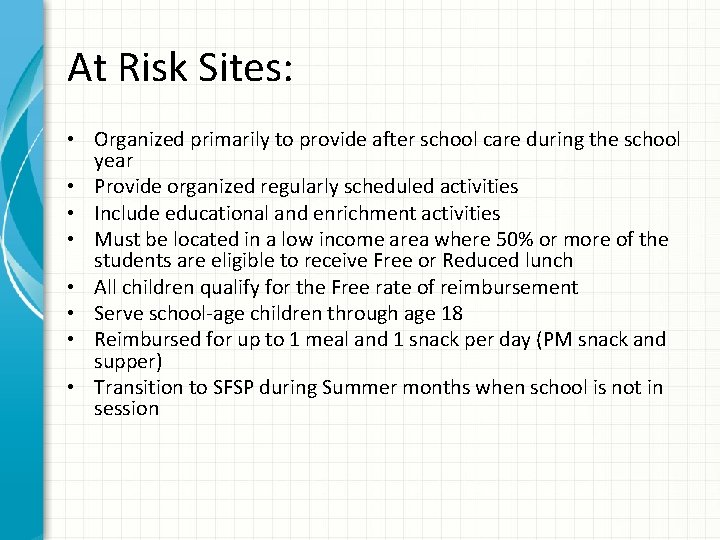
At Risk Sites: • Organized primarily to provide after school care during the school year • Provide organized regularly scheduled activities • Include educational and enrichment activities • Must be located in a low income area where 50% or more of the students are eligible to receive Free or Reduced lunch • All children qualify for the Free rate of reimbursement • Serve school-age children through age 18 • Reimbursed for up to 1 meal and 1 snack per day (PM snack and supper) • Transition to SFSP during Summer months when school is not in session
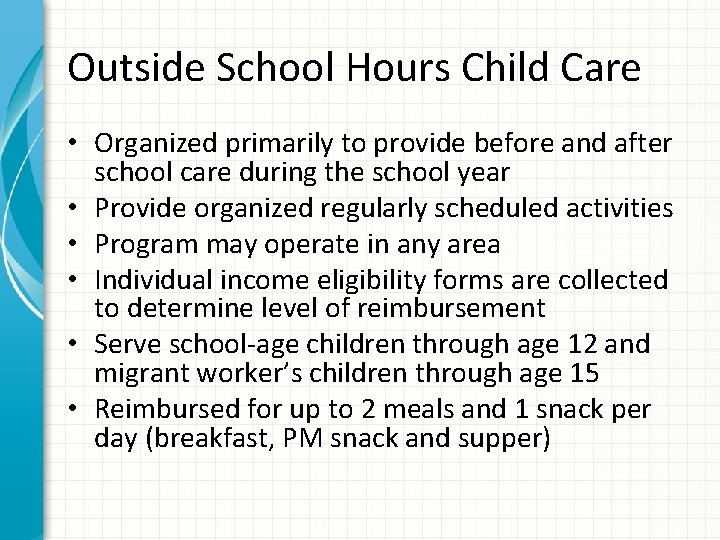
Outside School Hours Child Care • Organized primarily to provide before and after school care during the school year • Provide organized regularly scheduled activities • Program may operate in any area • Individual income eligibility forms are collected to determine level of reimbursement • Serve school-age children through age 12 and migrant worker’s children through age 15 • Reimbursed for up to 2 meals and 1 snack per day (breakfast, PM snack and supper)
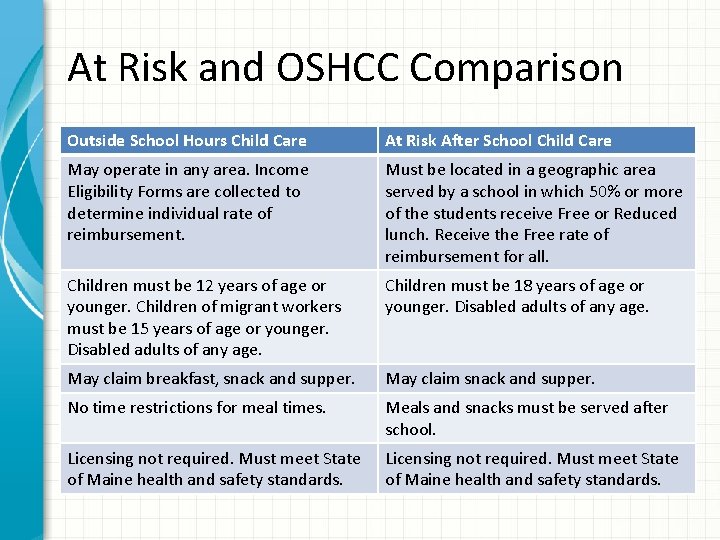
At Risk and OSHCC Comparison Outside School Hours Child Care At Risk After School Child Care May operate in any area. Income Eligibility Forms are collected to determine individual rate of reimbursement. Must be located in a geographic area served by a school in which 50% or more of the students receive Free or Reduced lunch. Receive the Free rate of reimbursement for all. Children must be 12 years of age or younger. Children of migrant workers must be 15 years of age or younger. Disabled adults of any age. Children must be 18 years of age or younger. Disabled adults of any age. May claim breakfast, snack and supper. May claim snack and supper. No time restrictions for meal times. Meals and snacks must be served after school. Licensing not required. Must meet State of Maine health and safety standards.
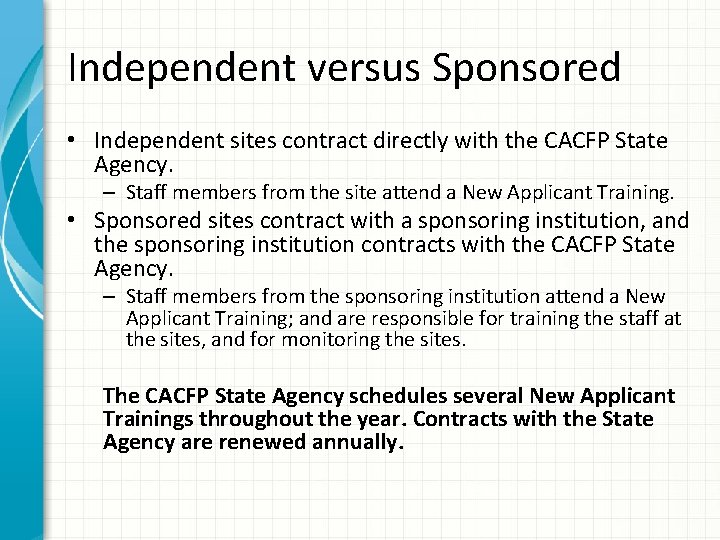
Independent versus Sponsored • Independent sites contract directly with the CACFP State Agency. – Staff members from the site attend a New Applicant Training. • Sponsored sites contract with a sponsoring institution, and the sponsoring institution contracts with the CACFP State Agency. – Staff members from the sponsoring institution attend a New Applicant Training; and are responsible for training the staff at the sites, and for monitoring the sites. The CACFP State Agency schedules several New Applicant Trainings throughout the year. Contracts with the State Agency are renewed annually.
Affiliated versus Unaffiliated Sponsors • Institutions may sponsor both affiliated and unaffiliated sites. • Affiliated sites and the institution are part of the same legal entity. • Unaffiliated sites are not a legal responsibility of the sponsoring institution. However, the sponsor is held responsible if the site is declared seriously deficient in the operation of the CACFP. • Sponsors of unaffiliated sites must be public or private non-profit organizations. • Sponsors may retain up to 15% of the monthly reimbursement for administrative expense.
Meals and Snacks Meet a Pattern • Breakfasts consist of 3 components: Milk; grain; fruit or vegetable • Snacks consist of 2 different components • Lunches and Suppers consist of 5 components – Components: • • • Fluid milk Fruit Vegetables Grain Meat/Meat Alternate
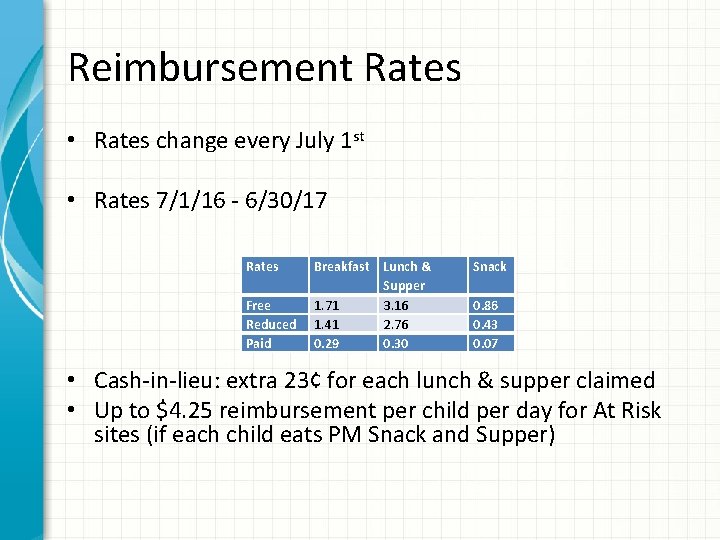
Reimbursement Rates • Rates change every July 1 st • Rates 7/1/16 - 6/30/17 Rates Free Reduced Paid Breakfast Lunch & Supper 1. 71 3. 16 1. 41 2. 76 0. 29 0. 30 Snack 0. 86 0. 43 0. 07 • Cash-in-lieu: extra 23¢ for each lunch & supper claimed • Up to $4. 25 reimbursement per child per day for At Risk sites (if each child eats PM Snack and Supper)
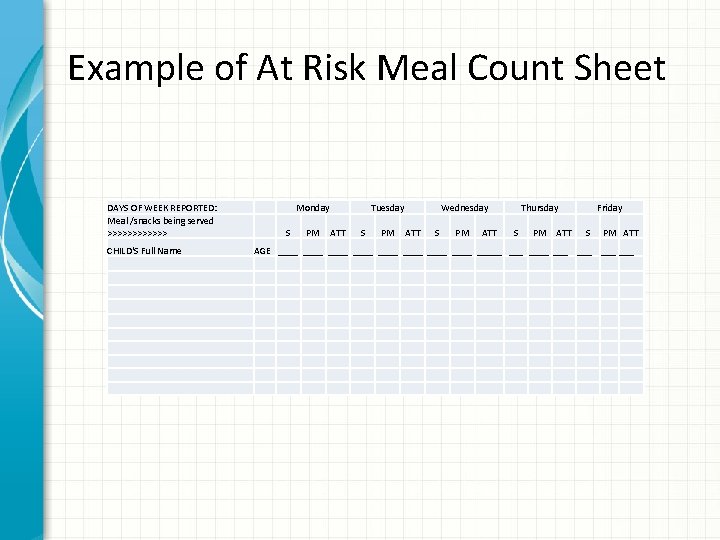
Recordkeeping • Menus meeting meal pattern requirements must be created and posted. • Records showing when each child is in attendance must be kept each day. • Records showing the number of meals/snacks consumed must be kept each day. • Point of Service (POS) meal counts help to reduce count errors. • Race and ethnicity records must be maintained for each child, and collected on an annual basis.
Example of At Risk Meal Count Sheet DAYS OF WEEK REPORTED: Meal /snacks being served >>>>>> Monday CHILD'S Full Name AGE ____ ____ _____ ___ S PM Tuesday ATT S PM Wednesday ATT S PM Thursday ATT S Friday PM ATT S PM ATT
Edit Checks • Menus should be reviewed to double-check compliance with the CACFP meal pattern. • Meal counts should be done at point of service and added daily. • A second count of the number of meals served should be completed before the monthly claim is submitted for reimbursement.
Monthly Claims • Sponsors and independent centers must submit claims for reimbursement to the State Agency each month. • These claims must accurately report the number of meals and snacks served. • Original claims should be postmarked and/or received by the State Agency by the 15 th day of the month following the last day of the month covered by the claim. • Claims will be processed within 45 days of receipt by the State Agency, and a reimbursement payment will be issued.
Financial Management • The entire amount of money received from the CACFP as reimbursement must be spent on CACFP-related expense. • Dated receipts and invoices for food and nonfood service supplies must be kept for a minimum of 3 years plus the current year. • Records must be maintained to track and separate time spent on CACFP-related duties. • CACFP income and expense must be tracked separately from other income and expense.
Required Training • In-house CACFP training must be completed before Program participation and for all new staff with CACFP duties, and annually thereafter, by all relevant staff. • In-house Civil Rights training must be completed before Program participation and for all new staff with CACFP duties, and annually thereafter, by all staff and their immediate supervisor. • In-house training must be documented with a dated agenda and sign-in sheet, that includes the location of the training, for each staff member with food service, CACFP administrative and monitoring duties. • A staff person from each institution must attend a mandatory annual training conducted by the State Agency.
State Agency Oversight • A Pre-approval visit must be conducted by the State Agency before CACFP participation can begin. • Technical Assistance visits will be conducted as needed. • A complete review of Program records and on-site operations will be conducted within the first few months of Program participation and at least every 3 years thereafter.
Reasons that Institutions Don’t Participate in the CACFP • Most institutions running afterschool sites that choose to not participate in the CACFP either: – Lack the funds to pay staff members to purchase, prepare/cook and serve food; create and post menus; oversee the daily collection of attendance records; take point of service meal counts; compile monthly records to complete and submit the claim; implement and employ edit checks to assure that claims are correct and that only meals and snacks containing the required components are claimed for reimbursement; keep accurate records to separate CACFP-related income and expense from other sources of income and expense; perform monitoring duties at each site a minimum of 3 times each year, if a sponsor. – Lack the funds to buy the required components. – Lack the facilities to prepare meals and snacks and to keep cold and hot food at the required temperatures.
QUESTIONS?
Contact Information • Cindy Chase cindy. chase@maine. gov • Androscoggin, Aroostook, Knox, Penobscot, Piscataquis, Sagadahoc, Somerset, Washington, Waldo and Northern Kennebec Counties • Kerri Wyman kerri. wyman@maine. gov • Cumberland, Franklin, Hancock, Lincoln, Oxford, York and Southern Kennebec Counties • The best way to contact us is by email since our jobs take us out of the office on a frequent basis.
In accordance with Federal civil rights law and U. S. Department of Agriculture (USDA) civil rights regulations and policies, the USDA, all its Agencies, offices, and employees, and institutions participating in or administering USDA programs are prohibited from discriminating based on race, color, national origin, sex, disability, age, or reprisal or retaliation for prior civil rights activity in any program or activity conducted or funded by USDA. Persons with disabilities who require alternative means of communication for program information (e. g. Braille, large print, audiotape, American Sign Language, etc. ), should contact the Agency (State or local) where they applied for benefits. Individuals who are deaf, hard of hearing or have speech disabilities may contact USDA through the Federal Relay Service at (800) 877 -8339. Additionally, program information may be made available in languages other than English. To file a program complaint of discrimination, complete the USDA Program Discrimination Complaint Form, (AD 3027) found online at http: //www. ascr. usda. gov/complaint_filing_cust. html , and at any USDA office, or write a letter addressed to USDA and provide in the letter all of the information requested in the form. To request a copy of the complaint form, call (866) 632 -9992. Submit your completed form or letter to USDA by: (1) mail: U. S. Department of Agriculture Office of the Assistant Secretary for Civil Rights 1400 Independence Avenue, SW Washington, D. C. 20250 -9410 (2) fax: (202) 690 -7442; or (3) email: program. intake@usda. gov. This institution is an equal opportunity provider.