
Child Abuse The Hidden Epidemic Copyright Texas Education
Child Abuse: The Hidden Epidemic
Copyright © Texas Education Agency, 2017. These Materials are copyrighted © and trademarked ™ as the property of the Texas Education Agency (TEA) and may not be reproduced without the express written permission of TEA, except under the following conditions: 1) Texas public school districts, charter schools, and Education Service Centers may reproduce and use copies of the Materials and Related Materials for the districts’ and schools’ educational use without obtaining permission from TEA. 2) Residents of the state of Texas may reproduce and use copies of the Materials and Related Materials for individual personal use only, without obtaining written permission of TEA. 3) Any portion reproduced must be reproduced in its entirety and remain unedited, unaltered and unchanged in any way. 4) No monetary charge can be made for the reproduced materials or any document containing them; however, a reasonable charge to cover only the cost of reproduction and distribution may be charged. Private entities or persons located in Texas that are not Texas public school districts, Texas Education Service Centers, or Texas charter schools or any entity, whether public or private, educational or non-educational, located outside the state of Texas MUST obtain written approval from TEA and will be required to enter into a license agreement that may involve the payment of a licensing fee or a royalty. For information contact: Office of Copyrights, Trademarks, License Agreements, and Royalties, Texas Education Agency, 1701 N. Congress Ave. , Austin, TX 78701 -1494; phone 512 -463 -7004; email: copyrights@tea. state. tx. us. Copyright © Texas Education Agency, 2017. All rights reserved. 2
5 children die every day as a result of child abuse. Copyright © Texas Education Agency, 2017. All rights reserved. 3
Instructional Objectives > Analyze reasons for the high rate of child abuse. > Describe the types of abuse and neglect > Determine warning signs for each type of abuse and neglect. > Become aware of the risk factors for child abuse and neglect. > Analyze ways of breaking the cycle of abuse. Copyright © Texas Education Agency, 2017. All rights reserved. 4
Definition of Abuse and Neglect > Child abuse and neglect is defined as being any physical or mental injury, act of sexual abuse or exploitation, negligent treatment, or maltreatment of any child under the age of 18. Copyright © Texas Education Agency, 2017. All rights reserved. 5
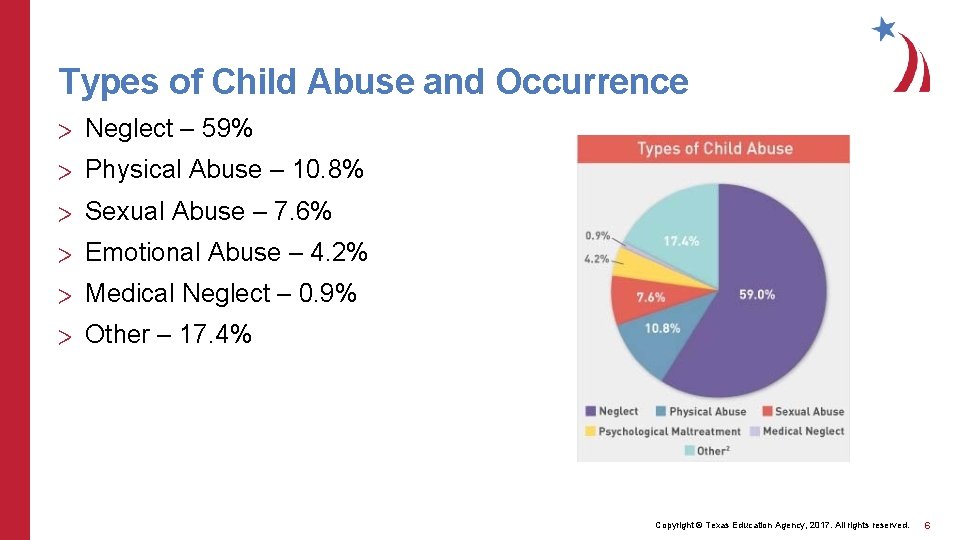
Types of Child Abuse and Occurrence > Neglect – 59% > Physical Abuse – 10. 8% > Sexual Abuse – 7. 6% > Emotional Abuse – 4. 2% > Medical Neglect – 0. 9% > Other – 17. 4% Copyright © Texas Education Agency, 2017. All rights reserved. 6
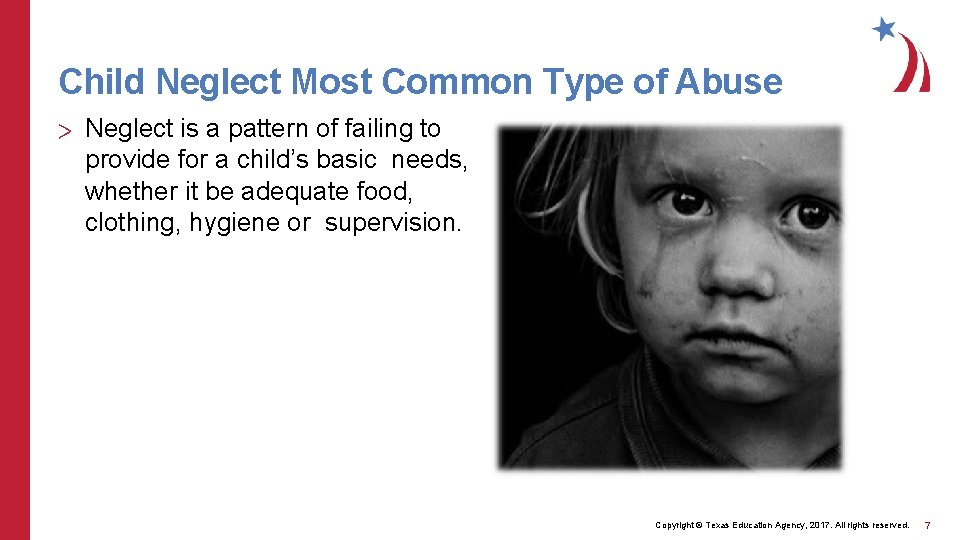
Child Neglect Most Common Type of Abuse > Neglect is a pattern of failing to provide for a child’s basic needs, whether it be adequate food, clothing, hygiene or supervision. Copyright © Texas Education Agency, 2017. All rights reserved. 7
Warning Signs of Neglect in Children > Clothes are ill-fitting or dirty > Hygiene is consistently poor > Untreated illnesses and physical injuries > Frequently unsupervised > Frequently late or missing from school Copyright © Texas Education Agency, 2017. All rights reserved. 8
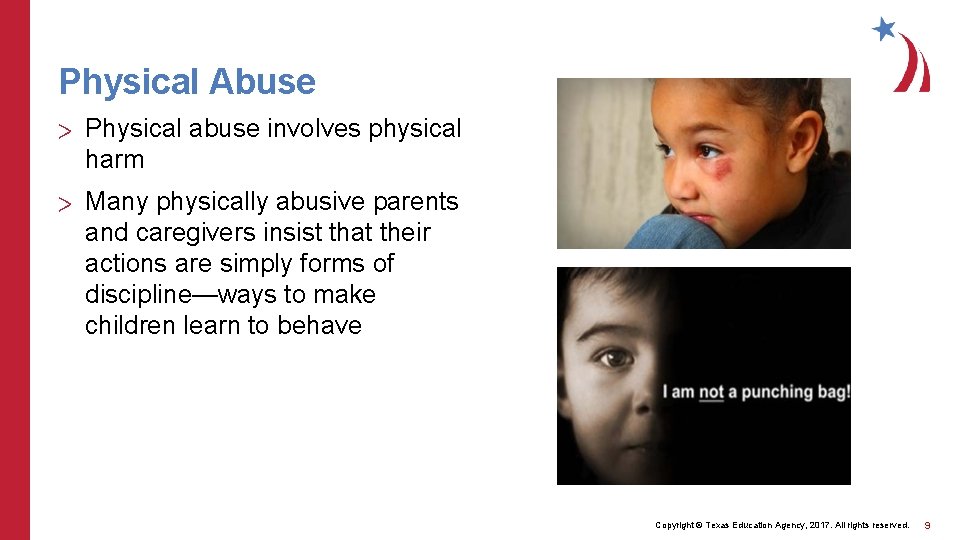
Physical Abuse > Physical abuse involves physical harm > Many physically abusive parents and caregivers insist that their actions are simply forms of discipline—ways to make children learn to behave Copyright © Texas Education Agency, 2017. All rights reserved. 9
Warning Signs of Physical Abuse in Children > Frequent injuries > Always watchful and “on alert, ” > Injuries appear to have a pattern > Shies away from touch > Wears inappropriate clothes Copyright © Texas Education Agency, 2017. All rights reserved. 10
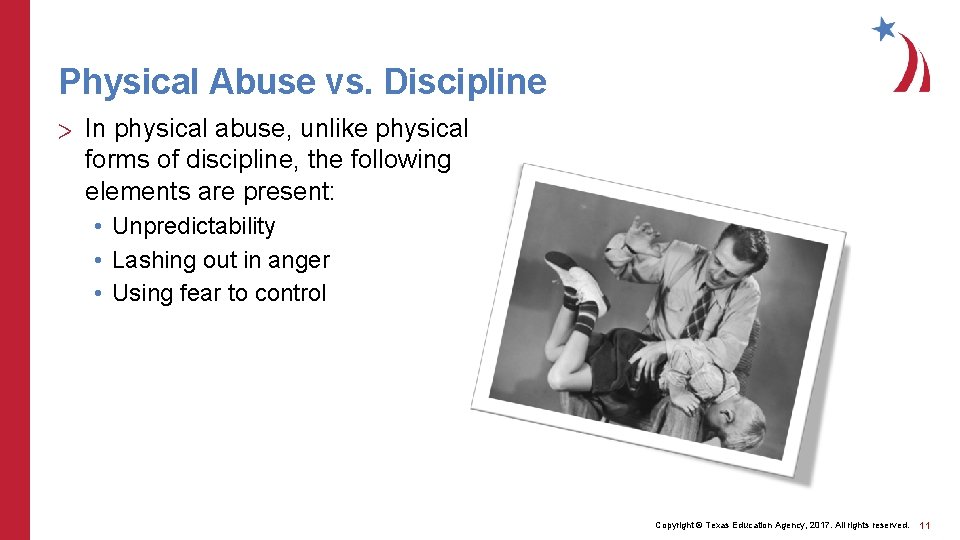
Physical Abuse vs. Discipline > In physical abuse, unlike physical forms of discipline, the following elements are present: • Unpredictability • Lashing out in anger • Using fear to control Copyright © Texas Education Agency, 2017. All rights reserved. 11
They may forget what you said, but they will never forget how you made them feel. Copyright © Texas Education Agency, 2017. All rights reserved. 12
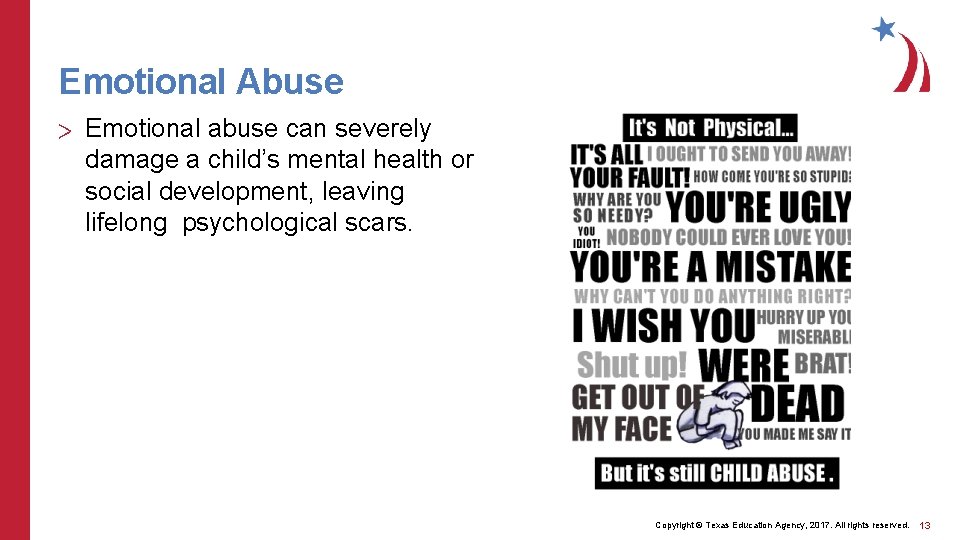
Emotional Abuse > Emotional abuse can severely damage a child’s mental health or social development, leaving lifelong psychological scars. Copyright © Texas Education Agency, 2017. All rights reserved. 13
Examples of Emotional Child Abuse include: > Constant belittling > Calling child inappropriate names > Telling a child he or she is “no good" > Frequent yelling > Ignoring or rejecting a child as punishment > Limited physical contact with the > Exposing the child to violence or the abuse of others Copyright © Texas Education Agency, 2017. All rights reserved. 14
Warning Signs of Emotional Abuse in Children > Excessively withdrawn > Shows extremes in behavior > Appears detached from parent /caregiver > Acts inappropriately adult or inappropriately infantile Copyright © Texas Education Agency, 2017. All rights reserved. 15
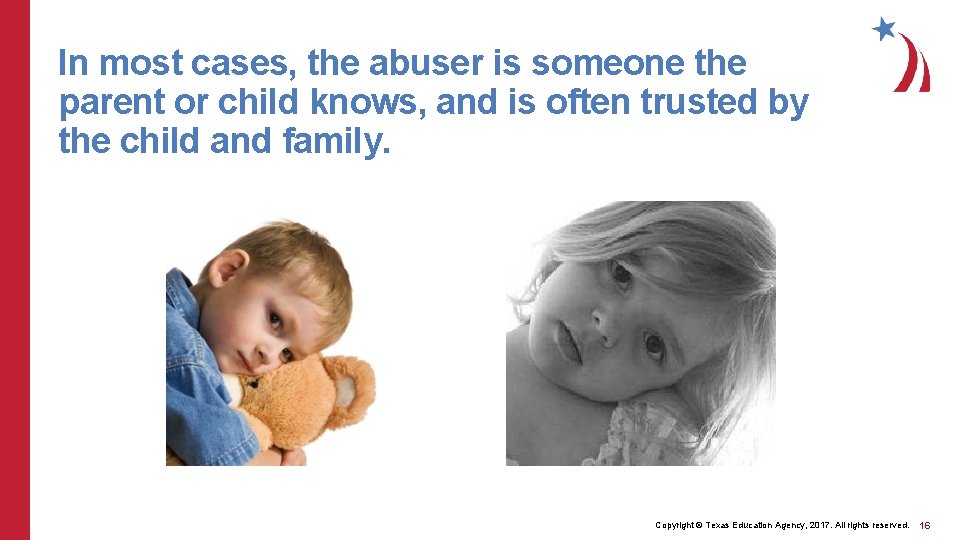
In most cases, the abuser is someone the parent or child knows, and is often trusted by the child and family. Copyright © Texas Education Agency, 2017. All rights reserved. 16
Sexual Abuse > An act which forces, coerces, or threatens a child to engage in sexual activity. Copyright © Texas Education Agency, 2017. All rights reserved. 17
Warning Signs of Sexual Abuse in Children > Trouble walking or sitting > Displays knowledge or interest in sexual acts inappropriate to his or her age, or even seductive behavior > Makes strong efforts to avoid a specific person, without an obvious reason > Doesn’t want to change clothes in front of others or participate in physical activities > An STD or pregnancy, especially under the age of 14 > Runs away from home Copyright © Texas Education Agency, 2017. All rights reserved. 18
Risk Factors for Child Abuse and Neglect > Domestic violence > Alcohol and drug abuse > Untreated mental illness > Lack of parenting skills > Stress and lack of support Copyright © Texas Education Agency, 2017. All rights reserved. 19
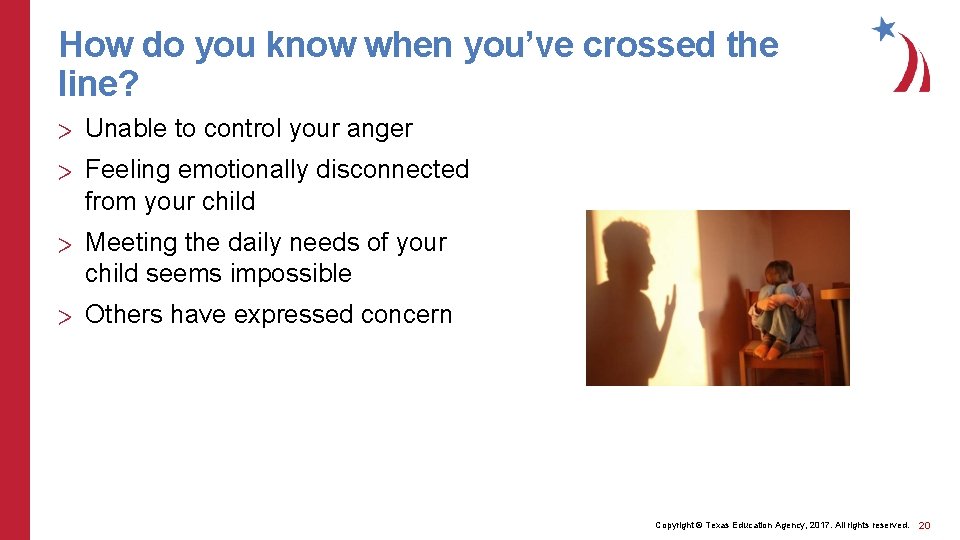
How do you know when you’ve crossed the line? > Unable to control your anger > Feeling emotionally disconnected from your child > Meeting the daily needs of your child seems impossible > Others have expressed concern Copyright © Texas Education Agency, 2017. All rights reserved. 20
Breaking the cycle of Child Abuse > Tips for changing your reactions: • Learn what is and is not age appropriate • Develop new parenting skills • Take care of yourself • Get professional help • Learn strategies to get your emotions under control Copyright © Texas Education Agency, 2017. All rights reserved. 21
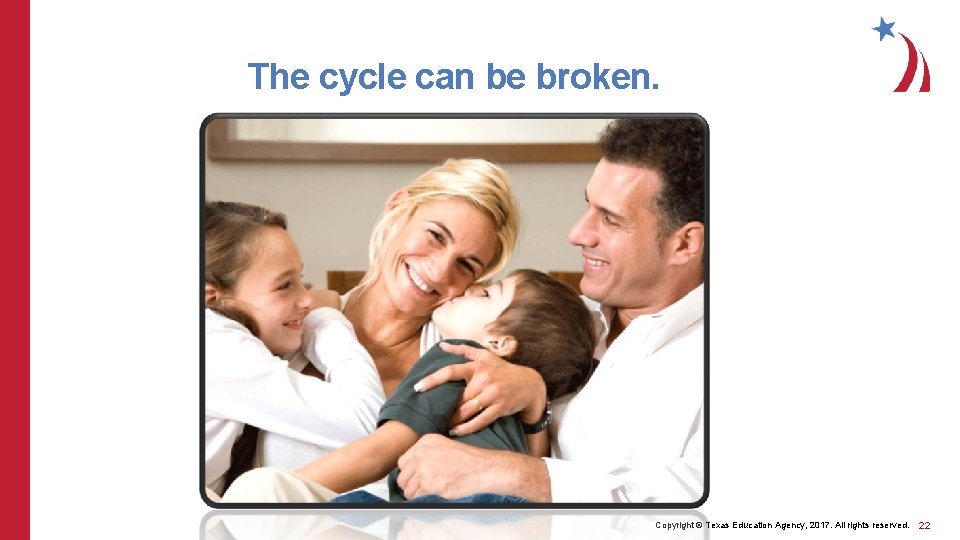
The cycle can be broken. Copyright © Texas Education Agency, 2017. All rights reserved. 22
References/Resources > Websites • www. helpguide. org • www. preventchildabuse. org • www. childhelp. org Copyright © Texas Education Agency, 2017. All rights reserved. 23
- Slides: 23