
CHIEF FINANCIAL OFFICERS FORUM IRREGULAR EXPENDITURE FRAMEWORK Office
- Slides: 21
CHIEF FINANCIAL OFFICERS FORUM IRREGULAR EXPENDITURE FRAMEWORK Office of the Accountant General: Governance Monitoring & Compliance Presenter: Moipone Ramoipone | National Treasury | 12 February 2018
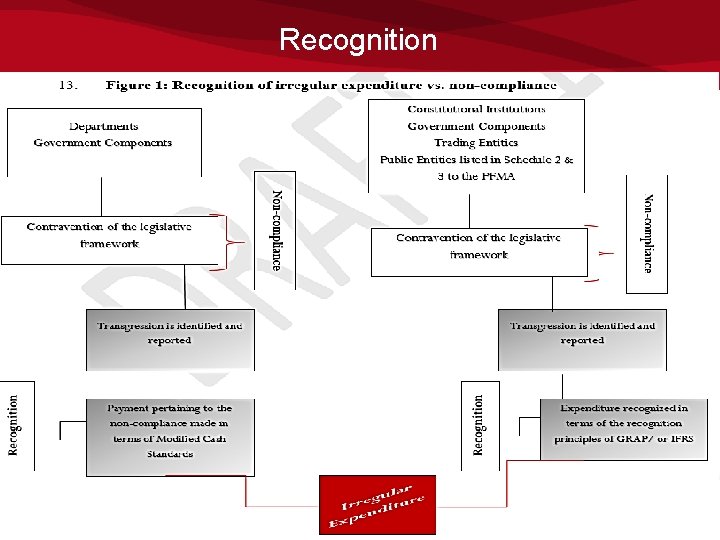
Recognition 2
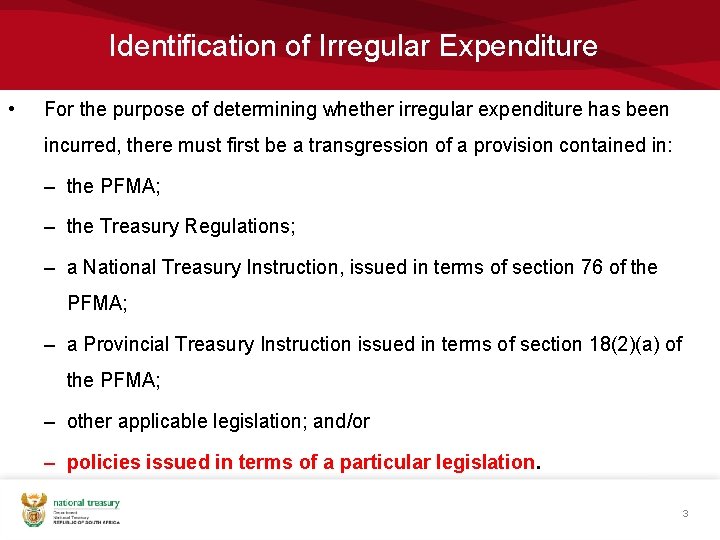
Identification of Irregular Expenditure • For the purpose of determining whether irregular expenditure has been incurred, there must first be a transgression of a provision contained in: – the PFMA; – the Treasury Regulations; – a National Treasury Instruction, issued in terms of section 76 of the PFMA; – a Provincial Treasury Instruction issued in terms of section 18(2)(a) of the PFMA; – other applicable legislation; and/or – policies issued in terms of a particular legislation. 3
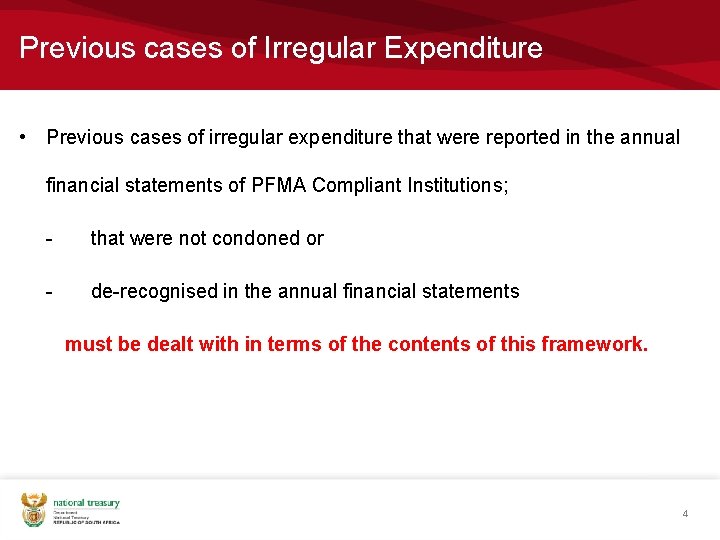
Previous cases of Irregular Expenditure • Previous cases of irregular expenditure that were reported in the annual financial statements of PFMA Compliant Institutions; - that were not condoned or - de-recognised in the annual financial statements must be dealt with in terms of the contents of this framework. 4
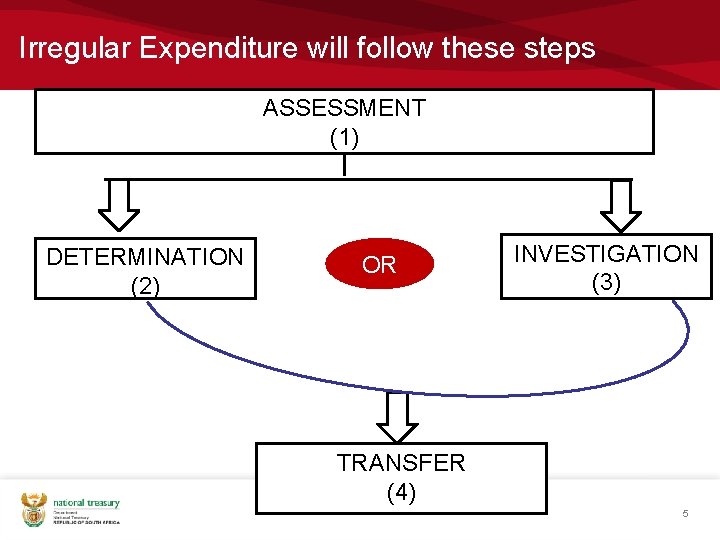
Irregular Expenditure will follow these steps ASSESSMENT (1) DETERMINATION (2) OR INVESTIGATION (3) TRANSFER (4) 5
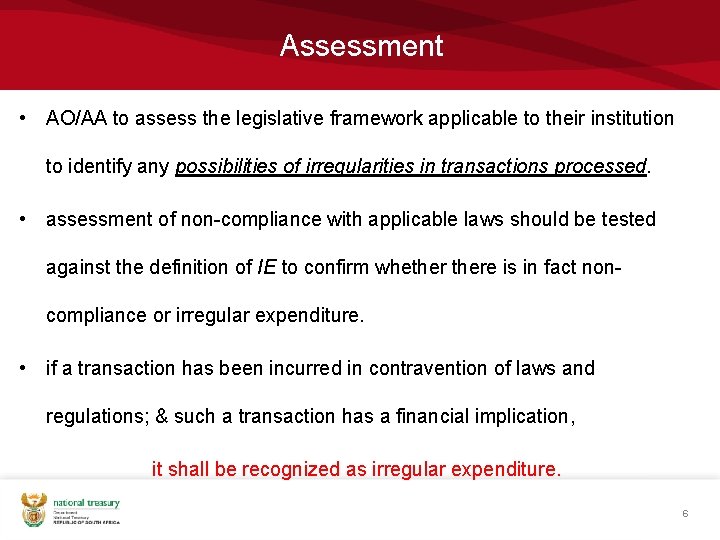
Assessment • AO/AA to assess the legislative framework applicable to their institution to identify any possibilities of irregularities in transactions processed. • assessment of non-compliance with applicable laws should be tested against the definition of IE to confirm whethere is in fact noncompliance or irregular expenditure. • if a transaction has been incurred in contravention of laws and regulations; & such a transaction has a financial implication, it shall be recognized as irregular expenditure. 6
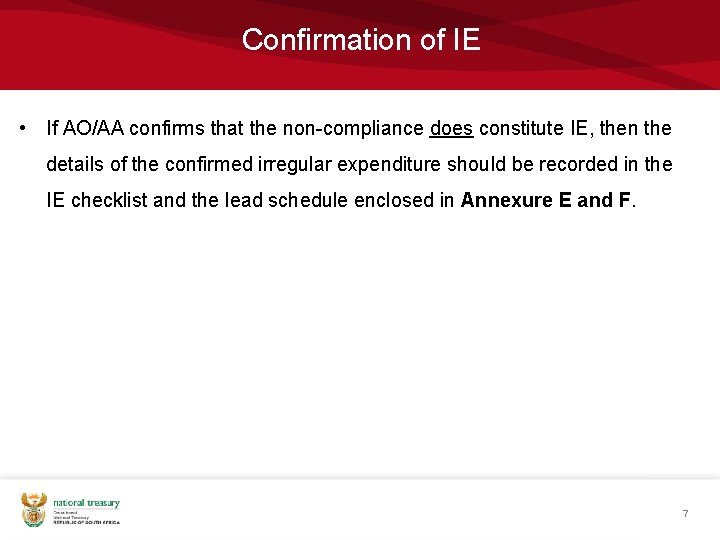
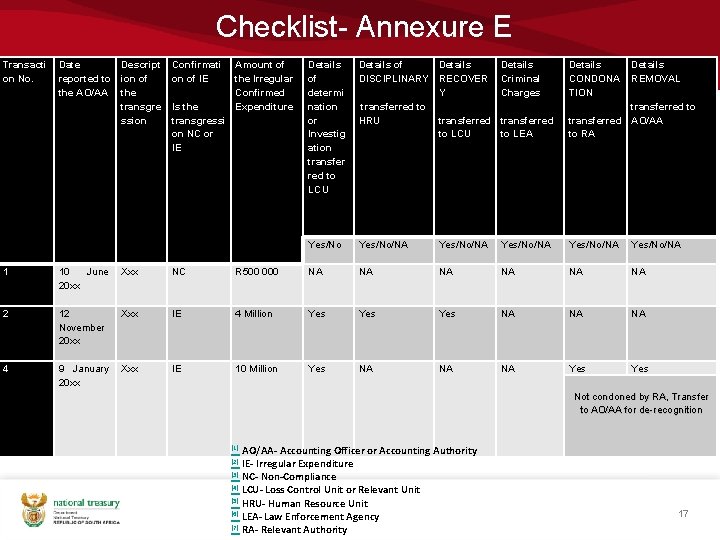
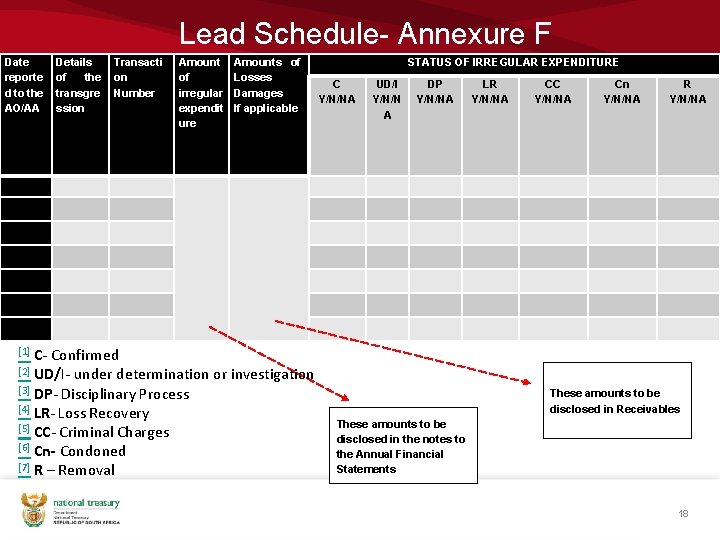
Confirmation of IE • If AO/AA confirms that the non-compliance does constitute IE, then the details of the confirmed irregular expenditure should be recorded in the IE checklist and the lead schedule enclosed in Annexure E and F. 7
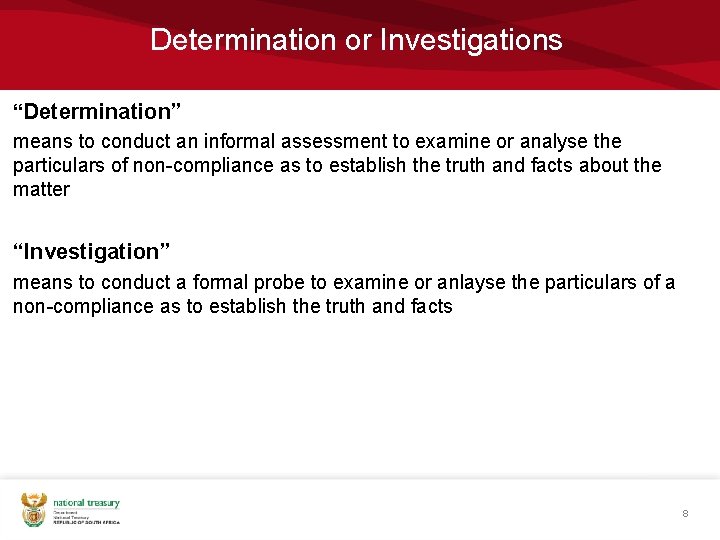
Determination or Investigations “Determination” means to conduct an informal assessment to examine or analyse the particulars of non-compliance as to establish the truth and facts about the matter “Investigation” means to conduct a formal probe to examine or anlayse the particulars of a non-compliance as to establish the truth and facts 8
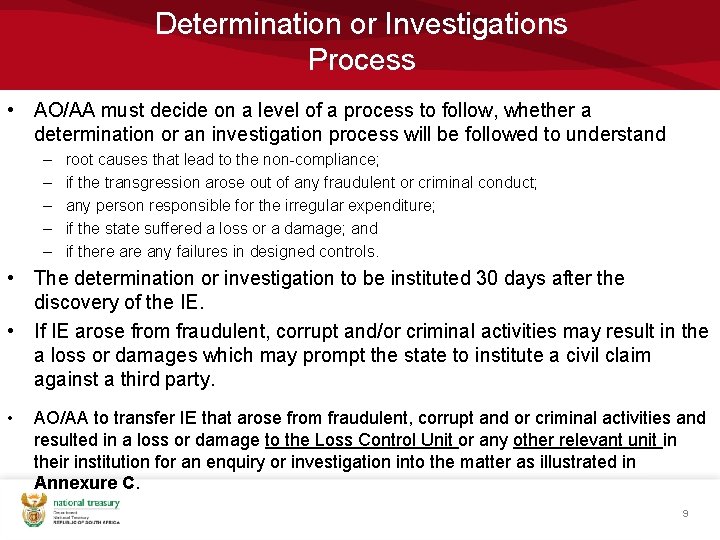
Determination or Investigations Process • AO/AA must decide on a level of a process to follow, whether a determination or an investigation process will be followed to understand – – – root causes that lead to the non-compliance; if the transgression arose out of any fraudulent or criminal conduct; any person responsible for the irregular expenditure; if the state suffered a loss or a damage; and if there any failures in designed controls. • The determination or investigation to be instituted 30 days after the discovery of the IE. • If IE arose from fraudulent, corrupt and/or criminal activities may result in the a loss or damages which may prompt the state to institute a civil claim against a third party. • AO/AA to transfer IE that arose from fraudulent, corrupt and or criminal activities and resulted in a loss or damage to the Loss Control Unit or any other relevant unit in their institution for an enquiry or investigation into the matter as illustrated in Annexure C. 9
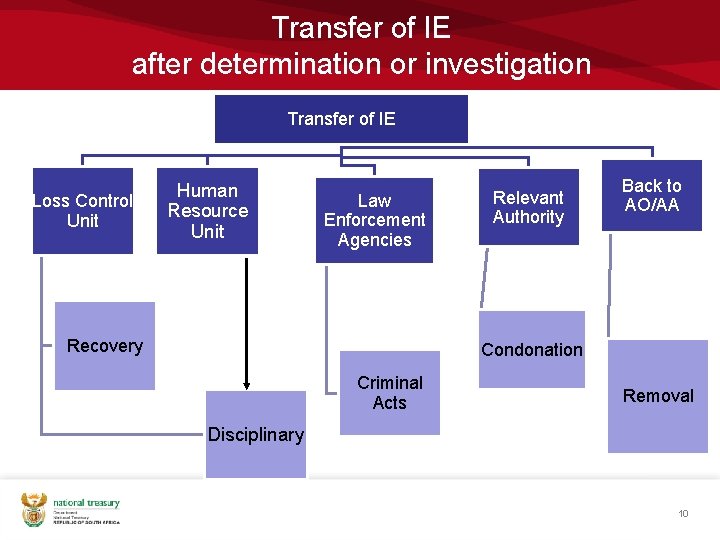
Transfer of IE after determination or investigation Transfer of IE Loss Control Unit Human Resource Unit Law Enforcement Agencies Recovery Relevant Authority Back to AO/AA Condonation Criminal Acts Removal Disciplinary 10
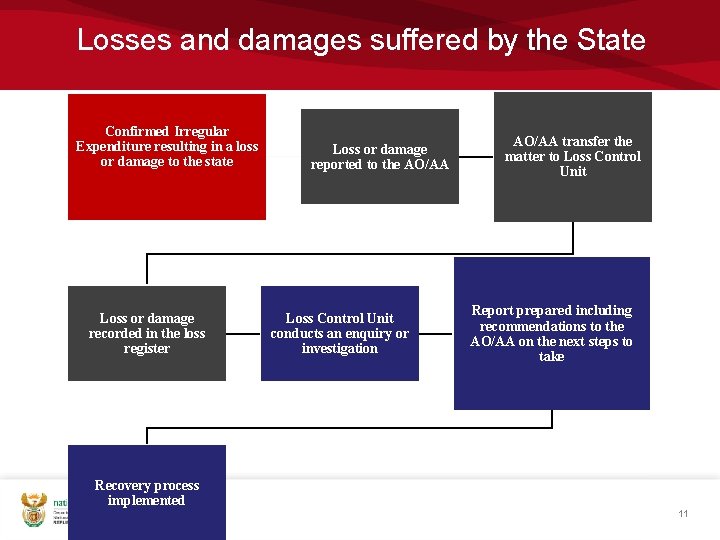
Losses and damages suffered by the State Confirmed Irregular Expenditure resulting in a loss or damage to the state Loss or damage recorded in the loss register Loss or damage reported to the AO/AA Loss Control Unit conducts an enquiry or investigation AO/AA transfer the matter to Loss Control Unit Report prepared including recommendations to the AO/AA on the next steps to take Recovery process implemented 11
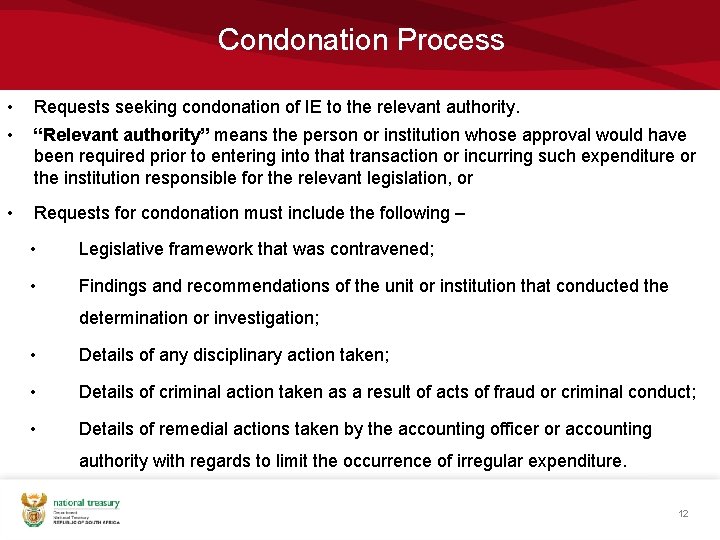
Condonation Process • Requests seeking condonation of IE to the relevant authority. • “Relevant authority” means the person or institution whose approval would have been required prior to entering into that transaction or incurring such expenditure or the institution responsible for the relevant legislation, or • Requests for condonation must include the following – • Legislative framework that was contravened; • Findings and recommendations of the unit or institution that conducted the determination or investigation; • Details of any disciplinary action taken; • Details of criminal action taken as a result of acts of fraud or criminal conduct; • Details of remedial actions taken by the accounting officer or accounting authority with regards to limit the occurrence of irregular expenditure. 12
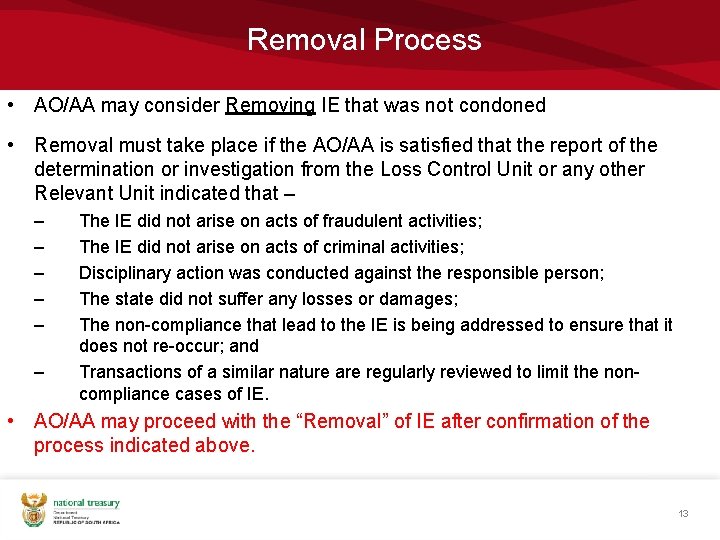
Removal Process • AO/AA may consider Removing IE that was not condoned • Removal must take place if the AO/AA is satisfied that the report of the determination or investigation from the Loss Control Unit or any other Relevant Unit indicated that – – – – The IE did not arise on acts of fraudulent activities; The IE did not arise on acts of criminal activities; Disciplinary action was conducted against the responsible person; The state did not suffer any losses or damages; The non-compliance that lead to the IE is being addressed to ensure that it does not re-occur; and Transactions of a similar nature are regularly reviewed to limit the noncompliance cases of IE. • AO/AA may proceed with the “Removal” of IE after confirmation of the process indicated above. 13
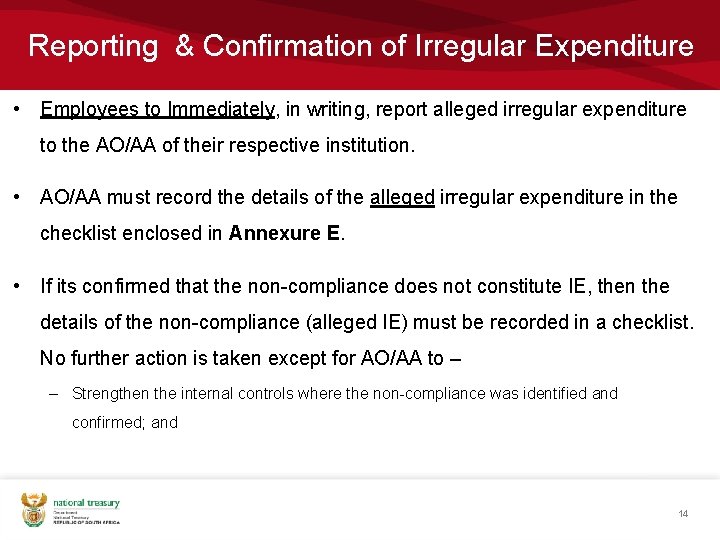
Reporting & Confirmation of Irregular Expenditure • Employees to Immediately, in writing, report alleged irregular expenditure to the AO/AA of their respective institution. • AO/AA must record the details of the alleged irregular expenditure in the checklist enclosed in Annexure E. • If its confirmed that the non-compliance does not constitute IE, then the details of the non-compliance (alleged IE) must be recorded in a checklist. No further action is taken except for AO/AA to – – Strengthen the internal controls where the non-compliance was identified and confirmed; and 14
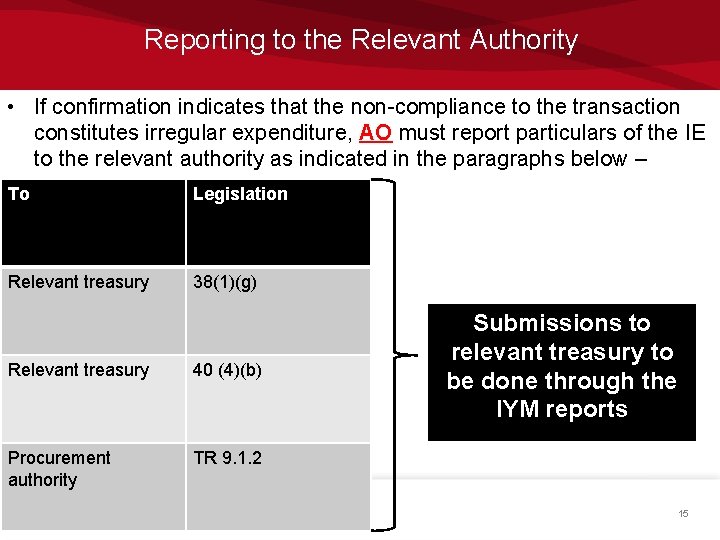
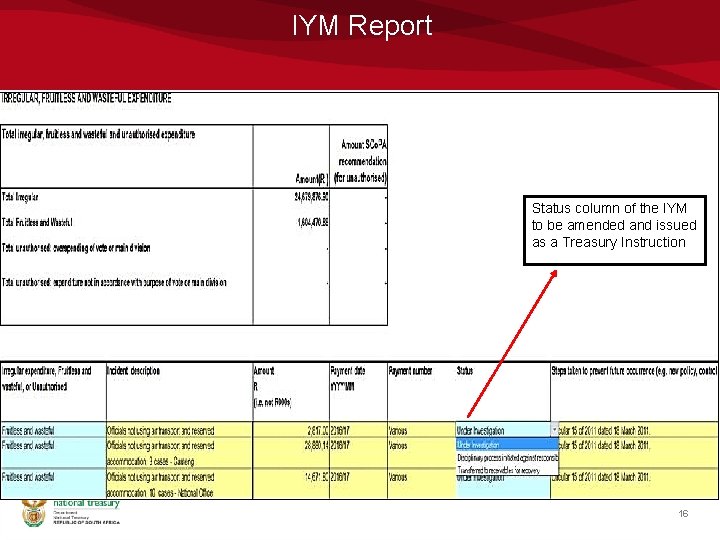
Reporting to the Relevant Authority • If confirmation indicates that the non-compliance to the transaction constitutes irregular expenditure, AO must report particulars of the IE to the relevant authority as indicated in the paragraphs below – To Legislation Relevant treasury 38(1)(g) Relevant treasury 40 (4)(b) Procurement authority TR 9. 1. 2 Submissions to relevant treasury to be done through the IYM reports 15
IYM Report Status column of the IYM to be amended and issued as a Treasury Instruction 16
Checklist- Annexure E Transacti on No. Date Descript reported to ion of the AO/AA the transgre ssion Confirmati on of IE Is the transgressi on NC or IE Amount of the Irregular Confirmed Expenditure Details of determi nation or Investig ation transfer red to LCU Yes/No Details of Details DISCIPLINARY RECOVER Y transferred to HRU transferred to LCU Details Criminal Charges Details CONDONA TION Details REMOVAL transferred to LEA transferred to transferred AO/AA to RA Yes/No/NA Yes/No/NA 1 10 June Xxx 20 xx NC R 500 000 NA NA NA 2 12 November 20 xx Xxx IE 4 Million Yes Yes NA NA NA 4 9 January Xxx 20 xx IE 10 Million Yes NA NA NA Yes Not condoned by RA, Transfer to AO/AA for de-recognition AO/AA- Accounting Officer or Accounting Authority IE- Irregular Expenditure [3] NC- Non-Compliance [4] LCU- Loss Control Unit or Relevant Unit [5] HRU- Human Resource Unit [6] LEA- Law Enforcement Agency [7] RA- Relevant Authority [1] [2] 17
Lead Schedule- Annexure F Date reporte d to the AO/AA Details Transacti of the on transgre Number ssion Amount of irregular expendit ure Amounts of Losses Damages If applicable STATUS OF IRREGULAR EXPENDITURE C Y/N/NA UD/I Y/N/N A DP Y/N/NA C- Confirmed UD/I- under determination or investigation [3] DP- Disciplinary Process [4] LR- Loss Recovery [5] CC- Criminal Charges [6] Cn- Condoned [7] R – Removal LR Y/N/NA CC Y/N/NA Cn Y/N/NA R Y/N/NA [1] [2] These amounts to be disclosed in Receivables These amounts to be disclosed in the notes to the Annual Financial Statements 18
CASE STUDY DISCUSSIONS Separate annexure 19
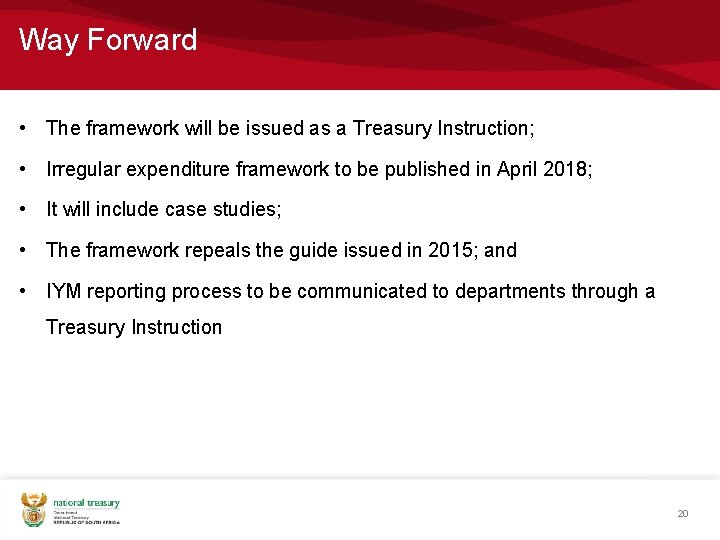
Way Forward • The framework will be issued as a Treasury Instruction; • Irregular expenditure framework to be published in April 2018; • It will include case studies; • The framework repeals the guide issued in 2015; and • IYM reporting process to be communicated to departments through a Treasury Instruction 20
THE END Moipone Ramoipone National Treasury Office of the Accountant-General Tel: 012 315 5532 E-mail address: Moipone. ramoipone@treasury. gov. za Website: http: //www. treasury. gov. za/legislation/PFMA/default. aspx Query Portal: http: //pfmportal. treasury. gov. za/Pages/Splash. aspx Centralized email: OAGqueries@treasury. gov. za