
Chi square test of independence Eyeball differences between
Chi square test of independence • Eyeball differences between percentages: large enough to be “important” • Better: Are they statistically significant? • Statistical significance: are observed differences significantly different from zero that they could not occur by chance?
Chi square test of independence • Statistical significance: often used as measure of substantive importance • But, statistical significance and importance are theoretically distinct • Some differences can be statistically significant but not very important substantively
Chi square test of independence • Chi square test of independence: cross classification tables • Chi square test: are two variables statistically associated ? • Are differences in sample likely to persist in the population?
Association • Association: two variables covary, either positively or negatively • Test for significant association: compare observed frequencies to a model that assumes statistical independence
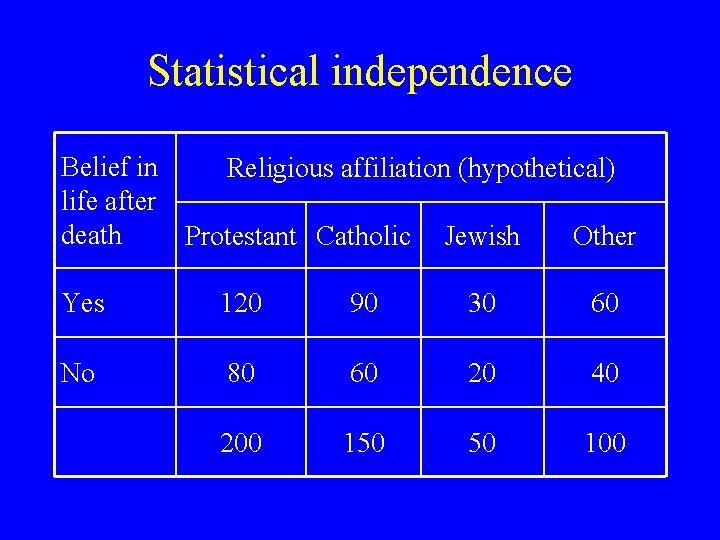
Statistical independence Belief in Religious affiliation (hypothetical) life after death Protestant Catholic Jewish Other Yes 120 90 30 60 No 80 60 20 40 200 150 50 100
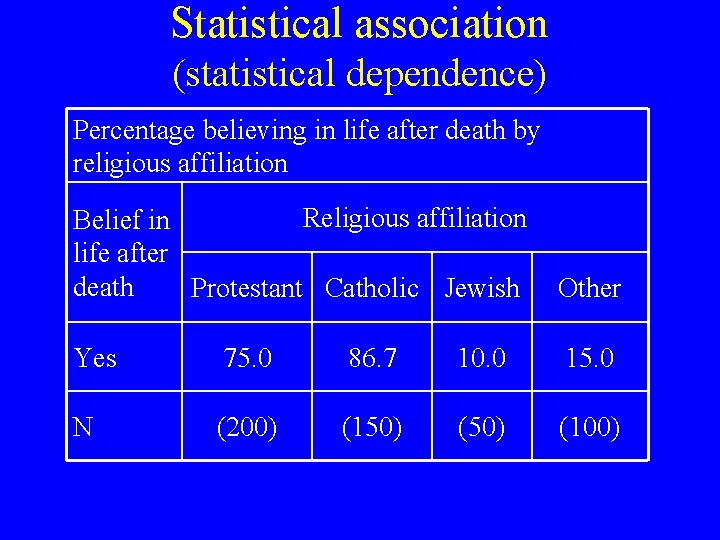
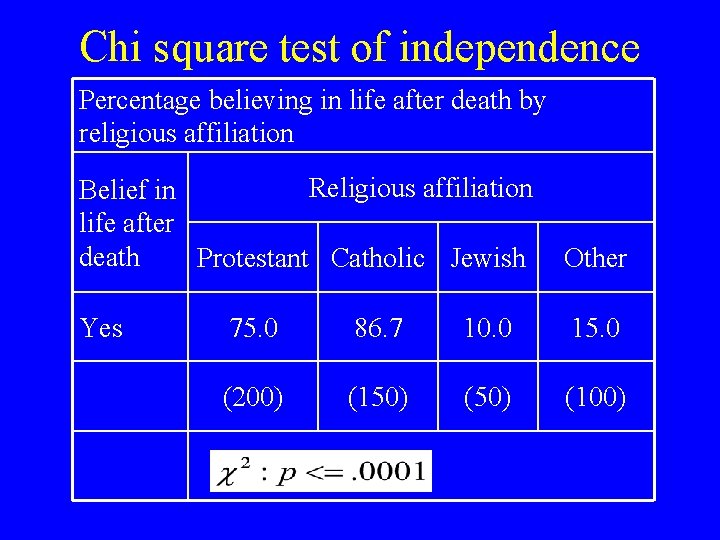
Statistical association (statistical dependence) Percentage believing in life after death by religious affiliation Religious affiliation Belief in life after death Protestant Catholic Jewish Other Yes 75. 0 86. 7 10. 0 15. 0 N (200) (150) (100)
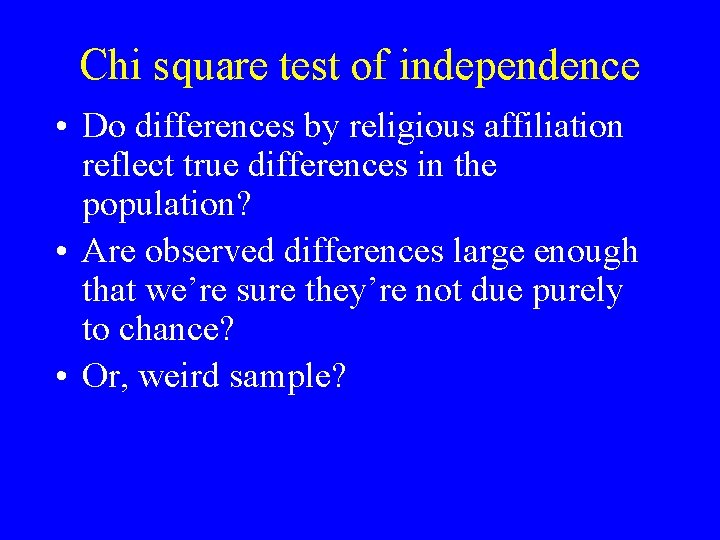
Chi square test of independence • Do differences by religious affiliation reflect true differences in the population? • Are observed differences large enough that we’re sure they’re not due purely to chance? • Or, weird sample?
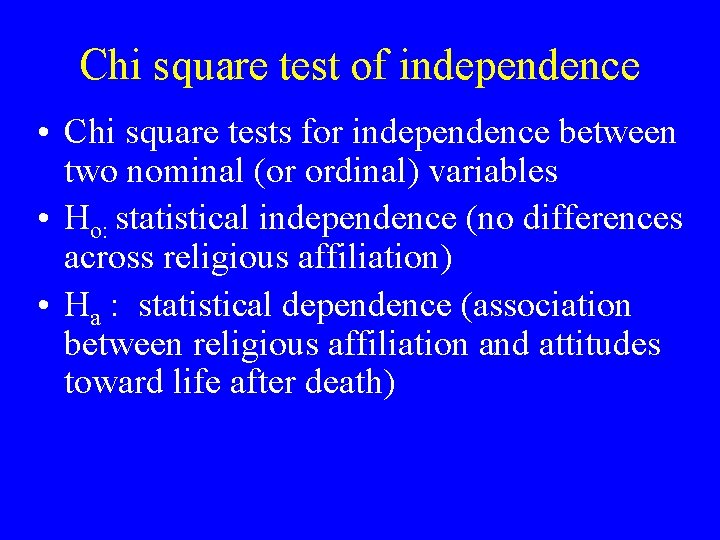
Chi square test of independence • Chi square tests for independence between two nominal (or ordinal) variables • Ho: statistical independence (no differences across religious affiliation) • Ha : statistical dependence (association between religious affiliation and attitudes toward life after death)
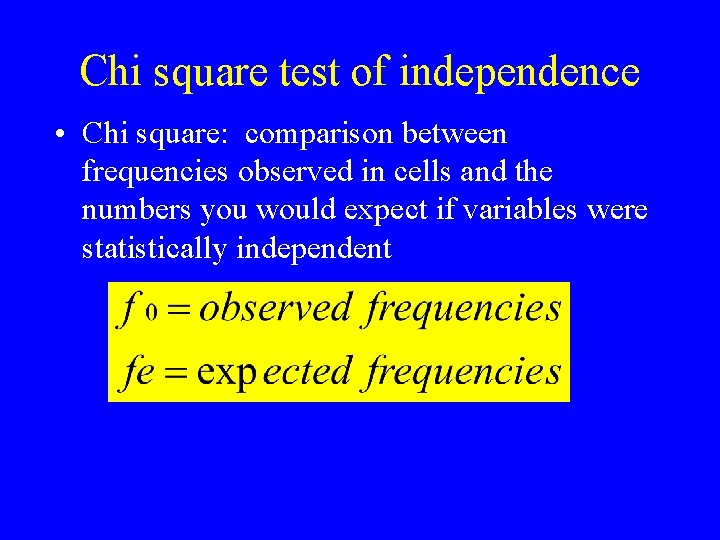
Chi square test of independence • Chi square: comparison between frequencies observed in cells and the numbers you would expect if variables were statistically independent
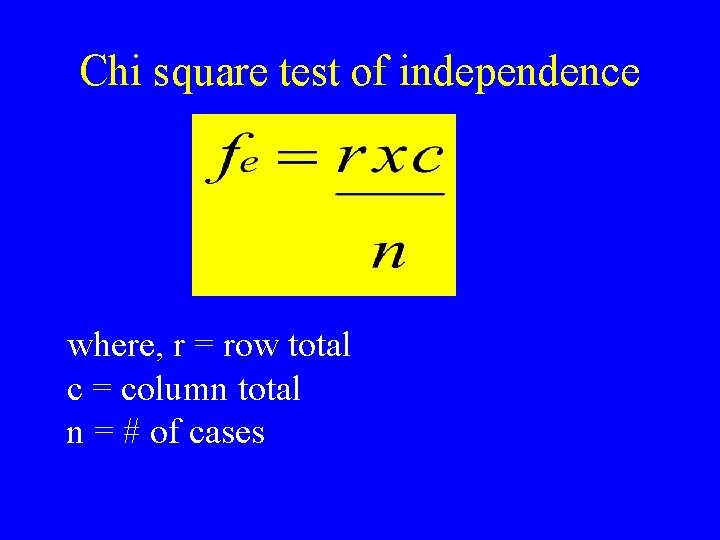
Chi square test of independence where, r = row total c = column total n = # of cases

Calculating chi square: observed frequencies Belief in life after death Religious affiliation Prot. Cath. Jewish Other Row totals Yes 150 130 5 15 300 No 50 20 45 85 200 Column totals 200 150 50 100 500
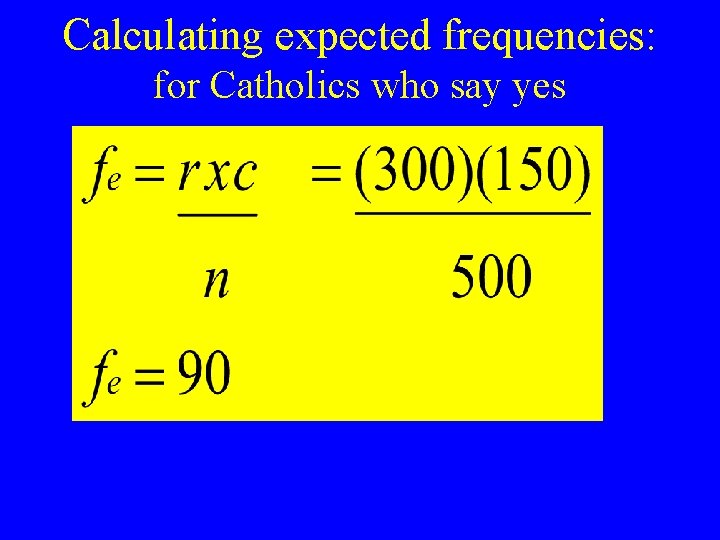
Calculating expected frequencies: for Catholics who say yes
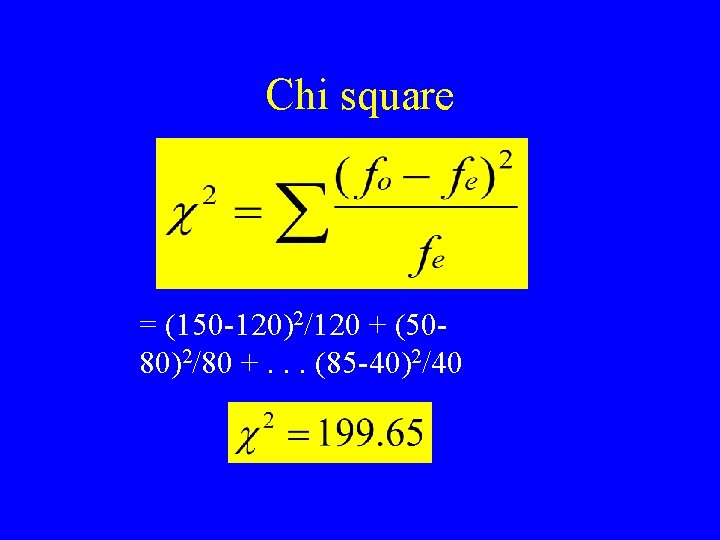
Chi square = (150 -120)2/120 + (5080)2/80 +. . . (85 -40)2/40
Chi square: evaluation • If H 0 of no association is true, then fo and fe will be close and the chi square value small • If H 0 of no association is false, fo and fe should be relatively farther apart, and hence the chi square value larger • Chi square value = 0 when fo = fe

Chi square evaluation made easy • How big is 2 = 199. 65? • Evaluate relative to degrees of freedom for the table (a measure of the number of rows and columns) • Also sensitive to sample size (the larger the N the greater the statistic)

How big is 2 = 199. 65? • Decide on how confident you want to be that the null hypothesis (H 0) is false • Typically, either 95% or 99% confident • If 95%, then possibility of error is. 05 • If 99%, then possibility of error is. 01 • Let’s assume. 05 level of error
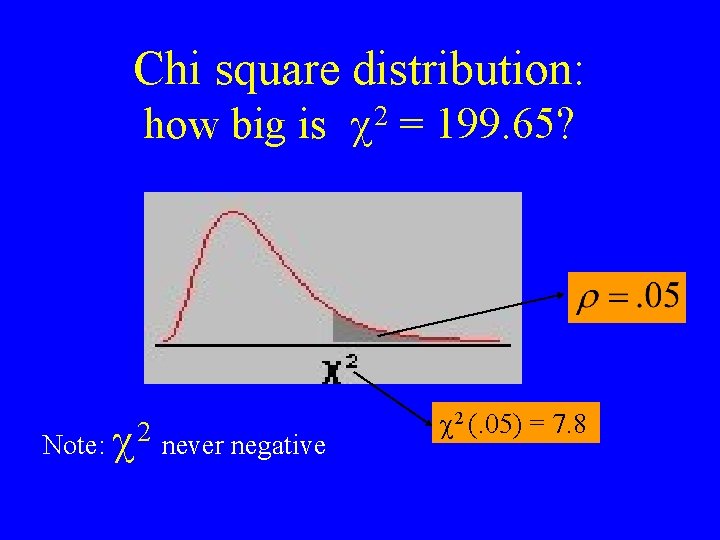
Chi square distribution: how big is 2 = 199. 65? Note: 2 never negative 2 (. 05) = 7. 8

Chi square distribution: how big is 2 = 199. 65? • GSS provides p values for you • Want p <=. 05 (indicates significance) • p = probability, when H 0 is true, of getting a value at least as large as the observed 2
Chi square test of independence Percentage believing in life after death by religious affiliation Religious affiliation Belief in life after death Protestant Catholic Jewish Other Yes 75. 0 86. 7 10. 0 15. 0 (200) (150) (100)
Interpretation Substantively: Religious affiliation is significantly associated with belief in life after death
- Slides: 20