
Chi square Sign test Significance values and appropriate





- Slides: 20
Chi square Sign test Significance values and appropriate symbols (= ≤ < > ≥) Inferential Statistics
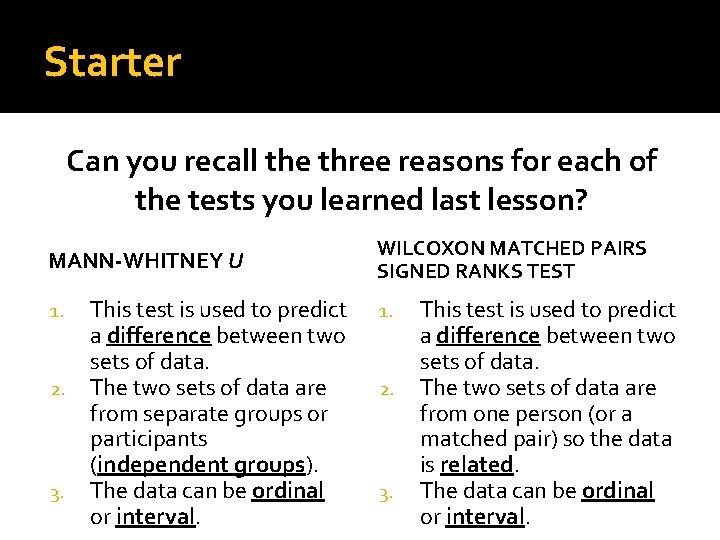
Starter Can you recall the three reasons for each of the tests you learned last lesson? MANN-WHITNEY U 1. 2. 3. This test is used to predict a difference between two sets of data. The two sets of data are from separate groups or participants (independent groups). The data can be ordinal or interval. WILCOXON MATCHED PAIRS SIGNED RANKS TEST 1. 2. 3. This test is used to predict a difference between two sets of data. The two sets of data are from one person (or a matched pair) so the data is related. The data can be ordinal or interval.
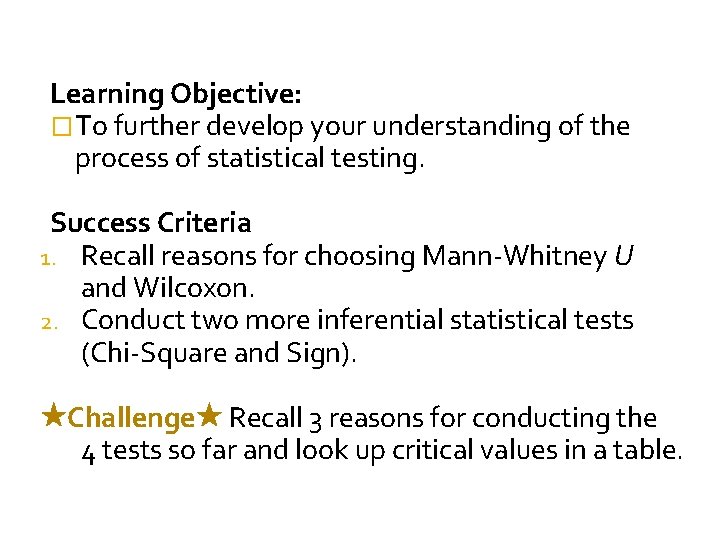
Learning Objective: �To further develop your understanding of the process of statistical testing. Success Criteria 1. Recall reasons for choosing Mann-Whitney U and Wilcoxon. 2. Conduct two more inferential statistical tests (Chi-Square and Sign). Challenge Recall 3 reasons for conducting the 4 tests so far and look up critical values in a table.
Chi square
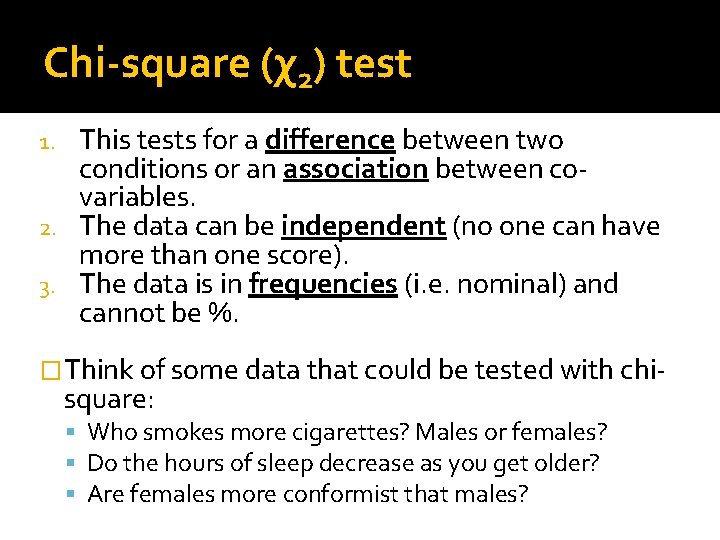
Chi-square (χ2) test This tests for a difference between two conditions or an association between covariables. 2. The data can be independent (no one can have more than one score). 3. The data is in frequencies (i. e. nominal) and cannot be %. 1. �Think of some data that could be tested with chi- square: Who smokes more cigarettes? Males or females? Do the hours of sleep decrease as you get older? Are females more conformist that males?
Chi-square (χ2) test �Step 1. Write a null hypothesis and an alternative hypothesis. �Step 2. Draw up a contingency table. �Step 3. Find observed value by comparing observed and expected frequencies for each cell. �Step 4. Add all the values in the final column. �Step 5. Find the critical value of chi-square. �Step 6. State the conclusion.
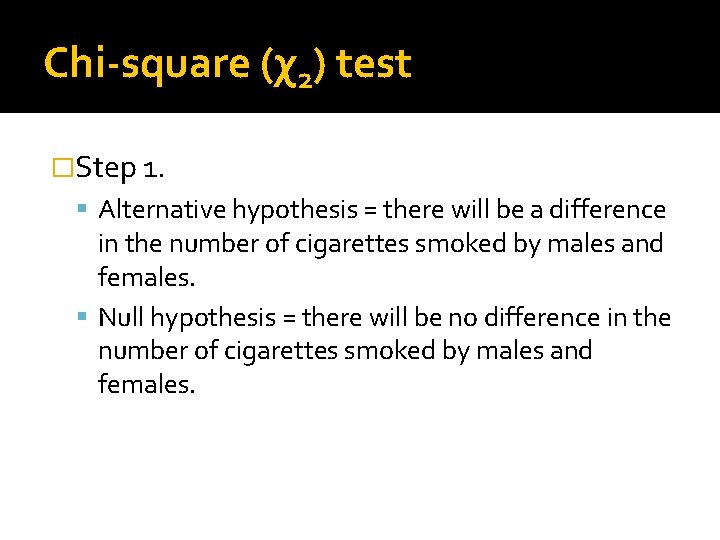
Chi-square (χ2) test �Step 1. Alternative hypothesis = there will be a difference in the number of cigarettes smoked by males and females. Null hypothesis = there will be no difference in the number of cigarettes smoked by males and females.
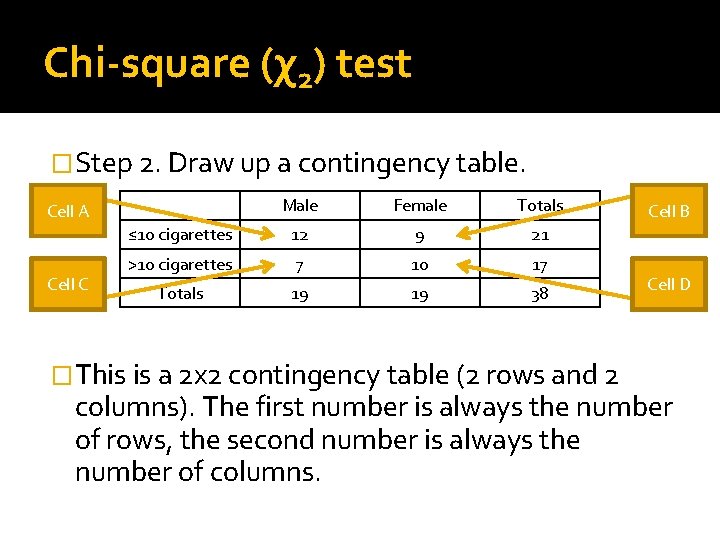
Chi-square (χ2) test �Step 2. Draw up a contingency table. Male Female Totals ≤ 10 cigarettes 12 9 21 >10 cigarettes 7 10 17 Totals 19 19 38 Cell A Cell C �This is a 2 x 2 contingency table (2 rows and 2 Cell B Cell D columns). The first number is always the number of rows, the second number is always the number of columns.
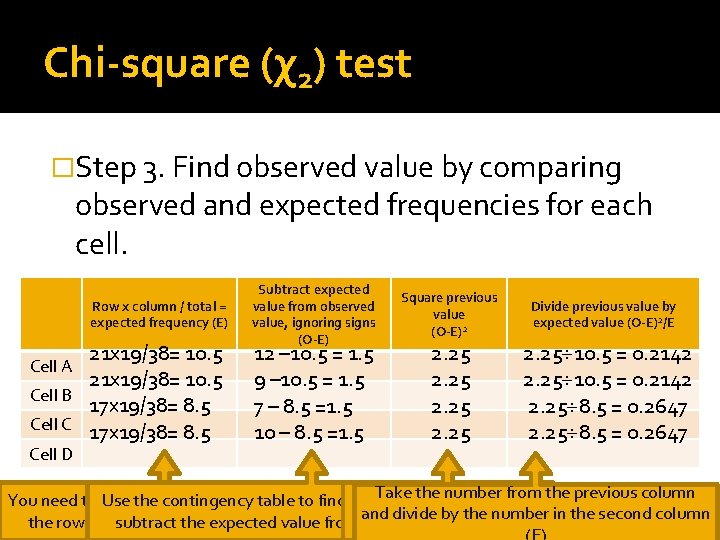
Chi-square (χ2) test �Step 3. Find observed value by comparing observed and expected frequencies for each cell. Row x column / total = expected frequency (E) 21 x 19/38= 10. 5 Cell A 21 x 19/38= 10. 5 Cell B 17 x 19/38= 8. 5 Cell C 17 x 19/38= 8. 5 Cell D Subtract expected value from observed value, ignoring signs (O-E) 12 – 10. 5 = 1. 5 9 – 10. 5 = 1. 5 7 – 8. 5 =1. 5 10 – 8. 5 =1. 5 Square previous value (O-E)2 2. 25 Divide previous value by expected value (O-E)2/E 2. 25 10. 5 = 0. 2142 2. 25 8. 5 = 0. 2647 the number from the previous column You need to use Usethe thenumbers contingency at the table endtooffind the. Take observed value and 2 (O-E) x (O-E) = (O-E) and divide by the number in the second column the rows andsubtract columns the toexpected calculate value ‘E’ from it (ignore any signs)
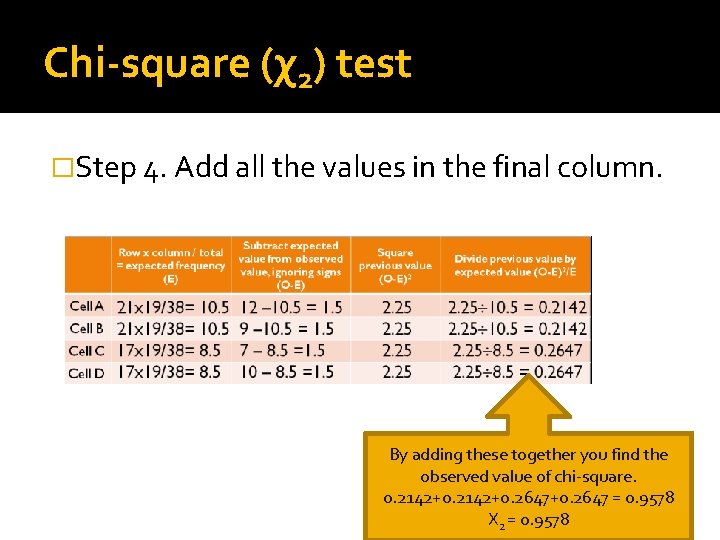
Chi-square (χ2) test �Step 4. Add all the values in the final column. By adding these together you find the observed value of chi-square. 0. 2142+0. 2647+0. 2647 = 0. 9578 Χ 2 = 0. 9578
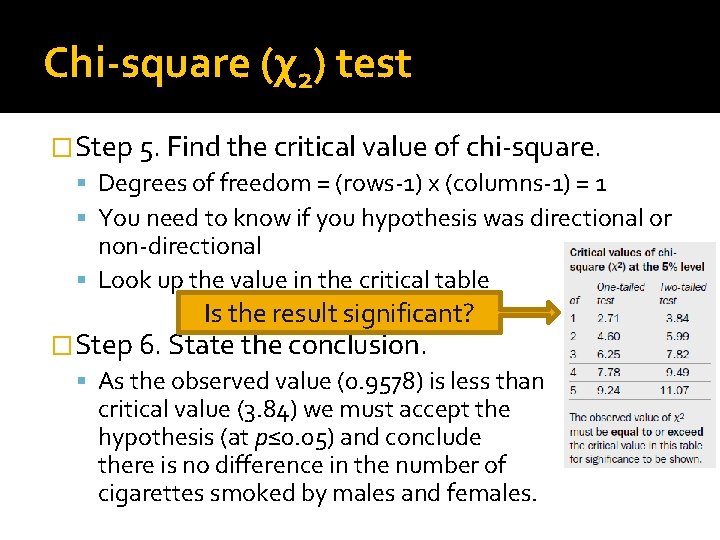
Chi-square (χ2) test �Step 5. Find the critical value of chi-square. Degrees of freedom = (rows-1) x (columns-1) = 1 You need to know if you hypothesis was directional or non-directional Look up the value in the critical table Is the result significant? �Step 6. State the conclusion. As the observed value (0. 9578) is less than critical value (3. 84) we must accept the hypothesis (at p≤ 0. 05) and conclude there is no difference in the number of cigarettes smoked by males and females. the null that
Sign test
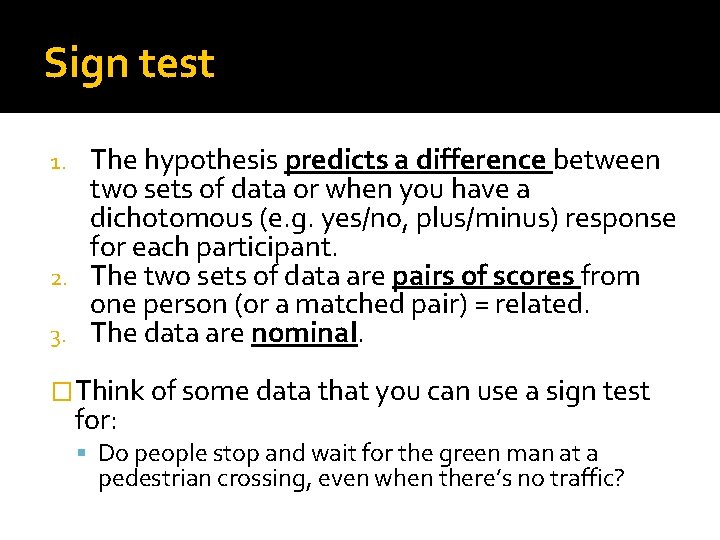
Sign test The hypothesis predicts a difference between two sets of data or when you have a dichotomous (e. g. yes/no, plus/minus) response for each participant. 2. The two sets of data are pairs of scores from one person (or a matched pair) = related. 3. The data are nominal. 1. �Think of some data that you can use a sign test for: Do people stop and wait for the green man at a pedestrian crossing, even when there’s no traffic?
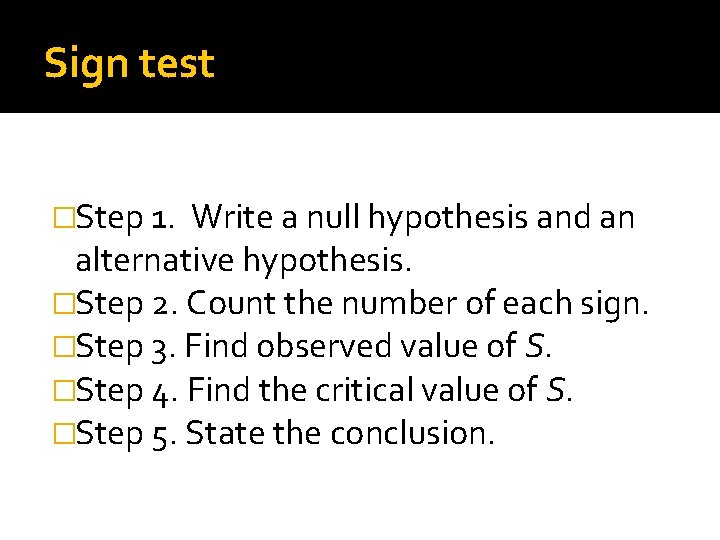
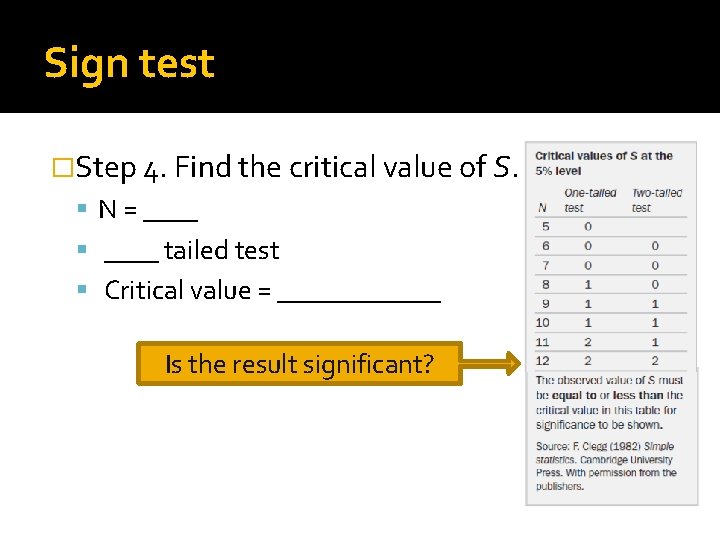
Sign test �Step 1. Write a null hypothesis and an alternative hypothesis. �Step 2. Count the number of each sign. �Step 3. Find observed value of S. �Step 4. Find the critical value of S. �Step 5. State the conclusion.
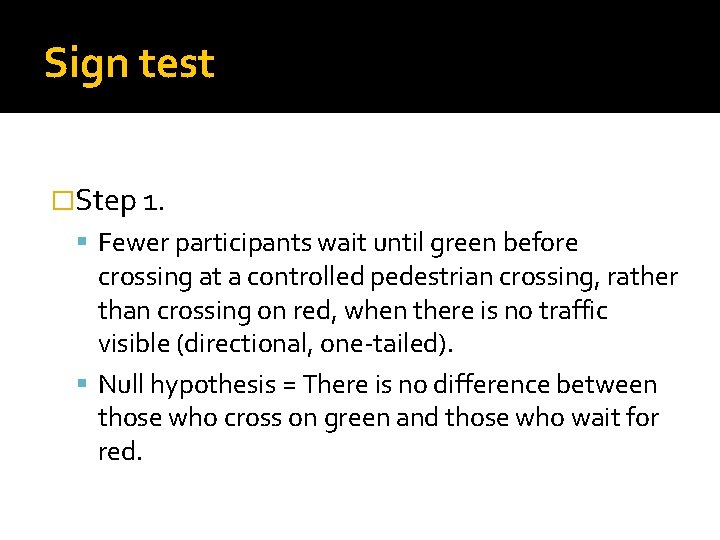
Sign test �Step 1. Fewer participants wait until green before crossing at a controlled pedestrian crossing, rather than crossing on red, when there is no traffic visible (directional, one-tailed). Null hypothesis = There is no difference between those who cross on green and those who wait for red.
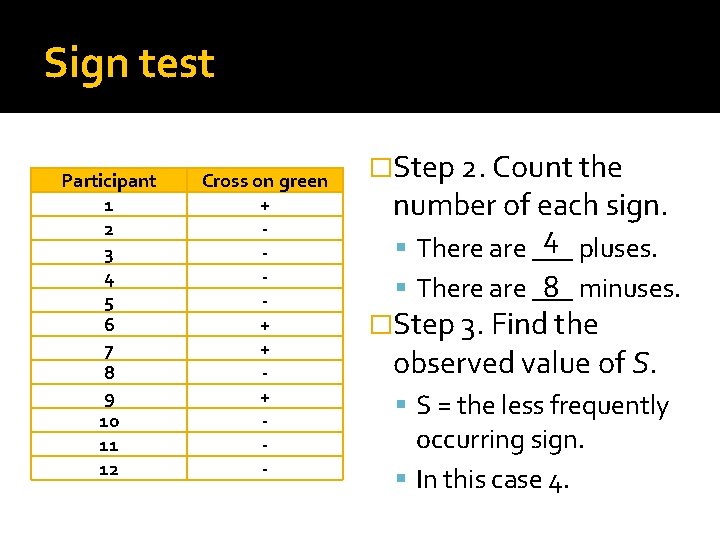
Sign test Participant 1 2 3 4 5 6 7 8 9 10 11 12 Cross on green + + - �Step 2. Count the number of each sign. 4 pluses. There are ___ 8 minuses. �Step 3. Find the observed value of S. S = the less frequently occurring sign. In this case 4.
Sign test �Step 4. Find the critical value of S. N = ____ tailed test Critical value = ______ Is the result significant?
Sign test �Step 5. State a conclusion As the observed value (4) is greater than the critical value (2), we must retain the null hypothesis (at p≤ 0. 05) and conclude that there is no difference between those who cross on green and those who wait for red.
Quick Recap When would you use a chi-square test? 1. Test of a difference Nominal data (i. e. frequencies not %) Data is independent 2. When would you use a Sign test? Tests for a difference between two sets of data Related data (matched pairs or repeated measures) Nominal data
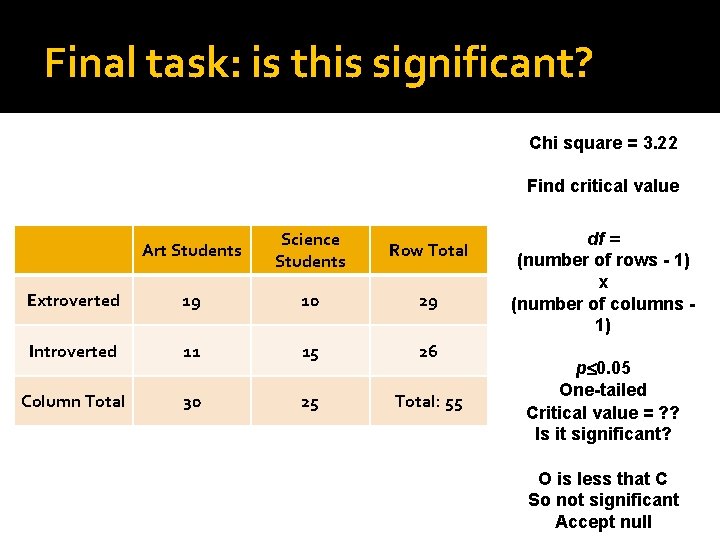
Final task: is this significant? Chi square = 3. 22 Find critical value Art Students Science Students Row Total Extroverted 19 10 29 Introverted 11 15 26 Column Total 30 25 Total: 55 df = (number of rows - 1) x (number of columns 1) p 0. 05 One-tailed Critical value = ? ? Is it significant? O is less that C So not significant Accept null