
Chest xray HOW TO INTERPRET CHEST XRAY By
Chest x-ray HOW TO INTERPRET CHEST X-RAY By Yusuf Shieba Assistant Lecturer of cardiothoracic surgery Yusuf. shieba@med. svu. edu. eg Tel: 01018110686 Faceook @ https: //fb. com/yusufshieba

Chest X-ray or chest film: is radiograph of the chest used to diagnose conditions affecting the chest, its contents, and nearby structures. Chest radiographs are the most common film taken in medicine. Chest radiographs • Simple ( just black and white film ) • Low cost • Sensitive • Excellent resolution

Chest X-ray Quality • Inclusion • inspiration/lung volume • projection • penetration • Rotation • Artifact Steps For Optimal Chest x-ray • Accurate patient positioning • Tube – film distance • Full inspiration • Adequate penetration
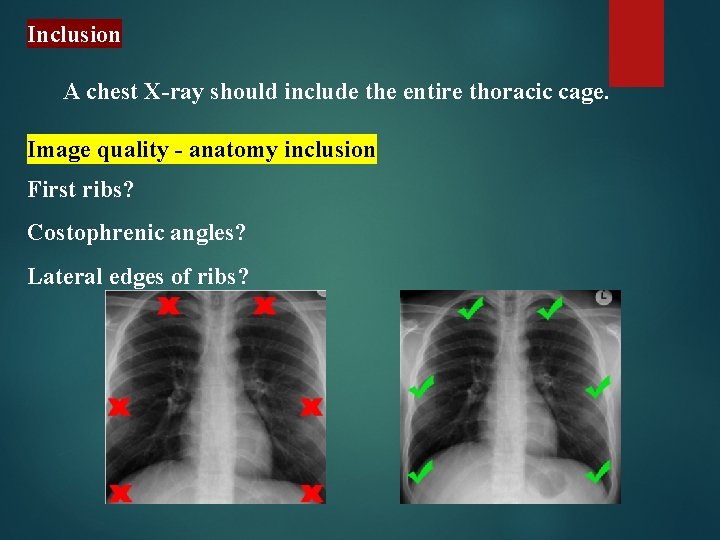
Inclusion A chest X-ray should include the entire thoracic cage. Image quality - anatomy inclusion First ribs? Costophrenic angles? Lateral edges of ribs?
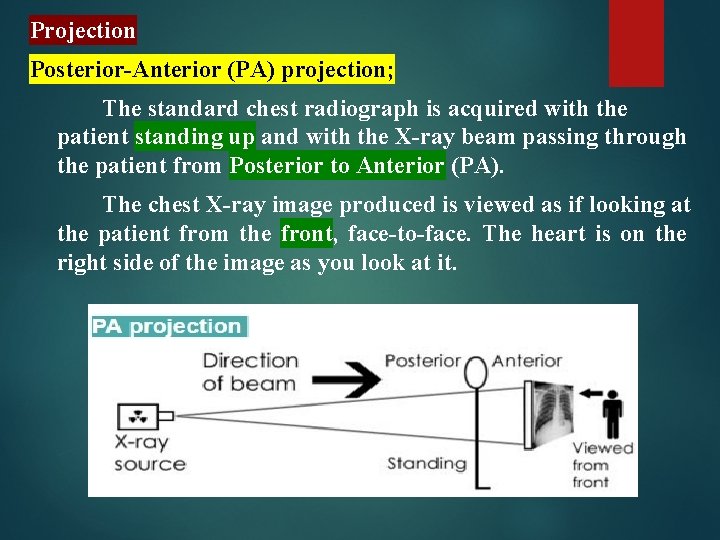
Projection Posterior-Anterior (PA) projection; The standard chest radiograph is acquired with the patient standing up and with the X-ray beam passing through the patient from Posterior to Anterior (PA). The chest X-ray image produced is viewed as if looking at the patient from the front, face-to-face. The heart is on the right side of the image as you look at it.
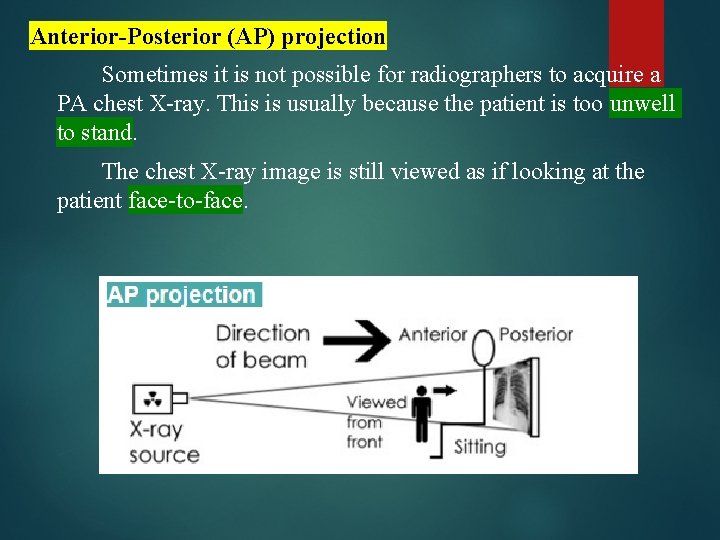
Anterior-Posterior (AP) projection Sometimes it is not possible for radiographers to acquire a PA chest X-ray. This is usually because the patient is too unwell to stand. The chest X-ray image is still viewed as if looking at the patient face-to-face.

AP v PA - Heart size The heart, being an anterior structure within the chest, is magnified by an AP view. Magnification is exaggerated further by the shorter distance between the X-ray source and the patient, often required when acquiring an AP image. This leads to a more divergent beam to cover the same anatomical field.
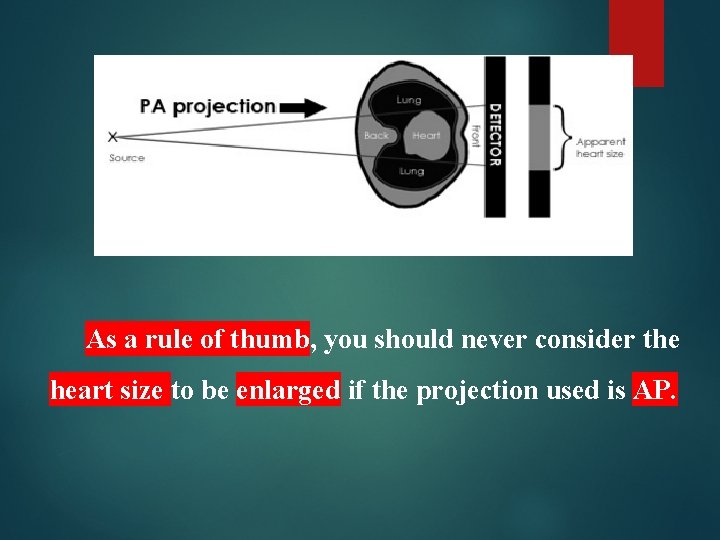
As a rule of thumb, you should never consider the heart size to be enlarged if the projection used is AP.

AP v PA - Scapular edges Radiographers will often label a chest X-ray as either PA or AP. If the image is not labelled, look at the medial edges of each scapula. AP projection - example • The scapulae are not retracted laterally and they remain projected over each lung. • Heart size is exaggerated (cardiothoracic ratio approximately 50%).
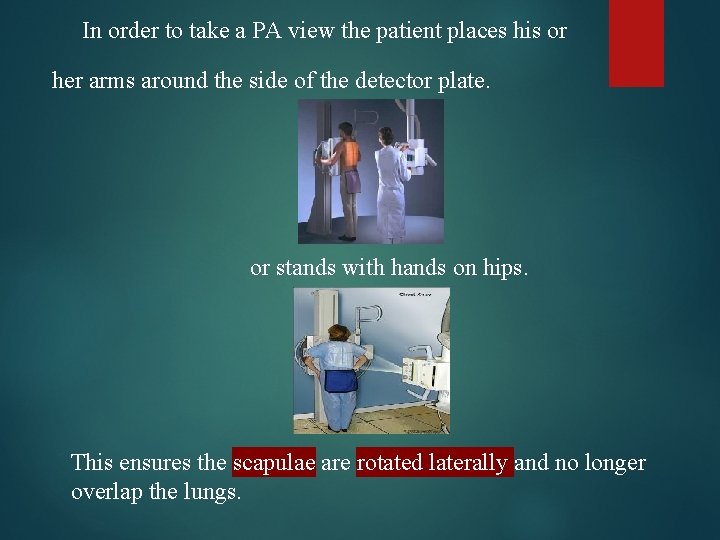
In order to take a PA view the patient places his or her arms around the side of the detector plate. or stands with hands on hips. This ensures the scapulae are rotated laterally and no longer overlap the lungs.
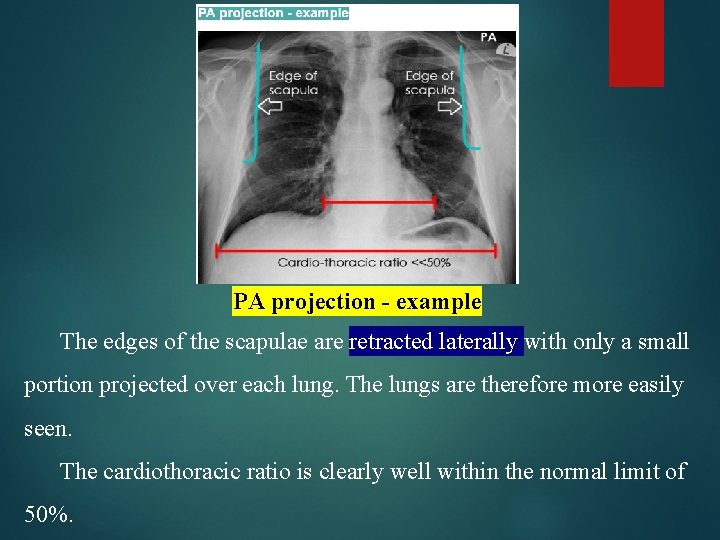
PA projection - example The edges of the scapulae are retracted laterally with only a small portion projected over each lung. The lungs are therefore more easily seen. The cardiothoracic ratio is clearly well within the normal limit of 50%.
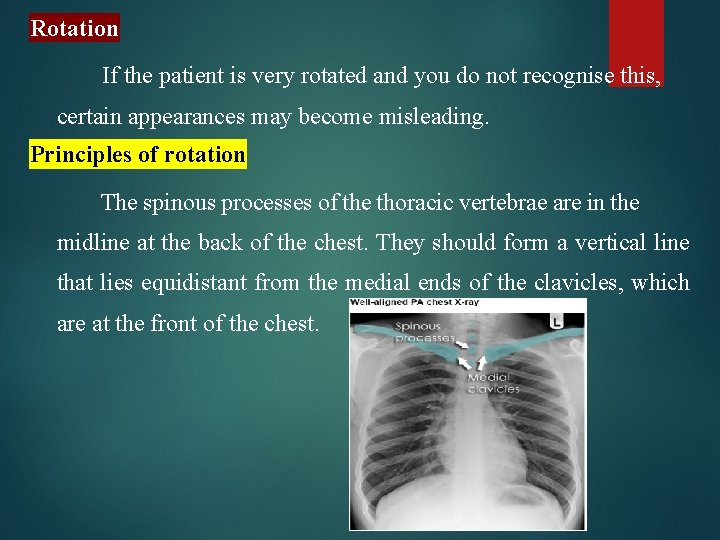
Rotation If the patient is very rotated and you do not recognise this, certain appearances may become misleading. Principles of rotation The spinous processes of the thoracic vertebrae are in the midline at the back of the chest. They should form a vertical line that lies equidistant from the medial ends of the clavicles, which are at the front of the chest.
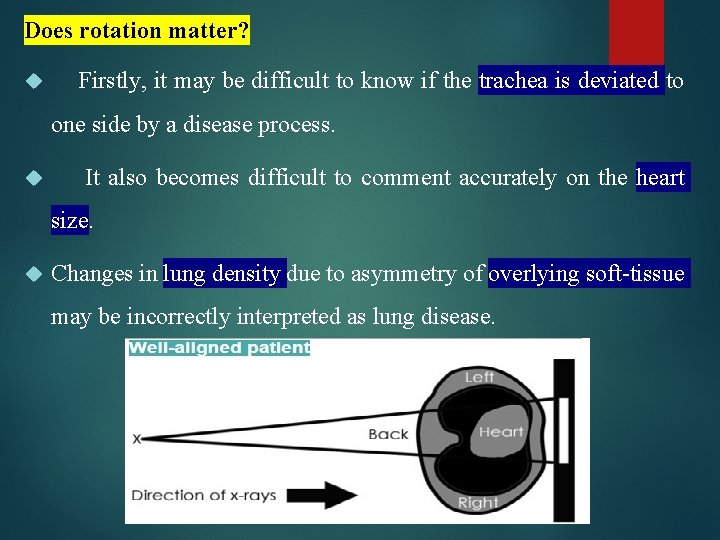
Does rotation matter? Firstly, it may be difficult to know if the trachea is deviated to one side by a disease process. It also becomes difficult to comment accurately on the heart size. Changes in lung density due to asymmetry of overlying soft-tissue may be incorrectly interpreted as lung disease.


Inspiration and lung volume Chest X-rays are acquired in the inspiratory phase of the respiratory cycle. The radiographer asks the patient to, 'breathe in and hold your breath!'. Assessing inspiration count ribs down to the diaphragm. The diaphragm should be intersected by the 5 th to 7 th anterior ribs in the mid-clavicular line. Less is a sign of incomplete inspiration.
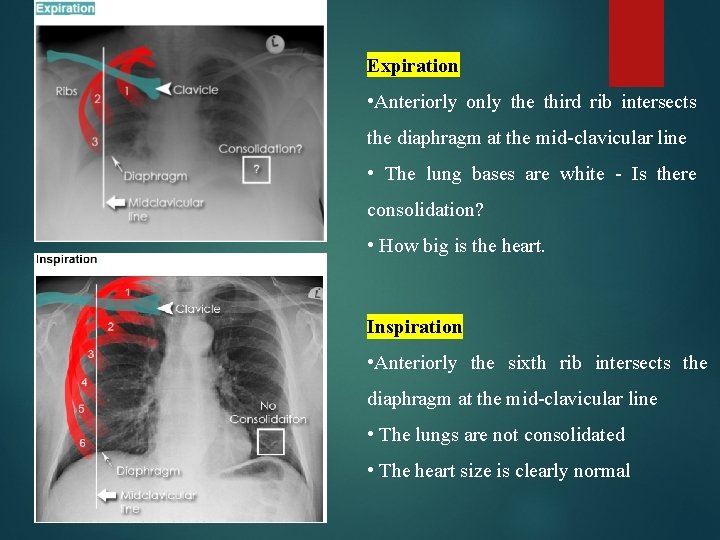
Expiration • Anteriorly only the third rib intersects the diaphragm at the mid-clavicular line • The lung bases are white - Is there consolidation? • How big is the heart. Inspiration • Anteriorly the sixth rib intersects the diaphragm at the mid-clavicular line • The lungs are not consolidated • The heart size is clearly normal

Assessing for hyperexpansion

Normal expansion The imaginary dotted line between the costophrenic and cardiophrenic angles. The distance between this line and the diaphragm (green lines) should be greater than 1. 5 cm (asterisk) in normal individuals.
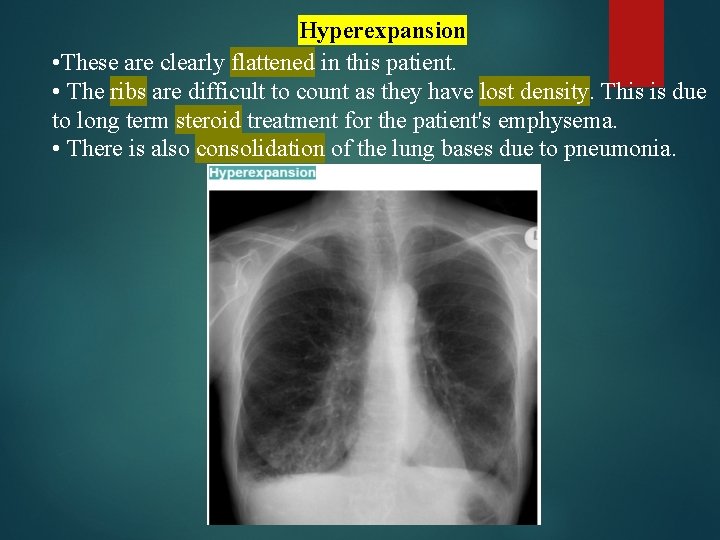
Hyperexpansion • These are clearly flattened in this patient. • The ribs are difficult to count as they have lost density. This is due to long term steroid treatment for the patient's emphysema. • There is also consolidation of the lung bases due to pneumonia.
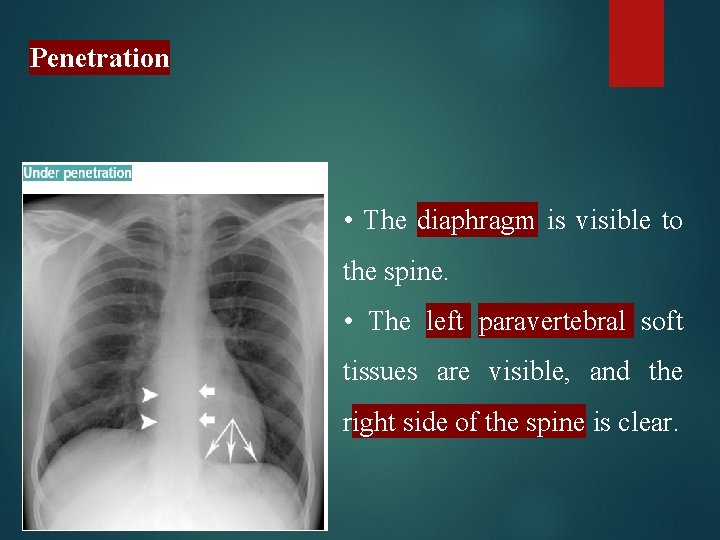
Penetration • The diaphragm is visible to the spine. • The left paravertebral soft tissues are visible, and the right side of the spine is clear.

Under penetration • The left hemidiaphragm is not visible to the spine • Lung tissue behind the heart cannot be assessed.
Artifact Key points Some artifacts are unavoidable A chest X-ray may be obtained to assess position of medical devices Ask yourself if artifact limits image interpretation Can the question clinical question still be answered. Radiographic artifact As previously discussed, examples include rotation, incomplete inspiration and incorrect penetration. Other radiographic artifact includes clothing or jewellery not removed.

Patient artifact Artifact may be due to patient factors such as poor cooperation with positioning or movement. Very often obesity exaggerates lung density. Occasionally normal anatomical structures such as hair or skin folds can cause confusion.


(Hand with Rings): print of Wilhelm Röntgen's first "medical" X-ray, of his wife's hand, taken on 22 December 1895.
- Slides: 25