
Chest Traumapart 2 BY Dr Ahmed Adnan Saad
Chest Trauma(part 2) BY Dr / Ahmed Adnan Saad Zaghloul Demonstrator of Cardiothoracic Surgery – South Valley University
Potential life threatening chest injuries : Pulmonary contusions. Flail Chest. Traumatic diaphragmatic rupture.
Pulmonary contusions : Ø Definition : parenchymal injury without laceration leading to alveolar hemorrhage and interstitial edema. Etiology : Usually caused by blunt chest trauma ( acceleration deceleration injury ) like motor vehicle accidents and falling from height. Ø Ø - Clinical manifestations: Patient may be a symptomatic if lesion is mild. Respiratory distress with hypoxia. Hemoptysis in up to 50 % of cases May be associated with other co-morbidities as pneumothorax, haemothorax , rib fractures.
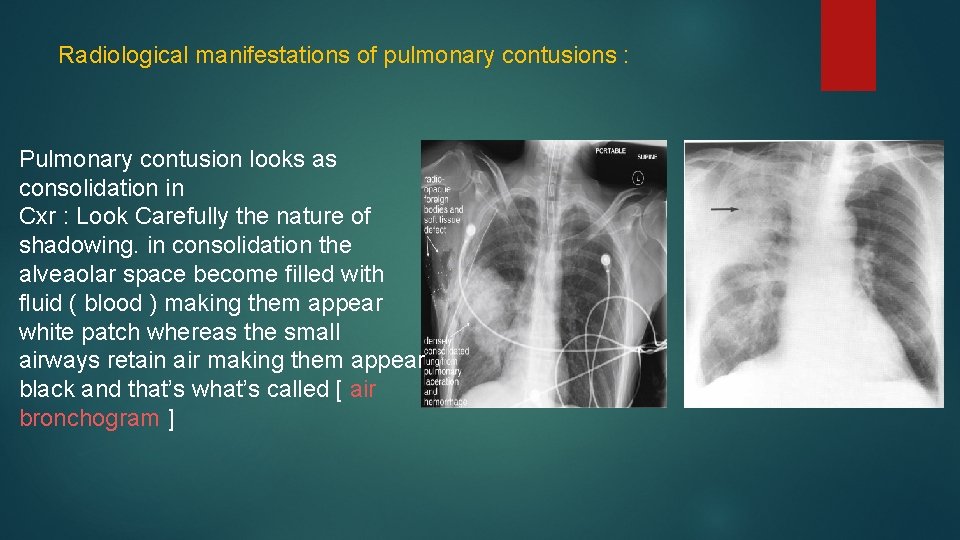
Radiological manifestations of pulmonary contusions : Pulmonary contusion looks as consolidation in Cxr : Look Carefully the nature of shadowing. in consolidation the alveaolar space become filled with fluid ( blood ) making them appear white patch whereas the small airways retain air making them appear black and that’s what’s called [ air bronchogram ]
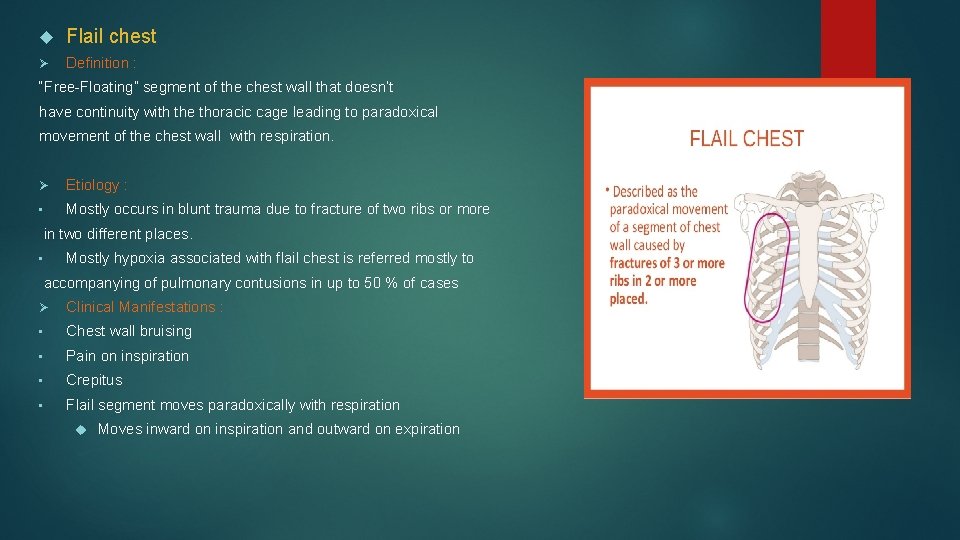
Flail chest Ø Definition : “Free-Floating” segment of the chest wall that doesn’t have continuity with the thoracic cage leading to paradoxical movement of the chest wall with respiration. Ø Etiology : • Mostly occurs in blunt trauma due to fracture of two ribs or more in two different places. • Mostly hypoxia associated with flail chest is referred mostly to accompanying of pulmonary contusions in up to 50 % of cases Ø Clinical Manifestations : • Chest wall bruising • Pain on inspiration • Crepitus • Flail segment moves paradoxically with respiration Moves inward on inspiration and outward on expiration
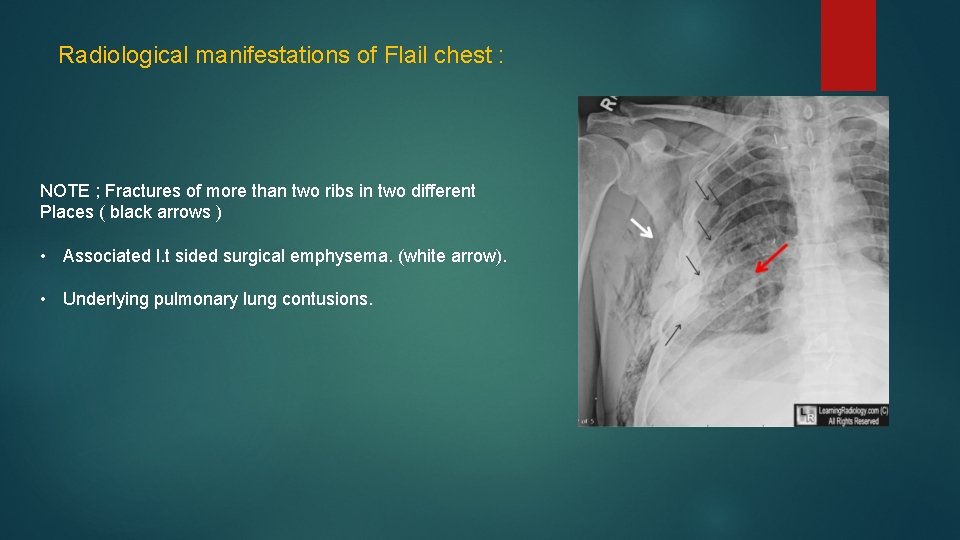
Radiological manifestations of Flail chest : NOTE ; Fractures of more than two ribs in two different Places ( black arrows ) • Associated l. t sided surgical emphysema. (white arrow). • Underlying pulmonary lung contusions.
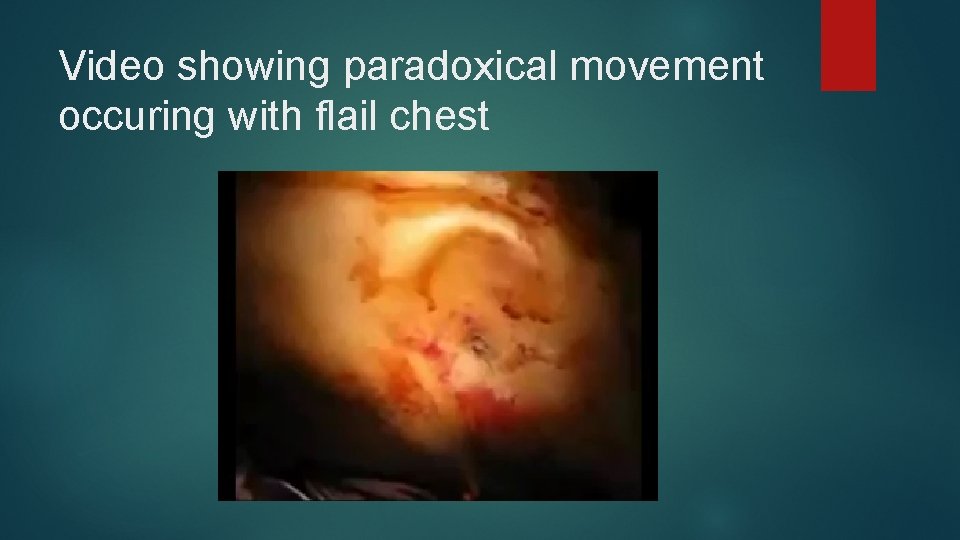
Video showing paradoxical movement occuring with flail chest
Traumatic diaphragmatic rupture : Traumatic diaphragmatic injury can occur as a sequence of blunt or penetrating thoracoabdominal injuries. Ø Blunt trauma : tears lead to immediate herniation. Ø Penetrating trauma : small tears which may take years to develop herniation. Ø Usually on the left side as the right side is protected by the large fixed liver which protects against herniation of abdominal contents.
Radiological manifestations traumatic diaphragmatic hernia : Suspect when lower multiple fracture ribs are present. Chest X-ray is known to be unreliable in diagnosing diaphragmatic rupture it has low sensitivity and specificity for the injury , however there are signs on cxr could be beneficial in diagnosis Signs On cxr : • The diaphragm may appear higher than normal. • Gas bubbles may appear in the chest • The mediastinum may appear shifted to the side • A nasogastric tube from the stomach may appear on the film in the chest cavity; this sign is pathognomonic for diaphragmatic rupture • Barium study
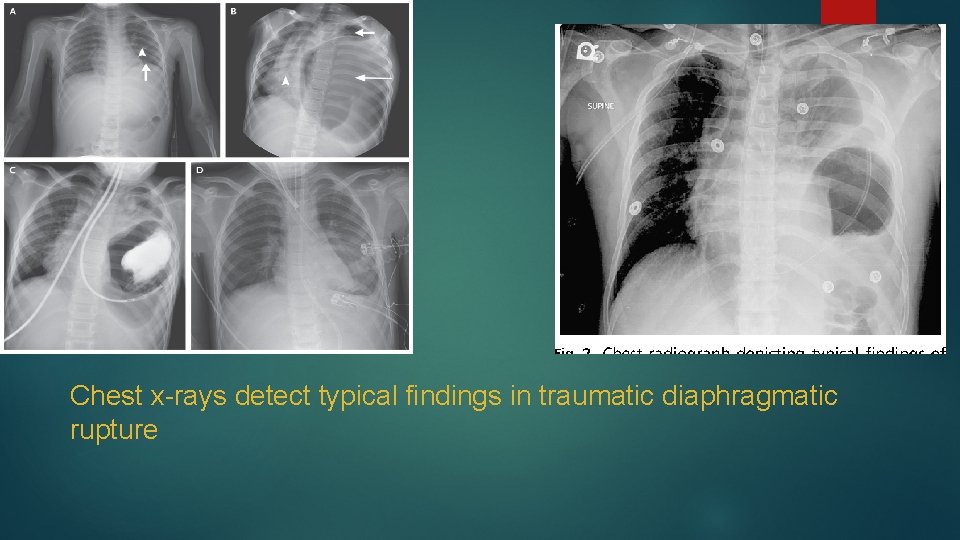
Chest x-rays detect typical findings in traumatic diaphragmatic rupture
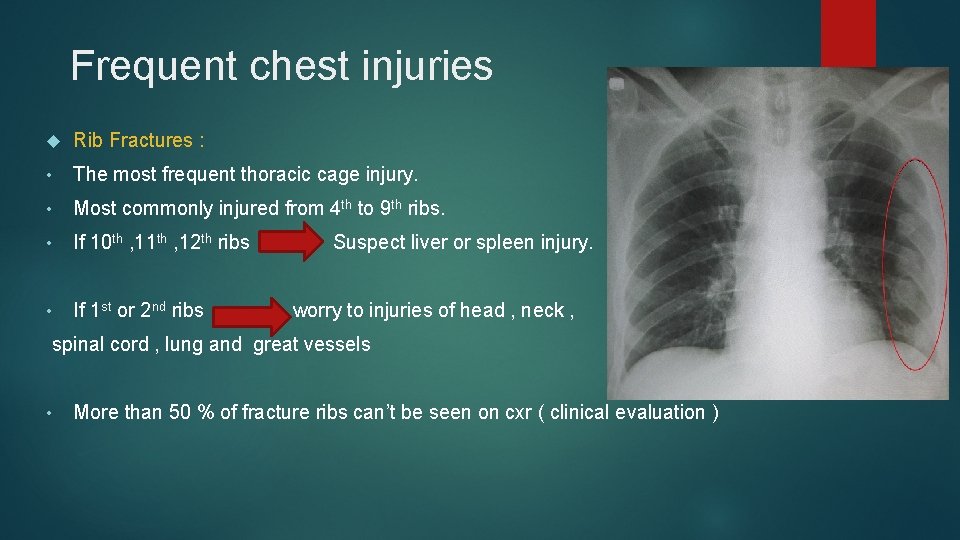
Frequent chest injuries Rib Fractures : • The most frequent thoracic cage injury. • Most commonly injured from 4 th to 9 th ribs. • If 10 th , 11 th , 12 th ribs • If 1 st or 2 nd ribs Suspect liver or spleen injury. worry to injuries of head , neck , spinal cord , lung and great vessels • More than 50 % of fracture ribs can’t be seen on cxr ( clinical evaluation )
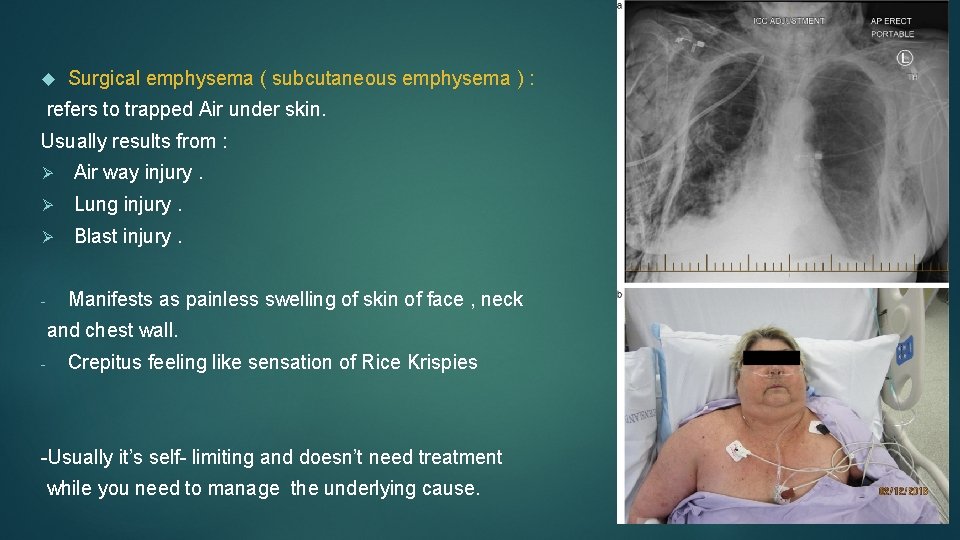
Surgical emphysema ( subcutaneous emphysema ) : refers to trapped Air under skin. Usually results from : Ø Air way injury. Ø Lung injury. Ø Blast injury. - Manifests as painless swelling of skin of face , neck and chest wall. - Crepitus feeling like sensation of Rice Krispies -Usually it’s self- limiting and doesn’t need treatment while you need to manage the underlying cause.

Thank you and My Best Wishes
- Slides: 13