
Chest Trauma By Prof Dr Mahmoud Khairy Prof
Chest Trauma By Prof. Dr: - Mahmoud Khairy Prof. of Cardio-Thoracic Surgery Assiut University


Acute lethal Injuries of the chest and their Management : Injury Management Tension pneumothorax Tube Thoracostomy Massive intrathoracic haemorrhage. Tube Thoracostomy , Operative repair Cardiac tamponade Pericardiocentesis, Operative repair Deceleration aortic injury Operative repair Massive Flail chest with pulmonary contusion Intubation, pain control fluid restriction. Upper and lower airway obstruction Intubation, airway clearance bronchoscopy Trachobronchial rupture bronchoscopy operative repair Diaphragmatic rupture with visceral herniation Operative repair Esophageal perforation Operative repair

Introduction: *Chest trauma is either blunt or penetrating injury *Blunt chest trauma is far more common than penetrating injury (70%). *One of four cases of cardiothoracic trauma. requires hospital admission *25 % of all Trauma deaths due to Thoracic Trauma.
*Aortic rupture, diaphragmatic hernia and Tracheobronchial injuries are considered for blunt chest trauma ; while cardiac tamponade and massive haemothorax are considered for penetrating injuries. *Pneumothorax is a common result of all types of chest trauma.
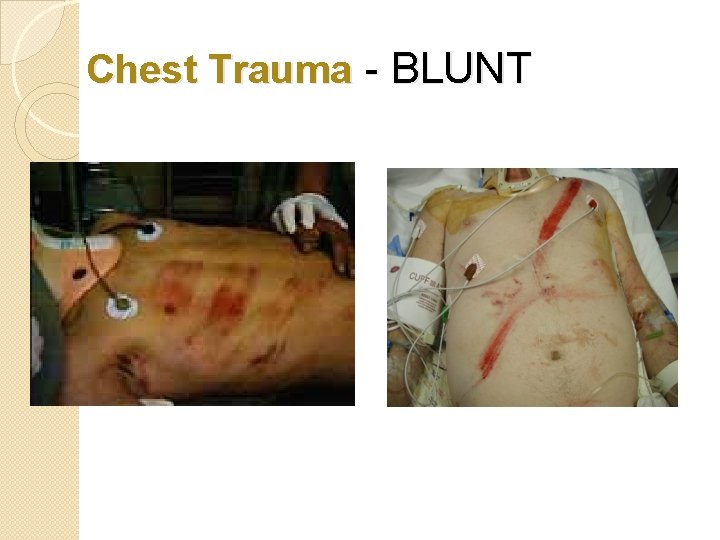
Chest Trauma - BLUNT
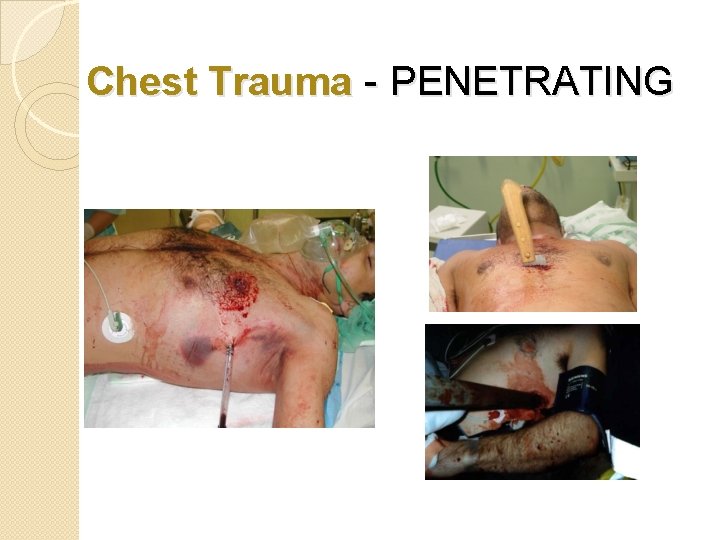
Chest Trauma - PENETRATING
• Blunt chest trauma *Etiology: i - High speed deceleration and crush injuries ii - Fall iii - Sports iv - Assaults v - Blast injury :

Effects of Trauma: *Extra thoracic : skin, subcutaneous tissues , muscles. *Protective bony skeleton: ribs, sternum, clavicle , scapula and vertebrae. *Thoracic and sub-diaphragmatic organs.
Chest wall: *Isolated chest wall trauma presents in 16 % of chest trauma patients. *The disruption of the respiratory mechanism leads to poor pulmonary toilet and significant morbidity. * Chest wall trauma : 1 -Single (simple)Fracture rib. 2 - Multiple fracture ribs.
�General consideration: *Below ninth rib look for spleen, liver and renal injuries *Fracture of the first or second rib indicates severe trauma. *Age of the patient play and important role in the severity of injuries (D. D) Pediatrics and elderly patients. *Haemothorax and /or pneumothorax present in 81% if two or more ribs fractured. *The greater the number of ribs fractured the higher the patients' morbidity and mortality. *Fourth to ninth rib fractured look for lung, bronchus, pleura and heart.

Right side fracture ribs : -
Diagnosis: � The primary survey should follow ABCS aiming to exclude and discover associated injuries. � To exclude foreign body, fracture, lung contusion, pneumothorax, Haemothorax, pneumo-mediastinum, mediastinal widening and the cardiac silhouette. � X-ray of the chest in stable patient: � Exclude associated injuries. � History and clinical examination( site of chest pain or palpable crepetus of fracture , do not try). **Patients either : � Haemodynamically unstable may required emergency thoracotomy in the presence of all facilities. � Haemodynamically stable perform all required investigations.
Diagnostic Tools: q Chest X-rays. q Echocardiography: - Transthoracic. -Transesophageal. q Angiography.
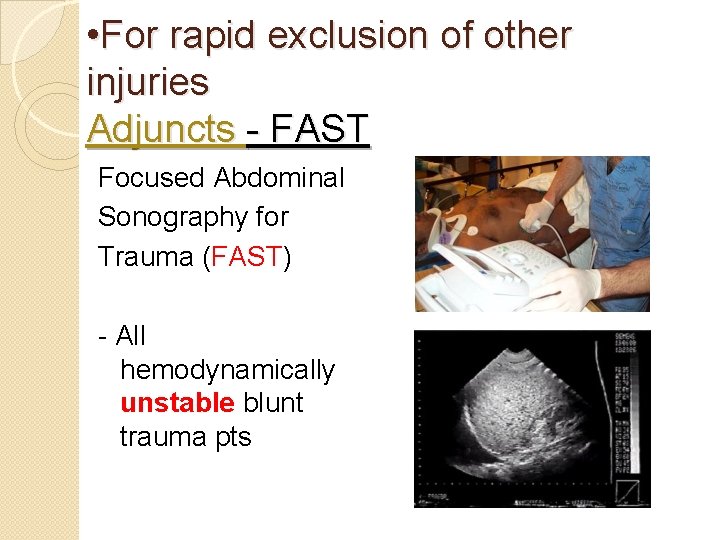
• For rapid exclusion of other injuries Adjuncts - FAST Focused Abdominal Sonography for Trauma (FAST) - All hemodynamically unstable blunt trauma pts

Flail Chest Segment of chest wall that does not have continuity with rest of thoracic cage � Usually 2 fractures per rib in at least 2 ribs � Segment does not contribute to lung expansion � Disrupts normal pulmonary mechanics � Accompanied by pulmonary contusion in 50% of patients with flail chest
Treatment of flail chest: �Usually �Deal conservative with pain relief. with associated condition. eg. -Pneumothorax. -Haemothorax. -Lung contusion. �Rarely stabilization of chest wall; outwards, inwards, endotracheal intubation.

Intrathoracic Injuries: Pulmonary Injuries: -pulmonary contusion. -pulmonary laceration. • Trachea and Bronchi. • • Esophagus. • Heart and great vessels. • Thoracic duct.
Pulmonary contusion: **Aetiology: �Deceleration injury or crush trauma leads to extensive parenchymal damage. In the form of haemorrhage and interstitial edema with obliteration of the alveolar space and consolidation of pulmonary tissue. The extent of consolidation varies with the severity of trauma. It may be unilateral or bilateral. �End result of hypoventilation and arterio – venous shunt in anon- ventilated area. �Associated injuries mostly are present as fracture ribs, pneumothorax or haemothorax, the patchy consolidation variable in size appears immediately after trauma. �D. D. A R D, pneumonitis, atelectasis (hours or days after trauma).

Pulmonary Contusion **Diagnosis: - �Parenchymal infiltrate seen in CXR adjacent to injured chest wall
** Treatment: �Pulmonary care and clearing of secretion. �Respiratory support. �Face mask �Nasal cannula. �E. T. T (Endotracheal intubation) if required. � Avoid pulmonary edema by restriction of IV fluid. �Albumin contains IV fluid to increase plasma osmotic pressure. �Corticosteroids (debatable) – PEEP if
• Pulmonary Laceration: - Pneumothorax - Haemothorax - Both
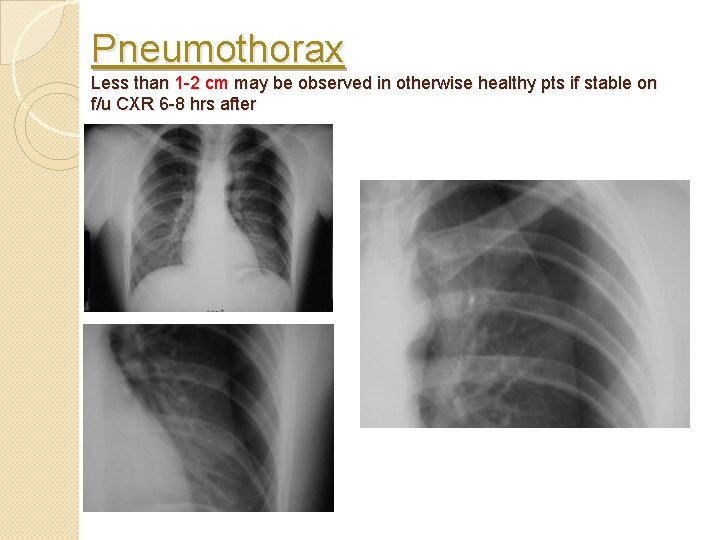
Pneumothorax Less than 1 -2 cm may be observed in otherwise healthy pts if stable on f/u CXR 6 -8 hrs after
Pneumothorax �Air in the pleural space: �primary: �Secondary: no obvious cause trauma, surgery, inflammation
Traumatic pneumothorax: -Open pneumothorax -Partial pneumothorax - Tension pneumothorax
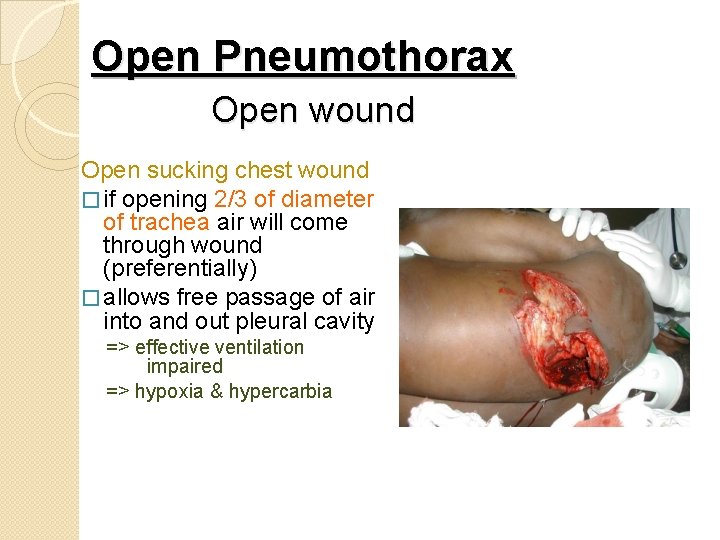
Open Pneumothorax Open wound Open sucking chest wound � if opening 2/3 of diameter of trachea air will come through wound (preferentially) � allows free passage of air into and out pleural cavity => effective ventilation impaired => hypoxia & hypercarbia
Treatment: �-Immediate wound closure by any means available is required �- Surgical closure with chest tube insertion are necessary on less urgent bases.
Tension pneumothorax: �Aetiology: �One way valve injury of the lung, chest wall, Trachobronchial tree, Oesophageal perforation. 1 -Partial adhesions (localized tension pneumothorax). 2 - Patient with diminished lung compliance due to pre-existing C O P D. �Tension pneumothorax is a true surgical emergency that require immediate diagnosis and decompression of the affected side by any means.
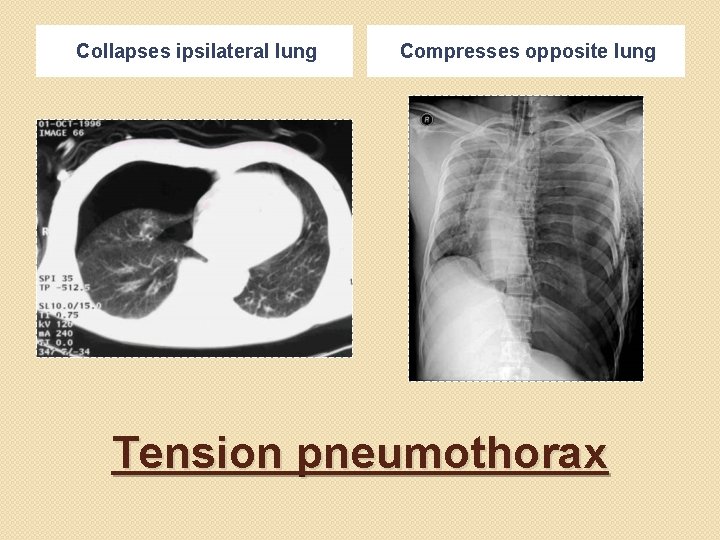
Collapses ipsilateral lung Compresses opposite lung Tension pneumothorax
Treatment: 1 -Wide bore needle in the second space in the mid clavicular line as a primary measures in the absence of other measures. 2 - Chest tube insertion if available. 3 - Thoracotomy for certain indication.
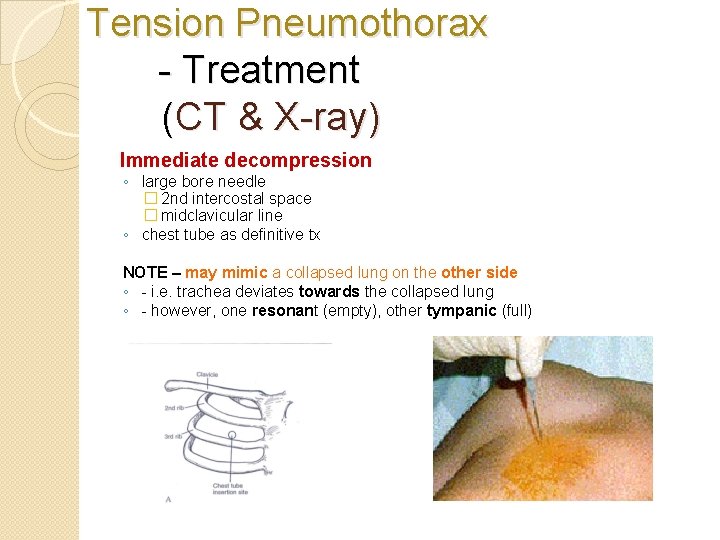
Tension Pneumothorax - Treatment (CT & X-ray) Immediate decompression ◦ large bore needle � 2 nd intercostal space � midclavicular line ◦ chest tube as definitive tx NOTE – may mimic a collapsed lung on the other side ◦ - i. e. trachea deviates towards the collapsed lung ◦ - however, one resonant (empty), other tympanic (full)
Haemothorax: �Blood space (haemorrhage) in the pleural presents in almost every patient with diagnosable chest injury, visualized in the CXR(250 -500 supine ml). in up-right chest film 1000 ml may be over looked.

Source of bleeding: �Chest wall blood vessels � Heart and great vessels �Pulmonary vessels. **Pneumothorax is almost always coexists. .

Types of Haemothorax: �Haemothorax. �Clotted Haemothorax. �Infected Haemothorax.
Treatment of Haemothorax: � Tube thoracostomy. � Immediate � Clotted Thoracotomy…. when …. . ? haemothorax…. Thoracotomy within one month. � Infected haemothorax…. . As empyema.
Delayed diagnosis may occur (missed): �Esophageal �Myocardial � Rupture rupture. contusion. aorta. �Diaphragmatic injuries.

Haemothorax: (CXR, CT. ) Massive Haemothorax Pleural cavity hold 3 liters blood � 200 cc – 1 L in chest cavity seen on CXR � 90% from internal mammary or intercostals � 10% from pulmonary vessels �
Penetrating thoracic injuries * In civilian life mostly due to: *Stab wounds. *Gun shot wounds. * At war time due to: *Bullet and shrapnel. *Blast injury.
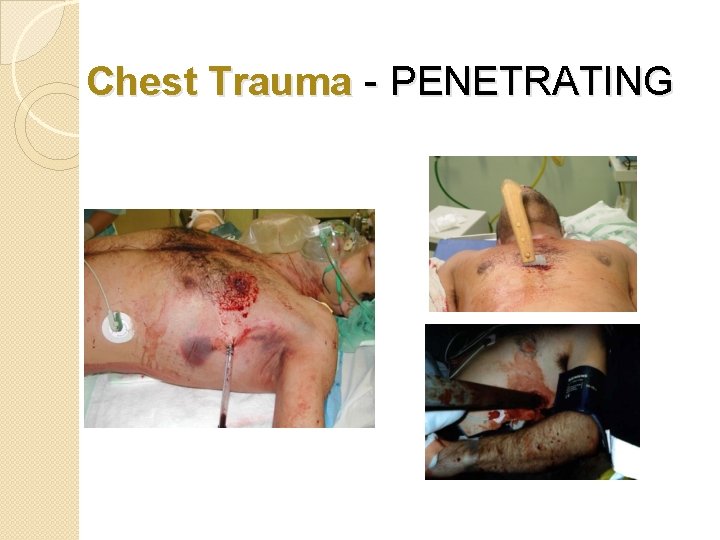
Chest Trauma - PENETRATING
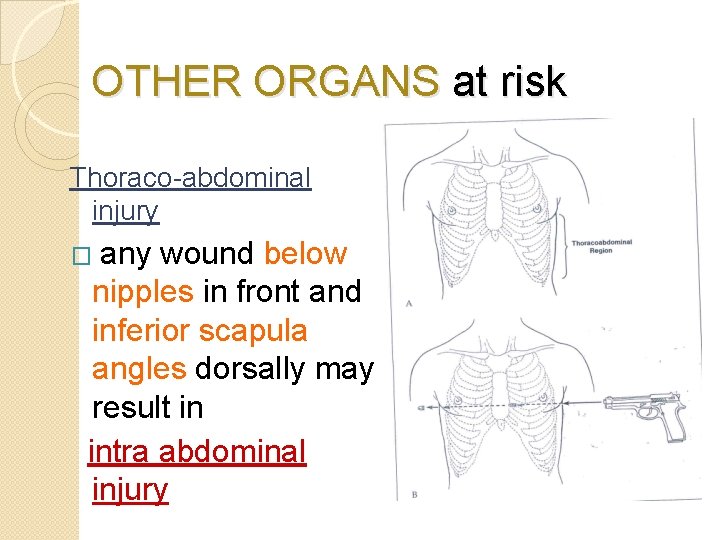
OTHER ORGANS at risk Thoraco-abdominal injury any wound below nipples in front and inferior scapula angles dorsally may result in intra abdominal injury �

- Slides: 41