
Chest pain Angina 19 December 2021 Coffs Harbour
Chest pain
Angina 19 December 2021 Coffs Harbour Divisional Training 2
What is Angina? • Angina (‘choking pain’) is temporary chest discomfort or pain that typically comes on with exercise or emotional stress. • It usually lasts only a matter of minutes.
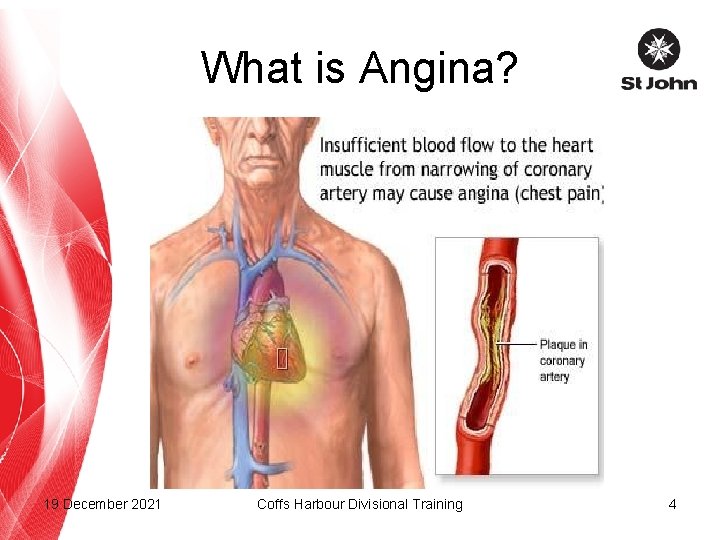
What is Angina? 19 December 2021 Coffs Harbour Divisional Training 4
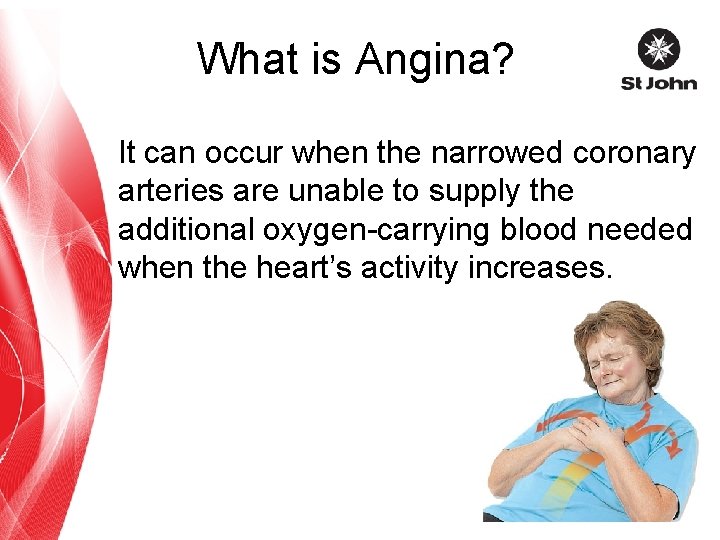
What is Angina? It can occur when the narrowed coronary arteries are unable to supply the additional oxygen-carrying blood needed when the heart’s activity increases.
Signs & Symptoms • • Tight, gripping or squeezing chest pain Varies from mild to severe Usually felt in the centre of the chest May spread to either or both shoulders, the back, neck or jaws or down the arm and can even be felt in the hands • Sometimes it is experienced in these other parts of the body without being felt in the chest • Sometimes angina is experienced as shortness of breath, rather than pain
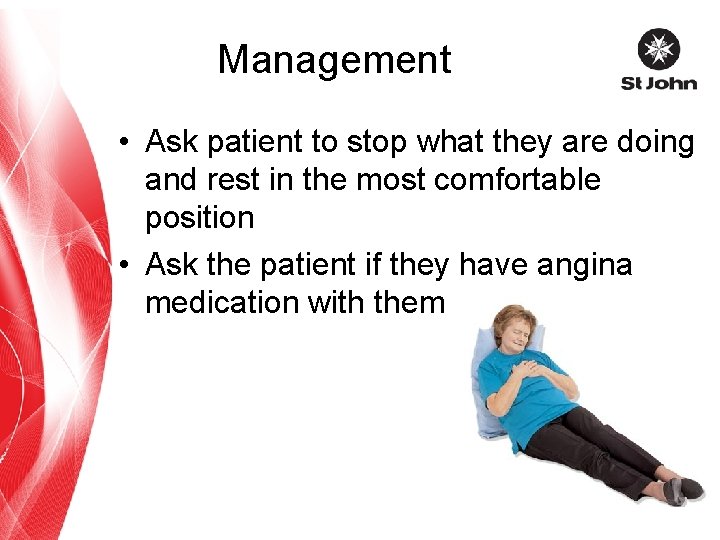
Management • Ask patient to stop what they are doing and rest in the most comfortable position • Ask the patient if they have angina medication with them
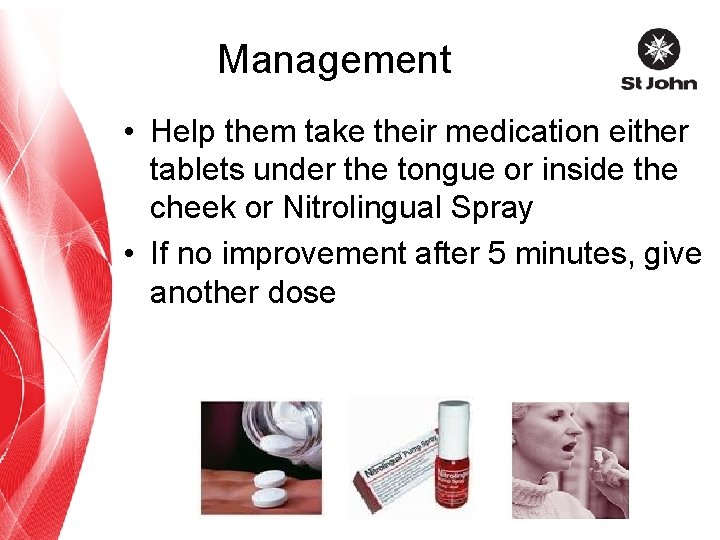
Management • Help them take their medication either tablets under the tongue or inside the cheek or Nitrolingual Spray • If no improvement after 5 minutes, give another dose
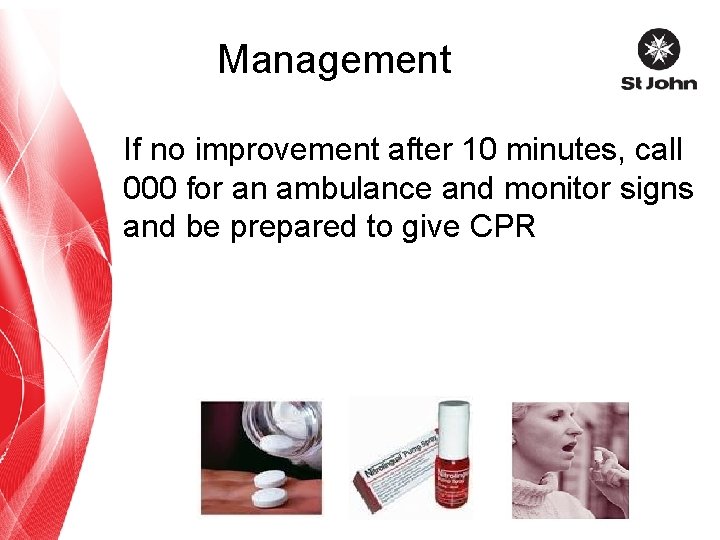
Management If no improvement after 10 minutes, call 000 for an ambulance and monitor signs and be prepared to give CPR
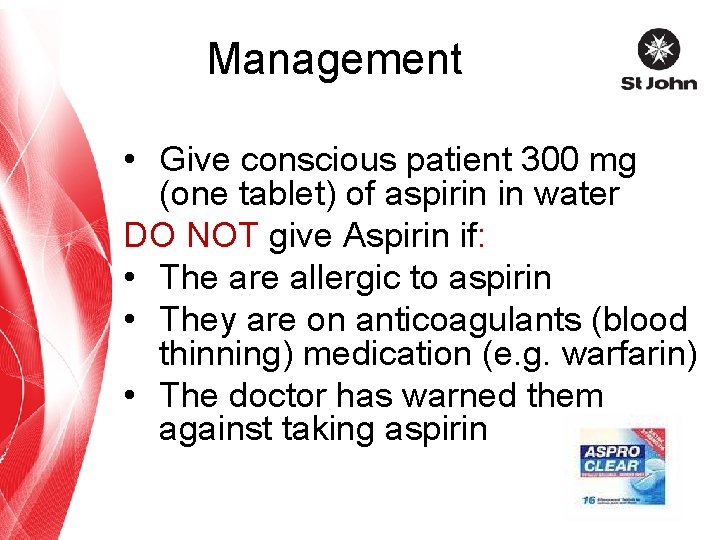
Management • Give conscious patient 300 mg (one tablet) of aspirin in water DO NOT give Aspirin if: • The are allergic to aspirin • They are on anticoagulants (blood thinning) medication (e. g. warfarin) • The doctor has warned them against taking aspirin
Heart Attack 19 December 2021 Coffs Harbour Divisional Training 11
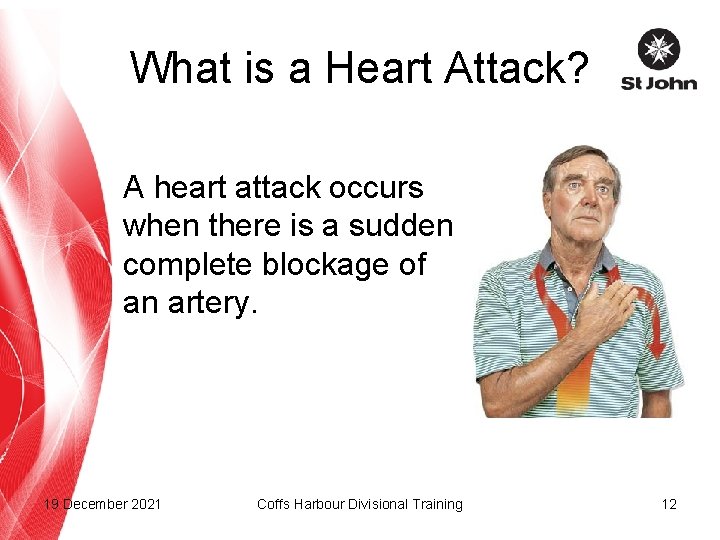
What is a Heart Attack? A heart attack occurs when there is a sudden complete blockage of an artery. 19 December 2021 Coffs Harbour Divisional Training 12
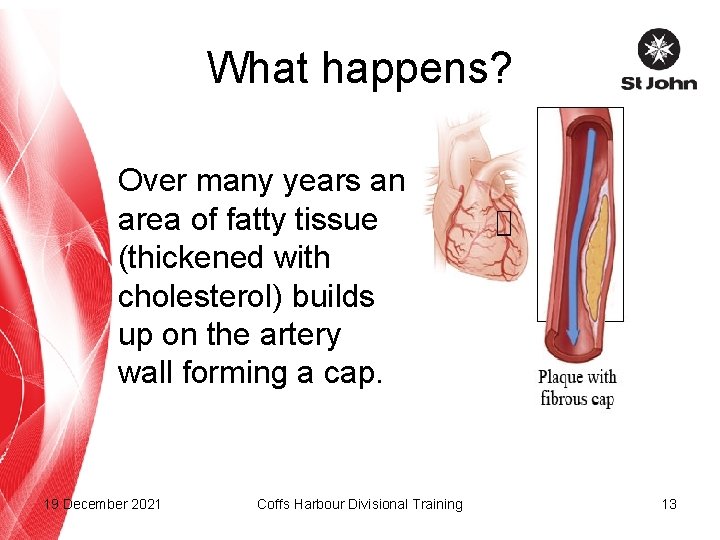
What happens? Over many years an area of fatty tissue (thickened with cholesterol) builds up on the artery wall forming a cap. 19 December 2021 Coffs Harbour Divisional Training 13
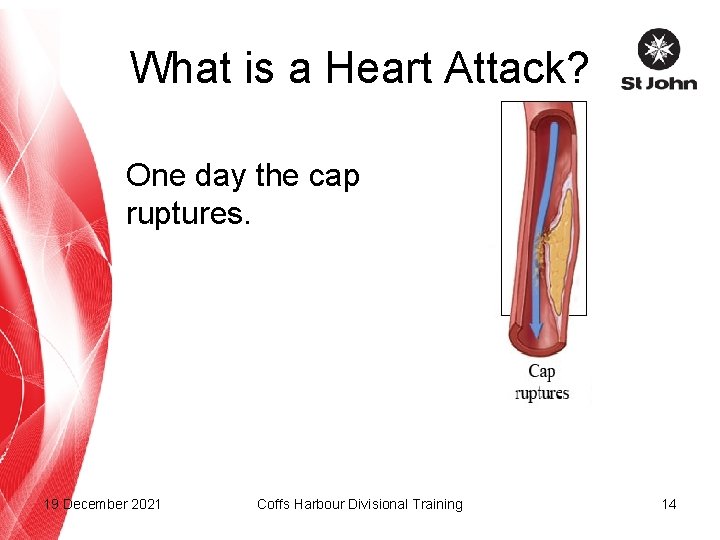
What is a Heart Attack? One day the cap ruptures. 19 December 2021 Coffs Harbour Divisional Training 14
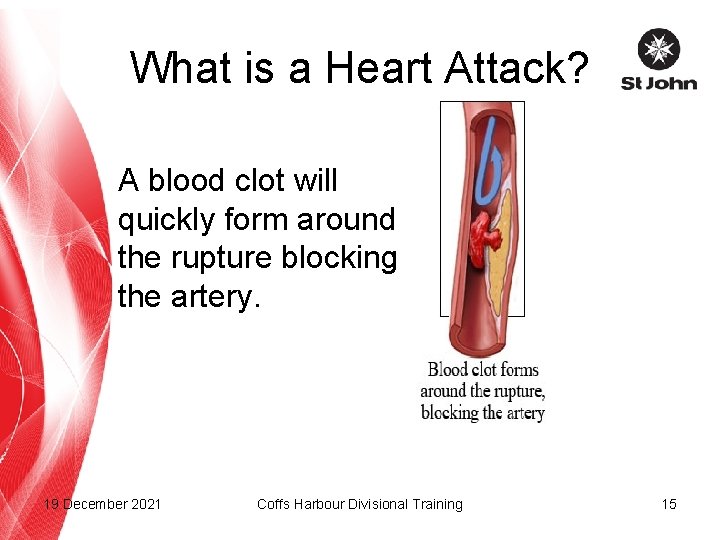
What is a Heart Attack? A blood clot will quickly form around the rupture blocking the artery. 19 December 2021 Coffs Harbour Divisional Training 15
Myocardial Infarction • A heart attack is also referred to by health professionals as a Myocardial infarction (MI) • The resulting ischemia (restriction in blood supply) and oxygen shortage, causes damage or death (infarction) of heart muscle tissue (myocardium). 19 December 2021 Coffs Harbour Divisional Training 16
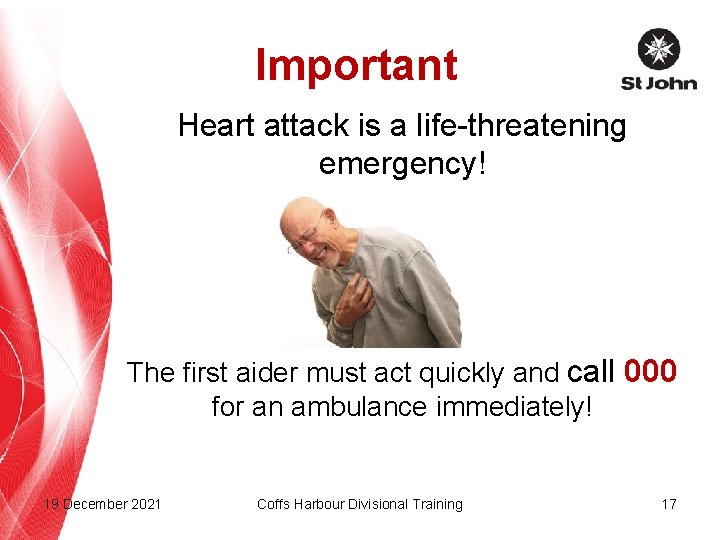
Important Heart attack is a life-threatening emergency! The first aider must act quickly and call 000 for an ambulance immediately! 19 December 2021 Coffs Harbour Divisional Training 17
Why must we act quickly? • Damaged heart muscle may initiate an uncontrolled disorganised rhythm that may stop the heart beating effectively. Ventricular fibrillation! • This is the most common cause of cardiac arrest. • When it occurs, cardiac arrest may follow within minutes of the first symptoms of a heart attack. 19 December 2021 Coffs Harbour Divisional Training 18
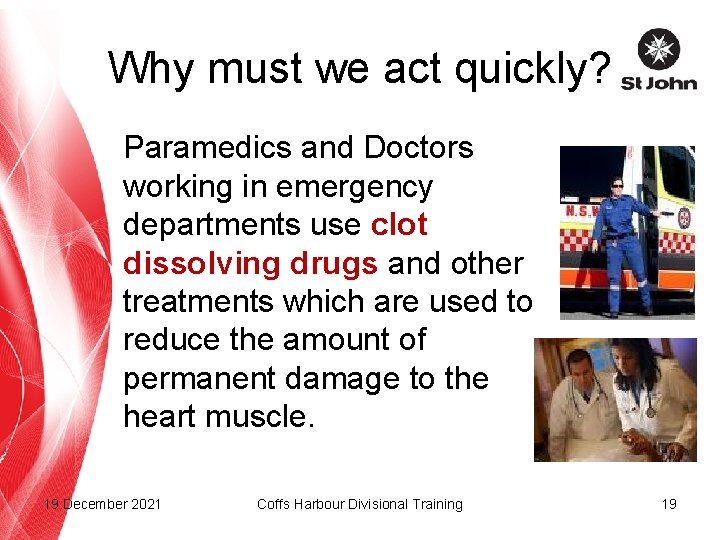
Why must we act quickly? Paramedics and Doctors working in emergency departments use clot dissolving drugs and other treatments which are used to reduce the amount of permanent damage to the heart muscle. 19 December 2021 Coffs Harbour Divisional Training 19
Why must we act quickly? These must be given soon after a heart attack occurs to be effective. 19 December 2021 Coffs Harbour Divisional Training 20
Important If the patient has chest pain similar to Angina, but it is not relieved by medication and rest, the first aider should manage the patient as if they are having a heart attack!
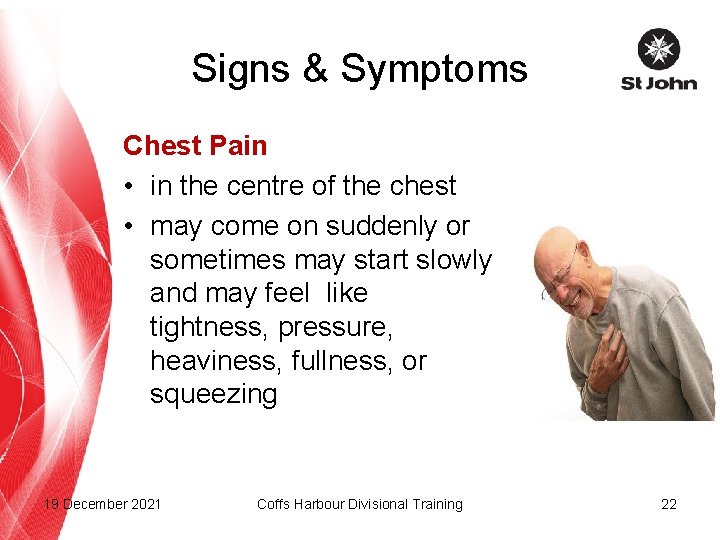
Signs & Symptoms Chest Pain • in the centre of the chest • may come on suddenly or sometimes may start slowly and may feel like tightness, pressure, heaviness, fullness, or squeezing 19 December 2021 Coffs Harbour Divisional Training 22
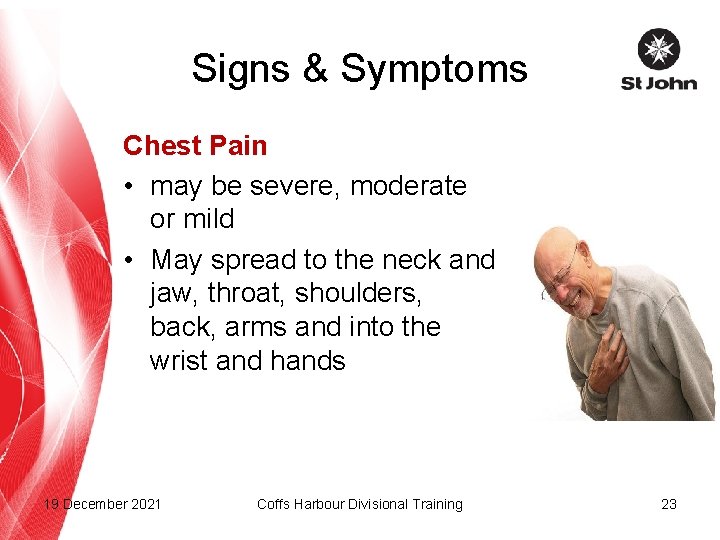
Signs & Symptoms Chest Pain • may be severe, moderate or mild • May spread to the neck and jaw, throat, shoulders, back, arms and into the wrist and hands 19 December 2021 Coffs Harbour Divisional Training 23
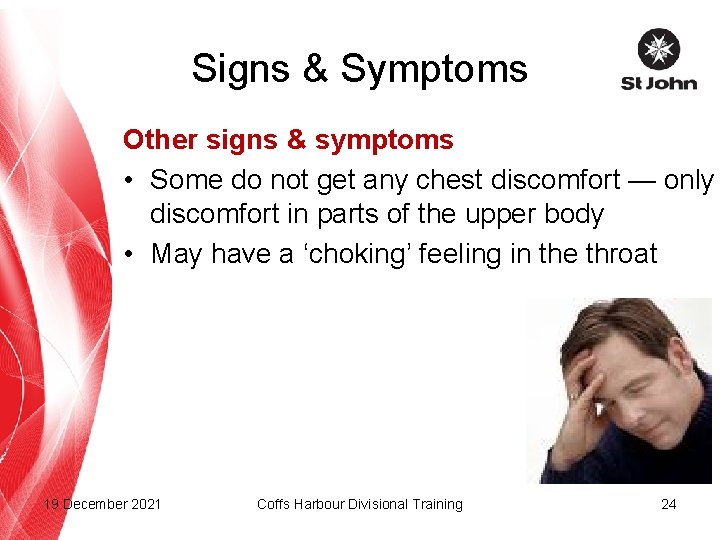
Signs & Symptoms Other signs & symptoms • Some do not get any chest discomfort — only discomfort in parts of the upper body • May have a ‘choking’ feeling in the throat 19 December 2021 Coffs Harbour Divisional Training 24
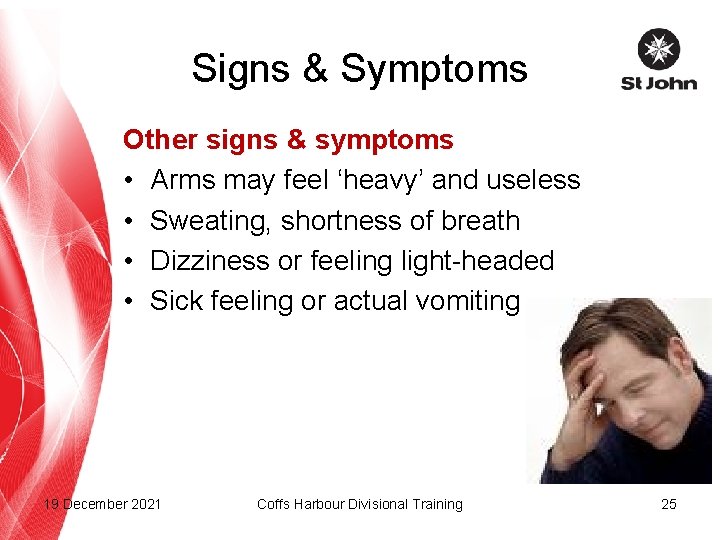
Signs & Symptoms Other signs & symptoms • Arms may feel ‘heavy’ and useless • Sweating, shortness of breath • Dizziness or feeling light-headed • Sick feeling or actual vomiting 19 December 2021 Coffs Harbour Divisional Training 25
Signs & Symptoms • Often women experience fewer typical symptoms than men, most commonly shortness of breath, weakness, a feeling of indigestion, and fatigue • Approximately one quarter of all myocardial infarctions are silent, without chest pain or other symptoms 19 December 2021 Coffs Harbour Divisional Training 26
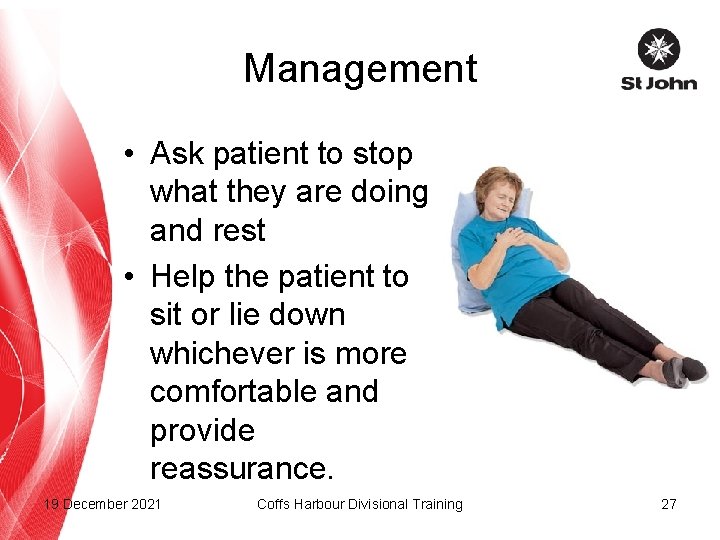
Management • Ask patient to stop what they are doing and rest • Help the patient to sit or lie down whichever is more comfortable and provide reassurance. 19 December 2021 Coffs Harbour Divisional Training 27
Management • Ask them to describe their symptom. • Loosen tight clothing. • Oxygen therapy 8‐ 15 LPM via Face Mask • If any symptoms are severe, get worse quickly or last 10 minutes call 000 for an ambulance 19 December 2021 Coffs Harbour Divisional Training 28
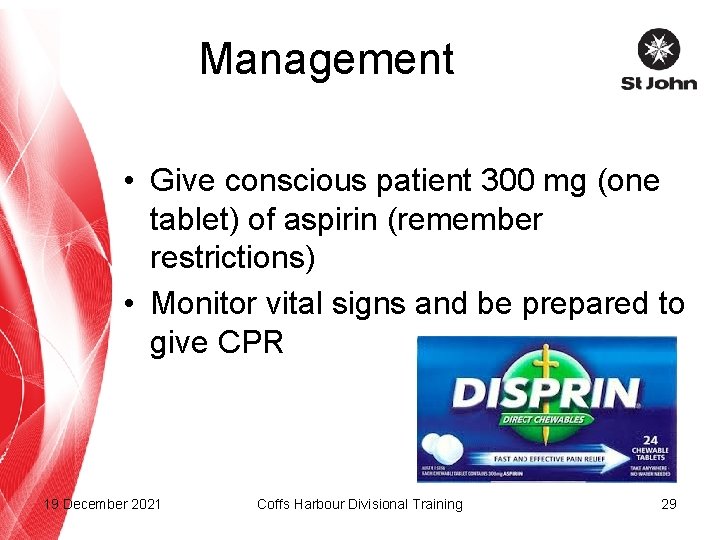
Management • Give conscious patient 300 mg (one tablet) of aspirin (remember restrictions) • Monitor vital signs and be prepared to give CPR 19 December 2021 Coffs Harbour Divisional Training 29
Questions 19 December 2021 Coffs Harbour Divisional Training 30
BREAK 19 December 2021 Coffs Harbour Divisional Training 31
Scenario You are on duty at a public event when a member of the public asks if you can come and have a look at their elderly father who is not feeling well. When you arrive he is sweaty with an obvious shortness of breath and complaining of dizziness and feeling sick in the stomach. He does not have a history of heart problems. 19 December 2021 Coffs Harbour Divisional Training 32
Management 1. Help the patient to sit or lie down whichever is more comfortable and provide reassurance. 2. Call 000. 3. Ask them to describe their symptoms. 4. Loosen tight clothing 19 December 2021 Coffs Harbour Divisional Training 33
Management 5. Oxygen therapy 8‐ 15 LPM via Face Mask 6. Give 300 mg (one tablet) of aspirin (remember restrictions) 7. Complete 2 sets of observations 8. Completed OB 12 in total and Handover
Scenario You are on duty at a public event when a member of the public presents to you with discomfort in the chest. They have been experiencing it for over an hour now and feel it is perhaps indigestion. They describe it as a tight squeezing feeling. You note they are pale, clammy and short of breath. 19 December 2021 Coffs Harbour Divisional Training 35
Management 1. Help the patient to sit or lie down whichever is more comfortable and provide reassurance. 2. Call 000. 3. Ask them to describe their symptoms. 4. Loosen tight clothing 19 December 2021 Coffs Harbour Divisional Training 36
Management 5. Oxygen therapy 8‐ 15 LPM via Face Mask 6. Give 300 mg (one tablet) of aspirin (remember restrictions) 7. Complete 2 sets of observations 8. Completed OB 12 in total and Handover
Questions 19 December 2021 Coffs Harbour Divisional Training 38
- Slides: 38