
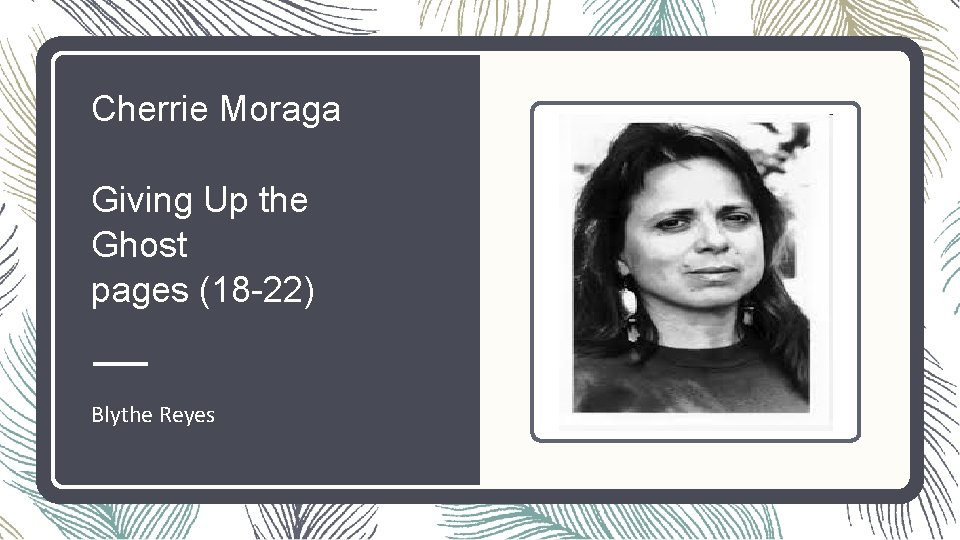
Cherrie Moraga Giving Up the Ghost pages 18
- Slides: 5
Cherrie Moraga Giving Up the Ghost pages (18 -22) Blythe Reyes
Cherríe Moraga – Born: September 25, 1952 (age 65) in Whittier, California – Education: Bachelor’s Degree in English from Immaculate Heart College (1974) // Master’s Degree in Feminist Writings from San Francisco State University (1980) – She has taught courses in dramatic arts and writing at various universities across the United States and is currently an artist in residence at Stanford University.
Cherríe Moraga She is best known for co-editing, with Gloria Anzaldúa, the anthology of feminist thought This Bridge Called My Back: Writings by Radical Women of Color. She has won countless awards such as the Creative Work Fund Award in 2008, and the Gerbode-Hewlett Foundation Grant for Playwriting in 2009.
Summary – The story/play includes Marisa (a Chicana in her late 20 s), Corky (Marisa as a teenager), and Amalia (who is a generation older than Marisa) – Scene Six starts off by Amalia describing a time where she only been crazy over one man in her life and claims that he was always clean physically and in some way mentally. – Amalia claims she never loved Alejandro in a loving way but loved his children. She loved the fact “…he had made México my home again” (Moraga 19). – Amalia was ashamed that she had started menstruating at the age of thirteen and she was warned by her Tía Fita beforehand about the bleeding. – In Scene Seven, Corky throws her chin out to Marisa “bato style” and she returns the gesture.
Thoughts I found interesting that Moraga describes some of the characters in different ways such as when she’s describing Alejandro’s appearance as clean but she also means that he’s pure. I love that Moraga gives the audience a glimpse of how “Giving Up the Ghost” can influence women into finding their true sexual identities.