
ChemistryPart 2 Notes Chemical Bonding Covalent Bonds Occur
Chemistry-Part 2 Notes Chemical Bonding
Covalent Bonds • Occur when both atoms need to gain electrons. • Chemical bond resulting from the sharing of valence electrons (between two non-metals). Most covalent bonds are between nonmetals (exceptions Be and B) • Generally occurs when elements are relatively close to each other on the Periodic Table. • The shared e- are considered part of the complete outer energy levels of both atoms involved. • Two atoms share an e- pair simultaneously. •
Molecules • Molecules are formed when 2 or more nonmetallic atoms bond covalently. All covalent compounds are also called molecular compounds. EX. H 2 O water Cl 2 chlorine gas O 2 oxygen gas CO 2 carbon dioxide gas CH 4 methane gas NH 3 ammonia
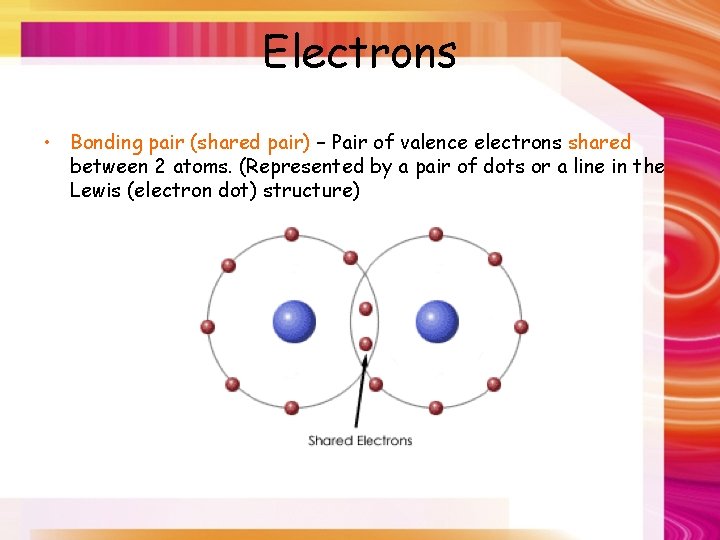
Electrons • Bonding pair (shared pair) – Pair of valence electrons shared between 2 atoms. (Represented by a pair of dots or a line in the Lewis (electron dot) structure)
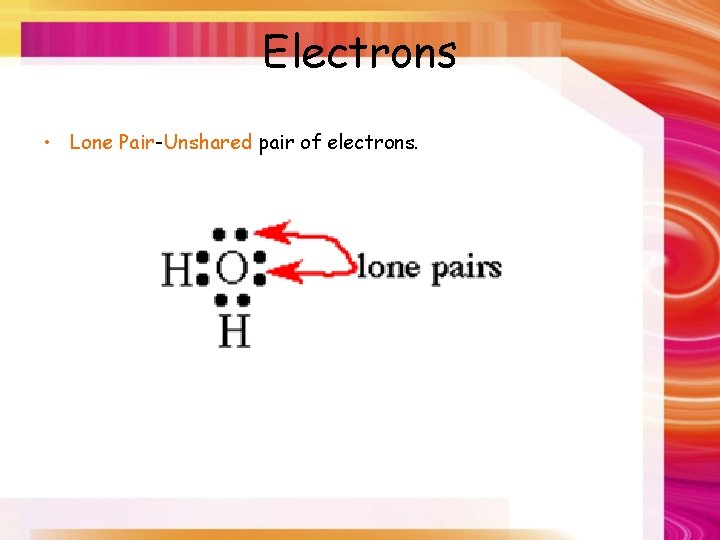
Electrons • Lone Pair-Unshared pair of electrons.

Diatomic Elements • Diatomic elements are all gases, form molecules because they don’t have full valence shells on their own. • Include: Bromine, Hydrogen, Oxygen, Nitrogen, Chlorine, Iodine, Fluorine. • Examples: H 2 F 2
Bonds Formed H– 1 Be – 2 B – 3 Group 4 A – 4 Group 7 A- 1 Group 5 A- 3 Group 6 A- 2
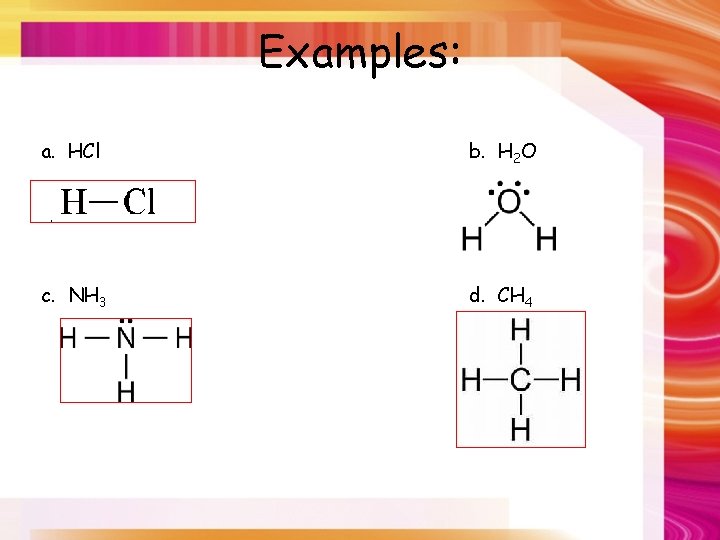
Examples: a. HCl b. H 2 O c. NH 3 d. CH 4
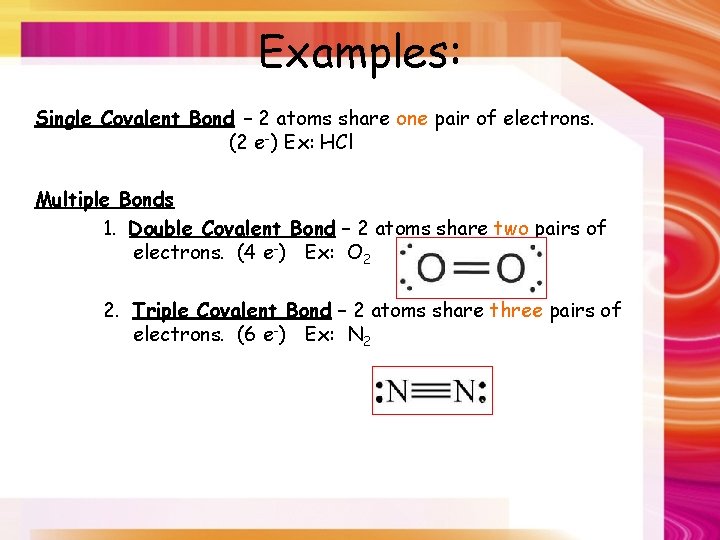
Examples: Single Covalent Bond – 2 atoms share one pair of electrons. (2 e-) Ex: HCl Multiple Bonds 1. Double Covalent Bond – 2 atoms share two pairs of electrons. (4 e-) Ex: O 2 2. Triple Covalent Bond – 2 atoms share three pairs of electrons. (6 e-) Ex: N 2
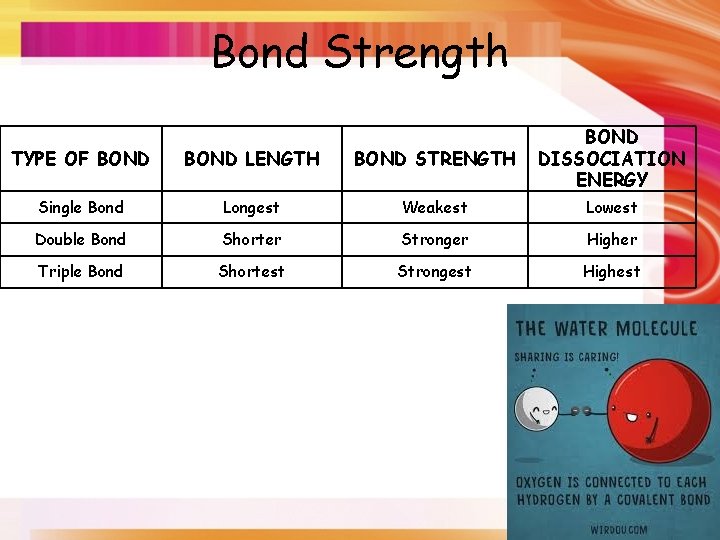
Bond Strength TYPE OF BOND LENGTH BOND STRENGTH BOND DISSOCIATION ENERGY Single Bond Longest Weakest Lowest Double Bond Shorter Stronger Higher Triple Bond Shortest Strongest Highest
- Slides: 10