
Chemistryosu edu Moleculuar Orbital MO Theory ANTBONDING These

Chemistry@osu. edu
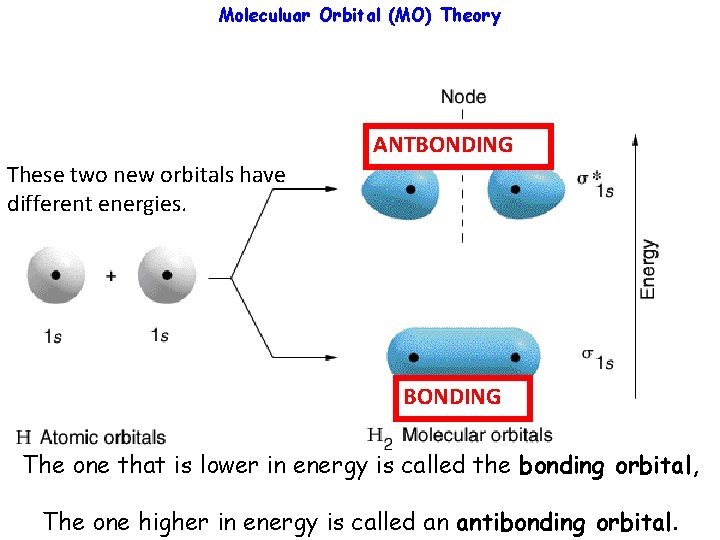
Moleculuar Orbital (MO) Theory ANTBONDING These two new orbitals have different energies. BONDING The one that is lower in energy is called the bonding orbital, The one higher in energy is called an antibonding orbital.
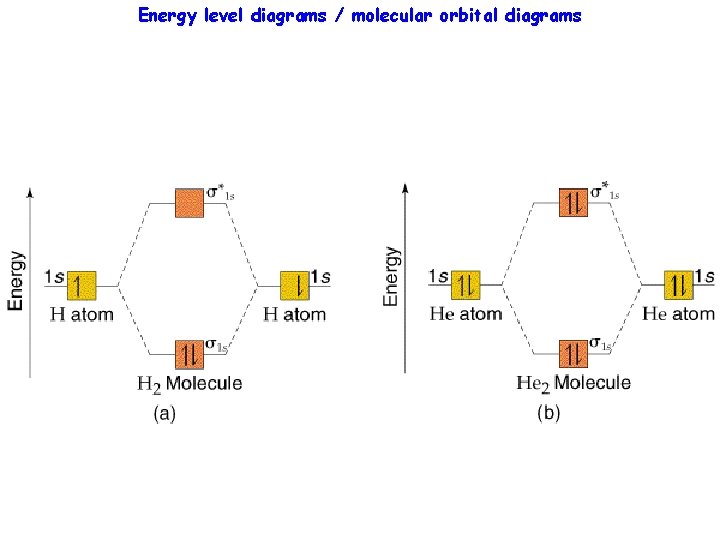
Energy level diagrams / molecular orbital diagrams
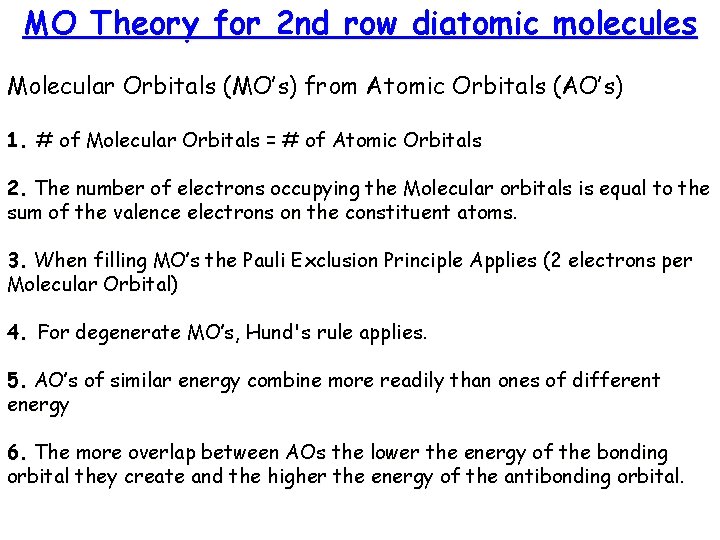
MO Theory for 2 nd row diatomic molecules Molecular Orbitals (MO’s) from Atomic Orbitals (AO’s) 1. # of Molecular Orbitals = # of Atomic Orbitals 2. The number of electrons occupying the Molecular orbitals is equal to the sum of the valence electrons on the constituent atoms. 3. When filling MO’s the Pauli Exclusion Principle Applies (2 electrons per Molecular Orbital) 4. For degenerate MO’s, Hund's rule applies. 5. AO’s of similar energy combine more readily than ones of different energy 6. The more overlap between AOs the lower the energy of the bonding orbital they create and the higher the energy of the antibonding orbital.
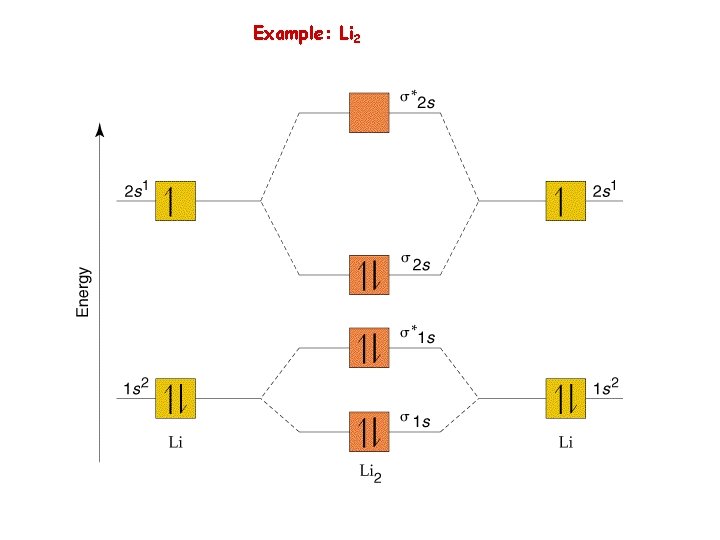
Example: Li 2
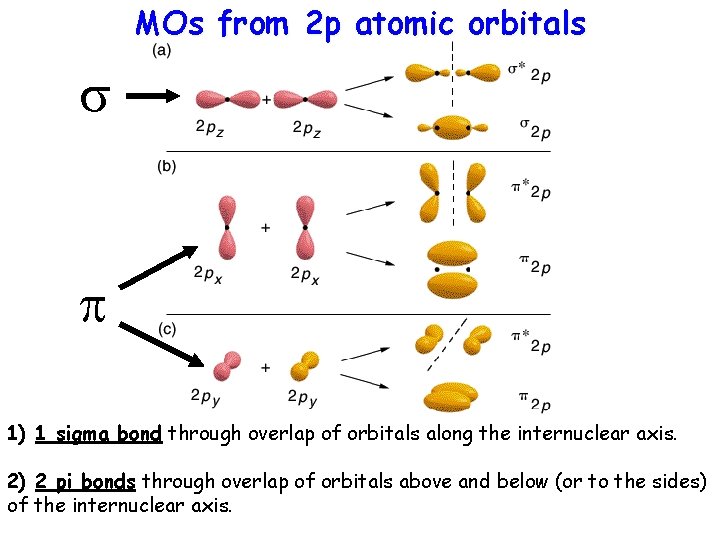
MOs from 2 p atomic orbitals s p 1) 1 sigma bond through overlap of orbitals along the internuclear axis. 2) 2 pi bonds through overlap of orbitals above and below (or to the sides) of the internuclear axis.
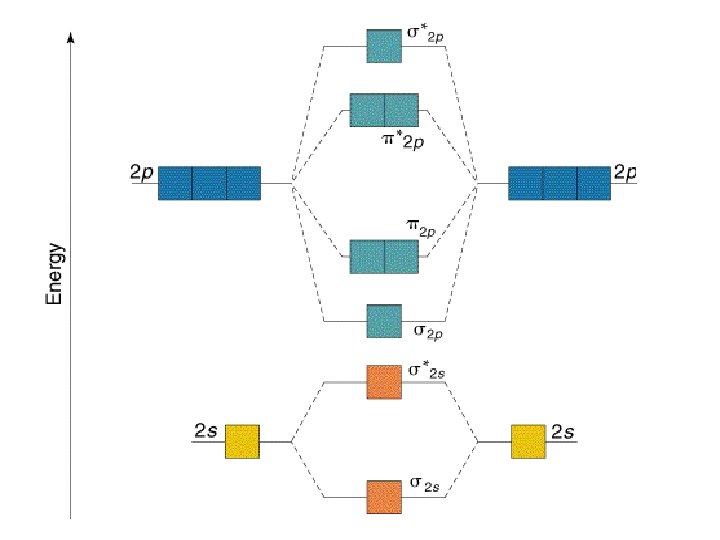
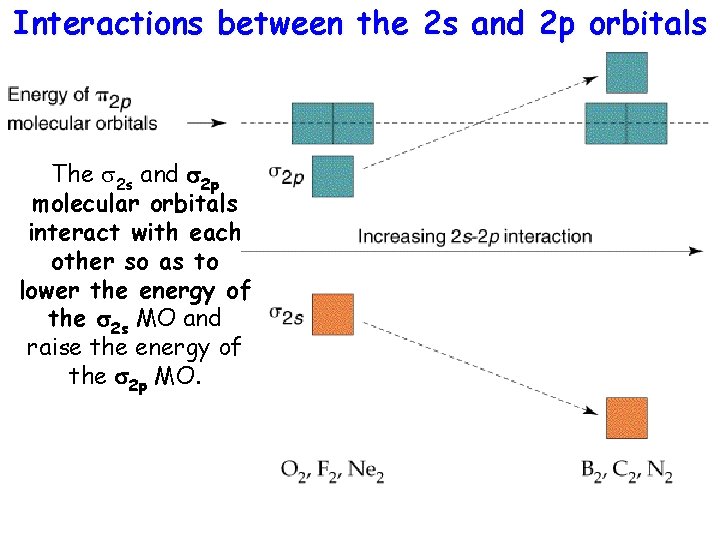
Interactions between the 2 s and 2 p orbitals The s 2 s and s 2 p molecular orbitals interact with each other so as to lower the energy of the s 2 s MO and raise the energy of the s 2 p MO.
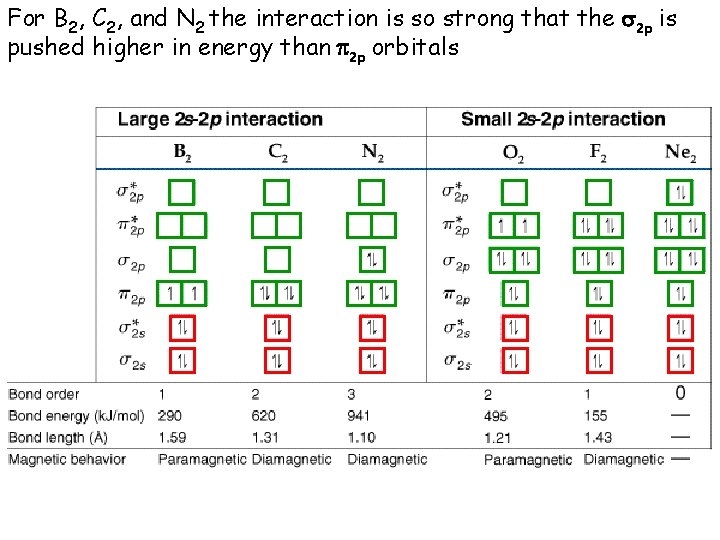
For B 2, C 2, and N 2 the interaction is so strong that the s 2 p is pushed higher in energy than p 2 p orbitals
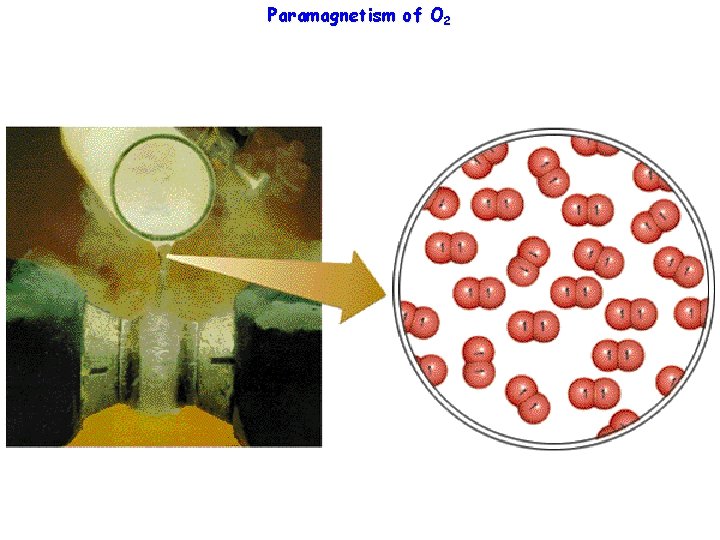
Paramagnetism of O 2
- Slides: 10