
CHEMISTRYCP CHAPTER 1 CHEMISTRY AND YOU This chapter


- Slides: 44
CHEMISTRY-CP CHAPTER 1 CHEMISTRY AND YOU This chapter will introduce you to chemistry and the uses of chemistry in our world. You will apply the scientific method to various problems and use experiments to prove hypotheses. You will also learn the basic mathematical skills needed to succeed in chemistry.
is also known as the central science • Chemists are employed in dozens of occupations • Whatever your career choice is, chances are you will need some knowledge of chemistry!!!!
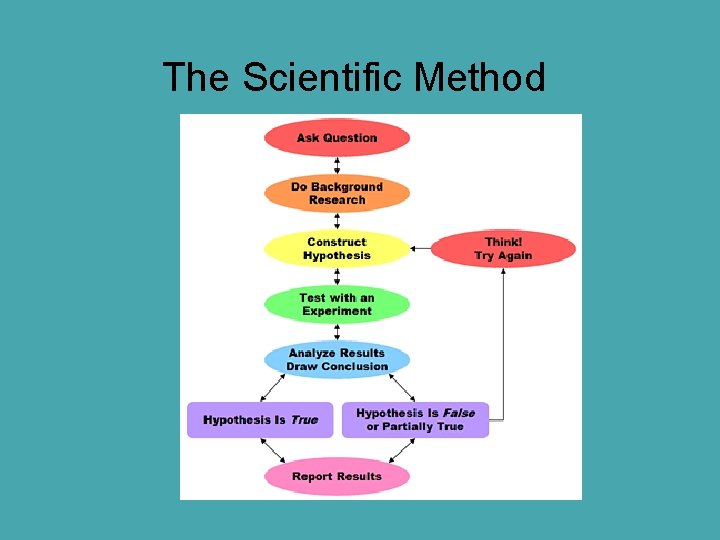
The Scientific Method
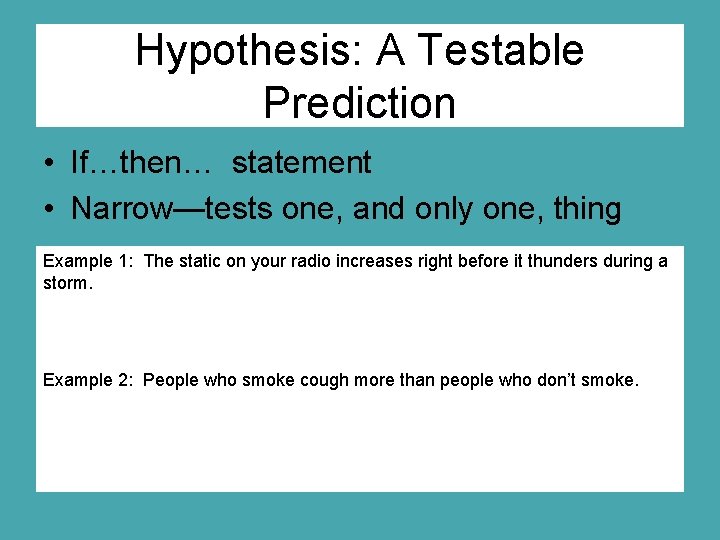
Hypothesis: A Testable Prediction • If…then… statement • Narrow—tests one, and only one, thing Example 1: The static on your radio increases right before it thunders during a storm. Example 2: People who smoke cough more than people who don’t smoke.
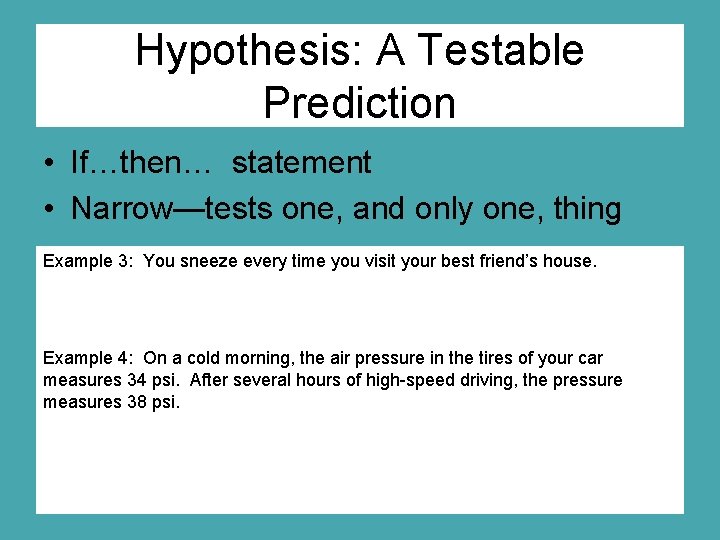
Hypothesis: A Testable Prediction • If…then… statement • Narrow—tests one, and only one, thing Example 3: You sneeze every time you visit your best friend’s house. Example 4: On a cold morning, the air pressure in the tires of your car measures 34 psi. After several hours of high-speed driving, the pressure measures 38 psi.
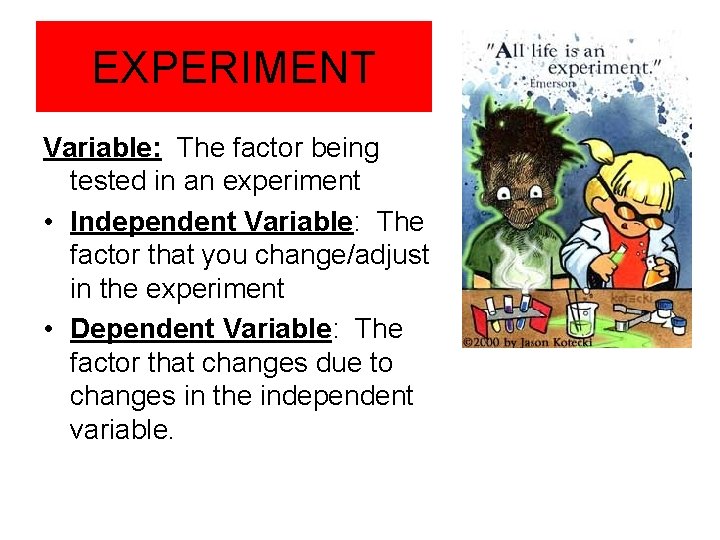
EXPERIMENT Variable: The factor being tested in an experiment • Independent Variable: The factor that you change/adjust in the experiment • Dependent Variable: The factor that changes due to changes in the independent variable.
EXPERIMENT Control: Factor that responds in a predictable way to the experiment – A control is what the rest of the experiment can be compared to Constant: Factor(s) that do not change during the experiment.
EXPERIMENT Example: What experiment could be done to prove/disprove the following hypothesis? “Clean” laundry detergent causes skin rash. • • Independent Variable: Dependent Variable: Control: Constant:
• Data: Recorded Observations – Qualitative: – Quantitative: • Graph: a visual representation of data
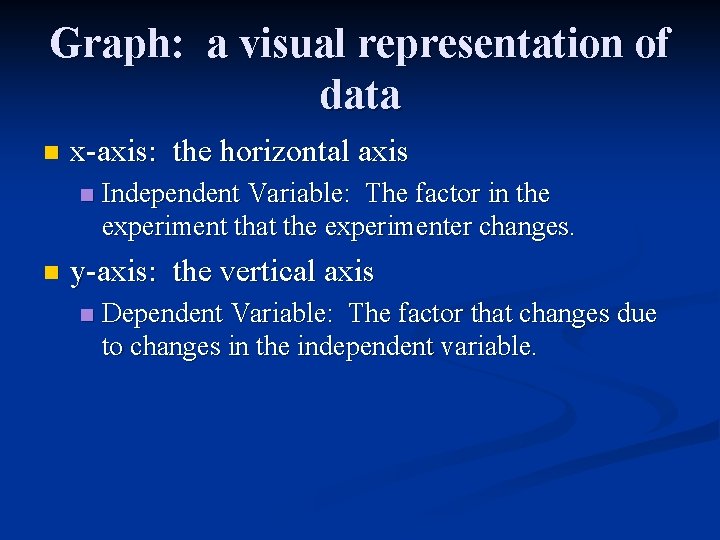
Graph: a visual representation of data n x-axis: the horizontal axis n n Independent Variable: The factor in the experiment that the experimenter changes. y-axis: the vertical axis n Dependent Variable: The factor that changes due to changes in the independent variable.
Y-axis x-axis
Steps to Graphing n Numbering: Make sure the numbers you put on the axes follow patterns. n n For example: 2, 4, 6, 8, 10 or 5, 10, 15, 20 or 0. 1, 0. 2, 0. 3, 0. 4 etc. Labeling: Make sure you label each axis with a title and a unit and that you title your graph.
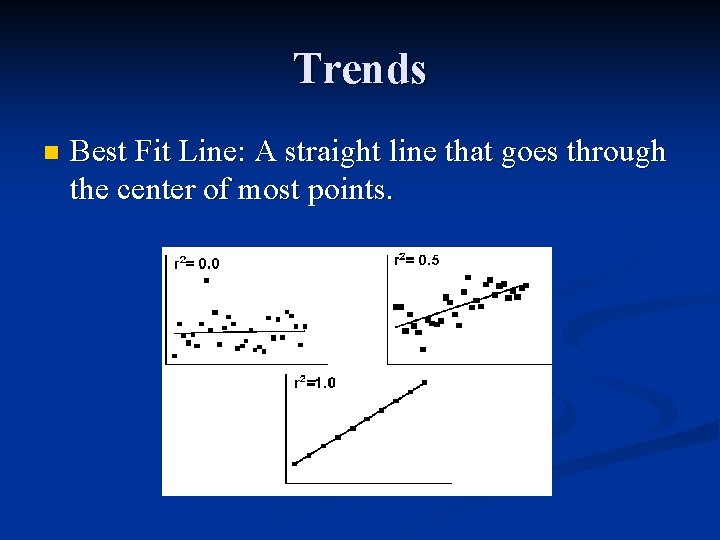
Trends n Best Fit Line: A straight line that goes through the center of most points.
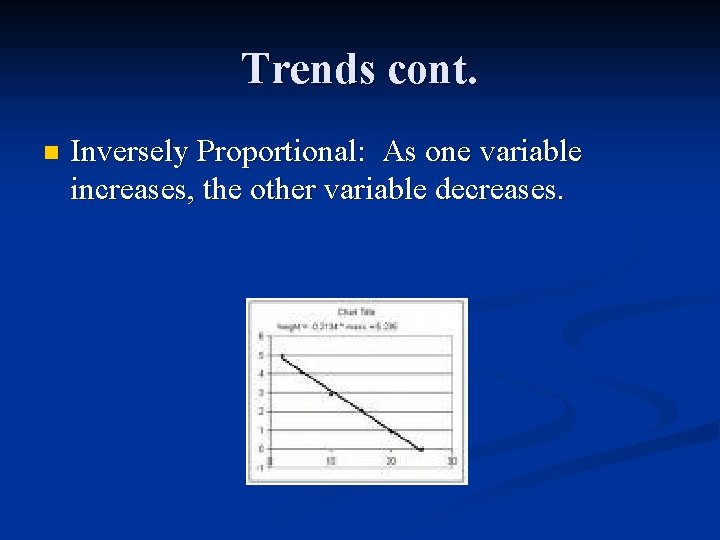
Trends cont. n Inversely Proportional: As one variable increases, the other variable decreases.
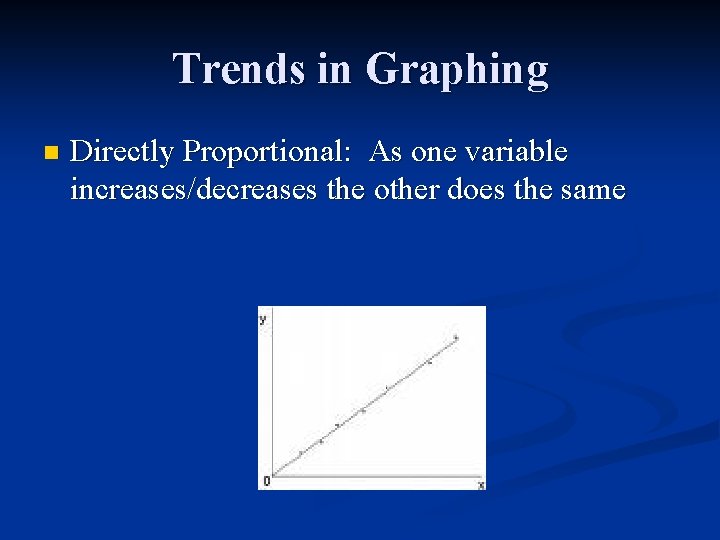
Trends in Graphing n Directly Proportional: As one variable increases/decreases the other does the same
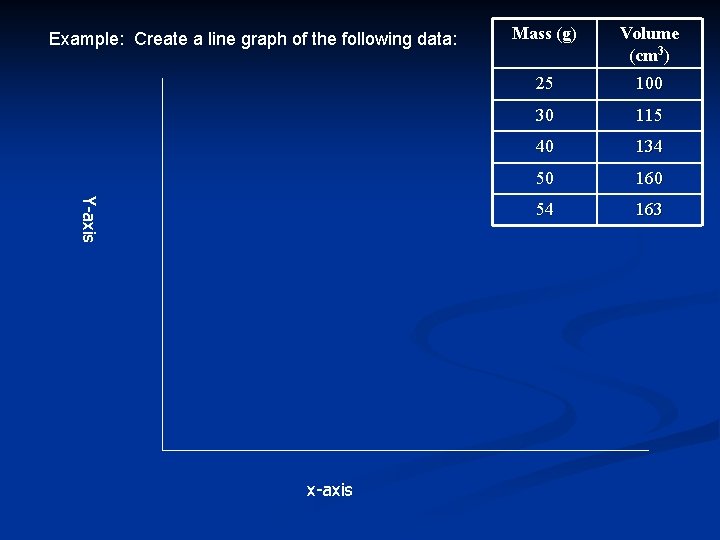
Example: Create a line graph of the following data: Y-axis x-axis Mass (g) Volume (cm 3) 25 100 30 115 40 134 50 160 54 163
Draw Conclusions Theory: Explains • States the “Why” Law: States a Fact • States the “What”
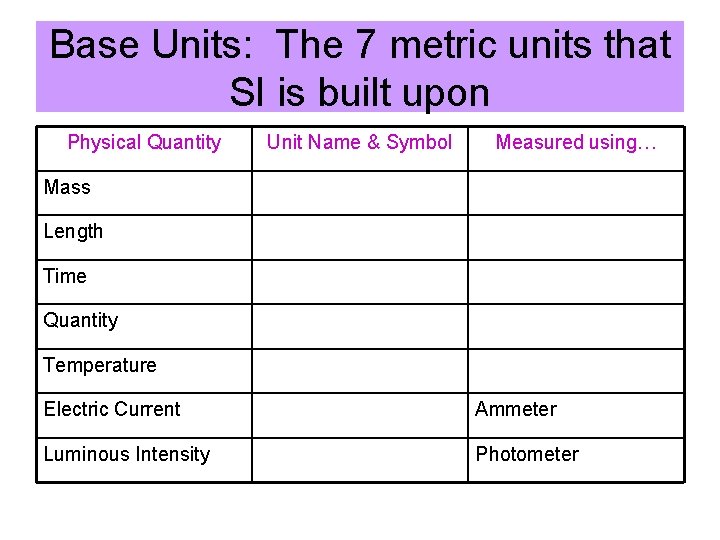
Base Units: The 7 metric units that SI is built upon Physical Quantity Unit Name & Symbol Measured using… Mass Length Time Quantity Temperature Electric Current Ammeter Luminous Intensity Photometer
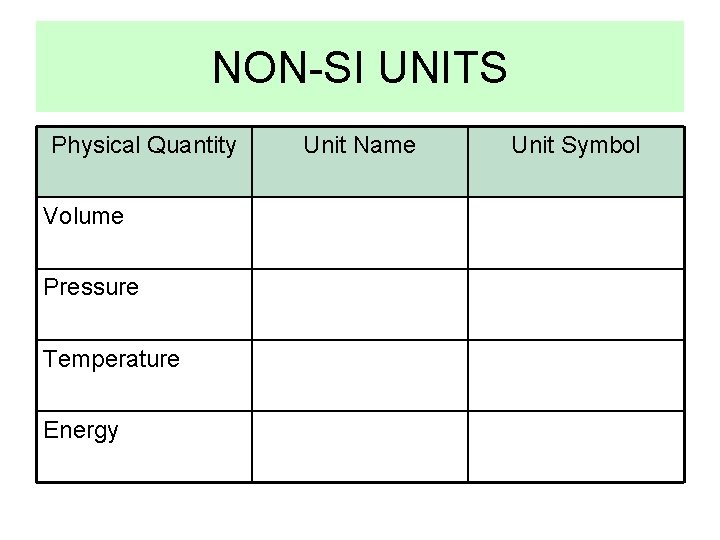
NON-SI UNITS Physical Quantity Volume Pressure Temperature Energy Unit Name Unit Symbol
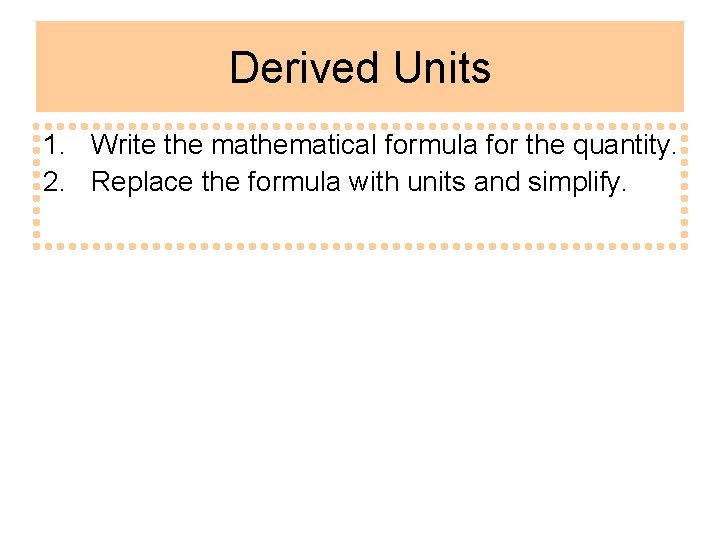
Derived Units 1. Write the mathematical formula for the quantity. 2. Replace the formula with units and simplify.
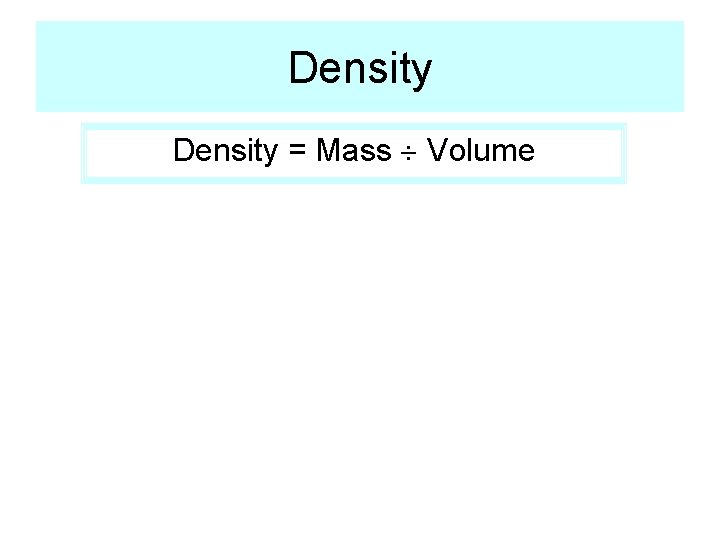
Density = Mass Volume
METRIC CONVERSIONS
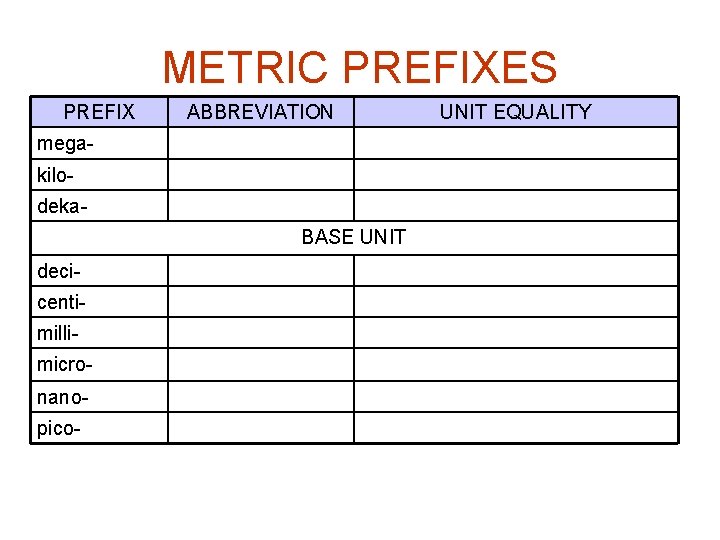
METRIC PREFIXES PREFIX ABBREVIATION megakilodeka. BASE UNIT decicentimillimicronanopico- UNIT EQUALITY
DIMENSIONAL ANALYSIS • What is a conversion factor equal to? • How do you use conversion factors?
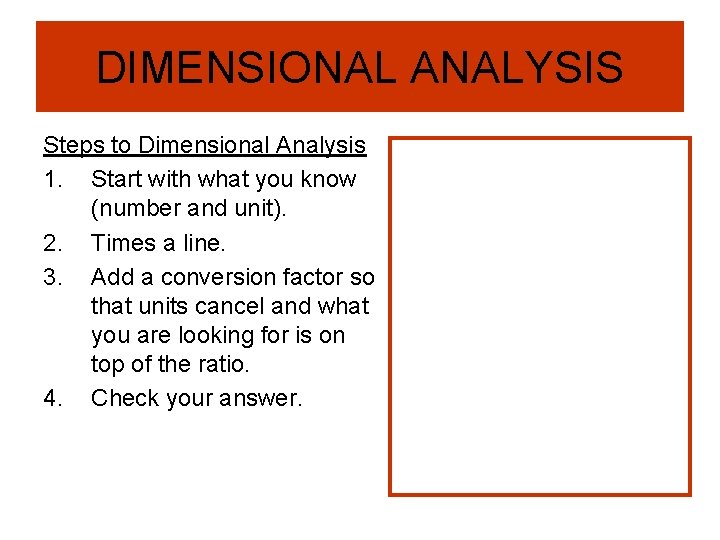
DIMENSIONAL ANALYSIS Steps to Dimensional Analysis 1. Start with what you know (number and unit). 2. Times a line. 3. Add a conversion factor so that units cancel and what you are looking for is on top of the ratio. 4. Check your answer.
Uncertainty in Measurements Why are measurements uncertain? o Precision of instrumentation varies o Human error
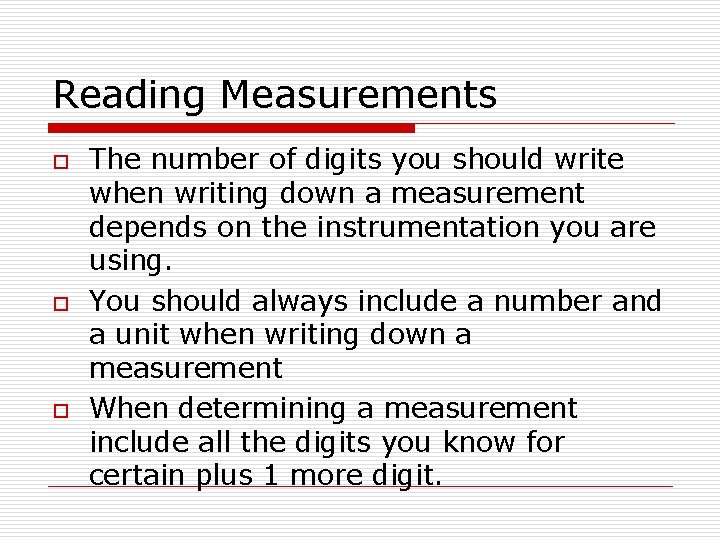
Reading Measurements o o o The number of digits you should write when writing down a measurement depends on the instrumentation you are using. You should always include a number and a unit when writing down a measurement When determining a measurement include all the digits you know for certain plus 1 more digit.
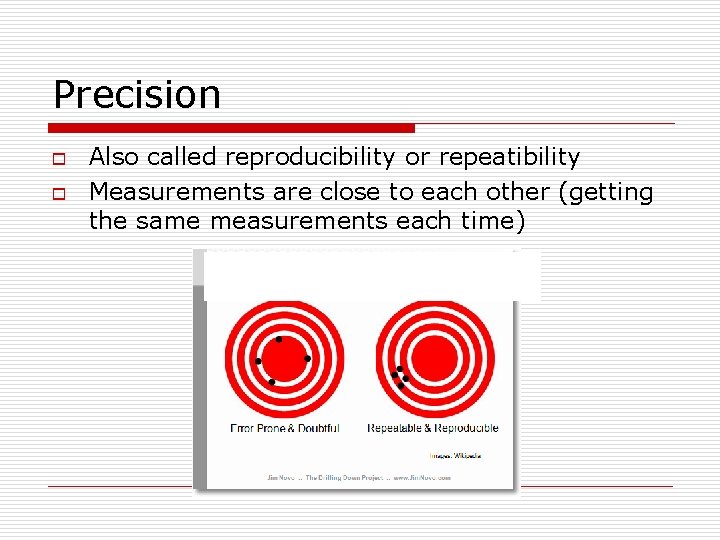
Precision o o Also called reproducibility or repeatibility Measurements are close to each other (getting the same measurements each time)
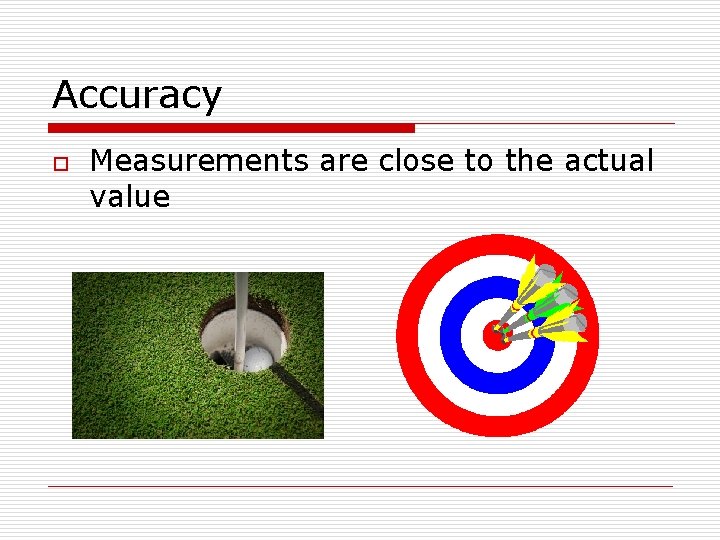
Accuracy o Measurements are close to the actual value
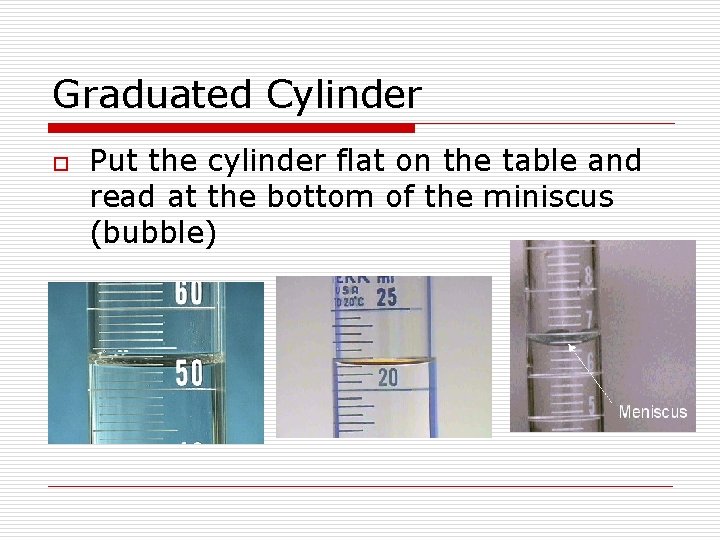
Graduated Cylinder o Put the cylinder flat on the table and read at the bottom of the miniscus (bubble)
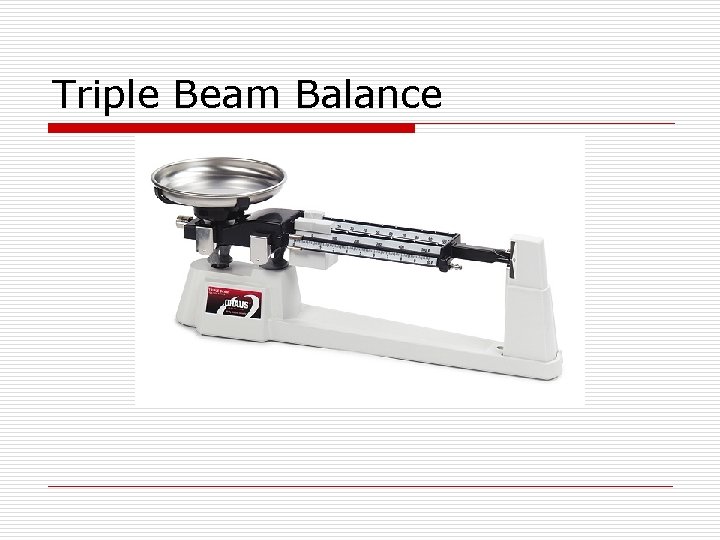
Triple Beam Balance
OPENER With your partner, make the following measurements. Be sure to make the measurements to the proper # of digits. Be sure to include units for all measurements. Write your answers on a sheet of paper and have Ms. Wack check your answers. All materials are in the back of the classroom. o o o The volume of water in the 100 m. L and 10 m. L graduated cylinders. The length of the paper clip. The mass of a 100 m. L beaker.
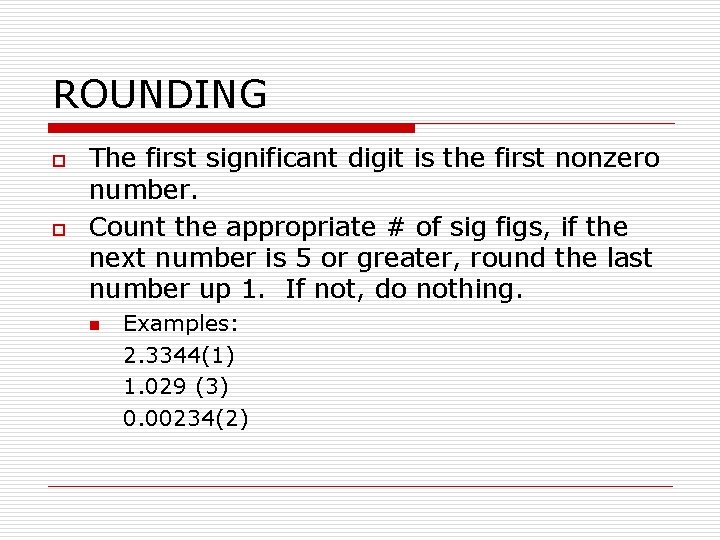
ROUNDING o o The first significant digit is the first nonzero number. Count the appropriate # of sig figs, if the next number is 5 or greater, round the last number up 1. If not, do nothing. n Examples: 2. 3344(1) 1. 029 (3) 0. 00234(2)
SIGNIFICANT FIGURES o o The certain digits and the estimated digit of a measurement. All the known digits of a measurement and the one estimated digit.
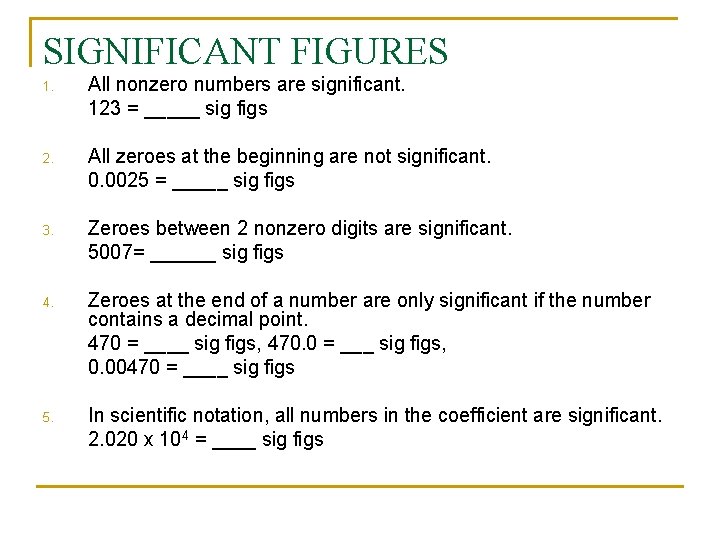
SIGNIFICANT FIGURES 1. All nonzero numbers are significant. 123 = _____ sig figs 2. All zeroes at the beginning are not significant. 0. 0025 = _____ sig figs 3. Zeroes between 2 nonzero digits are significant. 5007= ______ sig figs 4. Zeroes at the end of a number are only significant if the number contains a decimal point. 470 = ____ sig figs, 470. 0 = ___ sig figs, 0. 00470 = ____ sig figs 5. In scientific notation, all numbers in the coefficient are significant. 2. 020 x 104 = ____ sig figs
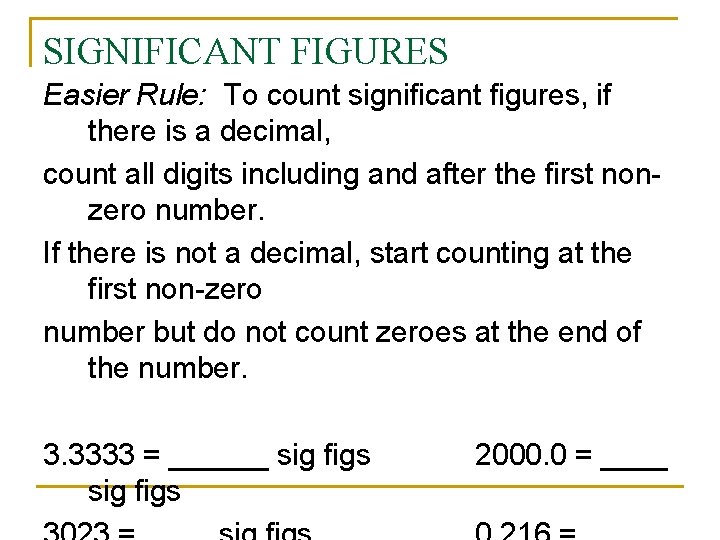
SIGNIFICANT FIGURES Easier Rule: To count significant figures, if there is a decimal, count all digits including and after the first nonzero number. If there is not a decimal, start counting at the first non-zero number but do not count zeroes at the end of the number. 3. 3333 = ______ sig figs 2000. 0 = ____
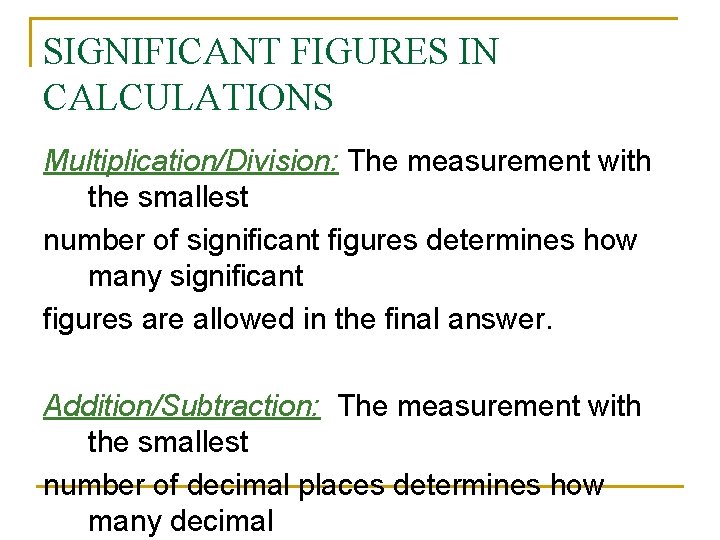
SIGNIFICANT FIGURES IN CALCULATIONS Multiplication/Division: The measurement with the smallest number of significant figures determines how many significant figures are allowed in the final answer. Addition/Subtraction: The measurement with the smallest number of decimal places determines how many decimal
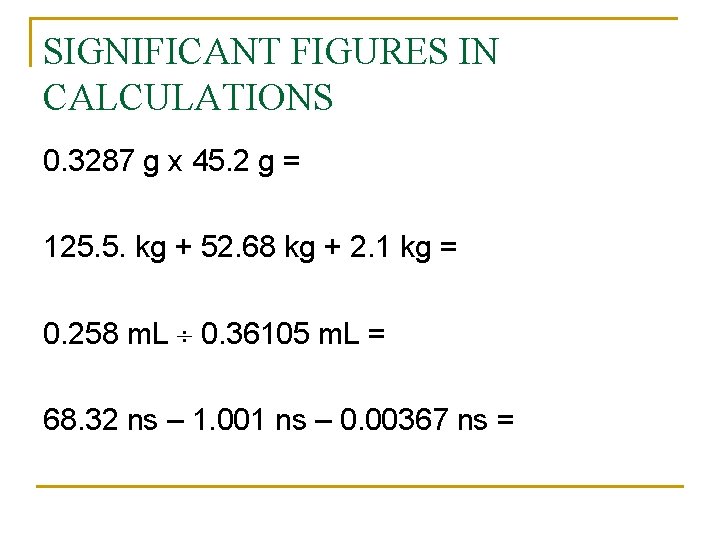
SIGNIFICANT FIGURES IN CALCULATIONS 0. 3287 g x 45. 2 g = 125. 5. kg + 52. 68 kg + 2. 1 kg = 0. 258 m. L 0. 36105 m. L = 68. 32 ns – 1. 001 ns – 0. 00367 ns =
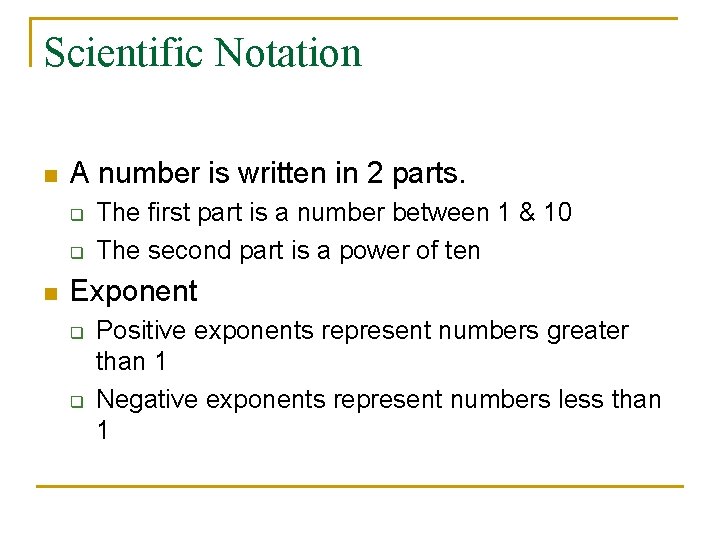
Scientific Notation n A number is written in 2 parts. q q n The first part is a number between 1 & 10 The second part is a power of ten Exponent q q Positive exponents represent numbers greater than 1 Negative exponents represent numbers less than 1
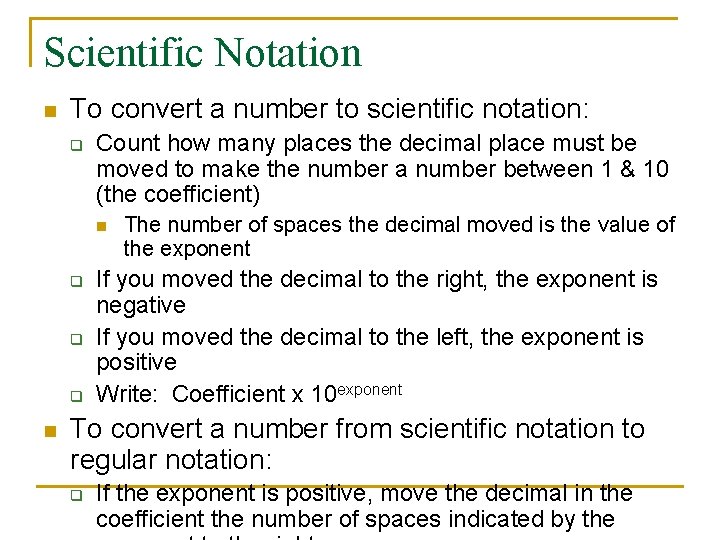
Scientific Notation n To convert a number to scientific notation: q Count how many places the decimal place must be moved to make the number a number between 1 & 10 (the coefficient) n q q q n The number of spaces the decimal moved is the value of the exponent If you moved the decimal to the right, the exponent is negative If you moved the decimal to the left, the exponent is positive Write: Coefficient x 10 exponent To convert a number from scientific notation to regular notation: q If the exponent is positive, move the decimal in the coefficient the number of spaces indicated by the
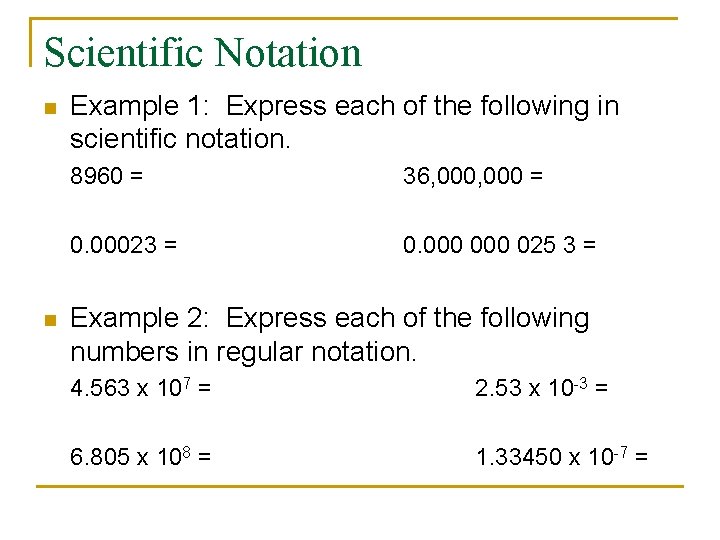
Scientific Notation n n Example 1: Express each of the following in scientific notation. 8960 = 36, 000 = 0. 00023 = 0. 000 025 3 = Example 2: Express each of the following numbers in regular notation. 4. 563 x 107 = 2. 53 x 10 -3 = 6. 805 x 108 = 1. 33450 x 10 -7 =
Scientific Notation n A number is written in 2 parts. q q n The first part is a number between 1 & 10 The second part is a power of ten Exponent q q Positive exponents represent numbers greater than 1 Negative exponents represent numbers less than 1
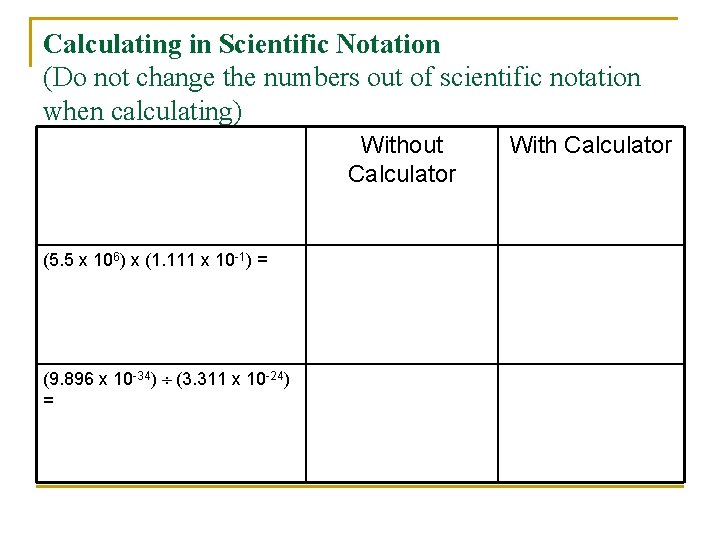
Calculating in Scientific Notation (Do not change the numbers out of scientific notation when calculating) Without Calculator (5. 5 x 106) x (1. 111 x 10 -1) = (9. 896 x 10 -34) (3. 311 x 10 -24) = With Calculator
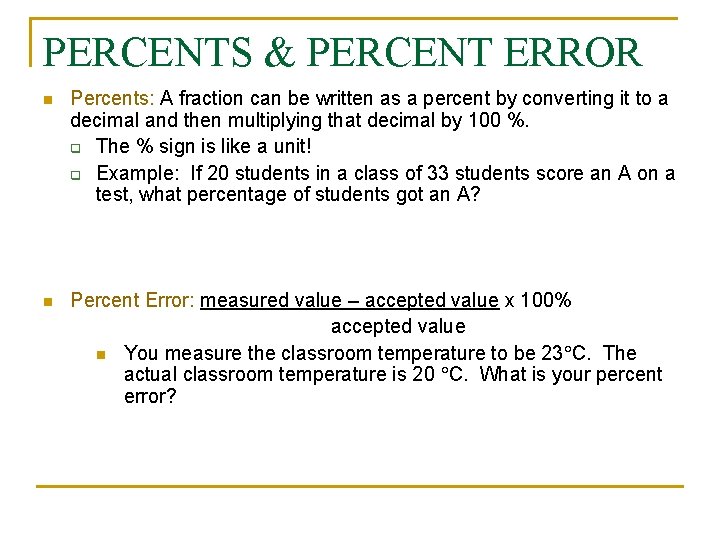
PERCENTS & PERCENT ERROR n Percents: A fraction can be written as a percent by converting it to a decimal and then multiplying that decimal by 100 %. q The % sign is like a unit! q Example: If 20 students in a class of 33 students score an A on a test, what percentage of students got an A? n Percent Error: measured value – accepted value x 100% accepted value n You measure the classroom temperature to be 23 C. The actual classroom temperature is 20 C. What is your percent error?