
Chemistry Unit 5 Types of Chemical Bonds l
Chemistry Unit 5
Types of Chemical Bonds l. A chemical bond forms when 2 or more atoms rearrange valence electrons to increase stability. l There are three types of bonds, ionic, covalent, and metallic bonds.
Ionic Bonds l Ionic Bonds form when valence electrons are transferred from one atom to another Cation- atom loses electrons and become + l Anion- atom gains electrons and become – l l In ionic compounds the ions are arranged in a crystal lattice with strong forces holding the ions together.
Ionic Bond Properties l High melting and boiling points l Hard- not easily crushed l Conduct electricity when melted or dissolved because the ions are free to move.
Covalent Bonds l Covalent bond forms when electrons are shared, forming molecules or compounds. l Covalent bonds have weaker forces holding the molecules together.
Covalent Bond Properties l Lower melting and boiling points l Many covalent compounds are volatile (evaporate easily) liquids or gases. l Softer- easier to crush l Are not conductors of electricity.
Electronegativity l Electronegativity is a property that tells how strong an atom’s attraction is for its electrons. l Since oxygen has a higher electronegativity than hydrogen, oxygen holds onto shared electrons more, giving the oxygen a slightly negative charge and the hydrogen a partial positive charge.
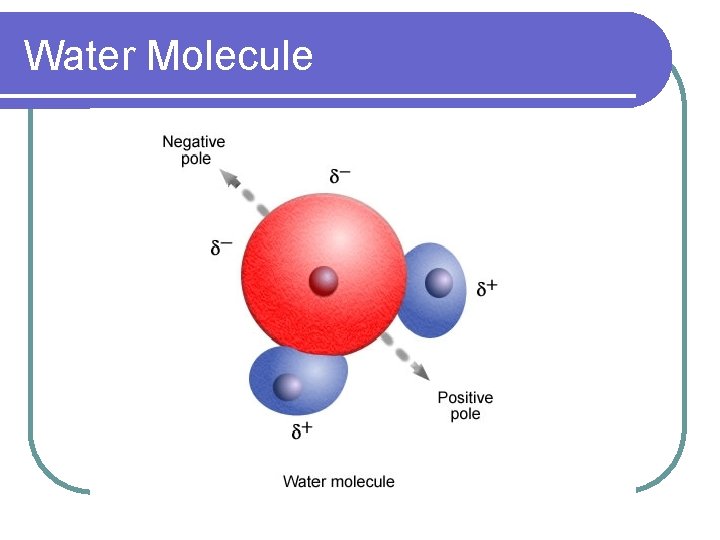
Water Molecule
Two types of Covalent Bonds l Polar covalent bonds form when electrons are shared unequally, creating partially charged ends or poles. l Nonpolar covalent bonds form when electrons are shared equally because atoms have the same electronegativities.
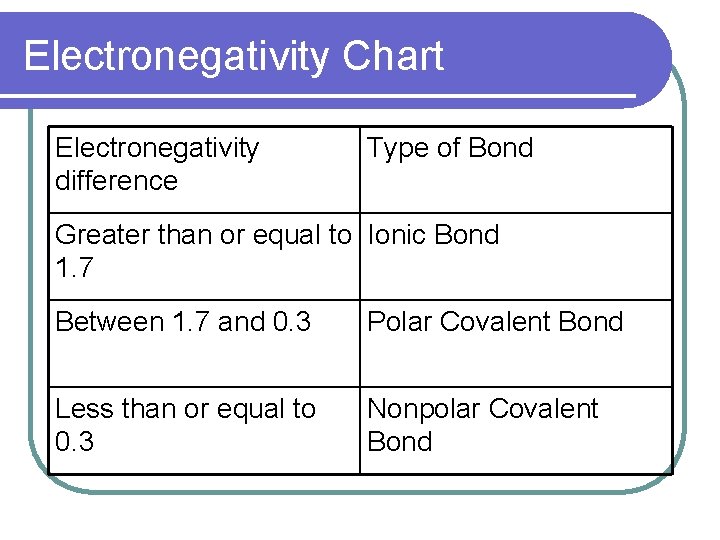
Electronegativity Chart Electronegativity difference Type of Bond Greater than or equal to Ionic Bond 1. 7 Between 1. 7 and 0. 3 Polar Covalent Bond Less than or equal to 0. 3 Nonpolar Covalent Bond
Practice l Mg and F? l S and O
More Practice l Li and Cl? l C and O? l Na and Cl? l Cl and Br? l S and H?
Metallic Bond l Metallic bonds are formed when electrons are delocalized or creates a sea of electrons between two metals. l Properties of Metals Conduct Electricity l Malleable l Ductile l Luster l
Oxygen l Symbol =O l Atomic number = 8 l Protons = 8 l Electrons= 8 l Electron distribution= 1 s 22 p 4 l Valence electrons=6
Electron Dot Diagrams l Electron Dot Diagrams are atom’s symbol surrounded by dots to represent its valence electrons l Example l O Li
More Practice l Mg l Br l He l Kr l N l Al l Si
Lewis Structure l Lewis Structure- diagram representing the arrangement of valence electrons in a molecule. l Most atoms need 8 valence electrons to become stable. The exceptions are H and He which only need 2 valence electrons to be stable.
Lewis Structure for H 2 l H-H l Shared pair of electrons is where 2 electrons belonging to both atoms are represented by a line between the symbols.
Lewis Structure for Cl 2 l Each Cl atom has 7 electrons, giving a total of 14 valence electrons to work with. l Cl—Cl l Have one shared pair l An Unshared pair are electrons belonging to only one atom and are represented by 2 dots.
Lewis Structure for HCl l H—Cl l When more than two atoms bond, you must determine which is central. The central atom is often the atom with the smallest electronegativity l Most commonly C l And Never H l
Lewis Structure for CH 3 I l Total number of electrons is _____. l What is the central atom?
Episode Unit 5 problem set
Lewis Structure for C 2 H 4 l Total number of valence electrons
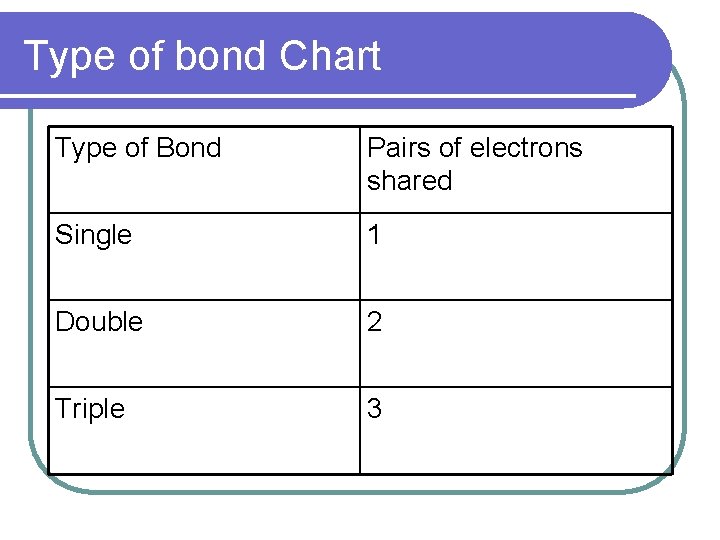
Type of bond Chart Type of Bond Pairs of electrons shared Single 1 Double 2 Triple 3
Problem Set 3
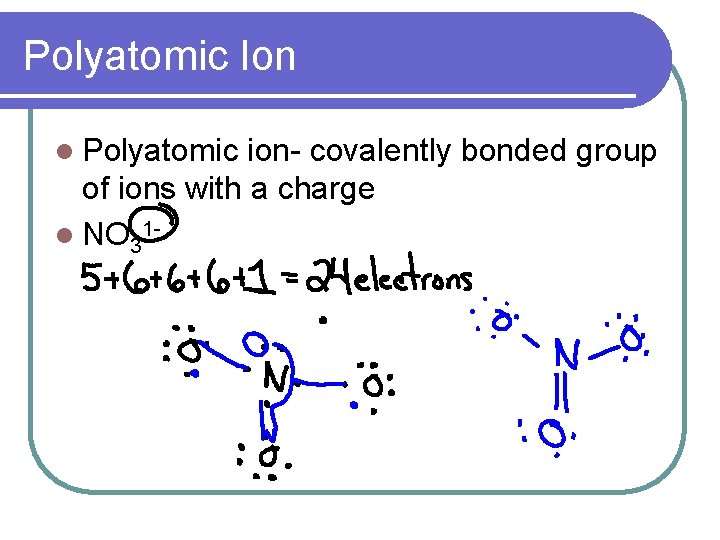
Polyatomic Ion l Polyatomic ion- covalently bonded group of ions with a charge l NO 31 -
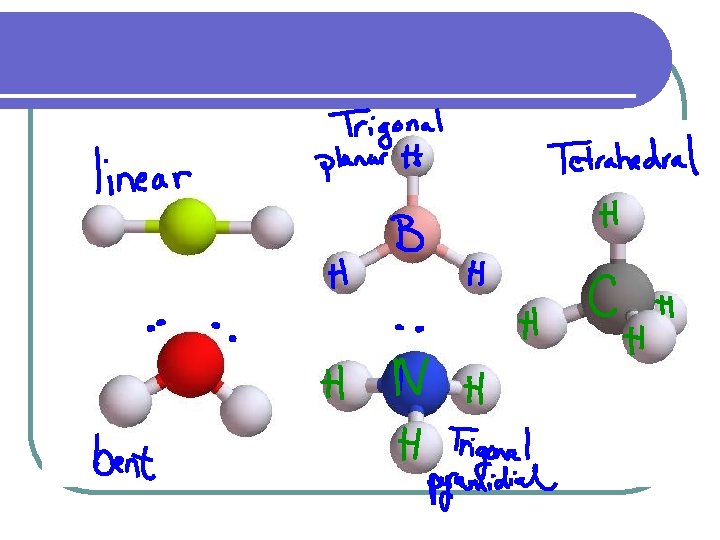
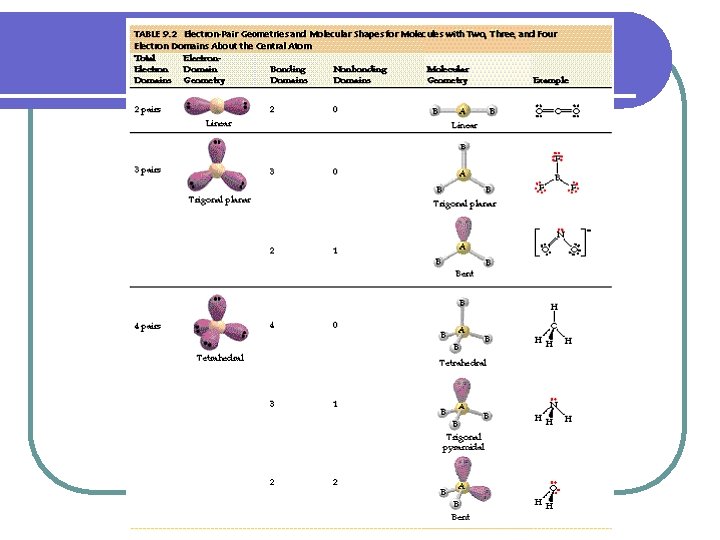
Geometric Shape l VSEPR-valence shell electron-pair repulsion. l Since electrons repel each other, electron pairs will be as far apart as possible
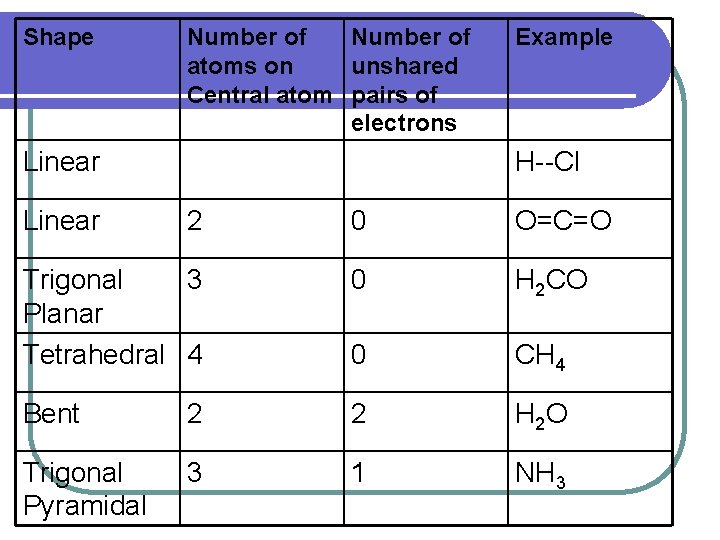
Shape Number of atoms on unshared Central atom pairs of electrons Linear Example H--Cl 2 0 O=C=O Trigonal 3 Planar Tetrahedral 4 0 H 2 CO 0 CH 4 Bent 2 2 H 2 O Trigonal Pyramidal 3 1 NH 3
Polar Molecules l Polar Molecules must contain at least one polar bond and shaped so that there is a + and – end. l water
Non-polar Molecule l Non-polar molecule contains only nonpolar bonds or contains polar bonds, but has no charged ends.
Intermolecular Forces l Forces of attraction between molecules. l Are weaker than covalent and ionic bonds.
Types of Intermolecular Forces l Dipole-dipole forces: force of attraction between + end of one molecule and – end of another molecule l The strongest intermolecular force.
Types of Intermolecular Forces l Hydrogen Bonding: occurs in molecules with H-F, H-O, H-N l Large + charge on H is attracted to an unshared pair of electrons on a neighboring molecule
Types of Intermolecular Forces l London Dispersion Forces: weak intermolecular forces resulting from constant motion of electrons. l The only type of intermolecular force between nonpolar molecules. l Induces a temporary polar end on a molecule.
- Slides: 36