
Chemistry Triple Science Key Stage 4 Processing Titration
- Slides: 14
Chemistry - Triple Science - Key Stage 4 Processing Titration Results Mr Campbell
Source: Oak
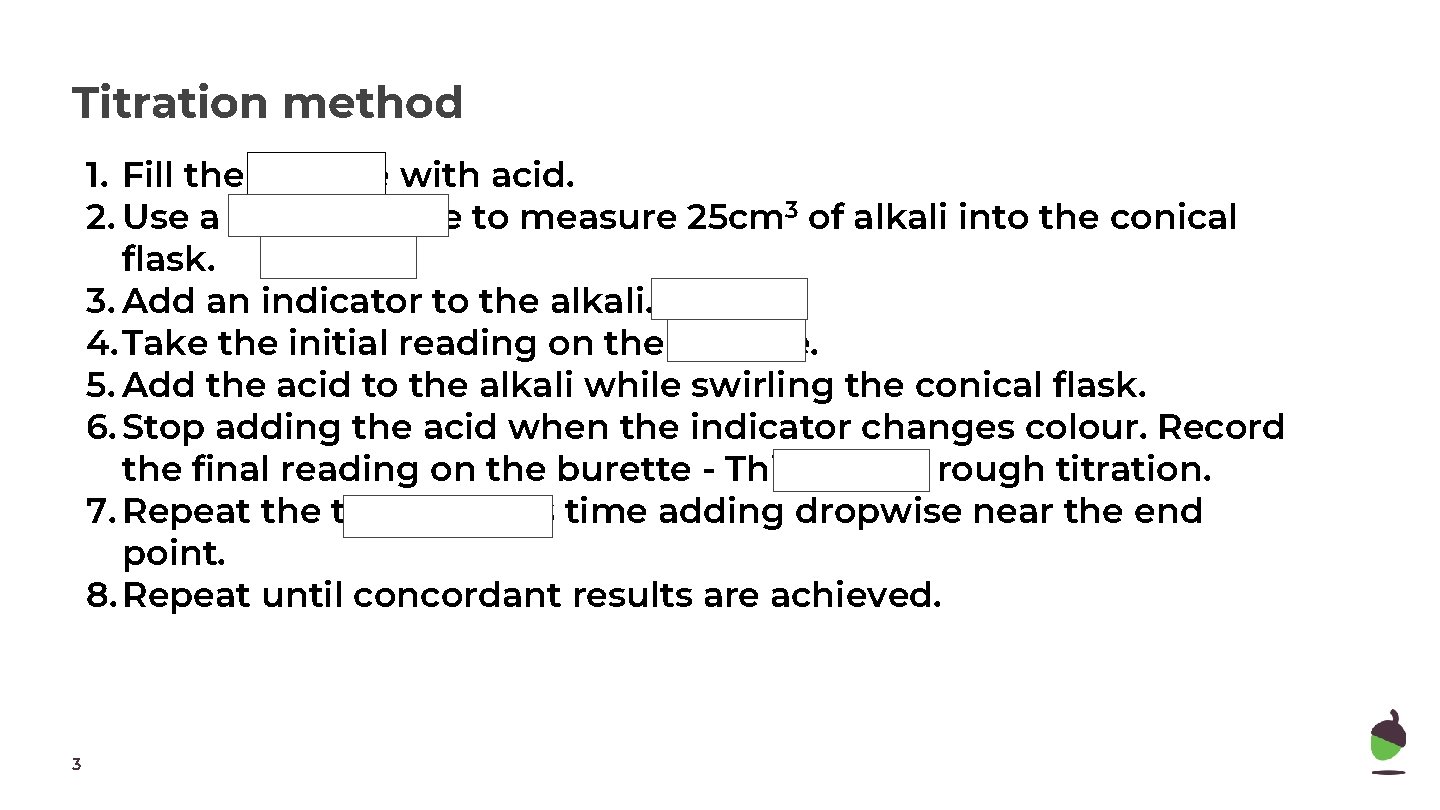
Titration method 1. Fill the burette with acid. 2. Use a glass pipette to measure 25 cm 3 of alkali into the conical flask. 3. Add an indicator to the alkali. 4. Take the initial reading on the burette. 5. Add the acid to the alkali while swirling the conical flask. 6. Stop adding the acid when the indicator changes colour. Record the final reading on the burette - This is your rough titration. 7. Repeat the titration this time adding dropwise near the end point. 8. Repeat until concordant results are achieved. 3
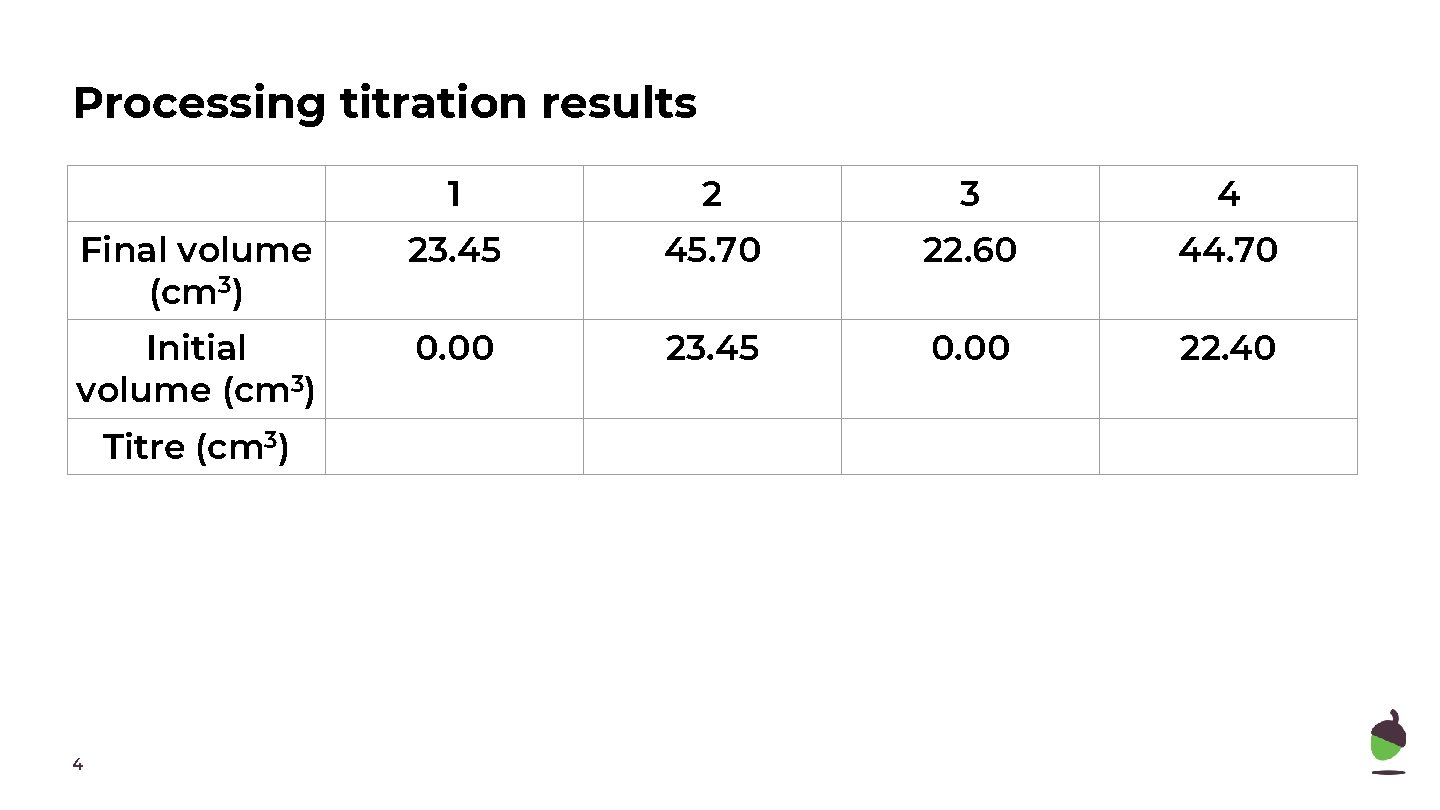
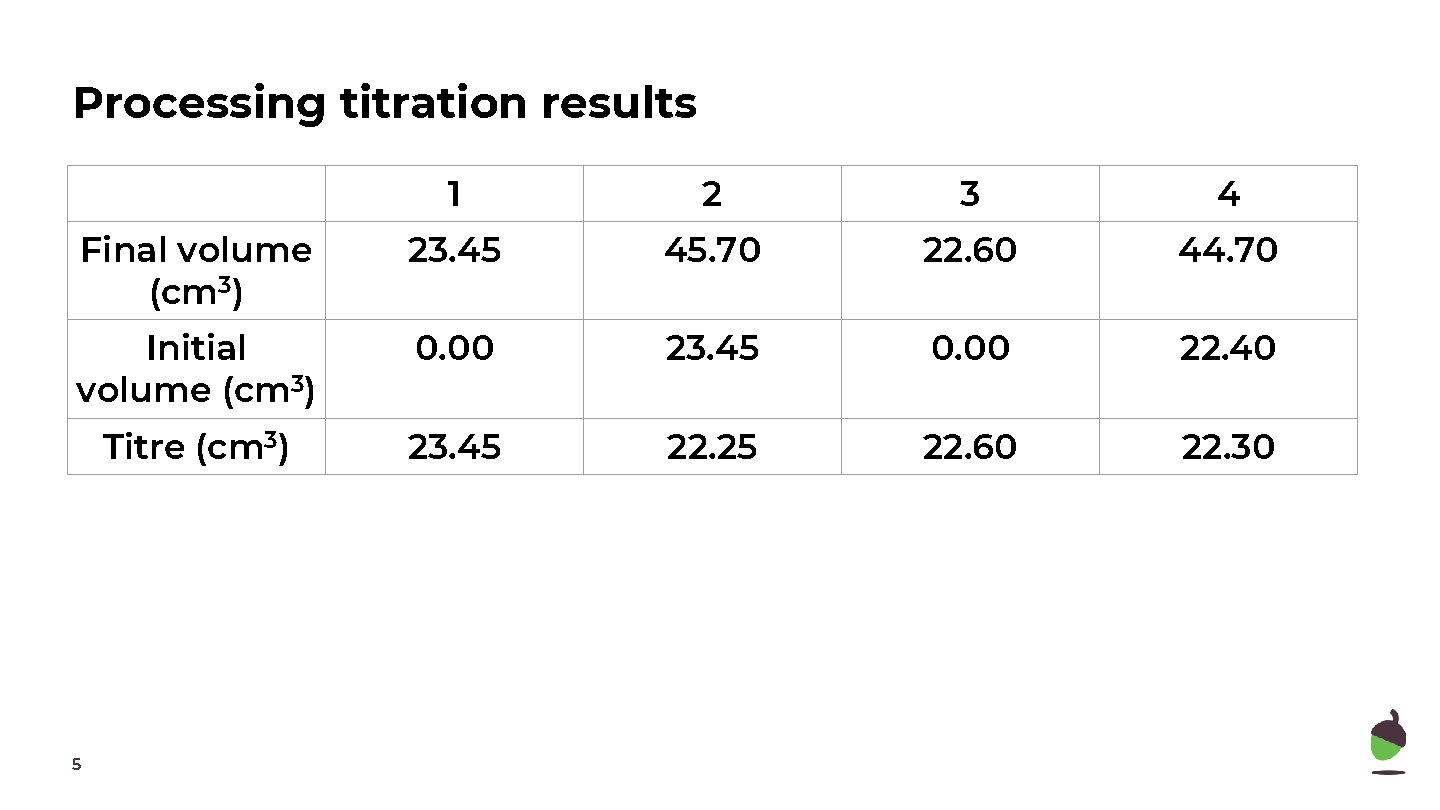
Processing titration results 1 2 3 4 Final volume (cm 3) 23. 45 45. 70 22. 60 44. 70 Initial volume (cm 3) 0. 00 23. 45 0. 00 22. 40 Titre (cm 3) 4
Processing titration results 1 2 3 4 Final volume (cm 3) 23. 45 45. 70 22. 60 44. 70 Initial volume (cm 3) 0. 00 23. 45 0. 00 22. 40 Titre (cm 3) 23. 45 22. 25 22. 60 22. 30 5
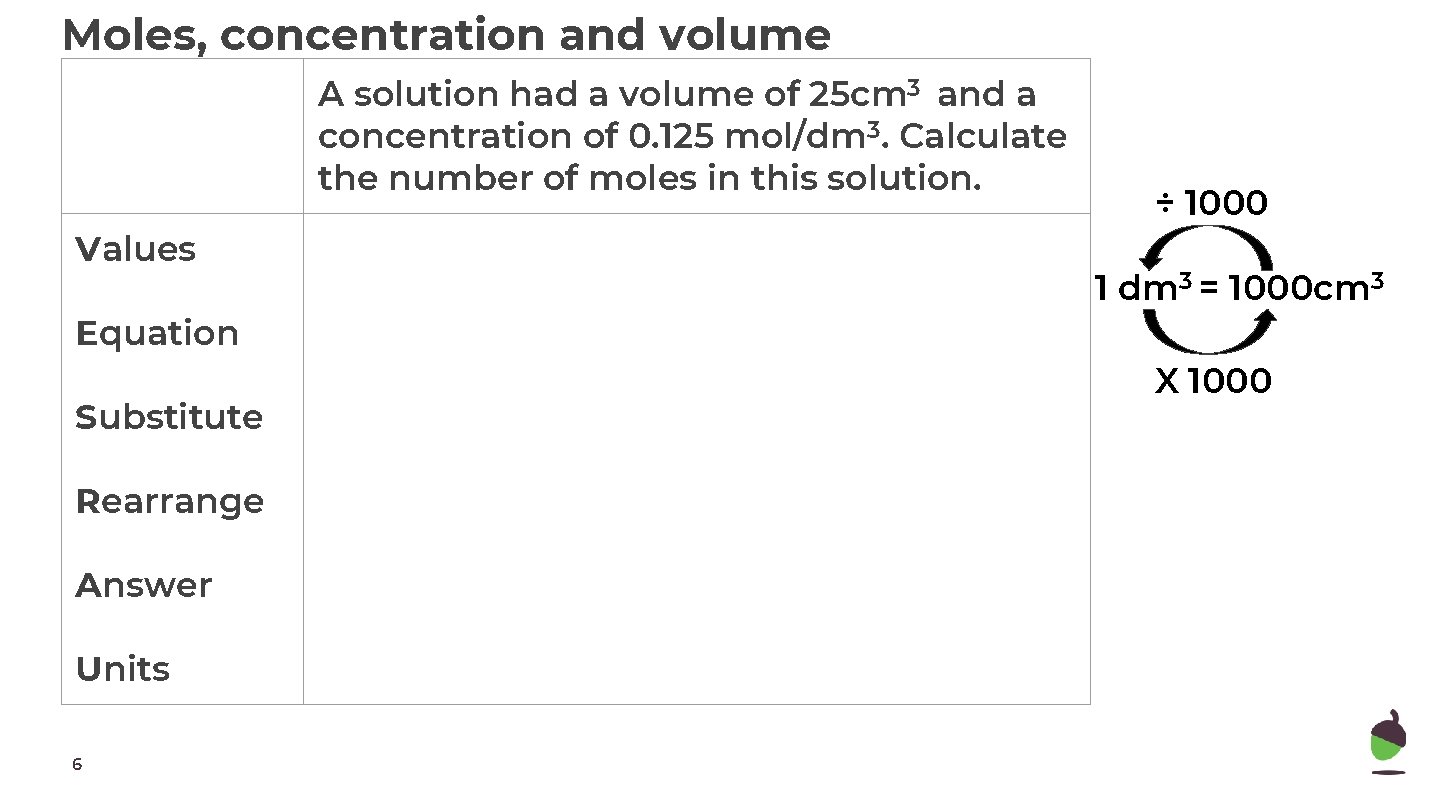
Moles, concentration and volume A solution had a volume of 25 cm 3 and a concentration of 0. 125 mol/dm 3. Calculate the number of moles in this solution. Values Equation Substitute Rearrange Answer Units 6 ÷ 1000 1 dm 3 = 1000 cm 3 X 1000
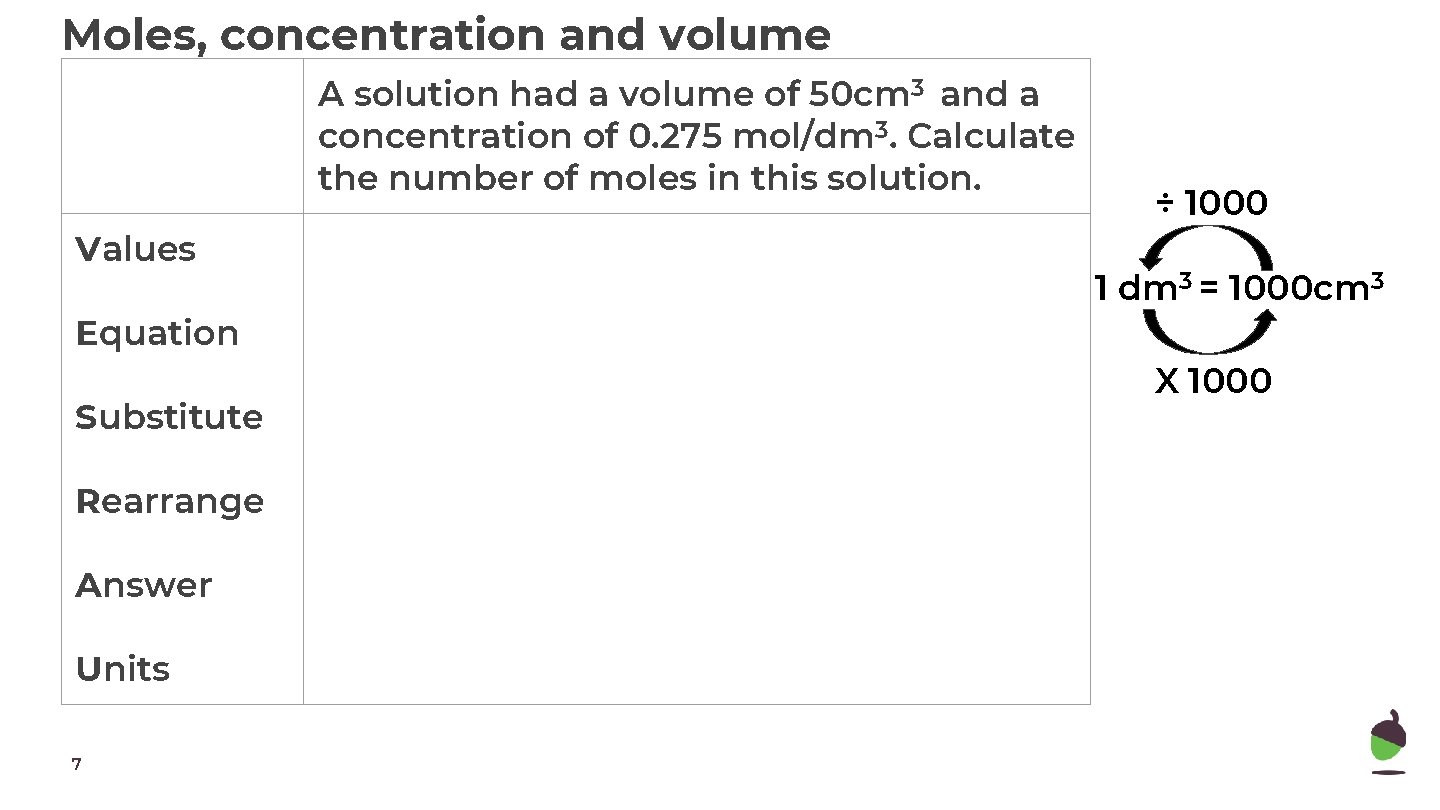
Moles, concentration and volume A solution had a volume of 50 cm 3 and a concentration of 0. 275 mol/dm 3. Calculate the number of moles in this solution. Values Equation Substitute Rearrange Answer Units 7 ÷ 1000 1 dm 3 = 1000 cm 3 X 1000
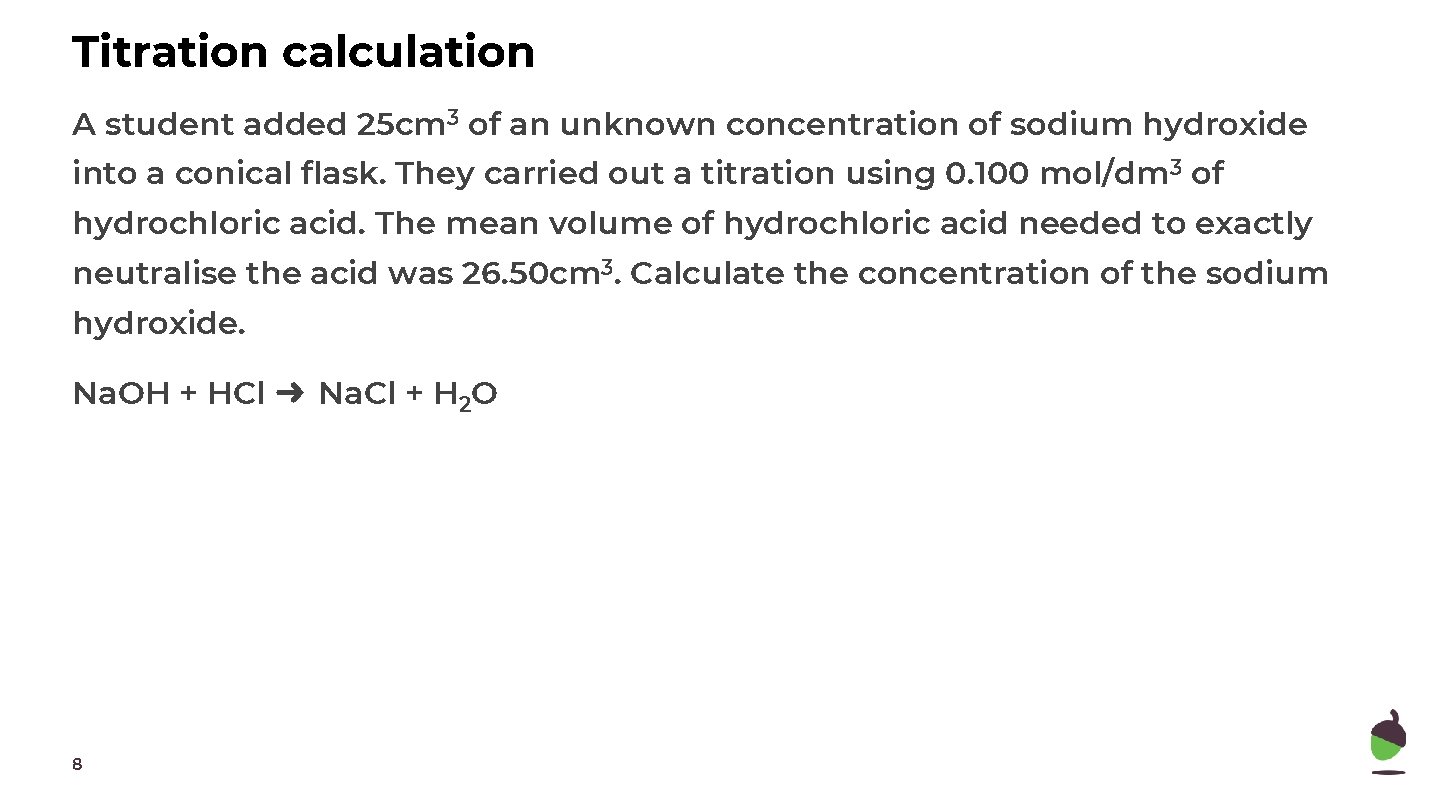
Titration calculation A student added 25 cm 3 of an unknown concentration of sodium hydroxide into a conical flask. They carried out a titration using 0. 100 mol/dm 3 of hydrochloric acid. The mean volume of hydrochloric acid needed to exactly neutralise the acid was 26. 50 cm 3. Calculate the concentration of the sodium hydroxide. Na. OH + HCl ➜ Na. Cl + H 2 O 8
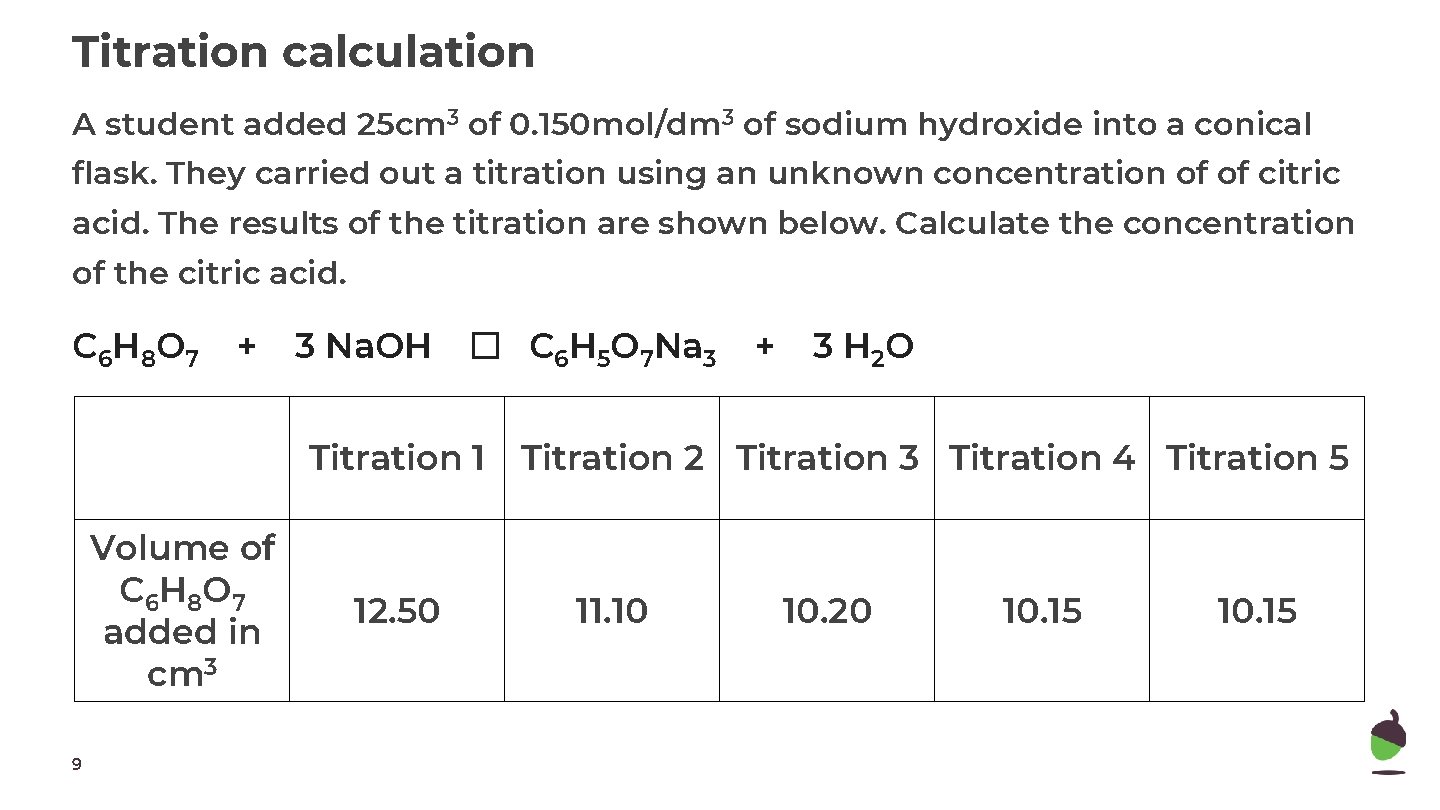
Titration calculation A student added 25 cm 3 of 0. 150 mol/dm 3 of sodium hydroxide into a conical flask. They carried out a titration using an unknown concentration of of citric acid. The results of the titration are shown below. Calculate the concentration of the citric acid. C 6 H 8 O 7 + 3 Na. OH � C 6 H 5 O 7 Na 3 Titration 1 Volume of C 6 H 8 O 7 added in cm 3 9 12. 50 + 3 H 2 O Titration 2 Titration 3 Titration 4 Titration 5 11. 10 10. 20 10. 15
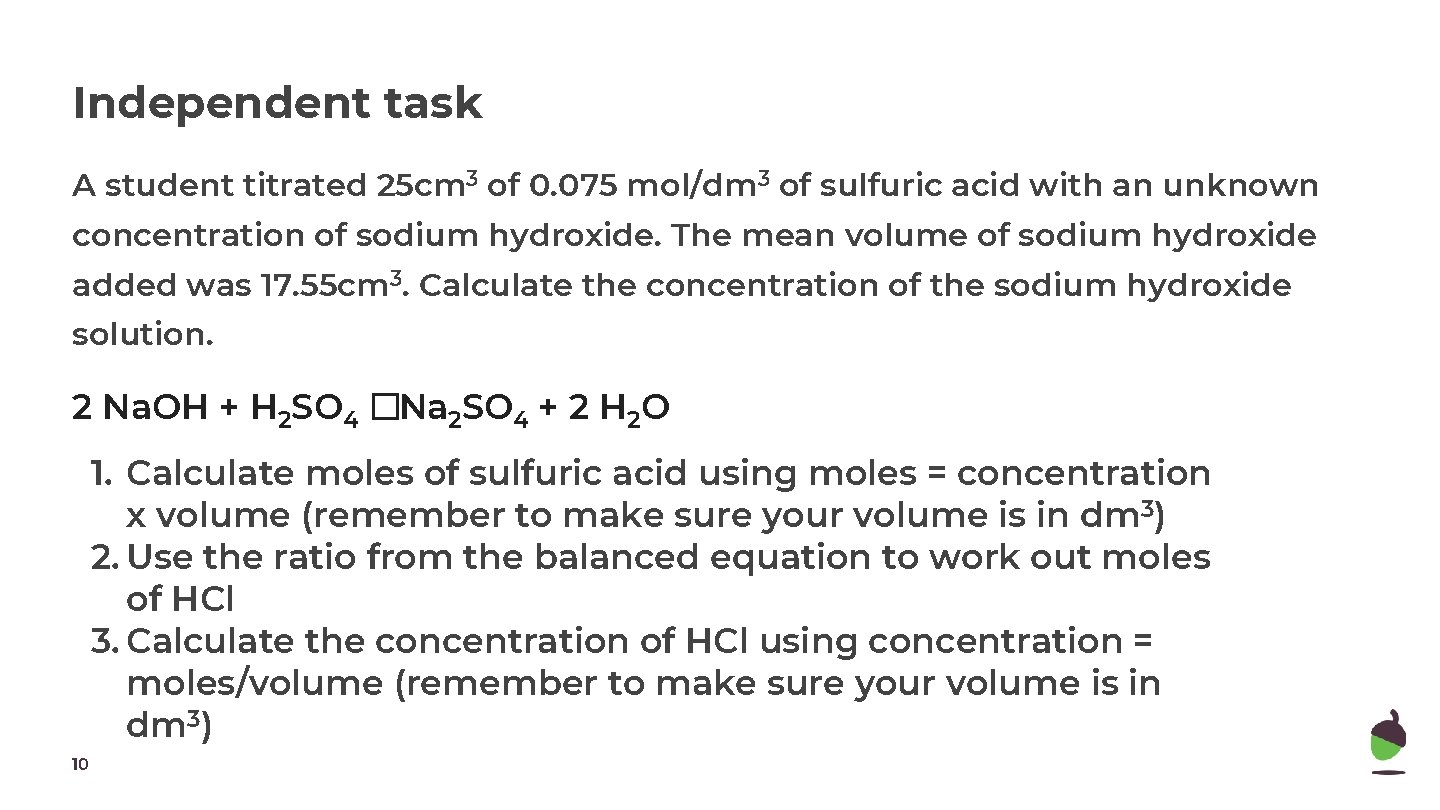
Independent task A student titrated 25 cm 3 of 0. 075 mol/dm 3 of sulfuric acid with an unknown concentration of sodium hydroxide. The mean volume of sodium hydroxide added was 17. 55 cm 3. Calculate the concentration of the sodium hydroxide solution. 2 Na. OH + H 2 SO 4 �Na 2 SO 4 + 2 H 2 O 1. Calculate moles of sulfuric acid using moles = concentration x volume (remember to make sure your volume is in dm 3) 2. Use the ratio from the balanced equation to work out moles of HCl 3. Calculate the concentration of HCl using concentration = moles/volume (remember to make sure your volume is in dm 3) 10
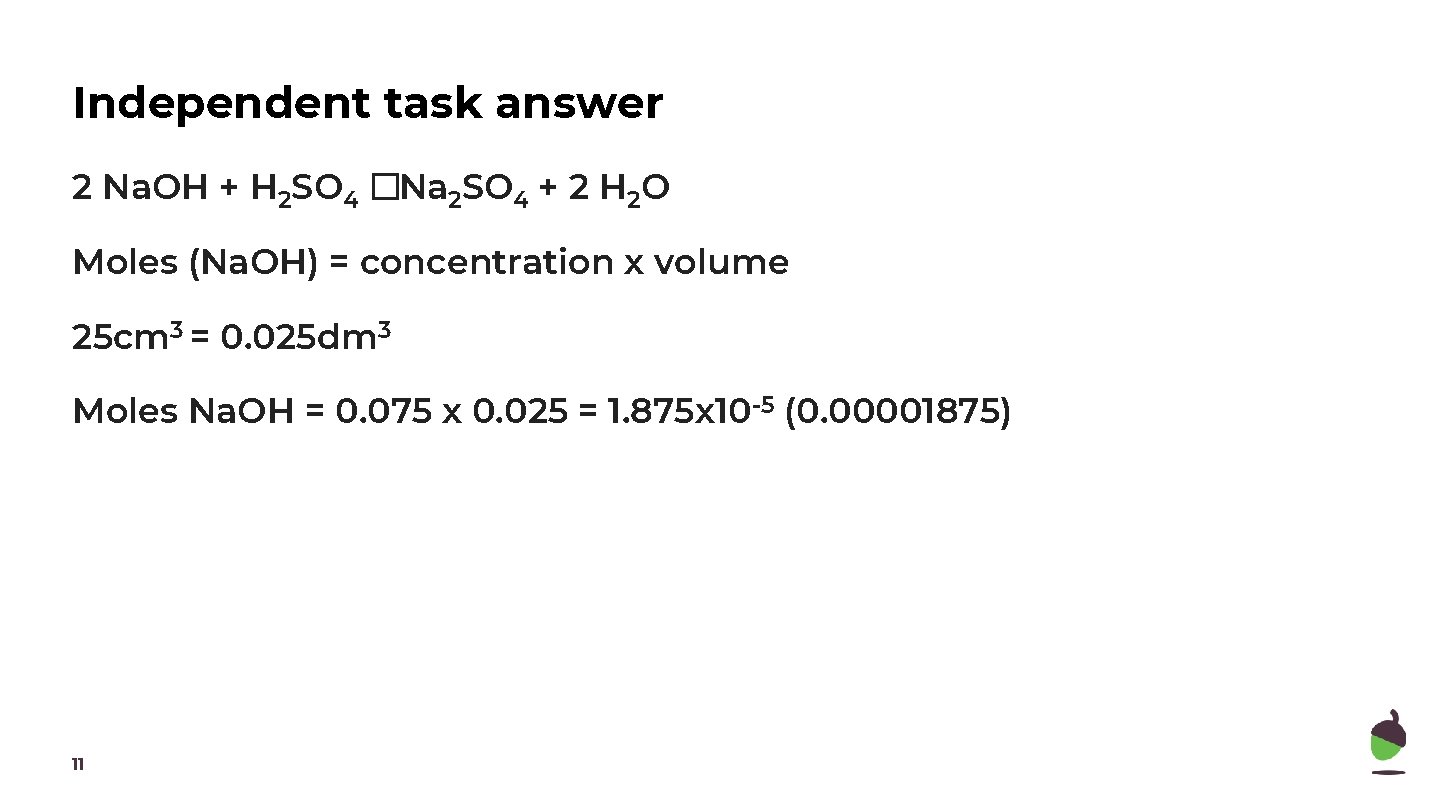
Independent task answer 2 Na. OH + H 2 SO 4 �Na 2 SO 4 + 2 H 2 O Moles (Na. OH) = concentration x volume 25 cm 3 = 0. 025 dm 3 Moles Na. OH = 0. 075 x 0. 025 = 1. 875 x 10 -5 (0. 00001875) 11
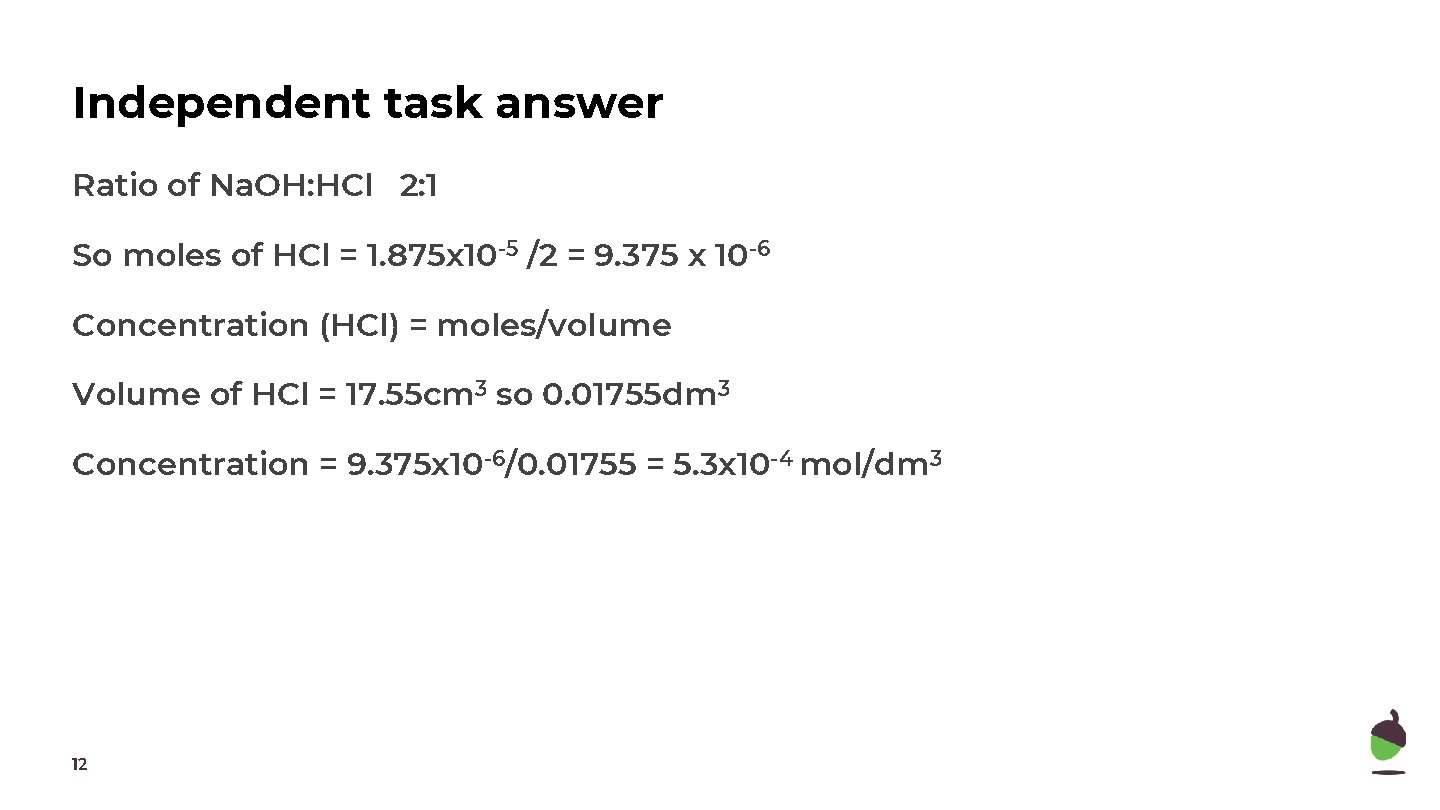
Independent task answer Ratio of Na. OH: HCl 2: 1 So moles of HCl = 1. 875 x 10 -5 /2 = 9. 375 x 10 -6 Concentration (HCl) = moles/volume Volume of HCl = 17. 55 cm 3 so 0. 01755 dm 3 Concentration = 9. 375 x 10 -6/0. 01755 = 5. 3 x 10 -4 mol/dm 3 12
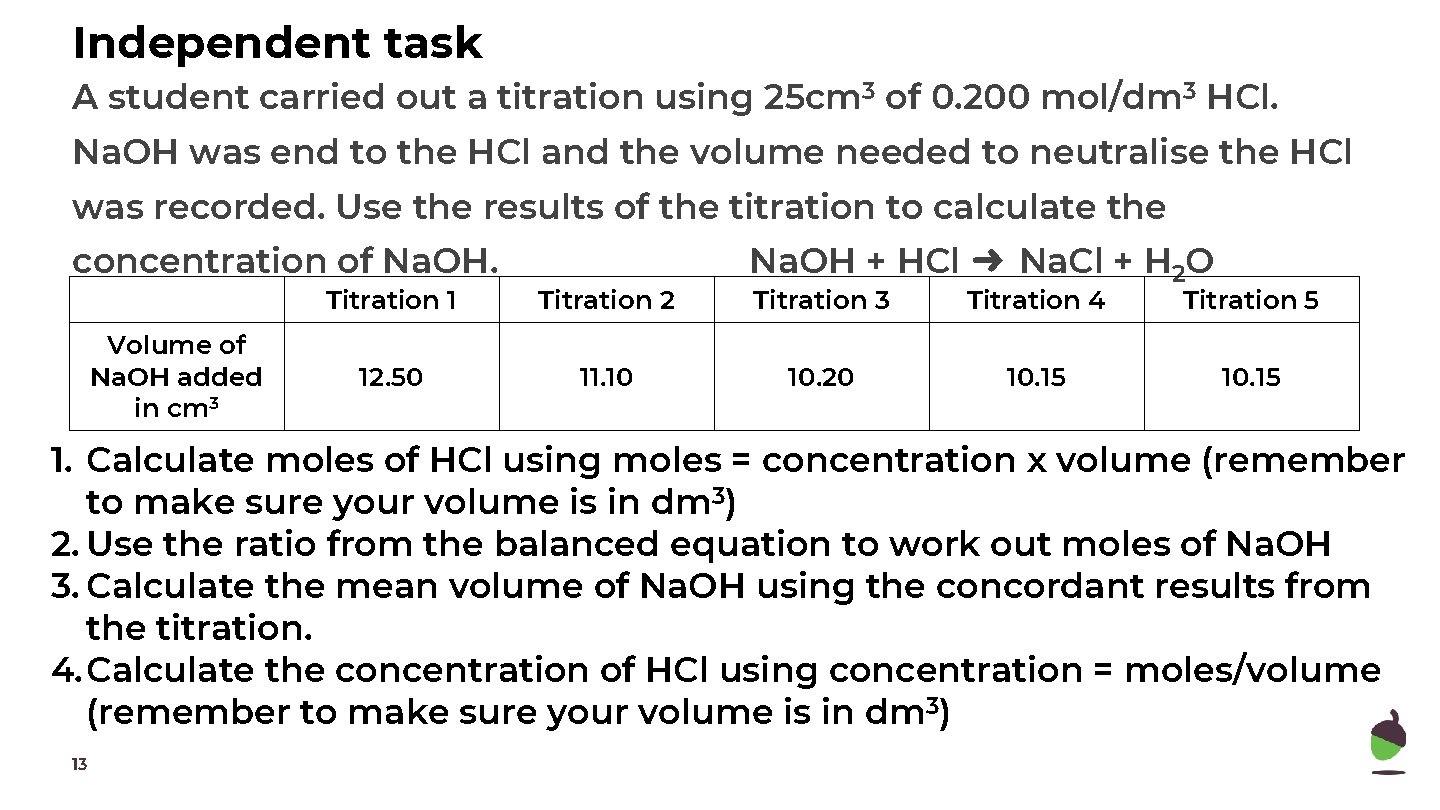
Independent task A student carried out a titration using 25 cm 3 of 0. 200 mol/dm 3 HCl. Na. OH was end to the HCl and the volume needed to neutralise the HCl was recorded. Use the results of the titration to calculate the concentration of Na. OH. Volume of Na. OH added in cm 3 Titration 1 Titration 2 12. 50 11. 10 Na. OH + HCl ➜ Na. Cl + H 2 O Titration 3 Titration 4 Titration 5 10. 20 10. 15 1. Calculate moles of HCl using moles = concentration x volume (remember to make sure your volume is in dm 3) 2. Use the ratio from the balanced equation to work out moles of Na. OH 3. Calculate the mean volume of Na. OH using the concordant results from the titration. 4. Calculate the concentration of HCl using concentration = moles/volume (remember to make sure your volume is in dm 3) 13
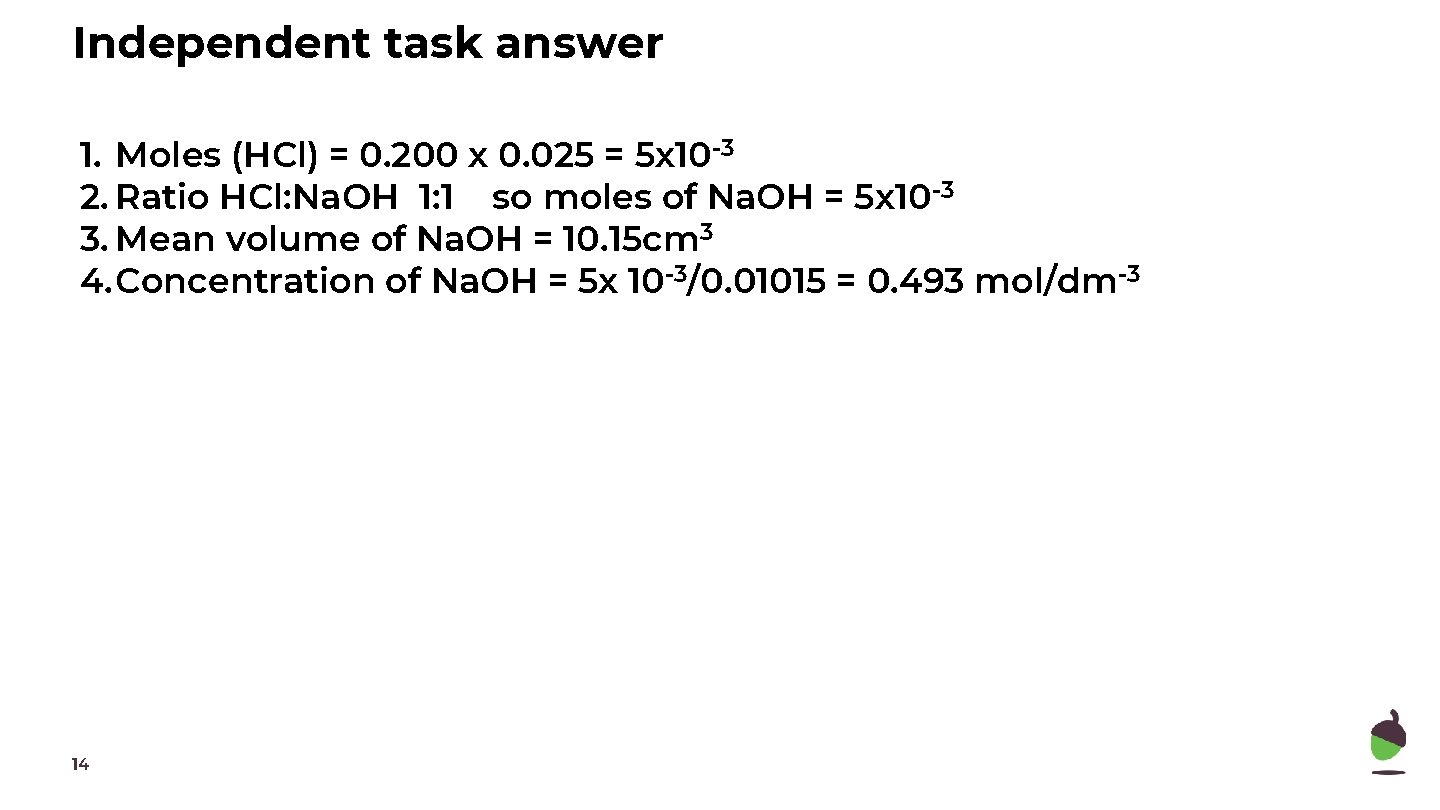
Independent task answer 1. Moles (HCl) = 0. 200 x 0. 025 = 5 x 10 -3 2. Ratio HCl: Na. OH 1: 1 so moles of Na. OH = 5 x 10 -3 3. Mean volume of Na. OH = 10. 15 cm 3 4. Concentration of Na. OH = 5 x 10 -3/0. 01015 = 0. 493 mol/dm-3 14