
Chemistry the study of matter its structure properties
- Slides: 13
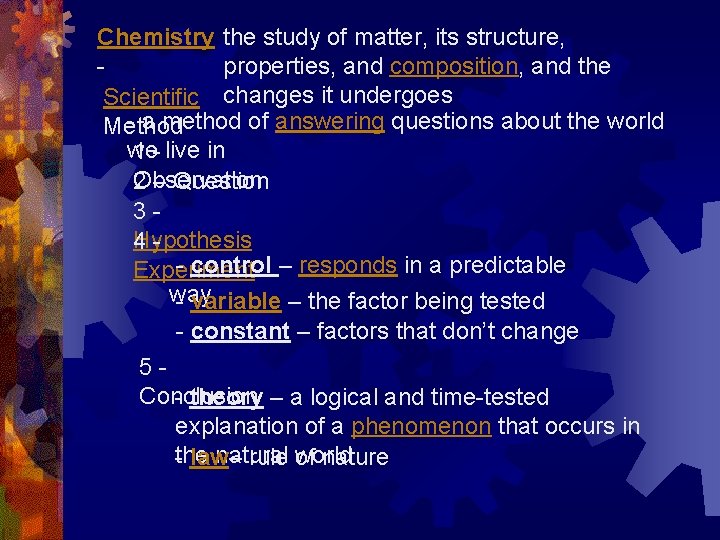
Chemistry the study of matter, its structure, properties, and composition, and the Scientific changes it undergoes - a method of answering questions about the world Method we 1 - live in Observation 2 – Question 3 Hypothesis 4 - control – responds in a predictable Experiment way - variable – the factor being tested - constant – factors that don’t change 5 Conclusion - theory – a logical and time-tested explanation of a phenomenon that occurs in the natural - law– rule world of nature
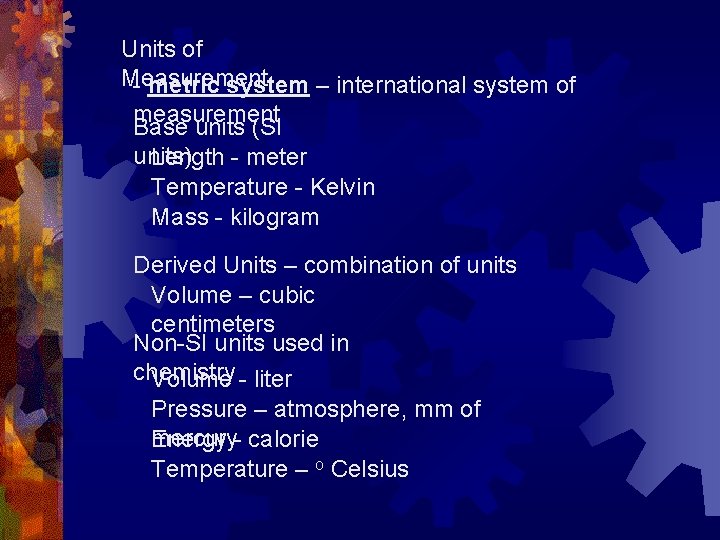
Units of Measurement - metric system – international system of measurement Base units (SI units) Length - meter Temperature - Kelvin Mass - kilogram Derived Units – combination of units Volume – cubic centimeters Non-SI units used in chemistry Volume - liter Pressure – atmosphere, mm of mercury Energy - calorie Temperature – o Celsius
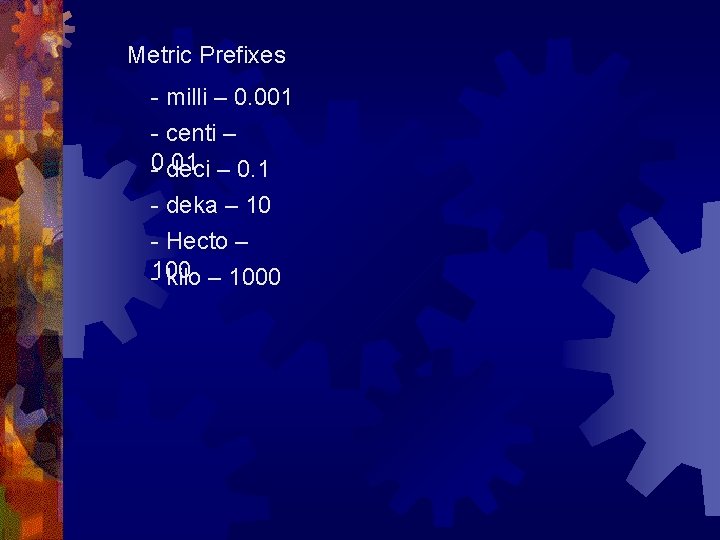
Metric Prefixes - milli – 0. 001 - centi – 0. 01 - deci – 0. 1 - deka – 10 - Hecto – 100 - kilo – 1000
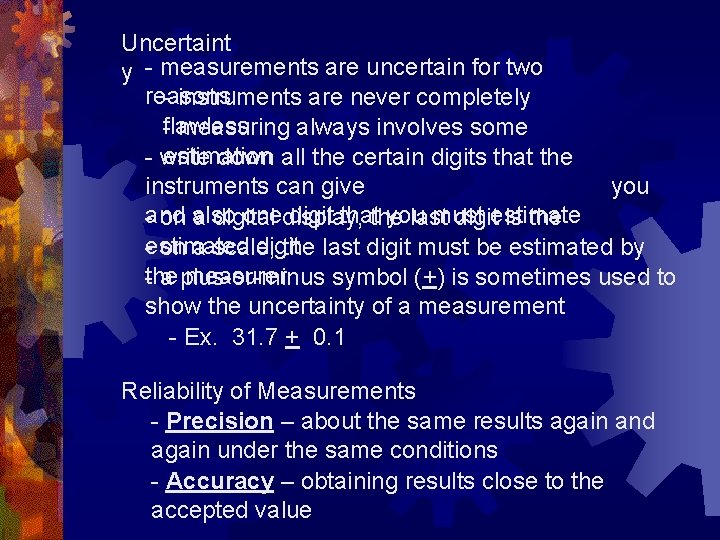
Uncertaint y - measurements are uncertain for two reasons: - instruments are never completely flawless - measuring always involves some estimation - write down all the certain digits that the instruments can give you and onedisplay, digit thatthe you must - on also a digital last digitestimate is the digit -estimated on a scale, the last digit must be estimated by the measurer - a plus-or-minus symbol (+) is sometimes used to show the uncertainty of a measurement - Ex. 31. 7 + 0. 1 Reliability of Measurements - Precision – about the same results again and again under the same conditions - Accuracy – obtaining results close to the accepted value
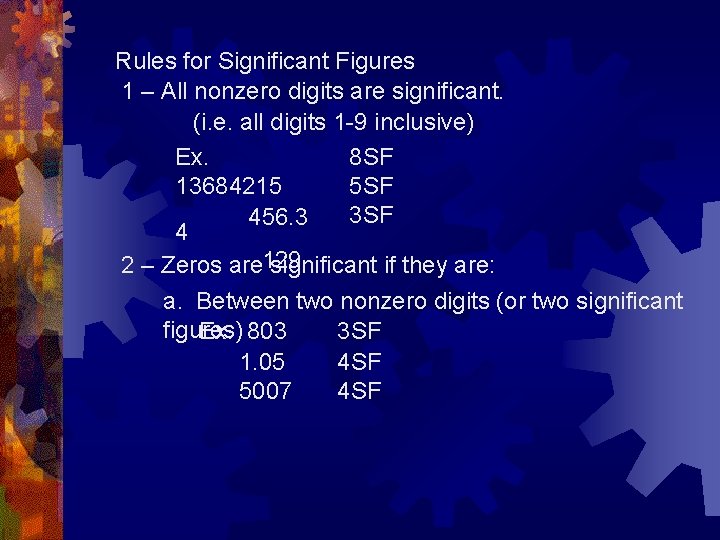
Rules for Significant Figures 1 – All nonzero digits are significant. (i. e. all digits 1 -9 inclusive) Ex. 8 SF 13684215 5 SF 3 SF 456. 3 4 2 – Zeros are 129 significant if they are: a. Between two nonzero digits (or two significant figures) Ex. 803 3 SF 1. 05 4 SF 5007 4 SF
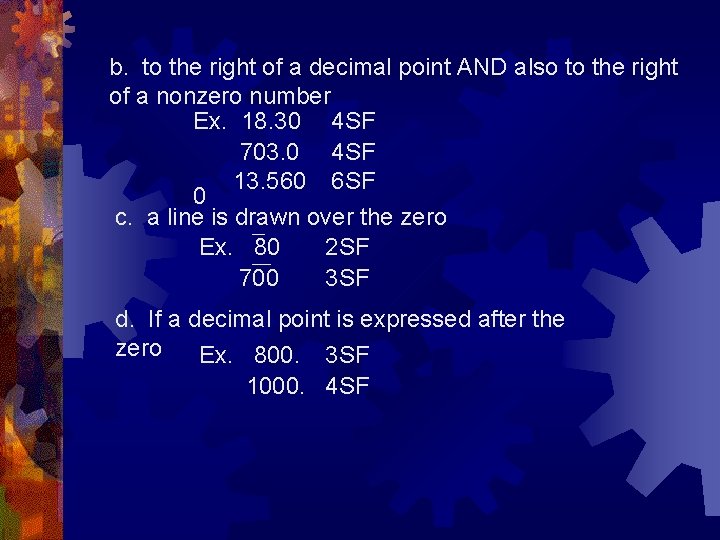
b. to the right of a decimal point AND also to the right of a nonzero number Ex. 18. 30 4 SF 703. 0 4 SF 13. 560 6 SF 0 c. a line is drawn over the zero Ex. 80 2 SF 700 3 SF d. If a decimal point is expressed after the zero Ex. 800. 3 SF 1000. 4 SF
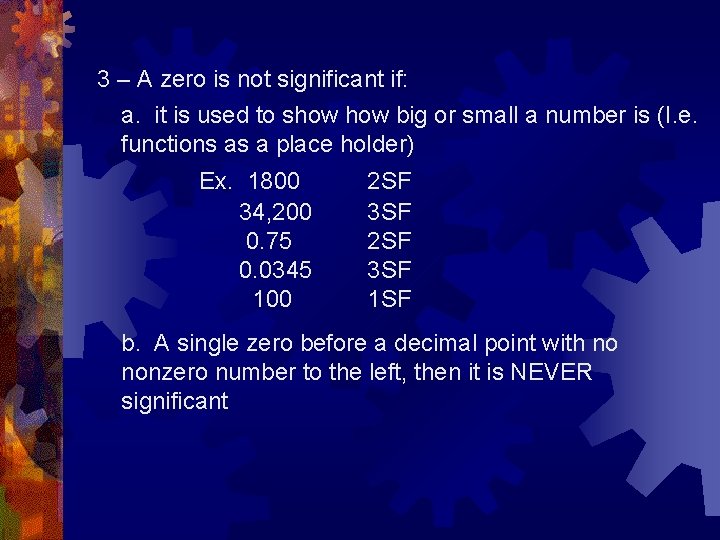
3 – A zero is not significant if: a. it is used to show big or small a number is (I. e. functions as a place holder) Ex. 1800 34, 200 0. 75 0. 0345 100 2 SF 3 SF 1 SF b. A single zero before a decimal point with no nonzero number to the left, then it is NEVER significant
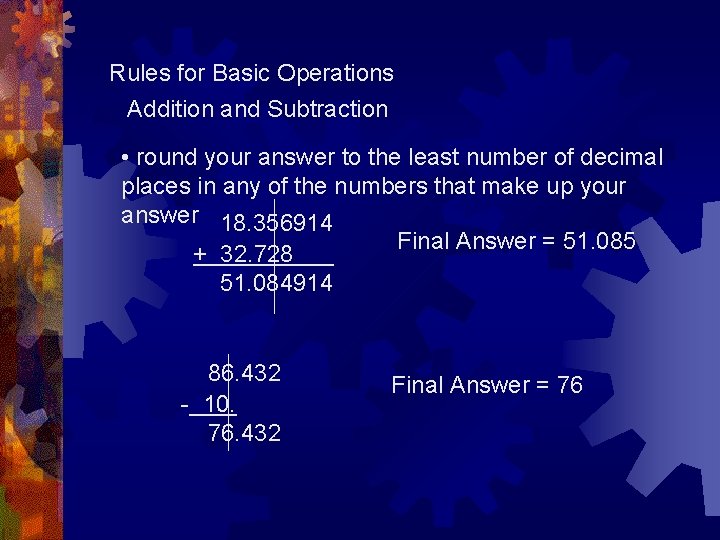
Rules for Basic Operations Addition and Subtraction • round your answer to the least number of decimal places in any of the numbers that make up your answer 18. 356914 Final Answer = 51. 085 + 32. 728 51. 084914 86. 432 - 10. 76. 432 Final Answer = 76
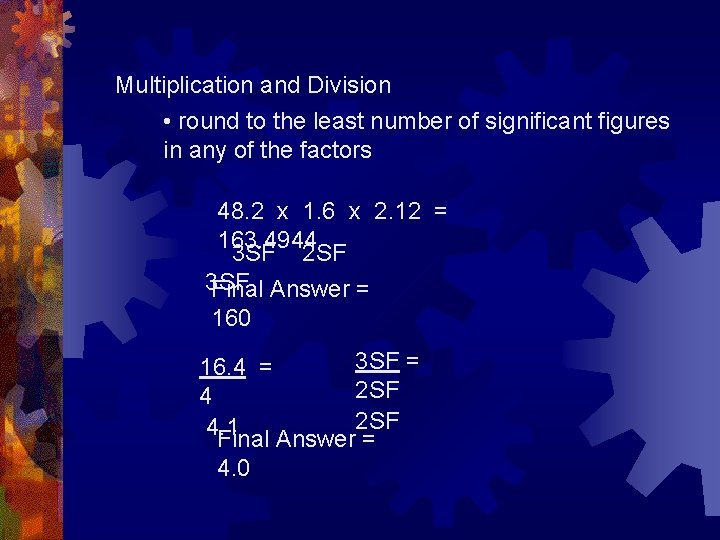
Multiplication and Division • round to the least number of significant figures in any of the factors 48. 2 x 1. 6 x 2. 12 = 163. 4944 3 SF 2 SF 3 SF Final Answer = 160 3 SF = 16. 4 = 2 SF 4. 1 Final Answer = 4. 0
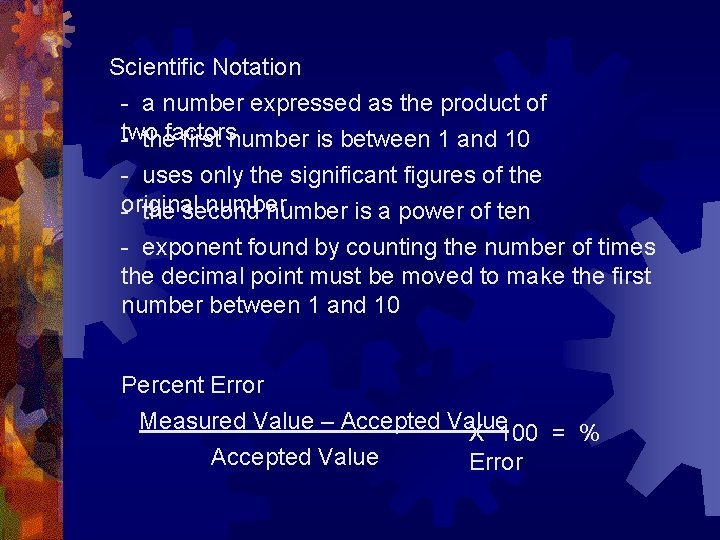
Scientific Notation - a number expressed as the product of two - thefactors first number is between 1 and 10 - uses only the significant figures of the original number - the second number is a power of ten - exponent found by counting the number of times the decimal point must be moved to make the first number between 1 and 10 Percent Error Measured Value – Accepted Value X 100 = % Accepted Value Error
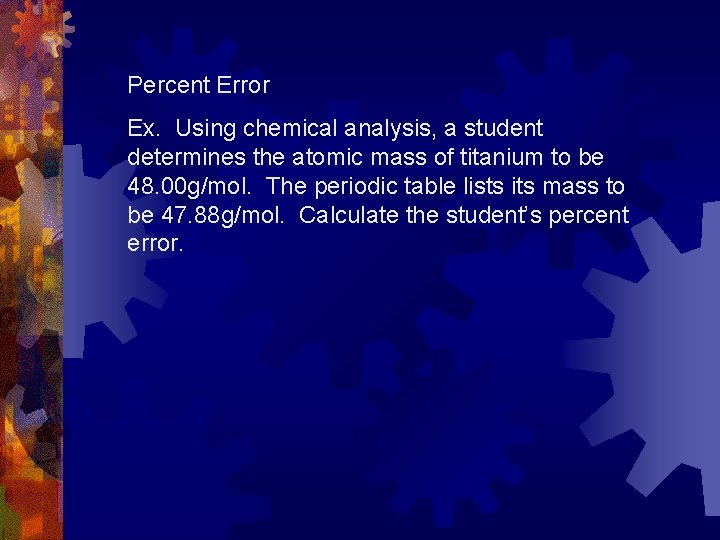
Percent Error Ex. Using chemical analysis, a student determines the atomic mass of titanium to be 48. 00 g/mol. The periodic table lists its mass to be 47. 88 g/mol. Calculate the student’s percent error.
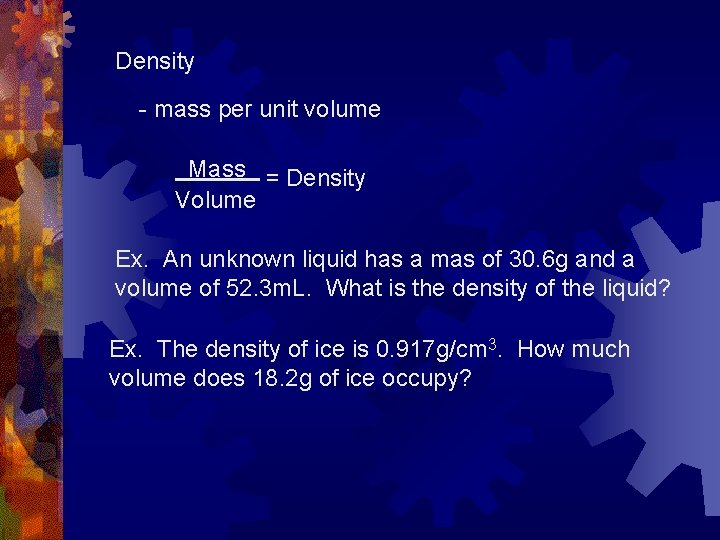
Density - mass per unit volume Mass = Density Volume Ex. An unknown liquid has a mas of 30. 6 g and a volume of 52. 3 m. L. What is the density of the liquid? Ex. The density of ice is 0. 917 g/cm 3. How much volume does 18. 2 g of ice occupy?
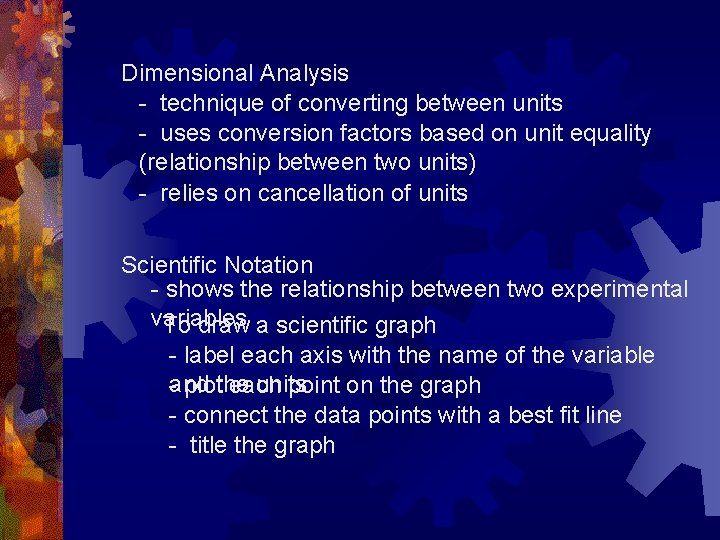
Dimensional Analysis - technique of converting between units - uses conversion factors based on unit equality (relationship between two units) - relies on cancellation of units Scientific Notation - shows the relationship between two experimental variables To draw a scientific graph - label each axis with the name of the variable and units - plotthe each point on the graph - connect the data points with a best fit line - title the graph