
Chemistry Session Purification And Characterisation of Organic Compounds






- Slides: 44
Chemistry
Session Purification And Characterisation of Organic Compounds - 1
Session Opener
Session Objectives
Session objectives 1. Introduction — necessity of purification. 2. Methods of purification of organic compound. (a)Crystallisation (b) Fractional crystallisation (c) Sublimation (d) Distillation (e) Fractional distillation (f) Steam distillation (g)Vacuum distillation (h)Differential extraction (i) Chromatography
Session objectives 3. Detection of elements (Qualitative analysis) (a) Detection of carbon (b) Detection of hydrogen (c) Detection of nitrogen (d) Detection of sulphur (e) Detection of halogen (f) Detection of oxygen
Purification • • • Filtration Crystallization Sublimation Distillation Differential extraction Chromatography
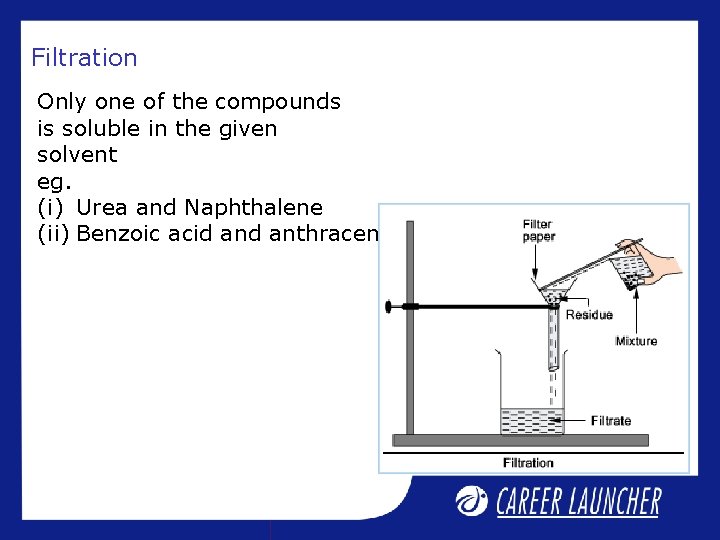
Filtration Only one of the compounds is soluble in the given solvent eg. (i) Urea and Naphthalene (ii) Benzoic acid anthracene
Crystallization Most common method for purification of solid organic compounds. Impurities and organic compound have different solubilities in the given solvent.
Crystallization v The organic compound should be insoluble or sparingly soluble in the solvent at room temperature but readily soluble in hot conditions. v The impurities should be insoluble in the solvent even in hot conditions. v The organic compound should not react with the solvent.
Crystallization The mixture of benzoic acid (water soluble) and naphthalene (water insoluble) purified by.
Crystallization How will you separate mixture of benzoic acid and napthalene ? benzoic acid (water soluble ) and napthalene (water insoluble)
Fractional crystallization Difference in solubilities of organic compounds and impurities are very less. eg. urea and copper sulphate.
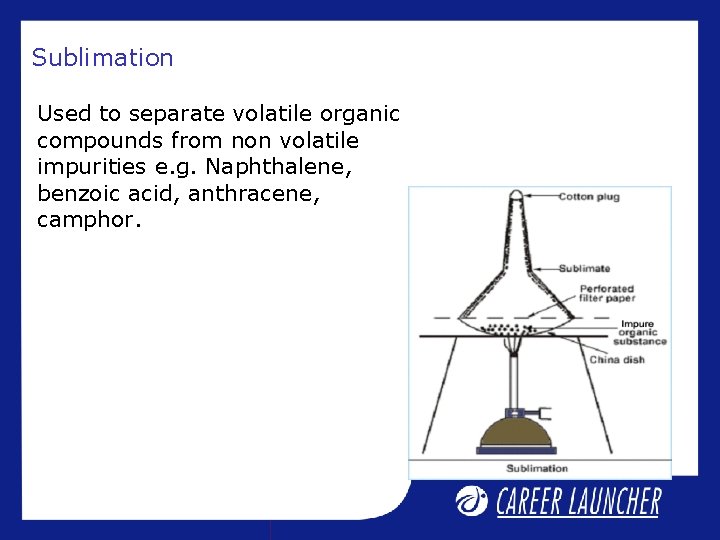
Sublimation Used to separate volatile organic compounds from non volatile impurities e. g. Naphthalene, benzoic acid, anthracene, camphor.
Questions
Illustrative problem A mixture of benzene and aniline can be separated by (a) alcohol (b) Na. OH (c) HCl (d) Hot water
Solution Amines are basic in nature. Therefore, aniline reacts with HCl to form a salt which dissolves in water. Hence, aniline can be separated from benzene by using HCl. Hence, answer is (c).
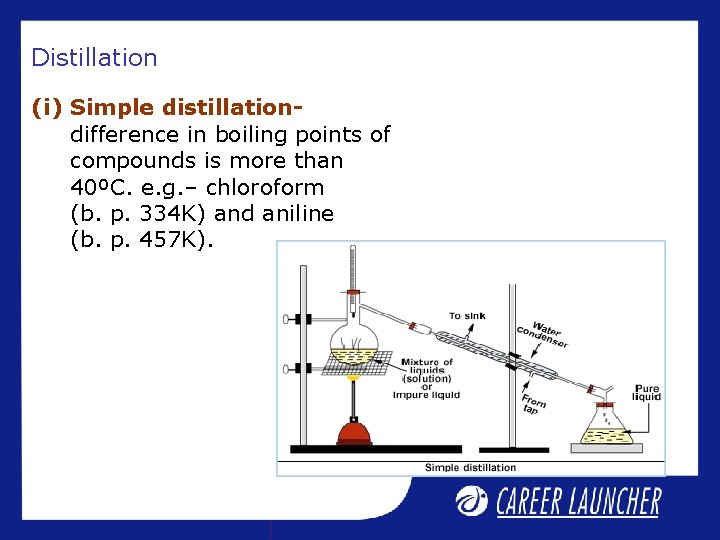
Distillation (i) Simple distillationdifference in boiling points of compounds is more than 40ºC. e. g. – chloroform (b. p. 334 K) and aniline (b. p. 457 K).
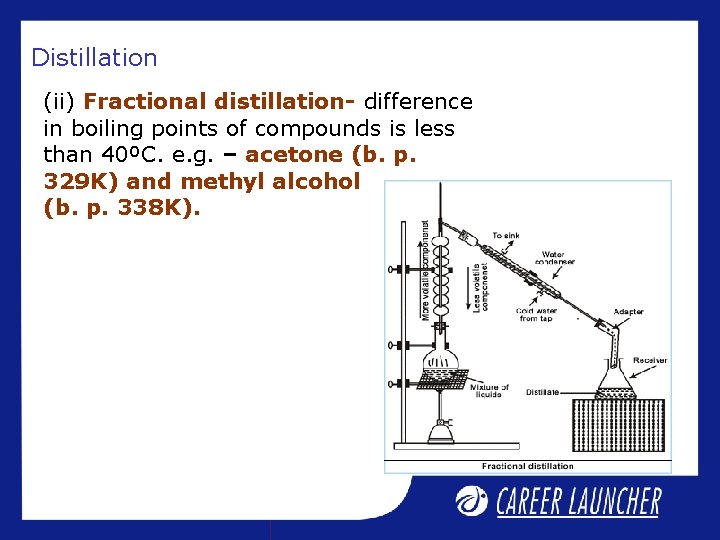
Distillation (ii) Fractional distillation- difference in boiling points of compounds is less than 40ºC. e. g. – acetone (b. p. 329 K) and methyl alcohol (b. p. 338 K).
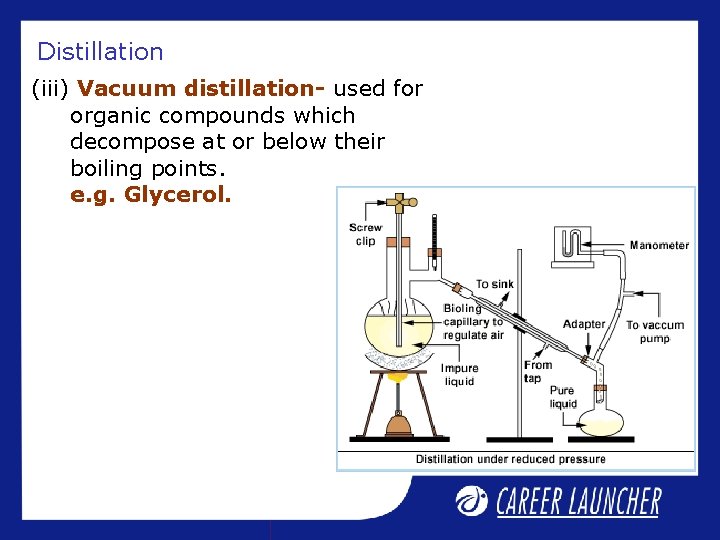
Distillation (iii) Vacuum distillation- used for organic compounds which decompose at or below their boiling points. e. g. Glycerol.
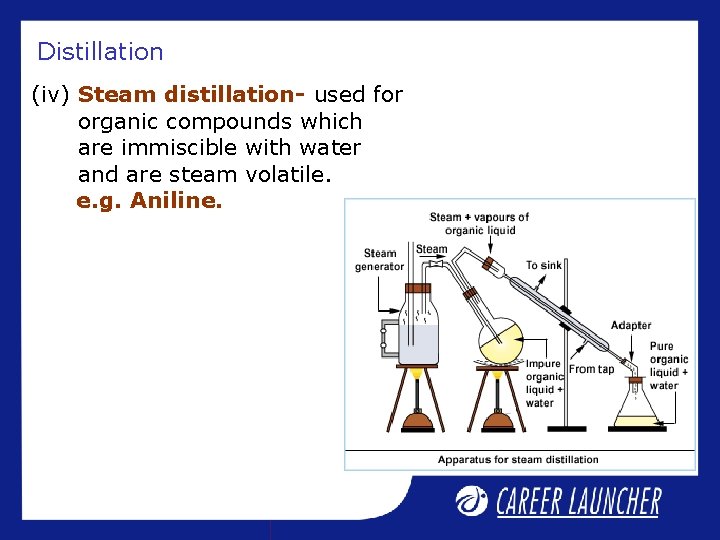
Distillation (iv) Steam distillation- used for organic compounds which are immiscible with water and are steam volatile. e. g. Aniline.
Questions
Illustrative problem The most suitable method for the separation of mixture of ortho and para nitrophenol in the ratio of 1: 1 is (a) distillation (b) crystallisation (c) vapourisation (d) colour spectrum
Solution The boiling point of o-nitrophenol is 210 o. C and that of p-nitrophenol is 245 o. C. Therefore, vapours of o-nitrophenol will be formed first (lower boiling point) and collected seperately and vapours of pnitrophenol will be formed latter. Hence, answer is (a).
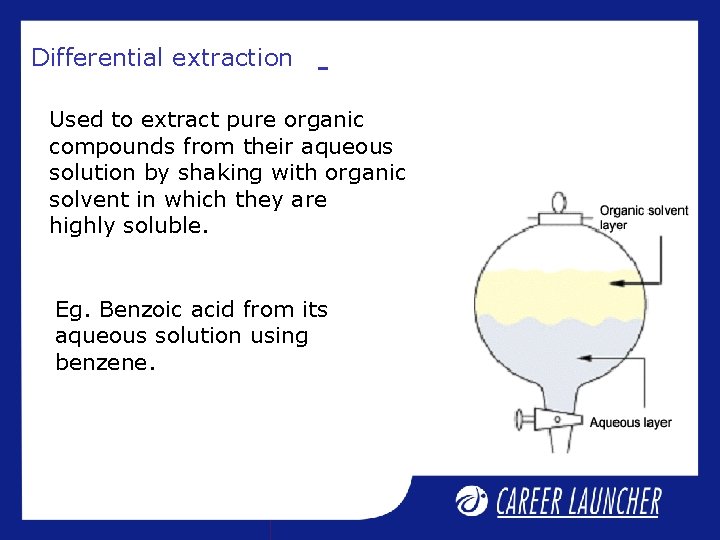
Differential extraction Used to extract pure organic compounds from their aqueous solution by shaking with organic solvent in which they are highly soluble. Eg. Benzoic acid from its aqueous solution using benzene.
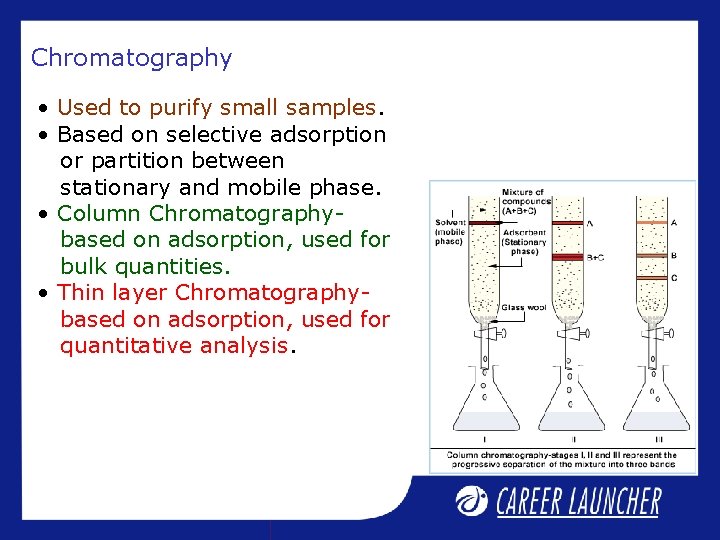
Chromatography • Used to purify small samples. • Based on selective adsorption or partition between stationary and mobile phase. • Column Chromatographybased on adsorption, used for bulk quantities. • Thin layer Chromatographybased on adsorption, used for quantitative analysis.
Chromatography • Paper Chromatography- based on partition and used for quantitative and qualitative analysis. • Gas Chromatography- used to separate and analyse volatile organic liquids. • High performance liquids Chromatography (HPLC)- used for qualitative and quantitative analysis of organic compounds.
Criteria of purity of organic compounds 1. Boiling point. 2. Melting point. 3. Mixed melting point.
Qualitative analysis Detection of C, H, N, halogens P, S, and oxygen.
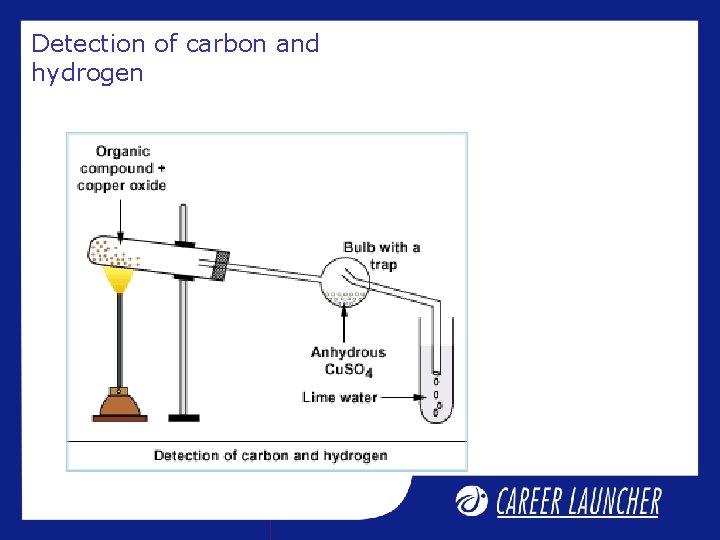
Detection of carbon and hydrogen
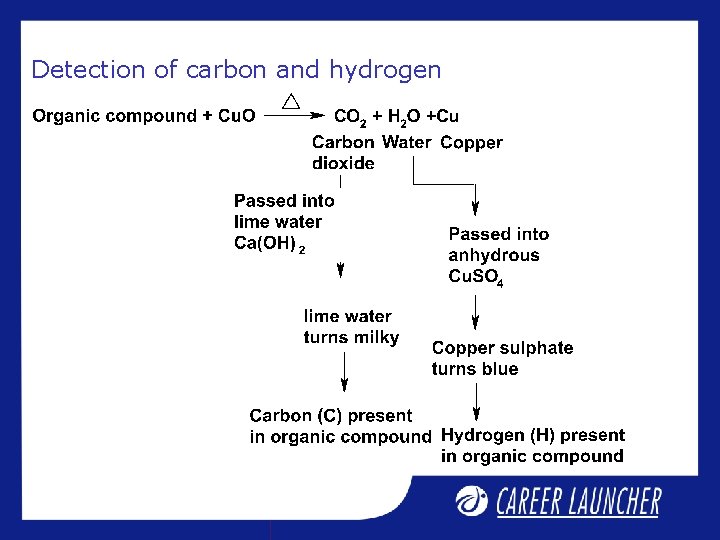
Detection of carbon and hydrogen
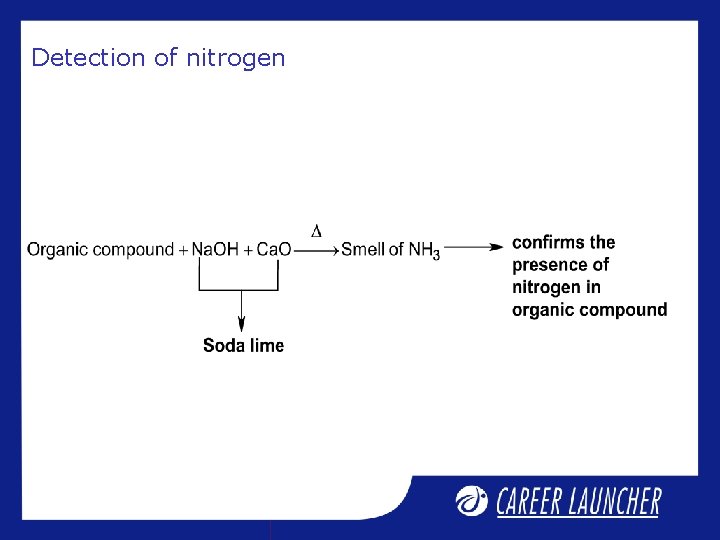
Detection of nitrogen
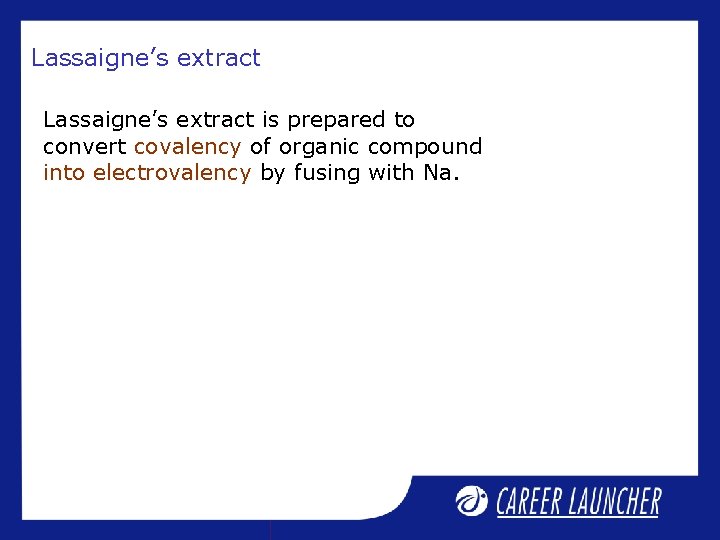
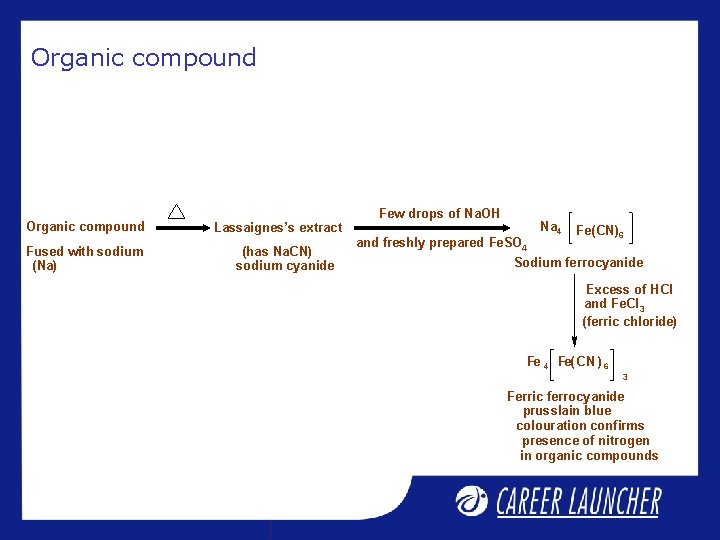
Lassaigne’s extract is prepared to convert covalency of organic compound into electrovalency by fusing with Na.
Organic compound Fused with sodium (Na) Lassaignes’s extract (has Na. CN) sodium cyanide Few drops of Na. OH and freshly prepared Fe. SO 4 Na 4 Fe(CN)6 Sodium ferrocyanide Excess of HCl and Fe. Cl 3 (ferric chloride) Fe 4 Fe( CN ) 6 3 Ferric ferrocyanide prusslain blue colouration confirms presence of nitrogen in organic compounds
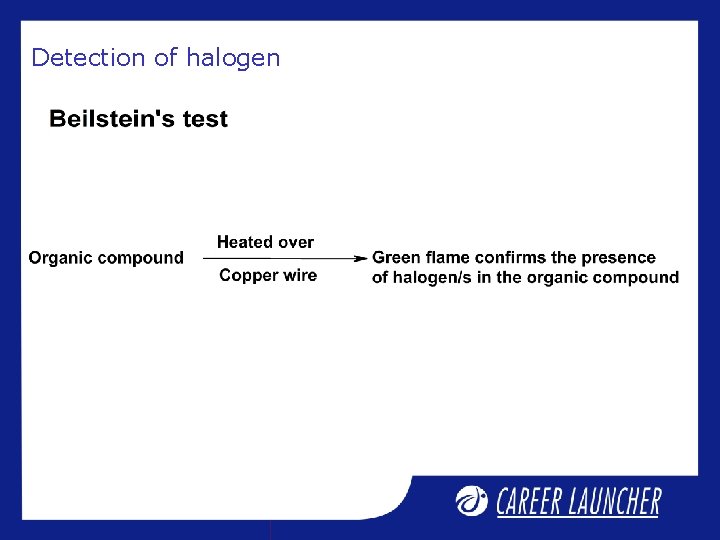
Detection of halogen
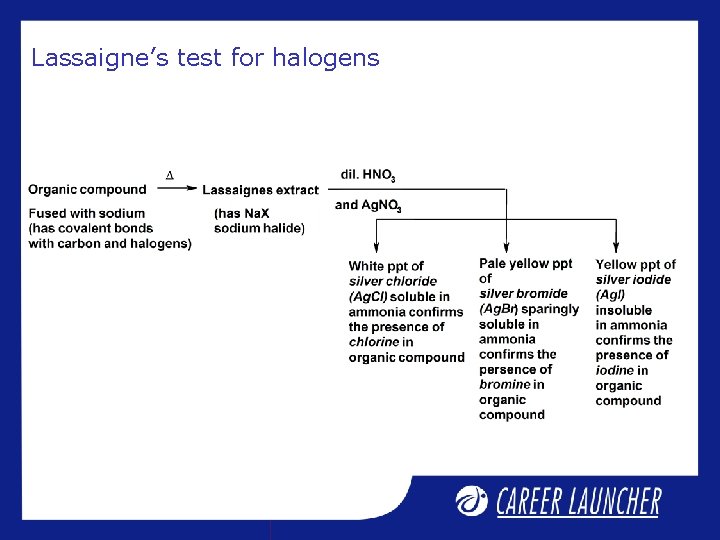
Lassaigne’s test for halogens
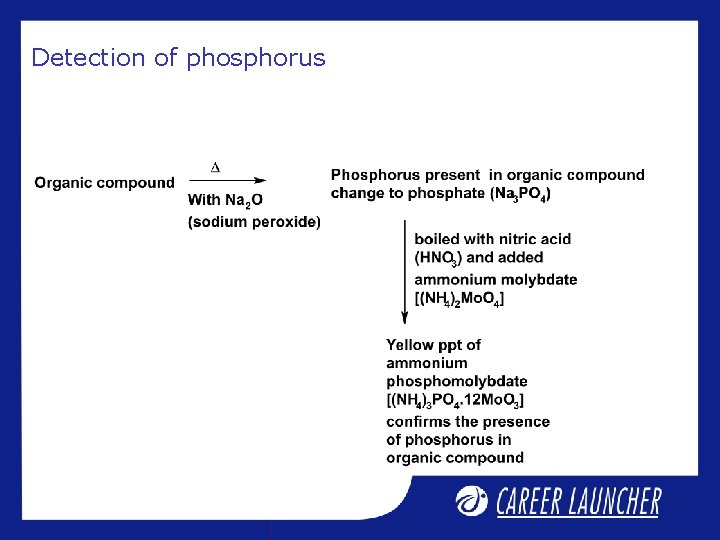
Detection of phosphorus
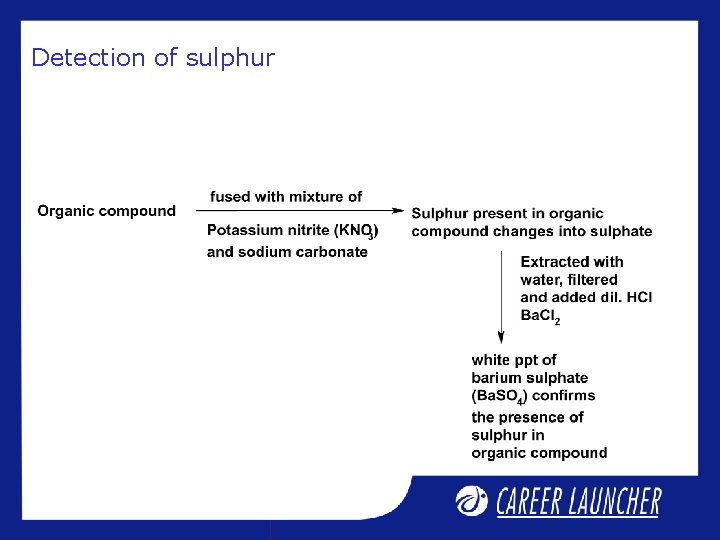
Detection of sulphur
Questions
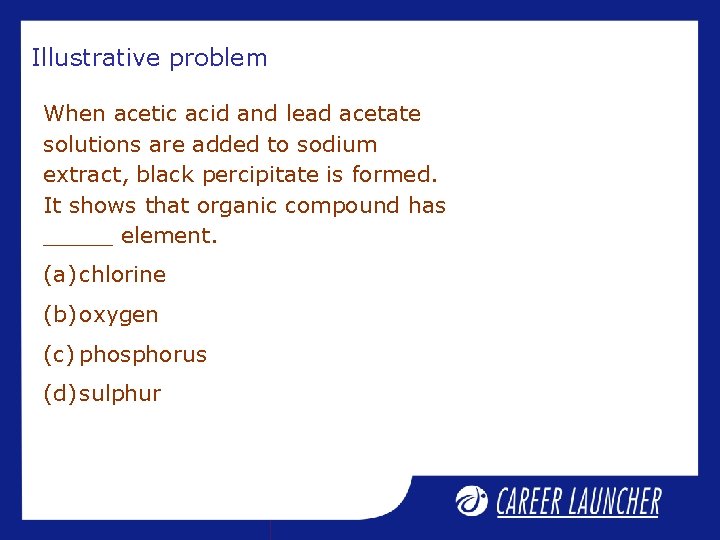
Illustrative problem When acetic acid and lead acetate solutions are added to sodium extract, black percipitate is formed. It shows that organic compound has _____ element. (a) chlorine (b) oxygen (c) phosphorus (d) sulphur
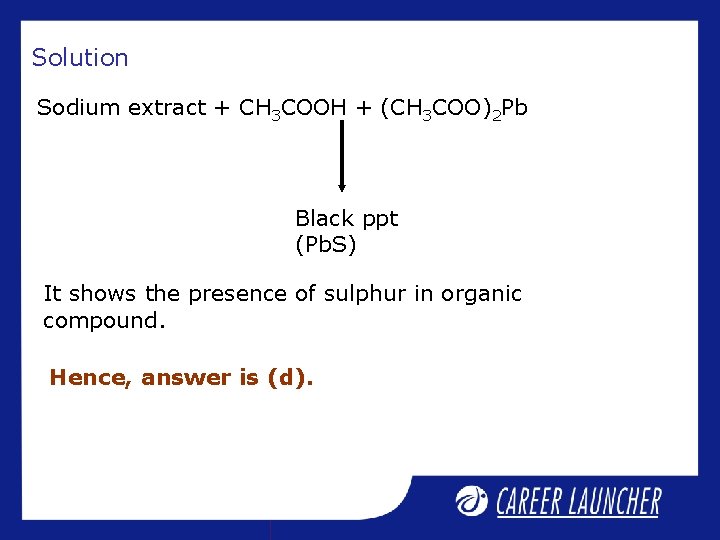
Solution Sodium extract + CH 3 COOH + (CH 3 COO)2 Pb Black ppt (Pb. S) It shows the presence of sulphur in organic compound. Hence, answer is (d).
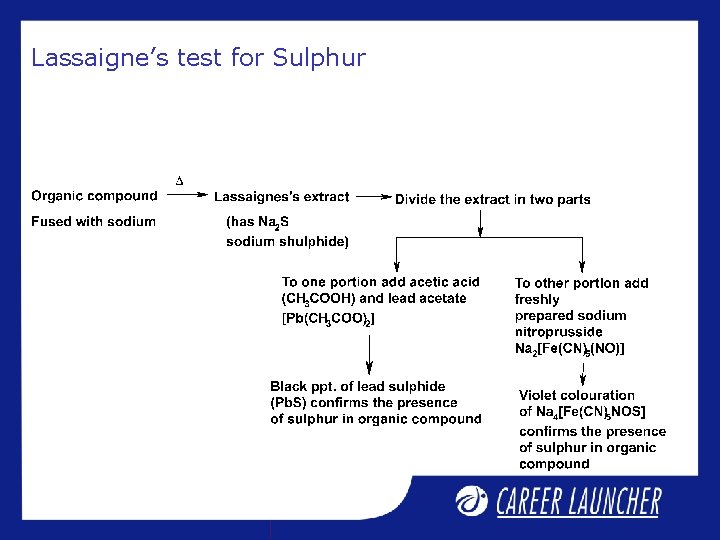
Lassaigne’s test for Sulphur
Detection of oxygen Presence of oxygen in organic compound is detected by testing for functional group containing oxygen eg- alcohol (–OH), aldehyde (– CHO), ketone (RCOR), carboxylic acid (–COOH), ester (–COOR) and nitro (–NO 2).
Thank you