
CHEMISTRY SBA 1 BAC QUALITATIVE ANALYSIS VERSION 1
CHEMISTRY SBA 1
BAC (QUALITATIVE ANALYSIS) [VERSION 1] Link with NSS curriculum: Topic IV (Acids and Bases) Number of period required 40 minutes Experimental work: 20 minutes 1 Prior knowledge sub-sections (a) and (d) of topic IV Objective To test the students’ knowledge on precipitation reactions and acid-carbonate reactions Assessment: Mainly based on the written worksheet 2
BAC (QUALITATIVE ANALYSIS) [VERSION 1] Instructions Given: Mg. SO 4(aq); Na 2 CO 3(aq); Pb(NO 3)2; and HCl(aq) Perform the tests as in table below. Observations? Identification? 3
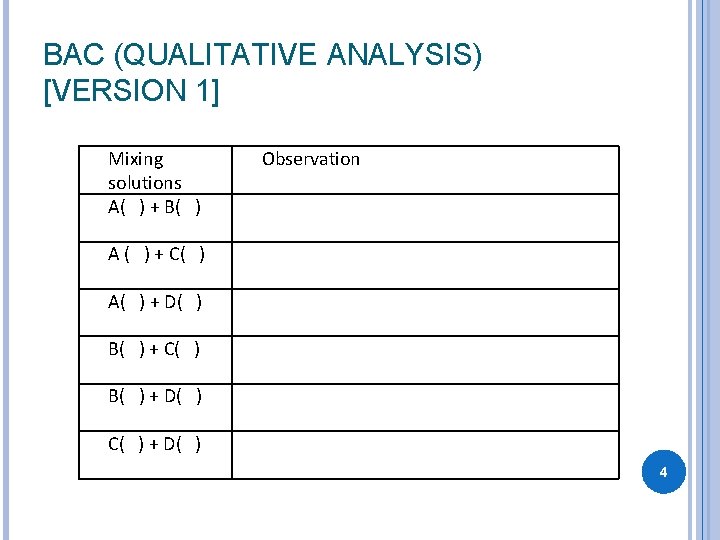
BAC (QUALITATIVE ANALYSIS) [VERSION 1] Mixing solutions A( ) + B( ) Observation A ( ) + C( ) A( ) + D( ) B( ) + C( ) B( ) + D( ) C( ) + D( ) 4
ASSESSMENT CONSIDERATIONS Mainly based on written worksheets Any unsafe practice? Marks to be deducted With prior notice 5

MARKING CRITERIA Mark Remarks 10 - 9 Accurate description of nearly all results. Logical deduction of the unknown. Safety procedures have been observed. 8 – 6 Accurate description of some results. Can deduce the cation / anion logically. Safety procedures have been observed. 5 – 3 Accurate description of at least one result. Can state the cation / anion. 2 – 1 Accurate description of one result OR Can state the cation / anion. 6
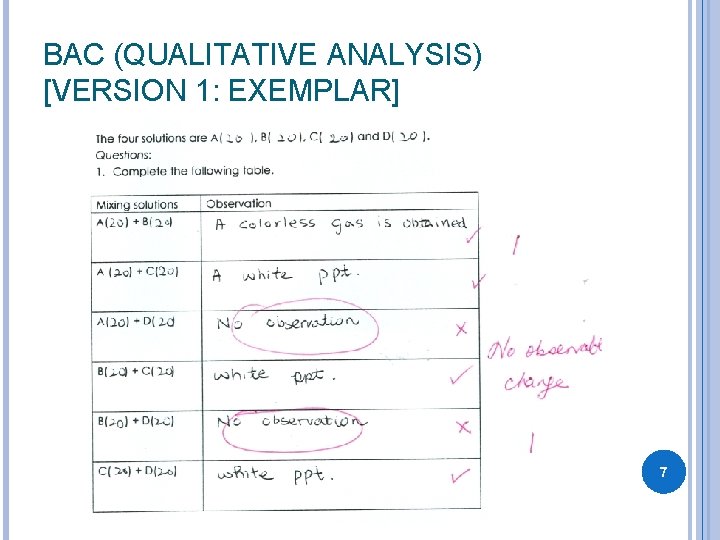
BAC (QUALITATIVE ANALYSIS) [VERSION 1: EXEMPLAR] 7

In this exemplar, the student BAC (QUALITATIVE ANALYSIS) correctly identified the four substances. However, in [VERSION 1: EXEMPLAR] recording his observations, he wrongly stated no observable change as no observations. Moreover, the description on his deduction is not systematic and could not convey his ideas clearly. 8
BAC (QUALITATIVE ANALYSIS) [VERSION 2] Link with NSS curriculum Topic IV (Acids and Bases); Topic VII (Redox reactions) Number of periods required 40 minutes The students are able to complete the experiment and hand in the worksheet within 30 minutes. 1 9

BAC (QUALITATIVE ANALYSIS) [VERSION 2] 1 2 Describe the sample. Estimate, using universal test paper, the p. H of an aqueous solution of the sample. 3 Report on the action of HCl on an aqueous solution of the sample. 4 Report on the action of H 2 SO 4 on an aqueous solution of the sample. 5 Report on the action of Na. OH on an aqueous solution of the sample. 6 Report on the action of aqueous NH 3 on an aqueous solution of the sample. 7 Report on the action of a few drops of KMn. O 4 in H 2 SO 4 on an aqueous solution of the sample. 10
BAC (QUALITATIVE ANALYSIS) [VERSION 2] Note: 2/3 of the marks are allocated to the observations. 1/3 of the marks are allocated to the interpretation of the observations and the deduction of the chemical nature of the sample. Summarise, in the space below, your conclusions as to the chemical nature of the sample. Deduce, where possible, what ionic and / or molecular species are present in the sample. 11
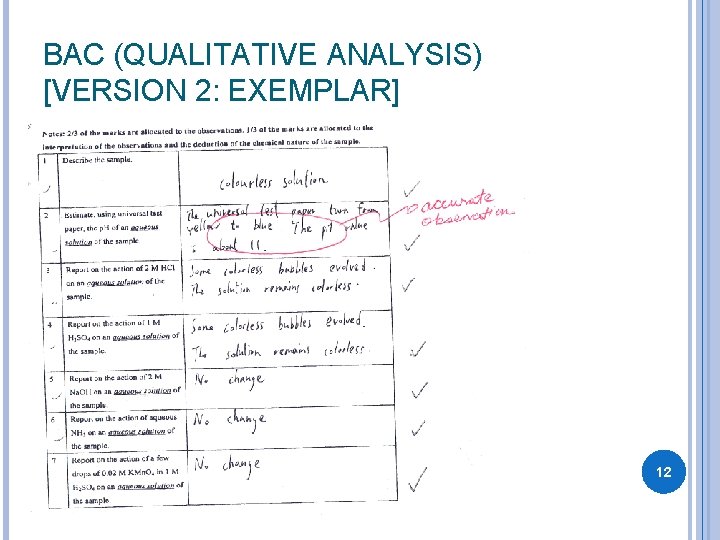
BAC (QUALITATIVE ANALYSIS) [VERSION 2: EXEMPLAR] 12
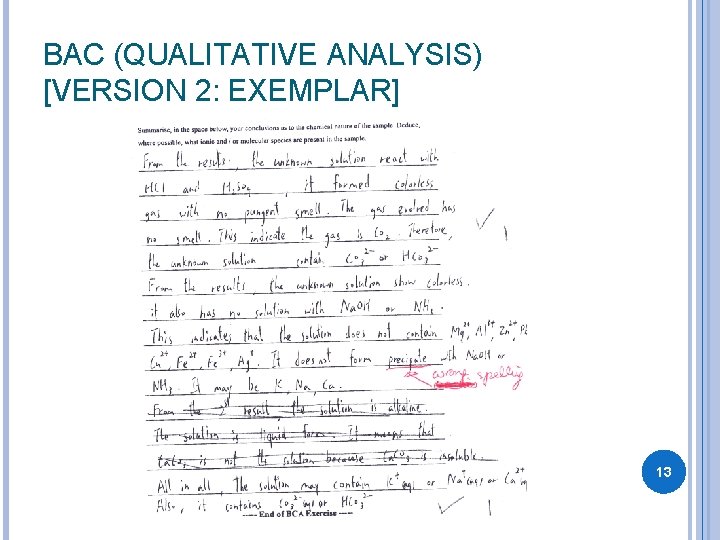
BAC (QUALITATIVE ANALYSIS) [VERSION 2: EXEMPLAR] 13
POINTS TO TAKE NOTE Safety practice Safety goggles Safety first before assessment Adequate number of apparatus / chemical reagents Use reagent bottles with dropper Flame test 2 fume cupboards [F&E] Test tube vs. microscale 14
- Slides: 14